Northern Thai food is the cuisine the rest of the country eats on holiday and then fails to find at home. It is mild where Bangkok is sweet, bitter where Isaan is sour, built on pork fat and sticky rice rather than coconut milk, and seasoned with a spice mix that tastes faintly of Sichuan. Most visitors to Chiang Mai eat one bowl of khao soi, photograph a khantoke tray, and leave thinking they have done it. This guide puts the whole Lanna table in front of you: nine dishes with Thai script and fair 2026 prices, the noodle decoder, the condiment tray, seven Chiang Mai places that are open and worth it, an ordering script, and an honest verdict on the dinner show.
I was raised on central-Thai food in Bangkok and spent my university years eating northern food in Chiang Mai. What shocked me first was how little sugar there was; second, the laab, with no lime, no mint, just dark spice and offal; third, that nobody outside the north can make a decent nam prik noom. Consider this the handover from a convert.
The short version: khao soi for lunch at a shop that closes by three, ฿40–70; a sticky-rice-and-dips spread for dinner at a Lanna restaurant, ฿250–400 for two; sai ua and pork crackling from Warorot market for the bus. Say phet noi (mild) at the laab shop and nowhere else. Prices are sanity-checked against our Thailand price index, which puts a fair bowl of khao soi at ฿60–90 in the north and ฿120–180 in an Old City café with a mood board; the morning version of this city is in our Chiang Mai breakfast guide.
What northern Thai food actually is, and why it is not the Thai food you know
Lanna, the “million rice fields”, was a separate kingdom with its capital at Chiang Mai from 1296 until Siam absorbed it in the nineteenth century, and the kitchen never fully joined. The staple is khao niao, sticky rice, eaten with the right hand. The protein is pork, including the blood, skin and offal. Coconut milk is rare: khao soi is the famous exception and it arrived with Yunnanese Muslim traders, not Lanna cooks. Sugar is barely present. Bitterness is prized, from bile, from herbs, and from makhwaen, a prickly-ash relative of Sichuan pepper that numbs the tongue in the laab spice mix. Fermented soybean discs, tua nao, do the job that shrimp paste does in the centre and pla ra does in Isaan.
Then the layers. Tai Yai (Shan) cooking from across the Burmese border gave the north its tomato noodle sauces and khao kan jin; Burma gave kaeng hang lay; the Chin Haw, Yunnanese Muslims who ran mule caravans into Chiang Mai, gave khao soi; the hill villages sell the produce at every market in town (our guide to Thailand’s ethnic groups explains who is who). The result is a cuisine of dips, herb curries and grilled things eaten at room temperature off one shared tray, fiddly to serve in a restaurant, which is why so few exist outside the north and why a proper Lanna dinner still costs less than a Bangkok cocktail.
Khao soi, khao soi Islam and khanom jeen nam ngiao: the noodle decoder
Four bowls get confused constantly, including by menus; two are not Lanna in origin and two are not curries. Our Thai noodles guide covers the national grammar; this is the northern footnote.
| Bowl (Thai) | Noodle and broth | Who brought it | Fair ฿ (2026) | Verdict |
|---|---|---|---|---|
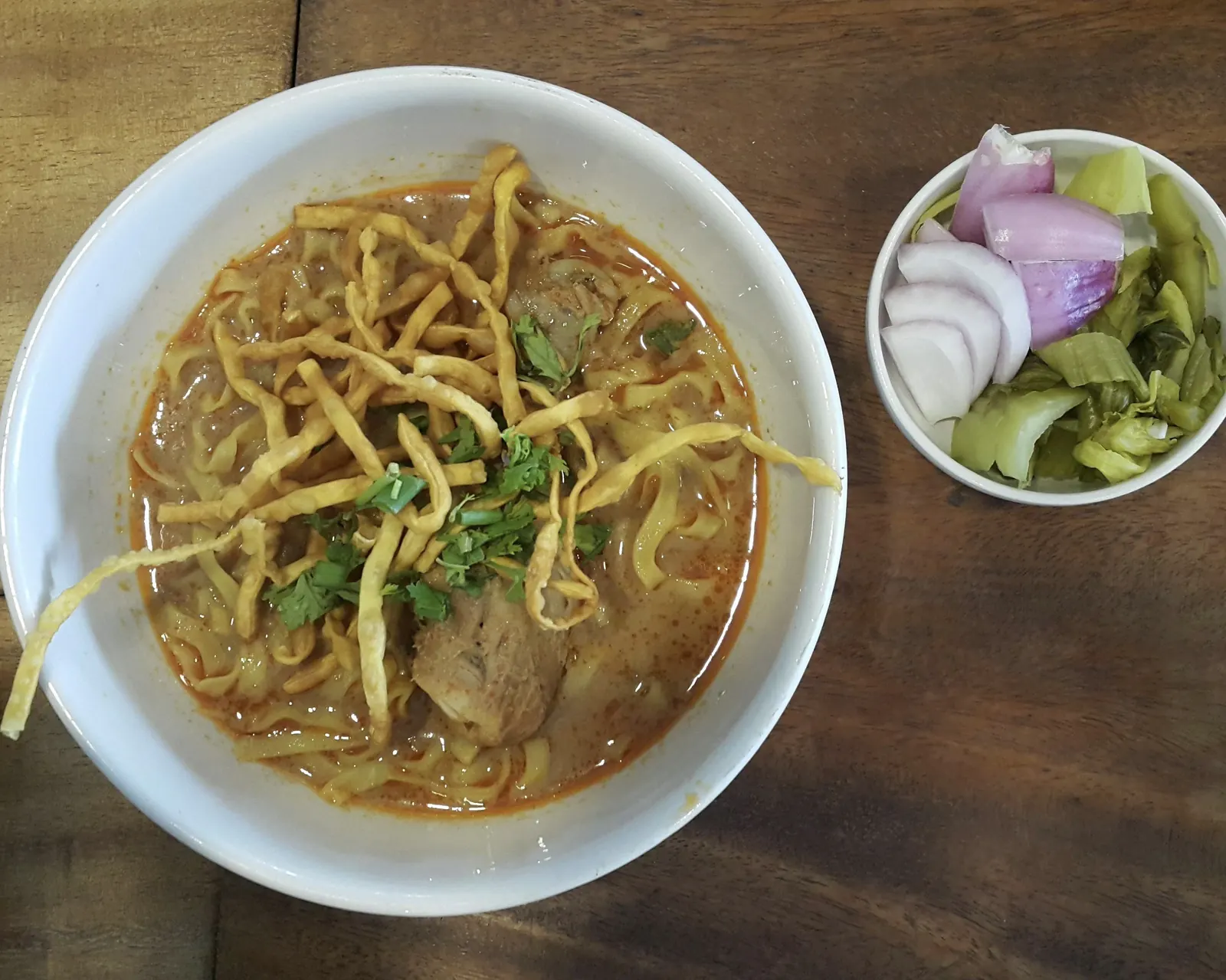
| Khao soi (ข้าวซอย) | Egg noodles in a coconut curry broth, chicken leg or beef, crispy fried noodles on top; pickled greens, shallots, lime and chilli oil beside | Yunnanese Muslim (Chin Haw) traders; the word is Shan for “cut rice” | 40–70 at the old shops; 60–90 fair; 120–180 in cafés | Do it, daily, before 14:00 |
| Khao soi Islam (ข้าวซอยอิสลาม) | The same bowl as cooked in the Ban Haw mosque lane: halal, beef-forward, spicier, sold beside khao mok (Thai-Muslim biryani) | The Chin Haw community itself | 60–70 | Do it; the beef is the point |
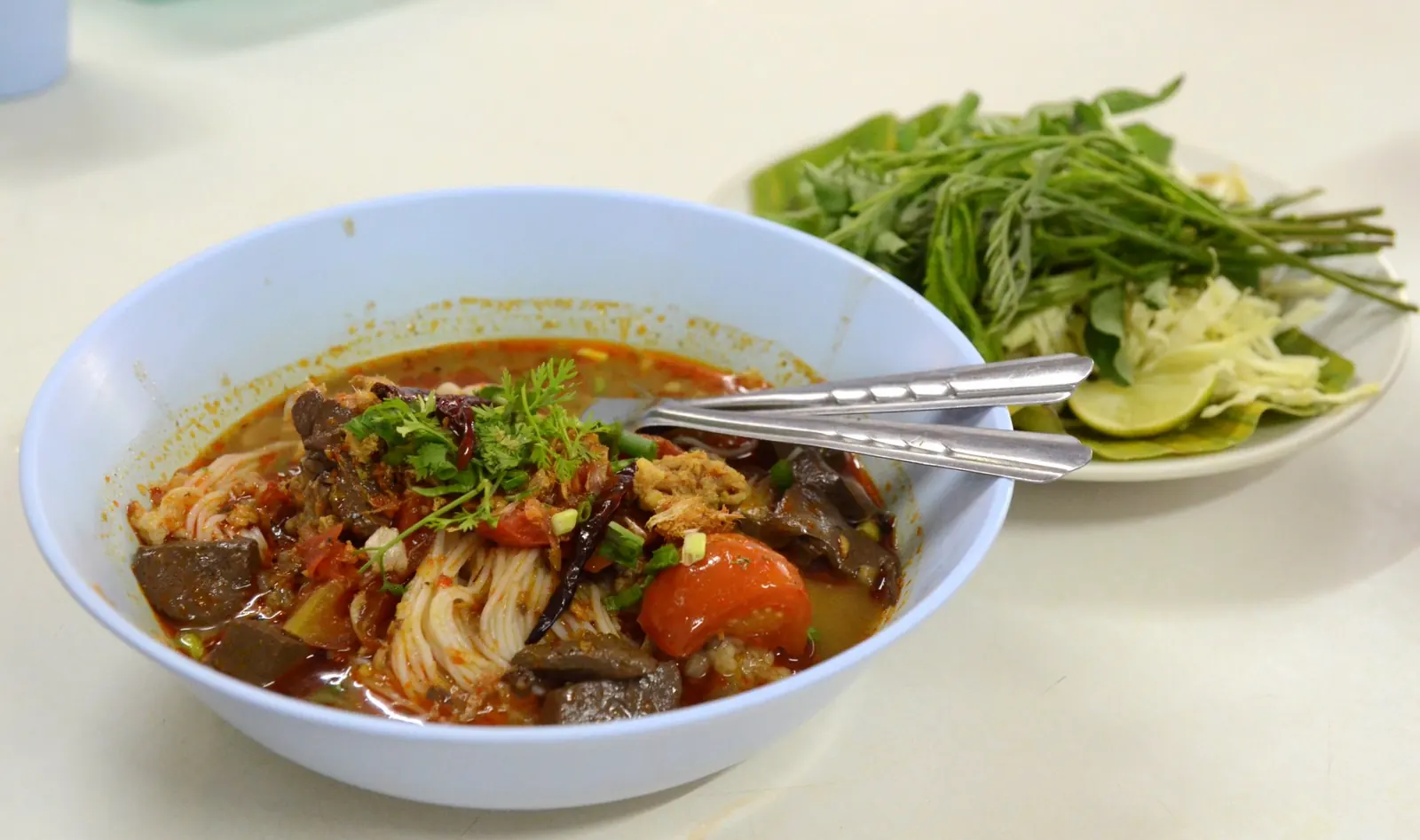
| Khanom jeen nam ngiao (ขนมจีนน้ำเงี้ยว) | Fermented rice vermicelli under a rust-red broth of tomato, pork rib, blood cake, tua nao and dried kapok flowers (dok ngiao); no coconut at all | Tai Yai (Shan); Chiang Rai and Mae Hong Son do it best | 40–60 | Do it; the better bowl, and the one tourists skip |
| Khao soi nam na (ข้าวซอยน้ำหน้า) | Shan khao soi: rice noodles with a tomato-pork topping, soup on the side, no coconut; what “khao soi” means in Mae Hong Son | Tai Yai | 40–60 | Do it if you reach Mae Hong Son or Pai |
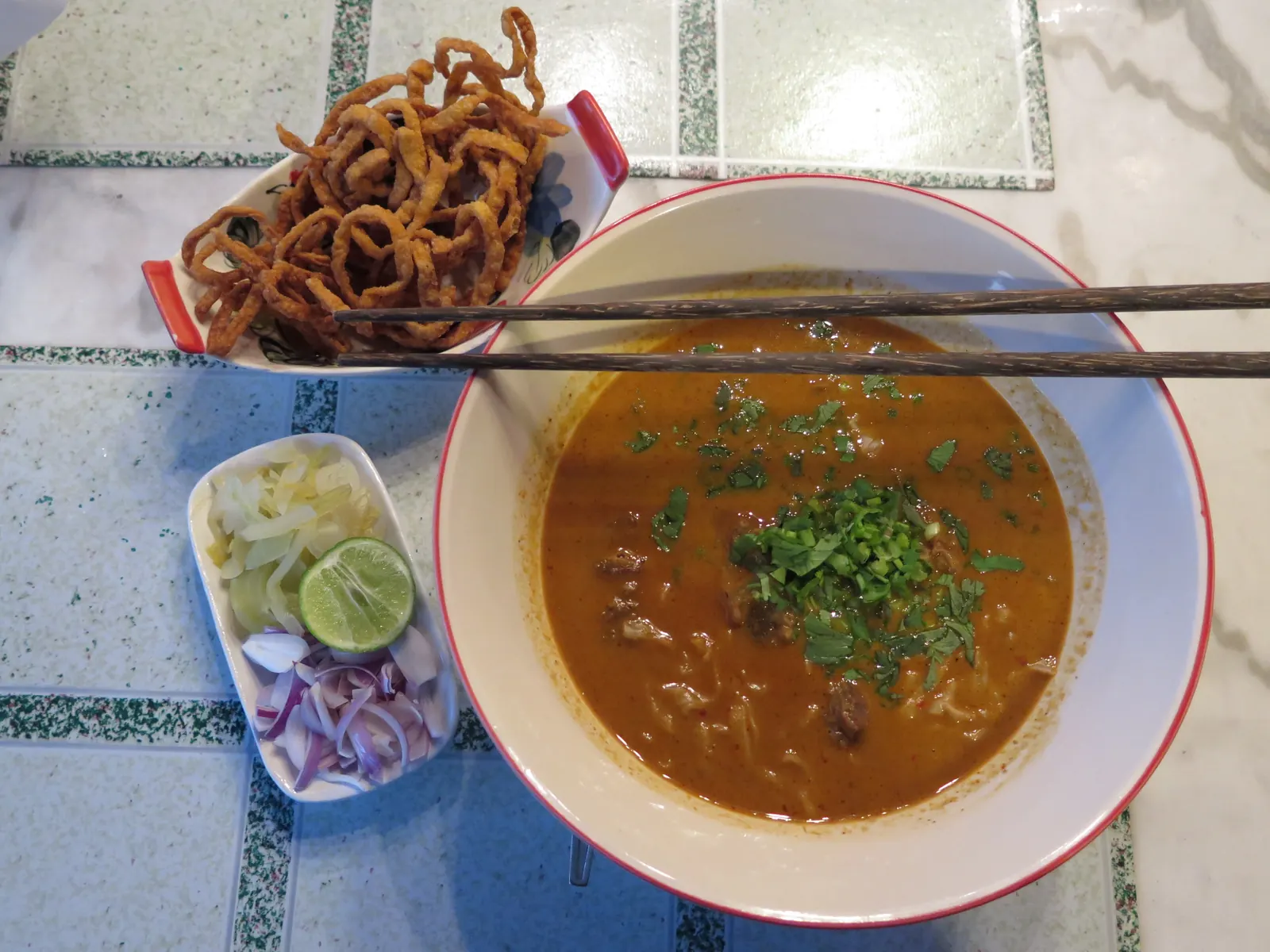
How to eat khao soi: squeeze the lime, add a spoon of pickled greens and a few raw shallots, then the chilli oil a little at a time. The chicken is a whole drumstick and is meant to fall apart with the spoon; the crispy noodles are structural, so eat them before they drown. A bowl is ฿40–50 at the oldest shops as of November 2026 and ฿60–70 everywhere else honest; the moment you see ฿150 and a sprig of coriander on the handle, you are paying for the chair.
The nine northern Thai dishes worth ordering, with prices
Prices are what a market stall or an open-fronted Lanna restaurant in Chiang Mai charges as of November 2026; air-conditioned places with a name on Instagram roughly double them. Thai script is there so you can read the sign and point.
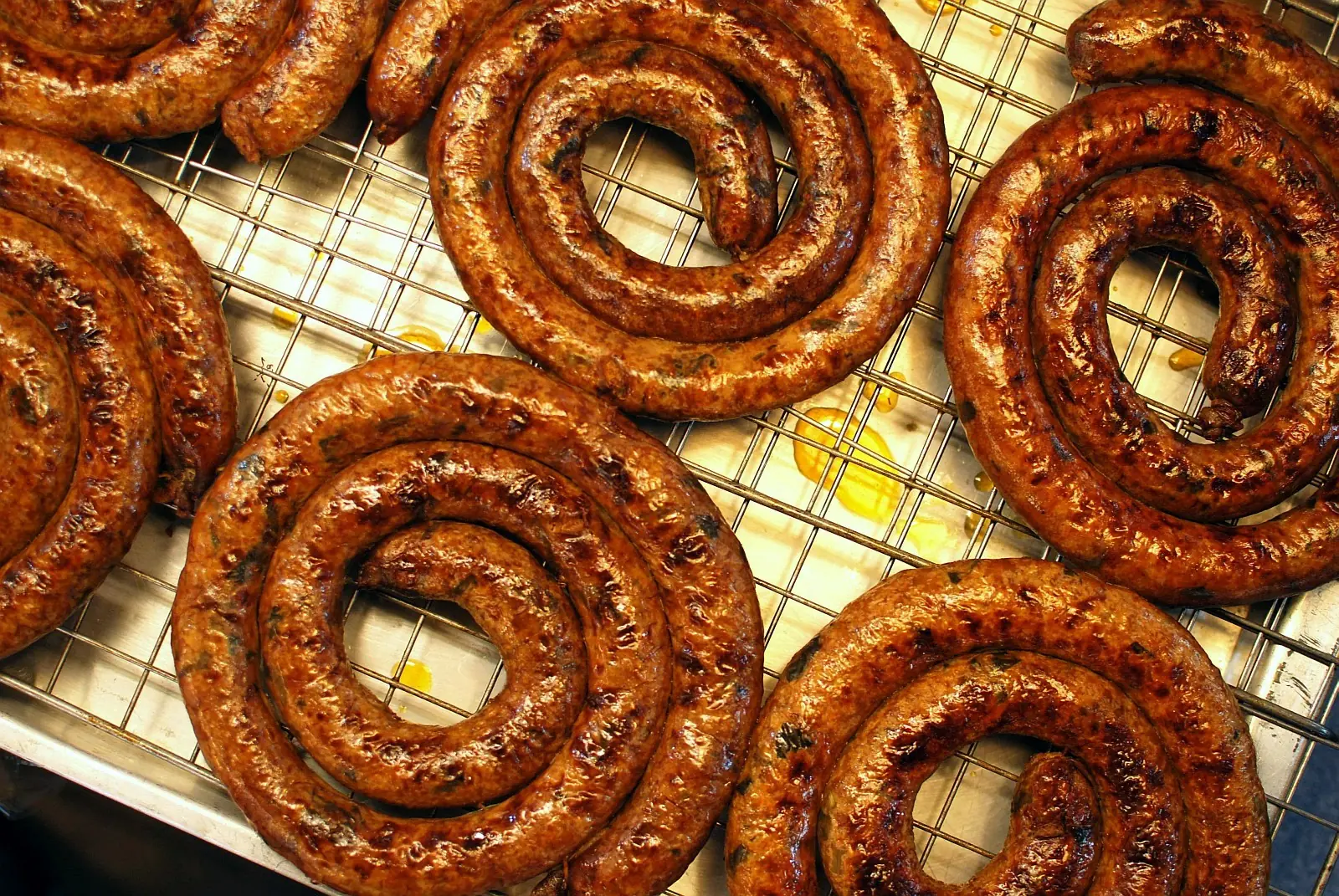
Sai ua (ไส้อั่ว) — ฿20–30 a chunk, around ฿40 per 100 g at the market
Coarse pork sausage coiled like a hose, packed with lemongrass, kaffir lime leaf, galangal, turmeric and chilli paste, grilled slowly over coals until the skin blisters. Herbal rather than hot. The best is sold by weight at Warorot and the morning markets; the chunks on sticks at night markets are fine but drier. Worth it, every time; the north’s best export, and it travels in a backpack for a day.
Nam prik noom (น้ำพริกหนุ่ม) — ฿20–40 a bag, ฿60–100 as a set with crackling
Large pale-green chillies, garlic and shallots charred over the fire, peeled and pounded to a stringy, smoky paste. It looks like guacamole and bites like a wasp. Eaten with kaep moo (pork crackling), steamed pumpkin, cabbage and sticky rice. The Chiang Mai version is the benchmark; the Bangkok supermarket version is a tragedy. Do it, and buy a sealed tub for the flight home.
Nam prik ong (น้ำพริกอ่อง) — ฿40–80
Minced pork and tomatoes simmered with dried chilli, shallots and tua nao into something between a relish and a ragù; mild, slightly sweet, the dip for children and nervous parents. Scooped with crackling and cucumber. Fine alone, excellent beside the green one: the two dips together are the Lanna starter.
Kaeng hang lay (แกงฮังเล) — ฿80–150 a bowl, ฿50–60 at a curry-rice counter
Pork belly braised for hours with ginger, tamarind, pickled garlic, peanuts and a masala-style curry powder, no coconut, sweet-sour and very rich. The name is Burmese and the dish is Chiang Mai’s festival curry, cooked for ordinations and weddings; the Chiang Rai version is thinner and more sour. Do it at a proper Lanna restaurant rather than a stall, because it rewards a kitchen with time. Our khao gaeng guide explains the cheaper counter version.
Laab muang / laab kua (ลาบเมือง / ลาบคั่ว) — ฿80–120
Not the Isaan larb. Northern laab is minced pork or beef with liver, skin and sometimes blood, seasoned with phrik laab, a dark roasted mix of makhwaen, long pepper, dried chillies, star anise and cumin, finished with crispy garlic and mint. Laab dip is raw; laab kua is the same mix stir-fried, and the one to order. Bitter, numbing, medium-hot, unlike anything else in Thailand. Do it cooked; the raw version is a Lanna gentleman’s whisky pastime and your stomach has not trained for it.
Kaeng khae (แกงแค) — ฿60–120
The herb curry: a thin, coconut-free broth of acacia leaf (cha-om), pea eggplant, long beans, wild mushrooms and whatever is in season, with chicken, frog or pork, warmed with chilli paste and makhwaen. Medium-hot and faintly medicinal. Do it when you have had enough pork fat; it is what northern grandmothers cook when somebody is ill, and it works.
Jin som / naem (จิ๊นส้ม / แหนม) — ฿20–40
Pork soured by a few days of fermentation with sticky rice and garlic, sold raw in banana leaf and best grilled in it (jin som mok khai, with an egg beaten in). Sour, garlicky, mild. Eat it grilled from a stall with a visible fire; raw only where the Thais in the queue are doing so. Fine, and better as the ฿20 snack between temples than as a course.
Khao kan jin (ข้าวกั๊นจิ๊น) — ฿15–30 a parcel
A Tai Yai dish: rice massaged with minced pork and pork blood, wrapped in banana leaf and steamed, eaten with fried garlic, garlic oil, cucumber and a dried chilli. The blood is a seasoning, not a flavour; the result is savoury, soft and mild. Sold at Warorot and Siri Wattana in the mornings, gone by ten. Do it; the cheapest proper breakfast in the north.
Tam khanun (ตำขนุน) — ฿50–80
Young jackfruit boiled soft and pounded with chilli paste, then stir-fried with minced pork, cherry tomatoes, kaffir lime leaf and crispy garlic. Mild, nutty, a texture like pulled pork. Do it, and note it is a northern tam, pounded then cooked, not a raw salad; the Isaan word travelled, the recipe did not.
The condiment tray: dips, crackling and how to eat sticky rice with your hands
A Lanna meal does not come in courses. Everything lands at once on a shared tray, at room temperature, and the eater builds mouthfuls: a ball of sticky rice in the right hand, pressed into a dip or used to pinch a piece of sausage, with crackling as the spoon and steamed vegetables as the brake. The table is what arrives, what it costs at a market and what it is for.
| On the tray (Thai) | What it is | Heat | Market ฿ | Eat it with |
|---|---|---|---|---|
| Nam prik noom (น้ำพริกหนุ่ม) | Charred green chilli dip | Medium-hot, builds | 20–40 a bag | Crackling, steamed pumpkin, sticky rice |
| Nam prik ong (น้ำพริกอ่อง) | Pork and tomato relish | Mild | 40–80 | Crackling, cucumber, cabbage |
| Nam prik ta daeng (น้ำพริกตาแดง) | “Red-eye” dried-chilli and fermented-fish dip | Hot, dry | 20–40 | Sticky rice only; a little goes a long way |
| Kaep moo (แคบหมู) | Pork crackling, with or without fat | None | 20–50 a bag | Everything; it is the spoon |
| Khao niao (ข้าวเหนียว) | Sticky rice in a woven basket or banana leaf | None | 10 a parcel | Right hand, small ball, lid closed between bites |
| Phak nueng (ผักนึ่ง) | Steamed pumpkin, cabbage, long beans, aubergine | None | Included or 10–20 | The dips; the cooling element |
| Sai ua and jin som (ไส้อั่ว / จิ๊นส้ม) | Herb sausage and sour pork, grilled | Mild | 20–40 a piece | Sticky rice, raw ginger, bird’s-eye chilli |
Etiquette, briefly. Take rice from the basket with your fingers, roll it small and firm, press it into the food rather than dunking, and never put a licked finger back in a shared dish. A fork and spoon arrive the moment a foreign face sits down and using them is forgiven; using your hand is noticed, approvingly. Close the basket lid or the rice dries. A whole spread for two, two dips, crackling, sausage, a laab, vegetables and rice, is ฿250–400 at a Lanna restaurant and about ฿150 assembled from a market, which is why our cost-per-day budgets are kinder in Chiang Mai than anywhere on the coast.
Where to eat northern Thai food in Chiang Mai: seven places open and honest in 2026
Every one of these has fed the city for decades and none paid to be here. Hours are the ones they kept through 2026 as far as we can establish; khao soi shops close when the pot empties, so treat the closing time as a ceiling. Where you sleep decides which are a walk away: see where to stay in Chiang Mai and the Old City, Nimman or riverside comparison.
| Place (Thai) | Where | Hours | Order, ฿ | Verdict |
|---|---|---|---|---|
| Khao Soi Khun Yai (ข้าวซอยคุณยาย) | Sri Poom Road by Wat Kuan Kama, inside the north moat | About 10:00–14:00, closed Sunday; sells out | Chicken or pork khao soi ฿40–50; the sweet longan drink | Do it; the benchmark bowl, and the cheapest |
| Khao Soi Lam Duan Fa Ham (ข้าวซอยลำดวนฟ้าฮ่าม) | Charoen Rat Road, riverside north of Nakhon Ping bridge | About 08:30–15:30 daily | Beef khao soi ฿60–80; sai ua by the piece | Do it; the 1940s original, more beef, more depth |
| Khao Soi Islam (ข้าวซอยอิสลาม) | Charoen Prathet Soi 1, the Ban Haw mosque lane behind the Night Bazaar | About 07:30–17:00 | Beef khao soi ฿60–70; khao mok gai ฿60 | Do it; the Yunnanese Muslim story in a bowl |
| Huen Phen (เฮือนเพ็ญ) | Ratchamanka Road, Old City | Lunch counter about 08:30–16:00; antique-house dinner 17:00–22:00 | Nam prik set with crackling ฿140; laab kua ฿85; hang lay ฿100–150 | Do it at lunch for the food, at dinner for the room |
| Tong Tem Toh (ต๋อง เต็ม โต๊ะ) | Nimmanhaemin Soi 13 | About 11:00–22:30; 20–40 minute queue at dinner | Sai ua ฿90–100; grilled pork neck; kaeng khae; ฿150–250 a head | Do it, at 17:00 before the queue; the best grilled things in town |
| SP Chicken (เอสพี ไก่ย่าง) | Samlan Soi 1, beside Wat Phra Singh | About 10:00–17:00 | Whole rotisserie chicken around ฿160, half ฿80–90; som tam ฿40–50 | Do it; not Lanna, strictly, but the city’s best lunch bird |
| Nam Ngiao Yong (น้ำเงี้ยวยอง), Siri Wattana market | Kad Thanin, Chang Phuak, north of the moat | Mornings only, roughly 07:00–13:00 | Khanom jeen nam ngiao ฿40–50 | Do it; a Michelin-listed stall with plastic stools |
The markets. Warorot (Kad Luang) and the adjoining Ton Lamyai flower market by the river are where Chiang Mai buys its own food, from about 05:00 to 18:00 on the ground floor: coils of sai ua sold by the khit (100 g), pillow bags of crackling (kaep moo, ฿20–50, with or without the fat), tubs of both nam prik, khao kan jin parcels in the morning and khao taen rice crackers for the bus; the upstairs food court is the cheapest sit-down northern plate in the city at ฿40–80. Siri Wattana, usually called Kad Thanin, is the Chang Phuak morning market where the Michelin stall lives, and the better one for khanom jeen. The Chang Phuak Gate night market, outside the north moat from about 17:00, is the neighbourhood’s dinner: the famous “cowboy hat lady” sells braised pork leg on rice at ฿50–60, Chinese-Thai rather than Lanna but honest, and the stalls around her grill sai ua. The evening markets are ranked in our Chiang Mai night markets guide; for someone to lead you through Warorot at seven in the morning, a Chiang Mai market food tour covers most of the nine dishes in one walk.
Is the khantoke dinner worth it? An honest verdict
A khantoke (ขันโตก) is the low, round lacquered tray Lanna families eat from on the floor; a “khantoke dinner” is the tourist evening built around it, and the Old Chiang Mai Cultural Center on Wualai Road has run the definitive one since the 1970s. You sit on cushions under a teak roof, the tray arrives with kaeng hang lay, nam prik ong, crackling, fried chicken, a stir-fry and sticky rice, refilled on request, and for two hours dancers in Lanna dress perform the fingernail dance and the sword dance before a hill-tribe show closes the night. Tickets through agents run around ฿690 an adult as of November 2026, more with hotel transfer and drinks; the show starts around 19:00.
Verdict: fine, for the right people. The dancing and costumes are real, the setting is lovely, and the food is a lukewarm, de-chillied edition of the dishes above, cooked for 200 people at once. With parents, or on a first night when you want Lanna culture explained with music, do it. If you came for the food, skip it: the same ฿690 buys the full nam prik set, a hang lay, a laab kua, sausage and a beer for two at Huen Phen, whose own khantoke set in the antique house is the quiet compromise, better food on the same trays without the microphone. The khantoke dinner and show listings bundle the ticket with transport if the parents win.
How to order northern Thai food: a seven-line script with Thai script
Point and smile does most of it. These seven lines do the rest; the romanisation is approximate and the Thai script is there to show the vendor. Khit is the market unit of 100 g, and the single most useful word in the north.
| Say | Thai | Means |
|---|---|---|
| Khao soi gai neung cham | ข้าวซอยไก่หนึ่งชาม | One chicken khao soi (swap neua, เนื้อ, for beef) |
| Kho phak dong phoem | ขอผักดองเพิ่ม | More pickled greens, please (always free) |
| Sai ua song khit | ไส้อั่วสองขีด | 200 g of sai ua, grilled |
| Nam prik noom kap kaep moo | น้ำพริกหนุ่มกับแคบหมู | Green chilli dip with crackling |
| Khao niao song ho | ข้าวเหนียวสองห่อ | Two parcels of sticky rice |
| Laab kua moo, mai ao dip | ลาบคั่วหมู ไม่เอาดิบ | Cooked pork laab, not raw |
| Phet noi / mai sai lueat | เผ็ดน้อย / ไม่ใส่เลือด | Mild / no blood (for nam ngiao or khao kan jin) |
Locals order khao soi by size, tham ma da (ธรรมดา, regular) or phi set (พิเศษ, large, usually ฿10 more), and name gai or neua first. Two at a Lanna restaurant order two dips, one curry, one laab and rice, and that is dinner. Cooking classes teach the dips and the hang lay in a half-day for the ฿1,000–1,600 our price index records; the Chiang Mai cooking classes that start with a market walk are the ones to pick.
Beyond Chiang Mai: Shan food in Mae Hong Son, and what Nan, Phrae, Lampang and Chiang Rai do better
Chiang Mai is the shop window, not the farm. In Mae Hong Son the food is Tai Yai: khao soi means the tomato-pork nam na bowl, breakfast is khao sen (thin rice noodles under a tomato-and-tua-nao sauce) from the morning market beside Wat Hua Wiang, tua nao is fried into crisps, and the stalls around Nong Jong Kham lake sell Shan tofu salad and pumpkin fritters for ฿20–40 a plate. Pai, halfway there, has a smaller version at its morning market. The minivan from Chiang Mai’s Arcade terminal is five to six hours of corners for around ฿250 as of November 2026; 12Go lists the Chiang Mai to Mae Hong Son vans and our Chiang Mai to Pai guide explains the first half of the road.
Chiang Rai is the nam ngiao capital: redder, more sour, served with raw bean sprouts and pickled cabbage, and its hang lay is sharper with tamarind. Three hours by Green Bus, ฿200–300, bookable on 12Go and costed in our Chiang Mai to Chiang Rai guide. Nan, six hours east and almost tourist-free, does the gentlest Lanna cooking, with the weekend walking street at Wat Phumin serving laab and nam prik on khantoke trays for around ฿50 a dish (our Nan guide; buses on 12Go). Phrae next door is khanom jeen and indigo shirts (Phrae guide). Lampang, an hour south by train, is where khao taen rice crackers come from and where Chin Haw descendants keep their own khao soi shops (Lampang guide).
Vegetarians, chilli, hygiene and the season: the honesty lines
Vegetarians. Lanna food is a pork cuisine, so most of it is off-limits and the dips are a lottery: nam prik noom is often vegan but some cooks add fish sauce, and nam prik ong is pork by definition. Ask for jay (เจ) and watch for the yellow sign. Kaeng khae with mushrooms, tam khanun without the pork and steamed vegetables with a clean nam prik noom is a real meal, and Chiang Mai has more vegetarian restaurants per head than any Thai city. You will not go hungry; you will go without the sausage.
Chilli. Milder than Isaan and far milder than the south, with two exceptions: nam prik noom, which creeps up on you, and the laab spice mix, which numbs before it burns. Hygiene. Raw laab and raw jin som are the two genuine risks; eat them cooked unless you are at a Thai table eating them raw, and read our street-food safety guide for the rest. Season. The north eats best in the cool season, November to February, when the markets fill with hill produce and the evening food markets are a pleasure rather than a sauna; the Yi Peng weeks in November are the city’s busiest. March and April bring the burning season haze, when eating outdoors is unwise and the khao soi shops open at ten regardless. Our best time to visit Thailand guide has the month-by-month, the Chiang Mai province page has everything else, and what to do between meals is covered too.
Northern Thai food: your questions, answered
What is northern Thai food?
The cooking of the old Lanna kingdom around Chiang Mai: sticky rice eaten by hand, pork in every form, charred chilli dips, herb curries without coconut milk, grilled herb sausage, and a laab seasoned with a numbing spice mix rather than lime. It is milder and more bitter than central or Isaan food, with Shan, Burmese and Yunnanese Muslim influences, and khao soi is its one famous coconut dish.
What is khao soi and how much should it cost?
Egg noodles in a mild coconut curry broth with a chicken drumstick or beef, topped with crispy fried noodles and served with pickled mustard greens, shallots, lime and chilli oil. It came to Chiang Mai with Yunnanese Muslim traders. As of November 2026 a bowl is ฿40–50 at the oldest shops, ฿60–90 is fair anywhere, and ฿120–180 in an Old City café is paying for décor. Lunch dish; the good shops close by mid-afternoon.
Is northern Thai food spicy?
Less than the rest of Thailand, with two traps. Nam prik noom, the green chilli dip, looks harmless and builds heat steadily; the northern laab spice mix numbs the tongue with makhwaen pepper before it burns. Khao soi, nam prik ong, hang lay, sai ua and khao kan jin are all mild, and children eat them. Say phet noi for mild at a laab or nam ngiao shop and you will be fine.
Where is the best khao soi in Chiang Mai?
Three shops settle most arguments: Khao Soi Khun Yai by Wat Kuan Kama on the north moat (about 10:00–14:00, closed Sunday, ฿40–50), Khao Soi Lam Duan Fa Ham on the riverside Charoen Rat Road (about 08:30–15:30, ฿60–80, the beef), and Khao Soi Islam in the Ban Haw mosque lane behind the Night Bazaar (about 07:30–17:00, ฿60–70). All close when the pot runs out, so go before one.
Is the khantoke dinner in Chiang Mai worth it?
For the dancing and the setting, yes, if you are with parents or on a first night and want Lanna culture explained with music; tickets run around ฿690 an adult through agents as of November 2026. For the food, no: it is a lukewarm, de-chillied version of the dishes cooked for a crowd. The same money buys a far better northern dinner for two at Huen Phen or Tong Tem Toh.
Related guides
- Isaan Food: Som Tam, Larb, Gai Yang and the Fire That Follows
- Thai Noodles, Decoded: How to Order a Bowl, the 12 Worth Knowing, and Why There’s Sugar on the Table (2026)
- Breakfast in Chiang Mai: six places to eat like a local
Book the trip
Some links in this guide are affiliate links. If you book through them we may earn a small commission at no extra cost to you — it helps keep Destination Thailand independent.
Hotels: sleep inside the north moat or along Charoen Rat Road and three of the seven places above are a walk away: compare Chiang Mai hotels on Agoda. Tours: a Chiang Mai food tour gets you through the markets with a translator, and a cooking class with a market walk sends you home able to make the dips. Getting there: our Bangkok to Chiang Mai transport guide ranks the sleeper train, the flights and the night bus, and 12Go sells the tickets; for the Shan table, the vans to Mae Hong Son are there too. Not sure which province is next? Try our where to go in Thailand matcher.