Ask a Bangkok taxi driver what he’s having for lunch and the answer, four days out of five, is Isaan food: som tam pounded in a clay mortar, a plate of grilled chicken, a basket of sticky rice, maybe a larb if it’s payday. The cooking of Thailand’s northeast — twenty provinces on the Khorat plateau, a third of the country’s people, most of its migrant labour — is the food Thais actually crave, and it is almost nothing like the coconut-and-curry Thai food the world thinks it knows. No coconut milk, barely any sugar, a fermented fish sauce that smells like a dare, chillies counted in handfuls, and sticky rice eaten with the fingers. Here’s how it works, what to order, what it costs, and where it’s best.
The short version: eat it at the som tam stalls and open-fronted shops with a charcoal grill out front and a mortar going like a drum, anywhere in the country — ฿50–70 for the salad, ฿60–120 for the chicken, ฿10 for the rice. Say pet nit noi (a little spicy) the first time and mean it. And if you can, eat it in Isaan itself, where it’s cheaper, hotter and comes with a mor lam soundtrack. Prices below are from our Price Index; the region’s food-first night markets are in our Khon Kaen and night market guides.
How Isaan food works: the holy trinity and the fish that shocks
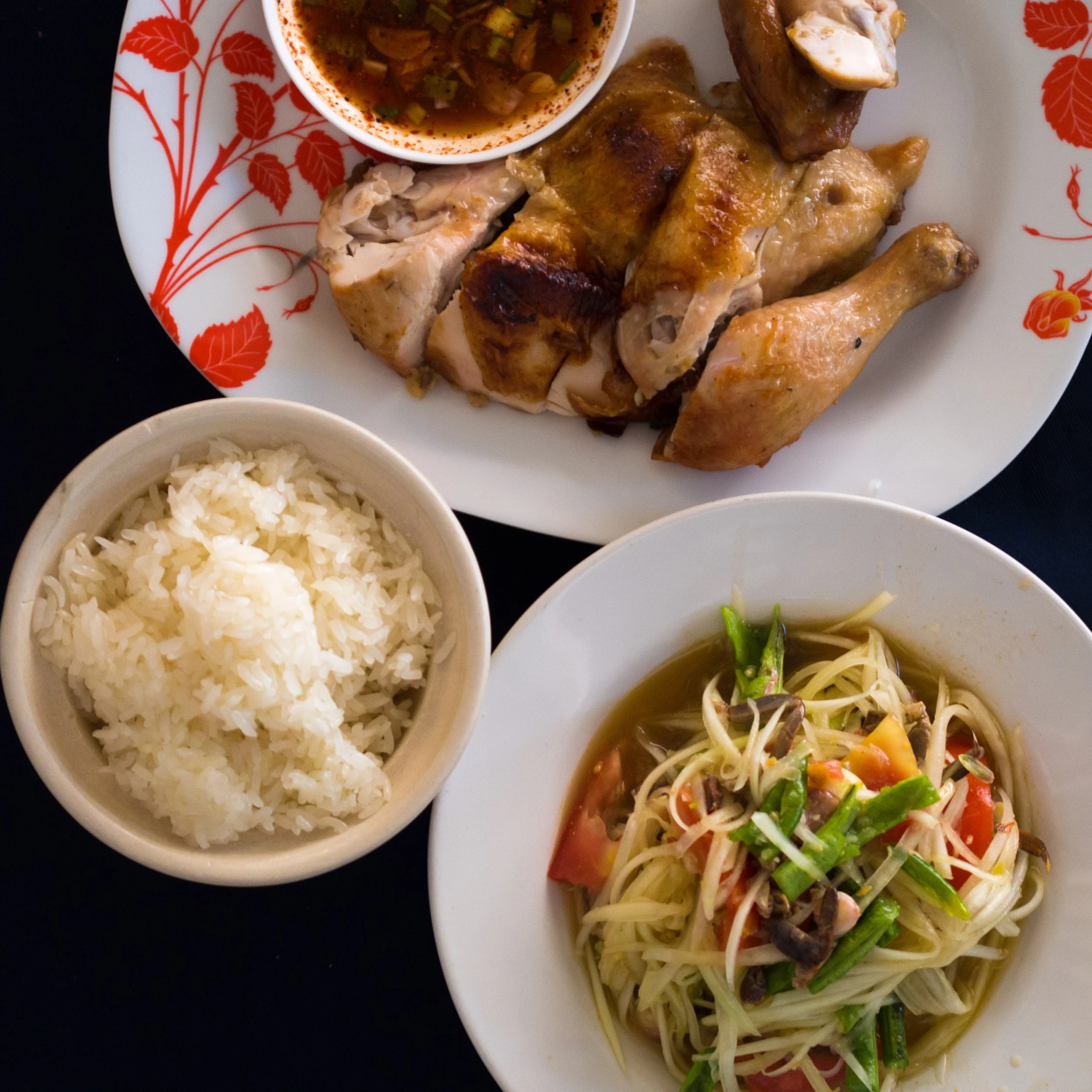
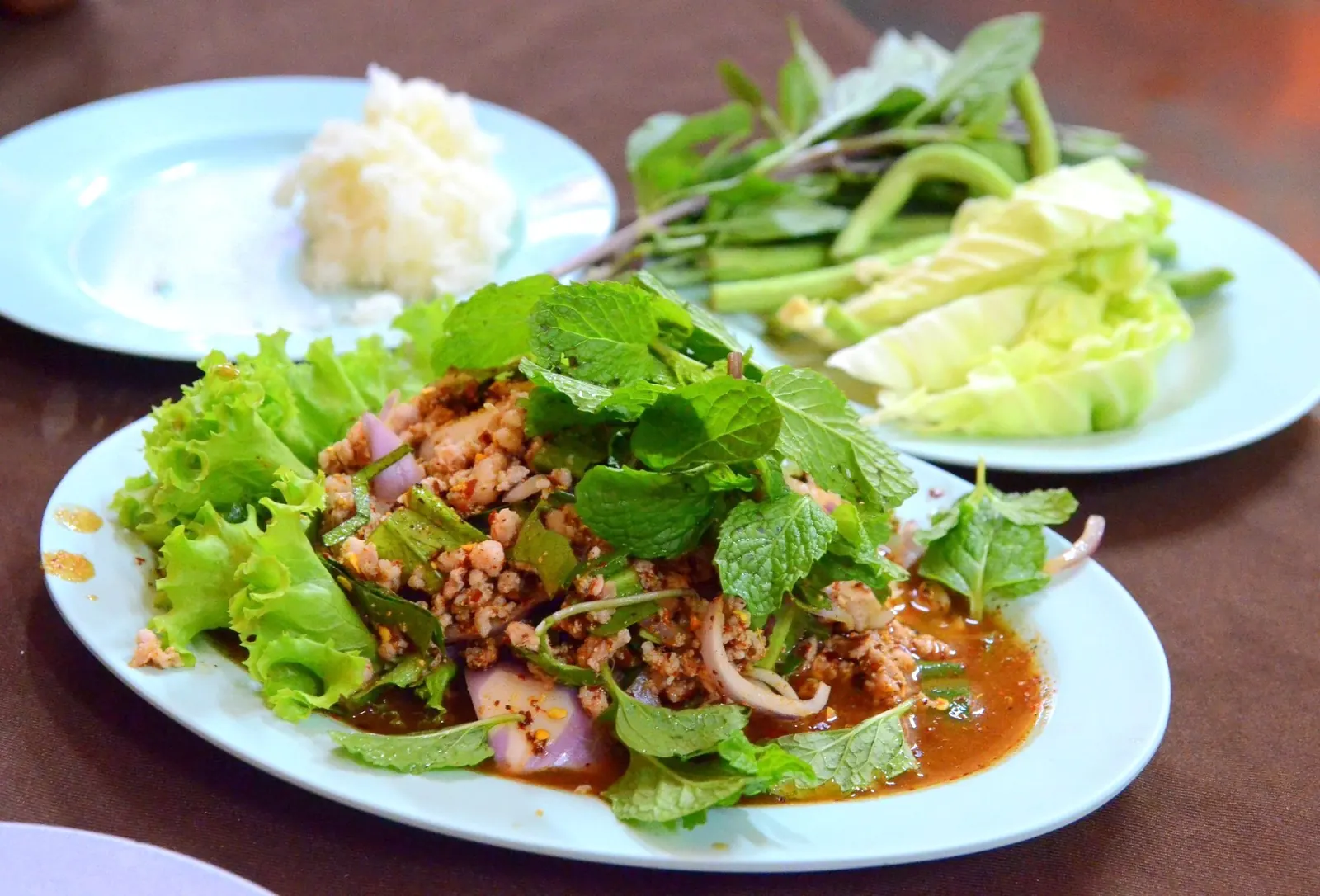
Almost every Isaan meal is built on three things eaten together: som tam (the pounded salad), something grilled (chicken, pork neck, catfish, sausage), and khao niao — sticky rice, steamed in a bamboo basket and eaten by pinching off a ball with your right hand and using it to pick up everything else. The fourth element is pla ra, fermented freshwater fish, a cloudy brown sauce that is to Isaan what fish sauce is to the rest of Thailand, only deeper, funkier and — yes — alarming the first time. Most central-Thai versions of Isaan dishes leave it out; the real ones put it in. Then the seasoning logic: sour from lime and tamarind, salty from pla ra and fish sauce, a restrained sweetness from palm sugar, and heat from fresh bird’s-eye chillies and dried chilli flakes, with khao khua — toasted ground rice — for nuttiness and texture in the meat salads. Herbs are mint, sawtooth coriander, dill, and the raw vegetables that arrive uninvited with everything: cabbage, long beans, Thai basil, sometimes a whole plate of leaves to cool the fire.
The dishes that matter, and what to say
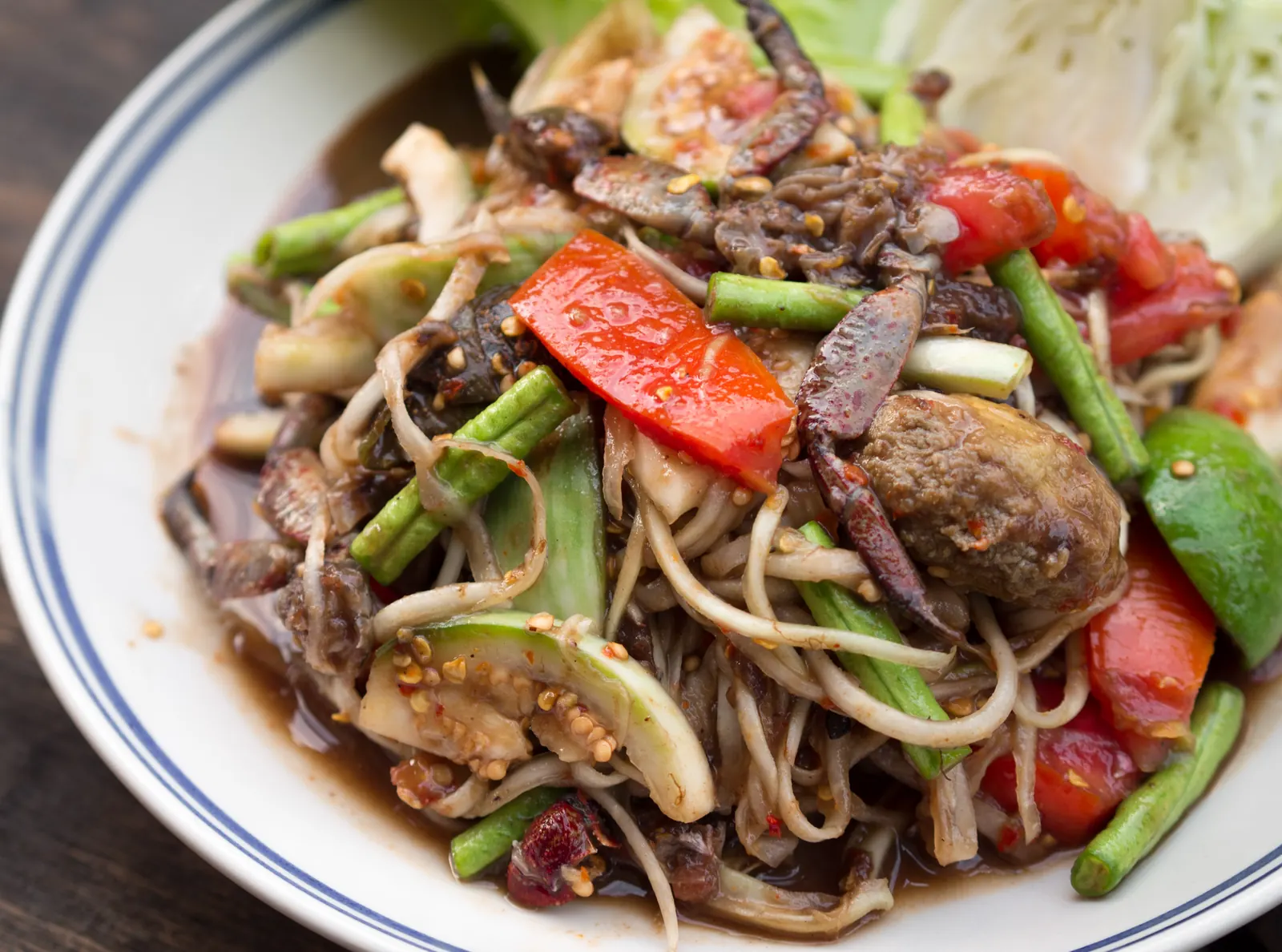
Som tam (ส้มตำ) — ฿50–70. Green papaya, pounded with garlic, chilli, long beans, tomato, lime, palm sugar and fish sauce. Som tam Thai is the sweet-sour one with peanuts and dried shrimp, built for outsiders; som tam pla ra (or tam Lao) is the Isaan original — no peanuts, fermented fish, darker, saltier, better. Tam poo adds salted black crab; tam sua adds rice noodles; tam thaad is the party tray with everything. Order by chilli count: “song met” (two chillies) is polite-hot; five is a statement.
Gai yang (ไก่ย่าง) — ฿60–120 a half, ฿150–250 whole. Chicken marinated in garlic, coriander root, pepper and fish sauce, split flat and grilled slowly over charcoal until the skin is lacquered. Served with nam jim jaew, the tamarind-chilli-toasted-rice dipping sauce that’s reason enough to come. The best versions in the country come from Wichian Buri in Phetchabun and the roadside grills outside Khon Kaen and Udon Thani.
Larb (ลาบ) — ฿60–90. Minced meat — pork, chicken, duck, beef, catfish — dressed with lime, fish sauce, chilli flakes, toasted rice powder, shallots and a fistful of mint. Eaten warm, with sticky rice, by the handful. Larb moo is the entry point; larb ped (duck) is the connoisseur’s; larb dip (raw beef) exists and is for the initiated. Nam tok (น้ำตก) is the same dressing on sliced grilled pork neck or beef — “waterfall”, for the juices dripping onto the coals — and it’s the one to order when larb feels like too much mince.
Sai krok Isaan (ไส้กรอกอีสาน) — ฿10–20 each. Fermented pork-and-rice sausages, sour and garlicky, grilled at the roadside and eaten with raw ginger, chilli and cabbage. The best ฿20 you’ll spend on a bus journey. Moo ping (pork skewers, ฿25–40 with rice) are the cousin everyone knows; sai krok is the one to try.
Tom saep (ต้มแซ่บ) — ฿80–150. The Isaan answer to tom yum: a clear, fiercely sour-spicy soup of pork bones or offal, galangal, lemongrass, lime and dried chilli, with a handful of sawtooth coriander. “Saep” is the Isaan word for delicious, and it is.
Gaeng om (แกงอ่อม) — ฿60–100. The region’s herbal stew — chicken, beef or frog with dill, lemongrass, holy basil and the leaves of whatever’s growing — thickened with toasted rice, no coconut anywhere near it. Gentle by Isaan standards and the dish to order when the chilli has won.
Pla pao (ปลาเผา) — ฿150–250 a fish. A whole tilapia or snakehead packed with lemongrass and pandan, crusted in salt and grilled until the skin cracks; peel it back, pull the white flesh out with your fingers, dip it in the green nam jim seafood sauce. Usually the centrepiece of an evening with a bottle of Leo.
Khao niao (ข้าวเหนียว) — ฿10. The sticky rice itself, the edible cutlery. Take a small ball from the basket, squeeze it in your fingers, press it into the larb or the chicken, eat. Close the basket lid between bites or it dries out. And the dessert version, khao niao mamuang — mango sticky rice — is central-Thai by reputation and Isaan by rice.
How to order at a som tam stall without getting the tourist edit
Point at the mortar and say “som tam“; specify “Thai” (sweet, peanuts) or “pla ra” (the real one); say the chilli count with fingers; add “gai yang neung tua” (one grilled chicken) or “khreung tua” (half); “khao niao song” (two sticky rices). “Mai pet” — not spicy — is understood but mildly tragic; “pet nit noi” keeps your dignity. If the vendor hesitates at pla ra for a foreign face, say “sai pla ra” (put the pla ra in) and watch the approval. A full Isaan spread for two — som tam, half a chicken, a larb, sticky rice, a tom saep — runs ฿250–400, which is the best-value meal in the country and why every construction site in Bangkok has one of these stalls outside it.
Where it’s best: in Isaan, honestly
Every Thai city has Isaan food because every Thai city has Isaan people. But the region itself is where the dishes are sharpest and cheapest, and it’s the least-visited corner of the country by a distance — Khon Kaen’s night markets (our guide), Udon Thani and Ubon Ratchathani for the gai yang and the river fish, Kalasin for the rural version (where we ate it), and the tiny provinces like Amnat Charoen (Thailand’s least visited) where lunch is a som tam stall under a tree and dinner is whatever the lady with the grill decided. The overnight trains from Bangkok to Nong Khai, Ubon and Udon are ฿600–900 in a sleeper berth and are the civilised way in — Bangkok to Khon Kaen on 12Go lists the sleepers against the one-hour flights. Isaan is also where Thailand’s Lao, Khmer and Phu Thai cultures overlap; our guide to Thailand’s ethnic groups explains why the food, the language and the music differ from the centre.
Isaan food: your questions, answered
What is Isaan food?
The cuisine of northeastern Thailand — sticky rice, pounded salads like som tam, grilled meats, herb-heavy meat salads like larb, and sour, spicy soups — seasoned with lime, chilli and fermented fish rather than coconut milk and sugar. It shares its roots with Lao cooking and is the food most Thais eat most often.
Is Isaan food very spicy?
It can be the spiciest in Thailand, but it’s adjustable to order — som tam by chilli count, larb and soups by asking for pet nit noi. Sticky rice, raw vegetables and the grilled meats are the cooling elements; eat them alongside and the heat becomes part of the rhythm rather than a test.
What is pla ra and should I try it?
Fermented freshwater fish, aged for months, used as a seasoning — the backbone of real som tam and many Isaan soups. It smells strong and tastes deep, salty and savoury rather than fishy once it’s in the dish. Try it in som tam pla ra at a busy stall; most visitors who expect to hate it don’t.
How much does an Isaan meal cost?
At a stall or open-front shop: som tam ฿50–70, half a grilled chicken ฿60–120, larb ฿60–90, sticky rice ฿10, an Isaan sausage ฿10–20. A generous spread for two is ฿250–400. Air-conditioned Isaan restaurants in Bangkok roughly double that and are still cheap.
How do you eat sticky rice properly?
With your right hand: pinch a small ball from the basket, squeeze it firm, press it into the dish to pick up meat or dip sauce, eat. Don’t dip your fingers in shared plates, and close the basket lid between bites so the rice doesn’t dry out. A fork is tolerated; the hand is correct.
Related guides
- The Five Tastes of Thai Cuisine
- Southern Thai Cuisine: 6 Essential Dishes and the Cultures Behind Them
- Khon Kaen Night Market: Isaan Food After Dark
Eat your way there
Some links in this guide are affiliate links. If you book through them we may earn a small commission at no extra cost to you — it helps keep Destination Thailand independent.
Learn to pound your own som tam at a cooking class that includes Isaan dishes; take the overnight sleeper into the northeast; and if Isaan’s twenty quiet provinces sound like your Thailand, our Where to Go in Thailand matcher will tell you which one — it spends most of its attention on the places nobody lists.