Category
Food
Thai food from every angle — street stalls, regional specialties, market finds, and the dishes worth going out of your way for.
Thai food is regional before it is national. The dish list changes every few hundred kilometres, the chilli logic changes with it, and the version of “Thai food” sold abroad is mostly one region’s cooking with the heat turned down. Below: the four kitchens, how the flavour balance actually works, what things cost, and how to order at a stall without ending up with the tourist edit.

Thailand Fruit Season Chart 2026–27: 36 Fruits, Month by Month
When is mangosteen season, and what should a kilo cost? A month-by-month Thailand fruit season chart: 36 fruits, peak months,…
Breakfast in Bangkok: Where the City Actually Eats Before Nine
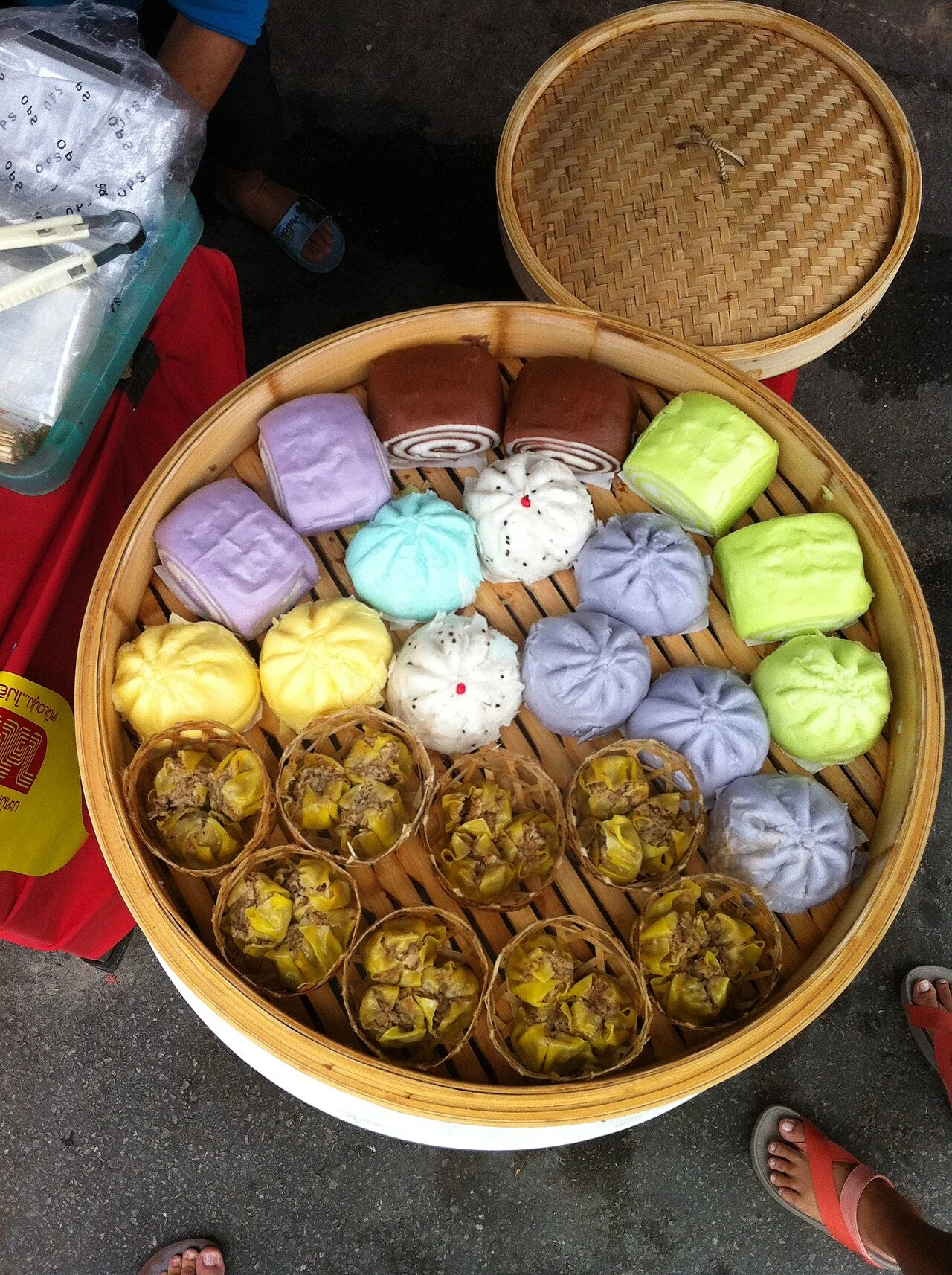
Where does Bangkok really eat before 9am? Jok, patongo, pork leg and dim sum by neighbourhood, with hours, prices, queues…
Thai Noodles, Decoded: How to Order a Bowl, the 12 Worth Knowing, and Why There’s Sugar on the Table (2026)
Noodle + protein + soup or dry, then the four jars: the ordering grammar every Thai noodle shop assumes you…
Bangkok Street Food by Neighbourhood: What to Eat, Exactly Where, and What It Should Cost (2026)
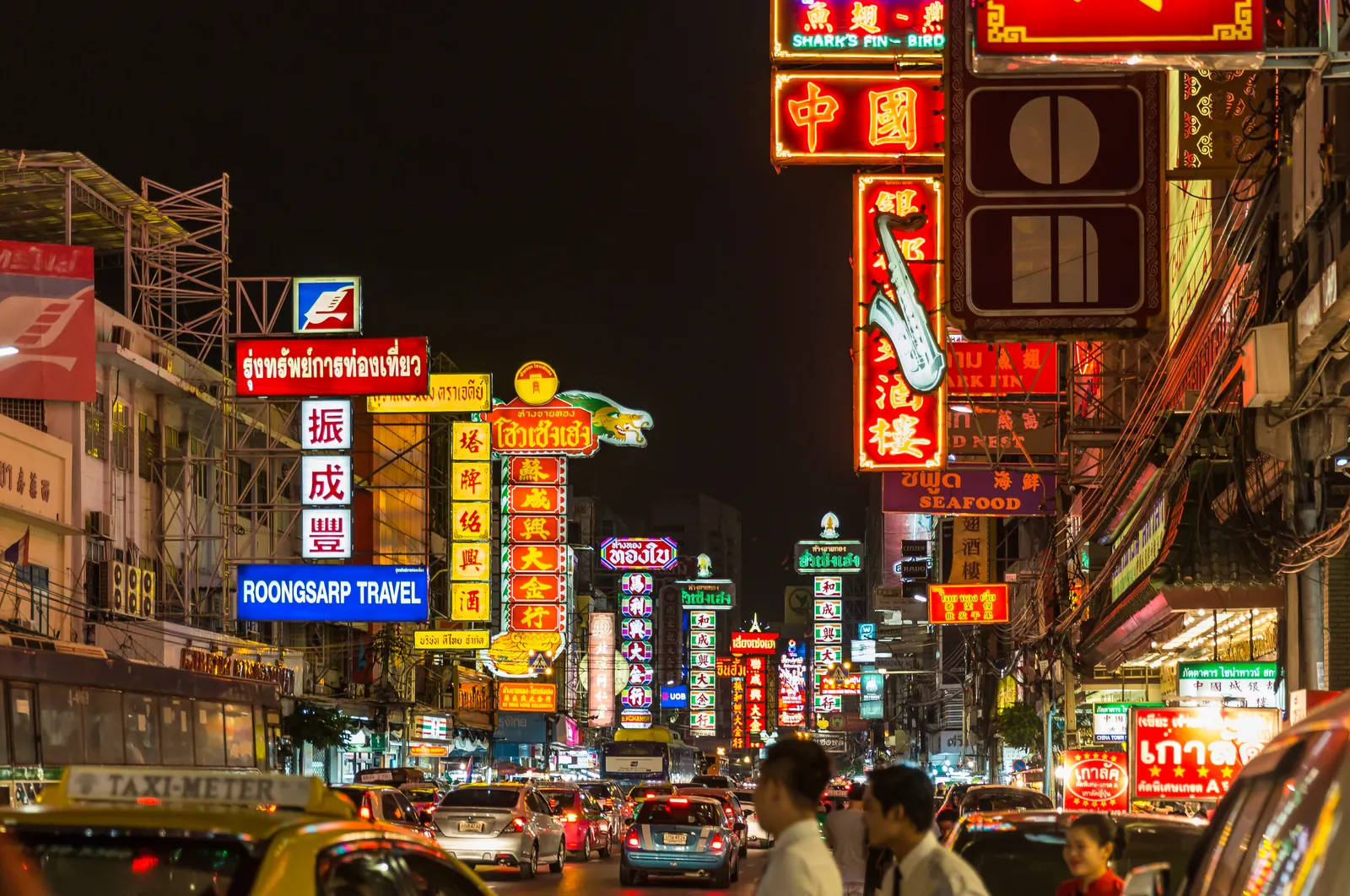
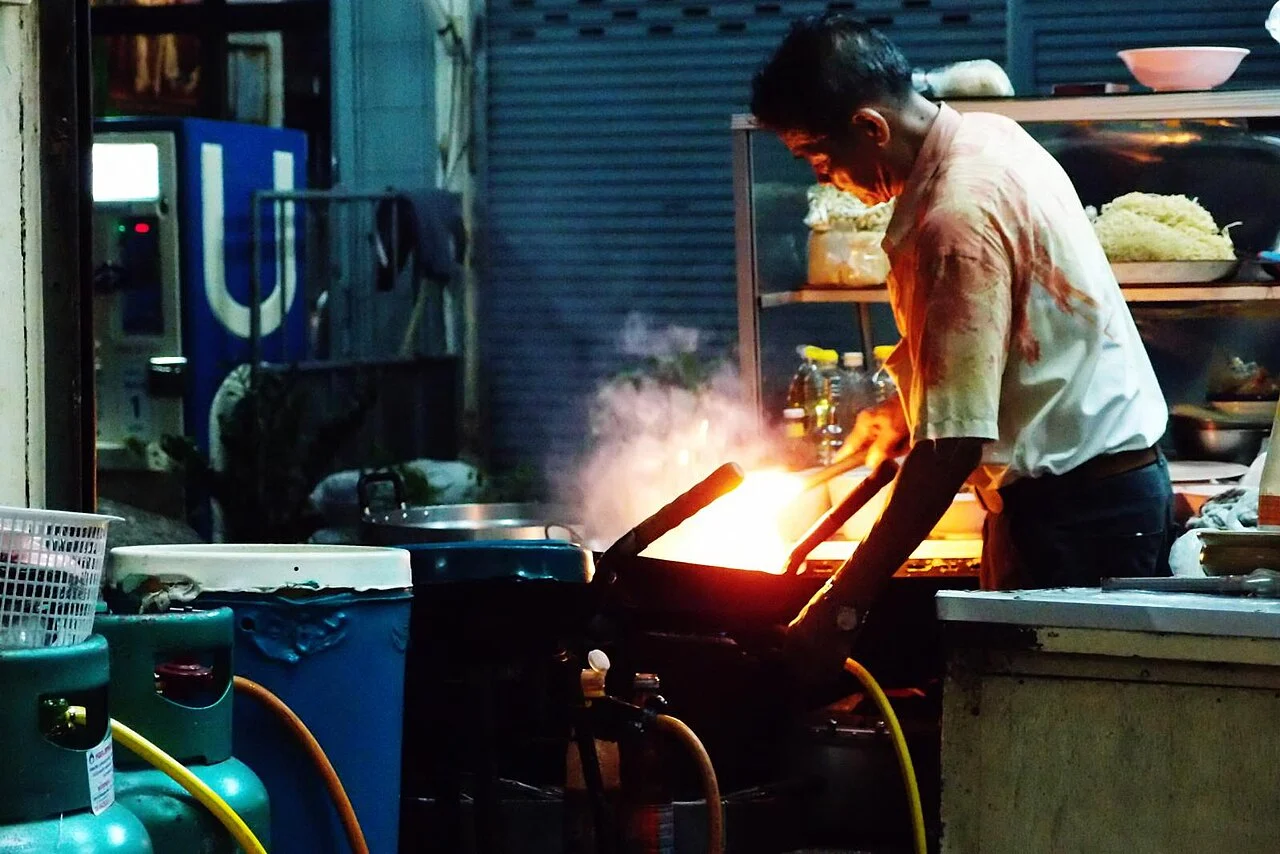
Yaowarat after dark, the Old Town’s famous two, Bang Rak’s century-old duck, boat noodles at Victory Monument, Wang Lang across…
Isaan Food: Som Tam, Larb, Gai Yang and the Fire That Follows
The food Thais actually crave: how Isaan cooking works, the ten dishes that matter with 2026 prices, how to order…
Thailand’s Vegetarian Festival: What the Yellow Flags Mean (and What to Eat)
For nine days each October the yellow เจ flags go up and Thailand’s street food goes vegan. Here’s what to…
Is Thai Street Food Safe? An Honest Answer
Yes — if you read the queue. What actually makes travellers sick in Thailand, and how to pick a stall…
Khao Gaeng: How Thailand’s Curry-Rice Shops Actually Work
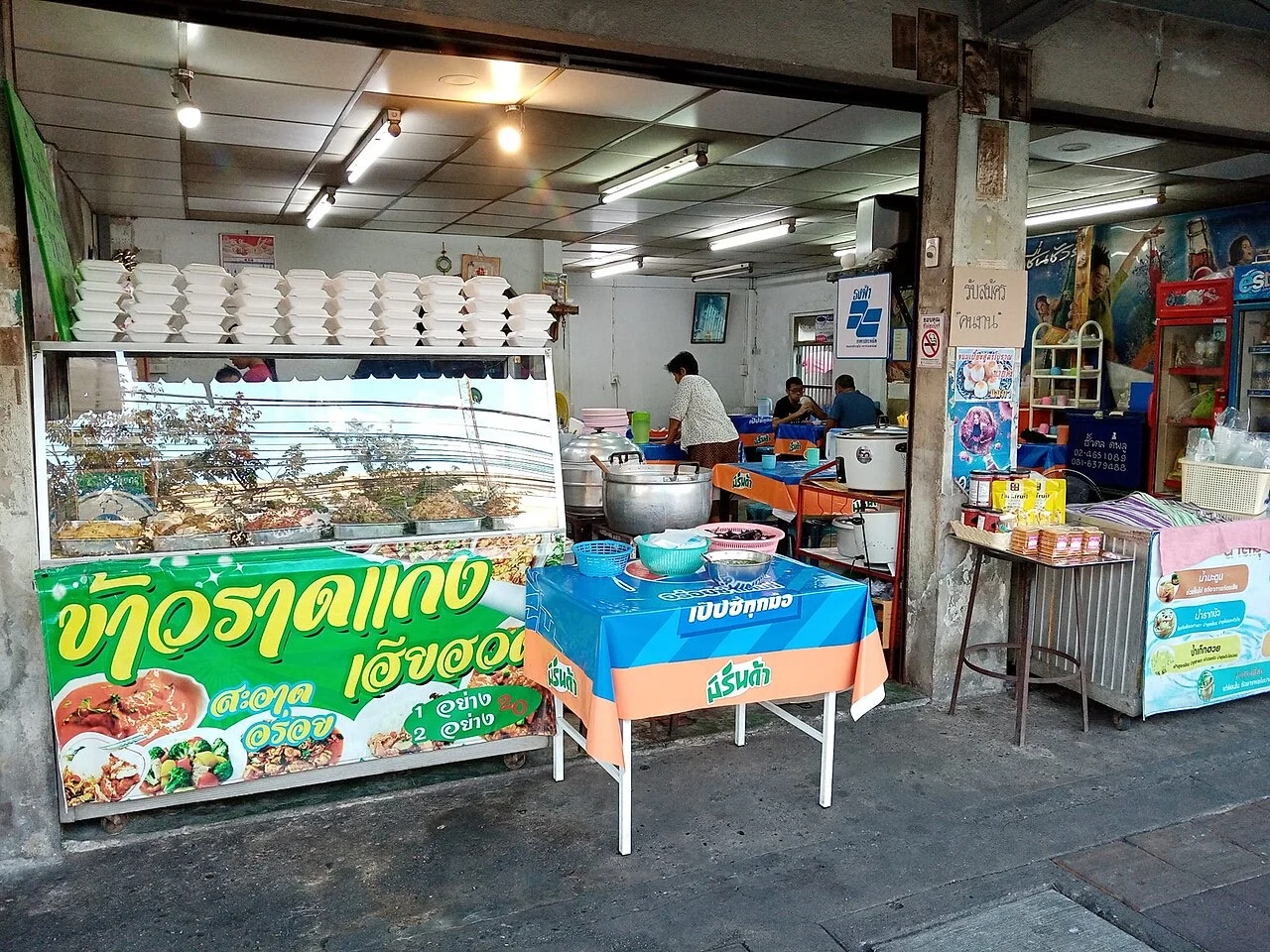
The steel trays, the pointing, the ฿60 plate — how Thailand’s raan khao gaeng works and why it beats most…
Khon Kaen Night Market: Isan’s Real Capital After Dark
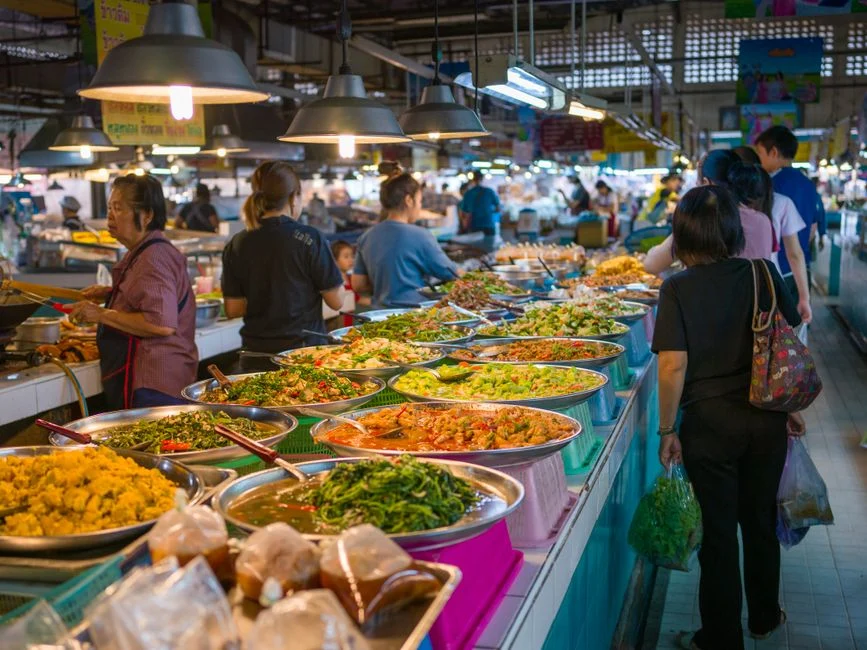
Khon Kaen Night Market — the real Isan capital after dark. Where to eat, what to order, and the markets…
Ari, Bangkok: The Neighbourhood That Locals Spend Weekends In
Ari, Bangkok — the leafy, café-dense neighbourhood north of the centre where Bangkokers actually spend their weekends. Cafés, food, and…

The long version
How to eat in Thailand: regions, flavour logic and street rules
Two things transform eating here. The first is knowing which region’s cooking is in front of you. The second is knowing that a stall selling one dish has made it ten thousand times, and the restaurant with a laminated twelve-page menu has not.
Four kitchens, not one menu
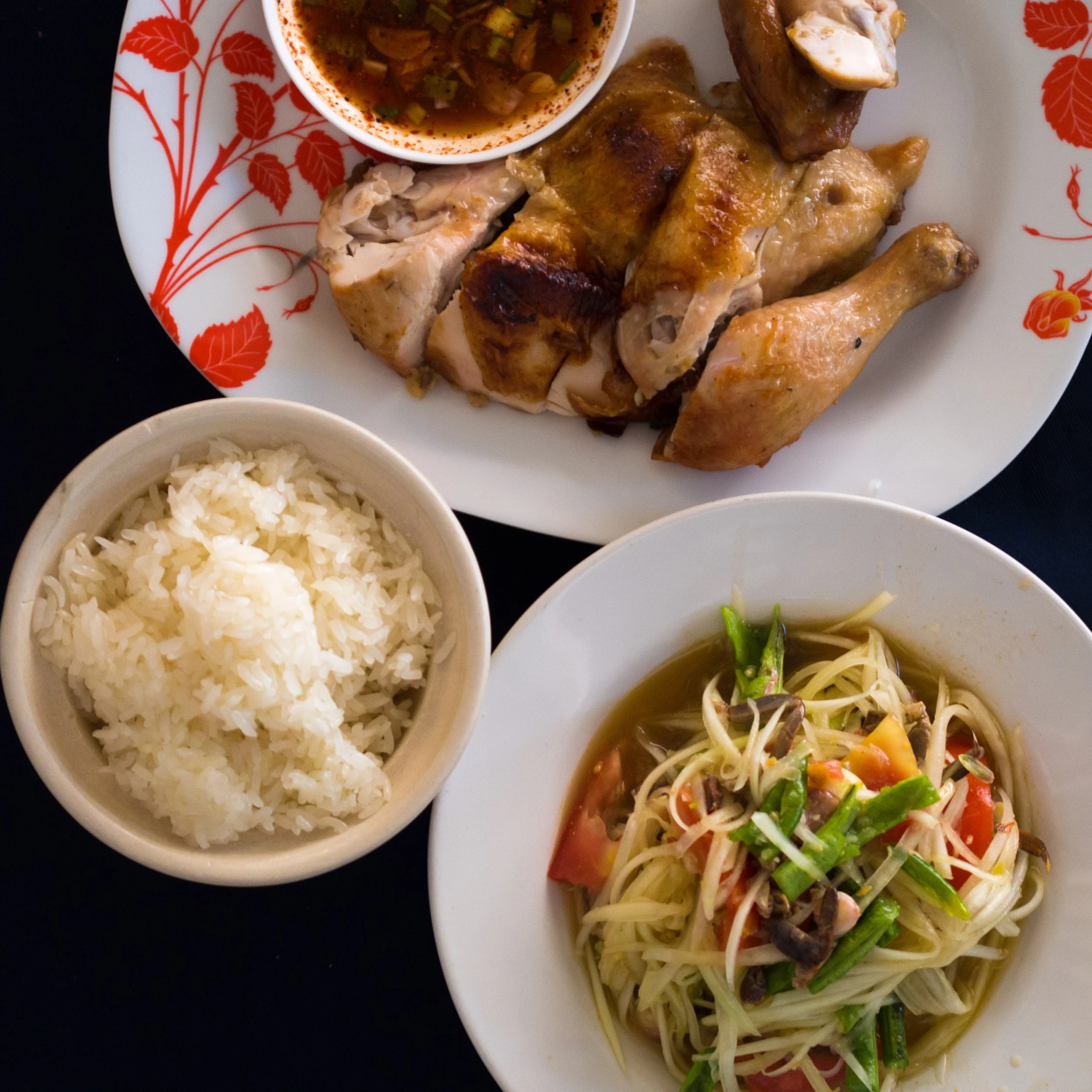
Central Thai cooking is the diplomatic one: coconut milk, palm sugar, the green and red curries, tom yum, and a deliberate balance no single flavour is allowed to win. It travelled abroad because it flatters everybody. Isaan food, from the north-east, is the opposite — almost no coconut, aggressive sour-salt-chilli, grilled meat, sticky rice eaten with your right hand, and pla ra fermented fish underneath more of it than menus admit. Som tam, laab and grilled chicken is the national street trinity and it is Lao by ancestry. Start with Khon Kaen’s night market, which is the region cooking for itself.
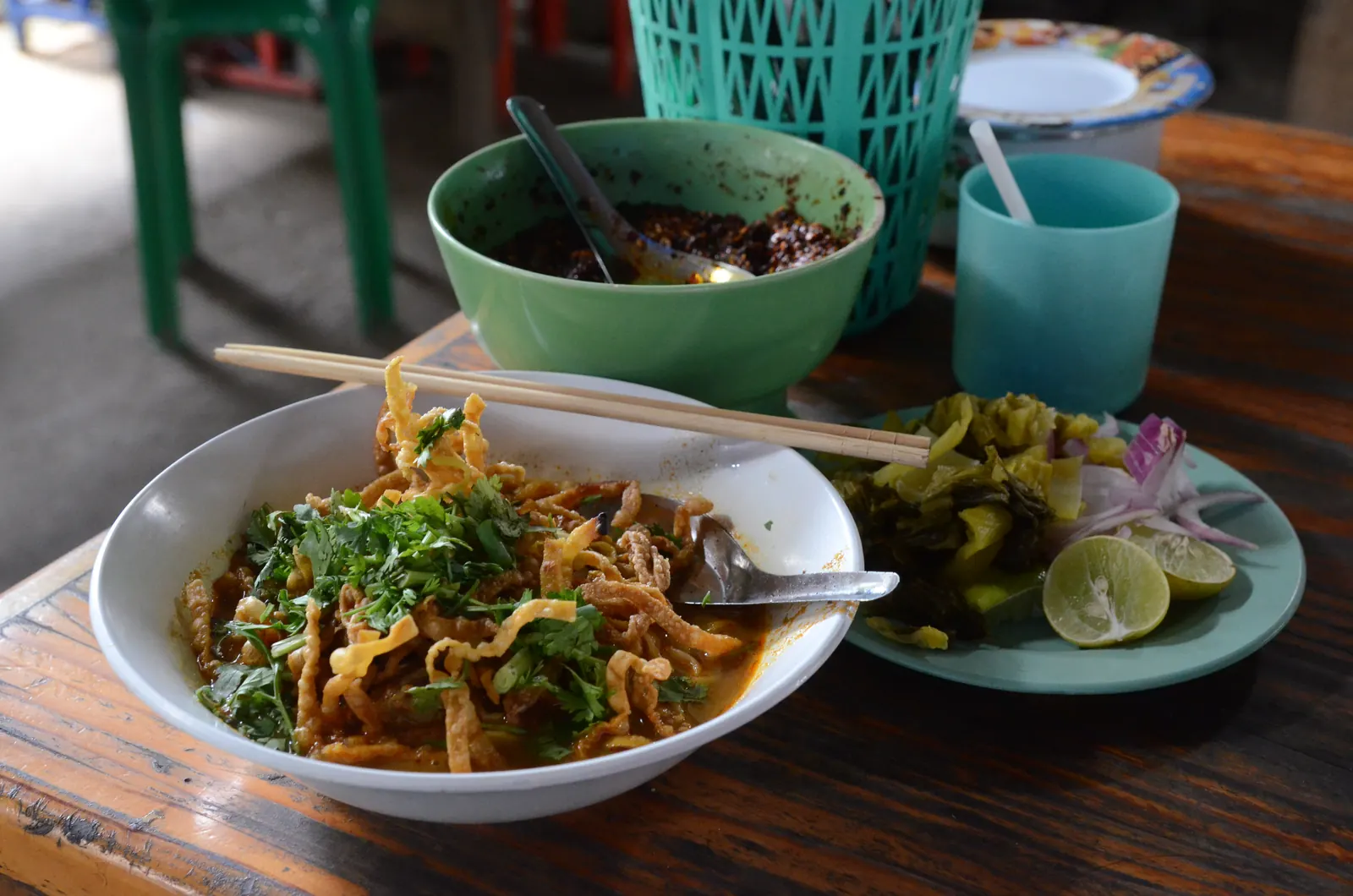
Northern (Lanna) food is the mildest and the most Burmese-adjacent: khao soi’s curried noodles, sai ua herb sausage, nam prik ong and nam prik num with vegetables and pork crackling, and sticky rice again. Chiang Mai mornings is the practical way in. Southern food is the hottest in the country and the least compromised for visitors: turmeric-yellow curries, gaeng som, khao yam rice salad, stink beans, and a Malay-Muslim strand that gives you roti, massaman and beef where the rest of the country reaches for pork. Six essential southern dishes covers the canon; Nakhon Si Thammarat is where to eat it.
The flavour logic (and why your first plate tasted flat)
Thai cooking builds every dish from a small number of axes — salty, sour, sweet, bitter and hot — and the skill is the ratio, not the ingredient list. Our guide to the five tastes explains why fish sauce does the work salt does in European cooking, why lime and tamarind are not interchangeable, and why sugar in a savoury dish is a structural choice rather than a sweet tooth.
The practical consequence sits on the table. A noodle shop gives you a caddy of four condiments — sugar, dried chilli flakes, chilli in vinegar and fish sauce — and you are expected to use them: the bowl arrives deliberately under-seasoned so you can tune it. If a plate of noodles tastes like nothing, that is not a bad stall, that is an unfinished dish. Away from noodles, the equivalent is prik nam pla, the saucer of chilli in fish sauce that comes with rice plates.
Ordering street food without getting the tourist edit
Pick the stall doing one thing. A cart with a single dish, a queue of office workers and visible turnover is a better bet than a restaurant with photographs of everything; the food is fresher because it moves, and the cook has no other job. Eat where the pot is emptying, roughly 11am to 1pm and after 6pm, rather than at 3pm when it has been sitting.
On money: in most of the country a street plate of pad kaphrao or a bowl of noodles runs about 50–70 baht, central Bangkok pushes that to 60–90, a mall food court sits around 80–150, and a sit-down local restaurant dish is 120–250. Prices on a board are the prices; markets do not haggle over food.
On heat: mai phet means not spicy and phet nit noi means a little spicy, and both are frequently interpreted as “spicy, but for a foreigner”, which in the south is still very spicy. If you genuinely cannot eat chilli, say mai sai phrik — do not add chilli — because it asks for an ingredient to be left out rather than a judgement call. Ask for mai sai pla ra in Isaan som tam if fermented fish is not for you.
Fruit and sweets, by season
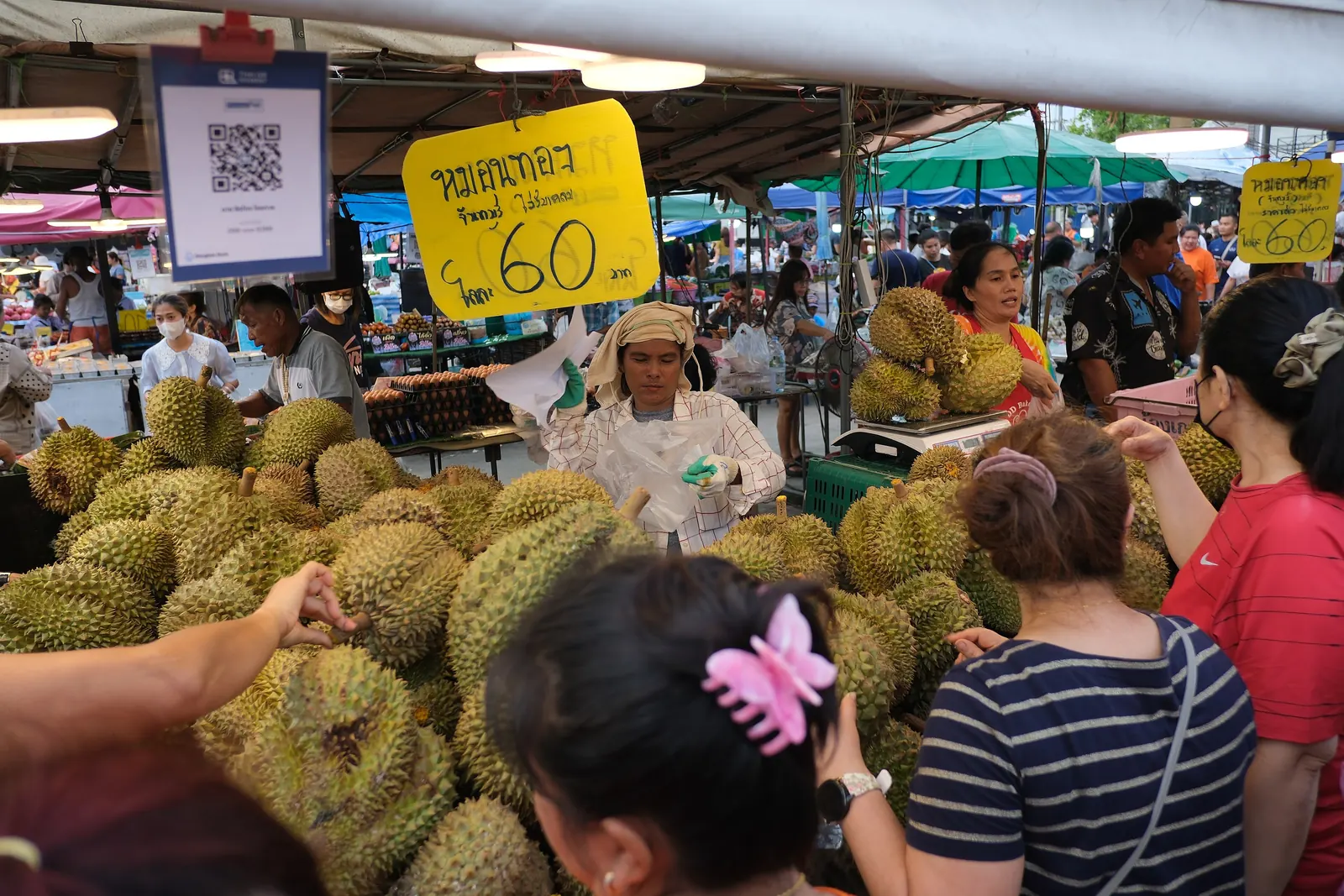
Fruit here is seasonal in a way supermarket shopping trains you out of noticing, and turning up in the right month is the difference between a good mango and a revelatory one. Mango season peaks March to May, durian runs roughly May to August, mangosteen and rambutan overlap through the middle of the year, and longan lands in the northern summer. Our month-by-month fruit calendar is the one to check before you go, and the grammar of Thai fruit covers how to buy it and how to ask.
Dessert deserves better than the mango sticky rice every hotel breakfast serves. Thai desserts beyond mango sticky rice gets you to the pandan, palm sugar and coconut end of the repertoire — and to the egg-yolk sweets a Portuguese cook introduced to the Ayutthaya court in the seventeenth century.
Markets and neighbourhoods worth travelling for
The best eating in Thailand is organised by market, not by restaurant. Khon Kaen and Nakhon Si Thammarat are the two provincial night markets we send people to first. Amphawa in Samut Songkhram does grilled river prawns from boats on a weekend evening, an hour and a half from Bangkok. And in the city itself, Ari is where Bangkokians actually spend a weekend: old shophouse noodle shops and third-wave coffee on the same soi.
The old, the royal and the reconstructed
“Royal Thai cuisine” is the most abused phrase on a Bangkok menu, and most restaurants using it are betting you cannot tell. The real tradition — palace cooking, obsessive knifework, carved fruit, milder chilli, dishes assembled rather than stir-fried — is a genuine thing worth eating once. Ahan boran traces where the old recipes come from and what has been reconstructed rather than remembered, and our review of Luk Kaithong at One Bangkok is us paying our own bill to test one of the mall versions against the claim.
Thai food FAQ
Is street food in Thailand safe to eat?
For the overwhelming majority of visitors, yes — and busy street stalls are often safer than quiet air-conditioned restaurants, because high turnover means nothing sits. Use the same logic a Thai office worker uses: pick a stall with a queue, a single specialism and food that is cooking or has just cooked, eat at peak hours, and be more careful with raw shellfish, pre-cut fruit that has sat unrefrigerated, and anything lukewarm. Drink bottled or filtered water; ice from commercial machines is made from treated water and is fine.
How much should a meal cost in Thailand?
A street plate or a bowl of noodles is about 50–70 baht outside Bangkok and 60–90 baht in the centre of the city. A mall food court runs 80–150 baht a dish, a local sit-down restaurant 120–250, and a mid-range restaurant aimed at visitors 300–600. Big Chang or Leo beer is 60–90 baht from a shop and 120–180 in a bar. You can eat extremely well here on 400 baht a day and it is easy to spend ten times that in Bangkok without eating better.
How do I order food that is not spicy?
Say mai phet for not spicy, or better, mai sai phrik — do not add chilli — which asks for an omission rather than a judgement. Phet nit noi gets you a little spice. Be aware that in the south and in Isaan the baseline is high enough that a toned-down dish may still be hot, and that some heat is built into a curry paste hours before you order and cannot be removed. Safe harbours: khao man gai, khao kha moo, most Chinese-Thai noodle soups, massaman and omelette rice.
What is the difference between Thai food and Isaan food?
Isaan food is Thai food, but its ancestry is Lao rather than Central Thai, and the differences are structural. It uses almost no coconut milk, leans hard on sour and salty and chilli rather than balance, is built around sticky rice eaten with the hand instead of jasmine rice with a spoon, favours grilling and pounding over stir-frying, and uses pla ra fermented fish as its base note. Som tam, laab and grilled chicken are Isaan dishes that colonised the whole country.
Do Thais eat with chopsticks?
Only for noodles. The default setting is a spoon in the right hand and a fork in the left, with the fork used to push food onto the spoon — the spoon goes in your mouth, the fork does not. Sticky rice in Isaan and the north is eaten with your right hand, rolled into a ball. Knives are not on the table because the kitchen has already cut everything. Chopsticks appear with Chinese-Thai noodle dishes and in Chinese restaurants, and nowhere else.
Some links on this page are affiliate links. They cost you nothing, we only use partners we book with ourselves, and they keep this site independent. Full disclosure.