Samut Songkhram is the smallest province in Thailand, sits about 70 kilometres south-west of Bangkok, and most of the people who visit it every day could not tell you its name. They arrive on a coach, watch a train fold a market in half, spend forty minutes on a boat, and are back at their Sukhumvit hotel by mid-afternoon convinced they have seen it. They have seen a car park and two photo opportunities.
The truth is that Samut Songkhram — Maeklong to the people who live there, after the river that runs through it — is the best overnight escape from Bangkok that almost nobody does properly. It is a province of coconut orchards and slow brown canals, a river mouth carpeted with shellfish, a temple swallowed whole by a banyan tree, and an evening floating market that only makes sense once the day-trippers have been herded back onto their buses. There is a short version on our Samut Songkhram province profile; this is the long one.
Stay the night. That is the entire thesis of this guide.
What Samut Songkhram really is
On paper it is Thailand’s smallest province: roughly 400 square kilometres, three districts, and you can drive across the whole thing in well under an hour. In practice it is a delta. The Mae Klong river splits into a lattice of khlongs and empties into the Gulf of Thailand at a mudflat called Don Hoi Lot. Everything here — the orchards, the markets, the temples, the food — is organised around water.
The canals feed coconut palms, lychees and pomelos, and the coconut palms feed one of the province’s oldest trades: coconut sugar, boiled down in smoke-blackened sheds you can smell from the water. Amphawa, the middle district, was the birthplace of King Rama II. Maeklong town, down at the river mouth, is a working fishing port whose short-bodied mackerel is so famous that across Thailand the fish is simply called pla tu Mae Klong.
Why go to Samut Songkhram
Because it has two of the most photographed set pieces in Thailand — the railway market and Amphawa floating market — and the stuff in between is actually better. Because it is 60 to 90 minutes from Bangkok, which makes it the easiest overnight trip in the country. And because staying the night flips the whole experience: fireflies instead of tour groups, boat noodles at dusk instead of a rushed lunch.
Day-trippers see Samut Songkhram at its worst hours. Overnighters get it at its best. It really is that simple.
Getting to Samut Songkhram
The fast way is a minivan from Bangkok’s Southern Bus Terminal (Sai Tai Mai). Vans leave roughly every half hour through the day, cost about ฿70-100, and take 60 to 90 minutes depending on how badly Rama II Road is behaving. Ask for Maeklong or Amphawa — most services stop at both.
The slow way is one of the great small train journeys of Asia, and it costs ฿20. Take the Mae Klong line from Wongwian Yai station in Thonburi to Mahachai in Samut Sakhon (about an hour, ฿10), cross the Tha Chin river by ferry for a few baht, then catch the second train from Ban Laem station to Maeklong — another hour, another ฿10. The finale is the point: you arrive through the umbrellas of the railway market instead of standing behind them. Budget three to three and a half hours end to end.
A taxi or Grab from central Bangkok runs about ฿1,000-1,500 one way. Locally, songthaews shuttle between Maeklong town and Amphawa for ฿10-20; motorbike taxis fill the gaps.
Where to stay
Amphawa is the obvious base in Samut Songkhram. Canal-side homestays in old wooden houses run ฿800-1,500 for a double — thin walls at the cheap end, completely worth it for the sound of the khlong at night. Proper riverside resorts along the Mae Klong go for ฿1,500-3,000 and add air-con and a pool.
Maeklong town is the budget option: plain, clean guesthouses near the market for ฿400-700, handy if you want the railway market at 8am before anyone else arrives. Two warnings: Amphawa books out on weekends, and on weekdays some homestays simply do not open. Check before turning up on a Tuesday.
What to eat in Samut Songkhram
Start with the mackerel. Pla tu Mae Klong — steamed in little bamboo baskets, heads bent, eaten with rice and a ferocious chilli dip — is the most famous fish in Thailand, and this is its home port. You will find it in Maeklong’s fresh market and at every serious local restaurant for well under ฿100 a plate.
At Amphawa on a market evening, eat from the boats: boat noodles at ฿50-80 a bowl, river prawns, squid and shellfish grilled over charcoal in a hull two metres below you. Down at Don Hoi Lot, the stilted seafood places at the river mouth do hoi lot — razor clams pulled straight off the mudflats — stir-fried with roasted chilli paste. And buy coconut sugar from one of the sugar-making houses along the canals; the soft, smoky, fresh stuff bears no relation to the supermarket version.
Top things to do in Samut Songkhram
1. Maeklong Railway Market
A fully functioning fresh market laid out along a working railway line. Eight times a day a train crawls through at walking pace, the vendors fold back their awnings and slide trays of fish and vegetables under the rails, and thirty seconds later everything is back where it was, as if nothing had happened. For the vendors, nothing did.
_Tourists_taking_photos_of_passing_train_along_Maeklong_Railway_Market_2024-02-11_(1).jpg)
Trains arrive at roughly 8:30, 11:10, 14:30 and 17:40 and leave again shortly after, but the timetable shifts, so confirm locally the day before. Go for the 8:30: the market is genuinely trading, the light is good, and the coach tours have not landed yet. Entry is free. It is a real market — buy something.
2. Amphawa Floating Market
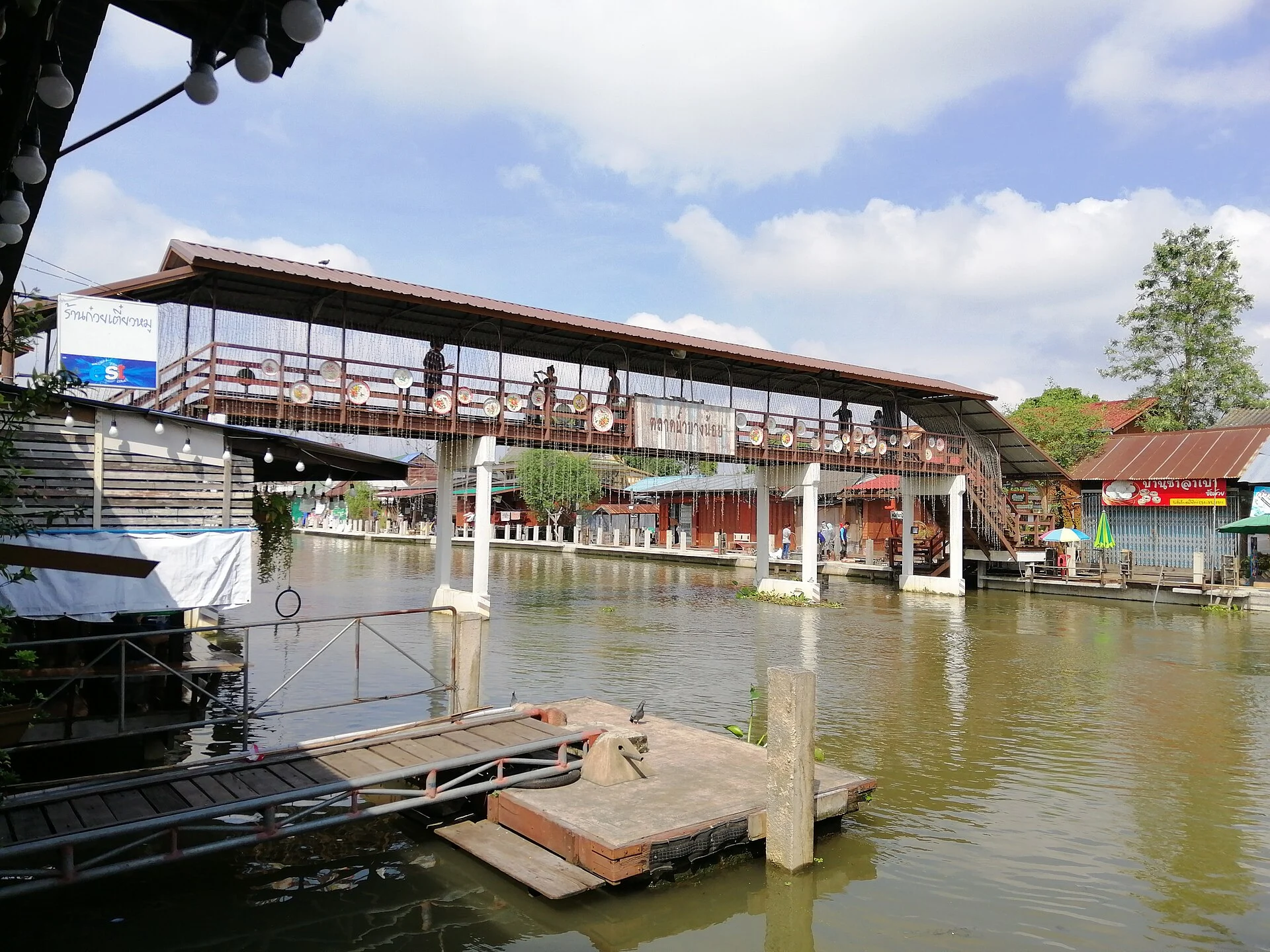
Thailand’s best floating market, precisely because it is an evening market that exists for Thais rather than a morning show staged for foreigners. It runs Friday to Sunday, from early afternoon until around 8 or 9pm, along a canal lined with century-old wooden shophouses. Noodle boats moor against the banks, and the whole thing feels like a provincial night out rather than an attraction. Arrive by late afternoon, eat until dark, then step straight onto a firefly boat.
.jpg)
3. Firefly boat tours on the Mae Klong
After dark, long-tail boats leave the Amphawa waterfront to hunt fireflies flashing in the lamphu trees along the riverbank. A seat in a shared boat costs about ฿60-100; chartering your own runs ฿500-600. On a good wet-season night the trees pulse like faulty fairy lights, and it is quietly magical in a way no photograph captures. This is the single best argument for staying overnight — the day-trippers are already on the motorway when it happens.
4. Wat Bang Kung
An Ayutthaya-era ordination hall completely swallowed by a banyan tree — walls and roof held inside a cage of roots, with a gold Buddha still enshrined in the green half-light within. The grounds were a military camp for King Taksin’s forces after the fall of Ayutthaya in 1767, which is why the temple is scattered with life-size statues of Muay Thai fighters frozen mid-strike. It is odd, atmospheric and free, about 15 minutes from Amphawa by car or motorbike.

5. King Rama II Memorial Park
A calm riverside park on the birthplace of King Rama II, with a small museum of early Rattanakosin art and a cluster of traditional central-Thai houses under old trees. It sits next to Wat Amphawan Chetiyaram, itself worth twenty minutes for the murals. Entry is small change — a few tens of baht — and Amphawa’s market is five minutes’ walk away.
6. Don Hoi Lot
Where the Mae Klong meets the sea, a bank of mudflats famous for razor clams emerges at low tide, with a strip of stilted seafood restaurants and shellfish stalls perched on the edge of it. This is where local families come to eat on Sundays. Time it for low tide if you want to watch the clam collectors at work; time it for lunch regardless. It is about 15 minutes south of Maeklong town.

What to skip
The half-day coach tour from Bangkok. You know the one: railway market at 10:30 with four hundred other people, then a paddle round Damnoen Saduak floating market — which is not even in Samut Songkhram, it is over the border in Ratchaburi — where you sit in a plastic boat in a traffic jam of other plastic boats, photographing tourists who are photographing you, while somebody charges ฿100 for a mango. It is the single worst way to experience one of Thailand’s most likeable provinces, and roughly a million people a year do it anyway.
The market and the canals are wonderful. The format is the problem. Come independently, come at the right hours, stay the night, and every element the coach tour ruins becomes excellent.
Samut Songkhram travel: practical info
Plan around Amphawa’s schedule: the floating market only runs Friday to Sunday, so a Saturday overnight is the classic play. November to February brings the coolest, driest weather. The fireflies are at their best in the wet season, roughly May to October, so a rainy-season visit has a genuine case; evening storms pass quickly.
One night is right for most people; two if you want to add a lazy morning cycling the orchard lanes or a long-tail temple circuit on the khlongs. Onward travel from Samut Songkhram is easy: Ratchaburi is about 40 minutes away, Phetchaburi an hour south, Hua Hin roughly two hours, and Bangkok 90 minutes back the other way.
Planning the specifics? The Tourism Authority of Thailand’s official Samut Songkhram page and its things-to-do list carry current market days and firefly-season timings, and Wikipedia has the historical background.
FAQ
Is Samut Songkhram worth visiting?
Yes — with a condition. As a rushed half-day coach trip it is a pair of overcrowded photo stops. As an overnight stay built around the evening market, a firefly boat and the 8:30am train, it is one of the best short trips from Bangkok, full stop.
How do I get from Bangkok to Maeklong Railway Market?
Minivans from the Southern Bus Terminal take 60-90 minutes and cost about ฿70-100. The more entertaining route is the ฿20 double train ride from Wongwian Yai via the Mahachai ferry, which takes over three hours but delivers you through the market itself.
What days is Amphawa Floating Market open?
Friday, Saturday and Sunday, from early afternoon until around 8-9pm. On other days the canal is quiet and many stalls and homestays are shut, so build your visit around a weekend.
Can you see fireflies at Amphawa all year?
Boats run year-round, but the display varies. The rainy season, roughly May to October, is the peak; on a good night the riverside trees flash in near-unison. In the dry months you will still see fireflies, just fewer of them.
How many days do you need in Samut Songkhram?
One night covers the railway market, Amphawa, the fireflies and a temple or two without rushing. Add a second night for Don Hoi Lot at low tide, the coconut-sugar houses and some slow cycling between the canals.