Guide · Bangkok
In this guide
Bangkok is one of the world’s great river cities — the Chao Phraya and its network of khlong canals pre-date the city’s road grid by centuries. For a deeper look at the capital’s history, neighbourhoods, and what to do beyond the boat routes, see our full Bangkok province guide.
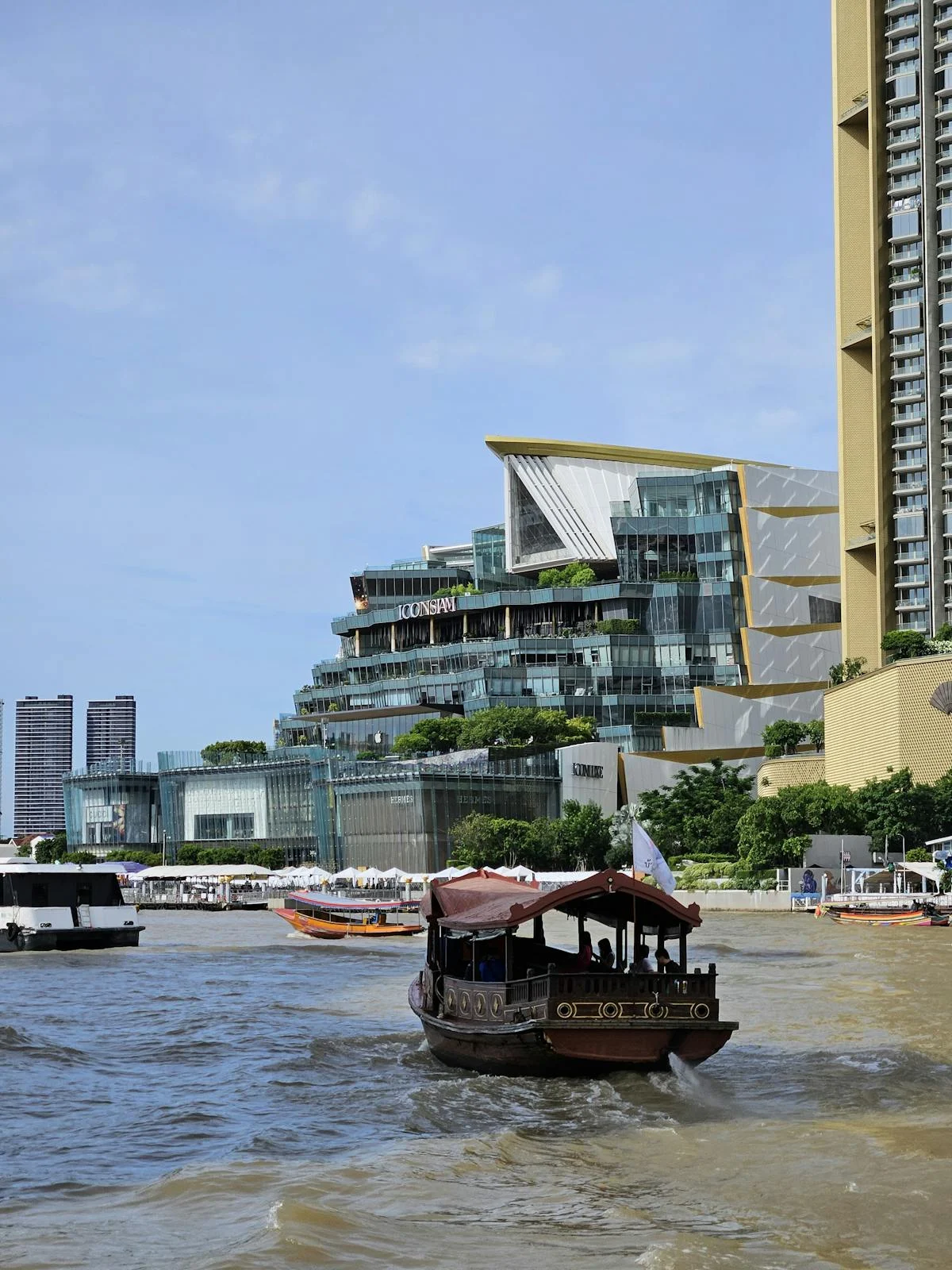
The Chao Phraya Express runs every fifteen minutes from six in the morning until seven at night, and in three decades of riding it, I have never paid more than 33 baht. A taxi from Saphan Taksin to Khao San costs six times that, takes twice as long in traffic, and shows you none of the gold-roofed temples that slide past the riverbank in slow procession.
Know your flag
There are five boat services on the Chao Phraya. The tourist boat flies a blue flag and costs 30 baht a ride — it’s slower, air-conditioned, and comes with a recorded commentary. Locals take the orange-flag express: same river, same stops, 15 baht, and three times the character. The green-flag and yellow-flag boats run limited-stop express services and skip several piers. The no-flag boat stops everywhere and is the slowest option. For most journeys between the tourist areas — Saphan Taksin in the south up to Phra Athit (Khao San Road area) in the north — the orange-flag is the sensible choice.
Tickets are sold on board by a collector who weaves through passengers with a leather satchel. Have exact change ready — 15 baht for most journeys on the orange-flag, 20 baht for some longer routes. If you board at a busy pier like Sathorn (Saphan Taksin), you can buy a ticket from the booth on the pier before boarding.
The key piers to know
N1 Phra Athit — the northern tourist hub. Closest pier to Khao San Road, the Democracy Monument, and the backpacker guesthouses along Samsen Road. Exit here for the National Library, Santichaiprakarn Park, and the evening riverside restaurants on Phra Athit Road.
N3 Maharaj — for Wat Mahathat, the weekend market, and Thammasat University. A five-minute walk to Sanam Luang and the Grand Palace area.
N8 Tha Tien — the pier directly opposite Wat Arun (Temple of Dawn). Disembark here for Wat Pho, the Grand Palace, and the traditional medicine market. The cross-river ferry from this pier to Wat Arun costs 5 baht and runs constantly.
N10 Wang Lang (Siriraj) — opposite the old city, adjacent to Siriraj Hospital. Good access point for the Royal Barge Museum.
N13 Phra Pin Klao — for the National Museum and Thammasat University’s rear entrance. Also the departure point for some chartered longtail boats into the Thonburi canals.
CEN Sathorn (Saphan Taksin) — the main southern hub. BTS Skytrain connects here (Saphan Taksin station), making this the easiest point to transfer between the river and the elevated rail network. Asiatique night market runs a free shuttle boat from this pier every 30 minutes from 16:00.
The canals nobody rides
Saen Saep canal cuts east from the old city all the way to Bang Kapi — roughly 18 kilometres of urban waterway that functions as a genuine commuter route for tens of thousands of Bangkokians every morning and evening. It is loud, fast, diesel-scented, and occasionally splashes you with water you prefer not to think about. It is also the single fastest way to cross the city at rush hour, cutting through traffic jams that would take 40 minutes by road in under 15.
Board at Phan Fa Leelard pier (at the east end of Khao San Road’s orbit, near the Democracy Monument) and ride east. Key stops include Pratunam (for the Pratunam market), Asok (to transfer to the BTS or MRT), and On Nut (for the eastern suburbs and the airport rail connection at Bearing). Fares are 10–20 baht depending on distance. Transfers between the eastern and western sections require a 200-metre walk at the Pratunam interchange. The boats run from 05:30 to 20:30 on weekdays, shorter hours at weekends.
Cross-river ferries
Separate from the express boats, a network of short-hop cross-river ferries (called reua kham fak) shuttles between the Bangkok and Thonburi banks at frequent intervals throughout the day. Fares are a flat 5 baht. The most useful crossings for visitors are the Tha Tien–Wat Arun ferry (essential for the Temple of Dawn), the Pha Chao Praya–Wang Lang crossing near the Grand Palace, and the service from Maharaj pier to the flower market on the Thonburi side. These ferries run from around 06:00 to 22:00 and are remarkably frequent — usually less than five minutes’ wait.
Longtail boat tours
For the Thonburi canal network — the khlongs that thread through the west bank’s coconut palms, wooden stilt houses, and spirit shrines — a chartered longtail boat is the right tool. These depart from several piers including Tha Chang (N9) and Oriental (Mandarin Oriental hotel pier). Prices are negotiable: a one-hour tour of the Thonburi khlongs runs around 1,000–1,500 baht for the whole boat (not per person), and the experience of threading through canals wide enough for one boat while monks wave from riverside temples is genuinely unlike anything else Bangkok offers.
Practical tips
The orange-flag boats do not run on public holidays — check the calendar before planning a river commute on a day that seems suspiciously quiet. At peak morning and evening rush hours, the express boats are crowded and do not slow much at smaller piers — be ready to step on and off quickly. Wearing light, easy-to-remove footwear helps on the Saen Saep boats, where the covered entry can be low. Keep your bag in front of you on busy boats. The tourist blue-flag boat is significantly more relaxed and is a reasonable choice for a first trip with heavy luggage.
Frequently asked questions
How much does the Chao Phraya Express Boat cost? The orange-flag local boat costs 15–20 baht per journey. The tourist boat (blue flag) is a flat 30 baht. Cross-river ferries are 5 baht.
What is the best pier for the Grand Palace and Wat Pho? Tha Chang pier (N9) for the Grand Palace, and Tha Tien pier (N8) for Wat Pho. A 5-baht cross-river ferry from Tha Tien goes directly to Wat Arun.
Is the Saen Saep canal boat tourist-friendly? It is functional but not tourist-oriented — no English signage, fast stops, and occasional spray from the canal. It is excellent for getting east across the city quickly and cheaply, but the Chao Phraya express boats are more comfortable for first-timers.
Does the river boat connect to the BTS Skytrain? Yes — at Sathorn pier (CEN / Saphan Taksin), which connects directly to the BTS Saphan Taksin station on the Silom line. This makes the river system a practical extension of Bangkok’s rail network.
At the temples you’ll pass: The Chao Phraya Express stops at Wat Pho, Wat Arun, and the Grand Palace precinct. Before you step off the boat, our guide on Thai temple etiquette covers what to wear, how to behave, and a few things most tourists get wrong.
Frequently Asked Questions
How much does the Chao Phraya Express Boat cost?
The orange-flag local boat costs 15–20 baht per journey. The tourist boat (blue flag) is a flat 30 baht. Cross-river ferries are 5 baht.
What is the best pier for the Grand Palace and Wat Pho?
Tha Chang pier (N9) for the Grand Palace, and Tha Tien pier (N8) for Wat Pho. A 5-baht cross-river ferry from Tha Tien goes directly to Wat Arun.
Does the river boat connect to the BTS Skytrain?
Yes — at Sathorn pier (CEN / Saphan Taksin), which connects directly to the BTS Saphan Taksin station on the Silom line.
Related guides
- Bangkok to Chiang Mai — four ways to travel, honestly ranked
- Seven days on the Andaman coast — an island-hopper’s itinerary from Phuket to Koh Lipe
- Ari, Bangkok: The Neighbourhood That Locals Spend Weekends In
If you’d rather be guided
Some links below are affiliate links. If you book through them we may earn a small commission at no extra cost to you — it helps keep Destination Thailand independent.
Canal tours: the commuter boats are the honest way to see the river, but if you want the khlongs with a longtail and someone explaining what you’re looking at, book a Bangkok canal tour on GetYourGuide.
Most transport fares in Thailand are official and fixed. The Thailand Price Index tracks 58 real prices across the country — what is fair, what is official, and what tourists get quoted — checked and dated.