Bangkok does not do brunch. Breakfast in Bangkok happens at an hour most visitors are still negotiating with the blackout curtains. By 6am the congee pots on Charoen Krung have skinned over, the pork leg at Charoen Saeng is on its second hour in the braise, and the men who run this city are eating on plastic stools with a newspaper under one elbow. By 9am the good stuff is sold out and the tourists are queueing for eggs benedict at ฿420. That is the whole argument of this piece.
I grew up eating breakfast the way most Thai-Chinese kids in this city did: a bowl of jok on the way to school, a bag of patongo if I had been good, a bag of patongo if I had not. Thirty years on, some shops have died, a few have been ruined by a Michelin sticker, and a handful are exactly as they were. This is the handful, plus the honest version of everything else, sorted by neighbourhood so you can eat where you wake up.
The short version: set an alarm for six, walk to the nearest cluster of stools, and order whatever the old man in the vest is eating. Names are below. For the northern equivalent, our Chiang Mai breakfast guide is the sister piece; for the rest of the day, the Bangkok street food guide picks up where this one stops.
Thai breakfast dishes you’ll see before 9am
Bangkok’s breakfast canon is two-thirds Teochew Chinese and one-third whatever the Muslim, Mon and central Thai communities were eating when the Chinese arrived. Nobody designed it; it accreted. In descending order of how often you will see it:
Jok (โจ๊ก) is rice porridge boiled until the grains give up, thickened with pork mince balls and finished with ginger threads, white pepper and, if you have any sense, a raw egg cracked into the middle and a spoon of chilli vinegar. It is the most eaten breakfast in the city. Khao tom (ข้าวต้ม) is its looser cousin, whole rice in clear broth, plain with side dishes or with pork, fish or prawns stirred in. Jok is for hangovers; khao tom is for people who want to feel virtuous about one.
Patongo (ปาท่องโก๋) are fried dough crosses, and they come with a cup of hot nam tao hu (น้ำเต้าหู้), fresh soy milk, sweetened unless you object. Dip, chew, repeat. Kuay jab (ก๋วยจั๊บ) are rolled rice-noodle sheets in a peppery pork broth full of offal; the Yaowarat versions are evening dishes, the Chan Road one is a morning dish. Khao kha moo (ข้าวขาหมู), braised pork leg on rice, is lunch in most of the city, but in Bang Rak the best of it is gone by 11am. Khao man gai (ข้าวมันไก่), Hainanese chicken rice, is a 6am dish at the Pratunam shops that made it famous.
Dim sum here means Teochew and Hainanese coffee-shop dim sum, bamboo baskets of kanom jeeb and har gow at ฿20 to ฿30, eaten with a glass of kopi, not the Hong Kong trolley circus. Roti in the Muslim quarter of Charoen Krung is griddled flatbread with condensed milk, or stuffed with egg and minced beef as mataba, washed down with pulled tea. Kanom krok (ขนมครก), coconut-rice half-moons from the dimpled pan, are a market snack rather than a meal; there is more on them in our Thai desserts guide. And the old kopi shops serve coffee the way it was drunk before Starbucks: thick, dark, sweet, over ice, with toast to blunt it.
| Dish | What it is | Where | ฿ |
|---|---|---|---|
| Jok | Thick rice porridge, pork balls, ginger, raw egg optional | Jok Prince, Charoen Krung (Bang Rak) | 50–70 |
| Khao tom | Rice in clear broth, plain or with pork or seafood | Any jok shop; Jok Sam Yan, Banthat Thong | 50–80 |
| Patongo + nam tao hu | Fried dough crosses, hot soy milk | Carts in Yaowarat and Talat Noi, 6–9am | 10 + 15–20 |
| Kuay jab | Rolled rice noodles, peppery broth, offal, crispy pork | Kuay Jab Mr Joe, Chan Road | 70–100 |
| Khao kha moo | Braised pork leg on rice, pickled mustard greens | Charoen Saeng Silom, Charoen Krung Soi 49 | 60–90 |
| Khao man gai | Poached chicken on chicken-fat rice, bean-paste sauce | Go-Ang, Phetchaburi Soi 30, Pratunam | 50–70 |
| Dim sum + kopi | Small steamed baskets, Thai-style sweet coffee | Ek Teng Phu Ki, Phat Sai Road, Yaowarat | 20–30 per basket |
| Roti + cha chak | Griddled flatbread, condensed milk or mataba, pulled tea | Muslim Restaurant, Charoen Krung 42 | 30–80 |
| Toast, eggs, kopi | Kaya toast, soft eggs, iced coffee, 1930s room | On Lok Yun, Charoen Krung 72 | 100–150 set |
| 7-Eleven toastie | Ham and cheese, pressed hot at the till | Every 200 metres | 32–39 |
Prices are what we paid or were quoted in 2026 and drift up a few baht a year; the wider context is in our Thailand price index. Nothing here is a rip-off, which is more than can be said for the coffee at your hotel.

Best breakfast in Bangkok by neighbourhood
Yaowarat, Talat Noi and lower Charoen Krung. Chinatown in the morning is a different city from Chinatown at night, and a better one: neon off, seafood tents stacked against the shutters, the Teochew neighbourhood having breakfast. Start at Ek Teng Phu Ki, 163 Phat Sai Road, a Hainanese coffee shop open since before the First World War, now 5am to about 7pm daily. The dim sum is ฿20 to ฿30 a basket and honest rather than dazzling; you are there for the coconut-custard toast (฿60) and the kopi. Round the corner at Charoen Krung 72, On Lok Yun has fried eggs since 1933, 6am to mid-afternoon: kaya toast, soft-boiled eggs in a glass, iced coffee, ฿100 to ฿150 a set. Go before 8am on a weekday or you will queue behind people photographing the tiles. Patongo and soy milk carts work the lanes around Wat Mangkon from 6am, ฿10 for a pair and ฿15 to ฿20 for the milk, gone by nine. Do not go looking for Pa Tong Go Savoey in the morning: the Michelin-listed one opens at 5.30pm and shuts Mondays. A Chinatown food tour earns its fee here more than anywhere, because the good shops have no English signs and no interest in acquiring any.
Bang Rak and Silom-side Charoen Krung. The strongest breakfast strip in Bangkok, and nobody markets it as one. Jok Prince, 1391 Charoen Krung, has made the same smoky, slightly caught-on-the-bottom congee for sixty-odd years; 6am to 1pm, then 3pm to 11pm. Jok with pork, egg and a side of patongo is ฿60 to ฿70. The Bib Gourmand lengthened the queue but did not change the pot. Two hundred metres along, Charoen Saeng Silom at the mouth of Charoen Krung Soi 49 does one thing, khao kha moo, from 7am until it sells out, usually before its nominal 1pm close: pork leg soft enough to eat with a spoon, ฿60 to ฿90 depending on how much skin you ask for. On the Muslim side, Muslim Restaurant, 1354 Charoen Krung near Soi 42, open since the 1930s, does 7am to 5pm weekdays and to 3pm at weekends; mataba, goat biryani, and a plain roti with condensed milk for ฿30 to ฿40 that is the correct thing to eat with pulled tea at 7.30am. Roti carts set up near Haroon Mosque in Soi 36. Arrive by river: Sathorn to Si Phraya is one stop, and our water taxi guide explains which flag to board.
Silom and Sathorn, the office crowd. Before the towers fill, the eating happens in Silom Soi 20 (Soi Prachum), a wet market with a breakfast fringe from roughly 5.30am to 9.30am, Tuesday to Sunday, five minutes from Chong Nonsi BTS. Khao mok gai, the Thai-Muslim chicken biryani, is the reason to come, ฿60 to ฿70 a plate, alongside congee, moo ping at ฿10 to ฿15 a skewer and the curry trays our khao gaeng guide is about. Further out, Kuay Jab Mr Joe, 313/7 Chan Road, Bang Kho Laem, opens 7.30am to 4.30pm, closed Thursdays: peppery rolled-noodle soup with the crispiest pork belly in Bangkok, ฿70 to ฿100, a taxi rather than a walk, and worth it. Jok Sam Yan on Banthat Thong Road opens 5.30am; the congee is fine, the point is that it exists at that hour.
Pratunam and Victory Monument. Go-Ang Pratunam Chicken Rice, the pink-shirt shop on Phetchaburi Soi 30, opens 6am with a mid-afternoon break; ฿50 to ฿70 for a plate exactly as good as it needs to be and not one degree better. Victory Monument is a boat-noodle place from late morning, so for breakfast use the sois off Ratchawithi Road, where khao gaeng trays and jok carts feed the hospital and army staff from 6am. Nothing famous, everything good.
Sukhumvit: Phrom Phong, Thonglor, Ekkamai. Bangkok’s breakfast is worst here, because here it has been imported. The café strip does a competent flat white and a ฿380 avocado toast; Roast in EmQuartier is the best of them and opens at 10am, which makes it brunch. Toby’s on Sukhumvit 38 is gone as of our last check, the space now trading as Folk Lane, 8am to 5pm. The real breakfast on Sukhumvit is at the mouth of your own soi: every residential soi from 22 to 71 has a jok cart, a patongo fryer and a khao gaeng table between 6am and 9am, cheaper and mostly better than anything with an English menu. Ask the motorbike-taxi rank; they eat there.
Ari. Split down the middle. On the café side, Landhaus Bakery, 18 Phahonyothin Soi 5, opens at 7am and bakes German bread that would pass in Munich, ฿90 to ฿180 for pastries and open sandwiches. On the street side, Ari Samphan and Phahonyothin Soi 7 have the usual dawn carts, and there is a fine kanom krok pan near the BTS steps at about 7am. Our Ari neighbourhood guide covers the rest of the day.
Old Town and Banglamphu. Khao San Road at 7am is the saddest place in Thailand; do not eat there. Walk to Tanao Road and Phraeng Phuthon, where old shophouses do jok, khao tom and noodles from 6.30am, or to the Bang Lamphu market for kanom krok and moo ping. The Chinese-Thai coffee shops on Dinso Road near the Giant Swing are the Old Town’s On Lok Yun with a tenth of the queue. If you are basing yourself here, our where to stay in Bangkok guide weighs the district honestly.
Talad Phlu and Thonburi. Across the river, Talad Phlu is a night market by reputation and a breakfast market by fact. In the morning the stalls are fewer but they are the ones that matter: the century-old kanom gui chai (steamed chive cake) shops, the patongo fryers and the sweet shops whose queues form before they open. BTS to Talat Phlu, ten minutes on foot. The neon crowd arrives after five and can keep it.

Markets at dawn: Or Tor Kor, Khlong Toei and Wang Lang
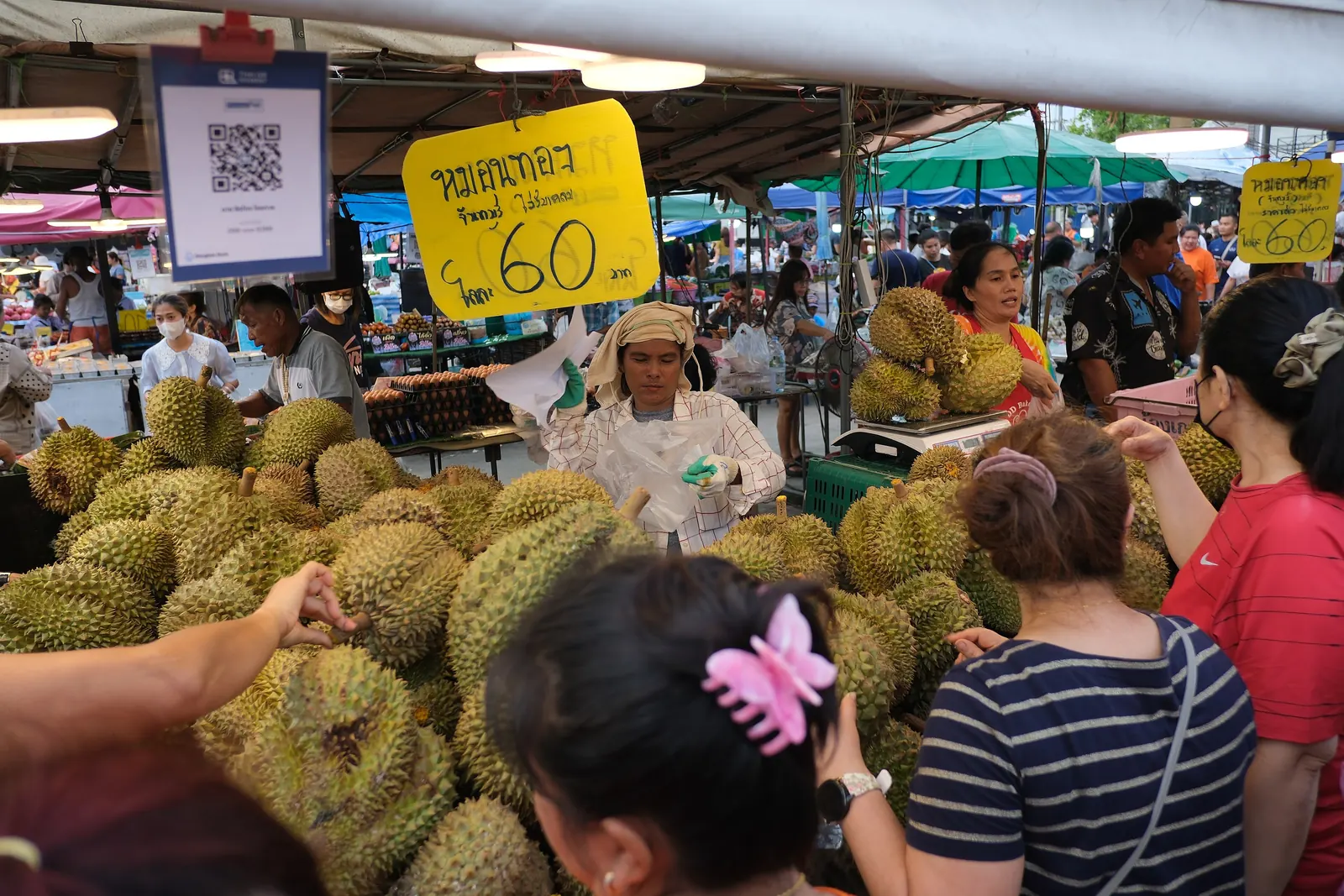
The markets open before the restaurants do. Or Tor Kor, 101 Kamphaeng Phet Road by Kamphaeng Phet MRT, opens at 6am and is the cleanest, priciest, most photogenic produce market in the country; go at 8am when the central food court is fully open and eat moo ping and a ฿150 plate of the best mango sticky rice in Bangkok, ฿100 more than elsewhere and, unusually, worth it. It is the one market I would send a nervous eater to; the questions in our street-food safety guide barely apply.
Khlong Toei, at Rama IV and Ratchadaphisek, is the opposite: the city’s wholesale belly, effectively 24 hours, most alive from 5am to 9am when every restaurant in town is buying. It is wet, loud and not built for you, which is the appeal. Eat at the jok and noodle stalls along the Rama IV edge, ฿40 to ฿50 a bowl, and watch a duck get sold. Wang Lang, opposite Siriraj Hospital on the Thonburi bank, opens 7am to 8am but is only fully awake from ten, so treat it as second breakfast after the Tha Chang ferry; the southern-Thai khao gaeng shops are the reason to bother. A guided morning market tour makes sense for Khlong Toei specifically, the one place here where a local beside you changes what you get to eat.

Hotel buffet or the street: verdicts, queues and the Monday rule
The buffet. A five-star Bangkok breakfast buffet costs ฿950 to ฿1,400 plus-plus a head if bought separately, and the omelette station is staffed by someone who could be making you jok. If breakfast is bundled into the rate, eat it once for the fruit; if it is a paid add-on, the answer is no. The exception is the river hotels, where the view does some of the eating for you. Agoda’s Bangkok listings let you filter for room-only rates, which is what you want, in Bang Rak or Chinatown, which is where you want to be.
The queues. Jok Prince: worth it, ten minutes, more at weekends. On Lok Yun: worth it before 8am on a weekday, not at 10am on a Saturday. Go-Ang Pratunam: not worth a queue of any length; there are other khao man gai shops on the same soi and one is better, though the pink shirt was earned. Charoen Saeng: no queue, because the people who know go at seven. Ek Teng Phu Ki: weekdays only. Kuay Jab Mr Joe: worth the taxi and the wait, any day but Thursday.
The Monday rule. Since 2017 the Bangkok Metropolitan Administration has designated Monday as street-cleaning day, and pavement vendors are supposed to stay home. Enforcement is uneven, harder in Pathumwan and Bang Rak, softer further out, and the carts deep in the sois often ignore it. But if you wake up on a Monday in Silom expecting the patongo man and find bare tarmac, that is why. Shophouse restaurants are unaffected: Jok Prince, On Lok Yun, Muslim Restaurant, Charoen Saeng and the market food courts all trade on Mondays.
The honest fallback. If it is raining, or 4am, or the cart has not turned up, the 7-Eleven ham-and-cheese toastie pressed at the till is ฿32 to ฿39, and the cashier heats it without being asked. Add a ฿25 iced latte from the All Café counter and you have spent less than the tip at a hotel buffet. I have eaten a thousand of them and I am not ashamed. For what to eat once the sun is properly up, our Thai noodles guide is the next chapter.
Breakfast in Bangkok: your questions, answered
What time does breakfast start in Bangkok?
Between 5am and 6am for the carts and old shophouses, peaking from 6.30am to 8.30am. Most places in this guide are winding down or sold out by 10am or 11am. Cafés on Sukhumvit and in the malls open at 8am to 10am and serve brunch rather than breakfast.
What is a typical Thai breakfast?
Jok, the thick rice congee with pork and ginger, is the most common, followed by khao tom, patongo with soy milk, and rice with curry from a khao gaeng stall. Noodle soup is eaten at any hour including breakfast. There is no rule that it has to differ from lunch; the same pork leg on rice is breakfast at seven and lunch at noon.
How much does breakfast in Bangkok cost?
Street and shophouse breakfasts run ฿40 to ฿100 a head including a drink. A café breakfast on Sukhumvit or in Ari costs ฿250 to ฿500 with coffee. A hotel buffet bought separately is ฿950 to ฿1,400 at the five-star end, which is a fortnight of jok.
Are street food stalls really closed on Mondays in Bangkok?
Pavement carts are, in theory: Monday is the designated street-cleaning day and kerbside vendors are told not to trade. Enforcement is patchy and carts deep in residential sois often carry on. Shophouse restaurants and market food courts are not affected, so plan a Monday breakfast around Jok Prince, On Lok Yun, Charoen Saeng or Or Tor Kor rather than a specific cart.
Which neighbourhood is best to stay in for breakfast in Bangkok?
Bang Rak and lower Charoen Krung, without much competition: Jok Prince, Charoen Saeng, Muslim Restaurant and On Lok Yun are within a fifteen-minute walk of each other and the river piers are on the doorstep. Chinatown is a close second and quieter in the morning than its reputation. Sukhumvit is the most convenient and the least interesting.
Related guides
- Bangkok street food: what to eat, where, and what to skip
- Breakfast in Chiang Mai: the northern version of this guide
- Bangkok province guide
Book the trip
Some links in this guide are affiliate links. If you book through them we may earn a small commission at no extra cost to you — it helps keep Destination Thailand independent.
Sleep in Bang Rak or Chinatown so the jok is a walk and not a taxi: compare Bangkok hotels on Agoda and filter for room-only. If you want the shops without the guesswork, an early Bangkok morning food tour covers most of the Charoen Krung strip in three hours. When you have eaten through this list, go on to Chiang Mai for the other breakfast city: book the Bangkok to Chiang Mai train or bus on 12Go. Not sure which province is next? Try our where to go in Thailand matcher.