Amnat Charoen came last. Of Thailand’s 77 provinces, it received the fewest visitors in 2025: 303,933 according to the Ministry of Tourism and Sports, of whom 7,332 were foreigners, roughly twenty a day across the whole province. Phuket gets that many before the first ferry. It was carved out of Ubon Ratchathani in 1993, has no airport, no railway and no famous beach, and most people see it through a bus window on the road between Ubon and Mukdahan. What they miss is a big white Buddha on a rock hill, a forest temple in the Ajahn Chah tradition, a 300-year-old Lao-style Buddha, a forest of monkeys and a stretch of Mekong where the Phu Thai still weave.
The short version: worth a day, not a week, and only with a car or driver. From Ubon Ratchathani it is 75 kilometres and about an hour; the sights are free, lunch is ฿50–100, and the honest total is the transport, around ฿1,000–1,500 for a hire car or ฿90–110 each way on the bus if you only want the town. Skip it if this is your first Isan trip and Ubon, Mukdahan or Khong Chiam are not done yet. The map and basics are on our Amnat Charoen province page; prices are checked against the Thailand Price Index, and nothing was comped.
Why Amnat Charoen is Thailand’s least-visited province, and why that is not the insult it sounds
Three reasons, none of them the province’s fault. It is young, so there was never a provincial brand: for most of the twentieth century this was simply the northern end of Ubon. It is in between, an hour from Ubon’s airport and the Mekong at Mukdahan, so the traffic passes through. And it has nothing that photographs like a sea of mist or a white sand beach. What it does have is very Isan: rice paddies to the horizon, a calm provincial town, temples used by the people who built them, and a reputation inside Thailand for being tidy, devout and polite. Thai visitors outnumber foreigners about forty to one; you will be noticed, and kindly.
The honesty line: outside the town there is almost no public transport and Grab is thin, English is scarce, and the sights are spread over 60 kilometres. This is a province for a car, a driver, or a patient bus traveller who only wants the big Buddha.
Phra Mongkhon Ming Mueang: the big Buddha on Khao Dan Phra Bat
Do it; it is why you came. Phra Mongkhon Ming Mueang, locally just Phra Yai, the big one, is a seated Buddha around 20 metres high and 11 metres across the lap, in the subduing-Mara posture, on a natural sandstone terrace at Khao Dan Phra Bat, about three kilometres north of the town centre off Chayangkun Road. The style borrows from the Pala art of north-east India, unusual this far into Isan, and the image is the province’s official emblem, so you will already have seen it on every government sign. Entry is free, it is open through the day, and the park around it is shaded and quiet. Shoulders and knees covered; our temple etiquette guide has the rest.
Below the hill, the Phuttha Utthayan reservoir holds Koh Chittrakut, a small island that is heart-shaped from above and reached by a floating bridge. Fine, at sunset, for twenty minutes; it is a local courting spot, not a sight. Go to the Buddha early, before 10am, when the light is soft and the rock is not yet hot.
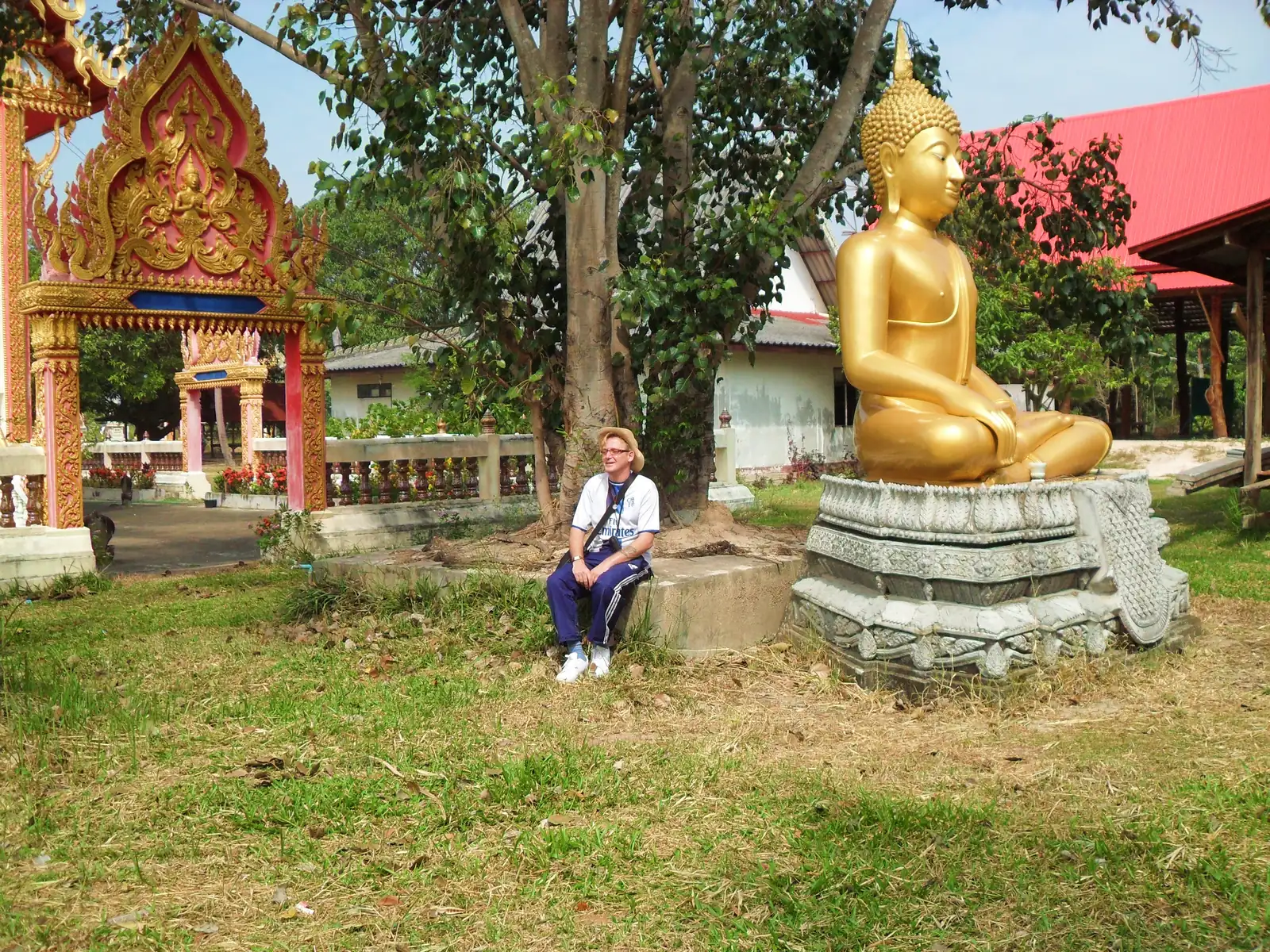
Wat Tham Saeng Phet: a forest temple in the Ajahn Chah tradition
Worth it, for the quiet as much as the cave. Wat Tham Saeng Phet sits on Phu Khao Kham, about 18–19 kilometres from town on the road to Khemarat, and belongs to the forest lineage of Ajahn Chah of Wat Nong Pa Phong, the monk whose students founded monasteries from Sussex to Perth. The name means cave of diamond light. Stairs, not steep, lead to a hilltop hall with long views over forest and fields; to the north is a large cave with a Buddha image, and the grounds hold a white mosaic reclining Buddha of around 19 metres. It is open roughly 7.30am to 5pm and free.
This is a working meditation monastery, not an attraction with a temple in it: speak quietly, dress properly, leave the drone in the car. Wat Nong Pa Phong itself is outside Ubon city; the city’s own headline temples are in our guide to the {L(‘/top-5-temples-in-ubon-ratchatani/’, ‘top temples in Ubon Ratchathani’)}.
Phana: a Lao-style Buddha from 1720 and a forest full of monkeys
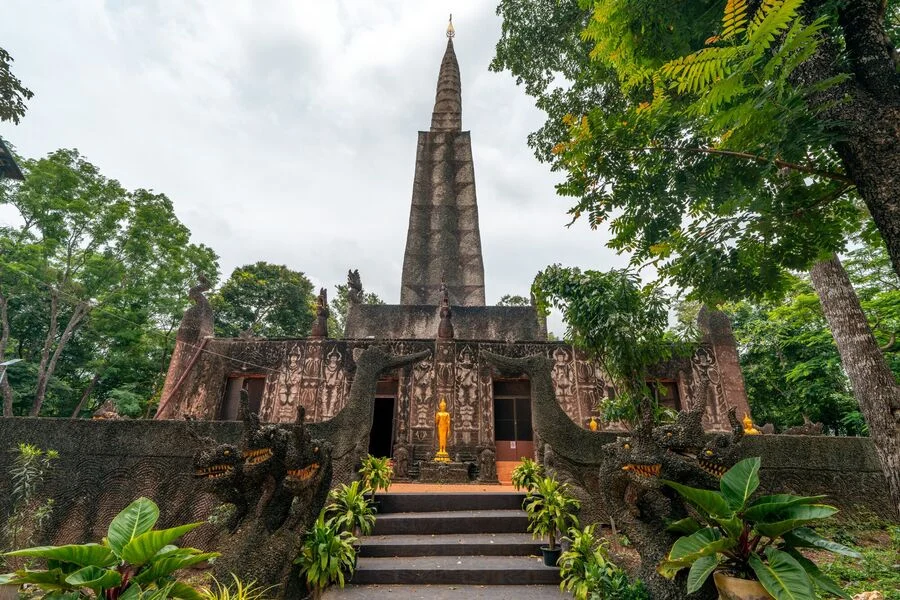
Do it, if you have the car. Phana district, about 40 kilometres from town, holds the province’s two other real sights within a few minutes of each other. Wat Phra Lao Thepnimit, around two kilometres from the district centre on Highway 2134, keeps Phra Lao Thepnimit, a seated Buddha in the Vientiane Lao style inside an ordination hall dated to around 1720, late in the Ayutthaya period: naga stairs, stucco over a three-arched door, and a face that devotees in Isan rate among the region’s most beautiful. Free; the annual homage festival falls in late January or early February, when Phana fills up.
Don Chao Pu, nearby, is a community forest of roughly 260 rai and several thousand crab-eating macaques who have lived beside the town for centuries and now regard parked cars as vending machines. Free, open roughly 8.30am to 4.30pm, with villagers selling bananas and peanuts for ฿10–20 a bag. Fine, with conditions: lock the car, hold nothing you want to keep, and do not crouch to small monkeys with large mothers. Unlike {L(‘/lop-buri-monkeys/’, ‘Lop Buri’)}, they go home to a forest.
Phu Sing–Phu Pha Phueng Forest Park, back towards town in Lao Phruan subdistrict, is the province’s highest ground: a sandstone ridge with rock terraces, a sunrise cliff and a basic campsite. Skip unless you are staying the night and want a dawn walk; it is pleasant, and much like every other sandstone park in Isan.
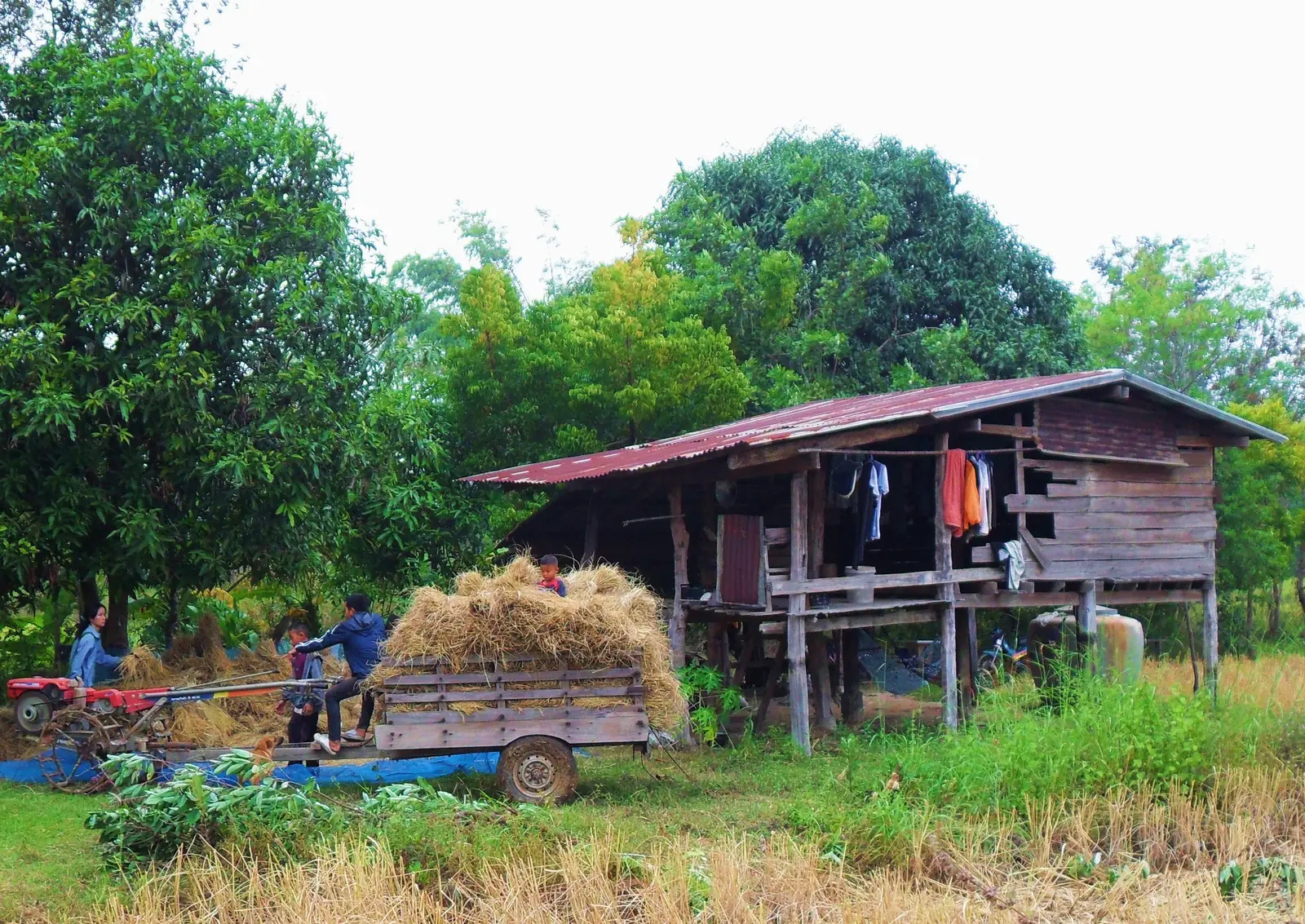
Chanuman, the Mekong and the weavers: worth the extra hour?
Fine, if you are driving the river road anyway. Chanuman, the province’s north-eastern district, is its only stretch of Mekong, with Laos on the far bank and, in the dry season, rocks and rapids rather than the broad river you see at Mukdahan. The Phu Thai communities here are known for khit cloth, a supplementary-weft weave of small geometric patterns, and for silk; ask in the villages or at the Wednesday Green Market in town for lengths at village prices, typically from around ฿300 for a cotton piece to several thousand for silk. Around the end of Buddhist Lent, in October or November, long-boat crews from Chanuman, Khemarat and Laos race on the Mekong in front of the district office. If your trip is the full riverside run, our Mekong road from Loei to Ubon passes this way.
Music people should know about Ban Pla Khao, which bills itself as Thailand’s mor lam village and is home to dozens of performers and bands. There is no show schedule for visitors; it is a place where the genre lives rather than a place where it is staged.
What to eat in Amnat Charoen, and where the town eats it
Proper Isan, without a tourist menu in sight: som tam, larb, grilled chicken, sticky rice and river fish, ฿40–80 a dish at the stalls and ฿60–150 in a sit-down restaurant. Two local names that come up again and again: Larb Pet Khon Luea, an old shop known for duck larb seasoned the way locals like it, which is loudly; and Plueak Mai Ngam, the town’s family restaurant with a menu of about a hundred Thai, Isan and Chinese dishes, known for kaeng som with snakehead fish. The Wednesday Green Market by the clock tower, from late afternoon, sells organic vegetables, Isan snacks and community produce and is the best hour in town. Primer on the dishes: our Isaan food guide.
Getting to Amnat Charoen: via Ubon, Mukdahan or the overnight bus
No airport, no train. Ubon Ratchathani airport is the gateway, 75 kilometres south; flights from Bangkok take about an hour. One adult, one way, as of November 2026.
| Route | Time | Fare | Book |
|---|---|---|---|
| Bangkok Mo Chit 2 to Amnat Charoen, Nakhonchai Air (via Yasothon) | 8–10 h; mostly evening departures | around ฿630 economy, more for first class | Bangkok to Amnat Charoen on 12Go |
| Bangkok to Ubon Ratchathani, flight, train or bus | 1 h 5 flight; 8–11 h by land | around ฿1,000–2,500 flight | Bangkok to Ubon on 12Go |
| Ubon to Amnat Charoen, bus | 1.5–2 h | around ฿90–110 | Ubon to Amnat Charoen on 12Go |
| Ubon to Amnat Charoen, private car with driver | about 1 h | around ฿2,000–2,500 one way | same page |
| Mukdahan to Amnat Charoen, bus | around 1.5–2 h | around ฿100–150 | Mukdahan to Amnat Charoen on 12Go |
The bus drops you in town, which reaches the big Buddha (a ฿60–100 tuk-tuk or motorbike taxi) and nothing else. For Tham Saeng Phet and Phana you need wheels: hire a car at Ubon airport, around ฿1,000–1,500 a day, or arrange a driver for the day through your Ubon hotel, around ฿2,500–3,500. The roads are flat, straight and quiet; watch for dogs, cattle and tractors without lights after dark.
A day in Amnat Charoen from Ubon, and where to sleep if you stay
The day: leave Ubon at 7am; Phra Mongkhon Ming Mueang by 8.15; Wat Tham Saeng Phet by 10; lunch in town around noon; Phana for Wat Phra Lao Thepnimit and the monkeys in the early afternoon; back in Ubon for dinner. About 250 kilometres, all of it easy. From Mukdahan, run it in reverse and sleep in Ubon. With a second day, add the Mekong at Chanuman and keep going north, or bolt it onto the Ubon cliffs and the Sam Phan Bok canyon; Ubon day trips are on GetYourGuide if you would rather not drive.
Staying the night is cheap and needs no advance booking outside festivals: clean rooms with air-con and parking run ฿400–900. Faikid Hotel (from around ฿600) on Arun Prasoet Road is the most-reviewed bed in town; The C hotel (from around ฿700) on the bypass is a small, newer boutique place; Amnat Charoen Residence Hotel and Nakarin Hotel (both from around ฿500) are fine. Day-tripping from Ubon, Sunee Grand Hotel and Convention Center (from around ฿1,300) is the comfortable big-city base. A full Isan day here costs well under the figures in our cost-per-day guide.
Is Amnat Charoen worth it? The verdict by traveller type
Province collectors and repeat Isan travellers: yes, one day, with a car; this is as quiet as Thailand gets. Temple and Buddhism people: yes, for Tham Saeng Phet and Phra Lao Thepnimit. Textile buyers: yes, for the khit and silk, ideally on a Wednesday. First-timers in Isan: not yet; do Ubon, Khong Chiam and Mukdahan first, and Yasothon if you are passing in rocket-festival season. Bus-only travellers: the big Buddha and a bowl of larb, then onwards. Anyone wanting nightlife or a pool: no. The cool, dry months from November to February are the time, as best time to visit Thailand sets out; April is fierce. Last on the list for visitors, then, but not for any good reason. If you want mountains rather than plains on the same trip, see Phu Kradueng or Phu Ruea and Chiang Khan in Loei.
Amnat Charoen: your questions, answered
Is Amnat Charoen worth visiting?
Worth a day if you have a car and have already seen Ubon, Mukdahan or Khong Chiam. The big Buddha of Phra Mongkhon Ming Mueang, the forest temple of Wat Tham Saeng Phet and the Lao-style Buddha and monkey forest in Phana make a good, quiet day for almost no money. Without a car, or on a first Isan trip, put your time elsewhere.
Why is Amnat Charoen the least-visited province in Thailand?
It is young, created from Ubon Ratchathani in 1993, has no airport or railway, and sits between better-known Ubon and Mukdahan, so traffic passes through. It also lacks a headline beach, mountain or festival. In 2025 it recorded 303,933 visitors, 7,332 of them foreigners, the lowest total of all 77 provinces in Ministry of Tourism and Sports figures.
How do I get to Amnat Charoen from Ubon Ratchathani?
By bus, around ฿90–110 and 1.5–2 hours to the town centre, as of November 2026. By car it is 75 kilometres and about an hour; hire cars at Ubon airport start around ฿1,000–1,500 a day, and a private driver for the day is around ฿2,500–3,500. You need a car for the sights outside town, because public transport and Grab are thin.
What is Amnat Charoen famous for?
Phra Mongkhon Ming Mueang, the 20-metre Buddha that is the province’s emblem; Wat Tham Saeng Phet, a forest monastery in the Ajahn Chah lineage; khit cloth and silk woven by Phu Thai communities in Chanuman; the Phana monkey forest; and, among Thais, a reputation for being quiet, devout and spotlessly tidy. Ban Pla Khao bills itself as Thailand’s mor lam village.
Where should I stay in Amnat Charoen?
In town, where clean air-conditioned rooms with parking cost around ฿400–900 and rarely need booking ahead outside festivals. Faikid Hotel on Arun Prasoet Road is the most-reviewed; The C hotel on the bypass is newer and quieter. Many visitors simply day-trip and sleep in Ubon Ratchathani, an hour away, which has more hotels, restaurants and evening life.
Related guides
- Mukdahan: Where Thailand Watches Laos Across the River
- Top 5 temples in Ubon Ratchatani
- Isaan Food: Som Tam, Larb, Gai Yang and the Fire That Follows
Book the trip
Some links in this guide are affiliate links. If you book through them we may earn a small commission at no extra cost to you — it helps keep Destination Thailand independent.
Hotels: the town’s handful of hotels are on Agoda’s Amnat Charoen page; day-trippers will find far more choice on the Ubon Ratchathani page. Tours/Boats: nobody runs Amnat Charoen tours, but Ubon day trips and drivers on GetYourGuide cover the wider region. Getting there: flights, trains and buses to the gateway are on 12Go’s Bangkok to Ubon page, the direct coach on Bangkok to Amnat Charoen, and the river road north in our Mekong road guide. Not sure the north-east is your Thailand at all? Our Where to Go in Thailand matcher scores all 77 provinces against your month and what you want from the trip.