Surin Thailand gets one loud weekend a year. Every November the town fills up with elephants and camera crews, the world remembers this quiet corner of lower Isaan exists, and then everyone packs up. Surin goes back to what it actually is: jasmine rice country with Khmer bones, where mahout families keep elephants beside the house and women weave silk for royalty.
That is the real story, and it is better than the festival. The Round-Up is a spectacle — some of it genuinely moving, some of it uncomfortable, and I will be straight with you about which is which. Come only for the show and you will miss the province entirely.
This guide covers the elephants honestly, the five-towered Khmer ruin almost nobody visits, the village that weaves brocade for the palace, and what to eat along the way. For the quick facts, start with our Surin province profile.
What Surin really is
Surin is a border province in lower Isaan, pressed hard against Cambodia, and it is about as culturally Khmer as Thailand gets. Roughly half the province grows up speaking Khmer Surin, a northern Khmer dialect, the folk music of choice is kantrum rather than the Lao-style molam you hear further north, and the paddies are dotted with small Angkor-period ruins that would pull coach parties anywhere else. Everyone also grows jasmine rice, and Surin hom mali is some of the best in the country; locals will tell you so before you have sat down.
The capital is a flat, functional railway town. It is not pretty. It is friendly, cheap and completely unbothered by tourism for eleven months of the year, which is precisely its charm.
Why go to Surin
Three reasons. First, elephants — not the November circus, but Ban Ta Klang, a village where the Kuy people have kept elephants for centuries and still do, twelve months a year. Second, the Khmer heritage: Prasat Sikhoraphum is one of the loveliest small temple ruins in Thailand and you will probably have it to yourself. Third, silk. Ban Tha Sawang weaves brocade so complex it takes four weavers a full day to produce a few centimetres.
Add proper Isaan food at Isaan prices and a near-total absence of other foreigners, and Surin earns three days of anyone’s trip.
Getting to Surin
The train is the sensible choice. Surin sits on the Bangkok–Ubon Ratchathani line, about 420 km away, with several services a day from Krung Thep Aphiwat station. Day trains take seven to nine hours; the overnight sleeper puts you on the platform around dawn. Third class costs under ฿300 if you enjoy character-building, an air-conditioned second-class seat runs ฿400-600, and a sleeper berth ฿700-1,100.
Buses from Bangkok’s Mo Chit terminal take six to seven hours and cost ฿350-550. They are fine. The train is better.
There is no airport in Surin. The nearest is Buriram, about an hour’s flight from Don Mueang for ฿800-1,800, then a bit over an hour by car or local bus into Surin town. Local trains and buses shuttle along the line through Buriram and Si Sa Ket all day for small money.
For live timetables and tickets on these routes, compare your options on 12Go before you commit to a departure time.
Where to stay
Stay in Surin town, within walking distance of the railway station and the night market — everything worth eating sits in that grid. Clean fan and air-con guesthouses run ฿400-700, and mid-range hotels with a pool and breakfast sit around ฿800-1,600. Nobody needs to spend more here.
Two caveats. During Round-Up week in November the town sells out completely and rates jump, so book two or three months ahead or resign yourself to commuting from Buriram. And if elephants are the point of your trip, spend a night in a Ban Ta Klang homestay instead — a basic room with home-cooked meals for a few hundred baht, and you wake to elephants being bathed rather than to traffic.
What to eat in Surin
This is Isaan with a Khmer accent. The night market a couple of blocks from the city-pillar roundabout is the place to start: som tam pounded to order for ฿40-60, grilled chicken at ฿80-150 a bird, larb, sticky rice, and sai krok Isan — the sour fermented pork sausages — grilled in fat little links for pocket change.
The Khmer side of the table shows up in sourer, herbier soups and an even heavier hand with fermented fish than the rest of Isaan manages. Ask for anything described as Khmer-style and you will eat well. Between roughly February and May you will also spot kai mot daeng, red ant egg salad, which is far better than it has any right to be.
And the rice matters. Surin’s jasmine rice is nationally famous, harvested in November and December when the whole province smells faintly of it. A bowl of khao hom mali here is not a side dish; it is the point.
Top things to do in Surin Thailand
1. Ban Ta Klang elephant village
About 60 km north of town in Tha Tum district, Ban Ta Klang is where the Kuy people — Thailand’s traditional elephant catchers and keepers — live with their animals year-round. This is not a sanctuary with a gift shop; it is a working village where elephants stand in the shade beside stilt houses and there is an elephant graveyard on the village edge. The Elephant Study Centre at its heart has a modest museum and daily demonstrations. A songthaew from Surin’s terminal takes about an hour and a half; your own wheels, under an hour. This is real life rather than a curated experience, and far more interesting for it.
2. The Elephant Round-Up, honestly reviewed
Held in Surin town, usually over the third weekend of November, the Round-Up brings a couple of hundred elephants into the streets. The Friday morning elephant breakfast — a procession followed by an enormous fruit buffet laid out along the road — is genuinely worth planning a trip around. The stadium shows are another matter: elephants playing football, tug-of-war against soldiers, staged battle re-enactments. Watch for bullhooks and tired animals and draw your own conclusions; mine is that the procession and buffet are the good parts, the tricks are not, and nobody should be riding an elephant in 2026. Standing areas are free; grandstand seats cost a few hundred baht.
3. Prasat Sikhoraphum
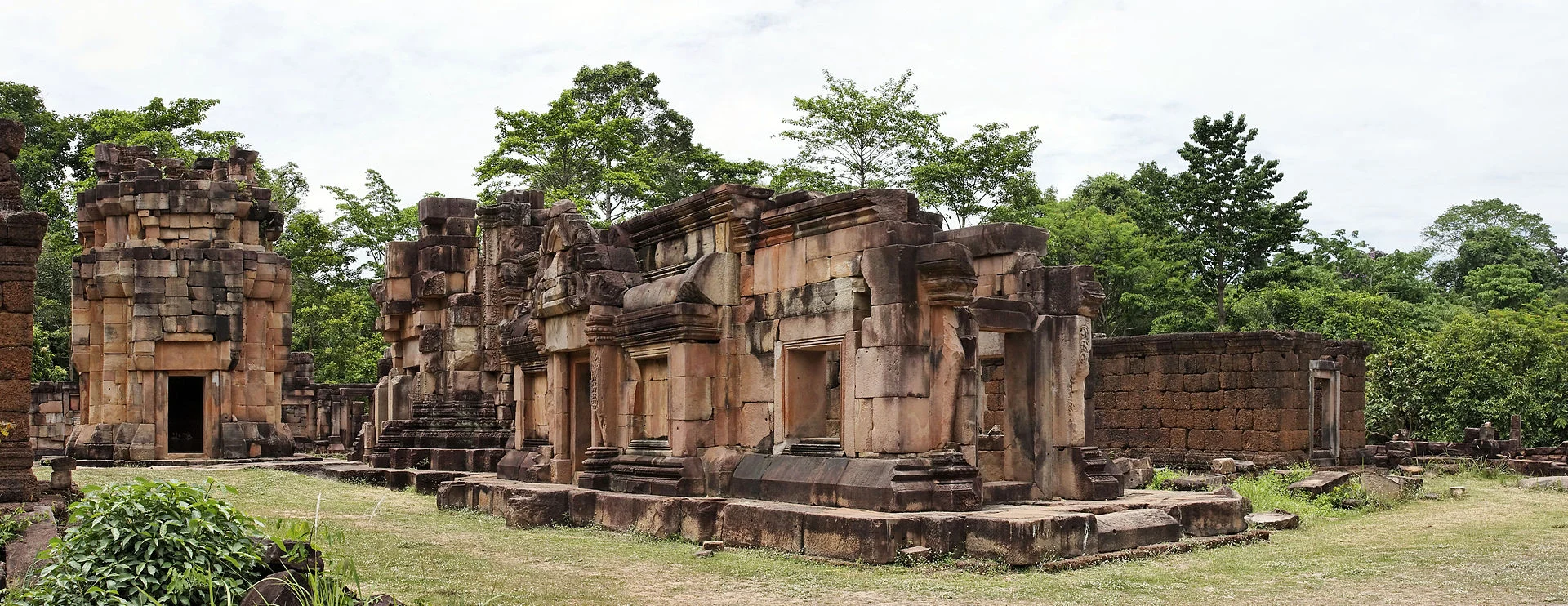
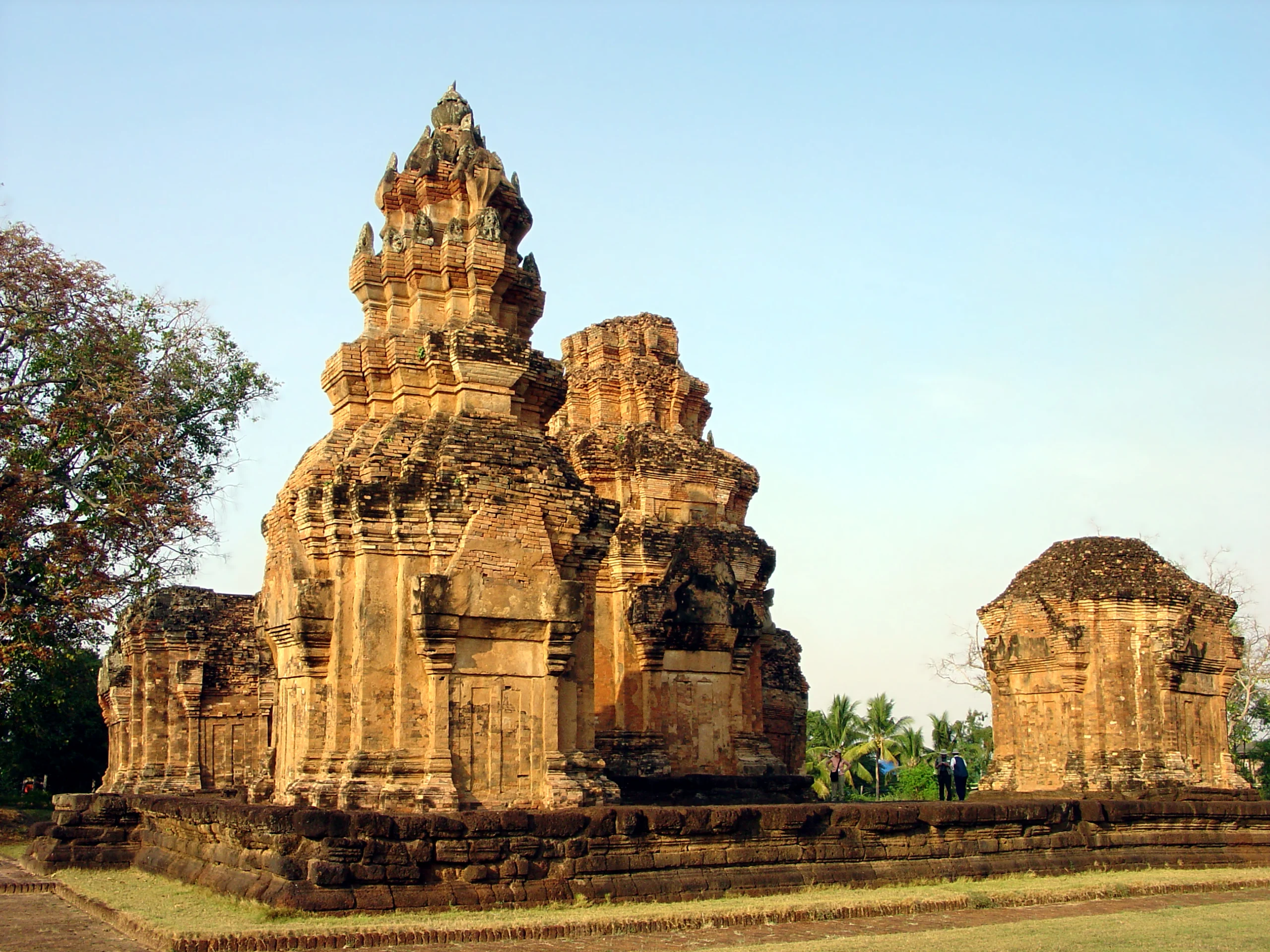
Thirty-four kilometres east of town, this five-towered Khmer temple from the 12th century is the province’s masterpiece. Five brick prangs stand on a square laterite platform ringed by a lotus pond, and the lintel over the central tower’s doorway — a dancing Shiva flanked by Apsara dancers — is among the finest Khmer carving in Thailand. Sikhoraphum has its own railway station a short hop from the temple, so you can do this by local train for pocket change. Entry is about ฿50, and your only company will likely be the gardener.
4. Ban Tha Sawang silk village
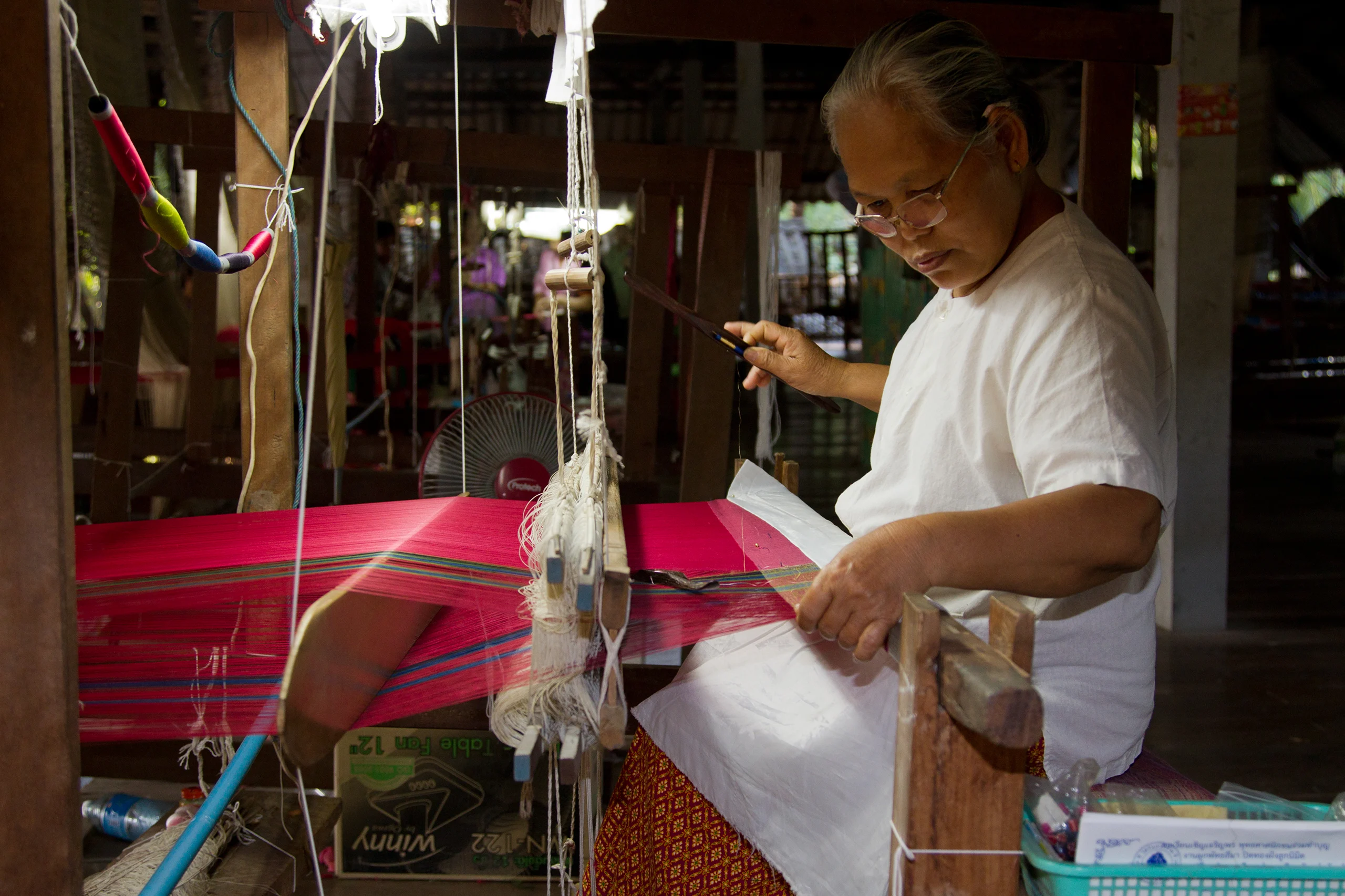
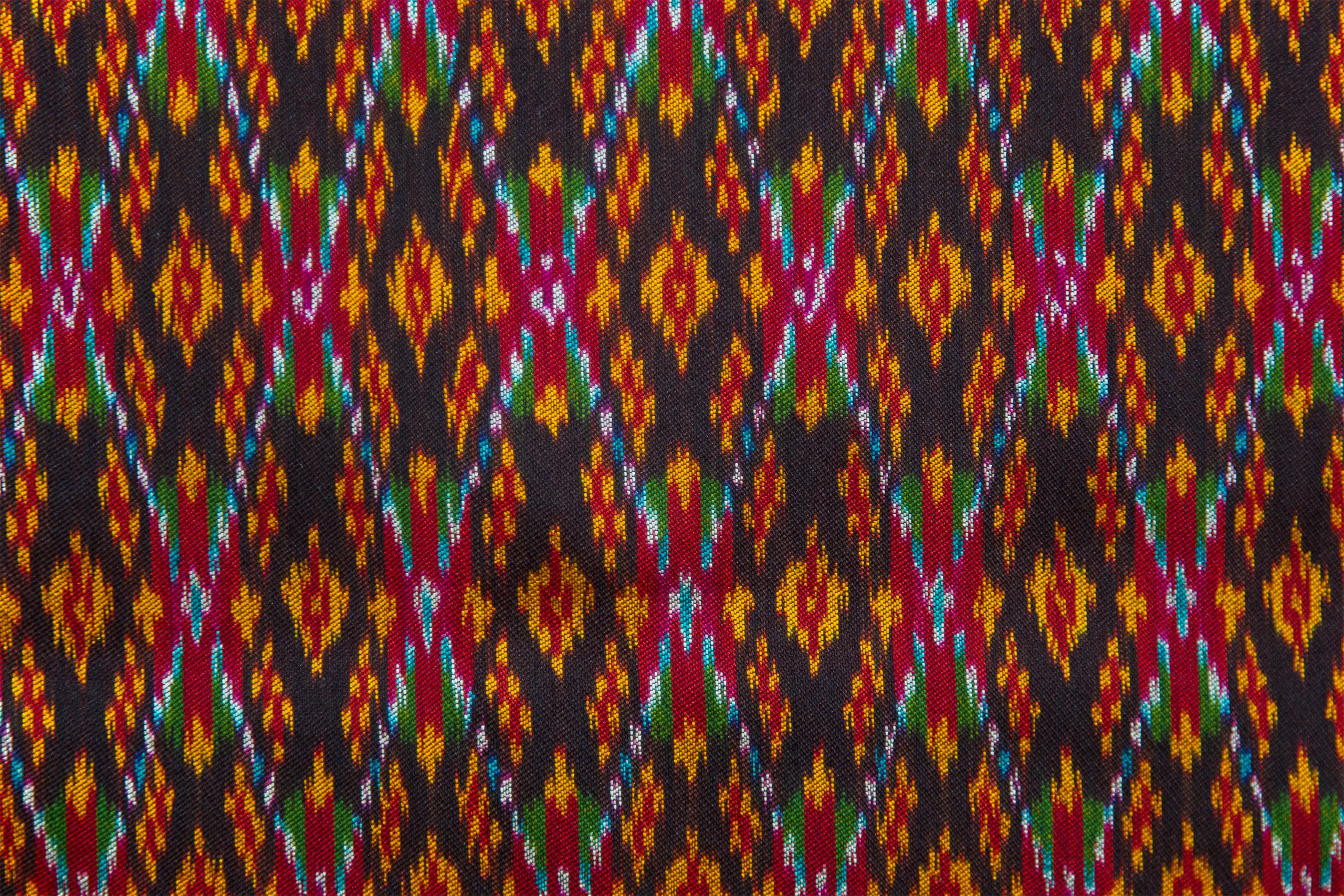
Eight kilometres west of Surin town, Ban Tha Sawang weaves the royal brocade, and the numbers are absurd: the signature looms carry more than 1,400 heddle threads and need four weavers working in concert — one perched above the loom, three below — to produce five or six centimetres of cloth in a day. This is the fabric that dressed APEC leaders in 2003 and still supplies the royal court. Watching costs nothing, the weavers are used to visitors, and village shops sell everyday mudmee silk from about ฿1,000 a piece. The royal-grade brocade runs to tens of thousands of baht a metre, which, once you have watched it being made, starts to look reasonable.
5. Khmer border culture and jasmine rice country
Give the countryside an unhurried day. Listen for Khmer Surin in the morning markets, catch kantrum music if a temple fair is on, and cycle or ride a motorbike through the paddies — luminous green from August to October, gold at the November harvest. The Prasat Ta Muean temple group sits directly on the disputed border ridge south of here, and access opens and closes with the political weather between Thailand and Cambodia, so ask locally before making the trip.
6. Phanom Sawai Forest Park
Around 20 km southwest of town, three forested hills carry a giant seated Buddha, a scatter of temples and staircases lined with bells that visitors ring on the way up. An easy half-day with wide views over the rice plain, best late afternoon. Combine it with nearby Huai Saneng reservoir, where locals demolish grilled chicken in waterside shelters at weekends — join them.
What to skip
Chong Chom border market, 70 km south on the Cambodian frontier. You will be told it is an exotic frontier bazaar. It is a car park of stalls flogging counterfeit trainers and dubious electronics, plus a stream of punters bound for the casinos on the O Smach side. Unless you urgently need fake Crocs, spend that afternoon at a silk village instead. And skip anything, anywhere in the province, that involves sitting on an elephant or watching one paint. Surin’s elephant story is genuinely rich; that is the cheapest possible version of it.
Surin travel: practical info
Best season is November to February — cool, dry and festive. The paddies are at their greenest from August to October if you can live with some rain. April is a furnace; give it a miss. Two nights is the minimum to cover the elephants and a temple; three lets you add silk and the countryside without rushing.
Wikipedia’s Surin entry covers the Kuy mahout history.
TAT’s 10 things to do in Surin is a fair companion list.
TAT’s official Surin page carries Round-Up dates when they’re announced.
Onward, Buriram is under an hour west by train for ฿20-50, Si Sa Ket about an hour east, and Ubon Ratchathani a couple of hours beyond that. The Chong Chom crossing into Cambodia has been tense and periodically closed in recent years — check the current situation before relying on it.
FAQ
Is the Surin Elephant Round-Up ethical?
Parts of it. The processions and fruit buffet are relatively benign and culturally rooted; the stadium tricks are circus acts, with everything that implies. Go for the street events, skip the shows, and never pay for a ride.
How do you get from Bangkok to Surin?
Train from Krung Thep Aphiwat takes seven to nine hours for roughly ฿300-1,100 depending on class, with an overnight sleeper option. Buses from Mo Chit take six to seven hours for ฿350-550. There is no airport; fly to Buriram and finish by road in about an hour.
Is Surin Thailand worth visiting outside November?
Yes — arguably more so. Ban Ta Klang’s elephants, the Khmer ruins and the silk villages are there all year, without festival crowds or festival hotel prices. November simply adds the spectacle on top.
What language do they speak in Surin?
Thai is universal, but a large share of the province speaks Khmer Surin, a northern Khmer dialect, at home, alongside Kuy and Lao communities. A Khmer greeting raises smiles near the border.
Can you cross into Cambodia from Surin?
The Chong Chom-O Smach checkpoint, about 70 km south of town, has long served as an international crossing. Its status shifts with Thai-Cambodian border tensions, so verify through official channels before relying on it, and do not plan a tight Siem Reap connection through it.
Related guides