Buriram is the province that refused to accept its fate. Twenty years ago it was a flat stretch of Isaan farmland that most Thais could not place on a map and no tourist had any reason to visit. Then a local political family built a football empire and a Formula One-grade race track, and suddenly Buriram, Thailand’s unlikeliest boomtown, had the best sporting infrastructure in the country. In a rice field. Four hundred kilometres from Bangkok.
The sport is the newest reason to visit Buriram, Thailand, though not the best one. The best reason has sat on an extinct volcano for roughly a thousand years: Prasat Hin Phanom Rung, the finest Khmer temple in Thailand, with a sunrise trick Angkor itself would envy. Below it sit Muang Tam and its lotus ponds, and a few hills over, a ruined sanctuary where a million bats pour out of a cave at dusk like smoke.
This guide covers what genuinely deserves your time, what it costs, and the one thing to skip. For the quick-reference version, see our Buriram province profile.
What Buriram really is
On paper, Buriram is a big agricultural province in lower Isaan, hard against the Cambodian border, home to about 1.5 million people who mostly grow rice, weave silk and send their children to work in Bangkok. For decades it was somewhere you passed through on the train to Ubon.
Then Newin Chidchob happened. A provincial political heavyweight walked away from national politics, took over a football club and set about turning his home town into Thailand’s sporting capital. The result: Buriram United, the most relentlessly successful club in modern Thai football; the Chang Arena, a 32,000-seat stadium thrown up in well under a year; and the Chang International Circuit, a race track built to Formula One standard in a province previously famous for rice.
None of this erased what Buriram already was. Drive twenty minutes out of town and you are back among paddies, silk looms and some of the finest Khmer ruins outside Cambodia.
Why go to Buriram
Because Phanom Rung alone justifies the trip, and outside festival weekends you can have it nearly to yourself, which nobody has ever said about Angkor Wat. Because a night match at the Chang Arena is the best few hundred baht you will spend in Isaan. And because Buriram, Thailand remains almost entirely free of the backpacker economy: no banana pancakes, no touts, no elephant-print trousers. Prices are local, food is local, and English is thin on the ground.
Getting to Buriram
Buriram sits about 400 kilometres north-east of Bangkok. Three sensible options.
- Fly. Thai AirAsia and Nok Air fly daily from Don Mueang in just over an hour. Book ahead and you will pay roughly ฿800-1,800 one way; leave it late on a race weekend and you will pay whatever they feel like charging. The airport is 30 kilometres north of town; a taxi in runs about ฿300-400.
- Train. Several daily services leave Krung Thep Aphiwat on the Ubon Ratchathani line and take six to seven hours. Third class costs around ฿100 and is an experience; a second-class air-conditioned seat runs ฿300-500, an overnight sleeper ฿600-1,000. Buriram station is dead central, five minutes on foot from the night market.
- Bus. From Mo Chit, five to six hours, ฿300-450. Most buses also stop at Nang Rong, which is the sensible base for the temples.
For Phanom Rung and Muang Tam you need wheels: a rented motorbike in Nang Rong costs ฿200-300 a day, or a car with driver for the temple circuit about ฿1,200-1,500.
For live timetables and tickets on these routes, compare your options on 12Go before you commit to a departure time.
Where to stay
Buriram city is compact and cheap; where you sleep depends on why you came.
- Around the railway station and night market is the practical choice: a clean ฿400-900 guesthouse, or ฿1,000-1,800 for a mid-range hotel with a pool.
- Near the Chang Arena, a couple of kilometres south, makes sense on match nights so you can walk back after the final whistle.
- Nang Rong, an hour south-west, is the temple base: honest ฿500-800 guesthouses run by people who will draw you a map to Phanom Rung on a napkin.
One warning: during MotoGP week every bed in the province books out months ahead and prices triple. Sort your room before your flights.
What to eat in Buriram
This is Isaan, so the holy trinity applies: som tam pounded to order (฿40-60), grilled chicken over coals (฿70-120 for a decent half bird) and sticky rice served, fittingly, in the woven kratiep baskets this province produces. Add larb, sour Isaan sausage at ฿10-20 a skewer, and gaeng om herb soup if you see it bubbling.
The night market near the railway station is the easy win, most plates ฿40-80. In the cool season look for khao jee in the mornings: sticky rice pressed onto the grill and brushed with egg. On match days the streets around the Chang Arena become one long open-air kitchen, and the grilled chicken out there beats most of what Bangkok charges triple for.
Top things to do in Buriram, Thailand
1. Climb Phanom Rung, the temple on the volcano
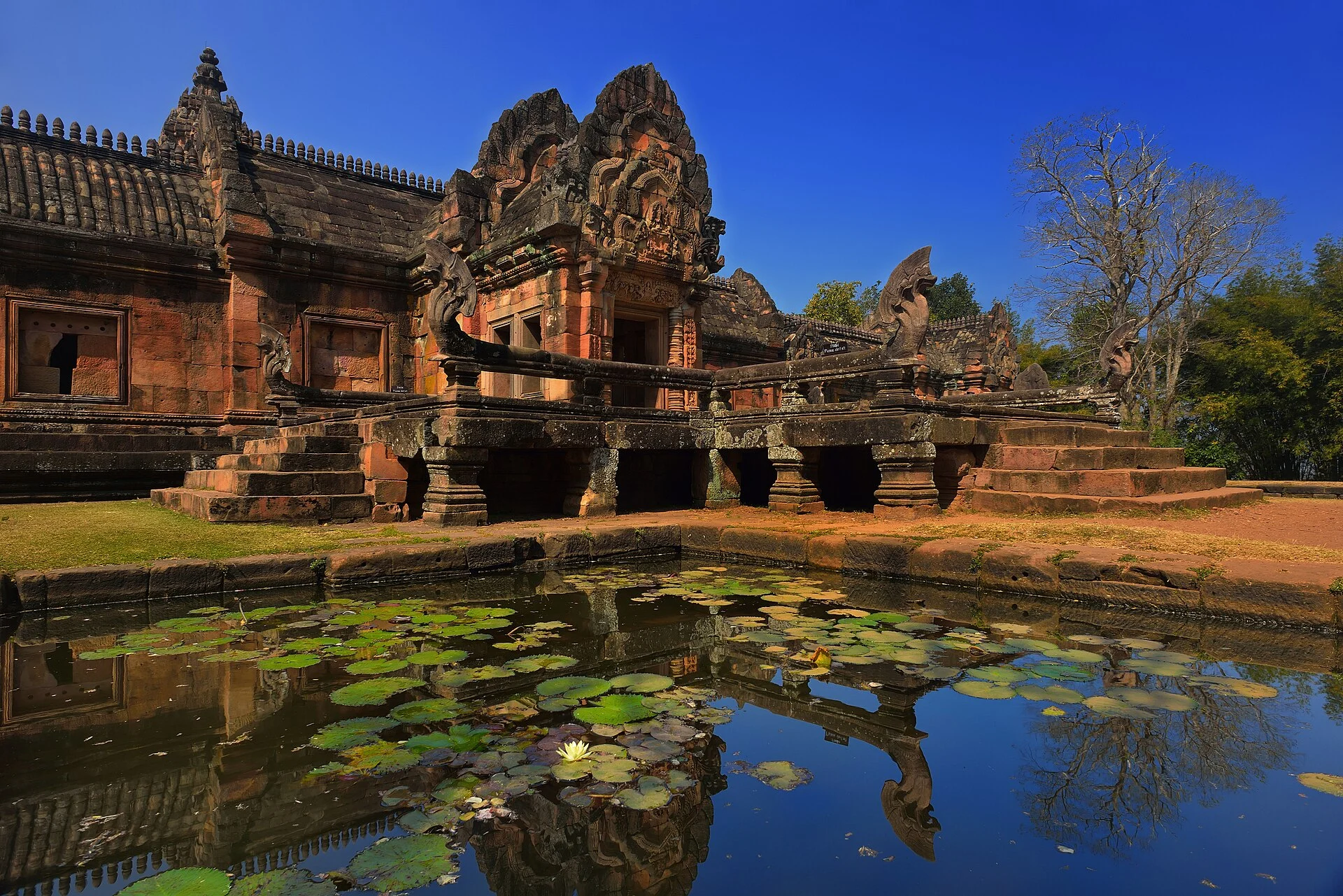
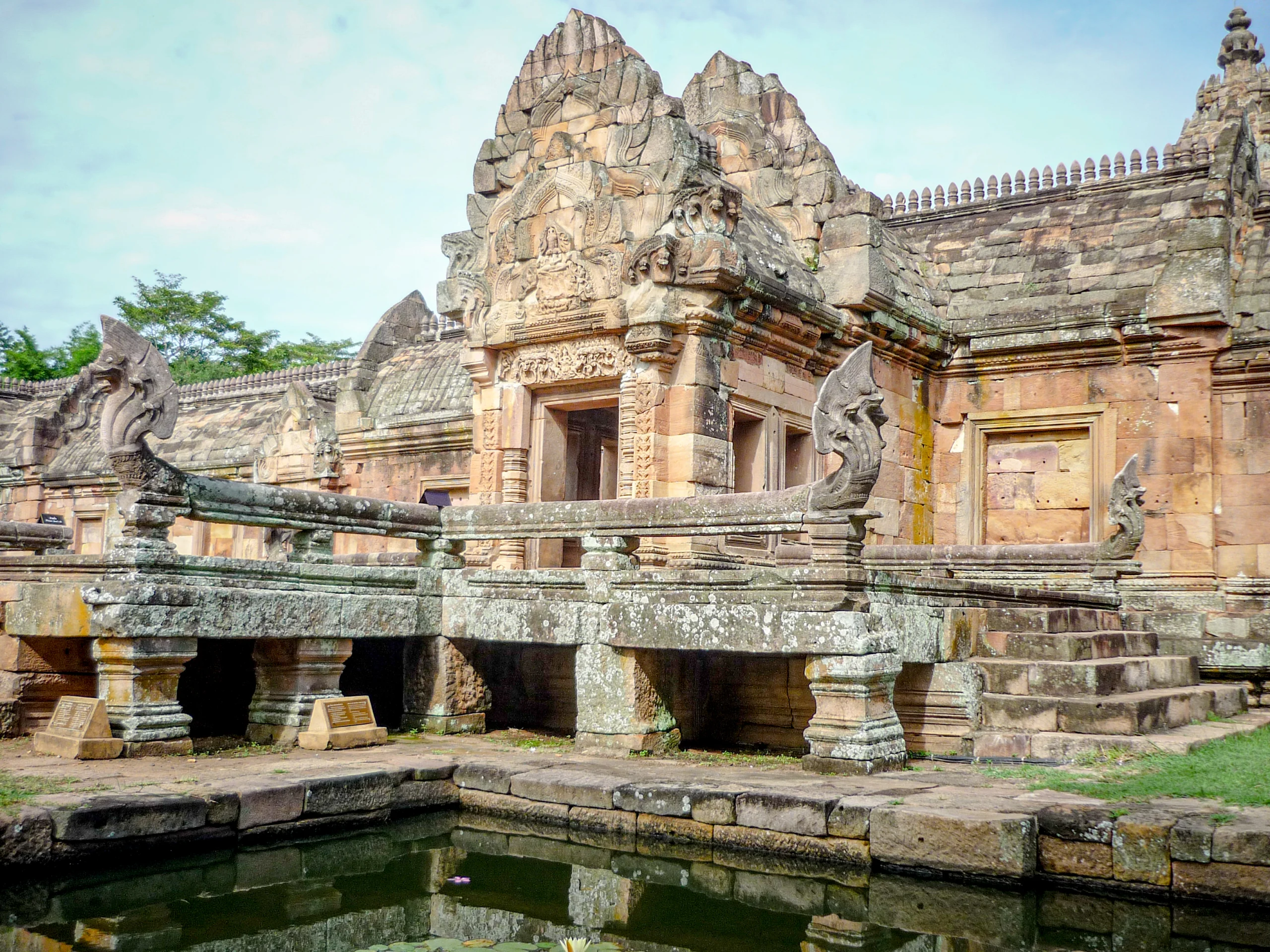
Prasat Hin Phanom Rung is a pink-sandstone Khmer sanctuary on the rim of an extinct volcano, roughly a thousand years old and reached the way pilgrims did it: up a long processional walkway and over naga bridges. Four times a year the sun lines up with all fifteen doorways at once, at sunrise in early April and early September and at sunset around March and October. April brings the Phanom Rung Festival and the crowds; September brings the same physics with a fraction of the people. Open daily, roughly 6am to 6pm; ฿100 entry, or ฿150 combined with Muang Tam.
2. Muang Tam and its lotus ponds
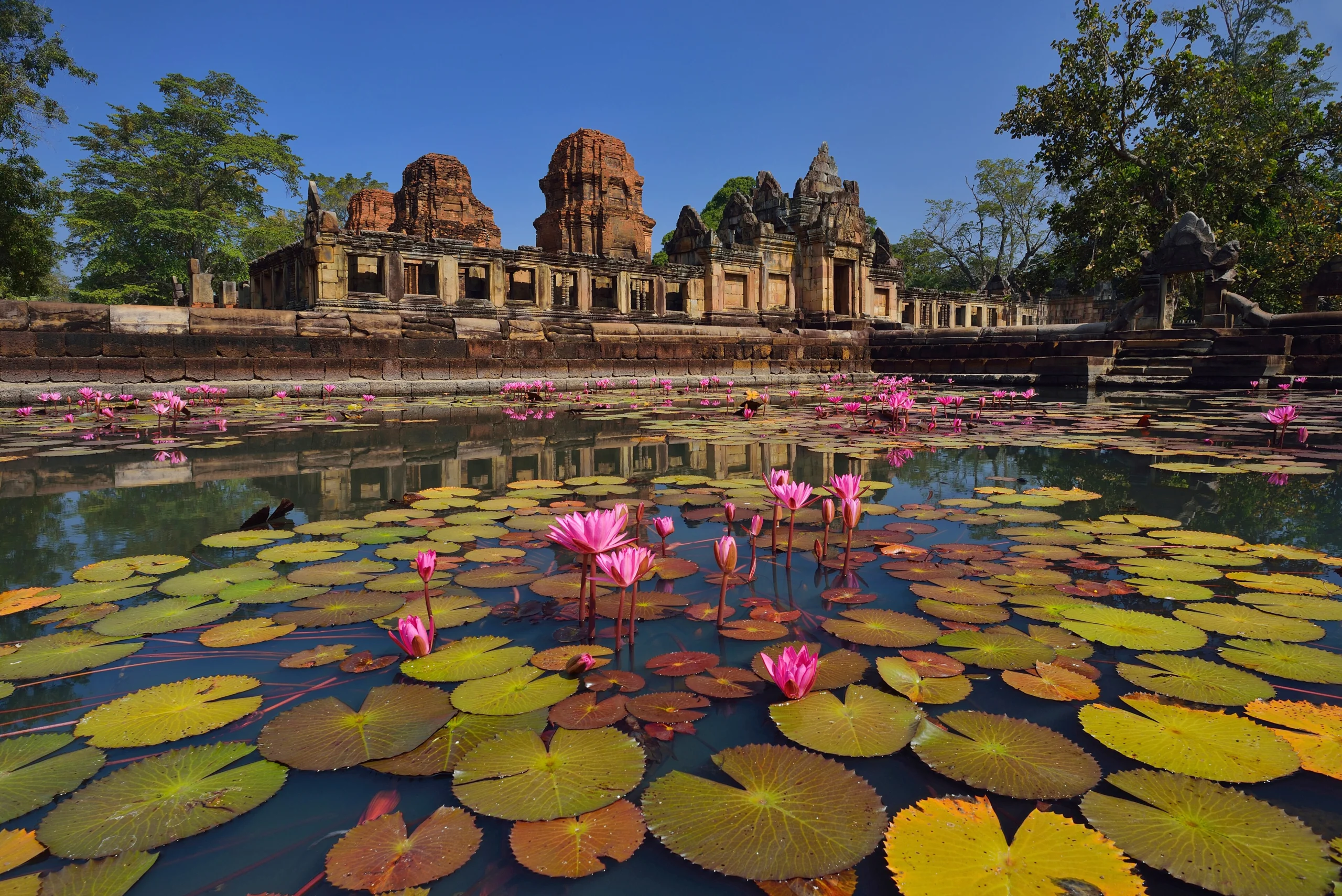
At the foot of the volcano, twenty minutes downhill, Prasat Muang Tam is older, lower and quieter, and some people quietly prefer it. Its signature is the four L-shaped lotus ponds framing the inner sanctuary, each rimmed with naga balustrades. Where Phanom Rung is theatre, Muang Tam is composure. Go late afternoon when the light softens and the tour vans have left; the ฿150 combined ticket makes skipping it financially irrational anyway.
3. Watch Buriram United at the Chang Arena
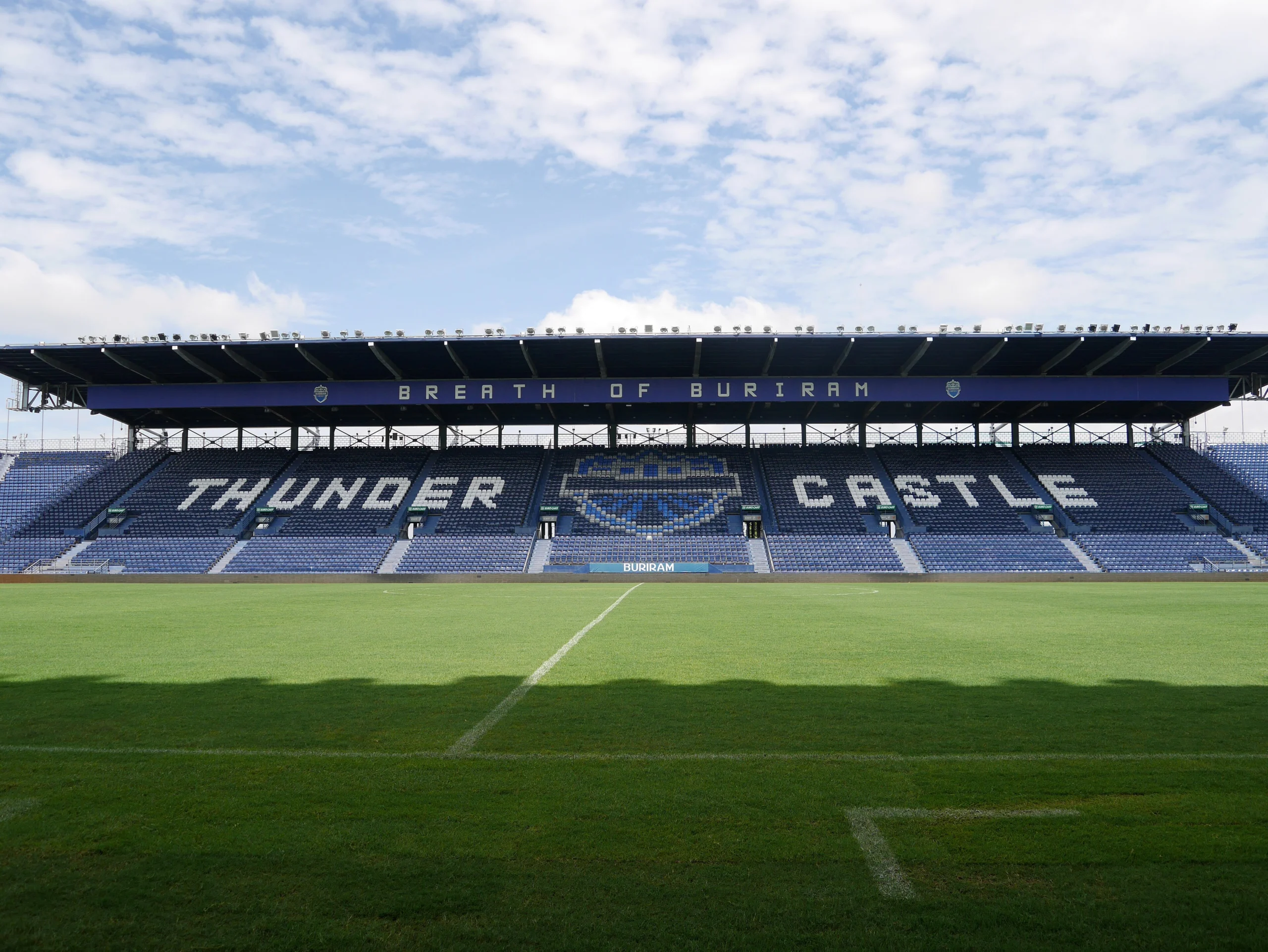
The Thunder Castle is the loudest evening in Isaan. Buriram United have hoovered up Thai league titles for over a decade, the 32,000-seat stadium was reportedly built in under a year, and the atmosphere on a big night embarrasses plenty of European grounds. Tickets cost a few hundred baht at most, the beer is cold and the entire town wears blue. Even if you do not care about football, go: ninety minutes here explains the modern province better than any museum.
4. MotoGP at the Chang International Circuit
Next to the stadium sits a 4.5-kilometre FIA Grade 1 circuit, technically good enough for Formula One. Its marquee event is the Thai round of MotoGP, traditionally run in October, though the slot has moved around the calendar in recent seasons, so check the current schedule before booking. General admission starts at a few hundred baht, decent grandstands run into the low thousands, and the atmosphere is Songkran with engines.
5. The bat exodus at Prasat Khao Plai Bat II
On another of the district’s extinct volcanic hills stands a ruined Khmer sanctuary almost nobody visits, and beneath it a cave holding millions of wrinkle-lipped bats. Every evening around sunset they pour out in a ribbon that can take half an hour to empty, twisting over the paddies while hawks pick at the edges. Arrive an hour before sunset for the short, steep walk up; entry is free. It is one of the strangest spectacles in Thailand and it happens daily to an audience of about a dozen locals.
6. Silk at Ban Ta Pek and the kratiep weavers
Buriram’s villages still produce serious hand-woven silk, and Ban Ta Pek is the place to watch mudmee patterns come off the loom, then buy direct from the person who made them for a fraction of a Bangkok boutique price. Expect a few hundred baht for a scarf, comfortably more for fine sarong lengths. The same village economy turns out kratiep, the lidded sticky-rice baskets you have been eating from all week; at ฿50-200 they are the most genuinely useful souvenir in Isaan.
What to skip
Buriram Castle. It is a shopping arcade beside the stadium dressed up with faux-Khmer towers, built so that people who cannot be bothered to drive an hour can photograph a pretend temple in a car park. Posing outside a concrete replica sixty-odd kilometres from the real thing is like flying to Agra and photographing a fridge magnet of the Taj Mahal. Buy your match ticket, eat the grilled chicken, keep walking.
Also skip Phanom Rung at midday from March to May: the bare hilltop works like a storage heater and 38-degree heat will ruin the best thing in the province. Sunrise or late afternoon, no exceptions.
Buriram travel: practical info
The comfortable window in Buriram, Thailand is November to February, with dry days and genuinely pleasant evenings. April is brutal at close to 40 degrees, but it brings the sunrise alignment and the Phanom Rung Festival, so pick your battles. Two to three days covers the province properly: one for the temple circuit out of Nang Rong, one for the town plus a match or the bats, and a spare for silk villages or the circuit.
Wikipedia’s Buriram entry tells the Khmer highway story properly.
TAT’s official Buriram province page has current temple hours and event dates.
Onward travel is easy. Surin is under an hour east by train for ฿20-50 in third class, Nakhon Ratchasima is two to three hours west, and the same line continues through Si Sa Ket to Ubon Ratchathani.
FAQ
Is Buriram, Thailand worth visiting?
Yes, and more than most stops on the Isaan rail line. It has the best Khmer temple in the country, top-flight football and motorsport, and no tourism machine inflating prices. If you want Thailand without the costume it wears for visitors, this is it.
What is Buriram Thailand famous for?
Two things: Phanom Rung, the Khmer sanctuary on an extinct volcano, and sport, meaning Buriram United and the Chang International Circuit, home of Thailand’s MotoGP round. It is also a serious producer of hand-woven silk and kratiep sticky-rice baskets.
How do you get from Bangkok to Buriram?
Fly from Don Mueang in about an hour (฿800-1,800), take the train from Krung Thep Aphiwat in six to seven hours (฿100-1,000 by class) or a bus from Mo Chit in five to six (฿300-450). For the temples, get off at Nang Rong.
How many days do you need in Buriram?
Two full days minimum: one for Phanom Rung, Muang Tam and the bat cave, one for the town and a match if the fixtures cooperate. Add a third for silk villages or the circuit.
When can you see the sun through all 15 doorways at Phanom Rung?
Four windows a year: sunrise in early April and early September, sunset around early March and October. April coincides with the Phanom Rung Festival and its crowds; September is near-empty. Exact dates shift slightly each year, so check locally before committing to a dawn start.
Related guides