The Destination Thailand Visa has no interview, no biometrics appointment, no visit to a beige office. It is approved — or refused — entirely on the PDFs you upload. Which makes the document stack the whole game, and the game has rules nobody prints in one place. This is that place. (New to the DTV entirely? Start with the complete Destination Thailand Visa guide, then come back.)
Everything below comes from official embassy checklists — London, Washington DC, Helsinki, Munich, Yangon, Ho Chi Minh City — cross-checked on 28 July 2026. Where posts differ, we say so, because “my mate applied through Vientiane” is not a legal framework.
The universal five: what every applicant uploads
| Document | The standard that actually applies |
|---|---|
| 1. Passport biodata page | Six months’ validity minimum (Yangon states it; treat as universal), clean colour scan |
| 2. Photograph | Taken within the last six months (London); biometric-style against a plain background (Munich) |
| 3. Proof of current location | You apply through the post covering where you physically are: utility bill, lease, or stamped entry. Third-country applicants add residence proof — London wants a BRP or UKVI letter, Washington a green card or a US visa with six months left |
| 4. Financial evidence | ฿500,000 or the local equivalent — £11,000 / US$16,000 / €15,000 (see below) |
| 5. Category evidence | DTV1: work proof · DTV2: acceptance letter · DTV3: family certificates (see below) |
The ฿500,000: what counts, what doesn’t, how long
The strictest published standard is Washington DC’s, so build to it and every other post becomes easy mode: bank statements covering the last three months, with the closing balance at ฿500,000-equivalent or higher in each month. London and Helsinki publish no month count at all — three months of clean statements satisfies everyone.
- Counts: ordinary bank statements in your name; a sponsorship letter (explicitly accepted by London and Washington); Yangon’s checklist even lists pay slips as supporting evidence.
- Not on any official list: crypto balances, brokerage screenshots, revolut-style app screenshots of dubious provenance. If your money lives in investments, move ฿500k-worth into a boring bank account and let it sit.
- The famous “six-month seasoning” rule: appears on zero official checklists. It’s agent folklore. Three stable months is the strictest official standard in existence — though any officer can always ask for more, so don’t give them a statement that dips to ฿498,000 in month two.
- After approval: no published rule polices the balance — but immigration can ask for financial evidence again when you extend. Drain the account theatrically at your own risk.
Category evidence: the document that defines your file
DTV1 — remote workers and freelancers
- Employed: employment contract or certificate. Munich’s checklist wants the letter to state permission to work remotely from Thailand — get HR to write that sentence verbatim. A contract that reads “must work from our Berlin office” is a self-rejection.
- Freelancers: Washington accepts “a professional portfolio showcasing digital nomad, remote worker, foreign talent or freelancer status”. In practice that means: business registration if you have one, two or three signed client contracts, invoices that visibly match deposits on your bank statements, and a one-page professional summary. A link to your personal website is decoration, not evidence.
DTV2 — soft power: gyms, schools, hospitals
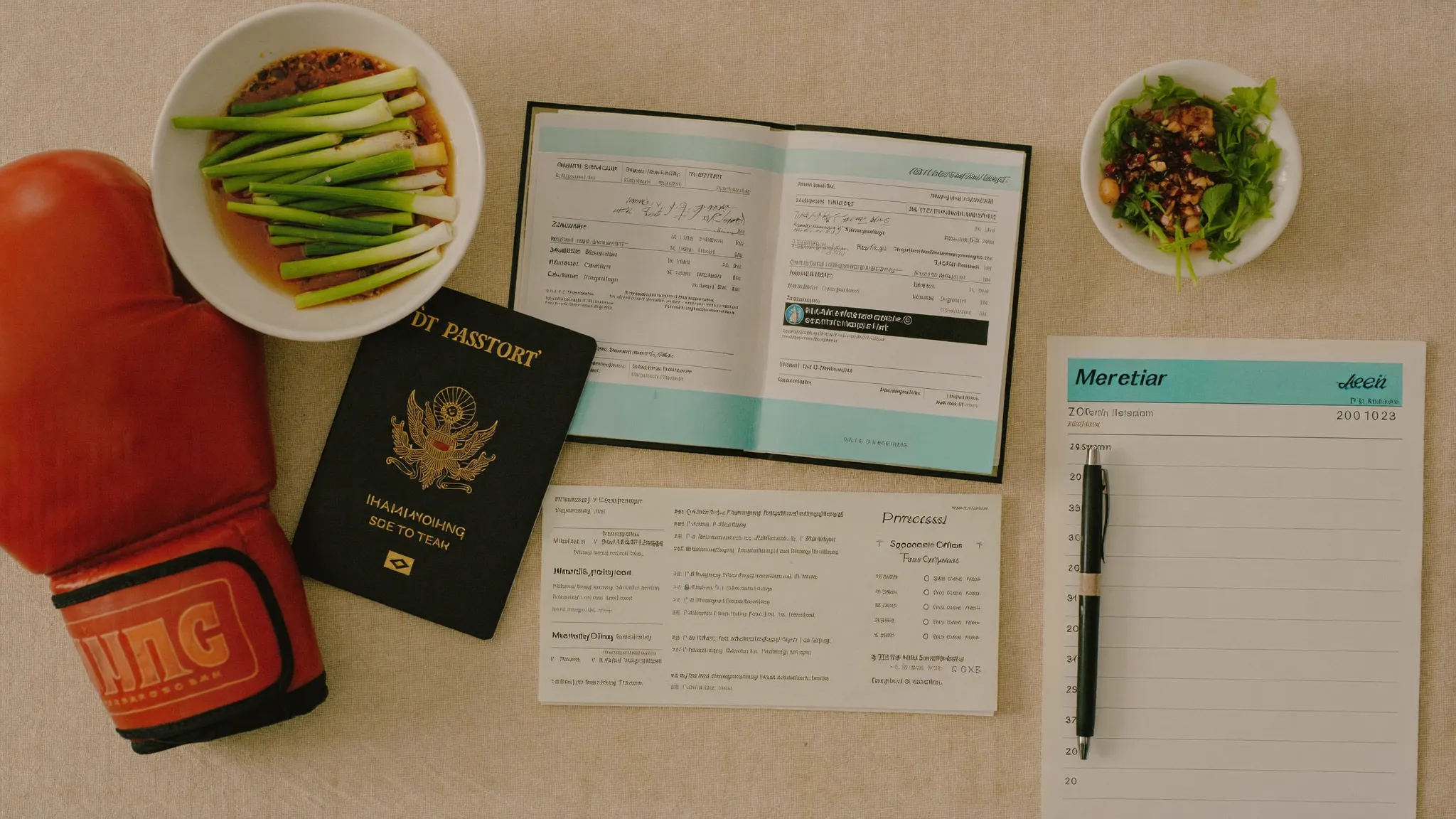
One document carries the entire application: the letter of acceptance from the organisation running your activity. Washington’s wording — “letter of acceptance from institute or company organizing activities”; for medical files, a “letter of appointment from hospital/medical center”. A convincing letter is on letterhead, names you and your passport number, states the course, its duration and schedule, and shows the provider is a registered Thai business. Official example activities: Muay Thai, Thai cooking, sports training, seminars, music festivals, medical treatment. Thai language schools no longer appear on any official list we checked — confirm with your embassy in writing before paying a language school anything. And if you haven’t actually chosen your gym or school yet, sample the discipline first — a drop-in Muay Thai session costs a few hundred baht and tells you whether you want six months of it.
DTV3 — spouses and children under 20
- Marriage certificate (spouse) or birth certificate (children); Yangon also accepts adoption papers.
- The main holder’s passport and DTV approval (Washington’s requirement — one parent’s visa anchors the family’s files).
- Minors travelling without both parents: a notarised travel consent plus the parents’ documents.
- Financial evidence: most posts expect dependents to show funds too — no official page says one ฿500k balance covers a family, so budget per person until your embassy tells you otherwise.
Translations, scans and the quiet killers
- Language: anything not in English (or Thai) needs a certified translation, notarised — London and Washington both spell this out. Your cousin’s translation with no stamp is a non-document.
- Scan quality: London warns, in writing, that “a screenshot or unclear file” triggers a request for more documents — which resets your waiting time. Flat PDFs, full pages, readable numbers.
- Consistency: the name on the contract, the statements and the passport must match to the letter. Maiden names, transliterations and nicknames are where clean files go to die.
- Post-specific extras exist: Helsinki wants an accommodation booking of at least seven days. A refundable hotel booking ticks the box without chaining you to plans. Always read your own embassy’s page top to bottom before uploading anything.
Why files get refused — and the reapplication maths
Embassies publish warnings rather than statistics, and the warnings map the minefield precisely: wrong jurisdiction (you must be physically present in the country you apply through — Mexico City requires it “throughout the application process”), thin freelance portfolios, statements that wobble under ฿500k, blurry uploads, uncertified translations, and acceptance letters from providers who look less like schools and more like visa mills. Yangon adds that officers may demand extra documents or an interview at their discretion.
If it goes wrong: the fee — £300 / US$400 / €350 depending on the post — is non-refundable, but nothing blocks reapplying. Ho Chi Minh City’s page notes the processing clock resets on resubmission, so fix the actual defect before refiling: strengthen the portfolio, re-season the balance, get the letter rewritten. Same weak file, same result, minus another four hundred dollars.
The pre-submission checklist
- Passport valid 6+ months, scanned flat
- Photo taken within 6 months, plain background
- Proof you’re legally in the country you’re applying from
- Three months of statements, every closing balance ≥ ฿500k-equivalent
- Category document: contract with the remote-work sentence / portfolio with contracts+invoices / acceptance letter on letterhead / family certificates
- Certified, notarised translations for anything non-English
- Names identical across every document
- All files as clean PDFs, no screenshots
- Your embassy’s own page read twice for local extras
- Fee card ready — and the application walkthrough open in the next tab
Not sure the DTV is even your visa? Ninety seconds with the visa matcher settles it — and if you’re still saving toward the ฿500k, Thailand’s 60-day entry rules cover the scouting trips meanwhile.
Every official fee on this page, in one checkable place: The Thailand Price Index tracks 58 real prices across the country — what is fair, what is official, and what tourists get quoted — checked and dated.
DTV documents: FAQ
Can someone else sponsor my DTV financial requirement?
Yes. London and Washington DC both list a sponsorship letter as acceptable financial evidence. Pair the letter with the sponsor’s bank statements, state the relationship plainly, and keep every name consistent with the certificates you upload.
Do my bank statements need to be certified or translated?
Statements issued in English download-as-PDF are accepted as-is when they’re clean and complete. Anything not in English (or Thai) needs a certified, notarised translation — that rule is printed on the London and Washington checklists. Some posts prefer bank-stamped statements; read your embassy’s own page.
How recent do the documents need to be?
The photo: taken within the last six months. Statements: covering the last three months, the strictest published standard (Washington DC). Acceptance letters should be freshly dated and match your intended start. The DTV needs no police or medical certificate at any post we checked.
Can I use crypto or stock portfolios as proof of funds?
They appear on no official DTV checklist. Accepted forms are bank statements, a sponsorship letter, and (at some posts) pay slips as support. If your net worth lives in Bitcoin or brokerage accounts, convert ฿500,000-worth into an ordinary bank balance and let it sit for three months first.
How soon can I reapply after a rejection?
Immediately — no official cooling-off period exists. But the fee is non-refundable and Ho Chi Minh City warns the processing clock resets on resubmission, so fix the actual defect (portfolio, balance, letter) before paying again.
Sources: official DTV checklists of the Royal Thai Embassies in London, Washington DC, Helsinki and Munich, and the Consulate-General in Ho Chi Minh City — all re-verified 28 July 2026.