Bangkok has hundreds of Muay Thai gyms, and most reviews of them are written by people who visited once, took a photo, and left. This isn’t one of those. Bowna Muay Thai Gym in Sathorn is where I actually train, week in and week out, so this is what the gym is like when nobody’s performing for a camera: the good, the sweaty, and the things you should know before you show up.
The short version: Bowna is that increasingly rare thing in central Bangkok — a proper Thai-run gym with genuine fight pedigree that still welcomes complete beginners, at prices that haven’t been inflated for the tourist market. The long version follows.
The man behind the gym
Bowna is owned and run by Rainbow Sor Prantalay, and if you know anything about Muay Thai’s golden era, that name needs no introduction. Fighting out of the famed Sor Prantalay camp in the late 1980s and 90s — the sport’s deepest era of talent — Rainbow climbed to the number-one ranking at Lumpinee Stadium, the most contested proving ground in Muay Thai. Promoter Songchai Ratanasuban gave him the ring name “Rainbow”; opponents came to know him as Rung Phikhat — “Rainbow the Destroyer” — for an aggressive, forward-marching style that knocked out champions like Boonlung Sor Thanikul and Nampon Nongkheepahuyut. In 1996 he added a European title at 67 kg, beating French champion Christian Garros.
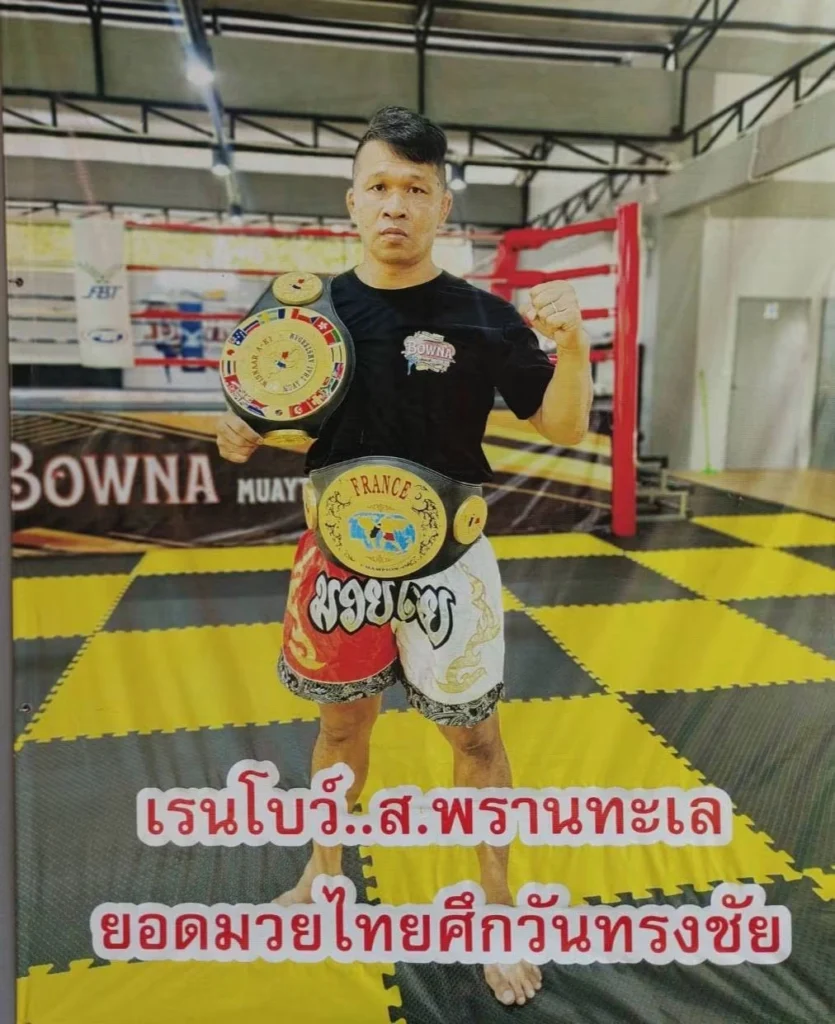
That history isn’t just wall decoration (though the trophy wall, stacked with belts and cups from his career and his fighters’, is worth a look while you’re wrapping your hands). It shapes how the gym teaches. Golden-era fighters learned Muay Thai as a complete art — timing, balance and ring craft, not just pad-whacking cardio — and that’s what gets passed on here, whether you’re a fighter prepping for a bout or an office worker throwing your first jab.
The gym itself
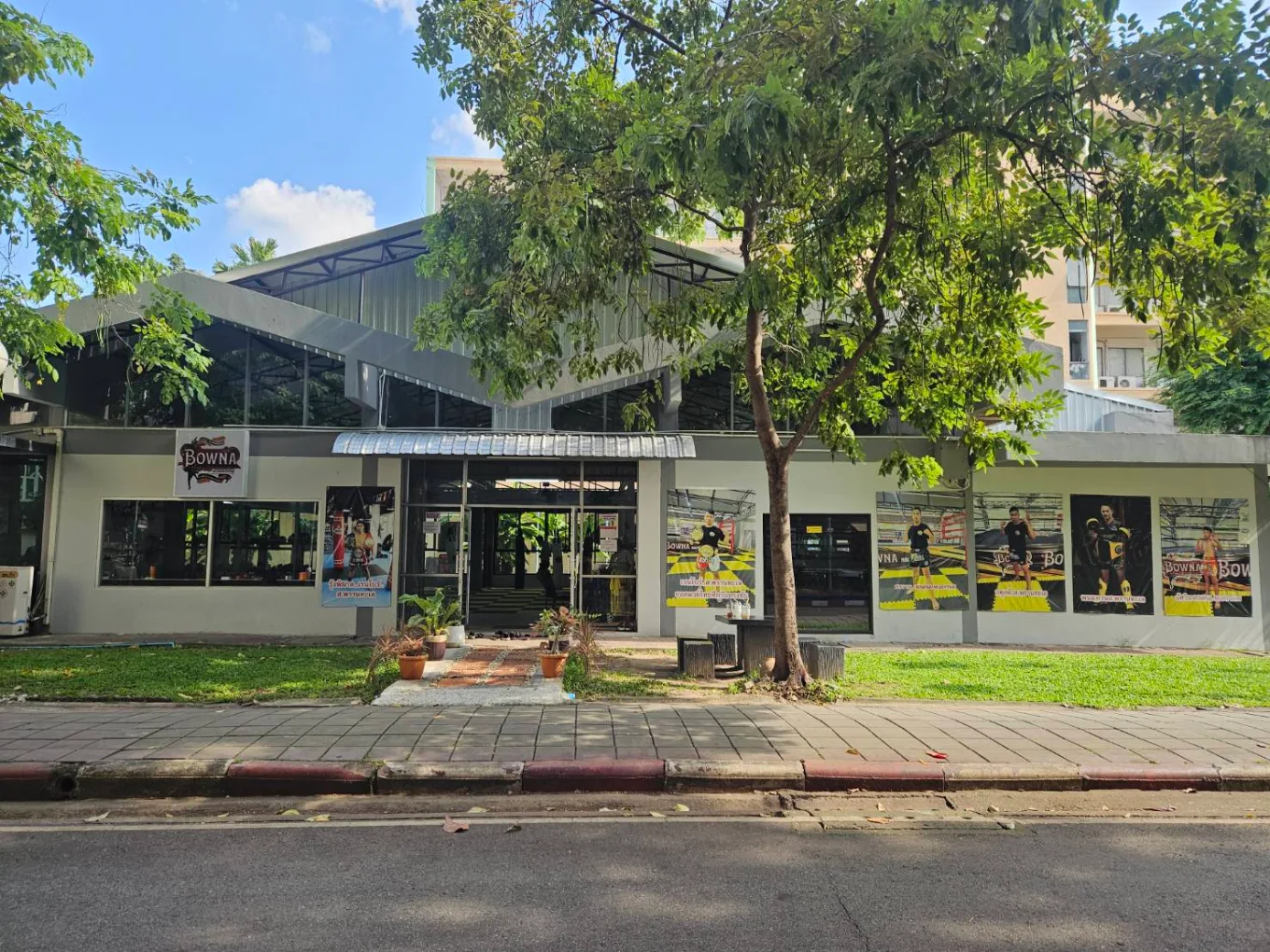
Rainbow opened Bowna in mid-2024 inside the Rajamangala University of Technology Krungthep campus in Sathorn, and two years on it still feels box-fresh — a full-size FBT ring, a rank of heavy bags, clean matting, good gear, and none of the mildew-and-mosquitoes charm of older Bangkok camps. The place gets cleaned more than once a day, which anyone who has trained in Thailand long enough will tell you is not a given. It’s an open, airy space under a high roof: you’ll sweat plenty (this is Bangkok), but it never feels like training in a shipping container.
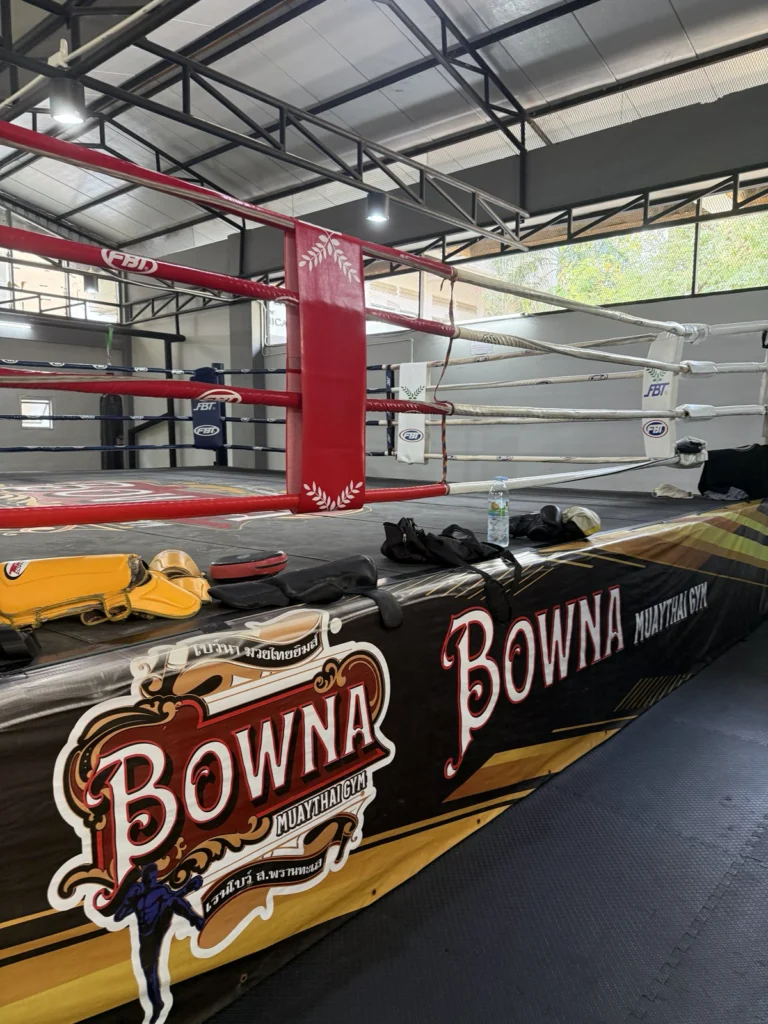
The practical stuff is properly sorted, which you can’t say for every Thai camp: there are lockers for your valuables, showers and bathrooms on site, and drinking water for sale, so you can train straight after work and head out clean. Best of all for travellers packing light — gloves and hand wraps are provided free, and there are shin pads and groin guards to borrow for sparring and clinch work. You can genuinely turn up with nothing but shorts, a shirt and a towel.
Training and classes
Group classes run six times a day, Monday to Saturday: 9:00 and 10:30 in the morning, then 15:00, 16:40, 18:00 and 19:30 — the gym closes for the hottest stretch of the day between midday and 3pm, and all day Sunday. That spread is genuinely useful: morning sessions before the heat peaks, evening sessions you can make after office hours (the 18:00 and 19:30 classes are the busiest for exactly that reason). Every Saturday at 3pm there’s also a dedicated children’s class, and it’s a small joy watching six-year-olds drill teeps with more discipline than most adults.
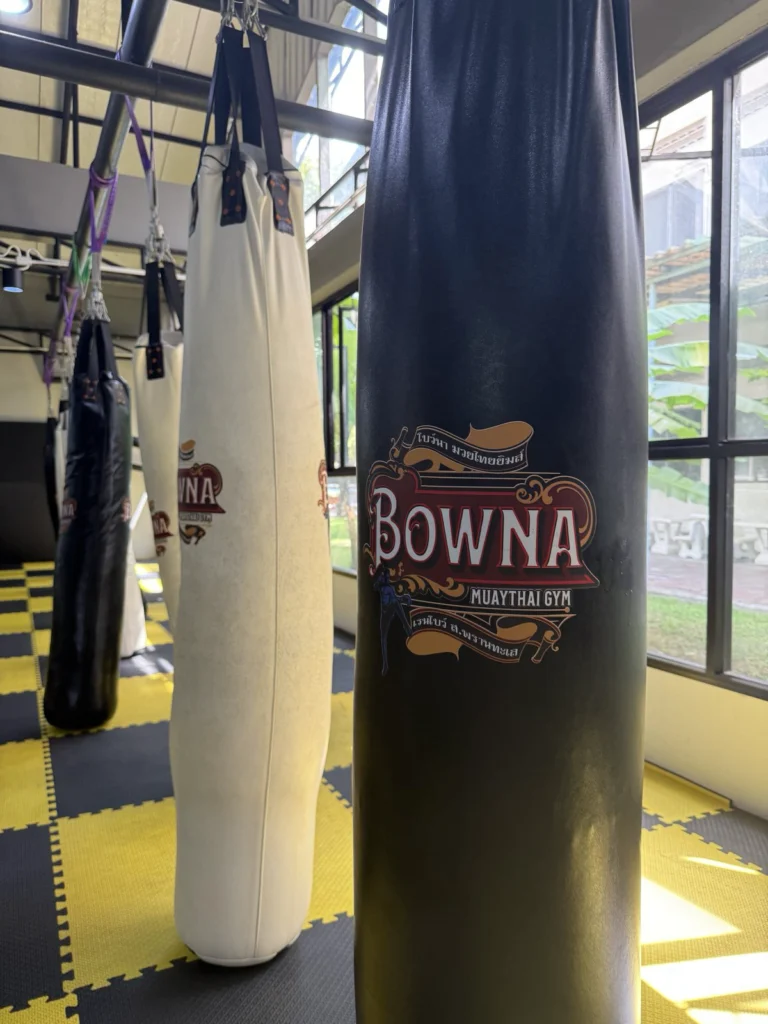
A session runs 90 minutes to two hours, and it follows the classic Thai camp template rather than a boutique-fitness remix: a warm-up run, stretching and skipping rope, shadow boxing, three three-minute rounds on the bags, three three-minute rounds on the pads, then optional clinching or sparring for those who want it, and conditioning before a cool-down stretch. The “optional” matters — nobody is pressured into sparring, but it’s there when you’re ready, with the gym’s shin pads and groin guards free to borrow.
The pad rounds are where the gym earns its keep: the trainers actually correct you. Sloppy hips get fixed, dropped hands get punished (gently), and you leave each session with one or two concrete things to work on rather than just a puddle of sweat.
The crowd is a healthy mix — Thai regulars, resident foreigners who live in the neighbourhood, and travellers dropping in for a week or two — with everyone from first-timers to the gym’s amateur fighters on the same floor without anyone feeling out of place. The trainers speak good English: comfortably enough to lead a class, coach technique and joke with you between rounds, which removes the main anxiety first-timers have about training at a “real” Thai gym.
Prices
This is where Bowna quietly embarrasses the tourist-belt gyms.
| Option | Price |
|---|---|
| Group class (per session, 90–120 min) | ฿500 |
| Private 1-on-1 with a trainer | ฿1,300 |
| Advanced private 1-on-1 with Kru Rainbow | ฿1,800 |
For context, big-name gyms in Sukhumvit and on the tourist islands routinely charge ฿600–800 for a group session half this length, and their headline-trainer privates run well past ฿2,000. ฿1,800 for a full private session with a fighter who was ranked number one at Lumpinee — the actual pinnacle of the sport — is, frankly, one of the best-value hours in Bangkok. If you book nothing else on your trip, book that.
Who it’s for — and who it isn’t
- Complete beginners: yes. Nobody will throw you in the ring; the first session is technique and pads at your pace.
- Travellers wanting real Muay Thai, not a fitness-class simulation: exactly this. You’re learning from a Lumpinee number one, minutes from the Sathorn business district.
- Families: the Saturday 3pm children’s class is a rarity for a proper fight gym this central — kids train while you watch, or book yourself into the same afternoon.
- Aspiring fighters: Bowna runs an active amateur fight team, so if you want to work toward a first bout under a golden-era corner, that path exists here. There are no professional fighters on the roster (yet), so if you’re a pro looking for a stable of pro sparring partners, a bigger fight camp will suit you better.
- People who want luxury-gym polish: manage expectations — this is a proper Thai camp, clean and well-kept, but you’re here for the training, not a juice bar.
The honest bit
No gym is perfect, and you’d be right not to trust a review with no criticisms, so here’s what to know before you commit. Morning classes tend to be quiet — great if you want more trainer attention per person, not great if you’re hunting sparring partners; come to the evening sessions for that. And because the gym lives inside a university campus, the amenities are functional rather than fancy: lockers, showers and bathrooms are all there and kept clean, but don’t expect a sauna, a smoothie counter or a lounge to linger in. The trade-off is that everything you actually train with is new and well maintained — the gym is barely two years old and it shows in the right way.
Getting there
Bowna sits inside the Rajamangala University of Technology Krungthep (RMUTK) campus in Sathorn. Enter through the university gate on Narathiwat Ratchanakharin Road, walk straight ahead about 50 metres, and the gym building is on your right — you’ll hear the pads before you see the sign.
- By BTS + BRT (the smart way): Take the BTS Silom line to Chong Nonsi, follow the skywalk to BRT Sathorn station, and ride the BRT two stops down Narathiwat to Technic Krungthep — the station is named after this very campus and drops you about 100 metres from the university gate. The BRT runs every 5–10 minutes from 6am to midnight, and the whole hop costs pocket change.
- By motorbike taxi: From BTS Chong Nonsi or Saint Louis, any motorbike taxi rank will run you down Narathiwat to “Rajamangala” for pocket change — say “mor rachamongkon” and you’re understood.
- By Grab/Bolt/taxi: Pin “BOWNA MUAYTHAI GYM” — drivers can drop you at the Narathiwat gate. From anywhere in Silom/Sathorn it’s a 5–15 minute ride outside rush hour.
- Driving: there’s parking available at the campus.
Practical details
Location: Bowna Muay Thai Gym, RMUTK campus, 2 Naradhiwas Rajanagarindra Rd, Thung Maha Mek, Sathorn, Bangkok 10120 — open in Google Maps.
Hours: Monday–Saturday; group classes at 9:00, 10:30, 15:00, 16:40, 18:00 and 19:30 (closed 12:00–15:00 and all day Sunday). Children’s class Saturdays at 15:00.
Contact: 064-962-6562 / 082-932-1505, or message them on Instagram or Facebook.
Booking: walk-ins are welcome for group classes; message ahead to reserve a spot, and definitely book in advance for private sessions — especially if you want Kru Rainbow himself.
Amenities: lockers, showers, bathrooms, drinking water for purchase.
Gear: gloves and hand wraps free to use; shin pads and groin guards available to borrow. Just bring training clothes and a towel.
Verdict
If you’re staying anywhere near Sathorn or Silom and want to train Muay Thai in Bangkok — for a single session or a whole trip — Bowna is the easiest recommendation I can make, because I keep going back with my own money. I’m not alone in the assessment either: the gym holds a perfect 5.0 Google rating across 70-plus reviews. You get golden-era coaching lineage, a friendly mixed crowd, and honest prices, ten minutes from the business district. Tell them the farang from Destination Thailand sent you.
Sorting out the rest of your Bangkok stay? Start with our Bangkok province guide.
This review is independent and unsponsored: I train at Bowna as a regular paying member, and the gym didn’t know this article was being written. Photos are my own. That’s how every review on Destination Thailand works — if that ever changes for a specific article, we’ll say so at the top.