Status: MANDATORY and FREE — in force since 1 May 2025. Every non-Thai traveller files the Thailand Digital Arrival Card at tdac.immigration.go.th within the three days before arrival, by air, land or sea. It costs ฿0. Since late September 2026 a filed TDAC is also a condition for the Suvarnabhumi arrival auto gates.
Update log — 12 Aug 2026: page created. 28 Sep 2026: rebuilt against portal version 2026.09.00 (17 Sep 2026), with the auto-gate condition and the copycat-site warning.
The Thailand Digital Arrival Card is the one piece of paperwork every foreign visitor to Thailand files before landing, and the one that causes the most needless panic in departure lounges. It is a web form. It takes three to five minutes. It is free at tdac.immigration.go.th, and it replaced the paper TM6 on 1 May 2025; since then only the software, the app that can file it and the number of websites charging for it have changed. Here is the complete 2026 walkthrough, from the filing window to the auto gates to telling the real portal from the copies.
What the Thailand Digital Arrival Card is, and what it is not
The TDAC is the paper TM6 card moved online and made compulsory before you travel, run by the Immigration Bureau and read by the officer at the counter. Three things it is not. Not a visa: the portal’s own guide says so, and your right to enter still comes from your visa or exemption. Not an approval: nobody reviews your answers, and the decision to admit you is still made at the border. Not the Thailand ETA, the pre-screening scheme that never launched; the post-mortem is on a separate page. Two rules: one card per entry, valid from submission until you arrive, so a visa run means a fresh card for the return; and the latest submission wins.
Who needs a TDAC in 2026, and the exemptions, precisely
Every non-Thai national entering by air, land or sea, regardless of age or visa. The Immigration Bureau’s FAQ is explicit: infants and children need one, diplomatic passports need one, and the card works with every visa type, visa on arrival included. Visa-exempt under the 30-day rule in force since 15 September 2026? TDAC. Tourist e-visa, DTV, retirement extension, work permit? TDAC, every time. Unsure which applies to you? See the visa guide by country.
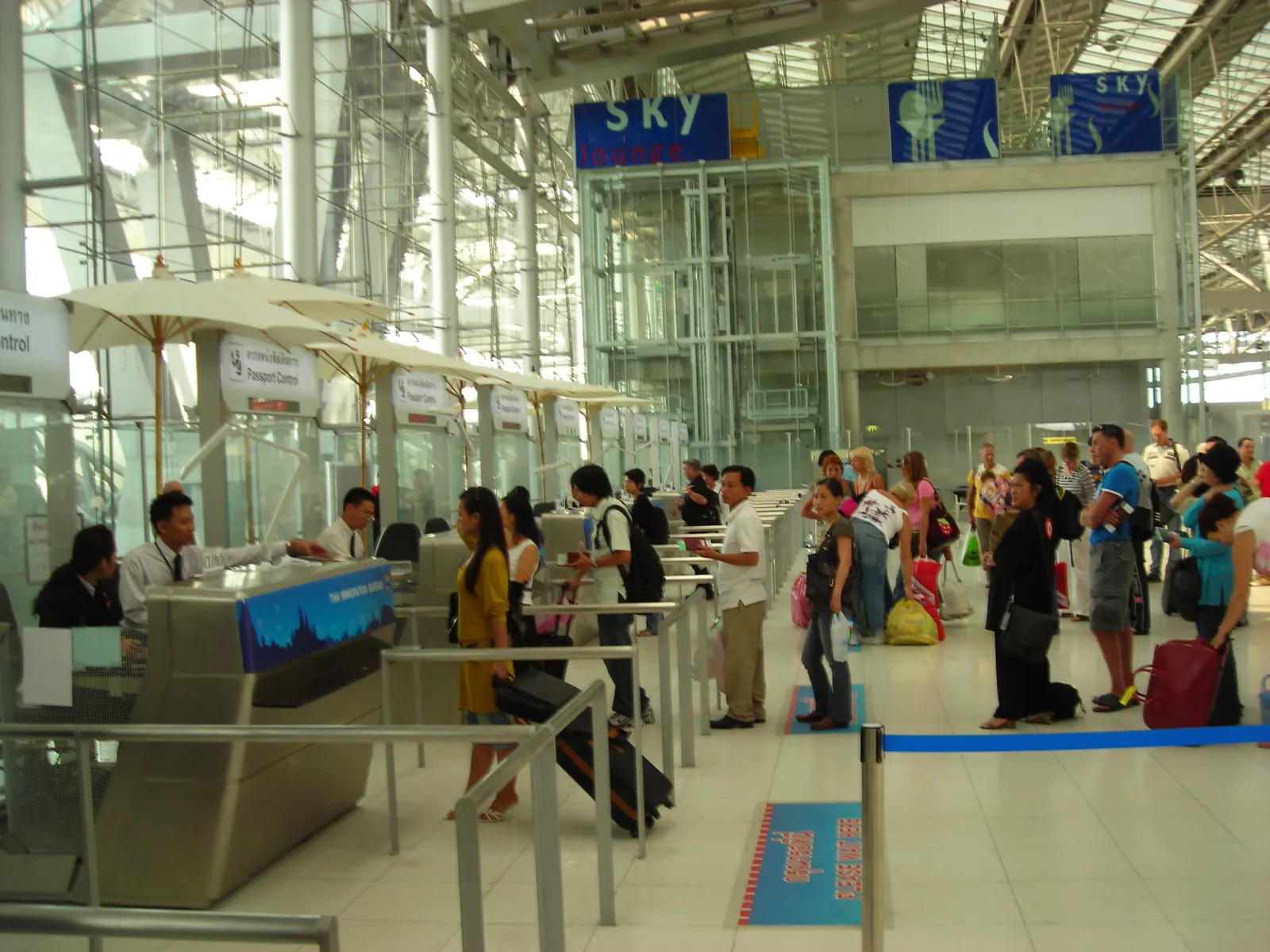
The exemptions are narrow: transit passengers who stay airside and never pass immigration control, technical landings, operating crew, and holders of a border pass at the land crossings, exempt since launch. A layover with a bag on a separate ticket, a change of airports or a hotel night means clearing immigration, so you need the card. Land and sea are not a loophole; the difference is practical. The five airports with kiosks are Suvarnabhumi, Don Mueang, Phuket, Chiang Mai and Hat Yai, while a crossing at Nong Khai or Sadao has your phone and whatever signal it finds, so file before leaving the other side.
When to file the TDAC: the three-day window explained
The FAQ states the window two ways: within three days of arriving, counting the arrival date itself, or up to 72 hours before entry. Land on a Friday and the portal accepts your card from Wednesday; try earlier and it refuses the date. It sends no reminders, so use online check-in as the trigger.
There is no cut-off before the immigration hall itself; the cost of leaving it late is not a fine but the queue position you forfeit while airport Wi-Fi decides whether it likes government websites. If the flight moves, the update function takes the new date and number. The card covers the entry, not the stay: leave after ten days or extend for ฿1,900 with the standard 30-day extension, and nobody asks for it again until you next cross inbound.
How to fill in the Thailand Digital Arrival Card, step by step
Gather everything first: the portal cannot save a half-finished form, and its three-to-five-minute estimate assumes passport, flight number and first-night address are to hand. Everything is in English; dropdowns accept three typed letters.
Step 1: the official portal, not the first advert
Type tdac.immigration.go.th yourself. The genuine address ends in immigration.go.th; nothing else does, and the paid copies below buy their way above the search results. It runs in English, Chinese, Japanese, Korean and Russian.
Step 2: individual or group
“Arrival Card” starts a fresh card. A group submission takes up to ten travellers on one email address and copies trip and hotel details between them. Families should file as a group; an agent may file on a client’s behalf.
Step 3: passport and personal information
The passport section can scan the machine-readable zone from your camera or a photo and fill the fields. Use it, then recheck every field, as the portal advises; a zero read as the letter O is the classic result. Then gender, occupation, country and city of residence, phone number and, if you hold one, visa number.
Step 4: trip information
Arrival date, mode of transport, flight or vehicle number, country boarded, purpose of visit, and expected departure if known. The flight number is your final leg into Thailand; a code-share number is fine if it is the aircraft you land on. Choose “other” as purpose and the form asks what.
Step 5: accommodation in Thailand
Type of accommodation first, because it decides which later fields are compulsory; then province, district, sub-district, post code and a street address of up to 215 characters. First night only. No booking yet? Fix that first: our Bangkok areas guide produces a real address in ten minutes, and the officer occasionally asks to see one.
Step 6: the health declaration
The Ministry of Public Health’s questions: countries stayed in during the previous fourteen days and, if your departure country, route, nationality or flight is on the ministry’s list, extra fields that can include yellow-fever proof. For most tourists it is one dropdown. Answer honestly.
Step 7: preview, email, terms, submit
The preview shows the whole card; “Edit” returns you to the wrong section. Enter the email for the card, tick the terms, submit. A “429” or “unknown error” means, per the FAQ, check your connection and retry; screenshot anything you cannot clear for staff on arrival.
Step 8: download the card, keep the QR offline
The card arrives as a PDF on screen and by email, with a QR code and a TH Digital Arrival Card number. Save the PDF, screenshot the QR, print it if you like paper; the officer can find the card from your passport number anyway. Check spam; if the email never comes, tell the officer at the checkpoint. Have an eSIM active before landing (Simbye; code DESTTHAI15 takes 15% off) so the phone copy is never the only copy.

Every TDAC field, and the mistakes that cause trouble at the counter
| Section | What it asks for | Where people go wrong |
|---|---|---|
| Passport information | Name as printed, passport number, nationality, date of birth; optional MRZ scan | Scan misreads (0 for O); name, nationality and date of birth cannot be edited later |
| Personal information | Gender, occupation, country and city of residence, phone, visa number if any | Blank visa number is correct on an exemption; “retired” is a fine occupation |
| Trip information | Arrival date, mode, flight or vehicle number, country boarded, purpose, expected departure | An overnight flight leaves on the 3rd and lands on the 4th: the arrival date is the 4th |
| Accommodation in Thailand | Type, province, district, sub-district, post code, address (215 characters) | Type decides which fields are compulsory; first night only |
| Health declaration | Countries visited in the previous 14 days; extra fields if on the Ministry of Public Health list | A long layover counts as a country visited |
Four of these actually cause trouble: a name or passport number that does not match the passport (file a new card; those fields are locked); an arrival date that does not match the day you land; a card filed for the outbound leg when the return needs one; and a typo in the email, which means no QR code, although the officer can still retrieve the card. The FAQ’s warning that entry may be refused at immigration’s discretion is about honest answers, not spelling.
Filing for a family or group, and changing a card after you submit
Group filing is the portal’s best feature and its least used: one person enters up to ten travellers in one session, “Same as Previous Traveler” copies flight and hotel across, and every card lands in one inbox with its own QR code. Agents may file for clients if authorised; a legitimate agency has your booking and your consent, the paid copies below have an advert.
To change a card, “Update Arrival Card” asks for the card number from your PDF, your date of birth and nationality, then reopens the form. Flight, dates, accommodation, purpose, health answers and email can change; full name, nationality and date of birth cannot, and the FAQ lists passport number as locked too, so treat it that way. For those, file a fresh card: only the most recent submission counts. Updates are open until you arrive, and free.
At the airport: the counter, the auto gates, and landing without a TDAC
At a staffed counter nothing has changed: passport, photograph, fingerprints on a first visit, a glance at the TDAC on screen, a stamp. You are rarely asked for the QR code, because the record is attached to your passport number, but have it ready. Our Suvarnabhumi, Don Mueang and Phuket arrival guides give the queue patterns by hour.
The auto gates are the 2026 change. Since late September the Suvarnabhumi arrival gates accept 33 nationalities on four conditions: your passport is on the eligibility list, you have entered before on the same passport so your biometrics are on file, you are entering visa-exempt, and your TDAC is already in the system. No card, no gate. Other airports still follow the older list as of late September, so expect a staffed counter there.
Did not file at all? Nobody is turned around for that alone. The FAQ promises kiosks and Wi-Fi on arrival at the five kiosk airports: file there, photograph the QR code off the screen and rejoin the queue behind everyone who did it on the sofa. Airlines may ask at check-in, inconsistently as of late September 2026. At a land border there is no kiosk and the officer’s patience is the only variable.
THIM app or the TDAC website: which one files it?
Either; neither replaces the other. THIM, the Immigration Bureau’s app, opened as a public trial on 6 June 2026 and launched officially in August. It files your TDAC: photograph the passport, add trip and hotel, about three minutes, groups of ten, a Tourist Police hotline built in. Free, official, and not mandatory whatever the launch-month headlines claimed; the Tourism Authority of Thailand said THIM neither adds a requirement nor replaces the TDAC, and our THIM page tracks any change. Families may prefer the app; both routes produce the same QR code.
The paid copycat sites: how the TDAC scam works and how to spot it
In late March 2026 the Immigration Bureau issued an advisory about websites impersonating the portal, after finding that a share of arrivals reported in the Thai press as around one in ten had filed through third-party sites charging roughly US$10 to US$90 for a free form. The money is the smaller problem: a card filed through a copy may never reach the immigration system, so the traveller who paid for peace of mind arrives with no card on file while a stranger holds a scan of their passport. The Bangkok Post, Khaosod English and the law firm Fragomen carried the warning with the same advice: submit only at tdac.immigration.go.th, whose official FAQ page now carries “No Fees Required” in its title.
The tells: a fee of any size; a domain that does not end in immigration.go.th, however official the crest; words like “processing”, “expedited” or “e-arrival”; a paid position above the search results. Already paid a copy? File the real one now, free, and check your card statement. The wider catalogue is in our scams guide; what officialdom actually charges, arrival card ฿0 included, is on the Thailand Price Index.
TDAC: your questions, answered
Is the Thailand Digital Arrival Card free?
Yes. It costs ฿0 at tdac.immigration.go.th and ฿0 through the official THIM app, for individuals and groups of up to ten; the Immigration Bureau’s FAQ page is titled “No Fees Required”. Any site charging for it is a third party at best, a data-harvesting copy at worst, and its card may never reach the immigration system.
How early can I fill in the TDAC before my flight?
Three days before arrival, counting the arrival day itself, which the FAQ also states as 72 hours before entry. The portal refuses an arrival date further out. It stays open until you reach immigration, but filing when online check-in opens is the habit that never fails; nobody sends a reminder.
Do I need a TDAC for a connecting flight through Bangkok?
Not if you stay airside and never pass through immigration on the way to your onward flight, nor for a technical landing. If the connection involves clearing immigration, because your bags are on a separate ticket, you are switching between Suvarnabhumi and Don Mueang, or you are sleeping in a hotel, you need the card.
What is the TDAC QR code, and do I have to print it?
It confirms that your card is in the system, delivered as a PDF on screen and by email with a TH Digital Arrival Card number. You do not have to print it: a screenshot or the saved PDF is accepted, and the officer can retrieve the card from your passport number. Keep an offline copy and check the spam folder.
THIM or TDAC: which one do I actually need?
The TDAC is the requirement; THIM is one of two free official ways to file it, the other being the website. No rule requires the app, and the Tourism Authority of Thailand has said THIM neither adds a requirement nor replaces the card. Groups tend to prefer the app, solo travellers the browser; both produce the same QR code.
Related guides
- Thailand’s Airport Auto Gates Open to 31 More Nationalities: The Full List
- The THIM App: What It Actually Does, and Whether You Need It
- Thailand Cuts Visa-Free Stays to 30 Days on 15 September: Check Your Country’s New Status
Book the trip
Some links in this guide are affiliate links. If you book through them we may earn a small commission at no extra cost to you — it helps keep Destination Thailand independent.
Hotels: the form wants a first-night address, and Agoda’s Bangkok listings are the quickest way to have one that exists. Tours/Boats: GetYourGuide’s Bangkok airport transfers for the night you would rather someone held a name board. Getting there: once through the hall, 12Go’s Bangkok to Phuket listing shows flights and overnight buses side by side, and our Bangkok to Phuket guide says which to take. Undecided on the first night? Our Where to Go in Thailand matcher settles it before the window opens.