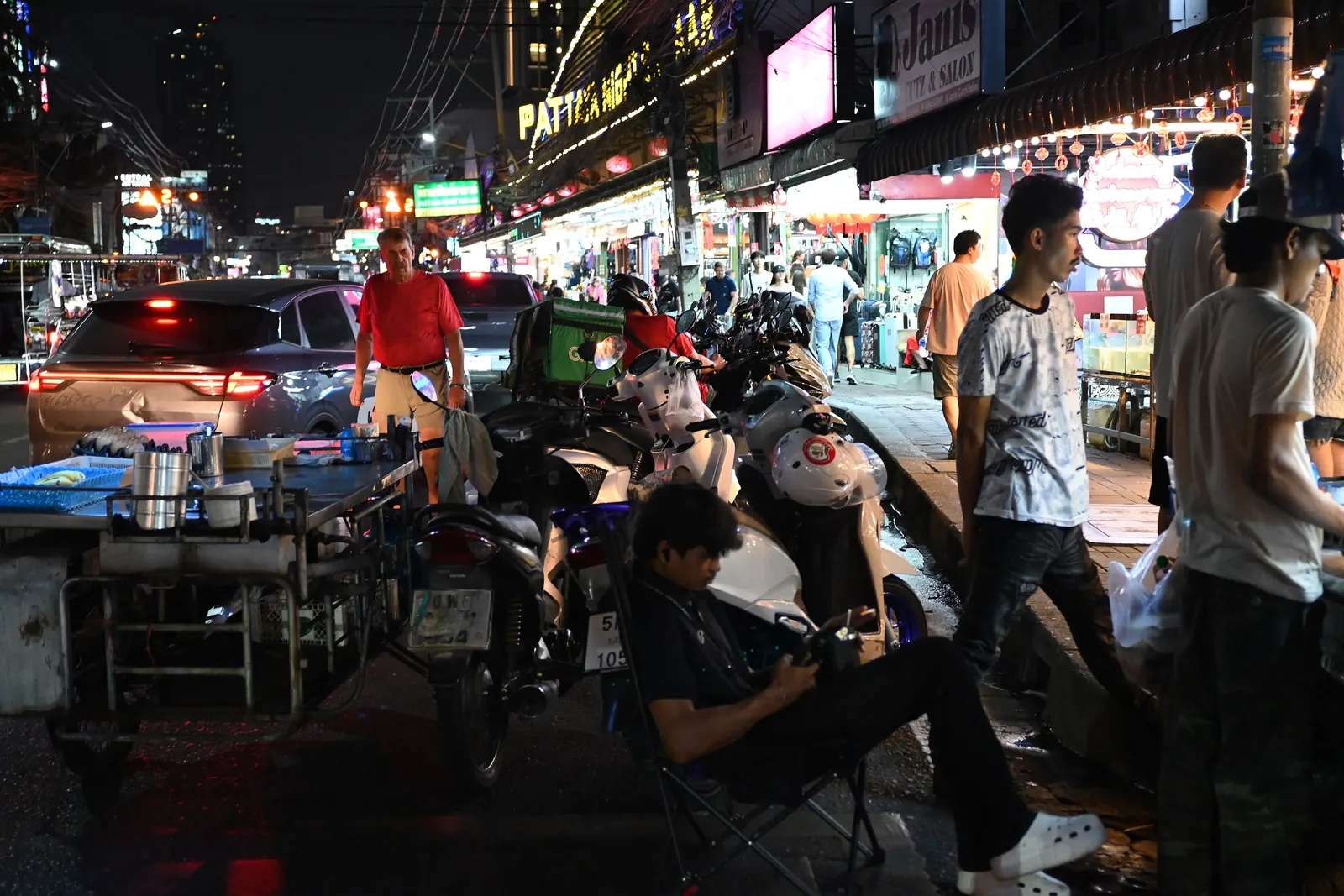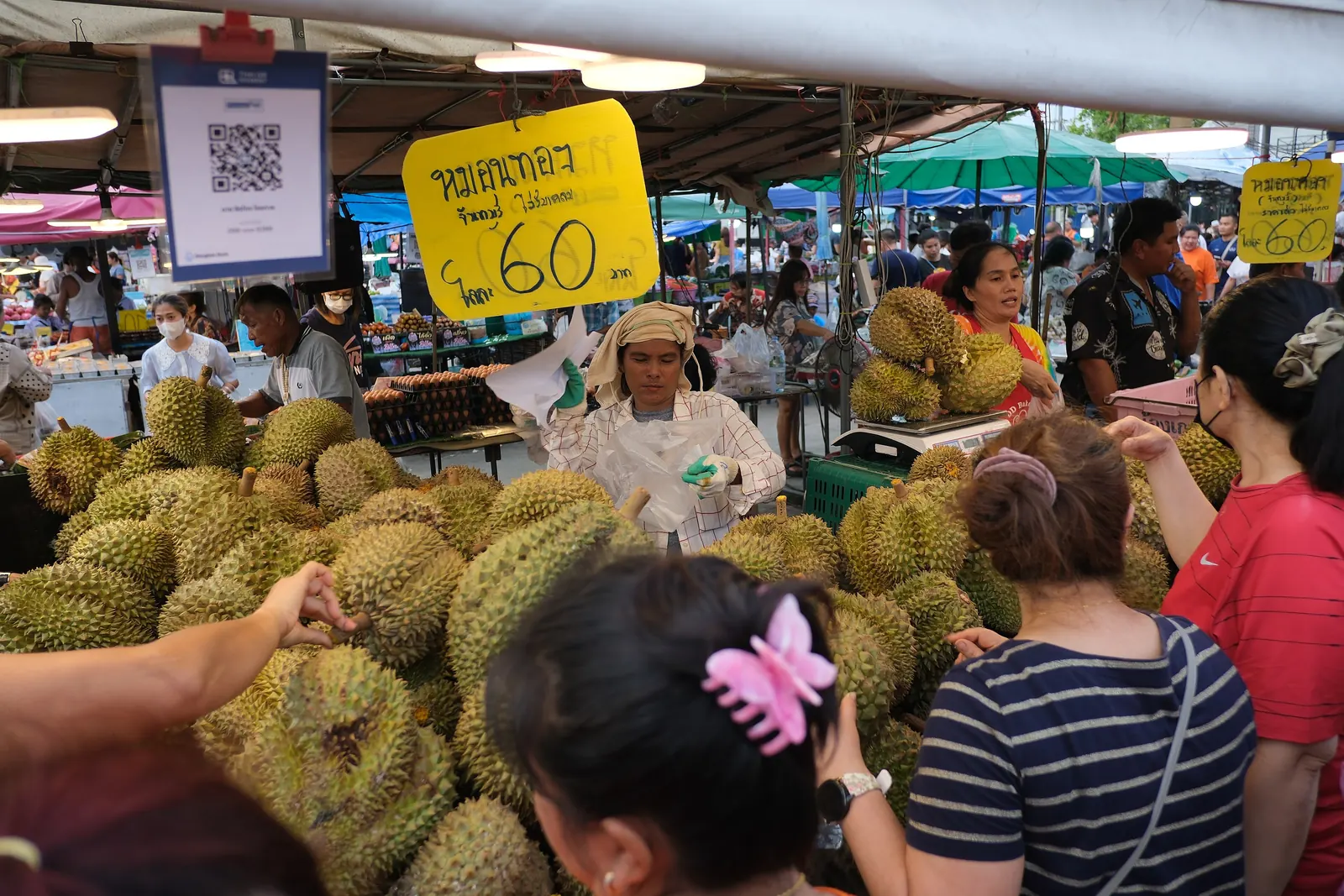
Thailand does not have a fruit season. It has about fifteen of them, stacked on top of each other, and the mistake most visitors make is arriving in the wrong one and concluding that the country runs on pineapple and watermelon. This Thailand fruit season chart is the desk’s attempt to fix that: 36 fruits, the months they actually peak, what a kilo should cost at a wet market as of October 2026, where each one is grown, and how to pick a good one before the vendor picks it for you.
I grew up in a Bangkok house where the calendar was kept in the kitchen, not on the wall. Crates of mangosteen meant school was nearly over; the first sweet tamarind meant it was cold enough for my grandmother to find her cardigan. That system is written down below, with prices.
The short version: the tropical crescendo is April to July, when the eastern provinces around Chanthaburi and Rayong dump durian, mangosteen and rambutan on the whole country at their cheapest; the south repeats the trick from July to September; the north answers from November to February with strawberries, tangerines and tamarind. Our Thai fruit guide covers what each fruit tastes like and how to ask for it; this chart is about timing and money. For what the timing does to the rest of your trip, read best time to visit Thailand.
Thailand fruit season chart: 36 fruits, peak months and a fair price per kilo
Peak means the weeks when supply is highest, quality is best and the price is lowest, which in Thailand are the same weeks. Shoulder months are in brackets. Off-season fruit exists for anything a farmer can coax with potassium chlorate or fly in from Vietnam, and you pay for it twice, in baht and in flavour. Prices are what a Bangkok or provincial wet market charges per kilo in peak, sanity-checked against the wholesale boards at Talaad Thai and the price list of the Marketing Organisation for Farmers, the body that runs Or Tor Kor; tourist-zone fruit cups are a different economy, covered further down. Thai names are there so you can read the sign.
| Fruit (Thai · romanised) | Peak months (shoulder) | Wet-market ฿/kg in peak | Grown | How to pick one |
|---|---|---|---|---|
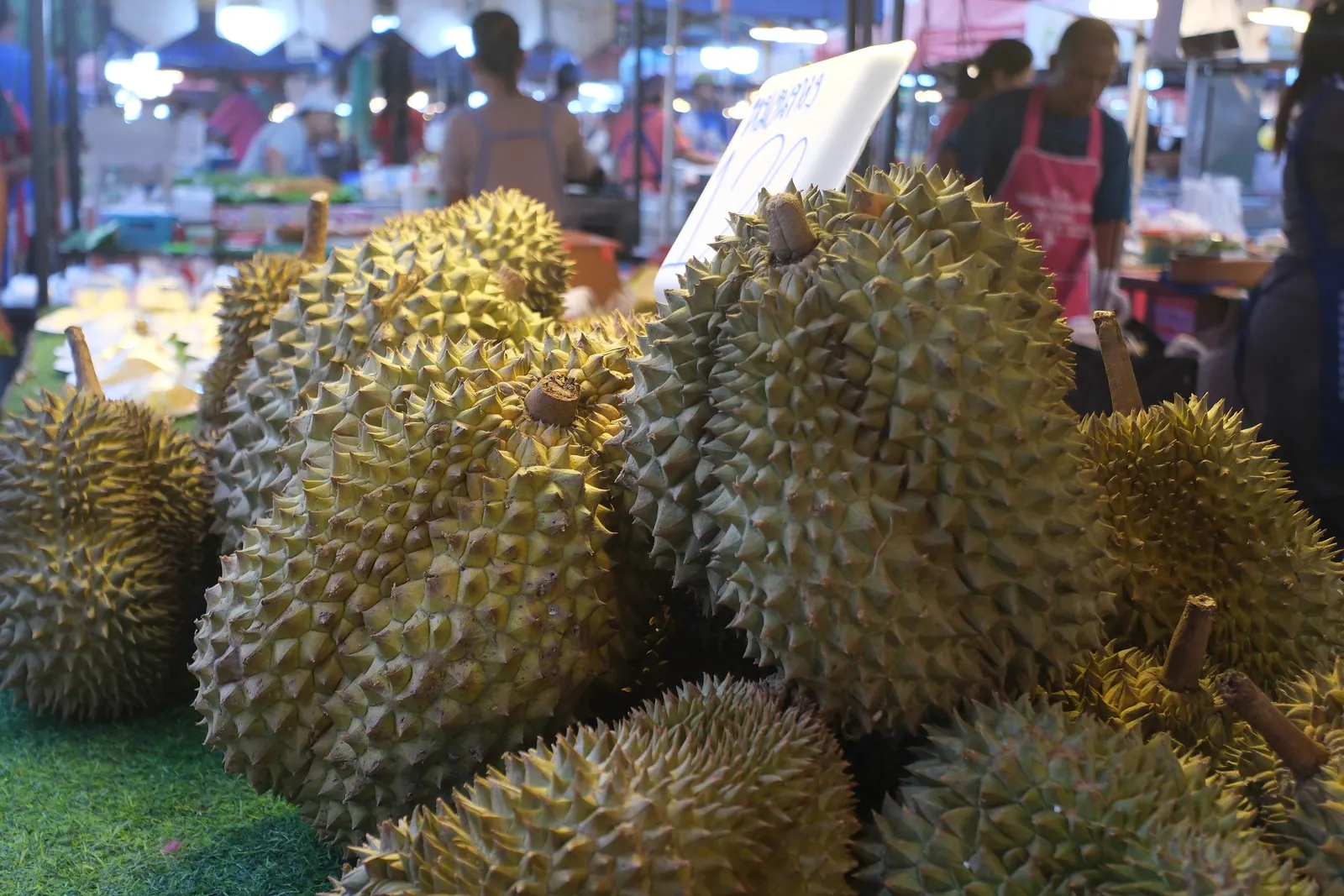
| Durian, Monthong (ทุเรียนหมอนทอง · mon thong) | May–Jun east (late Apr; Jul–Sep south) | 100–180 whole | Chanthaburi, Rayong, Trat | Green damp stem, hollow knock; let the seller open it |
| Durian, Chanee (ชะนี · chani) | late Apr–Jun | 80–120 | Chanthaburi, Rayong | Stronger and softer; for converts only |
| Durian, Kan Yao (ก้านยาว · kan yao) | May–Jun (Jul) | 150–300; Nonthaburi fruit priced per fruit, in the thousands | Nonthaburi, Chanthaburi | Long stem, round fruit; often a Monthong in disguise |
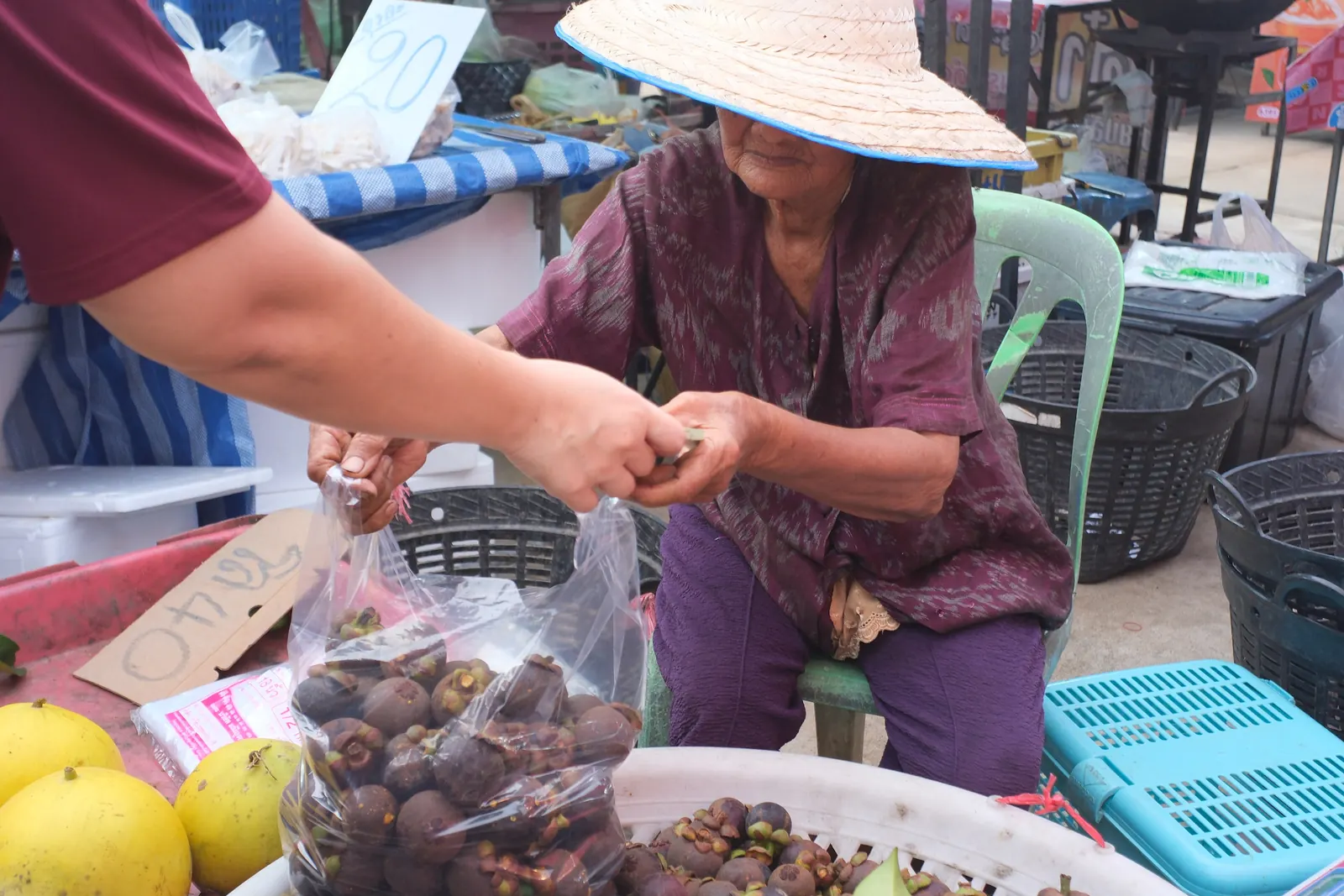
| Mangosteen (มังคุด · mangkhut) | May–Jul east; Jul–Sep south (Apr, Oct) | 30–80 in the glut; 100 at the edges | Chanthaburi, Trat, Nakhon Si Thammarat | Shell gives under a thumb; the petals underneath count the segments |
| Rambutan (เงาะ · ngo) | May–Jul east; Jul–Sep south | 30–60 | Chanthaburi, Surat Thani | Red shell, green-tipped hairs; brown hairs are yesterday’s |
| Longkong / langsat (ลองกอง · longkong) | Jul–Aug east; Aug–Oct deep south | 60–120 | Narathiwat, Yala, Chanthaburi | Dusty yellow, sticky stem; freckles fine, mould not |
| Longan (ลำไย · lamyai) | Jul–Sep, peak Aug (Dec–Feb off-season) | 40–80; 80–150 off-season | Lamphun, Chiang Mai | On the branch, heavy, no cracks |
| Lychee (ลิ้นจี่ · linchi) | Apr central; May–Jun north | 80–150; Hom Jakkraphat 250 and up | Samut Songkhram, Chiang Mai, Phayao | Bright red, flexible skin; brown means last week |
| Mango, Nam Dok Mai (มะม่วงน้ำดอกไม้) | Mar–May (Feb, Jun) | 40–80; double off-season | Chachoengsao, Ratchaburi | Pale gold, slight give, floral at the stem |
| Mango, Ok Rong (อกร่อง · ok rong) | Mar–May | 50–90 | Central plain | The sticky-rice mango; ripe when it smells ripe |
| Green mango, Khiao Sawoei (เขียวเสวย) | year-round, best Nov–Mar | 30–60; cut bags 10–20 | Nakhon Pathom, Ratchaburi | Firm and pale, eaten crunchy with chilli-salt |
| Jackfruit (ขนุน · khanun) | Jan–May (year-round) | 80–120 peeled | Rayong, Chonburi, Isaan | Buy it peeled in a tray; soft means fermenting |
| Papaya (มะละกอ · malako) | year-round | 25–50; 80 at Or Tor Kor | Everywhere | Holland type, slight give; green is for som tam |
| Pineapple, Phulae and Pattavia (สับปะรด · sapparot) | year-round, best Apr–Jun and Nov–Jan | 40–80 Phulae; 20–50 the big ones | Chiang Rai; Prachuap Khiri Khan | Phulae is eaten core and all; on big ones a leaf pulls out clean |
| Dragon fruit (แก้วมังกร · kaeo mangkon) | Jun–Oct (year-round) | 30–60; red-flesh a little more | Chanthaburi, Chiang Rai | Red flesh over white; no wrinkling at the base |
| Rose apple (ชมพู่ · chomphu) | Dec–Mar (Nov, Apr) | 40–80; Thap Thim Chan 100–150 | Ratchaburi, Phetchaburi | Waxy and heavy; the dark red Thap Thim Chan is the one |
| Sapodilla (ละมุด · lamut) | Nov–Feb (Oct, Mar) | 40–70 | Sukhothai, Samut Sakhon | Soft as a ripe pear, no milky sap |
| Custard apple, Phet Pak Chong (น้อยหน่าเพชรปากช่อง) | Jun–Sep (Oct) | 100–200 | Pak Chong | Big smooth hybrid; ripe when the segments part |
| Sugar apple (น้อยหน่า · noi na) | Jun–Sep | 50–100 | Pak Chong, Isaan | Knobbly, slightly soft, no black patches |
| Santol (กระท้อน · krathon) | Jun–Aug | 40–80; Tapan Thong 100 and up | Lop Buri, Nonthaburi | Big, golden, velvety; Tapan Thong eats plain |
| Salak / snake fruit (สละ · sala; ระกำ · rakam) | May–Aug | 60–120 | Chanthaburi, Trat | Sumalee cultivar, plump scales; rakam is for som tam |
| Sweet tamarind (มะขามหวาน · makham wan) | Dec–Feb (Mar) | 80–200 | Phetchabun | Fat brittle pods that rattle; Sri Chomphu is the cultivar |
| Guava (ฝรั่ง · farang) | year-round, best Jul–Sep and the cool season | 30–50 | Nakhon Pathom, Samut Sakhon | Kim Ju type, pale green, eaten crisp |
| Pomelo (ส้มโอ · som o) | Aug–Nov (Jul, Dec) | 50–120 per fruit | Nakhon Pathom, Nakhon Si Thammarat, Chai Nat | Heavy for its size; ask for it peeled, ฿10–20 more |
| Watermelon (แตงโม · taeng mo) | Mar–Apr (year-round) | 15–30; 40–80 a fruit | Everywhere | Dull skin, yellow belly, deep knock; the small Kinnaree type is sweeter |
| Banana, Nam Wa (กล้วยน้ำว้า) | year-round | 20–40 a hand | Everywhere | Short and fat; the cooking-and-everything banana |
| Banana, Hom (กล้วยหอม) | year-round | 30–50 a hand | Phetchaburi, Pathum Thani | Long and fragrant; freckles are flavour |
| Banana, Khai (กล้วยไข่) | Aug–Oct (year-round) | 30–60 a hand | Kamphaeng Phet | Thumb-sized, thin-skinned; eaten at Sart Thai with krayasat |
| Coconut, nam hom (มะพร้าวน้ำหอม) | year-round | 25–40 a nut at market; 40–60 on the street; 80–120 on a beach | Ratchaburi, Samut Songkhram | Small, trimmed white, heavy; the beach premium is a view tax |
| Passion fruit (เสาวรส · saowarot) | Nov–Feb (Aug–Oct) | 60–120 | Chiang Mai, Chiang Rai hill farms | Wrinkled is ripe, smooth is sour |
| Strawberry (สตรอว์เบอร์รี) | Dec–Feb (Nov, Mar) | 100–250 in Chiang Mai; 300 and up in Bangkok | Samoeng, Chiang Mai | Red to the stem; eat the same day |
| Marian plum (มะยงชิด / มะปราง · mayongchid / maprang) | Feb–Mar | 150–300 mayongchid; 60–100 maprang | Nakhon Nayok | Apricot-coloured, unblemished, smells sweet |
| Star fruit (มะเฟือง · mafueang) | Aug–Jan | 30–60 | Nakhon Pathom, Samut Sakhon | Yellow ribs, browning edges; green is for salad |
| Jujube (พุทรา · phutsa) | Dec–Feb | 40–80; milk jujube 80–120 | Chiang Mai, Phichit | Crisp, apple-green to gold; the milk jujube is worth the extra |
| Tangerine, Sai Nam Phueng (ส้มสายน้ำผึ้ง) | Nov–Feb, peak Dec–Jan | 40–80; 70–90 off-season | Fang, Chiang Mai | Loose thin skin, heavy with juice; green-tinged is fine |
| Avocado (อะโวคาโด · awokhado) | Aug–Nov | 60–120 | Phop Phra (Tak), Chiang Mai | Thai-grown; buy hard, ripen in the room |
Two footnotes. Durian is priced by the kilo whole, and roughly a third of that weight is flesh, so ฿150 a kilo at the stall is ฿450 a kilo of what you eat, which is why the sealed flesh-only clamshells at ฿300–600 a kilo are not the rip-off they look. And the eastern durian calendar moves by cultivar: in 2026 the Chanthaburi harvest was reported opening with Kradum Thong around 20 March, Chanee and Puang Manee around 10 April, and Monthong and Kan Yao around 20 April, which is why April Monthong costs June money and tastes of March.
What Thai fruit costs per kilo, and how not to pay the foreigner price
The honest baseline is wholesale. In the July 2025 glut, Talaad Thai, the wholesale market north of Bangkok, was clearing Monthong at ฿80–120 a kilo, Chanee at ฿60–70, Kan Yao at ฿100–120, rambutan at ฿20–28 and mangosteen at ฿10–25. A wet market doubles that and a good one adds a little more for sorting, which is where the chart’s ranges come from. At the top of the market, the Marketing Organisation for Farmers’ price board on 28 September 2026, effectively the Or Tor Kor list, had mangosteen at ฿100, longkong at ฿120, pineapple at ฿50, Holland papaya at ฿80 and Monthong flesh at ฿2,500 a kilo, which is what late season plus a famous market address does to a price. Our Thailand price index tracks the rest: a fresh coconut is ฿40–60 fair and ฿80–120 on a beach; mango sticky rice is ฿60–100 at an honest shop and ฿150–250 in a tourist night market; a fruit shake is ฿40–80.
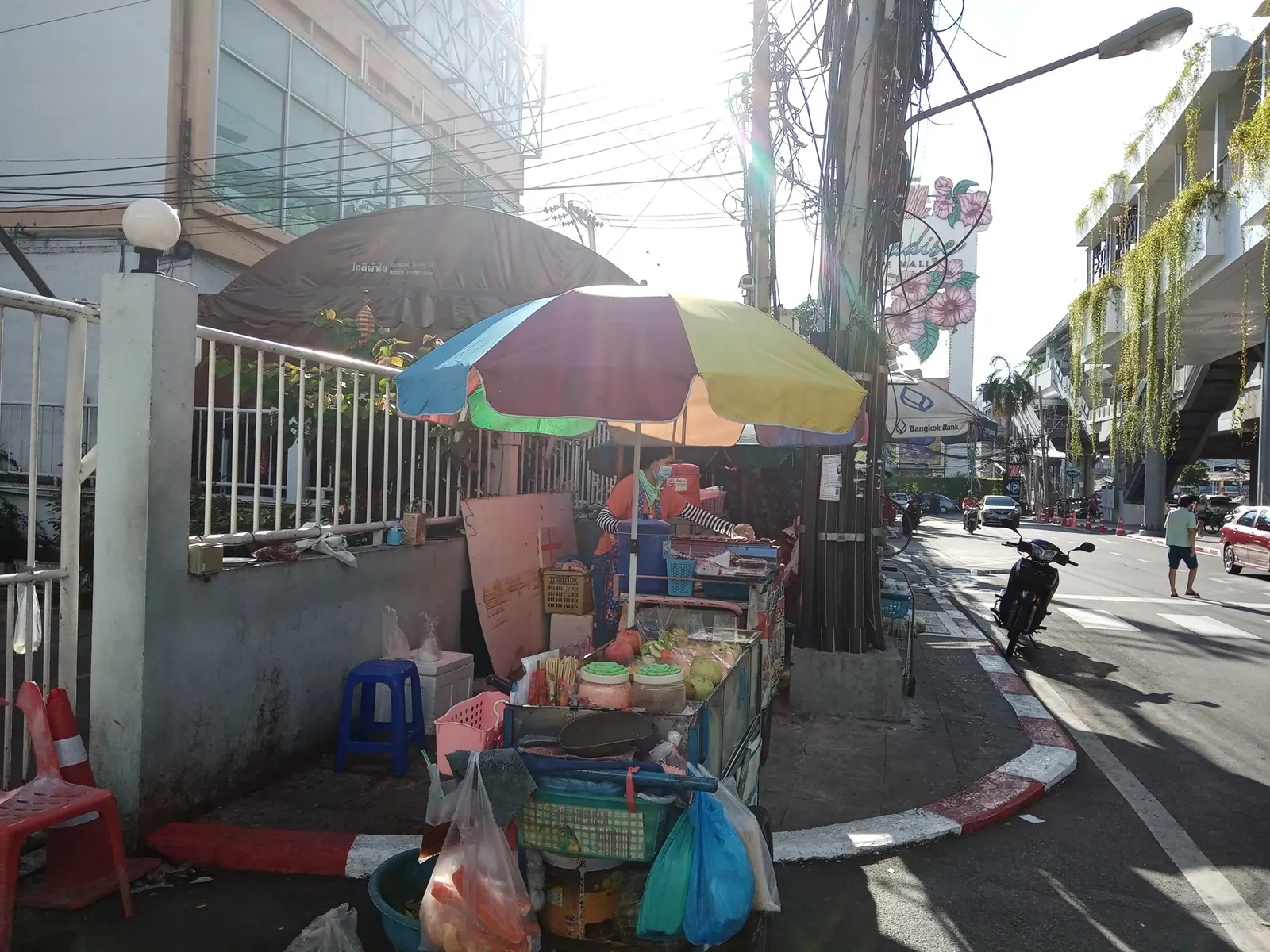
The foreigner price. At a wet market the sign is the price, written per kilo, and nobody rewrites it for your passport. Where there is no sign, ask lo la thao rai, how much a kilo, and expect the answer to be 20 or 30 per cent over what the woman behind you pays; that is the tourist premium, and it is not worth a scene. The real markups are elsewhere: the ฿100 cup of six watermelon cubes on a beach, the ฿250 mango sticky rice under fairy lights, the fruit basket in the hotel lobby. Sellers weigh on a hanging spring scale or a digital one, round up to the next hundred grams, and will sell half a kilo, khrueng lo, without complaint. Cut-fruit carts sell by the bag, ฿10–20 with the chilli-salt-sugar packet thrown in, ฿20–30 on Sukhumvit, ฿50 anywhere with a tuk-tuk rank outside; the hygiene questions are answered in our street-food safety guide, and the carts’ neighbours are in the Bangkok street food guide. If you want the market explained by someone who shops there, a Bangkok market food tour usually starts at Or Tor Kor and ends with somebody opening a durian for you.
What fruit is in season in Thailand right now, month by month
Read this with the chart: each month lists what is genuinely in season, the fruits to go out of your way for, and the one to leave on the stall. What the same months do to the weather and the rest of your itinerary is in our Thailand by season hub.
January
Cool-season fruit at its best: Sai Nam Phueng tangerines from Fang, Samoeng strawberries, sweet tamarind from Phetchabun (the provincial tamarind fair is usually late January), milk jujube, sapodilla, the first rose apples and crunchy green mango. Seek out: tangerines at ฿40–60 a kilo and a bag of tamarind pods. Skip: off-season Monthong at ฿250 a kilo, sold to the Chinese New Year crowd.
February
Marian plum month. Mayongchid from Nakhon Nayok, ฿150–300 a kilo and worth it once; the province’s fair runs February into March. Strawberries peak (the Samoeng festival is usually mid-February), rose apple hits its stride, jackfruit starts, tangerines fade. The first Kradum Thong durian appears in Chanthaburi at prices only an obsessive should pay. Seek out: mayongchid, Thap Thim Chan rose apple. Skip: early durian.
March
Mango season opens, and with it the only legitimate mango sticky rice season: Nam Dok Mai and Ok Rong at ฿40–90 a kilo by the end of the month. Watermelon is at its sweetest in the heat, jackfruit and pineapple are everywhere, and the eastern Kradum Thong durian harvest starts around the third week. Seek out: Ok Rong on sticky rice, ฿60–100 a plate away from the tourist zones. Skip: nothing. Eat mango.
April
Songkran means mango, coconuts by the truckload, and the shortest season of the year: Hom Jakkraphat lychee from Samut Songkhram, gone in a fortnight at ฿250 a kilo and up. In the east the durian gates open, Chanee from about the tenth, Monthong and Kan Yao from about the twentieth. Seek out: mango, central lychee, the first Chanee. Skip: paying June prices for early Monthong cut too young.
May
The big month. Eastern durian peaks, mangosteen and rambutan start flooding the wholesale markets and prices drop by the week; the Rayong Fruit Festival (23–29 May in 2026) and the Department of Internal Trade’s mall fruit fairs sell orchard-grade fruit at orchard prices, export-grade Monthong at ฿140–150 a kilo this year. Northern lychee from Chiang Mai and Phayao arrives late in the month, sala starts, mango finishes. Seek out: Monthong at ฿100–150 a kilo whole. Skip: the ฿2,000 durian buffet unless someone else is paying.
June
The cheapest mangosteen of the year, ฿30–50 a kilo, and the one fruit I would fly in for. Durian is still peaking in the east, rambutan is ฿30–40, sala and santol come in, longkong starts in Chanthaburi, whose durian fair usually runs late May into June. Seek out: mangosteen by the crate, Kan Yao if a seller you trust has it. Skip: the last fibrous mangoes.
July
The handover: the east winds down and the south, Chumphon, Surat Thani and Nakhon Si Thammarat, takes over durian, mangosteen and rambutan into September. Santol peaks, with Lop Buri’s Tapan Thong the one to pay for; sugar apples and Phet Pak Chong custard apples come down from Pak Chong; dragon fruit is at its cheapest; longkong from the east. Seek out: santol with chilli-salt, a custard apple. Skip: “northern” lychee in July; it is from China.
August
Longan month. Lamphun and Chiang Mai harvest, the Lamphun longan fair is in August, and a kilo on the branch is ฿40–60. Pomelo opens in Nakhon Pathom and Chai Nat, kluai khai bananas ripen in Kamphaeng Phet, star fruit and southern mangosteen continue. Seek out: longan, pomelo. Skip: dried longan sold at fresh-season prices.
September
Longkong from the deep south, Narathiwat and Yala, is the reason to be in a Thai market in September, ฿60–120 a kilo. Late southern durian and mangosteen hang on (Or Tor Kor was still asking ฿100 a kilo for mangosteen on 28 September 2026), pomelo is in full swing, kluai khai and star fruit are cheap. Seek out: longkong. Skip: anything labelled eastern durian; the east finished in July.
October
The tropical trough and the Vegetarian Festival, which in Phuket and Bangkok’s Chinatown means nine days of fruit-heavy eating; our vegetarian festival food guide explains the yellow flags. Pomelo peaks, sapodilla and papaya are good, the first oranges arrive, longkong tails off. Seek out: a peeled pomelo for ฿80. Skip: mangosteen, now last month’s fruit at this month’s price.
November
The cool season arrives: tangerines from Fang, the first Samoeng strawberries late in the month, sapodilla, jujube, rose apple, passion fruit from the hill farms. Pomelo, guava, papaya, banana, pineapple and coconut carry on regardless. Seek out: sapodilla, the first tangerines. Skip: strawberries before December, sour and ฿300.
December
Peak cool-season fruit: sweet tamarind, milk jujube, Sai Nam Phueng tangerines at their best, Samoeng strawberries at ฿100–200 a kilo in Chiang Mai, rose apple, sapodilla and off-season longan from Chanthaburi for the year-end Chinese market. Off-season Monthong reappears for Christmas at ฿250 a kilo and up. Seek out: tamarind, strawberries in the north. Skip: durian; it is the wrong half of the year.
Fruit festivals and fairs worth planning a trip around
Thailand celebrates a harvest the way other countries celebrate a football result, and the fairs are where orchard prices meet the public. The Rayong Fruit Festival at the Taphong fruit market ran 23–29 May in 2026 and sits in the same fortnight most years; pair it with the beach in our Koh Samet from Rayong guide. Chanthaburi’s durian fair, late May into June, is the one for the obsessives, and an orchard day trip from Bangkok is the lazy way to reach it. The Department of Internal Trade’s Fruits Festival toured Bangkok’s malls in 2026, Central Westgate 9–11 May and Central Pinklao 6–12 June, with 150 tonnes of fruit and Monthong at ฿140–150 a kilo. In the north: the Samoeng Strawberry Festival, usually mid-February; the Nakhon Nayok mayongchid fair, February into March; Lamphun’s longan fair in August; the sweet tamarind fair in Phetchabun, usually late January; and Kamphaeng Phet’s kluai khai fair around Sart Thai in September or October. Exact dates shift with the harvest and the provincial governor; our festivals and public holidays calendar tracks the ones that are confirmed.
Durian bans, the mangosteen stain and taking fruit home
Durian is banned wherever the sign says so, and the sign is everywhere. The BTS and MRT list it among prohibited items, most hotels post a no-durian rule with a cleaning charge behind it (฿2,000–5,000 is the range we have seen quoted; ask at check-in), Grab drivers will cancel the ride, and Thai airlines bar fresh durian from cabin and hold alike. The answer is the one Thais use: buy the flesh in a sealed clamshell, eat it on the plastic stool beside the stall, and wash your hands with the water the seller keeps for exactly that. Do not put it in the minibar. The same goes, more mildly, for jackfruit.
The mangosteen stain. The purple rind bleeds a sap that does not come out of cotton, ever. Hold the fruit top and bottom, press until it cracks, twist, and keep it away from white linen and the hotel towels. Rambutan, longan and longkong seeds go into your hand and then a bag; the vendor spits into the gutter, the guest does not. The chilli-salt-sugar packet, phrik kap kluea, goes on green mango, guava, santol and pineapple, and on nothing sweet; a Thai watching you salt a mangosteen will say nothing and remember it forever.
Taking fruit home. Thailand itself will not stop you leaving with most fruit, but your own border will: Australia, New Zealand, the United States, the EU, the UK, Japan and Singapore all confiscate fresh fruit without a phytosanitary certificate you will not have, and Thailand’s own Department of Agriculture tells travellers not to buy fresh fruit as souvenirs for that reason. Fresh durian is barred by the airlines before customs even gets a look. What travels is dried mango, freeze-dried durian and mangosteen jam, sealed and from a supermarket. Coming the other way, bringing fresh fruit into Thailand without a certificate breaks the Plant Quarantine Act: up to a year inside, a fine of up to ฿20,000, or both. Nobody checks the apple in your bag; that is not the same as it being allowed.
Five fruits to chase and four to skip
Chase. Mangosteen in June, from the east, by the kilo, ideally on a plastic stool in Chanthaburi. Longkong in September from the deep south, the fruit Thais drive across provinces for and tourists never hear about. Mayongchid in February, once, because ฿250 a kilo for an apricot that tastes of honey is a fair trade. Ok Rong on sticky rice in April, from a shop with no English menu, ฿60–100 a plate; our Thai desserts guide has what to eat after. And a kilo of Sai Nam Phueng tangerines in January, eaten in a Chiang Mai hotel room like a citrus-scented sin.
Skip. Dragon fruit on a hotel breakfast buffet, where it is served for its colour and tastes of the refrigerator. Durian outside its half of the year, at any price. Punnets of “Japanese” strawberries at ฿600 in a Bangkok mall when Samoeng’s are ฿150 a kilo and picked that morning. And the ฿100 cup of watermelon on a beach; walk two hundred metres inland and it is a whole fruit for the same money.
Thai fruit seasons: your questions, answered
What fruit is in season in Thailand in November?
The tropical trough, but not an empty one. Pomelo is at its best, sapodilla and jujube are starting, the first Fang tangerines and Samoeng strawberries arrive in the last fortnight, and papaya, guava, banana, pineapple and coconut never stop. Longkong from the deep south lingers into early November. Durian and mangosteen are off-season and priced accordingly; eat those in June and September.
When is mangosteen season in Thailand?
Twice a year. The eastern crop from Chanthaburi, Trat and Rayong runs May to July with the cheapest fruit in June, when a kilo falls to ฿30–50 at a wet market. The southern crop from Nakhon Si Thammarat, Chumphon and Surat Thani follows from July to September and was still ฿100 a kilo at Or Tor Kor in late September 2026. Outside those windows what you see is stored or imported, and tastes like it.
When is durian season in Thailand?
April to July in the east, with May and June the peak: in 2026 the Chanthaburi harvest was reported opening with Kradum Thong around 20 March, Chanee around 10 April and Monthong and Kan Yao around 20 April. The south, from Chumphon down to Yala, runs July to September. Nonthaburi’s heritage orchards crop in May and June in tiny, expensive quantities. Anything sold in December is off-season or was frozen.
When is mango sticky rice season in Thailand?
March to May, when Nam Dok Mai and Ok Rong ripen on the tree and a kilo is ฿40–90 rather than double that. Songkran in mid-April is the natural peak. Shops sell it all year on off-season fruit, and our price index puts an honest plate at ฿60–100 against ฿150–250 in tourist night markets; Or Tor Kor’s ฿150 version, as our Bangkok breakfast guide notes, is the one that earns it.
Can I bring fruit home from Thailand?
Not fresh, in practice. Thailand rarely stops fruit leaving, but airlines refuse fresh durian outright, and Australia, New Zealand, the United States, the EU, the UK, Japan and Singapore confiscate fresh fruit that arrives without a phytosanitary certificate. Thailand’s Department of Agriculture advises against buying fresh fruit as souvenirs for exactly that reason. Dried mango, freeze-dried durian and jam in sealed packets travel without trouble.
Related guides
- A grammar of Thai fruit — what to eat, when, and how to ask for it
- Thailand’s Vegetarian Festival: What the Yellow Flags Mean (and What to Eat)
- Best Thai Desserts Beyond Mango Sticky Rice
Book the trip
Some links in this guide are affiliate links. If you book through them we may earn a small commission at no extra cost to you — it helps keep Destination Thailand independent.
Hotels: sleep near a market that opens before you do, Or Tor Kor for the top of the range and Khlong Toei for the bottom: compare Bangkok hotels on Agoda. Tours: in May and June, a Chanthaburi durian and fruit orchard day trip puts you at the source; the rest of the year a Bangkok market tour is the honest substitute. Getting there: the fruit belt is three to four hours east of Bangkok: book the Bangkok to Chanthaburi bus on 12Go; for the northern winter fruit, our Bangkok to Chiang Mai transport guide ranks the options and 12Go sells the tickets. Not sure which province is next? Try our where to go in Thailand matcher.