Nakhon Nayok is the province Bangkok forgets it has. Just over 100 kilometres from the capital, 90 minutes from Don Mueang if the tollway behaves, it sits under the southern wall of the Khao Yai massif catching all the water that rolls off it. The result is a compact green pocket of waterfalls, a river you can raft down, and a dam so absurdly large you can cycle across the top of it. No islands, no full moon parties, no banana pancakes. That is precisely the point.
This is a day-trip and one-night province, and honest about it. Thai families and Bangkok office outings have kept it busy for decades whilst foreign tourism barrelled straight past toward Khao Yai’s fancier northern gate. For the data-sheet version, see our Nakhon Nayok province profile; this guide is the opinionated one.
Come in the rainy season, when the falls are actually falling, and you get the closest legitimate nature escape Bangkok possesses. Come in April and you will wonder what the fuss was about.
What Nakhon Nayok really is
Nakhon Nayok is Bangkok’s weekend pressure valve. The town itself is an unremarkable provincial capital, a market, some government buildings, a river through the middle, and you should not plan a trip around it. The action is all in the northern third of the province, where the land tilts up into Khao Yai National Park and the river comes crashing down out of it.
Functionally, that northern strip is an adventure-activity corridor. Rafting outfits, ATV tracks, rope courses and team-building camps line the Nang Rong valley road, because every Thai company within two hours needs somewhere to send its staff for enforced bonding. Around them sit the genuine article: a nine-tier waterfall, a swimmable river park, and Khun Dan Prakan Chon, the world’s longest roller-compacted-concrete dam. Half national park, half corporate away-day; it works far better than it sounds.
Why go to Nakhon Nayok
Because it is close, cheap and real. Leave Don Mueang at eight in the morning and you can be standing under a waterfall before half past ten, about ฿100 lighter. Kanchanaburi wants three hours of your life. Koh Samet wants four and a ferry. Nakhon Nayok wants ninety minutes and asks almost nothing in return.
The province also does one thing better than almost anywhere in Thailand: falling water. The Khao Yai escarpment drains straight into it, so within a 20-kilometre arc you get Sarika’s nine tiers, Nang Rong’s three, the swimming park at Wang Takhrai and a rafting river whose flow is guaranteed by dam releases rather than prayer. And in February and March there are marian plums. Nakhon Nayok grows the best maprang in the country, golden, sweet-sharp little things sold from orchard stalls along every road. Thais drive out from Bangkok purely for the fruit. They are right to.
Getting to Nakhon Nayok
There is no train; the Eastern Line swings south through Chachoengsao on its way to the Cambodian border and misses Nakhon Nayok completely. Your options are road, road or road.
Cheapest is a minivan from Mo Chit, the Bangkok Bus Terminal at Chatuchak: around ฿100 and roughly two hours depending on Rangsit traffic. From town, songthaews and motorbike taxis cover the run up to Sarika and Nang Rong but thin out badly by afternoon; agree a return pickup or you will be walking.
Driving is the way to do this province. Route 305 runs arrow-straight from Rangsit through Ongkharak, and from Don Mueang you are looking at about 90 minutes door to waterfall. That makes Nakhon Nayok quicker to reach than half of Bangkok’s own suburbs, which tells you everything about Bangkok traffic.
Where to stay
Most visitors do not stay at all; this is Thailand’s most day-trippable province. If you do, three zones make sense. The resort strip along the roads toward Sarika and the dam has the pick of it: garden resorts with pools and river frontage at ฿1,200-2,500 a night midweek, rising sharply at weekends when Bangkok arrives en masse. Book ahead for a Saturday; do not bother for a Tuesday.
The Nang Rong valley has riverside camps and simple bungalows aimed at the rafting crowd, from around ฿600-800, fine for a night and heaving with corporate groups in the cool season. The town itself has clean, dull guesthouses near the market at ฿500-700 if you just need a bed near the morning minivan.
What to eat in Nakhon Nayok
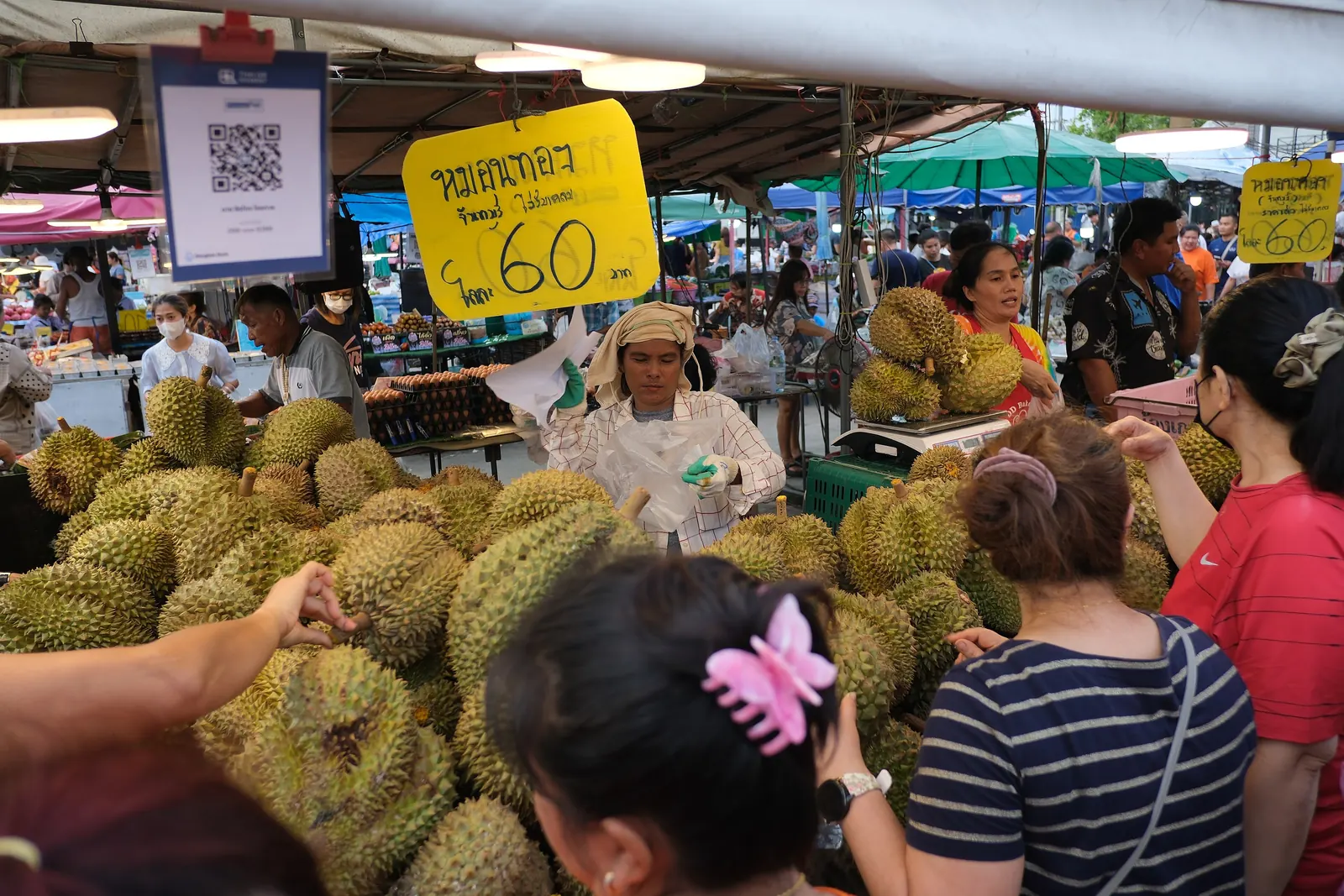
The headline is fruit. From February to early April the orchard stalls come out along Route 305 and the falls roads, selling maprang and its posher cousin mayongchid at around ฿100-200 a kilo depending on grade. Buy more than you think you want. Nakhon Nayok’s marian plums are a genuine national obsession, and this is the source.
Beyond that, eat where the water is. The lanes near Wang Takhrai and Nang Rong are lined with open-air places doing whole grilled river fish, tom yam and som tam at ฿60-150 a dish, aimed squarely at wet Thai families and all the better for it. In town, the night market covers the standards: noodles at ฿50-70 a bowl, grilled chicken, fried everything. Nobody has ever come here for fine dining, and the province has had the good sense not to pretend otherwise.
Top things to do in Nakhon Nayok
1. Cycle across Khun Dan Prakan Chon Dam
The world’s longest roller-compacted-concrete dam is a gloriously silly object: a wall of concrete over two and a half kilometres long, thrown across the Nakhon Nayok valley as one of King Bhumibol’s flood-control initiatives and completed in the mid-2000s. Hire a bicycle at the base and ride the full length of the crest, reservoir and the green bulk of Khao Yai on one side, the central plains fading off on the other. Shuttle trucks run up for a small fee if pedalling uphill offends you. Go late afternoon, when the light turns gold and the concrete stops radiating heat at you.

2. Sarika Waterfall
Nine tiers stacked down the southern face of Khao Yai, and the reason this province is on any map at all. Sarika sits inside the national park boundary, so foreigners pay a fee of a couple of hundred baht; pay it without grumbling, because in season this is one of the best waterfalls within striking distance of Bangkok. The lower pools are for splashing; the path climbs toward the upper tiers if you want to earn your swim. From roughly June to October it thunders. In April it does not.

3. Nang Rong Waterfall
Sarika’s gentler sibling, up its own valley a short drive away: three broad tiers of slides and pools rather than one dramatic plunge. This is the family option: shallower, easier, mats and picnics everywhere at weekends. If you want drama, go to Sarika; if you want to sit in the water for two hours with a bag of som tam, Nang Rong wins. The same wet-season rules apply.

4. Swim at Wang Takhrai
A former aristocratic estate turned streamside park where the river runs clear and shallow under big old trees. You rent an inner tube, drift about, eat, repeat. There is a modest entry fee, camping if you fancy it, and a gentle, unhurried Thainess that the waterfalls lose on busy days. This is the place that feels like being let in on somebody’s family Sunday.
5. Raft the Nakhon Nayok River
Below the dam the river runs a steady chain of small rapids, class I to III depending on the release, and an entire economy of rafting camps exists to send you down it. Expect a few hundred baht per person for a guided run with kit and pickup. It is splashy, cheerful, beginner-grade white water rather than anything heroic, which is what most people actually want. You will share the valley with Thai office parties on team-building day, and their collective joy is oddly infectious.
6. Phuttha Utthayan Makha Bucha Anusorn
On the road out toward the dam sits one of central Thailand’s stranger and more affecting sights: a great seated Buddha ringed by 1,250 identical statues, commemorating the 1,250 disciples who gathered unbidden on the day Makha Bucha marks. Entry is free, the geometry is hypnotic, and early morning or late afternoon light turns the whole field of figures into something genuinely moving. Twenty minutes here recalibrates a day otherwise spent falling off rubber rings.
What to skip
Skip the entire province from March to May. I mean it. Nakhon Nayok is a water province, and in the hot season the water largely goes home. Sarika shrinks to a damp cliff with a queue in front of it, Nang Rong becomes a series of warm puddles, and the rafting runs only on whatever the dam deigns to release. Turning up in April and complaining is like visiting a ski resort in July and being cross about the grass.
And unless you are actually attending one, give the corporate activity compounds a miss. The paintball-zipline-ATV strips are good at what they do, but what they do is Thai team-building, and paying tourist prices to drive a small quad bike around a muddy field is not the best use of anyone’s day.
Nakhon Nayok travel: practical info
Best season: June to October for full waterfalls and reliable rafting, November to February for cool-season camping, February to March for the marian plum harvest. One full day covers the dam, one waterfall and the Buddha park; a lazy overnight adds Wang Takhrai and the second waterfall. More than two nights and you will be inventing reasons to stay.
Onward, the geography is generous. Khao Yai National Park is next door, Saraburi sits to the north-west, and Route 33 runs east through Prachin Buri and Sa Kaeo to the Cambodian border at Aranyaprathet. Or simply roll back down Route 305 to Bangkok in time for dinner, which is what almost everyone does, and there is no shame in it.
Wikipedia’s Nakhon Nayok entry fills in the history properly.
TAT’s official Nakhon Nayok page keeps waterfall and rafting practicalities current.
FAQ
Is Nakhon Nayok worth visiting?
Yes, with conditions. In the wet and cool seasons it is the best quick nature escape from Bangkok: real waterfalls, a swimmable river and the world’s longest roller-compacted-concrete dam inside a 90-minute drive. In the hot season the water disappears, and so should you.
How do I get from Bangkok to Nakhon Nayok without a car?
Minivans run from Mo Chit bus terminal to the provincial town for around ฿100 and take about two hours. Songthaews and motorbike taxis reach Sarika and Nang Rong; arrange your return in advance, because transport fades by mid-afternoon.
Can you swim at the waterfalls in Nakhon Nayok?
Yes. The lower pools at Sarika and most of Nang Rong are swimmable in season, and Wang Takhrai is built entirely around river swimming, with inner tubes for hire. Respect closure signs after heavy rain; flow off the Khao Yai escarpment can rise quickly.
When is the best time to visit Nakhon Nayok?
June to October for waterfalls and rafting, November to February for cool dry sightseeing, February to March for marian plums. March to May is the one window to avoid; the dam, to be fair, works year-round.
How far is Nakhon Nayok from Bangkok?
Just over 100 kilometres from central Bangkok, and about 90 minutes by car from Don Mueang airport via Route 305. Minivans take closer to two hours. It is the fastest genuine escape Bangkok has.