Sa Kaeo is the province most travellers experience at 60 kilometres an hour through a minivan window, somewhere between Bangkok and a Cambodian border stamp. That is a mistake. This flat stretch of border country holds one of the most historically important Khmer temples anywhere, a UNESCO-listed forest where butterflies gather in their thousands, and the biggest second-hand bazaar in Southeast Asia. You will have nearly all of it to yourself.
This is border Thailand: flat, hot, Khmer-inflected. The signage drifts into Cambodian script, the noodle stalls serve fish curries closer to Battambang than Bangkok, and nobody is performing for tourists because there barely are any. Start with our Sa Kaeo province profile for the vitals, then read on for the honest version.
One thing straight away: Sa Kaeo the province and Poipet the Cambodian casino town are separate places; the far side of passport control is dealt with honestly below.
What Sa Kaeo really is
A young province, carved out of Prachin Buri in 1993, straddling the old overland road between Bangkok and Angkor. The south and centre are agricultural flatland: sugarcane, cassava, sweet corn and some of the best melons in the country. Aranyaprathet, the border district, is the economic engine, running on cross-border trade from first light. The north-east climbs into the Dongrek foothills and two proper national parks, Pang Sida and Ta Phraya, both part of the Dong Phayayen-Khao Yai Forest Complex, a UNESCO World Heritage listing most people never finish reading because they stop at the words Khao Yai.
Why go to Sa Kaeo
Three things, done better than almost anywhere else in Thailand. Commerce at its most raw at Rong Kluea Market, where second-hand everything arrives by the bale and leaves by the pickup load. Khmer history without a single tour bus at Prasat Sdok Kok Thom, whose inscription effectively dated the entire empire. And real wilderness at Pang Sida, where in butterfly season the forest tracks flicker like a shaken kaleidoscope.
Also, it costs almost nothing. The third-class train from Bangkok is cheaper than a bowl of airport noodles, a clean guesthouse is ฿500, and a full day out costs less than one Thonglor cocktail. Sa Kaeo is the cheap seats of Thai travel, and the view is better than advertised.
Getting to Sa Kaeo from Bangkok
The train is the romantic option and, for once, also the cheapest thing on the menu. Two ordinary trains a day leave Bangkok’s old Hua Lamphong station, one just before 06.00 and one around lunchtime, rattling east for five and a half to six hours to Aranyaprathet and on to Ban Khlong Luk, the halt a few hundred metres from the border fence. Third class, under ฿50. Not a typo. Wooden seats, open windows, fried-banana vendors included.
Buses and minivans from Bangkok’s Mo Chit terminal are quicker: four to four and a half hours to Aranyaprathet for ฿200-280, most stopping in the provincial capital en route. Driving, take Route 33 through Nakhon Nayok and Prachin Buri, roughly 200 kilometres to Sa Kaeo town and 250 to the border, three and a half to four hours if you resist the roadside melon stalls, which you should not.
There is no airport, which is precisely why the tour buses never come.
Where to stay in Sa Kaeo
Manage expectations: this is a working province, not a resort one, which keeps prices honest. Aranyaprathet has the widest choice: plain, clean guesthouses from about ฿400-600 near the market and clock tower, and aircon hotels at ฿800-1,400 that top out at a solid three stars whatever the lobby sign claims. Sleep here if Rong Kluea and the border are your focus.
Sa Kaeo town, the provincial capital, sits on both the railway and Route 33 and is the sensible base for Pang Sida; the park headquarters are about half an hour north. Same price bands, fewer options. Inside the park there are park-service bungalows and a campground with tents for hire at a few hundred baht; book through the national parks system in butterfly season rather than turning up hopeful.
What to eat in Sa Kaeo
The food leans Khmer, and it is better for it. Look for khanom chin, fermented rice noodles, under a Cambodian-style fish curry closer to num banh chok than anything in central Bangkok; expect ฿30-50 a plate at the morning markets. Grilled chicken with sticky rice and a som tam that does not hold back on the fermented fish runs ฿60-120 for a serious feed.
Rong Kluea’s food stalls exist to feed thousands of traders, which is the best possible pedigree: noodle soups at ฿40-60, strong sweet coffee, Khmer-style grilled fish. In the evening the night market in central Aranyaprathet is the move, point-and-order wok stalls at ฿50-80 a dish. On Route 33, pull over for the fruit: Sa Kaeo is serious cantaloupe and sweet-corn country, and a chilled melon on a 38-degree border afternoon is better than it has any right to be.
Top things to do in Sa Kaeo
1. Get lost in Rong Kluea Market
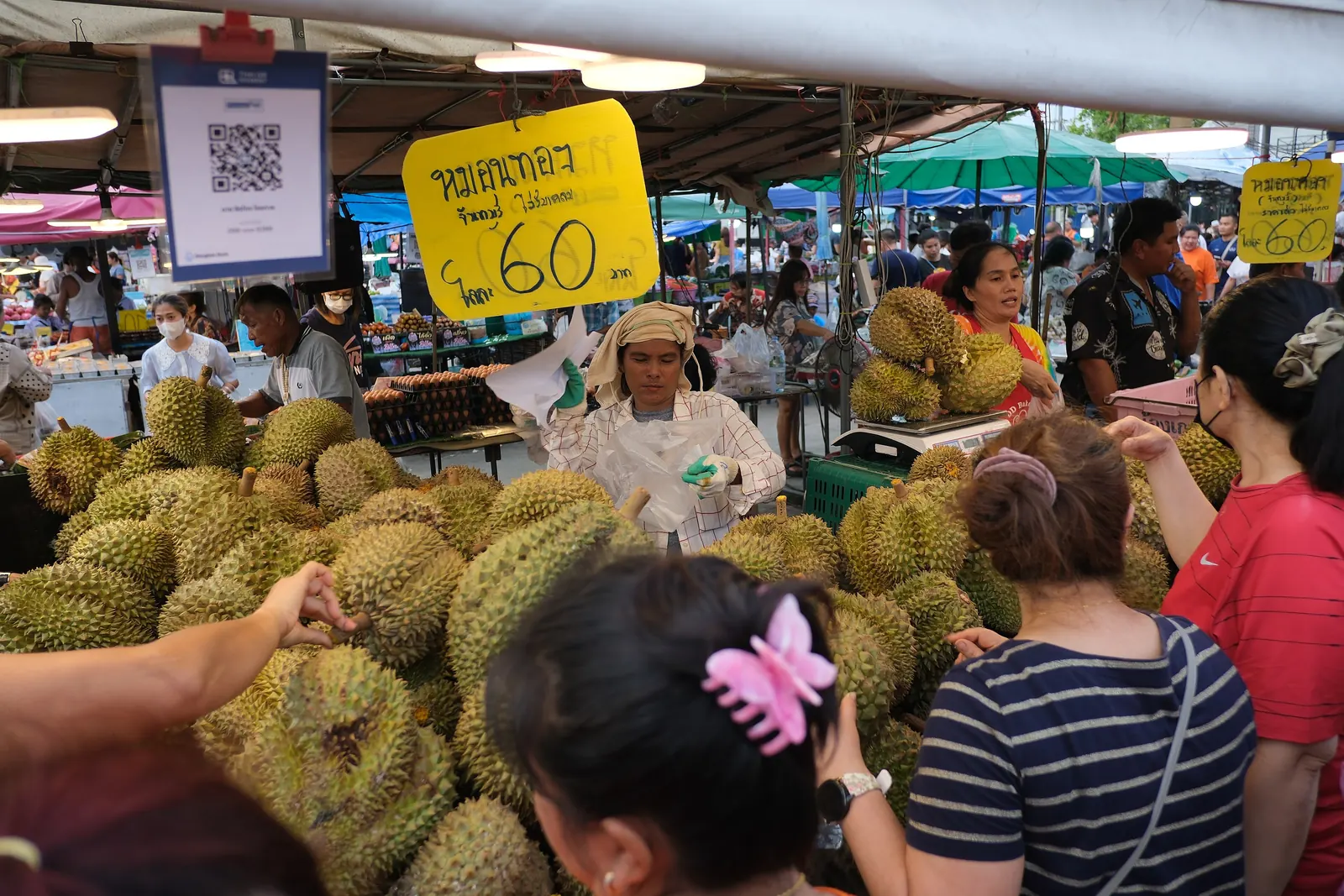
Hard against the border fence at Aranyaprathet sprawls Southeast Asia’s biggest second-hand bazaar: thousands of stalls where used clothing arrives in compressed bales, gets sorted by the tonne and is resold by traders who cross from Cambodia at first light. Denim, trainers, army surplus, bicycles, things you cannot name. This is not curated vintage with a Brooklyn mark-up; it is the raw end of the global supply chain, and it is mesmerising. Go in the morning before it wilts, haggle without shame, and expect ฿20-100 for most finds.
2. Stand alone at Prasat Sdok Kok Thom
An eleventh-century Shiva temple near Khok Sung, about 45 minutes north-east of Aranyaprathet, and arguably the most important Khmer site you have never heard of. The inscription found here, carved in 1052 in Sanskrit and Khmer, lists the kings of Angkor back to Jayavarman II in 802; it is the document scholars leaned on to date the whole Khmer empire. The temple has been handsomely restored: laterite walls, sandstone lintels, a ceremonial causeway, and most days not another visitor in sight. Open roughly 08.00-16.30. At Angkor you would queue for this history. Here you get it alone, with birdsong.

3. Chase butterflies at Pang Sida National Park
Part of the UNESCO-listed Dong Phayayen-Khao Yai Forest Complex, half an hour north of Sa Kaeo town, and gloriously under-visited. From May to July hundreds of butterfly species gather at the mineral licks near the headquarters; on a good June morning they lift off the tracks in clouds as you walk through. The park also runs Thailand’s flagship reintroduction of the Siamese crocodile, one of the rarest reptiles on earth, back into its waterways. Foreigner entry around ฿200, worth double in butterfly season.

4. Ride a farm truck to the Lalu earth pillars
Out in Ta Phraya country in the province’s north-east, rain has carved the ochre soil into pillars, fins and miniature canyons several metres deep, a pocket badlands in the middle of Thai farmland. Local farmers run visitors out from the village in converted farm trucks for a couple of hundred baht a load, dust flying. Go in the last two hours of daylight, when the earth turns amber; it photographs like another planet.

5. Brave the monkey mafia at Khao Chakan
A limestone crag heaving straight out of the plain beside Route 317 south of Sa Kaeo town, riddled with caves and shrines and governed, no other word for it, by several hundred macaques. Stairs climb past cave temples to viewpoints over an enormous flat green nothing. Entry is free; the monkeys will attempt to tax you anyway. Zip your bags, pocket your sunglasses and carry no visible food; you cannot out-negotiate a macaque.
6. Take the train to the very end of the line
Aranyaprathet’s railway reached the border in the 1920s, fell silent through the war and Khmer Rouge decades, and was reconnected in 2019. Today the ordinary train from Bangkok rolls to a stop at Ban Khlong Luk within sight of the fence, one of the great cheap railway journeys in Asia. The caution, delivered straight: Poipet, on the far side, is a casino strip built for Thai gamblers with a well-documented sideline in hustles, from invented visa fees to the scam-compound industry in the regional headlines. Cross with your paperwork sorted, your valuables boring, and no intention of lingering.
What to skip in Sa Kaeo
Poipet as a day trip. Nipping across the border for a look at Cambodia sounds adventurous over breakfast and feels like a slow mugging by lunchtime: a strip of casinos in departure-lounge architecture, existing purely because gambling is illegal in Thailand, wrapped in touts. There is no culture on offer, only extraction. If you want Cambodia, do it properly: cross early, ignore everyone offering help, and go straight through to Siem Reap, about two hours on. Skip, too, Rong Kluea’s new-goods aisles: a ฿150 pair of trainers with a famous logo will not survive the month. The second-hand section is the honest one, which tells you everything.
Sa Kaeo travel: practical info
Best season: November to February for dry, merciful weather at the temple and the earth pillars; May to July if the butterflies are the point, accepting brief downpours as the entry fee. March to May on this plain is brutal, high 30s and shadeless. How long: one full day covers Rong Kluea and Sdok Kok Thom; two to three days adds the parks, for which you want your own wheels or a hired driver at around ฿1,500-2,000 a day. Onward: Cambodia through the Aranyaprathet crossing (open roughly 06.00-22.00), Chanthaburi two and a half hours south on Route 317, Khao Yai via Prachin Buri, or Route 348 over the hills towards Buriram.
Wikipedia’s Sa Kaeo entry runs through the Dvaravati-to-Khmer border history.
TAT’s official Sa Kaeo page carries border-crossing status for Aranyaprathet.
Sa Kaeo travel FAQ
Is Sa Kaeo worth visiting?
Yes, if you like your travel unpolished. The province rewards curiosity rather than comfort: a world-class Khmer inscription site, a UNESCO forest and Southeast Asia’s biggest second-hand market, all without crowds. If your trip needs beach clubs and brunch, it will bore you rigid.
How do I get from Bangkok to the Aranyaprathet border?
Two ordinary trains daily from Hua Lamphong, under ฿50, run to Ban Khlong Luk at the border in five and a half to six hours. Buses and minivans from Mo Chit take about four hours for ฿200-280.
Can you cross into Cambodia at Aranyaprathet?
Yes. It is Thailand’s busiest land crossing to Cambodia, open roughly 06.00 to 22.00. A Cambodian tourist visa on arrival officially costs 30 US dollars; anything demanded beyond that is someone trying it on. Sort an e-visa in advance and walk past every helpful stranger.
When is butterfly season at Pang Sida National Park?
May to July, peaking around June, when hundreds of species gather at the mineral licks near the park headquarters. Mornings after light rain are best; pack for showers and leeches on the longer trails.
How many days do you need in Sa Kaeo?
One well-planned day covers the market and Prasat Sdok Kok Thom. Two to three days adds Pang Sida and the Lalu pillars without rushing.