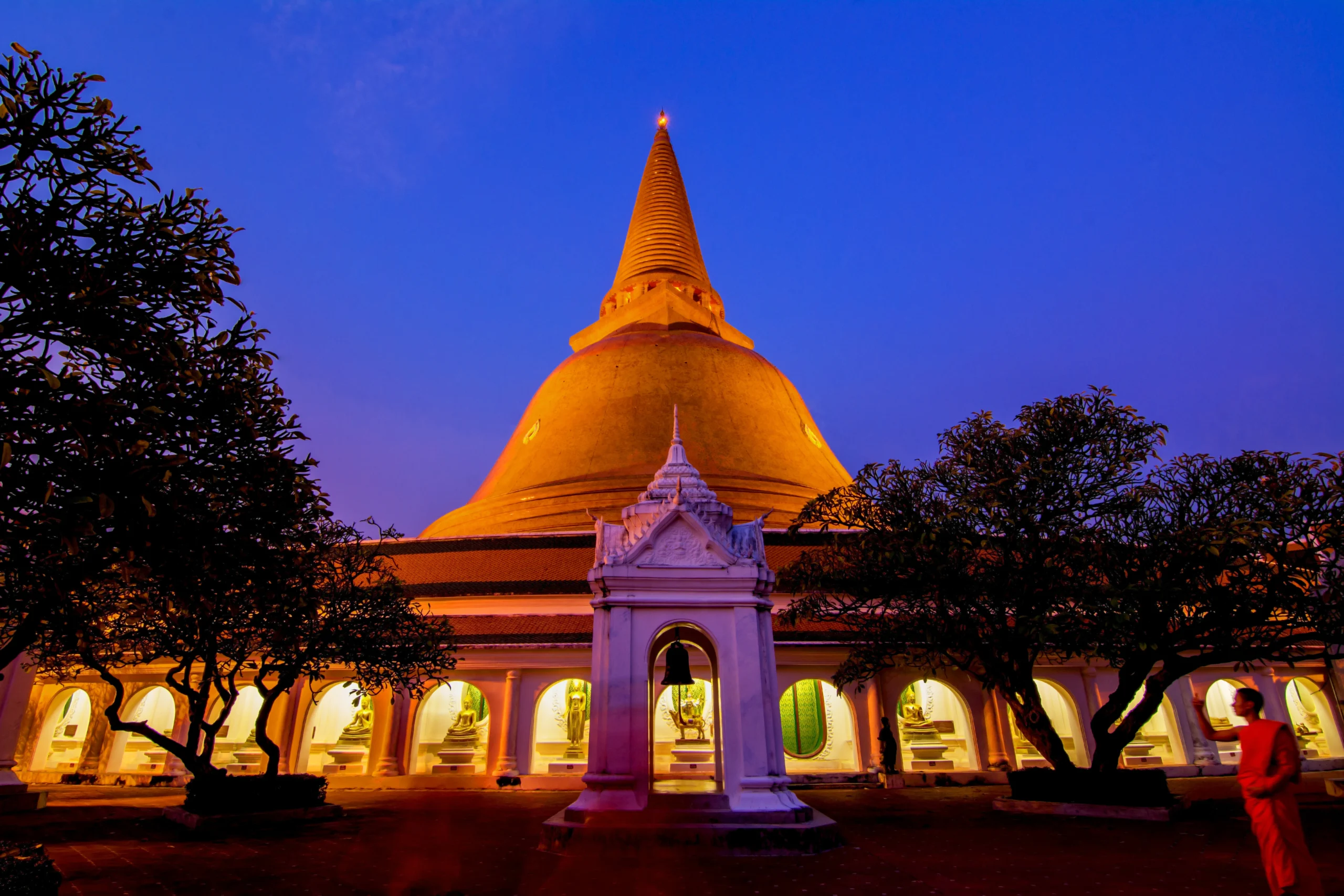
Nakhon Pathom has a marketing problem, and the problem is called Bangkok. Sit an hour west of the most-visited city on earth and nobody looks at you. Millions of people fly in, queue for the Grand Palace, get fleeced on Khao San Road and fly home, entirely unaware that the tallest Buddhist stupa on the planet — all 120.45 metres of it — stands one ฿20 train ride away in Nakhon Pathom, glowing like an enormous amber bell over an ordinary Thai market town.
Their loss is your gain. This is a province where the food is cooked for Thai stomachs and priced accordingly, and where the other visitors are Thai families on a Sunday out, not tour groups in matching lanyards. Our Nakhon Pathom province profile has the raw numbers; this guide tells you what to do with them.
What Nakhon Pathom really is
Officially, one of the oldest settlements in Thailand. The town grew out of the Dvaravati civilisation well over a thousand years ago, and Thai tradition holds that this is where Buddhism first entered the country — missionary monks despatched from India in the era of Emperor Ashoka are said to have landed here, when the coastline ran far further inland. The original stupa they supposedly raised now sits encased inside the current one, like a sacred matryoshka doll.
Unofficially, Nakhon Pathom is a farm-and-university town of the best possible kind. Silpakorn University gives the centre a cheap-food, young-crowd energy, whilst the surrounding districts grow the pomelos, orchids and pigs that feed Bangkok. Nothing here is dressed up for you, and that is precisely the appeal.
Why go to Nakhon Pathom
Three reasons. First, the chedi — a world-class monument that would be mobbed anywhere in Europe, shared here with pigeons and a handful of pilgrims. Second, the eating: bamboo-roasted sticky rice, honey-sweet pomelos and a night market that out-cooks most of Bangkok at half the price. Third, the strangeness of the supporting cast — a king’s Anglo-Thai fantasy palace, a pink tower with a dragon coiled around it, and two of the oddest museums in the country. All reachable before lunch.
Getting to Nakhon Pathom
The train is the correct answer. Ordinary services leave Thonburi station on the west bank of Bangkok a handful of times a day, cost about ฿20 in third class, and take roughly an hour and ten minutes. Wooden seats, open windows, orchards rolling past — and it is the same line that carries on west to Kanchanaburi. Some southern-line trains from Krung Thep Aphiwat stop here too.
If the timetable defeats you, minivans run from Bangkok’s Southern Bus Terminal (Sai Tai Mai) for around ฿60 and take about an hour when the traffic behaves. A Grab costs roughly ฿500-800 one way and makes sense split three or four ways, especially for Wat Samphran and the Nakhon Chai Si museums, which sit between Bangkok and town and are a pain without wheels.
Where to stay
Honestly? Most people should not stay: the town is an easy day trip and Bangkok’s beds are better value. If you do — for the November temple festival, say, or to eat the night market twice — the streets around the chedi have clean, plain guesthouses in the ฿400-800 range, with mid-range hotels near the Silpakorn campus at ฿800-1,500. Out east in Sam Phran, riverside resorts along the Tha Chin River charge ฿1,500-3,000 for garden-and-pool weekending. Near the chedi for the market, on the river for quiet.
What to eat in Nakhon Pathom
This is quietly one of central Thailand’s great eating towns. The signature is khao lam — sticky rice, coconut cream and black beans packed into bamboo tubes and roasted over charcoal until the whole thing tastes of smoke and caramel. Stalls ring the chedi; expect ฿20-60 a tube, and buy more than you think you want.
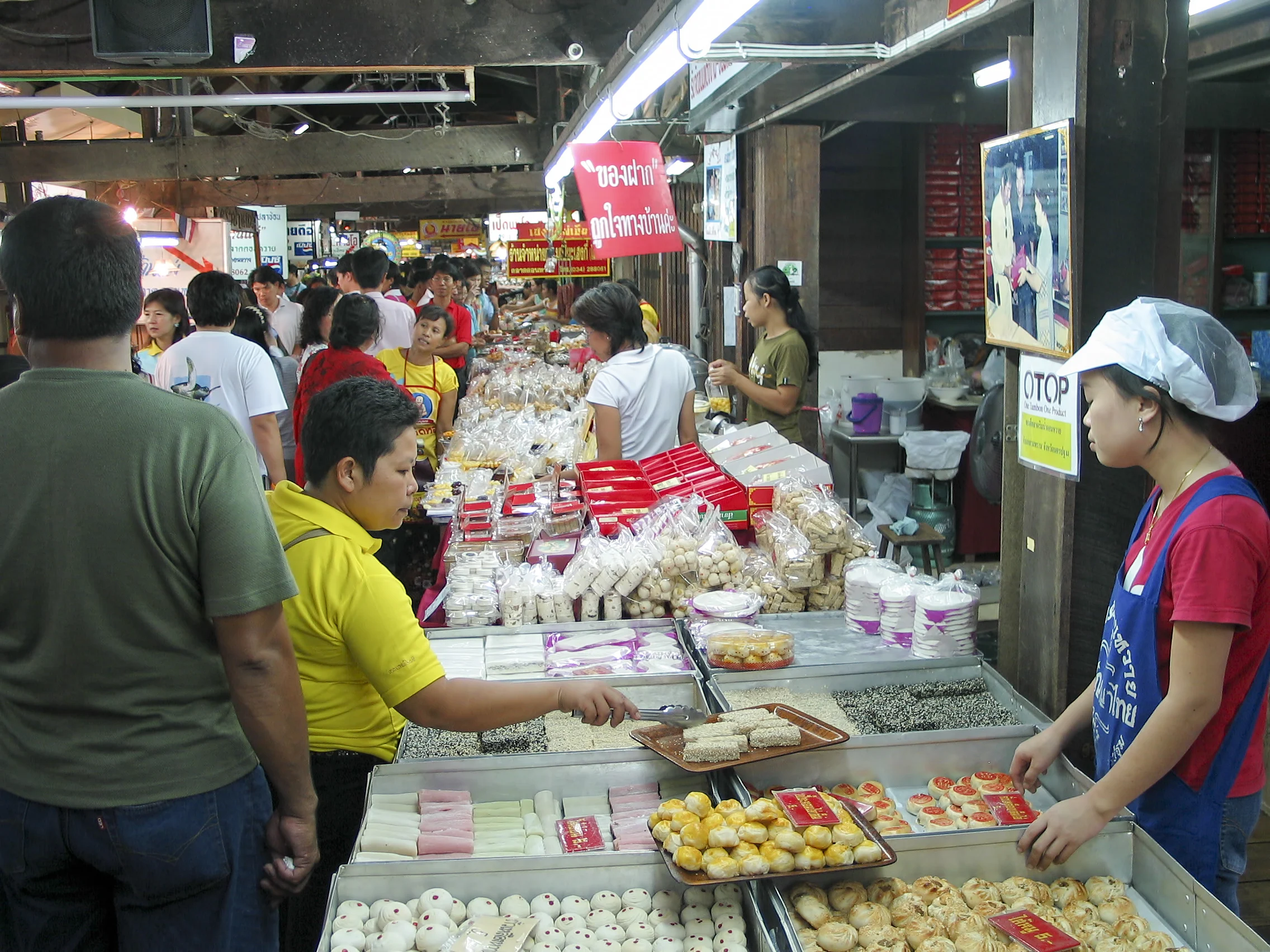
The second speciality is the pomelo. The orchards of Nakhon Chai Si district produce some of the sweetest som-o in Thailand, and a good one — pink-fleshed, honeyed, faintly floral — runs ฿60-120 at markets and roadside stands. Beyond that, graze: the som tam stalls around the chedi pound a fierce papaya salad for ฿40-60, noodle shops do bowls for ฿40-50, and Don Wai floating market on the Tha Chin is famous for ped palo — duck stewed in five-spice broth, sold by the bowl or as whole lacquered birds boxed up to carry home.
Top things to do in Nakhon Pathom
1. Phra Pathommachedi — the tallest stupa on earth
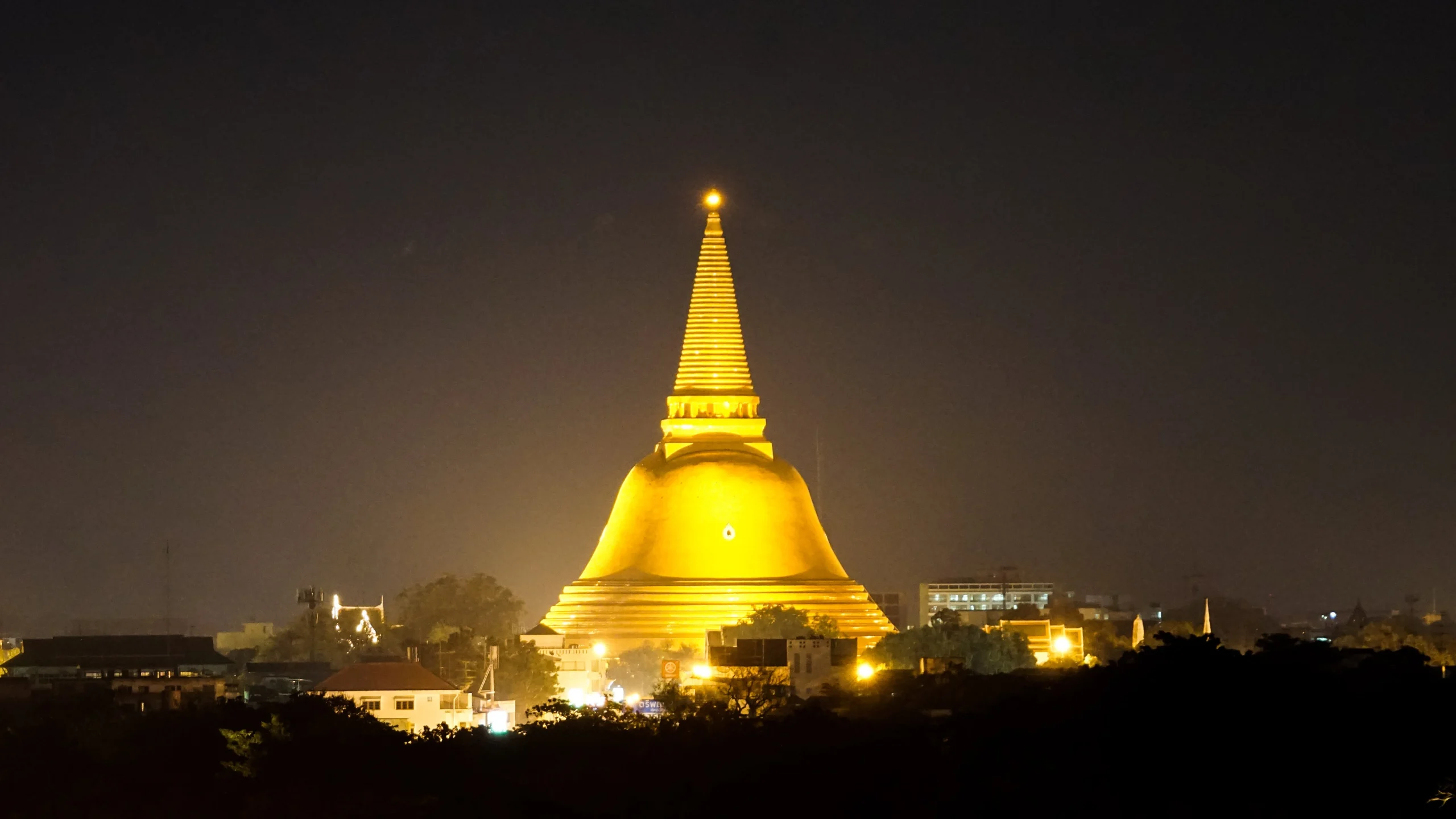
The reason you are here. At 120.45 metres, Phra Pathommachedi is the tallest stupa in the world, and Thai tradition names this spot as the place where Buddhism first arrived in the country. What you see today is King Mongkut’s 19th-century rebuild, an immense bell of orange-glazed tiles raised over the ruined ancient original, with a circular cloister at its base full of Buddha images and murmuring pilgrims. Walk the terrace clockwise, find the famous standing Buddha on the north side, then stand back and let the scale work on you. Foreigners pay about ฿60 to enter. Come from late afternoon: the tiles catch fire at sunset and the food market lights up at its feet.
2. Graze the market town around the chedi
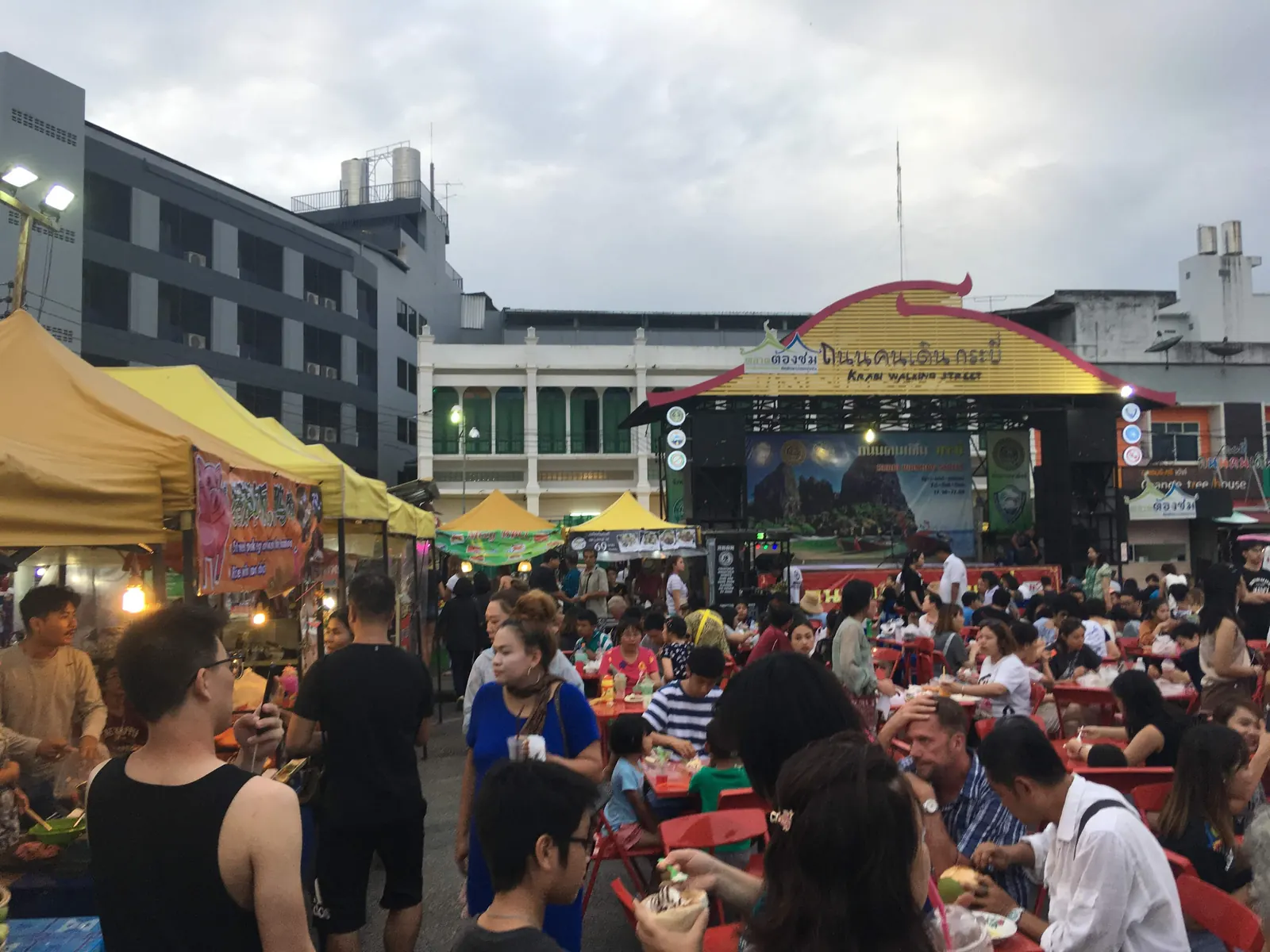
The genius of Phra Pathommachedi is that it never became a sealed-off attraction: a working market town carries on around its base, and from late afternoon the streets fill with food — khao lam smoking over coals, som tam stalls, grilled chicken, pyramids of pink pomelos, Thai sweets no tourist strip sells. Eat dinner facing the floodlit chedi for less than the price of a Bangkok cocktail.
3. Sanam Chandra Palace — Rama VI’s Anglo-Thai fantasy
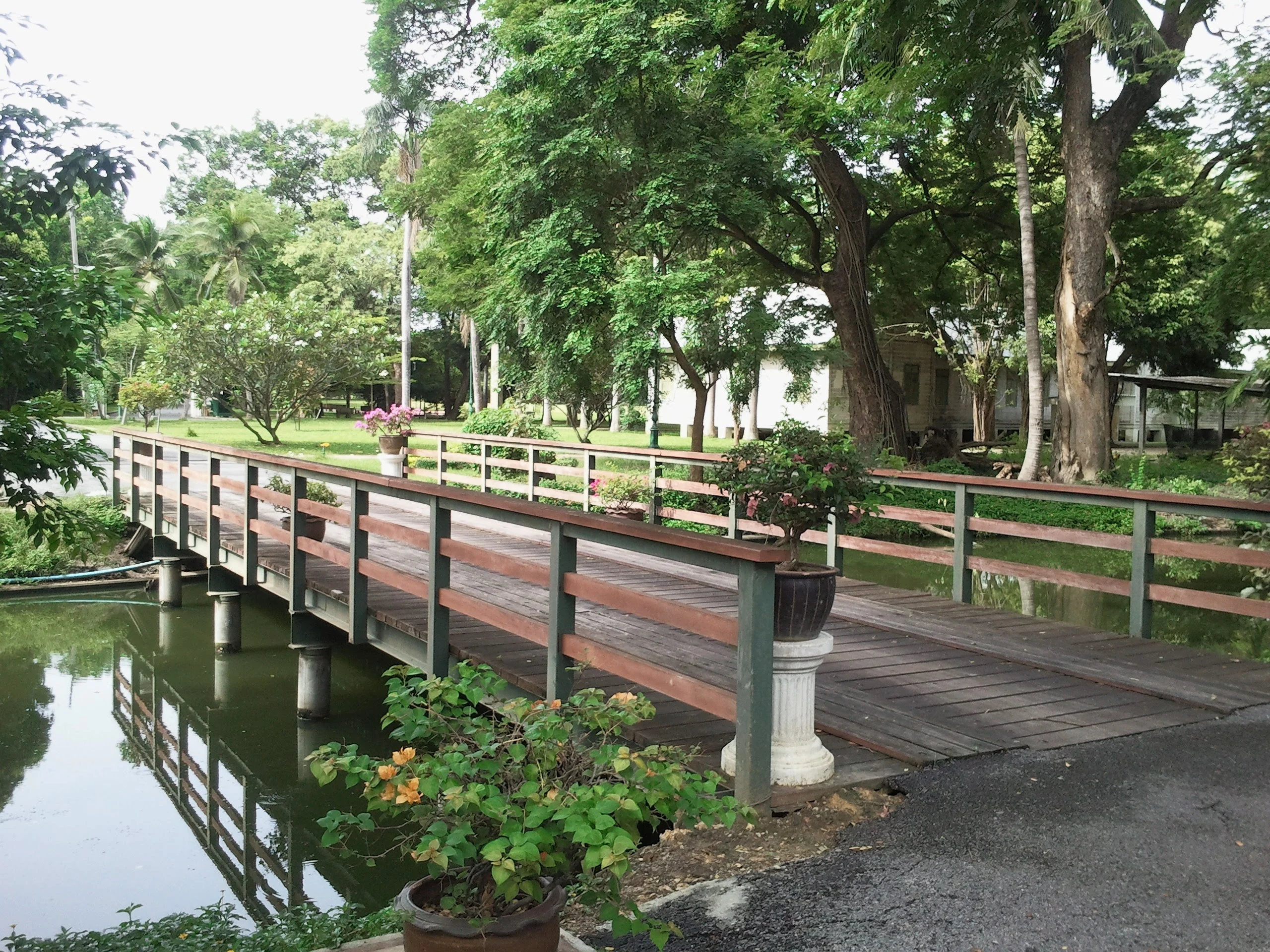
A kilometre or so west of the chedi sits one of the strangest royal compounds in Thailand. King Vajiravudh — Rama VI, Oxford-educated and thoroughly Anglophile — built Sanam Chandra in the early 1900s as a country retreat, and the result is an English half-timbered fantasy dropped into a Thai park: the Chaleemongkolasana Residence looks like a gingerbread cottage that got lost on its way to Surrey. Look for the bronze statue of Ya-Le, the king’s beloved dog, cast after the animal was shot — a genuinely touching story. The shaded grounds make a lovely hour’s wander; entry to the residences is around ฿50.
4. Wat Samphran — the pink dragon tower
You have seen it on Instagram: a 17-storey cylindrical tower, painted shocking pink, with a colossal green dragon coiled around the outside from ground to roof. What the photos do not tell you is that Wat Samphran is a working temple in Sam Phran district, about 40 minutes east of town towards Bangkok, and that the dragon is hollow — you climb through its body via a curving staircase, emerging beside a giant golden Buddha head with views over the orchards. Entry is by donation, dress modestly because monks live here, and go on a weekday morning unless you enjoy queueing behind influencers. Gloriously odd and entirely sincere — a rare combination.
5. Thai Human Imagery Museum
On the Pinklao-Nakhon Chai Si road at the eastern edge of the province, this is Thailand’s answer to a waxworks — except the figures are sculpted fibreglass, and far stranger and more affecting than Madame Tussauds. Revered monks sit in meditation so lifelike you catch yourself waiting for them to breathe; former kings of the Chakri dynasty stand in group portrait; scenes of old Siamese life play out in frozen tableaux. Foreigners pay a few hundred baht. It sounds like a curiosity; it turns out to be quietly memorable.
6. Jesada Technik Museum
Ten minutes away in Nakhon Chai Si, a Thai businessman has assembled one of the most cheerfully unhinged vehicle collections anywhere: bubble cars and Messerschmitt cabin scooters, tuk-tuks from half a dozen countries, vintage buses, amphibious oddities, even aircraft, packed into sheds and spilling across a field. There is no curation and no entry fee — free, which for this much bizarre machinery is frankly heroic. Petrolheads will lose two hours; everyone else, one.
What to skip
The Samphran Elephant Ground and Zoo, without hesitation. It sits near the dragon temple selling crocodile-wrestling shows and performing elephants to coach parties — an era of animal tourism Thailand is slowly, rightly growing out of. Elephants do not paint pictures or play football because they enjoy it. Spend your money on khao lam instead — nobody suffers for a tube of caramelised sticky rice. And Don Wai floating market is for eating, not scenery: go hungry or do not go, because as a spectacle it is a riverside car park with excellent duck.
Nakhon Pathom travel: practical info
Best season is November to February, when central Thailand is dry and merely warm rather than furnace-like. November is the smart pick: the annual Phra Pathommachedi festival fills the grounds with stalls, fairground noise and pilgrims for about a week — one of the country’s great unsung temple fairs. One full day covers the chedi, the palace and the night market; add a second day, or a long detour, for Wat Samphran and the Nakhon Chai Si museums on the way back to Bangkok.
Wikipedia’s Nakhon Pathom entry covers the Dvaravati history in depth.
TAT’s official Nakhon Pathom page keeps current hours for the chedi and palaces.
The same railway line rolls west to Kanchanaburi and the Death Railway in about an hour and a half — the classic move is chedi in the morning, Kanchanaburi by evening. Ratchaburi and its markets sit just to the south-west, and Bangkok is an hour east whenever you surrender.
FAQ
Is Nakhon Pathom worth visiting?
Yes, emphatically, as a day trip. The world’s tallest stupa, a royal palace, a dragon tower and a superb night market within one cheap hour of Bangkok is an outrageous return on effort. Not worth a week; worth one brilliant day, possibly two.
How do I get from Bangkok to Nakhon Pathom by train?
Take an ordinary train from Thonburi station on Bangkok’s west bank. Tickets cost about ฿20 in third class and the ride takes roughly 70 minutes, with several departures a day. Nakhon Pathom station is a five-minute walk from the chedi — one of the easiest rail day trips in Thailand.
What is Nakhon Pathom famous for?
Phra Pathommachedi, the tallest stupa in the world at 120.45 metres, and its traditional status as the place where Buddhism entered Thailand. Food-wise it is known for khao lam (sticky rice roasted in bamboo) and some of the country’s best pomelos, grown in the Nakhon Chai Si orchards.
Can I visit Wat Samphran without a car?
Yes, but budget patience. The dragon temple sits in Sam Phran district between Bangkok and Nakhon Pathom town; the practical options are a Grab from either end (a few hundred baht) or a local bus along Phetkasem Road plus a motorbike taxi. With a car you can chain it with Don Wai market and the Nakhon Chai Si museums in one loop.
How long should I spend in Nakhon Pathom?
One full day for the town — chedi, Sanam Chandra Palace, night market. Make it a night if you are here during the November temple festival, plus half a day for Wat Samphran and the museums on the Bangkok side.