Nobody goes to Samut Sakhon, and that is the first thing you need to know about it. While half of Bangkok crawls down the motorway to Hua Hin every Friday afternoon, this small province immediately southwest of the capital quietly lands, guts, boils and ships a colossal share of the seafood the entire country eats. Samut Sakhon is not pretty. It smells of brine, diesel and drying fish. It is also one of the most honest days out near Bangkok, and it costs almost nothing.
The centrepiece is Mahachai, the port town everyone actually means when they say Samut Sakhon. You reach it on a wooden-seated commuter train from Wongwian Yai that costs ฿10 — less than a bottle of water at the airport — and rattles through the back gardens of Thonburi before depositing you more or less inside a seafood market. Not next to it. Inside it.
If you want the map and the statistics, our Samut Sakhon province profile has them. This guide is about the good stuff: crab mountains, salt pyramids, an executed helmsman and the best Burmese food this side of Mae Sot.
What Samut Sakhon really is
A working province, full stop. The Tha Chin river reaches the Gulf of Thailand here, and around its mouth has grown one of Southeast Asia’s great seafood processing hubs: trawler fleets, ice factories, canneries, and wholesale piers where the catch comes ashore before dawn. Tens of thousands of Mon and Burmese migrant workers keep the machine running, which is why you will hear as much Burmese as Thai in the market lanes, and why the eating is more interesting than it has any right to be.
There is no beach worth the name — the coast is mudflats, mangroves and salt pans — and no old town dressed up for visitors. What Samut Sakhon offers instead is a Thai port going about its business, completely indifferent to whether you turn up or not. After one too many places that exist mainly to be photographed, that indifference is refreshing.
Why go to Samut Sakhon
Three reasons. First, the journey: the Wongwian Yai to Mahachai railway is the cheapest and oddest excursion in the Bangkok area, and by ferry and the Ban Laem line you can carry on to the famous umbrella-pulling market at Mae Klong. Second, the food: blue crab at wholesale prices, mantis shrimp the length of your forearm, and a Burmese quarter serving tea leaf salad and proper mohinga. Third, the western edge of the province, where salt farmers rake glittering white pyramids out of shallow ponds a few metres from the road.
None of this takes more than a day, and it beats most of the packaged tours touts will try to sell you on Khao San Road.
Getting to Samut Sakhon
The train is the whole point. Take the BTS to Wongwian Yai in Thonburi, walk ten minutes to the little railway station hiding behind a row of shophouses, and buy a ticket to Mahachai for ฿10. Trains run roughly hourly. The ride takes between 40 minutes and an hour: third class only, windows open, vendors walking the aisle, market stalls pressed so close to the rails that traders lean their awnings back as the carriages pass.
By road, vans and buses run from Bangkok’s Southern Bus Terminal, about an hour to Mahachai for ฿50-70. Driving is a straight run down Rama II Road (Highway 35), around 35 kilometres from central Bangkok — quick outside rush hour, miserable during it. There is no airport and no reason for one.
Where to stay
Be honest with yourself: you almost certainly should not stay. Mahachai works best as a full day out from Bangkok, or the first leg of an overnight loop ending in Amphawa over in Samut Songkhram, which has all the riverside guesthouses this province lacks.
If you do want a bed — dawn photography at the trawler piers is a legitimate reason — central Mahachai has plain Thai business hotels near the market and pier for ฿500-900 a night: clean, air-conditioned, zero charm. Along Rama II Road sit newer mid-range places in the ฿1,000-1,500 band. Nobody has built a boutique anything here yet, and long may that continue.
What to eat in Samut Sakhon
Seafood, at source, at prices that will make you resent every beach resort you have ever eaten at. Blue crab is the signature — steamed, fried with curry powder, or picked into som tam poo — sold live by the kilo at the market for a fraction of Bangkok prices. Mantis shrimp, oysters, cockles and the morning’s catch fill the tables at the plain seafood restaurants near the pier and market edges; expect ฿150-400 a dish rather than the ฿600-plus the same crab costs in Sukhumvit.
Then there is the Burmese side. The lanes around the market hold tea shops and rice-and-curry counters serving laphet thoke (fermented tea leaf salad), mohinga (fish noodle soup), Shan-style noodles and oily, savoury Burmese curries, mostly at ฿40-80 a plate. Point at what looks good; English menus are rare, and it does not matter. This is the best Myanmar eating in the Bangkok orbit, and most visitors have no idea it exists.
Top things to do in Samut Sakhon
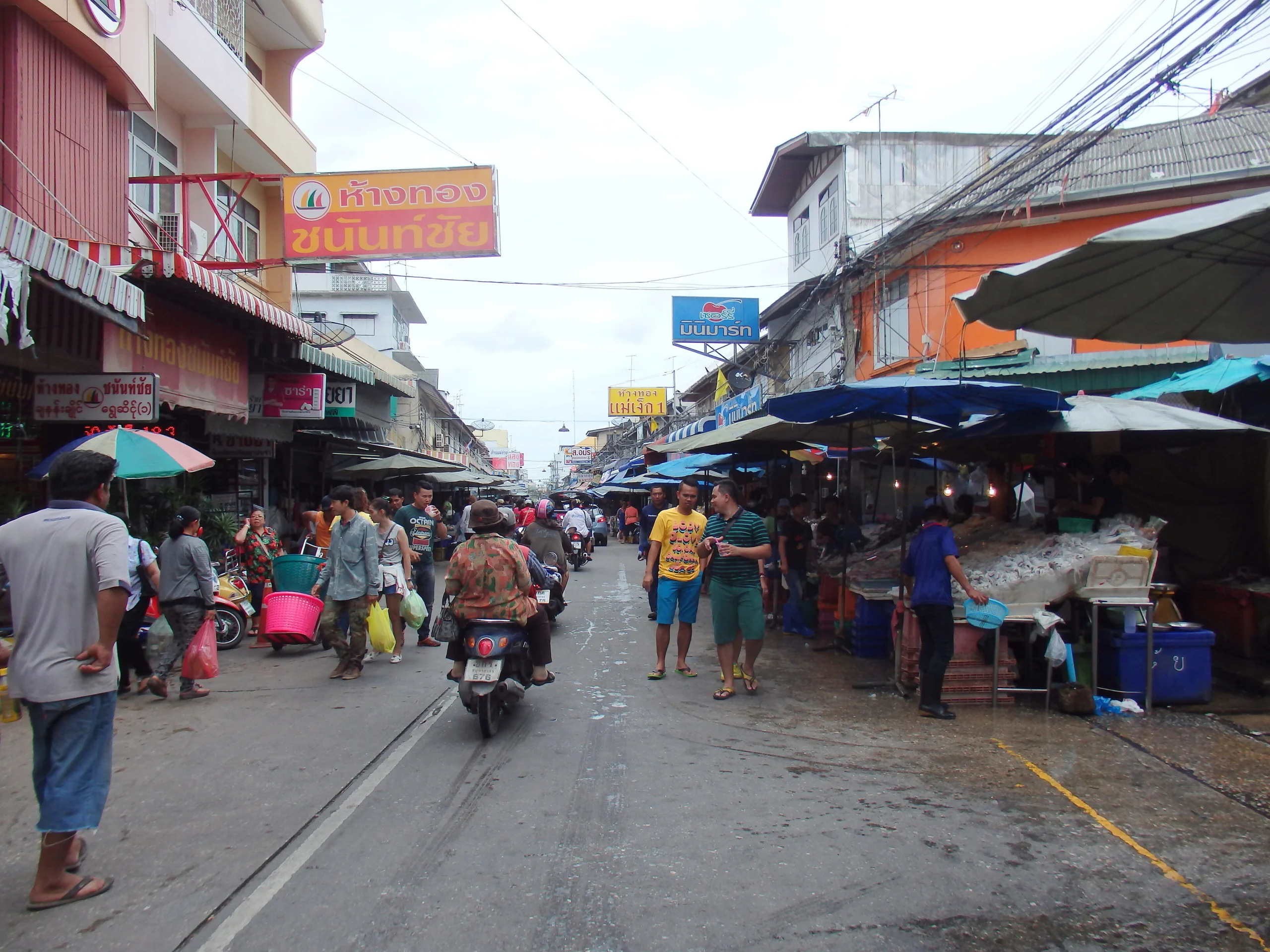
1. Get lost in Talat Maha Chai, Thailand’s seafood engine room
The fresh market that swallows the streets between the railway station and the pier is the province in miniature: mountains of blue crab stacked like ammunition, tubs of live mantis shrimp, dried squid by the sackful, and the wholesale piers behind, where trawlers unload onto ice before most of Bangkok is awake. Come in the morning, wear shoes you do not love, and bring small notes. Nothing here is staged, which is exactly why it deserves two hours of anyone’s time.
2. Ride the Wongwian Yai to Mahachai railway
Already covered in the getting-there section, but it deserves its own billing because the ride is the attraction. Ten baht buys you 31 kilometres of open-window Thailand: allotments, stilt houses, temple yards, and traders whose stalls sit close enough to the track that the train appears to part the merchandise. It is the strangest commuter line in the country and one of the last genuinely third-class experiences this near the capital.
3. Cross the Tha Chin and carry on down the Ban Laem line
The railway ends at Mahachai because the river is in the way. Walk to the pier, pay a few baht for the ferry across the Tha Chin, and on the far bank at Ban Laem station a second, even sleepier line continues to Mae Klong in Samut Songkhram — home of the umbrella-folding railway market from every travel show ever made. Only a handful of trains run each day, so check the board at Ban Laem before committing. Done right, this is one of the great slow-travel days in central Thailand, for well under ฿50 in fares.
4. See the salt pyramids of Kok Kham
Head west out of town toward Samut Songkhram and the landscape flattens into salt-pan country. Around Kok Kham, from roughly December to April, farmers flood shallow ponds with seawater, let the sun do its work, then rake the crystals into rows of white pyramids that look faintly Egyptian in the morning light. Come early or at golden hour for the photographs; in the rainy season the ponds are just ponds. The same flats pull in migratory shorebirds by the thousand in the cool season, if that is your thing.
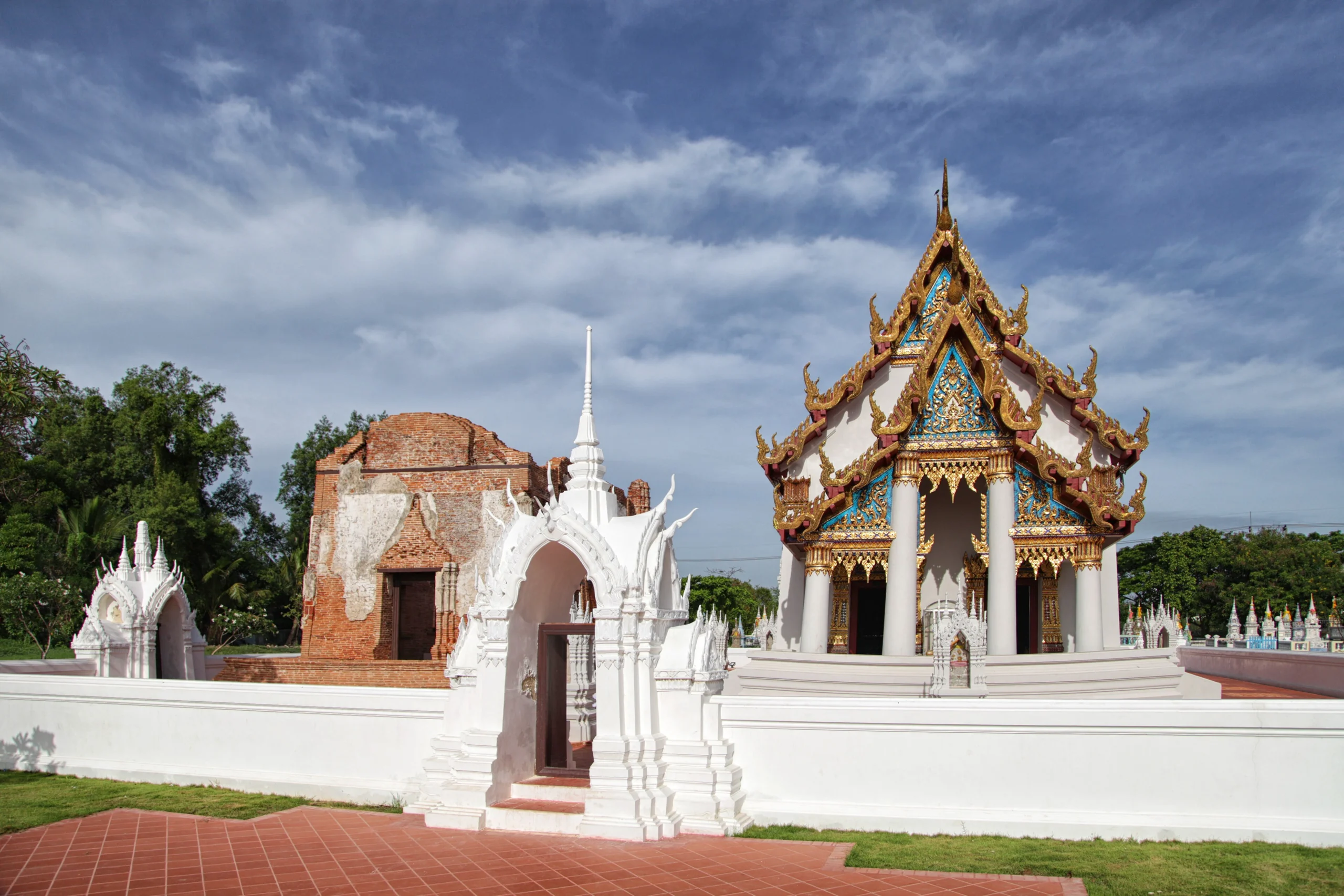
5. Wat Yai Chom Prasat and its carved doors
On the bank of the Tha Chin stands Wat Yai Chom Prasat, an Ayutthaya-era temple famous for a pair of intricately carved wooden doors — dense, deep-relief foliage regarded as some of the finest craftsmanship of the period. Quiet, riverside, and free of coach parties; ten minutes by motorcycle taxi from central Mahachai, and best paired with the shrine below.
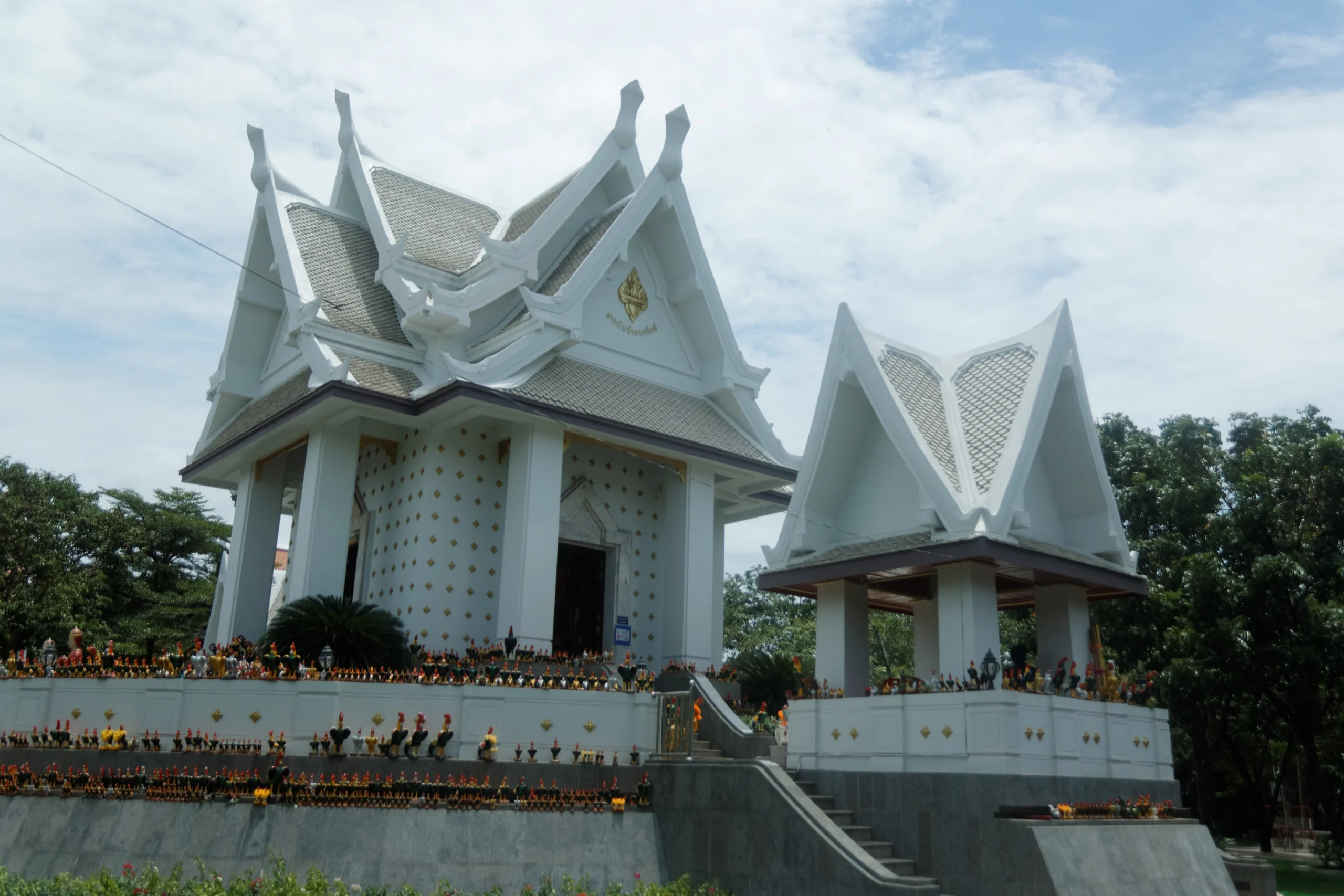
6. Phanthai Norasing shrine and the legend of the honest helmsman
The best story in the province. Phanthai Norasing was helmsman of the royal barge when it struck a bend in a winding canal and the bow broke off — a capital offence. The king, recognising an accident, offered a pardon; Norasing refused, insisting the law applied to everyone including himself, and was executed. His shrine stands near the old canal, busy with locals asking favours of a man famous for refusing one. As a monument to integrity, Thailand has built nothing better.
What to skip
The vast air-conditioned seafood barns along Rama II Road, the ones with coach parks the size of football pitches and photo menus in four languages. They serve the same crab you can eat at a plastic table by the market for double the price and half the atmosphere. If you have come all the way to Thailand’s seafood capital, eating in a roadside hangar with tour-group acoustics is an act of self-harm. Skip them without a flicker of guilt.
Also, manage expectations: the stalls along the Mahachai line are real and close, but the full umbrella-folding spectacle is at Mae Klong, one province over. Mahachai is the honest working version; Mae Klong is the show.
Samut Sakhon travel: practical info
Best season is November to February — cooler, drier, and the salt pans are in production from around December. April is brutally hot in a province with little shade. Half a day covers Mahachai market and the train; a full day adds the salt pans, temple and shrine; there is no honest case for more than one night.
Onward connections are the province’s ace: ferry and Ban Laem line (or a ฿70-ish van) to Samut Songkhram for Mae Klong and Amphawa, or road north to Nakhon Pathom and its enormous chedi. Locally, motorcycle taxis and songthaews run from the market area; agree the fare first, ฿40-100 for most hops.
Wikipedia’s Samut Sakhon entry covers the Mahachai fishing history.
TAT’s official Samut Sakhon page keeps ferry and market practicalities current.
FAQ
Is Samut Sakhon worth visiting?
Yes, if you want working Thailand rather than postcard Thailand. The ฿10 train, Mahachai’s seafood market and the salt pans make a superb, almost free day trip from Bangkok. If your idea of travel requires a beach or a rooftop bar, stay on the BTS.
How do I get from Bangkok to Samut Sakhon by train?
BTS to Wongwian Yai, ten minutes on foot to Wongwian Yai railway station, then a ฿10 third-class ticket to Mahachai. Trains run roughly hourly and take between 40 minutes and an hour. No reservations, no classes, no nonsense.
Can I continue from Mahachai to the Maeklong Railway Market?
Yes — ferry across the Tha Chin from the pier near Mahachai station, then catch the Ban Laem line to Mae Klong. Only a few trains run daily, so check times on arrival; vans cover the same route if the schedule fails you.
What food is Samut Sakhon famous for?
Blue crab above all, plus mantis shrimp, oysters and whatever the trawlers landed that morning, all cheaper than anywhere in Bangkok. The Burmese-Mon community adds tea leaf salad, mohinga and Shan noodles at ฿40-80 a plate.
How far is Samut Sakhon from Bangkok?
About 35 kilometres southwest of central Bangkok — roughly an hour by train, van or car. It is one of the closest provincial capitals to the city, which makes how few visitors bother all the more baffling.