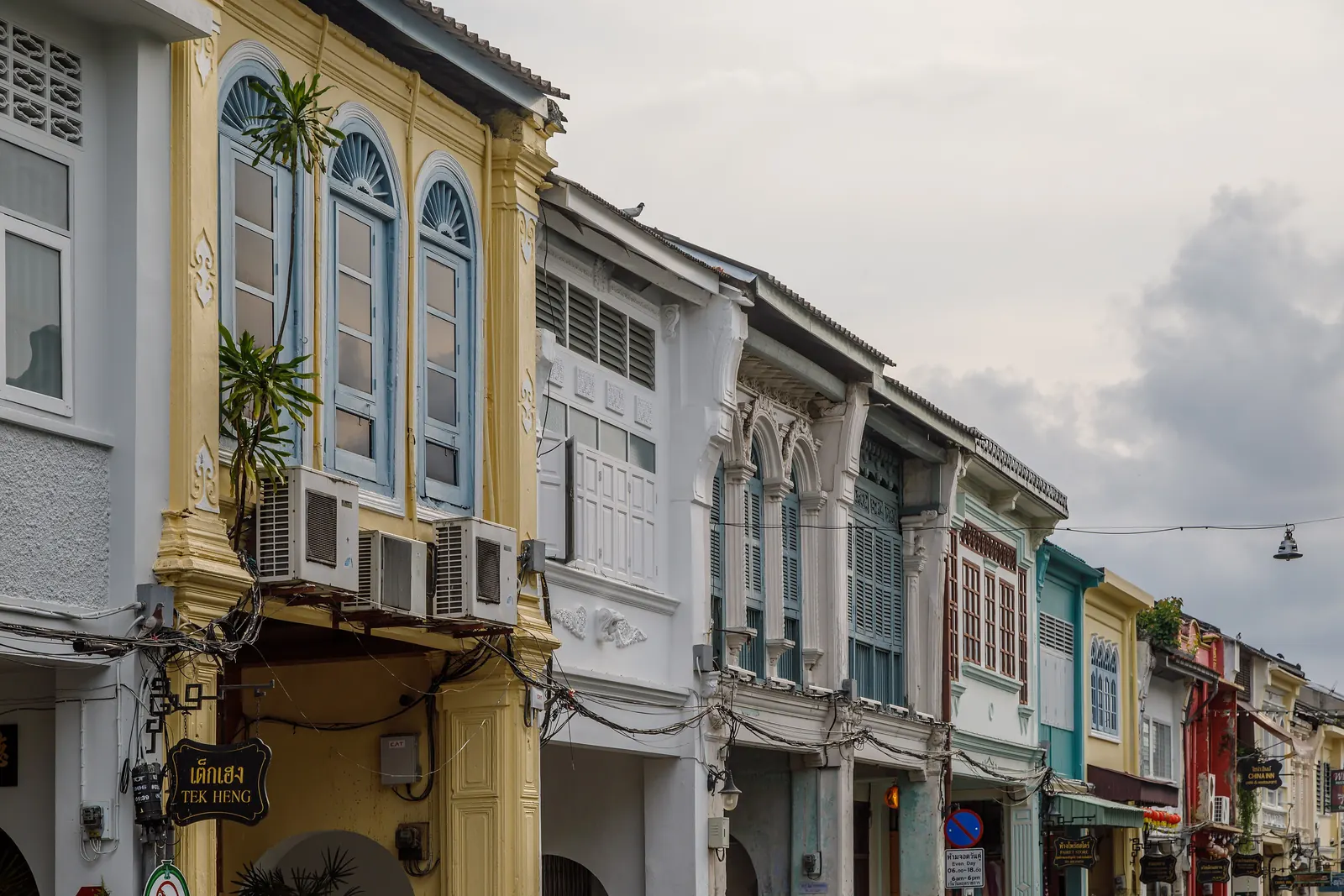
At half past seven on a weekday morning the loudest thing on Thalang Road is a wok. Lock Tien, the hawker centre on the corner of Dibuk and Yaowarat roads, has been frying o-tao since the 1950s; the shutters are down, the light is flat along the pastel fronts, and this is Phuket Old Town at its best hour, which almost nobody on the beaches has seen.
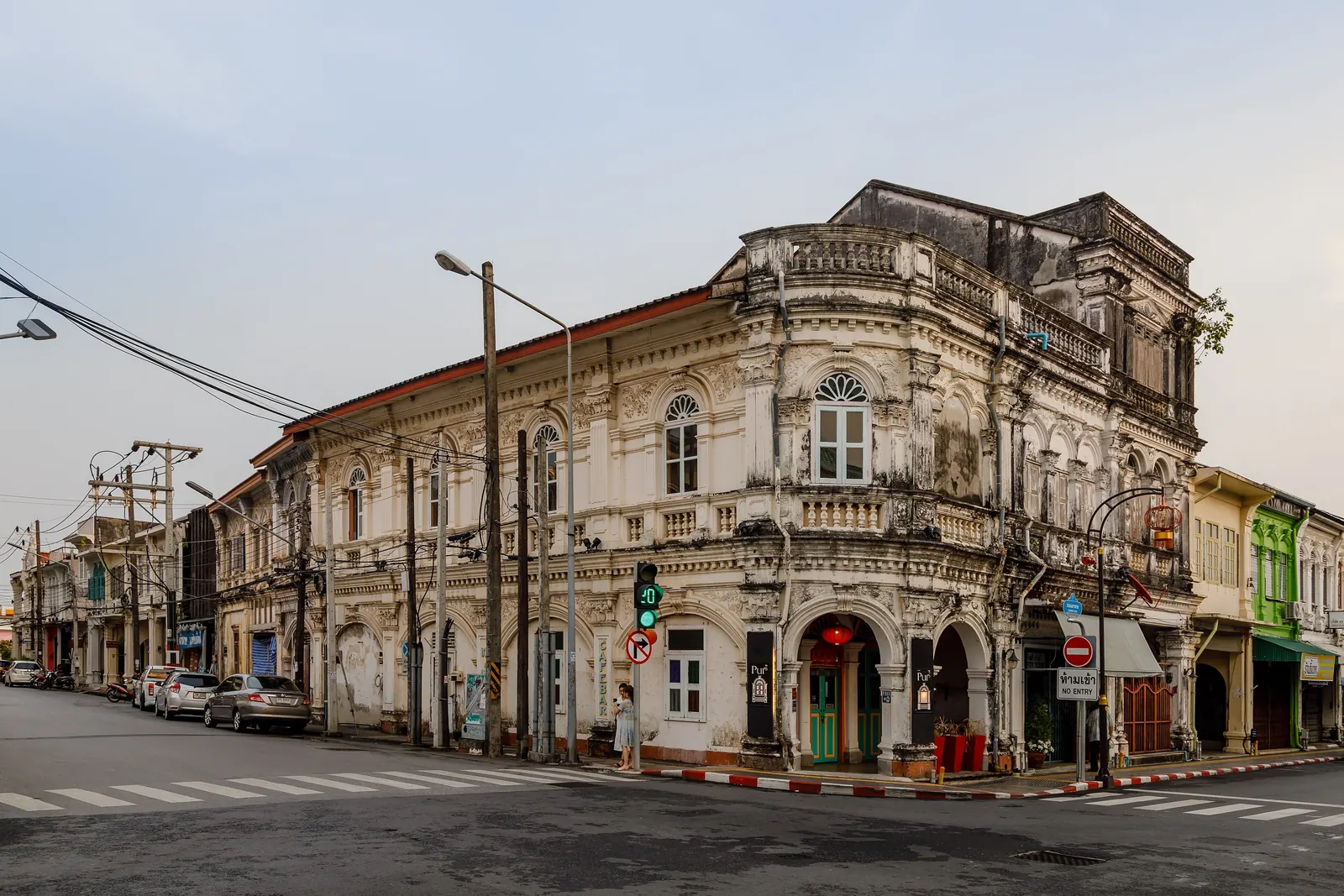
Phuket Old Town is the grid of streets in the middle of Phuket Town, the provincial capital on the island’s east side, built with Hokkien tin money between about 1900 and 1930 in the Straits style of George Town: two-storey shophouses, arched walkways, stucco fronts, courtyards behind. Thalang Road is the spine, Soi Romanee the pretty lane off it, and it is fifteen kilometres and a different country from Patong.
The short version: come for breakfast, not a photograph. Dim sum at Boonrat at seven, o-tao at Lock Tien, one museum (Thai Hua, ฿200), one mansion (Chinpracha, ฿150), a coffee on Soi Romanee, moo hong for lunch, out before the heat at two. On a Sunday do it backwards: arrive at four for the Lard Yai walking street and sleep in a shophouse hotel. Budget around ฿800 a head, ฿250 without the museums, and check any quote against our Thailand price index. The beaches are in things to do in Phuket; the Phuket province page has the map.
What Phuket Old Town actually is, and why it looks like Penang
Tin. From the early nineteenth century the island’s hills were dug over for it, and the labour and the capital came from Fujian by way of Penang. By 1900 the Hokkien mining families had built a port town in the style they knew from the Straits: a covered arcade at street level, European plasterwork on the front, a Chinese courtyard behind, and on Krabi Road a row of mansions with Italian tiles. “Sino-Portuguese” is a local coinage; there were almost no Portuguese here, and the style is Straits Chinese with a colonial face.
The tin price collapsed in the 1980s, tourism went to the west coast, and the town was saved the way old towns usually are: nobody could afford to knock it down. Restoration began in the 2000s, murals came with a street-art festival around 2016, the cafés followed, and in 2015 UNESCO named Phuket a Creative City of Gastronomy for what the mining families cooked, which is still the reason to come. Songkhla Old Town is the quieter cousin, Lanta Old Town the wooden one; this is the one with the money.
Breakfast in Phuket Old Town: dim sum, Hokkien mee and o-tao
Phuket eats breakfast the Hokkien way: early, at a marble table, in courses of small things. Dim sum means baskets of pork siu mai, prawn dumplings and steamed buns brought as you sit, around ฿15–30 a basket, with kopi, sweet sock-filtered coffee, at ฿30–50. Breakfast for two is under ฿300; more, and you are in a café. These are the places the town uses, as of October 2026.
| Place | Where | Order | Price | Verdict |
|---|---|---|---|---|
| Boonrat Dim Sum | 26/41 Bangkok Road, ten minutes west of Thalang; second branch on Dilok Uthit 2 Road | Siu mai, char siu buns, kopi | ฿15–30 a basket | Do it, before 9am; shuts at 10.30am |
| Lock Tien Food Court | Corner of Dibuk and Yaowarat roads | O-tao, loba, popia, Hokkien mee | ฿50–80 a plate | Do it: the 1950s hawker centre that explains the town |
| Mee Ton Poe | Phuket Road, at the clock tower | Hokkien mee, since 1946 | ฿60–90 | Do it, for lunch |
| Roti carts | Around the Ranong Road market, mornings | Roti with curry, or egg and banana | ฿20–50 | Do it, from the cart with the queue |
O-tao is taro and small oysters fried with egg and pork crackling; loba is braised offal, fried crisp; Hokkien mee is fat yellow noodles with pork, squid and an egg, darker than Penang’s. None of it is spicy; all of it beats the ฿600 hotel buffet. Southern Thai cuisine covers the Peranakan branch, Thai noodles, decoded the ordering words, and is Thai street food safe the obvious question, which for a seventy-year queue is yes.
Walking Thalang Road, Soi Romanee, Krabi Road and Phang Nga Road
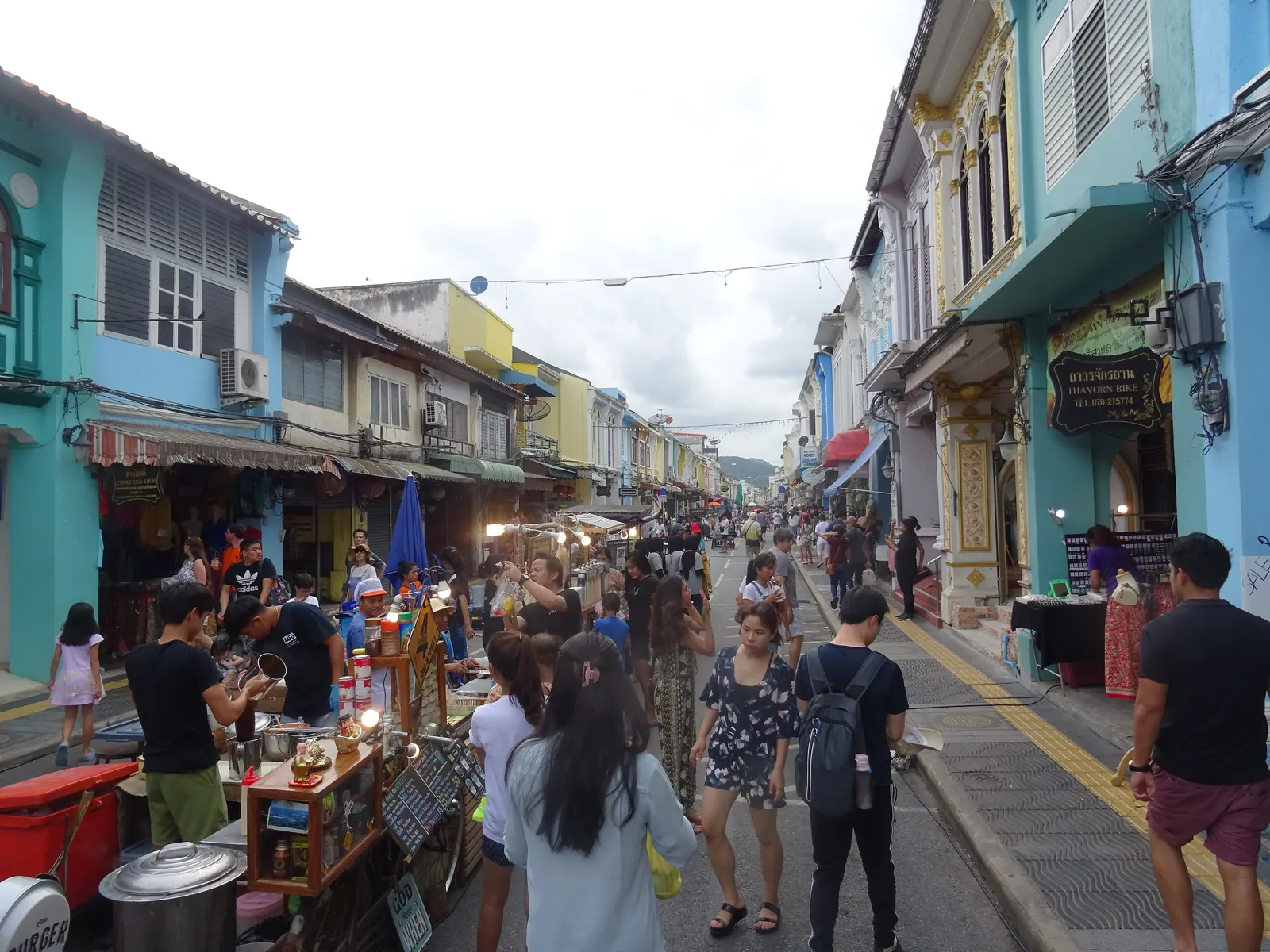
The quarter is a kilometre end to end; walk it before ten or after four, because in between the arcades are the only shade. Thalang Road is the spine: restored fronts in ochre, mint and pink, Chinese medicine shops, Indian-Muslim textile merchants who have been here as long as the Hokkiens, and on Sundays the market. Do it twice, at 8am with the shutters down and at dusk with the lanterns on. Soi Romanee, the lane north off it, was the miners’ red-light street a century ago; now it is the prettiest hundred metres in town and, from 10am, a queue photographing the same pink door.
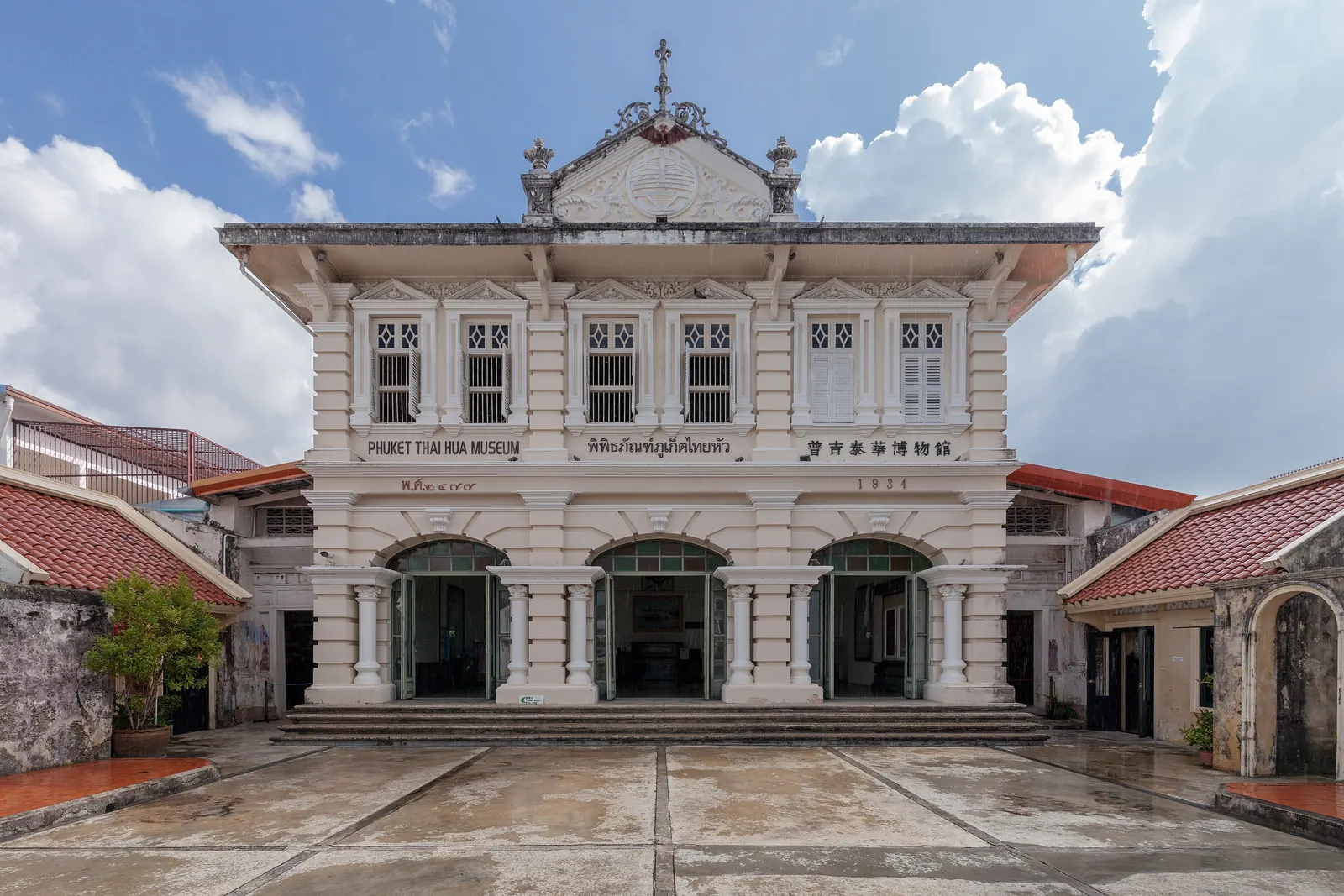
Krabi Road is the mansions, Chinpracha House and the Thai Hua Museum facing each other with the yellow Phra Pitak Chinpracha mansion, now the Blue Elephant restaurant, between them. Phang Nga Road has the On On Hotel of 1929, the 1907 bank on the corner with Phuket Road and the Shrine of the Serene Light down a passage you will walk past twice. Dibuk Road is the working street, with Lock Tien, Raya and the Limelight Avenue mall; Ranong Road has the fresh market, the Jui Tui shrine and the blue songthaews back to the beaches: not pretty, the most useful street in town.
Museums and old houses in Phuket Old Town, with the entry fees
Two are worth paying for, two are free, and the Phuket Trickeye Museum on Phang Nga Road, ฿290 online and around ฿500 on the door, is a photo booth with the word museum on it: skip it unless it is raining and you have children. Hours and prices are as of October 2026 from the museums’ own listings; where sources disagree we say so.
| Place | What it is | Hours | Entry | Verdict |
|---|---|---|---|---|
| Thai Hua Museum, 28 Krabi Road | 1930s Chinese school: the tin, the migration, the families | 9am–5pm daily per its 2026 listing; one source says closed Wednesdays | ฿200 | Worth it: the only place the story is told properly |
| Chinpracha House, 98 Krabi Road | 1903 mansion; ground floor open, family upstairs | 9am–4.30pm Mon–Sat; Sunday uncertain | ฿150 (฿100 for Thais) | Do it: thirty minutes of original tiles and furniture |
| Peranakannitat Museum, Phang Nga and Phuket roads | The 1907 Standard Chartered bank, now a small Baba-culture museum | Roughly 10am–8pm, closed Sunday; sources disagree | Free | Fine: twenty air-conditioned minutes at midday |
| Shrine of the Serene Light, off Phang Nga Road | Hokkien shrine of 1889 down a passage | Daytime | Free, donation box | Do it: five minutes of quiet |
The Thai Hua is a courtyard school with rooms on the mines, the clans, the Vegetarian Festival and the Peranakan kitchen, captioned in English and air-conditioned. Chinpracha House is a private home, the ground floor as the family furnished it a century ago, and whoever is in shows you round. The shrines are working shrines: shoes off, knees covered, nobody photographed mid-prayer; Thai temple etiquette covers the rest, and from 10 to 18 October 2026 our Phuket Vegetarian Festival guide has the procession days. For sunset, Rang Hill, three kilometres north-west with the Tunk-Ka café on top, is free and a ฿70–100 Grab each way.
Cafés, lunch and what a morning in Phuket Old Town costs
The Instagram problem is priced in: by mid-morning Soi Romanee has more tripods than residents, and its cafés charge ฿90–140 for a flat white where a kopi two doors down is ฿35. Torry’s Ice Cream, in the pink shophouse on Soi Romanee since 2015, open 10am to 6pm, makes ice cream from Phuket flavours, salted egg, black sesame, o-aew, at around ฿100–150, and is the one queue on the lane we would join. Campus Coffee Roaster is the serious roastery; Kopitiam by Wilai on Thalang Road does Peranakan plates and kaya toast at ฿80–150.
Lunch is moo hong, pork belly braised dark with black pepper, garlic and soy until it falls apart. Raya, at 48 Dibuk Road in a 1920s mansion, has been the famous restaurant for decades: moo hong ฿250, crab curry with cha-plu leaves ฿400–600, ฿300–600 a head; worth it once, for the building and the crab. One Chun on Thep Krasattri Road does the same dishes with a Michelin Bib Gourmand and a smaller bill, and is where we would send a friend; Tu Kab Khao on Phang Nga Road is the dressier option, fine if someone else pays.
A morning, per person, as of October 2026: dim sum and kopi ฿150, Thai Hua ฿200, Chinpracha ฿150, café coffee ฿120, Torry’s ฿120, lunch ฿70 at Lock Tien or ฿450 at Raya. Around ฿800 with a hawker lunch, ฿1,200 with the mansion, ฿250 if you skip the museums and the ice cream: the cheapest day you will have on Phuket, inside every Thailand cost per day budget.
Lard Yai: the Sunday walking street on Thalang Road
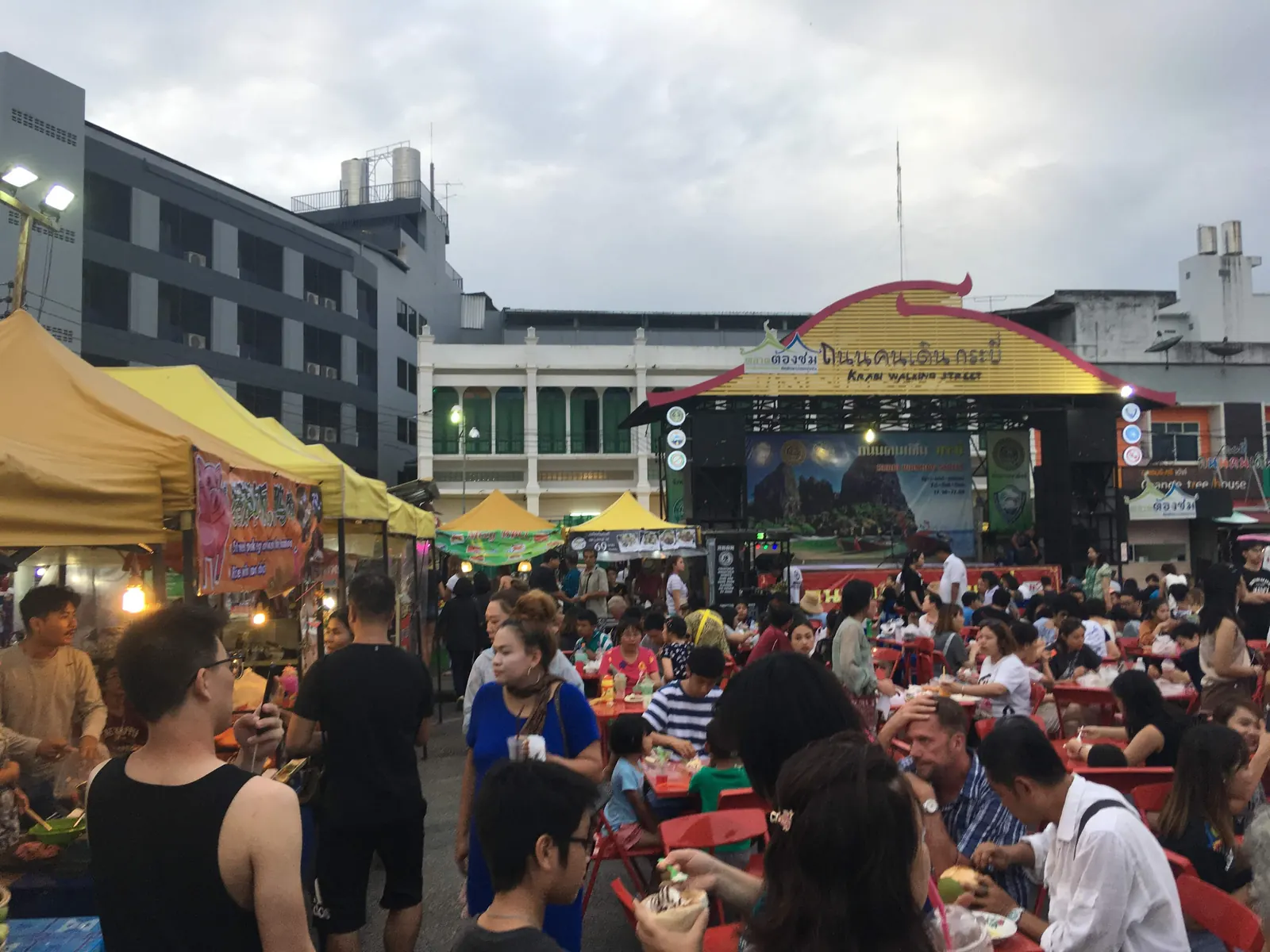
Every Sunday, all year, Thalang Road closes to traffic in the afternoon, the stalls go up from about 3pm, and from 4pm to 10pm the street is Lard Yai, “big market” in the southern dialect and the best night market on the island. The food peaks between 5pm and 8pm. Eat the town’s food: moo hong ฿60–80, Hokkien mee ฿50–60, loba ฿50, a-pong, the crisp coconut pancakes, ฿20–30, and o-aew, the Hokkien jelly-and-ice dessert, ฿30–40 from the stall with the queue of forty. Our Phuket night markets guide ranks it against Naka, Chillva and Patong.
During the Vegetarian Festival, 10 to 18 October 2026, Lard Yai still runs but is swallowed by the yellow-flag jay stalls around Jui Tui, a better market anyway at ฿30–60 a plate; what the yellow flags mean tells you what you are eating, and Chinese New Year in Thailand 2027 covers the other week the quarter lights up. To have the stalls translated on night one, GetYourGuide’s Old Town food walks run about three hours at ฿1,300–2,000.
How to get to Phuket Old Town from Patong, Kata and the airport
Old Town is on the east side of the island; Patong, Karon and Kata are fifteen to twenty kilometres away over the Kathu hill, hence the ranges. Fares are typical as of October 2026, estimates rather than quotes.
| From | How | Cost | Time | Book |
|---|---|---|---|---|
| Patong | Grab or Bolt | ฿350–500 | 30–45 min | In the app |
| Patong | Blue songthaew to the Ranong Road market | ฿30–50 | 45–60 min; roughly 7am–6pm | Pay on board |
| Patong | Smart Bus Route 2 to Bus Terminal 1, Phang Nga Road, ten minutes’ walk from Thalang | ฿50 | About an hour; hourly 6am–8pm | Cash or card on board |
| Kata or Karon | Grab or Bolt; songthaew until about 6pm | ฿300–450; songthaew ฿30–50 | 30–45 min; songthaew an hour | In the app; pay on board |
| Phuket Airport | Metered taxi or pre-booked car; or airport bus 8411 to Phuket Town | ฿650–750 with the ฿100 surcharge; bus ฿100 | 45 min off-peak; bus 60–90 | 12Go; bus cash on board |
The songthaews and the Smart Bus get you there and not back: the last songthaew leaves Ranong Road at about 6pm and Route 2 stops at 8pm, so an evening in town means a Grab home or a bed in town; 12Go’s Phuket to Patong page fixes a car if you want it booked. Street tuk-tuks quote ฿400–600 for rides Grab does for ฿150–250, so have the app working before you arrive (our SIM and eSIM guide) and read the Thailand scams list if a driver offers to wait. The airport bus goes nowhere near a beach, so it is for Old Town stays; the gate-to-kerb detail is in our Phuket airport arrival guide.
Parking, with a car or a ฿250–350-a-day scooter: weekday kerbs on Dibuk, Krabi and Phang Nga roads take cars. On Sundays Thalang Road and Soi Romanee close in the afternoon and anything parked on them stays until after 10pm; use the Wat Mongkhon Nimit car park on Dibuk Road for a small fee, or the Limelight Avenue mall. Which beach for the rest of the week is settled in Patong, Kata, Karon, Kamala or Bang Tao.
Where to stay in Phuket Old Town
Sleeping in Old Town is a specific choice and, for a night or two, a good one: the streets at 7am, Lard Yai on foot, the Vegetarian Festival from your doorstep, and shophouse rooms at half the price of a beach resort. No beach, no pool at most, and by eleven the quarter is asleep. Rates are low-season starting points; festival week and Chinese New Year book out months ahead. The island-wide picture is in where to stay in Phuket.
| Place | What it is | From around | Best for | Book |
|---|---|---|---|---|
| The Memory at On On Hotel | Phuket’s first hotel, 1929, on Phang Nga Road; the hostel in The Beach, restored 2014 | ฿1,300 | The building; Lard Yai two minutes away | Agoda |
| Casa Blanca Boutique Hotel | Restored shophouse on Phuket Road with a small pool | ฿1,900 | Couples who want the pool | Agoda |
| Sino House Hotel | Bigger Sino-style hotel on Montri Road | ฿1,300 | Families and longer stays | Agoda |
| The Rommanee Boutique Guesthouse | A few rooms on Soi Romanee itself | ฿1,200 | The lane before the tripods | Agoda |
| Quip Bed and Breakfast | Small design guesthouse on Phuket Road | ฿1,500 | Solo travellers | Agoda |
| Old Town guesthouses generally | Rooms above cafés and shops | ฿600 | Walk-ins outside festival week | Walk in |
The honest bit
It is small: three hours covers the streets, both museums and a long breakfast, and by the second lap you are looking at the same pink door. It is hot in a way the beaches are not, because no wind gets between shophouses. Soi Romanee at 11am is a photo shoot; the Trickeye and the costume “Peranakan museum” twenty kilometres north in Thalang are built for the tour-bus trade; a tuk-tuk quoting ฿500 for the five minutes to Rang Hill is the same trade on wheels. September and October are the wettest months, and best time to visit Thailand has the month-by-month. None of it changes the verdict: for the price of one beach-road dinner you get the best breakfast in the south, a century of tin money on the walls and a Sunday market worth planning the week around.
Phuket Old Town: your questions, answered
Is Phuket Old Town worth visiting?
Yes, for a morning or a Sunday evening: the best breakfast culture in southern Thailand, a proper museum for ฿200, a 1903 mansion for ฿150 and the island’s best market on Sunday nights. It is small and hot by midday, so make it a half-day from a beach base, or one night around Lard Yai.
How do I get from Patong to Phuket Old Town?
Grab or Bolt is around ฿350–500 and 30 to 45 minutes over the Kathu hill. The blue songthaew is ฿30–50 and about an hour but stops at around 6pm; the ฿50 Smart Bus Route 2 runs hourly to Bus Terminal 1 on Phang Nga Road until 8pm. Bus there, Grab back, or sleep in town.
What day is the Phuket Old Town walking street?
Sunday, every week of the year. Thalang Road closes to traffic in the afternoon and the Lard Yai market runs from about 4pm to 10pm, best between 5pm and 8pm, with plates at ฿40–80. Indy Market on Limelight Avenue, off Dibuk Road, runs Wednesday to Friday evenings if you miss it.
What should I eat for breakfast in Phuket Old Town?
Dim sum at Boonrat, open 5.30am to 10.30am, at around ฿15–30 a basket with a ฿35 kopi; then o-tao, loba or Hokkien mee at Lock Tien on the corner of Dibuk and Yaowarat roads for ฿50–80. A full Hokkien breakfast for two is under ฿300; Mee Ton Poe at the clock tower has made Hokkien mee since 1946.
Should I stay in Phuket Old Town or on the beach?
Both, if you have the nights. Base on a beach for the week and give Old Town one or two nights around a Sunday, or the Vegetarian Festival in October. Shophouse hotels such as The Memory at On On or Sino House start from around ฿1,300, about half a comparable beach room, but there is no sand and the quarter sleeps by eleven.
Related guides
- Things to Do in Phuket That Aren’t Bangla Road
- Phuket Vegetarian Festival 2026: Dates, Shrines and Etiquette
- Where to Stay in Phuket: The Complete 2026 Guide
Book the trip
Some links in this guide are affiliate links. If you book through them we may earn a small commission at no extra cost to you — it helps keep Destination Thailand independent.
Hotels: shophouse rooms in Old Town and every beach on the island are on Agoda’s Phuket page. Tours/Boats: for the streets and shrines explained, GetYourGuide’s Old Town walking tours fill a quiet afternoon. Getting there: flights and the overnight bus from Bangkok are on 12Go, the airport transfer on 12Go’s airport page, and every route is costed in our Bangkok to Phuket guide. Not sure Phuket is your island at all? Our Where to Go in Thailand matcher will tell you in about a minute.