Phuket airport is where Thailand’s holiday industry meets its transport industry, and the transport industry wins. Fifteen-million-odd people a year land at the top of the island and discover that the beach they booked is an hour away, and that every way of covering that hour has a counter, a price and a man who would rather you used him instead.
This is how a Phuket airport arrival runs as of October 2026: the arrival card, the queue, the money, and every route to Patong, Kata, Old Town or Bang Tao with the fare attached.
The short version: file your Thailand Digital Arrival Card online within the three days before you land (free), check what the 30-day visa exemption means for your passport, walk past everyone who speaks to you inside the hall, and go to the metered taxi counter outside the doors: around ฿700–800 all in to Patong, or ฿100 on the Smart Bus if you have time and a backpack. Ninety minutes from gate to hotel is a good international arrival; two and a half hours is high season.
Before you land at Phuket airport: the TDAC, the 30-day stamp and what is in your bag
The Thailand Digital Arrival Card replaced the paper TM6 in May 2025 and is checked at Phuket exactly as in Bangkok. File it at tdac.immigration.go.th, free, within the three days before you arrive; a QR code lands in your email and one group submission covers a family. Screenshot it, and ignore the lookalike sites charging USD 30–80 for the same form. If you flew in via Bangkok you cleared immigration there and Phuket is a domestic arrival: no card, no queue.
Then the stamp. From 15 September 2026 the visa-exempt nationalities get 30 days, not 60, and the list shrank to 60 countries, a few passports running on separate treaties at their old lengths; the 30 days can be extended once at Phuket immigration for ฿1,900. In the bag: vapes are illegal in Thailand and Phuket customs does pull bags for them, and cash over USD 20,000 must be declared.
International or domestic: which Phuket airport terminal you land in, and the walk between them
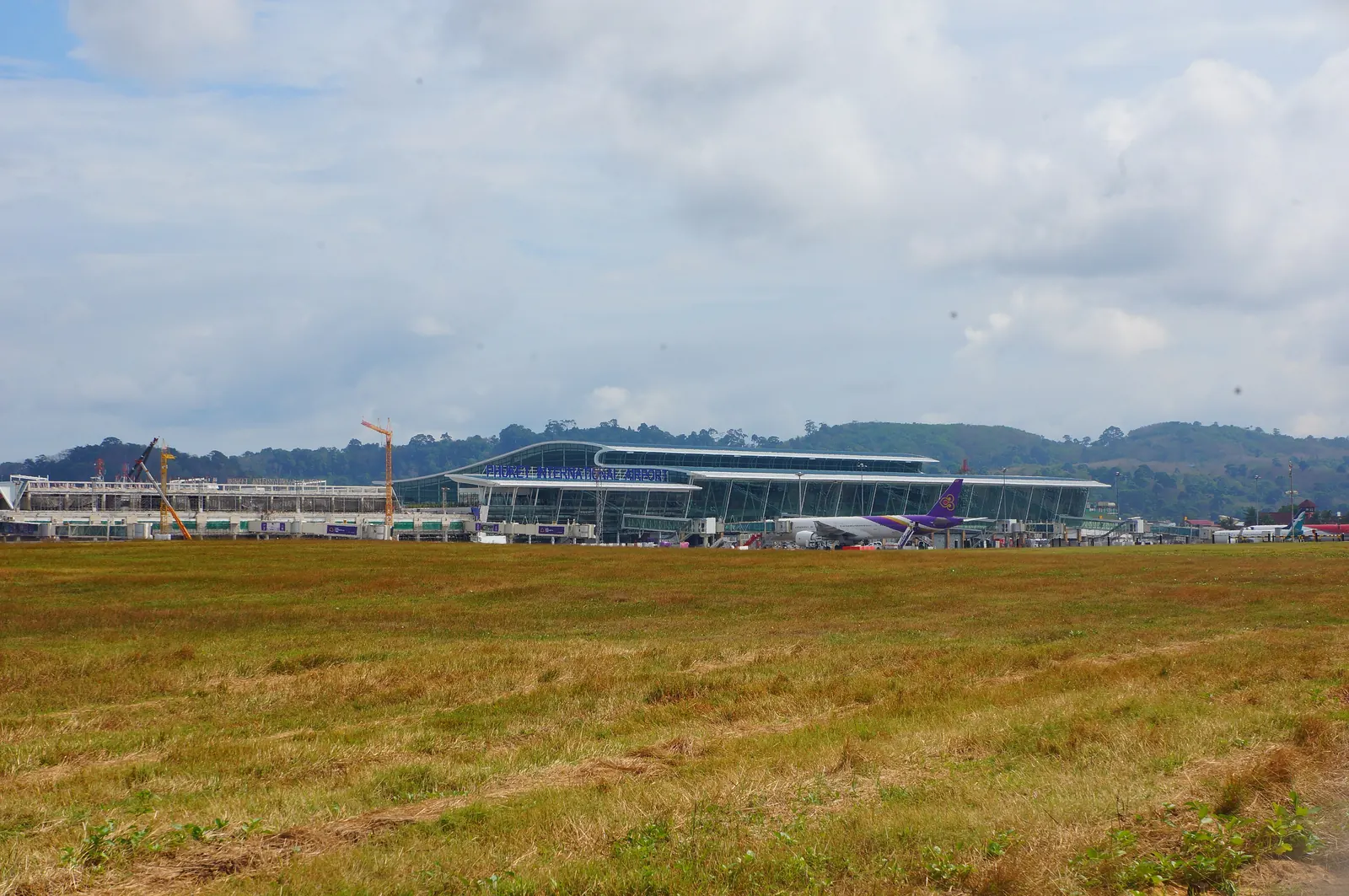
Two terminals share one kerb. The International Terminal is the glass building that opened in 2016 and takes every foreign flight, from Singapore to the Gulf carriers and the Russian charters; the older building next door is the Domestic Terminal, for AirAsia, Nok, Lion, Vietjet, Thai and Bangkok Airways from Bangkok and Chiang Mai. Ignore the terminal numbers on the signs and ask for international or domestic. A covered walkway on the departures level joins them, five minutes with a trolley.
Domestic arrivals are the easy version: belts 6 to 10, out through a hall the size of a large 7-Eleven, fifteen minutes on a good day. International arrivals go down to passport control, collect from belts 1 to 5 on level 1, and come out through customs. Everything below assumes the international version.
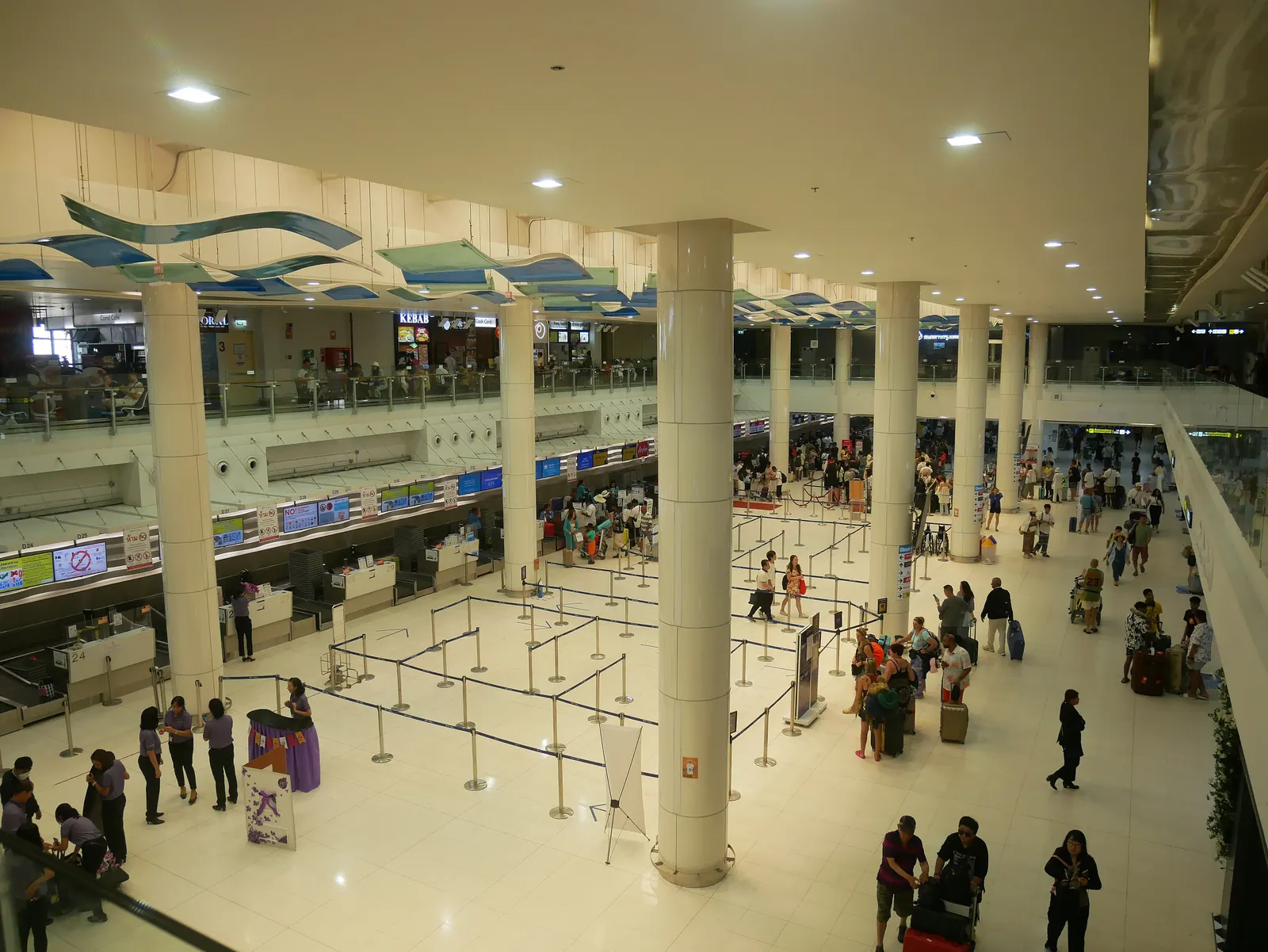
Phuket airport immigration: the queue, the autogates and the priority lane
The staffed Foreign Passport counters are what most people get: passport scanned, photo taken, TDAC checked on screen, stamp. Have the hotel name ready and the onward flight findable on your phone. There is a priority lane for the over-70s, pregnant travellers and anyone carrying an infant; use it.
Then the gates. Phuket got automated passport channels in June 2026. As of October 2026, who can use them on arrival follows the national Immigration Bureau list: Thai, Singaporean and Hong Kong passports first, then the 31 nationalities approved in August, rolling out before high season and only where your biometrics are on file from a previous visit. Our autogate guide keeps the current list. Any biometric passport can use the gates on the way out. Until a gate accepts your passport on the way in, plan for the human stamp.
The queue is governed by which wide-bodies landed before you. In low season an ordinary hour is 15 to 30 minutes. From November to March the pattern I see most is a midday-to-mid-afternoon bank, when the Russian, Indian and Chinese aircraft arrive within an hour of each other, and another from about 21:00 to midnight: 45 to 90 minutes then is normal. Somewhere in it you will be offered a “VIP fast track” for ฿1,500–3,000 cash; it is not sold in the line, and no officer here speeds up for a banknote in the passport (the scams guide has the rest).
Baggage, customs and the arrivals hall: SIM counters, the ฿220 ATM and the exchange booths
The belts are behind passport control on level 1, customs is a green channel past an x-ray, and then the doors open onto the arrivals lobby and the airport starts trying to sell you things. The AIS and True counters are the one fair deal: a tourist SIM with eight to fifteen days of data for ฿299–799 as of October 2026, registered against your passport in ten minutes. The kiosks between them sell the same thing at three times the price. An eSIM bought before you fly — Simbye’s Thailand eSIM from about $2, and code DESTTHAI15 takes 15% off — is cheaper again and means you have data before the taxi counter has explained its prices; the SIM and eSIM guide has the current plans.
Cash next. Every ATM in the hall charges a foreign card ฿220 per withdrawal on top of your own bank’s fees, so take one large sum, ฿20,000–30,000, and decline the offer to convert into your home currency; the money guide lists the cards that refund the ฿220. The exchange booths in arrivals are several per cent worse than the bank booths in Patong and Phuket Town: change a hundred dollars if you land with nothing, not a thousand. The Price Index has what the loungers and longtails should cost.
Getting from Phuket airport to Patong, Kata, Old Town and Bang Tao: taxis, Grab, minibus and the fixed-price counters
Geography first. The airport sits at Mai Khao on the island’s northern tip, about 32 kilometres from Phuket Town and 35 from Patong, and there is no train or ferry. Off-peak, Patong is 45 to 60 minutes, Bang Tao 30, Kata 60 to 70, Old Town 45; the school run from 07:00 to 09:00 adds twenty minutes, the evening rush over the Kathu hill from 16:30 to 19:00 adds thirty, and a downpour or a Friday in January puts Patong at 90.
Metered taxi. Counters outside the doors of both terminals, open until the last flight, the cheapest car and the honest one. The meter starts at ฿50, every car leaving the airport carries a ฿100 surcharge, and as of October 2026 Patong comes to around ฿700–800 all in, Kata or Karon ฿800–950, Phuket Town ฿650–750, Bang Tao ฿450–550. Watch the meter go on before the car moves; a flat quote means the next car. Verdict: the default with luggage, at any hour.
Fixed-price limousine. Inside the hall, near the belts, a laminated board: around ฿800–1,000 to Patong, ฿1,000–1,200 for Kata, Karon and Rawai, newer cars, no meter, pay in advance. Fine if you want the number fixed; ฿100–200 over the meter for the same road.
Grab. The one app allowed to collect at the terminal: the GrabMeet booth is outside Exit 8 of the International Terminal, or right of the taxi rank outside Domestic Exit 1. Fares to Patong run ฿750–1,250 with surge, so Grab is often dearer than the meter here; you are paying for a fixed price and an app in English. Do it for the fixed fare; skip it at midnight when the surge is on.
Shared minibus. The counter is on the domestic side, ฿180–200 a seat to Patong, Kata and Karon, leaving when full, which can mean a 30-minute wait and five hotels before yours. Fine for a couple to Patong in daylight; wretched at 23:00.
Pre-booked private car. 12Go’s Phuket airport to Patong page lists cars and shared vans side by side, around ฿700–1,000 for a car as of October 2026 and shared seats from about ฿150, with separate pages for Phuket Town, Kata and Bang Tao. It saves nothing against the meter; it means a driver holding your name in arrivals while you walk straight past the man in the hall who says “taxi, sir” and means ฿1,500 in an unmarked car. Hotel cars are the same service at ฿1,000–1,500 on the room bill. Worth it for late landings and families.
Going further. Khao Lak is 75 to 90 minutes north over the Sarasin Bridge, ฿1,500–2,000 by private car or a few hundred baht a seat in a shared van; 12Go lists both, and a booked van to Krabi beats changing at the bus terminal.
| Option | ฿ to Patong (Oct 2026) | Time to Patong | When it makes sense | Book |
|---|---|---|---|---|
| Metered taxi (outside both terminals) | around ฿700–800 incl. ฿100 surcharge | 45–60 min | Default with luggage, any hour | At the counter |
| Fixed-price limousine (inside the hall) | ฿800–1,000 | 45–60 min | The number fixed before you sit | At the counter |
| Grab (Exit 8 International, Exit 1 Domestic) | ฿750–1,250 with surge | 45–60 min | Fixed fare, app in English, daylight | App |
| Shared minibus (Domestic counter) | ฿180–200 a seat | 60–90 min | Couples and solos, daytime | At the counter |
| Phuket Smart Bus | ฿100 flat | about 60 min | One bag, daytime, hotel near a stop | On board |
| Airport bus 8411 | ฿100, Phuket Town only | 60–90 min to Old Town | Old Town stays | On board |
| Pre-booked car or shared van | ฿700–1,000 car; seats from about ฿150 | 45–60 min | Late landings, families, Khao Lak | 12Go |
| Meet-and-greet driver | around ฿900–1,500 | 45–60 min | First-timers who want a name board | GetYourGuide |
The Phuket Smart Bus and the 8411 airport bus: ฿100 to the beach, if you have the time
The Phuket Smart Bus exists and almost nobody off the international flights knows it. Blue, air-conditioned, with luggage racks, it runs down the whole west coast to Rawai, calling at Bang Tao, Surin, Kamala, Patong, Karon and Kata, for a flat ฿100; pay cash, tap a contactless Visa or Mastercard, or buy the ฿300 Phuket Rabbit card on board. Patong is about an hour, Kata 80 minutes, Rawai the best part of two.
The catches. It leaves roughly hourly, first bus around 06:00–06:30 and last in the late afternoon or evening depending on the timetable in force, so a midnight landing is out and a 17:30 landing is a gamble; the operator’s timetable page has live tracking and the current hours. The stop is outside the Domestic Terminal on the departures level and not obvious; ask at the information desk. Do it: one bag each, daytime, a hotel near a stop. Skip it: two suitcases, a toddler, a night flight.
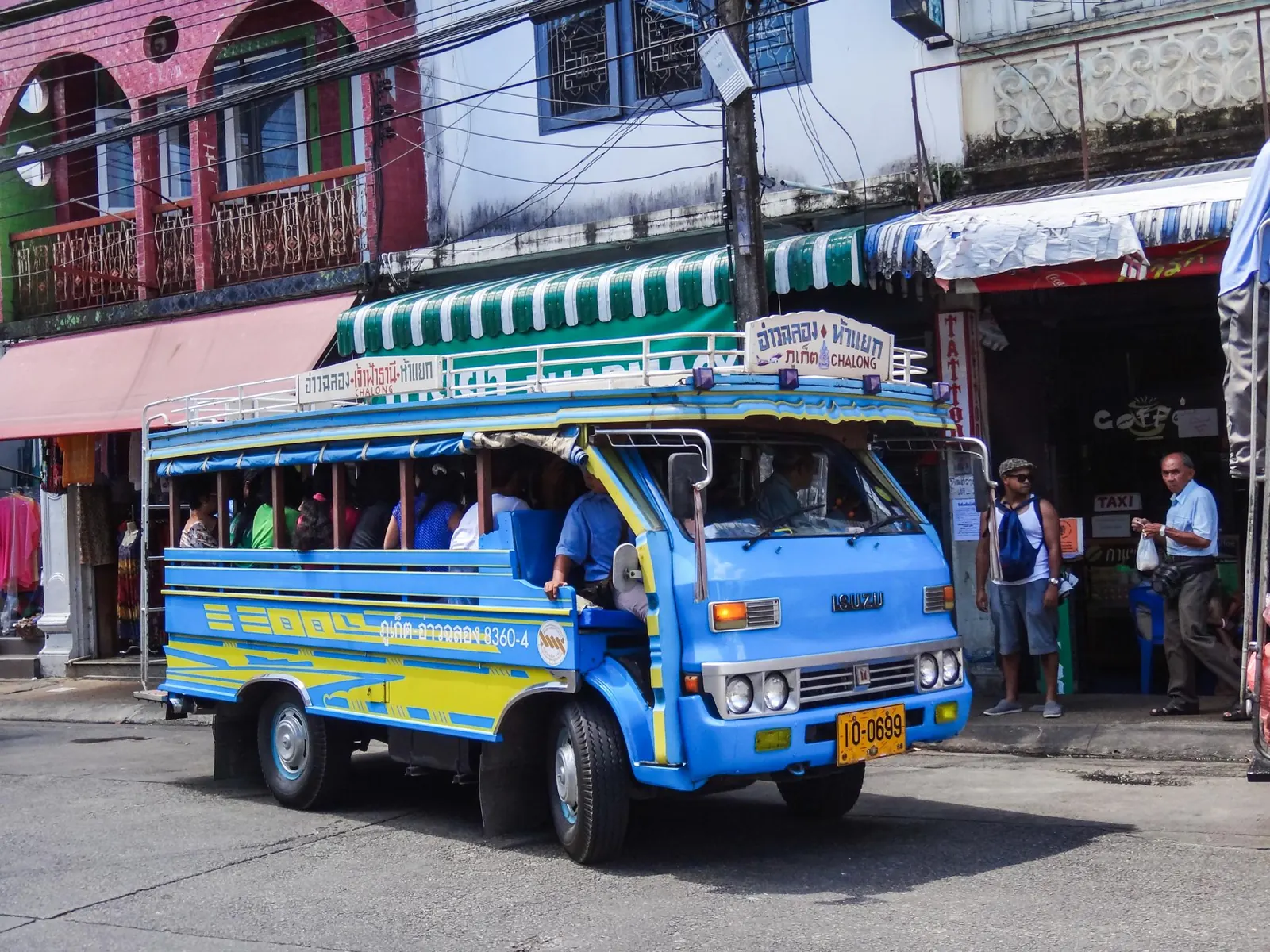
The other bus is route 8411, the orange government airport bus to Phuket Town: ฿100, 60 to 90 minutes, cash on board, early morning until about 22:30 on the last timetable I saw. It goes nowhere near a beach, so it is for Old Town stays, where a taxi is ฿700. From Phuket Town the blue songthaews reach Patong, Kata and Karon for ฿30–50 until dusk; after that it is a tuk-tuk at ฿400–500.
Sleeping next to Phuket airport: Nai Yang, Mai Khao and the runway hotels
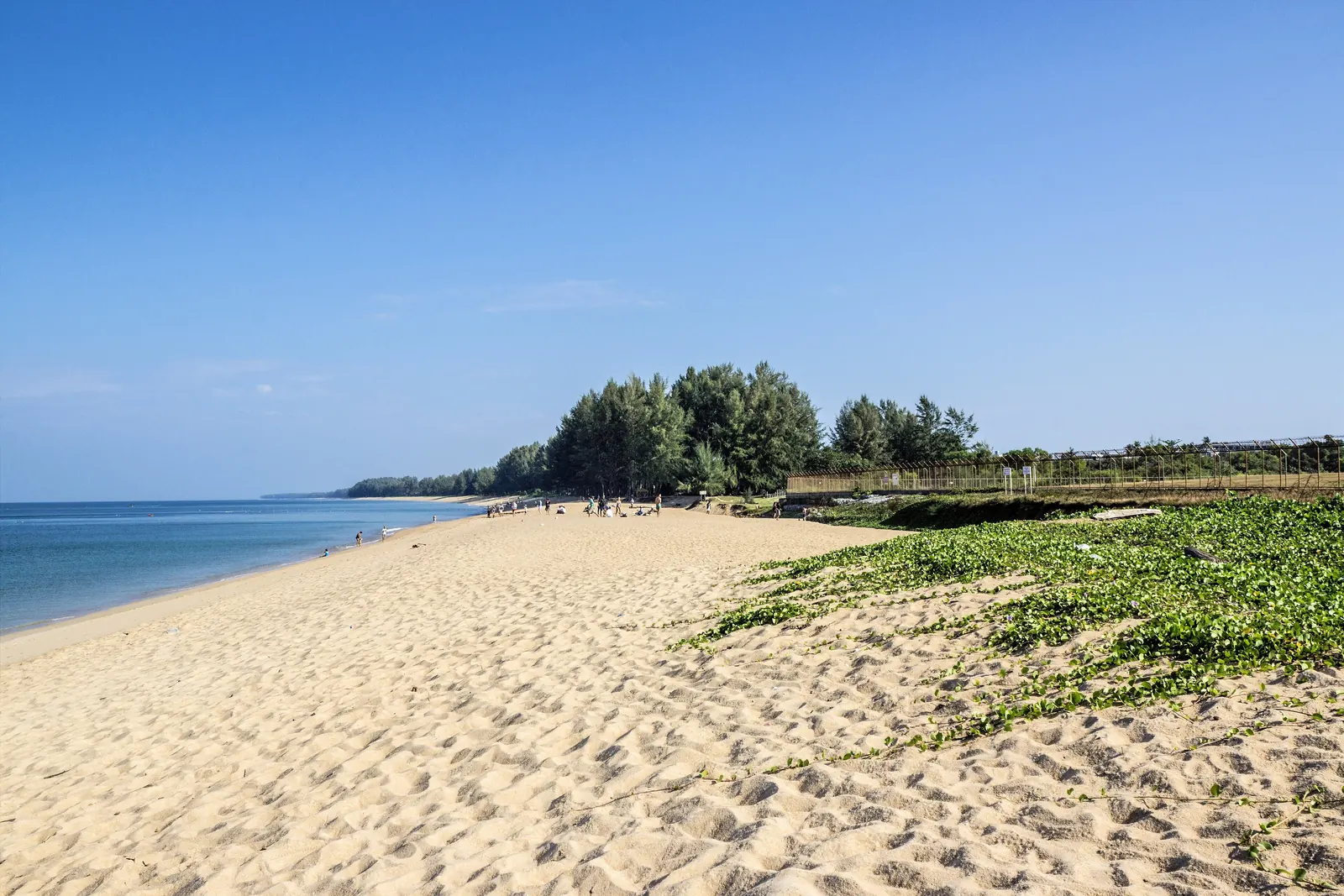
The airport’s position gives you two beaches nobody else uses: Nai Yang, ten minutes south, a casuarina-shaded bay inside Sirinat National Park, and Mai Khao, eleven kilometres of near-empty sand running north to the Sarasin Bridge, with the famous plane-spotting corner at its southern end.
Four places I would actually put people in. The Slate at Nai Yang is the polished one, the old Indigo Pearl rebuilt around the island’s tin-mining past, ten minutes from the door and around ฿6,000–12,000 a night by season. SALA Phuket Mai Khao Beach Resort is the pool-villa version on the quiet beach, around ฿8,000–15,000. Louis’ Runway View Hotel is the budget bed for a dawn flight, around ฿1,000–1,800. The plainly named Phuket Airport Hotel is ฿900–1,500. Phuket is a 24-hour airport and Nai Yang hears it; light sleepers pay for Mai Khao or pack earplugs.
This is for a late landing before an early Similan boat from Tab Lamu, a red-eye home after Khao Lak, or a first family night without the Patong hill; not for a week of seeing the island from here, at 30 to 45 minutes each way. The where-to-stay guide ranks every beach against that trade-off.
Leaving from Phuket airport: how early, the transfer back and the Sarasin Bridge
The departure side is where the high-season charter traffic does its worst, and the 22:00-to-02:00 wave of Russian and Chinese flights produces the longest check-in queues I have stood in anywhere in Thailand. For an international flight between November and March, three hours is not caution, it is arithmetic; 90 minutes for a domestic one. Passport control on the way out has automated gates for any biometric passport; security does not.
The transfer back costs less, because the ฿100 surcharge only applies to cars leaving the airport: a metered taxi from Patong runs around ฿600–700, a Grab ฿600–900, a hotel car ฿800–1,200, and the Smart Bus is the same ฿100 northbound, though the last northbound bus is late afternoon, so an evening flight means a car. Book it the night before; 12Go’s Patong to Phuket airport page fixes it at the hotel desk’s money without the desk.
Allow 60 minutes from Patong on a normal day and 90 from 16:30, 75 from Kata or Karon, 50 from Old Town, 30 from Bang Tao. From Khao Lak you come south over the Sarasin Bridge and through the Tha Chatchai police checkpoint at the island’s neck, a 20-to-40-minute queue on a holiday Sunday; around Songkran and New Year (the festival calendar has the dates) the roads and the bridge queue like nowhere else, and the best-time guide explains the rain. Buy the water after security: ฿40 inside, Thailand outside.
The honest bit
Phuket airport is not a difficult airport. It is a busy one with a long road at the end of it, staffed by people who know what a tired family will pay to shorten that road. The fares are not a scam in the sense the scams guide means: the meter is honest, the boards are printed, the driver takes you where you said. It is simply that the cheapest way to Patong is ฿100, the sensible way is ฿750 and the way the man in the hall prefers is ฿1,500, and the difference is whether you knew the sequence before you landed. The Phuket province page covers what happens once the taxi stops; the Bangkok to Phuket guide covers how most people get here.
Phuket airport arrival: your questions, answered
How much is a taxi from Phuket airport to Patong?
As of October 2026 a metered taxi from the official counters outside the terminals comes to around ฿700–800 to Patong, including the ฿100 airport surcharge, and takes 45 to 60 minutes. The fixed-price limousine counters inside the hall charge ฿800–1,000 for the same road, a shared minibus seat is ฿180–200, and the Smart Bus is ฿100.
Does Phuket airport have autogates for foreign arrivals?
Automated passport channels were installed at Phuket in June 2026, but who may use them on arrival follows the national Immigration Bureau list: Thai, Singapore and Hong Kong passports, with 31 more nationalities rolling out before high season and only for travellers whose biometrics are already on file. Everyone else uses the staffed counters. On departure, any biometric passport can use the gates.
Where does the Phuket Smart Bus stop at the airport?
Outside the Domestic Terminal on the departures level, a five-minute walk along the covered walkway from international arrivals; ask at the information desk if the sign has moved. Buses leave roughly hourly during the day for a flat ฿100 to any stop between Bang Tao and Rawai, and Patong takes about an hour. Pay cash or tap a contactless card on board.
Is Grab cheaper than a taxi at Phuket airport?
Usually not. Grab quotes ฿750–1,250 to Patong depending on surge, against around ฿700–800 on the meter from the official counter. What Grab gives you is a fare fixed before you get in, an English-language app and a receipt. The pick-up is the GrabMeet booth outside Exit 8 of the International Terminal, or to the right of the taxi rank outside Domestic Exit 1.
How early should I get to Phuket airport for an international flight?
Three hours in high season, November to March, when the late-evening charter wave can hold the check-in queues for an hour on its own; two hours in low season; 90 minutes for a domestic flight. Then add the road: 60 to 90 minutes from Patong, 75 from Kata, and a possible checkpoint queue at the Sarasin Bridge if you are coming from Khao Lak on a holiday weekend.
Related guides
- Things to Do in Phuket That Aren’t Bangla Road
- Bangkok to Phuket: Fly, Bus or the Long Way Down
- Where to Stay in Phuket: The Complete 2026 Guide
Book the trip
Some links in this guide are affiliate links. If you book through them we may earn a small commission at no extra cost to you — it helps keep Destination Thailand independent.
Hotels: Agoda’s Phuket listings let you sort by beach, which is the only way to see how far from the airport you are putting yourself. Tours/Boats: GetYourGuide’s Phuket day trips and transfers for the boats and the name-board driver on the night you would rather not think. Getting there: 12Go’s Bangkok to Phuket listing shows the flights and the overnight buses side by side, and our Bangkok to Phuket guide says which to take. And if Phuket was only a guess, our Where to Go in Thailand matcher will tell you before the taxi reaches the Heroines’ Monument.