Chiang Rai keeps three evenings, and most visitors only find the first. The Chiang Rai Night Bazaar runs every night beside Bus Terminal 1: two food courts, a stage of Lanna dancers, plates for ฿50–80 and a hundred stalls selling the same wooden frog. On Saturday the town closes Thanalai Road for a kilometre and eats khanom jeen nam ngiao at ฿40–60 a bowl while a band plays and grandmothers dance in the road, which is the evening you came north for. On Sunday a quieter version sets up on Sankhongnoi Road, and every night at seven, eight and nine the gold clock tower on the roundabout does a light show that nobody asked for and everybody films.
Hours and prices were checked in October 2026 against local listings and our own notes from the things to do in Chiang Rai rebuild. Market hours in a town this size drift with the weather and the festival calendar, so treat a closing time as the hour the stalls start packing, not the hour they are gone.
The short version: if you have one night, make it Saturday. If you have any night, the Night Bazaar is fine, cheap and three hundred metres from the clock tower, and its food court is a better dinner than its souvenir aisles suggest. Sunday is for people who found Saturday too loud. Do the clock tower at eight on the way to any of them, eat northern rather than pad thai, carry cash, and see how it all compares with the bigger circus down the road in our Chiang Mai night markets guide. Where to base yourself and what to do in daylight is on the Chiang Rai province page.
Which Chiang Rai night market is on tonight? The three evenings compared
All three are within two kilometres of the clock tower, all three are free to enter, and none of them sells seafood by the kilo, which already puts Chiang Rai ahead of most Thai resort towns. The difference is who they are for.
| Market | Night | Hours | Where | Size and food | Verdict |
|---|---|---|---|---|---|
| Chiang Rai Night Bazaar | Every night | About 6pm–11pm; food courts from about 5pm | Beside Bus Terminal 1, off Phahonyothin Road, 300 m from the clock tower | Around a hundred souvenir stalls, two food courts, Lanna dance stage, beer garden; plates ฿50–80 | Fine; eat here, shop elsewhere |
| Saturday Walking Street (Kad Jiang Hai Ramluek) | Saturday | About 4pm–11pm, stalls packing from 10pm | Thanalai Road, about a kilometre from the Government Savings Bank junction to the Nong Si Chaeng junction | Several hundred stalls, locals, a live stage with dancing in the road; plates ฿40–60 | Do it; the best evening in the province |
| Sunday Happy Street (Thanon Khon Muan) | Sunday | About 4pm–11pm | Sankhongnoi Road from Soi 2 westwards, near Wat Chetuphon, 2 km south-west of the clock tower | Smaller, more food than craft, students and families; plates ฿40–60 | Fine; do it if Saturday is not an option |
| Clock tower light show | Every night | 7pm, 8pm and 9pm, about ten minutes each | Central roundabout, Banphaprakan Road | No food; a gold tower changing colour to music | Fine, for ten minutes on the way to dinner |
| Kad Luang (municipal market) | Every morning | From before dawn; best before 9am | Uttarakit Road, between the clock tower and the river | Fresh market with breakfast counters: khao soi, khanom jeen, sticky rice; ฿30–50 | Do it once, for breakfast |
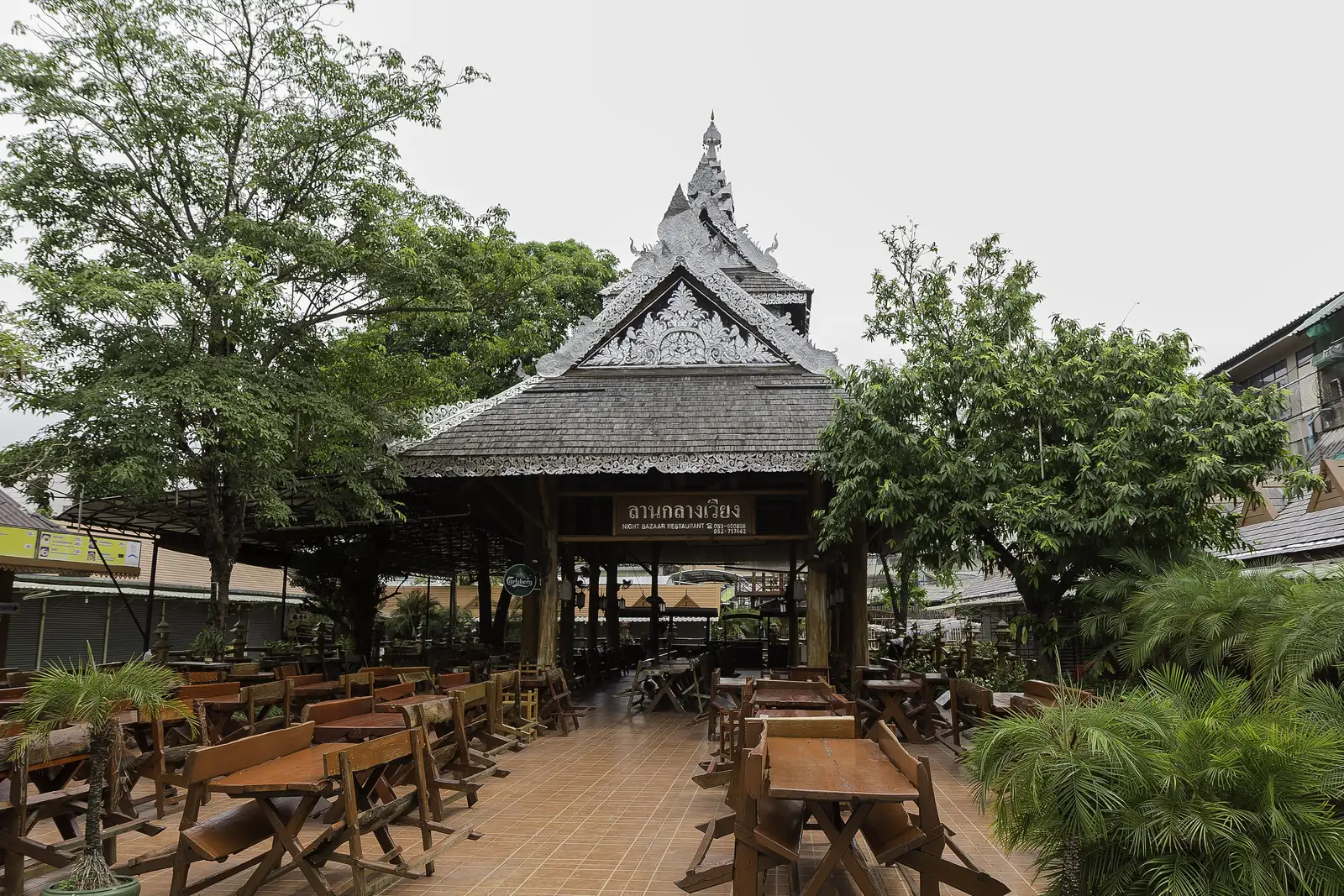
The Chiang Rai Night Bazaar beside Bus Terminal 1: nightly, two food courts and a stage
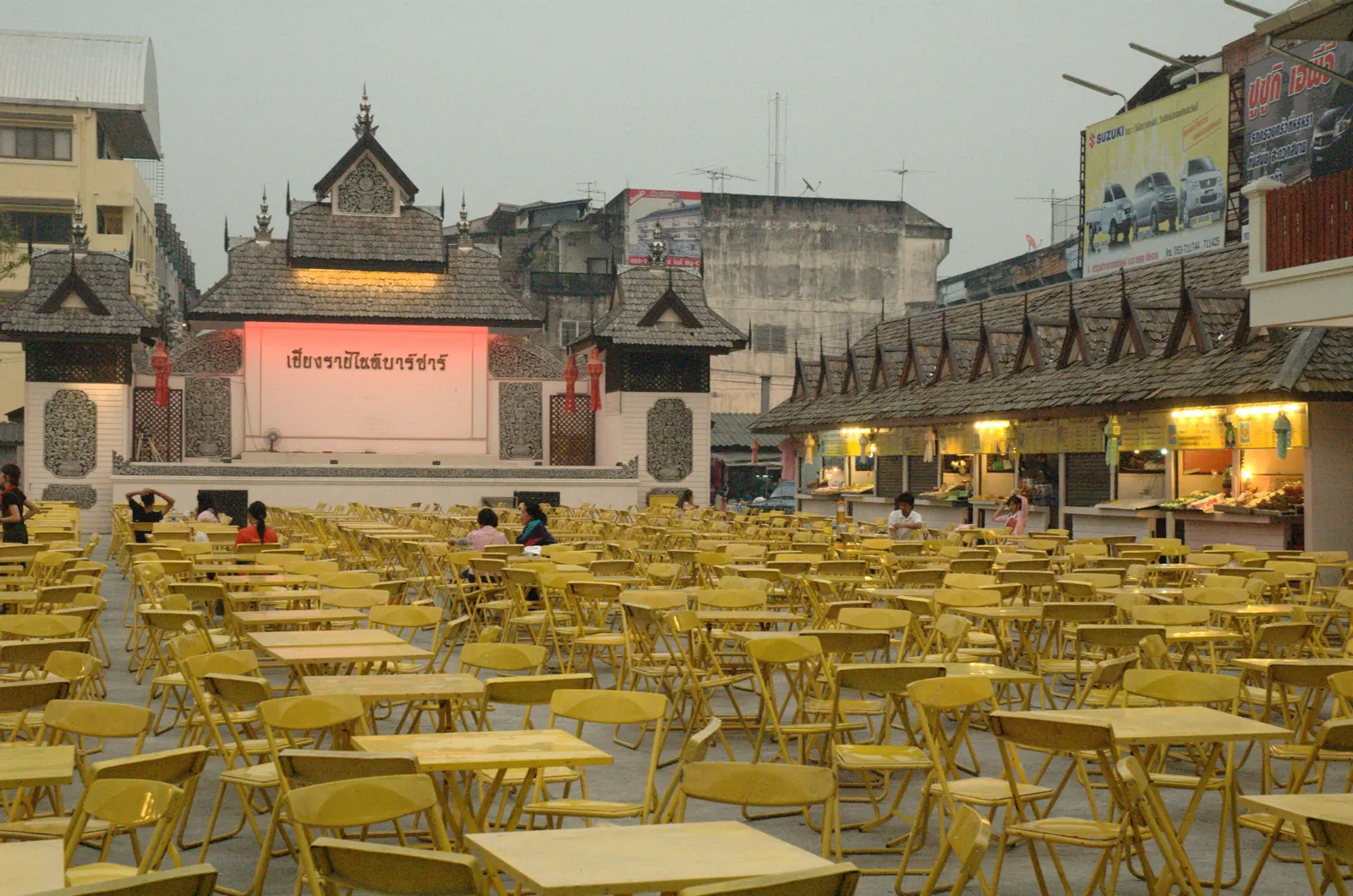
The Night Bazaar fills the lanes between Phahonyothin Road and the old bus station, now Bus Terminal 1, which means half the people in it arrived from Chiang Mai an hour ago with a rucksack and no dinner plan. Stalls open from about six and the lights go off around eleven; the food courts start earlier, from around five, and run later. There are two of them. The main one, behind the souvenir rows, is a hangar of yellow Singha tables between two long ranks of kitchens, with a stage at the east end where students from the Rajabhat university do Lanna dance in full costume, the fingernail dance included, between sets from a northern band. The second, a beer garden with its own stage, runs louder and later with cover bands and jugs. Both are free to sit in.
Order from the kitchens, carry the plate to a table, and someone will appear to sell you beer: a large Chang or Singha around ฿80–100, a jug of draught around ฿100–120, a fruit shake ฿20–40. The food is wider than it is deep. Northern plates sit beside sushi, steak-and-chips, a Mexican counter and a tray of fried insects, and most of it is ฿50–80, ten baht above the same dish on a pavement, which is the rent for the chair and the dancers. Eat the northern things: khao soi at ฿50–60, khanom jeen nam ngiao at ฿40–50, sai ua by the portion, grilled pork neck with sticky rice, nam prik noom with crackling, and kung ten, the “dancing shrimp”, live freshwater shrimp tossed in lime and chilli that our is Thai street food safe guide would politely steer you past. Two people eat and drink for about ฿300–400; check anything that looks high against the Thailand price index.
Then the shopping, honestly. The souvenir rows are the Night Bazaar’s weak half: hill-tribe embroidery that is sometimes hill-tribe and sometimes a factory in Lamphun, Akha headdresses, wooden frogs that croak when you stroke them, elephant trousers, the same T-shirts as Chiang Mai at ฿150–250. Haggling takes ten or twenty per cent off; the genuine textiles, the ones with weight and uneven stitching, are at the back where the older women sit with the work in their laps. The nearest beds are beside it: Wiang Inn Hotel on Phahonyothin Road, from around ฿1,100–1,500, is the old-school business hotel with a pool whose front door is a hundred metres from the stalls; Mercy Hostel, dorm beds from around ฿350–500, is the clean, quiet budget bed a few streets towards the clock tower.
Verdict: Fine. Eat in the main food court, watch one dance set, skip the beer garden unless a cover of Hotel California is your idea of Lanna culture, and buy nothing you have already seen in Chiang Mai. If it is a Saturday, leave by seven and walk to Thanalai Road.
The Saturday Walking Street on Thanalai Road: the one Chiang Rai actually goes to
Kad Jiang Hai Ramluek, which translates roughly as the “Chiang Rai remembers” market, closes Thanalai Road to traffic every Saturday from about four in the afternoon, from the Government Savings Bank junction near the clock tower for roughly a kilometre to the Nong Si Chaeng junction. By five the stalls are open, by six the road is a slow river of families, students, monks on an evening walk and a scattering of foreigners who worked out which night to be in town. It thins from ten and is gone by eleven. Arrive at five if you want a table in the food lanes; arrive at seven if you want the band and do not mind eating standing up.
The route, from the clock tower end. The first few hundred metres are crafts and clothes: indigo cotton, hill-tribe bags, carved wooden spoons, a man doing live wood carving for an audience of three. The food is roughly halfway down, where side lanes fill with charcoal grills and plastic tables, and it is the best market food in the province: khanom jeen nam ngiao, the Tai Yai tomato-and-pork-rib noodle soup that is Chiang Rai’s own dish, ฿40–60; khao soi, ฿40–70, often sold out by eight; sai ua sliced from a coil on the grill, ฿50–80 a portion; grilled river fish stuffed with lemongrass, ฿100–150; moo ping at ฿10–15 a stick; khanom krok coconut pancakes, ฿20–30 a tray; kanom wong, the northern doughnut rings, ฿20 a bag; and Chiang Rai coffee from Doi Chaang or Doi Tung at ฿50–80, because this is the province that grows it. Halal and jay stalls are flagged in Thai and usually in English. What everything is and how to point at it is in our northern Thai food guide, and the bowls are decoded in Thai noodles, decoded.
Towards the far end is the stage, and this is the part no photograph conveys: a live band plays northern folk and lukthung, and the road in front of it fills with people doing the ram wong, the slow circle dance, in a loop that grows until it blocks the street. Grandmothers lead, children copy, a few foreigners are pulled in and are terrible and nobody minds. Beer is sold from coolers at the food lanes, around ฿70–90 a large bottle; it is a family market first and a bar second. Nak Nakara Hotel, from around ฿1,500–2,200, Lanna teak and a pool, is five minutes from the Thanalai Road end and is the mid-range room we would book for a Saturday.
Verdict: Do it, and build the Chiang Rai leg of the trip around a Saturday if you possibly can. This is the market the Night Bazaar is a rehearsal for, and it costs the same ฿300 for two people to eat too much.

The Sunday Happy Street on Sankhongnoi Road, and the clock tower show at seven, eight and nine
Sunday’s market, Thanon Khon Muan or the Sankhongnoi Happy Street, closes Sankhongnoi Road from Soi 2 westwards, around Wat Chetuphon, from about four until eleven, two kilometres south-west of the clock tower in a part of town visitors rarely reach, which is its point. The balance tips from craft to food: more grills, more noodle stalls, more students eating ฿40 bowls on plastic stools, a stage of school bands. Fewer textiles, fewer tour groups, the same ฿40–60 plates as Saturday. Go from 5.30pm, when the stalls are all open and the light has gone.
Verdict: Fine, and better than fine if Saturday was too much. Skip unless you are here on a Sunday anyway; it does not justify rearranging a route for.
The clock tower, Ho Nalika Chalerm Phrakiat, is the gold confection on the central roundabout on Banphaprakan Road, designed by Chalermchai Kositpipat, the artist behind the White Temple. At 7pm, 8pm and 9pm the floodlights cycle through colours while a song plays and the traffic keeps circling, for somewhere between five and ten minutes depending on who you believe. It is free, faintly ridiculous and 300 metres from the Night Bazaar, so you will see it whether you plan to or not. Aim for the 8pm show, on the way to dinner rather than back from it, and do not stand in the road, as several people do every night. The same artist’s day job is covered in White Temple, Blue Temple, Black House. Verdict: Fine, for ten minutes. It is for the camera; the markets are for the stomach.

What to eat at Chiang Rai’s night markets: the northern plate decoder with prices
Northern Thai food is built on pork fat, sticky rice, bitter herbs and tomato rather than coconut and sugar, and Chiang Rai’s version leans Tai Yai, the Shan cooking that came over the Burmese border with the noodle soups. The prices below are November 2026 market prices, consistent with our northern Thai food guide and the price index; the Night Bazaar food court adds ฿10 or so to most of them for the chair.
| Dish | What it is | Market price | Verdict |
|---|---|---|---|
| Khanom jeen nam ngiao (ขนมจีนน้ำเงี้ยว) | Rice vermicelli in a tomato, pork-rib and fermented-bean broth with blood cake and dried kapok flower | ฿40–60 | Do it; Chiang Rai’s own bowl |
| Khao soi (ข้าวซอย) | Egg noodles in a coconut curry broth, chicken or beef, a hat of fried noodles, pickled greens | ฿40–70 | Do it, early; stalls sell out |
| Sai ua (ไส้อั่ว) | Coiled pork sausage with lemongrass, galangal and kaffir lime, grilled over charcoal | ฿50–80 a portion; around ฿40 per 100 g | Do it; the bus snack too |
| Nam prik noom and nam prik ong with khaep moo | Green-chilli dip and tomato-pork dip, with pork crackling, blanched vegetables and sticky rice | ฿40–60 a plate; ฿20–40 a bag to take away | Do it; the vegetarian-adjacent plate |
| Khao kan jin (ข้าวกั๊นจิ๊น) | Rice kneaded with pork blood, steamed in a banana leaf, with fried garlic and chilli | ฿15–30 | Do it once; it tastes of iron and garlic |
| Kaeng hang lay | Burmese-style pork-belly curry with ginger, tamarind and peanuts, no coconut | ฿50–70 over rice at a market; ฿80–150 in a restaurant | Do it when you see it |
| Laab kua | Northern laab, cooked, dark with dried spices, nothing like the Isaan one | ฿60–100 | Fine; say phet noi |
| Moo ping and grilled pork neck | Skewers, or kor moo yang sliced with a jaew dip | ฿10–15 a stick; ฿60–80 a plate | Do it; the safe plate for children |
| Kung ten, “dancing shrimp” | Live freshwater shrimp in lime, chilli and herbs | ฿50–80 | Skip it, on health grounds |
| Khanom krok, kanom wong, khao lam | Coconut pancakes; northern doughnut rings; sticky rice roasted in bamboo | ฿20–40 each | Do it; dessert is ฿20 here |
| Doi Chaang or Doi Tung coffee | Chiang Rai arabica, hot or iced | ฿50–80 | Do it; this is the coffee province |
Two notes. Chiang Rai’s nam ngiao is thinner and more sour than Chiang Mai’s and comes with raw bean sprouts and pickled cabbage on the side; order it first, at whichever stall has a queue of Thai women. And khao soi is a lunch food that the markets sell at night as a courtesy; the best bowls in town are gone by two, which is the argument for the morning market below. The Lanna sweets are cheap and strange and covered in Thai desserts beyond mango sticky rice.
Kad Luang before eight: the morning market that makes the night ones look expensive
Kad Luang, the municipal market on Uttarakit Road between the clock tower and the Kok river, is where the Night Bazaar’s kitchens shopped that morning, and it is Chiang Rai’s best breakfast. It opens before dawn and runs to the evening, but the point is the first three hours: counters doing khao soi and khanom jeen for ฿30–50 a bowl, sticky rice steaming in bamboo baskets, sai ua by the coil, nam prik in plastic bags, jok rice porridge, and the Lanna sweets that never reach the night markets because they are eaten by nine. Coffee is a ฿25 glass of oliang over ice or a ฿50 pour-over under a Doi Chaang sign. Nobody speaks English and nobody needs to; point, pay, sit on the kerb. If your bus to Chiang Mai leaves from Terminal 1 at ten, this is the breakfast and the picnic for the road. Verdict: Do it once, before eight, and bring a bag.
How Chiang Rai’s night markets compare with Chiang Mai’s
Chiang Mai has the Sunday Walking Street on Ratchadamnoen Road, a kilometre of beauty and a kilometre of queue, the Saturday market on Wualai Road, and a Night Bazaar on Chang Khlan Road that has become a shopping mall with a food court attached. Chiang Rai’s equivalents are between a fifth and a tenth of the size, and better for it in every way except choice of souvenirs: the same stalls-and-stage format with a third of the people, no need to eat standing in a temple courtyard, and dancers performing to locals rather than to tour groups eating pizza. Plates run ฿10–20 lower and beer about the same. What Chiang Mai has that Chiang Rai lacks is range, a different market every night of the week; here you get one nightly bazaar, two weekend streets and a clock. For a two-night stop that is enough, and it is why our Chiang Rai guide tells you to sleep here rather than day-trip from Chiang Mai. The same logic applies to Khon Kaen’s night market in Isaan: a provincial capital’s market, run for the capital, is a better evening than a resort’s market run for you.
Getting to Chiang Rai’s night markets and back: tuk-tuks, Grab, walking and scooters
Chiang Rai is a walking town at night if you sleep where we tell you to. From the clock tower, the Night Bazaar and Bus Terminal 1 are five minutes south-east, Thanalai Road starts at the next junction and Kad Luang is five minutes north towards the river. Only the Sunday market needs wheels. Tuk-tuks wait at the clock tower and outside the Night Bazaar, have no meters and quote ฿60–100 for any ride inside town, more after ten; agree it first. Grab and Bolt both work with a thinner pool of drivers than Chiang Mai, around ฿60–120 for a town ride, and a Sunday-night pickup from Sankhongnoi can take ten minutes to be accepted, so book from the table. Scooters are ฿150–250 a day from the guesthouse strip on Jet Yod Road, and the one-way system around the clock tower is confusing enough sober. The daytime songthaews, ฿20–30, are gone by dark. The only scam risk is the tuk-tuk round-up, and Thailand scams has the sentence that ends it.
| Route | How | Price | Book |
|---|---|---|---|
| Clock tower to Night Bazaar or Thanalai Road | Walk, 2–5 minutes | Free | Your feet |
| Centre to the Sunday Happy Street, Sankhongnoi Road | Tuk-tuk or Grab, 10 minutes | ฿60–100 / ฿60–120 | Agree it first / in the app |
| Riverside hotels to the Night Bazaar | Tuk-tuk or Grab | ฿80–150 | In the app |
| Chiang Rai airport to town, evening | Taxi counter or Grab, 20 minutes | ฿150–250 | 12Go or the counter |
| Chiang Mai to Chiang Rai (Terminal 1, beside the bazaar) | Green Bus, 3–3½ hrs | ฿200–400 | 12Go |
| Bangkok to Chiang Rai | Flight 1¼ hrs, or night bus 11–12 hrs | ฿1,200–2,500 / ฿700–1,100 | 12Go |
| Guided evening food walk, Night Bazaar or walking street | Small group, 3 hrs | ฿1,200–2,000 | GetYourGuide |
One thing about the buses. The Green Bus from Chiang Mai arrives at Terminal 1, inside the Night Bazaar block, so an evening arrival puts you in the food court with your bag before you have found your hotel. Terminal 2, for Bangkok and the night buses, is about seven kilometres south on the highway, a ฿100–150 tuk-tuk, which makes the Bangkok night bus a less convenient arrival than it looks. The whole journey, including the day tour we tell you not to take, is in Chiang Mai to Chiang Rai.
What to skip at Chiang Rai’s markets, vegetarian notes, cash versus QR and the seasons
The skip list. Skip the Night Bazaar’s sushi, steak and pizza; you are in the one region of Thailand with a cuisine nobody exports. Skip the “dancing shrimp” unless you enjoy risk as a seasoning. Skip the hill-tribe photo stalls, where a woman in Akha silver poses for ฿40 a frame; our ethnic groups of Thailand guide explains why that transaction leaves a taste. Skip the Night Bazaar entirely on a Saturday after seven. And skip anything with a printed English menu board and no Thai customers, the universal rule.
Vegetarians. Northern food is pork-forward, but the markets are kinder than they look. Say jay (เจ) and look for the yellow flags; the Saturday street marks jay and halal stalls in Thai and usually English. Nam prik noom with sticky rice and steamed vegetables is vegetarian if you decline the crackling, some stalls do khao soi with tofu, and the dessert end is almost entirely safe. Ask about nam pla and shrimp paste if it matters; the honest answer is often yes. The yellow flags are explained in what to eat at the Vegetarian Festival.
Cash versus QR. Every stall takes PromptPay QR from Thai bank apps and a growing number take the tourist-wallet apps; none take a tapped Visa, and the beer sellers want notes. Bring ฿500–800 a head in small notes; a ฿1,000 note is a nuisance at a ฿40 stall. The ATMs at the clock tower charge the standard ฿220 foreign-card fee, so draw once; the maths is in money in Thailand.
Seasons. November to February is the point: dry, 15–20°C after dark, locals in puffer jackets and foreigners in shorts, the Saturday street at its biggest; bring a layer, because Chiang Rai is one of the coldest provincial capitals in the country. Loy Krathong falls on 24 November 2026, when the town floats its krathongs on the Kok and the markets run late; the festivals calendar has the rest. Late February to April is the burning season, when smoke from the hills parks itself over the town and an outdoor market is an exercise in breathing through your T-shirt; Chiang Mai burning season explains the numbers, and they are worse up here. May to October is the rains, when a 6pm downpour empties Thanalai Road into the shophouses for an hour and the Night Bazaar’s covered food court earns its keep. Month by month is in best time to visit Thailand.
Chiang Rai Night Bazaar and walking streets: your questions, answered
What time does the Chiang Rai Night Bazaar open and close?
The souvenir stalls open from about 6pm and shut around 11pm every night of the week; the two food courts behind them start earlier, from about 5pm, and run to around midnight. The Lanna dance sets on the main food-court stage begin around 7pm. It is beside Bus Terminal 1, 300 metres from the clock tower, and free to enter.
Which day is the Chiang Rai walking street?
Saturday, on Thanalai Road, from about 4pm to around 11pm, with the stalls packing from ten. A second, smaller walking street runs on Sunday on Sankhongnoi Road, about two kilometres south-west of the centre, over the same hours. Both are free. If you can only be in Chiang Rai one weekend night, choose Saturday; it is the best evening in the province.
Is the Chiang Rai Night Bazaar worth visiting?
For dinner, yes: the main food court does northern plates for ฿50–80 with free Lanna dancing on the stage, and it runs every night, which the walking streets do not. For shopping, not especially; the souvenirs repeat what Chiang Mai sells and the genuine textiles are a small corner at the back. Treat it as a cheap dinner with a show, not a destination.
What should I eat at Chiang Rai night markets, and what does it cost?
Order northern: khanom jeen nam ngiao at ฿40–60, khao soi at ฿40–70, sai ua sausage at ฿50–80 a portion, nam prik noom with sticky rice and crackling at ฿40–60, grilled pork skewers at ฿10–15 and a bag of kanom wong doughnut rings for ฿20. A large beer is ฿80–100 at the Night Bazaar, ฿70–90 from a cooler on Thanalai Road. Two people eat and drink well for ฿300–400.
What time is the Chiang Rai clock tower light show?
Every night at 7pm, 8pm and 9pm, for roughly five to ten minutes: the gold tower on the central roundabout cycles through coloured floodlights while music plays. It is free and needs no planning, since the Night Bazaar is 300 metres away and Thanalai Road starts at the next junction. The 8pm show is the one to catch on the way to dinner; times can shift during festivals.
Related guides
- Things to Do in Chiang Rai, Thailand: The Northern Province That Doesn’t Try to Be Chiang Mai
- White Temple, Blue Temple, Black House: Chiang Rai’s Big Three, Ranked
- Chiang Mai to Chiang Rai: Green Bus, Minivan, Private Car or the Day Tour Everyone Regrets (2026)
Book the trip
Some links in this guide are affiliate links. If you book through them we may earn a small commission at no extra cost to you — it helps keep Destination Thailand independent.
A room within ten minutes’ walk of the clock tower puts the Night Bazaar, Thanalai Road, Kad Luang and the Chiang Mai buses on foot; compare them on Agoda’s Chiang Rai page. A guided evening at the markets with the ordering done for you, and the Golden Triangle and temple day trips for the daylight hours, are on GetYourGuide’s Chiang Rai tours. The Green Bus from Chiang Mai and the flights and night buses from Bangkok are on 12Go, with the honest comparison in our Chiang Mai to Chiang Rai guide. Not sure the north is your Thailand at all? Our Where to Go in Thailand matcher will tell you in about a minute.