Chiang Rai gets sold as Chiang Mai’s quieter cousin, which is lazy. It is a different province: a different river, a border with two countries, half a dozen peoples Chiang Mai never had, and the strangest religious art compound in Asia. The things to do in Chiang Rai that most visitors actually see are a 13-hour minivan day from Chiang Mai and a car park with a sign saying Golden Triangle.
The short version: sleep here, four nights. White Temple at 8am for its new ฿200, Black House and Blue Temple the same day, then point a car north. The Hall of Opium is the best museum in the north; the viewpoint beside it is a car park. Doi Mae Salong deserves a night, Phu Chi Fa a 4am alarm. Eighteen verdicts follow, each with a November 2026 price.
The big three in detail are in White Temple, Blue Temple, Black House, the evenings in Night Bazaar or Saturday Walking Street, the road up in Chiang Mai to Chiang Rai, the map and seasons on the Chiang Rai province page.
How Chiang Rai is laid out, and how this list works
The city sits on the Kok river with the clock tower at its centre. The White Temple is 13 kilometres south; the Black House, Blue Temple and big Guan Yin are north. Beyond them Highway 1 runs north through Mae Chan tea country to Doi Tung, Doi Mae Salong and the Mae Sai border, an hour to ninety minutes out. North-east is the Mekong: Chiang Saen and the Golden Triangle, 60 kilometres. East, three hours away, is Phu Chi Fa. Nothing north of the Black House is reachable by Grab.
Each entry ends with a verdict — Do it, Fine or Skip it — and the foreigner price, because the province now dual-prices its best-known site. Prices are November 2026, checked against our Thailand Price Index; estimates say “around”. Nothing was comped. Hotels: compare Chiang Rai rates on Agoda once you have read the base section.
Things to do in Chiang Rai city
1. The clock tower show
The gold clock tower on the central roundabout is by Chalermchai Kositpipat, the White Temple’s artist. At 7pm, 8pm and 9pm it changes colour for ten minutes while a song plays and the traffic keeps circling. Faintly ridiculous, and 300 metres from the Night Bazaar.
Verdict: Fine, for ten minutes on the way to dinner. Free.
2. The Night Bazaar and the Saturday Walking Street
The Night Bazaar beside Bus Terminal 1 runs nightly: two food courts, a Lanna dance stage, plates ฿50–80, a tenth the size of Chiang Mai’s and better for it. The real evening is the Saturday Walking Street on Thanalai Road, 4pm to around midnight: khanom jeen nam ngiao and sai ua at ฿40–60 a plate, dancing in the road. What to point at is in our northern Thai food guide; the markets compared in Night Bazaar or Walking Street.
Verdict: Do it, Saturday. Plates ฿40–80; a large Chang around ฿80–100.
3. Mae Fah Luang Art and Cultural Park
Rai Mae Fah Luang, on the western edge of town, is the Lanna collection the tours never see: a lake, old teak houses moved here whole, and Haw Kham, a hall of golden teak full of Buddhas from the old northern kingdom. Run by the Mae Fah Luang Foundation, closed Mondays, hours roughly 8.30am to 6pm by season. Ninety minutes, in shade.
Verdict: Do it, if teak and Lanna art mean anything to you. ฿200; Grab around ฿80–120.
4. Chiang Rai Beach on the Kok river
Hat Chiang Rai, a few kilometres north-west of the centre, is where the town goes at the weekend: a sandy river bank, bamboo salas on stilts, grilled fish and beer delivered to your mat. In the cool season the Kok is low enough to paddle; in the rains it is brown and fast and the salas shut. A local afternoon rather than a sight.
Verdict: Fine, November to March, with a beer. Free; a sala for the afternoon around ฿100–200.
The art temples: the White Temple, the Black House and the rest
5. Wat Rong Khun, the White Temple
A temple-shaped art installation in white plaster and mirror glass, reached over a bridge above a pit of reaching hands, with murals that put Neo and the Twin Towers in a Buddhist hell. Chalermchai has built it with his own money since 1997. Foreigners pay ฿200 since 1 January 2026, doubled from ฿100, the ticket now including the Cave of Art; Thais are free. Gates 8am to 5pm; from 10.30am to 2pm it is every coach from Chiang Mai. No photographs inside. Full account in our big-three guide.
Verdict: Do it, at 8am or after 3.30pm. ฿200; Grab around ฿150–200.
6. Baan Dam, the Black House
Twelve kilometres north at Nang Lae: around forty black teak buildings built over four decades by the painter Thawan Duchanee, with tables laid in crocodile skin, chairs of antler, shelves of buffalo skulls and a room of carved phalluses. Nothing is labelled. Thais call the pair Chalerm sawan, Thawan narok: Chalermchai heaven, Thawan hell. Open 9am to 5pm, with a reported lunch-hour closure. Under-eights will not enjoy it.
Verdict: Do it, having read who Thawan was. ฿80; Grab around ฿150–200.
7. Wat Rong Suea Ten, the Blue Temple
A working village temple across the river, finished in 2016 by a former pupil of Chalermchai: sapphire blue inside and out, a white Buddha two storeys high. Half an hour covers it. At noon the blue reads as navy and the car park is a tour lunch stop; from 4.30pm the low sun comes through the doors and the hall glows. Free, 7am to 8pm, knees covered — see our temple etiquette guide.
Verdict: Do it, at five o’clock. Free; Grab around ฿60–80, or a 35-minute walk.
8. Wat Huay Pla Kang and the big Guan Yin
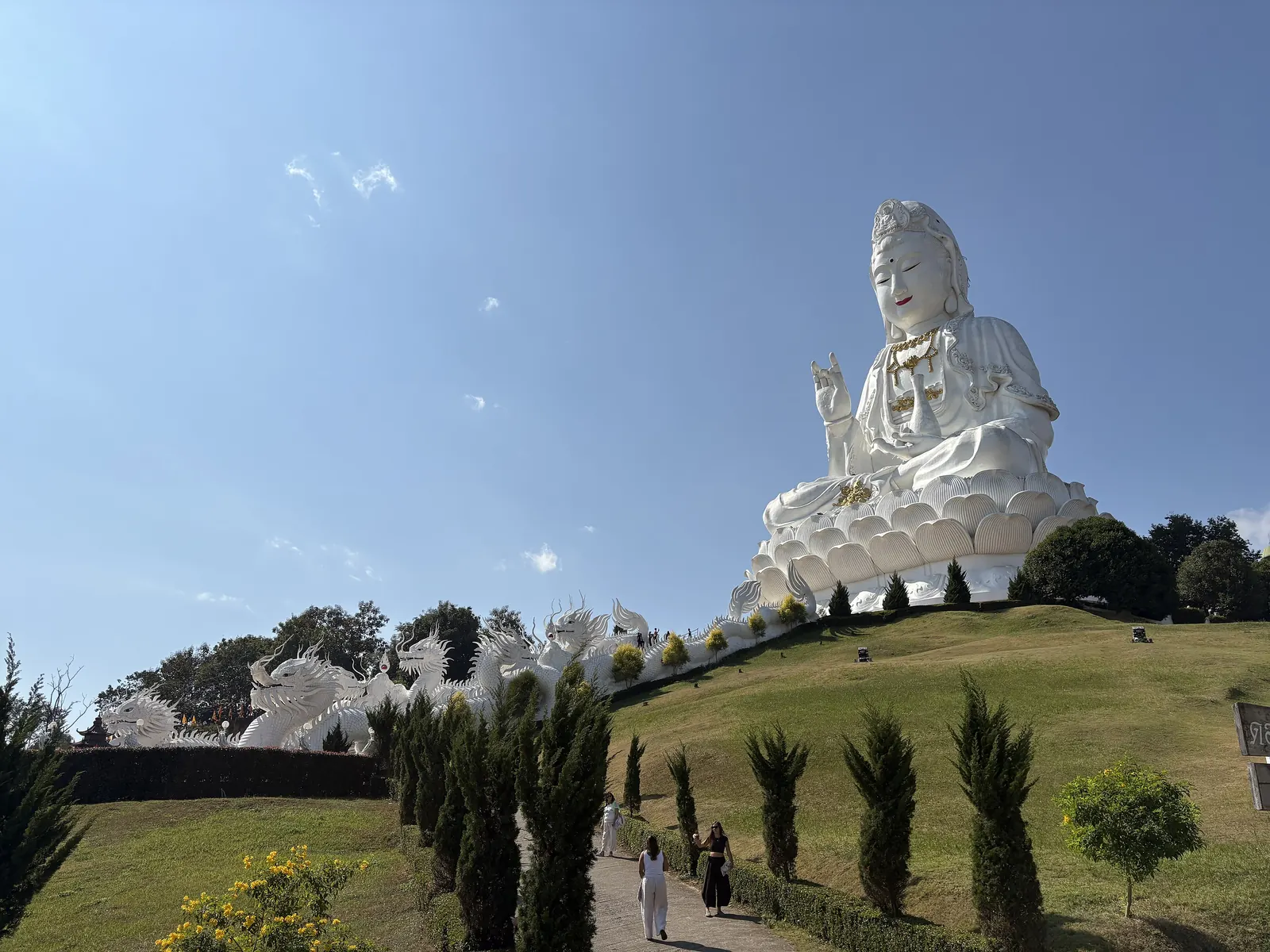
Eight kilometres north-west, a white Guan Yin the height of a 20-storey building sits on a hill beside a nine-tier Chinese-Lanna pagoda, barely known to Western visitors. Grounds free, 7am to around 9pm; the lift inside the statue to a room behind her eyes is ฿40, and it is the one site here with no steps. New, concrete, and the best dusk view in town.
Verdict: Fine; Do it first if anyone in the party cannot climb. Free; lift ฿40; Grab around ฿120–160.
North-east to the Mekong: the Golden Triangle, Chiang Saen and Mae Sai
9. The Golden Triangle viewpoint at Sop Ruak, and the boat
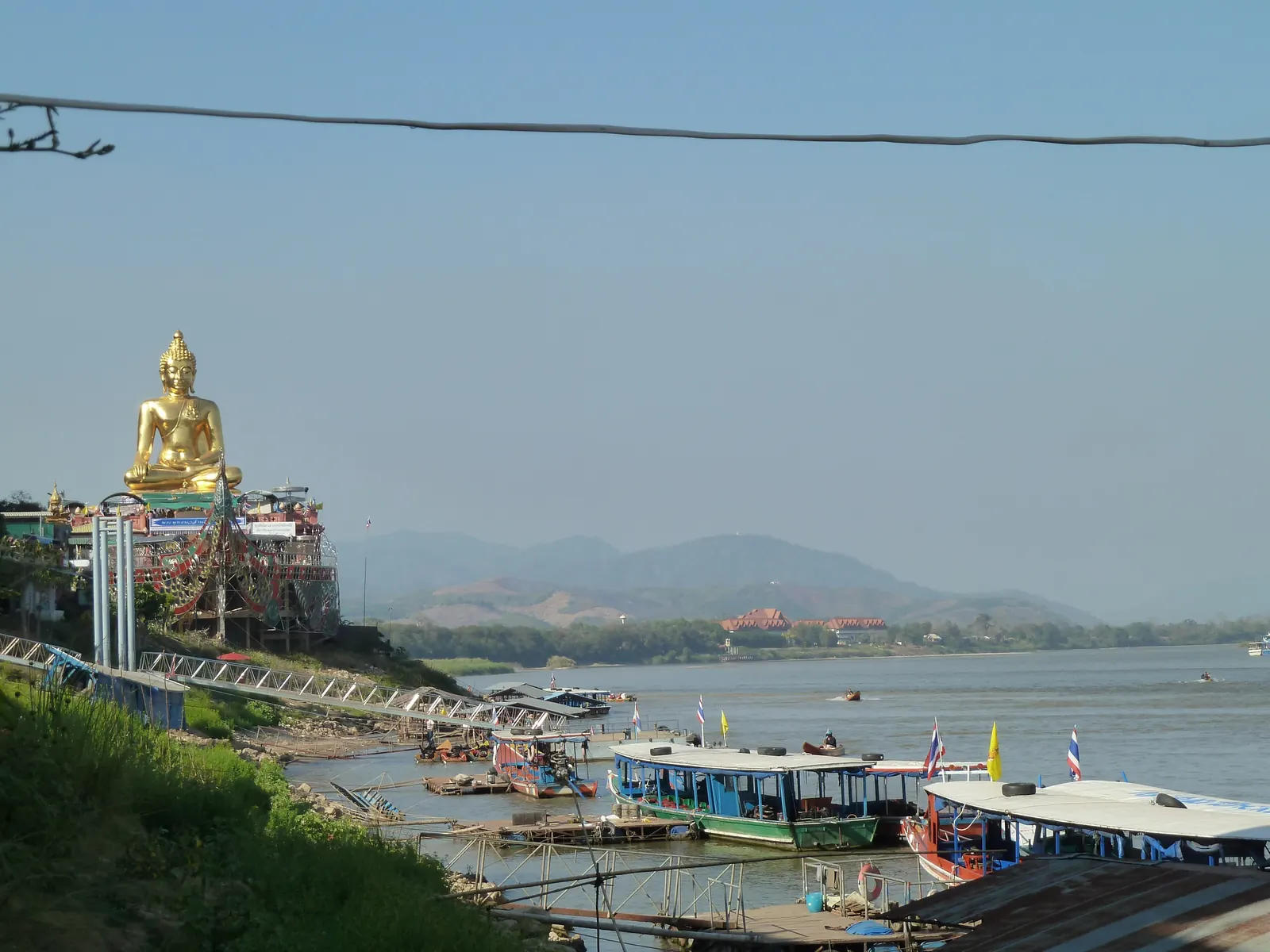
Where the Ruak meets the Mekong and Thailand, Laos and Myanmar share a view. The “viewpoint” is a riverside car park with a giant golden Buddha, souvenir stalls and a sign; the three countries are a bank of trees, a casino and more trees. The boat is the better half: longtails loop past the Myanmar bank to Don Sao, a Lao market island you can stand on without a visa for around ฿20–30 landing money. Around ฿500–1,000 a boat, six seats, 40 minutes; agree the price first.
Verdict: Skip the viewpoint; Fine for the boat. Free; boat around ฿500–1,000.
10. The Hall of Opium
A kilometre from the car park, entered through a long dark tunnel, is the reason to make the trip: a serious, beautifully built museum of the opium trade, from the poppy through the Opium Wars and the Golden Triangle warlords to the royal project that replaced the crop with coffee. Two hours. Tuesday to Sunday, roughly 8.30am to 4pm, last entry around 3.30pm. Not to be confused with the House of Opium, a ฿50 private collection by the car park with a pipe and a gift shop.
Verdict: Do it; the best museum in the north. ฿200; around ฿150 for Thais.
11. Chiang Saen’s ruins and the Mekong riverfront
Nine kilometres downstream, Chiang Saen is a 14th-century Lanna walled town with brick ramparts and dozens of temple ruins between the houses. Wat Pa Sak, outside the west gate, is the one to walk round; the national museum is small and good. Then the riverfront: Chinese cargo barges, Laos 300 metres away, and from late afternoon stalls grilling Mekong fish on the bank. Everyone else is back in the minivan by then.
Verdict: Do it, as the slow end to the Golden Triangle day. Wat Pa Sak around ฿50, museum around ฿100.
12. Mae Sai, the northernmost town, and the border you may not cross
Thailand’s most northerly town: a long market street running to the Friendship Bridge, Tachileik in Myanmar on the other side, and a sign for the photograph. The market sells Burmese lacquer, jade of uncertain parentage and cheap everything. The crossing reopened to day-trippers in 2023, but foreign access has opened and shut since, Shan State beyond it is a conflict zone and Western governments advise against going. As of November 2026, ask at Mae Sai immigration that week; do not build a day around it.
Verdict: Fine for the market and the sign; Skip the crossing. Free; bus from Terminal 1 around ฿40–60.
Tea, mountains and the royal projects north and east of Chiang Rai
13. Singha Park and the February balloon fiesta
The beer company’s farm 10 kilometres south-west of town: oolong terraces, flower fields, a lake, a zipline, bicycles and a farm tram. Free to enter; tram and bikes around ฿50–150. In isolation a pleasant corporate park. In Valentine’s week it hosts the Singha Park International Balloon Fiesta, thirty-odd balloons at dawn and lit at night; the 2026 edition ran 11–15 February, the 2027 dates were unannounced as of November 2026, so expect the same week. Hotels fill.
Verdict: Fine; Do it in balloon week. Free entry; tram or bike around ฿50–150.
14. Choui Fong tea plantation
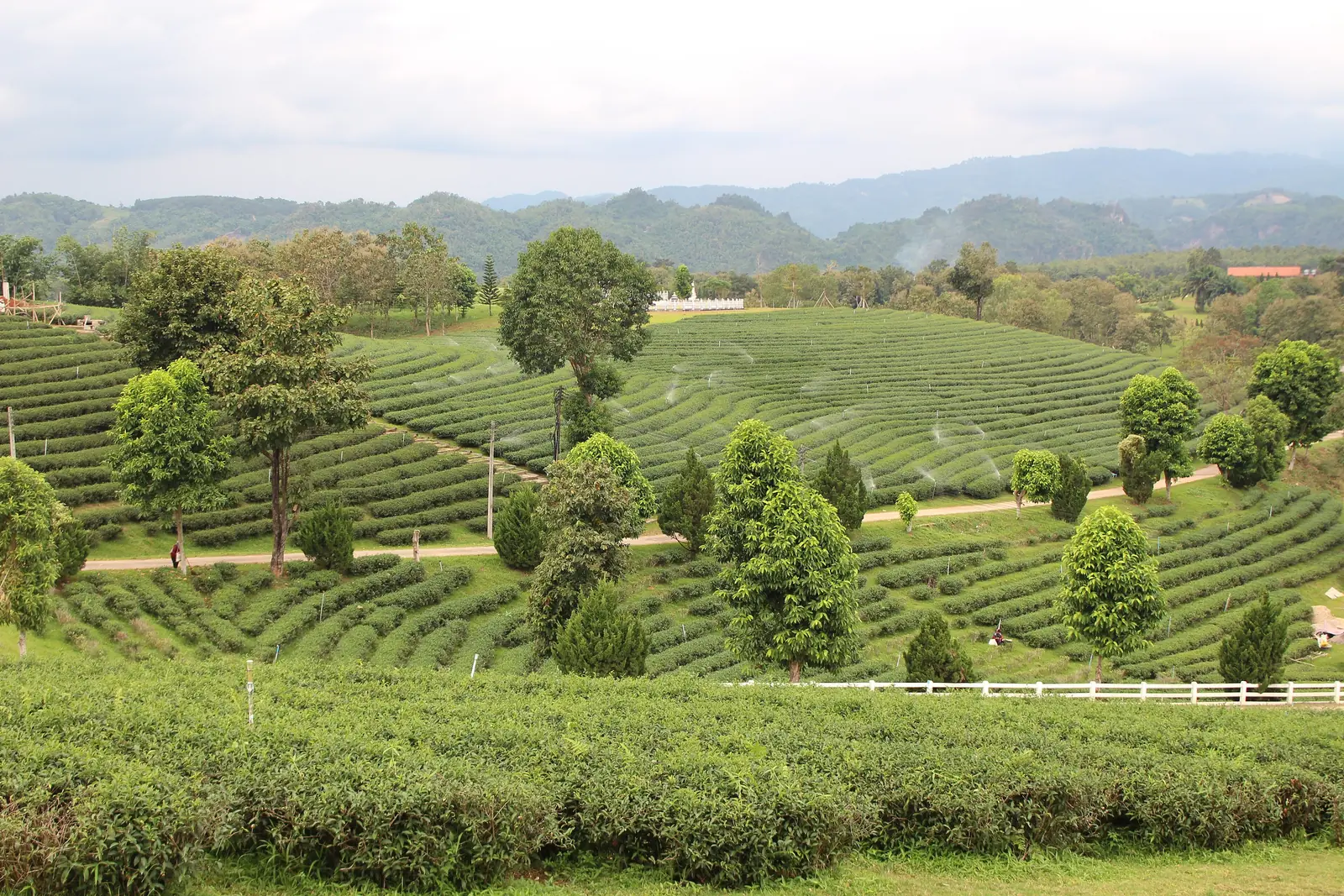
An hour north in Mae Chan, Choui Fong is the tea estate on every Chiang Rai postcard: terraces of oolong with a concrete-and-glass café cantilevered over them. Entry is free; the café is where you pay, ฿60–150 for a pot or a green-tea latte, the right price for the view. Daily, roughly 8.30am to 5.30pm, on the road to Doi Tung and Mae Salong: the morning coffee stop, not a destination.
Verdict: Do it, on the way north. Free; café ฿60–150 a drink.
15. Doi Tung: the Royal Villa and the Mae Fah Luang Garden
The mountain where the late Princess Mother built a Swiss-Lanna chalet in 1988 and a project that turned opium slopes into coffee and macadamia. The Royal Villa is modest, personal and more interesting than any palace; the Mae Fah Luang Garden below it is a formal hillside flower garden, best December to February. Combined ticket for villa, garden, Hall of Inspiration and arboretum around ฿220, or ฿90 a site, roughly 8am to 5pm. Ninety minutes from town.
Verdict: Do it, villa and garden. Around ฿220 combined; ฿90 a single site.
16. Doi Mae Salong, the Yunnanese tea town
At 1,200 metres on a ridge 70 kilometres north-west, Mae Salong was settled in 1961 by the Kuomintang’s 93rd Division: Chinese nationalist soldiers who fought on from Burma, funded themselves with opium and earned Thai citizenship fighting communists. Their grandchildren grow oolong. Stay the night: the 6am market is Yunnanese, breakfast is mantou and pork leg, and the summit chedi has the valley to itself at dawn. Day tours give it forty minutes. Beds: Phumektawan Resort (from around ฿1,500) has the ridge view; Maesalong Mountain Home (from around ฿1,200) is the farm-stay in the tea.
Verdict: Do it, overnight. Free; rooms from around ฿1,200.
17. Phu Chi Fa at sunrise
A cliff on the Lao border, 100 kilometres and nearly three hours east, where between November and January the valley fills with cloud overnight and the sun rises over a sea of mist with Laos poking through. The drill: sleep in Ban Rom Fa Thai below the summit (guesthouses around ฿500–1,000, full over New Year), pickup truck to the car park at 5am for around ฿50–100 a head, walk 20–30 minutes, stand in a fleece with 300 Thais. As a day trip it is six hours in a van for a sunrise you may miss.
Verdict: Do it, December or January, with a night in the village. Free; truck around ฿50–100; beds around ฿500–1,000.
18. Khun Korn waterfall
The province’s best free afternoon: 30 kilometres south-west, a 1.4-kilometre forest trail along a stream, half an hour each way, to a 70-metre fall that is swimmable in the dry season. A forest park, not a national park, so no ฿200 ticket. No public transport: a scooter, a driver, or add it to a White Temple morning on the same side of town. Shoes you can get wet; leave by four.
Verdict: Do it; the free one. Free; Grab there is possible, Grab back is luck.
Skip it: long necks, tigers and the thirteen-hour day
“Long-neck villages.” The Kayan women in brass coils you are driven to for around ฿300 are refugees from Myanmar who cannot legally work elsewhere, kept in a compound to be photographed: a human zoo with a gift shop. Chiang Rai is home to Akha, Lahu, Lisu, Mien and Karen communities; the honest way in is the PDA’s Hilltribe Museum on Thanalai Road (around ฿50) and its treks. Who is who is in our ethnic groups of Thailand guide.
Tigers and elephants on chains. Any “tiger kingdom” or riding camp is a Skip; the test in our ethical elephant sanctuaries guide is whether the animal can walk away. The Golden Triangle viewpoint and the House of Opium, covered above. And the Chiang Mai day tour: 13 hours, six in a minivan, the White Temple at its 11am worst. Our Chiang Mai to Chiang Rai guide has the ฿200–400 bus that fixes it.
Verdict: Skip it. Around ฿300, ฿800 and ฿1,200 you keep.
Chiang Rai day trips compared
| Day out | Price, Nov 2026 | Verdict | Book |
|---|---|---|---|
| White Temple, Black House, Blue Temple half day | ฿200 + ฿80 fees; join tour around ฿850–1,200 | Do it, from a Chiang Rai bed | Half-day temple tours |
| Golden Triangle, Hall of Opium, Chiang Saen | Join tour around ฿1,500–2,500 + ฿200 museum | Do it, for the museum | Golden Triangle day tours |
| Doi Tung and Doi Mae Salong | Join tour around ฿1,800–2,800 + ฿220 | Do it; better as an overnight | Doi Tung and Mae Salong tours |
| Choui Fong and Singha Park tea day | Free entry; tour around ฿1,200–1,800 | Fine; Do it in balloon week | Tea plantation tours |
| Phu Chi Fa sunrise | Private car around ฿3,500–4,500; beds ฿500–1,000 | Do it, Dec–Jan, overnight | Phu Chi Fa trips |
| Khun Korn waterfall | Free | Do it | Scooter or driver |
Getting around Chiang Rai: Grab, scooter or a driver for the day
Grab covers the city and the art temples — ฿60–80 to the Blue Temple, ฿150–200 to the White Temple or Black House — and stops being reliable north of Nang Lae. It needs data: ten minutes in our SIM and eSIM guide. Scooters are ฿200–300 a day, but the law wants a motorcycle licence plus an International Driving Permit, there is a checkpoint before Mae Chan, and without the paperwork your insurance will not pay for the hospital. A car and driver is the answer beyond the Black House: around ฿2,500–3,500 for a Golden Triangle day, ฿3,000–4,000 for the Doi Tung and Mae Salong loop, split between four. Compare private-driver days, or hire a car for ฿900–1,500 a day. Public buses from Terminal 1 reach Chiang Saen and Mae Sai for around ฿40–60.
Getting here: the Green Bus from Chiang Mai is ฿200–400 and three to three and a half hours — Chiang Mai to Chiang Rai on 12Go, costed in our route guide; the return runs the same pattern. From the capital, a 1 hour 20 minute flight at around ฿1,000–2,500 booked early, or the night bus — Bangkok to Chiang Rai on 12Go. The airport is 8 kilometres north, around ฿200–250 by Grab. Museums, boats and markets are cash; every ATM takes the ฿220 fee. The one scam of note is the “temple is closed” tuk-tuk line at the White Temple; our scams guide ends it in a sentence.
Where to base yourself in Chiang Rai
Anywhere within ten minutes’ walk of the clock tower puts the Night Bazaar, the Saturday street and Bus Terminal 1 at your feet. Nak Nakara Hotel (from around ฿1,500–2,200) is the boutique sweet spot with a pool; Mercy Hostel (dorms from around ฿350–500) the clean budget answer. On the river, The Riverie by Katathani (from around ฿3,000) is the big resort, Le Méridien Chiang Rai Resort (from around ฿4,000) the international one. For one extravagant night on the Mekong, Anantara Golden Triangle Elephant Camp & Resort (from around ฿25,000) runs a rescue camp where the elephants do the deciding. Everything else: compare Chiang Rai hotels on Agoda.
When to go to Chiang Rai
November to February is the window: dry, 25°C by day, single digits before dawn on Mae Salong and Phu Chi Fa, the mist running and the balloons up in Valentine’s week (see November, December and February). Late February to April is burning season: field fires on both sides of the border push the AQI past 150 and the mountains vanish — our burning season guide has the numbers. May to October is green and wet, rooms around 30 per cent cheaper, the river beach shut. Month by month in best time to visit Thailand; holiday dates in the festivals calendar.
Things to do in Chiang Rai: your questions, answered
How many days do you need in Chiang Rai?
Four nights. One day for the White Temple, Black House, Blue Temple and Guan Yin; one for the Golden Triangle, Hall of Opium and Chiang Saen; one for Doi Tung and Choui Fong ending with a night on Doi Mae Salong; the city and the Saturday Walking Street fill the rest. Add a night for Phu Chi Fa between November and January.
Is the White Temple still worth ฿200?
Yes. The foreigner fee doubled to ฿200 on 1 January 2026, with the Cave of Art gallery now included, and it remains the best-value ticket in northern Thailand provided you arrive at 8am or after 3.30pm. Between 10.30am and 2pm the Chiang Mai day tours turn the bridge into a queue and the white into glare.
Is the Golden Triangle worth visiting?
For the Hall of Opium, yes: ฿200, two hours, closed Mondays, the best museum in the north. The viewpoint beside it is a car park with a golden Buddha and a sign. Add the ฿500–1,000 longtail to Don Sao if standing in Laos appeals, then finish with grilled fish on the Chiang Saen riverfront rather than racing back.
Can you visit Chiang Rai without a scooter?
Yes. Grab handles the city and the four art temples for ฿60–200 a ride, public buses from Terminal 1 reach Chiang Saen and Mae Sai for around ฿40–60, and a car with driver at ฿2,500–4,000 a day covers Doi Tung, Mae Salong and the Golden Triangle. A scooter only makes sense with a motorcycle licence and an International Driving Permit.
When is the burning season in Chiang Rai?
Roughly late February to mid-April, peaking in March, when field fires in Thailand, Laos and Myanmar push the AQI past 150 and hide the mountains. Chiang Rai is often worse than Chiang Mai because the smoke crosses the border. Phu Chi Fa and Mae Salong lose their point; come November to January or after the May rains.
Related guides
- White Temple, Blue Temple, Black House: Chiang Rai’s Big Three, Ranked
- Chiang Mai to Chiang Rai: Green Bus, Minivan, Private Car or the Day Tour Everyone Regrets (2026)
- Chiang Rai Night Bazaar or the Saturday Walking Street: Which Evening, Where
Book the trip
Some links in this guide are affiliate links. If you book through them we may earn a small commission at no extra cost to you — it helps keep Destination Thailand independent.
Hotels: pick your base first, then compare Chiang Rai hotels on Agoda. Tours/Boats: browse Chiang Rai trips on GetYourGuide and read the newest reviews. Getting there: book Chiang Mai to Chiang Rai on 12Go, every class costed in our Chiang Mai to Chiang Rai guide, or Bangkok to Chiang Mai first. Not sure the far north is your Thailand? Our Where to Go in Thailand matcher scores all 77 provinces against your month, your crowd tolerance and what you actually want from the trip.