Phrae and Nan are the northern loop for people who have already heard about Pai. Call it the Phrae Nan loop: two old teak towns east of Chiang Mai, a mountain province hard against Laos, salt wells that have been boiling brine for centuries, and some of the best empty mountain roads in the country, with a fraction of the minivans. The full circuit, Chiang Mai to Phrae, Phrae to Nan, along the ridge to Bo Kluea, over Doi Phu Kha and home through Phayao, is roughly 800 km. Here it is costed for November 2026: every leg in kilometres, hours and baht by bus, car or motorbike, a verdict on each stop, a 4–6 day plan, and an honest comparison with the Mae Hong Son Loop, which it beats for some people and not for others.
The short version: five days is right, four is possible, six is a pleasure. Buses do Chiang Mai–Phrae–Nan–Chiang Mai for around ฿750–1,100 in fares; a hire car is ฿1,000–1,500 a day plus fuel; a motorbike is the best way and only for licensed riders. Go November to February, never March or April. Both provinces are in our Phrae province profile and Nan province profile; small prices live in the Thailand Price Index.
The Phrae and Nan loop leg by leg: kilometres, hours and baht
Road kilometres between town centres; driving time for a hire car without stops; bus fares one adult, one way, as of November 2026, from operator and booking-site listings.
| Leg | Road | Km | Car / bus | Bus fare | Notes | Book |
|---|---|---|---|---|---|---|
| Chiang Mai → Phrae | 11, 101 (or 1023 via Ban Pin) | 200 | 3.5 h / about 4 h | Around ฿210–310 (Green Bus) | Fast highway; the 1023 back road is the prettier last hour | Chiang Mai to Phrae on 12Go |
| Phrae → Nan | 101 | 118 | 2 h / 2–2.5 h | ฿160–330 (Nakhonnan Yanyon, Green Bus) | Easy valley road; Tham Pha Nang Khoi cave halfway | Phrae to Nan on 12Go |
| Nan → Santisuk → Bo Kluea → Pua (mountain day) | 1169, 1081, 1256 | 150 | 4–5 h / no bus | — | The best day: ridge road, salt wells, Doi Phu Kha; fuel only in Bo Kluea | Nan tours on GetYourGuide |
| Pua → Tha Wang Pha → Chiang Kham → Phayao | 1080, 1148, 1021 | 200 | 4–5 h / no direct bus | — | Route 1148: 91 km of mountain bends, no fuel, no villages | Nan to Phayao on 12Go |
| Nan → Phayao (bus alternative) | 1091 via Chiang Muan | 160 | 3 h / about 4 h | Around ฿200–350 | Few departures a day; book ahead | Nan to Phayao on 12Go |
| Phayao → Chiang Mai | 1, 120, 118 | 150 | 2.5 h / about 3 h | Around ฿150–250 | Route 120 over the hills; Highway 1 and 11 is longer and duller | Phayao to Chiang Mai on 12Go |
| Nan → Chiang Mai direct | 101, 11 | 320 | 5 h / 6–7 h | Around ฿330–530 | The bus traveller’s way home | Nan to Chiang Mai on 12Go |
Around 800 km for drivers and riders, or roughly ฿750–1,100 in bus fares for the simpler Chiang Mai–Phrae–Nan–Chiang Mai triangle. As on every northern road trip, the real cost is five nights of beds, and here they are cheap.
Phrae and Nan or the Mae Hong Son Loop: which northern loop is yours?
The Mae Hong Son Loop is the famous one, and for good reason. This is the comparison we would give a friend choosing between them.
| Phrae and Nan loop | Mae Hong Son Loop | |
|---|---|---|
| Distance | About 800 km with the mountain day and Phayao | About 600 km |
| Roads | Long, flowing mountain roads (1081, 1256, 1148) plus easy valley highways | Tighter, more technical; 1,864 bends, villages and traffic on the Pai leg |
| Towns | Two teak-boom old towns with real temples and museums | Pai (busy), Mae Hong Son (small, Shan), Mae Sariang (quiet) |
| Crowds | Thai tourists on cool-season weekends; few foreigners | Backpacker trail; vans sell out in December |
| Public transport | Good between towns, absent on the mountain roads | Minivans almost everywhere except the Doi Inthanon detour |
| Best for | Second-time visitors, culture first, riders who have done Mae Hong Son | First northern road trip, nature first, people who want Pai |
Verdict: Mae Hong Son has the more famous stops; Phrae and Nan have the better towns and, riders tend to agree, the better roads. If you have never been north of Chiang Mai, do Mae Hong Son first. If you have, or if Pai sounds like the problem rather than the point, this is the loop.
Bus, hire car or motorbike: how to do Phrae and Nan without regretting it
By bus. Green Bus runs Chiang Mai’s Arcade terminal to Phrae in about four hours and on to Nan; Nakhonnan Yanyon and Green Bus link Phrae and Nan roughly hourly from early morning to evening; Nan to Chiang Mai direct is six to seven hours. Book on Chiang Mai to Phrae, Phrae to Nan and Nan to Chiang Mai. The catch is that the best of Nan, Pua, Bo Kluea and the ridge roads, has almost no public transport. Bus travellers should hire a scooter in Nan town (฿200–300 a day) for the valley, or a car with driver for the mountain day.
By hire car. The underrated answer: a small automatic from the Chiang Mai airport desks is ฿1,000–1,500 a day with basic insurance, and roads here are wide, well surfaced and quiet. Budget around ฿3,000–4,000 for petrol over 800 km. You need a licence plus an International Driving Permit. The Bo Kluea and Doi Phu Kha climbs are steep; use low gears on the way down, or the brakes will tell you.
By motorbike. The best way, with the honesty line from our Mae Hong Son guide: Thai law wants a motorcycle licence and an IDP covering motorcycles, and almost every travel policy refuses claims from unlicensed riders. The Doi Phu Kha grades reach 15–20 per cent, so take 150cc minimum and ideally a 250; a 125cc scooter is a struggle two-up. Fuel at every town, because Route 1148 has none for 91 km. Data is patchy in the mountains; sort it in Chiang Mai with our SIM and eSIM guide. Verdict: car for couples and families, motorbike for licensed riders, bus plus a Nan scooter for everyone else.
Phrae in a day and a half: Vongburi House, Wat Phra That Cho Hae and Phae Mueang Phi
Phrae got rich on teak a century ago and has been politely ignored since, which is why it still looks the way it does. The old town inside the earthen ramparts is walkable in an hour. Our Phrae travel guide has the full list; these are the loop stops.
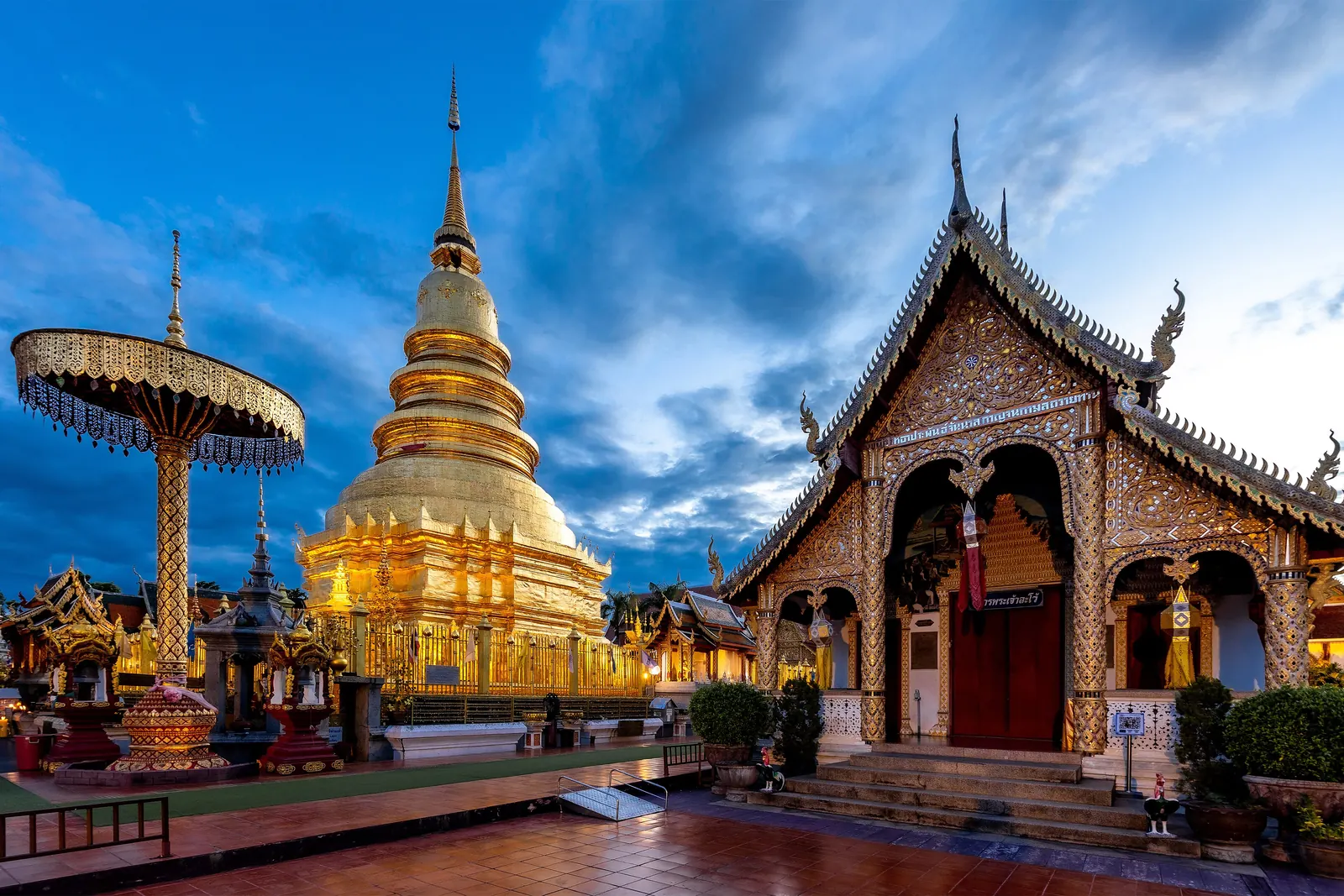
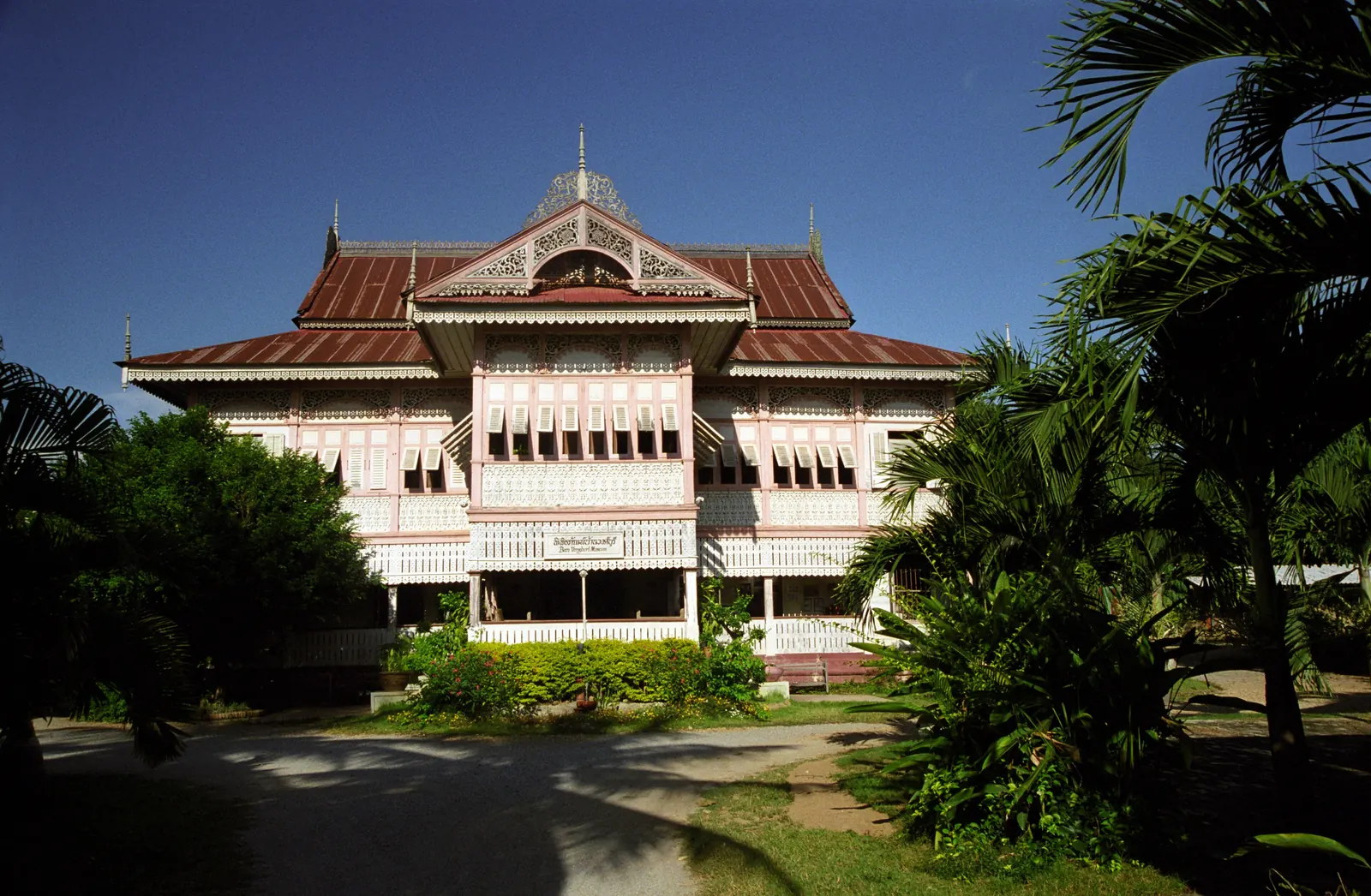
Vongburi House, the pink gingerbread teak mansion on Kham Lue Road built in the 1890s for a timber family, keeps its furniture and logging-trade papers, elephant registrations included; entry around ฿20–30, roughly 09:00–17:00. Do it. Khum Chao Luang, the 1892 mansion of the last lord of Phrae, with the basement cells, is free or by donation. Do it. Wat Phra That Cho Hae, 9 km out of town, is Phrae’s holiest chedi, gilded and wrapped in satin, the pilgrimage temple for those born in the Year of the Tiger; free. Go late afternoon, when the gold catches the light. Phae Mueang Phi, the eroded earth pillars about 18 km northeast, is small and strange; recent visitors report ฿100 for foreigners. Fine, at golden hour only; skip it at midday, when it looks like a building site. Ban Thung Hong, ten minutes north, is where the indigo mo hom shirts are dyed; ฿150–300 a shirt. Do it.
Eat khanom jeen nam ngiao and khao soi at the morning market for ฿40–70 (the dishes are decoded in our northern Thai food guide), and plan around the Saturday-evening walking street in the old town if you can. Verdict: one night is possible on a four-day plan, two is right.
Nan town: Wat Phumin, the National Museum and the weekend walking street
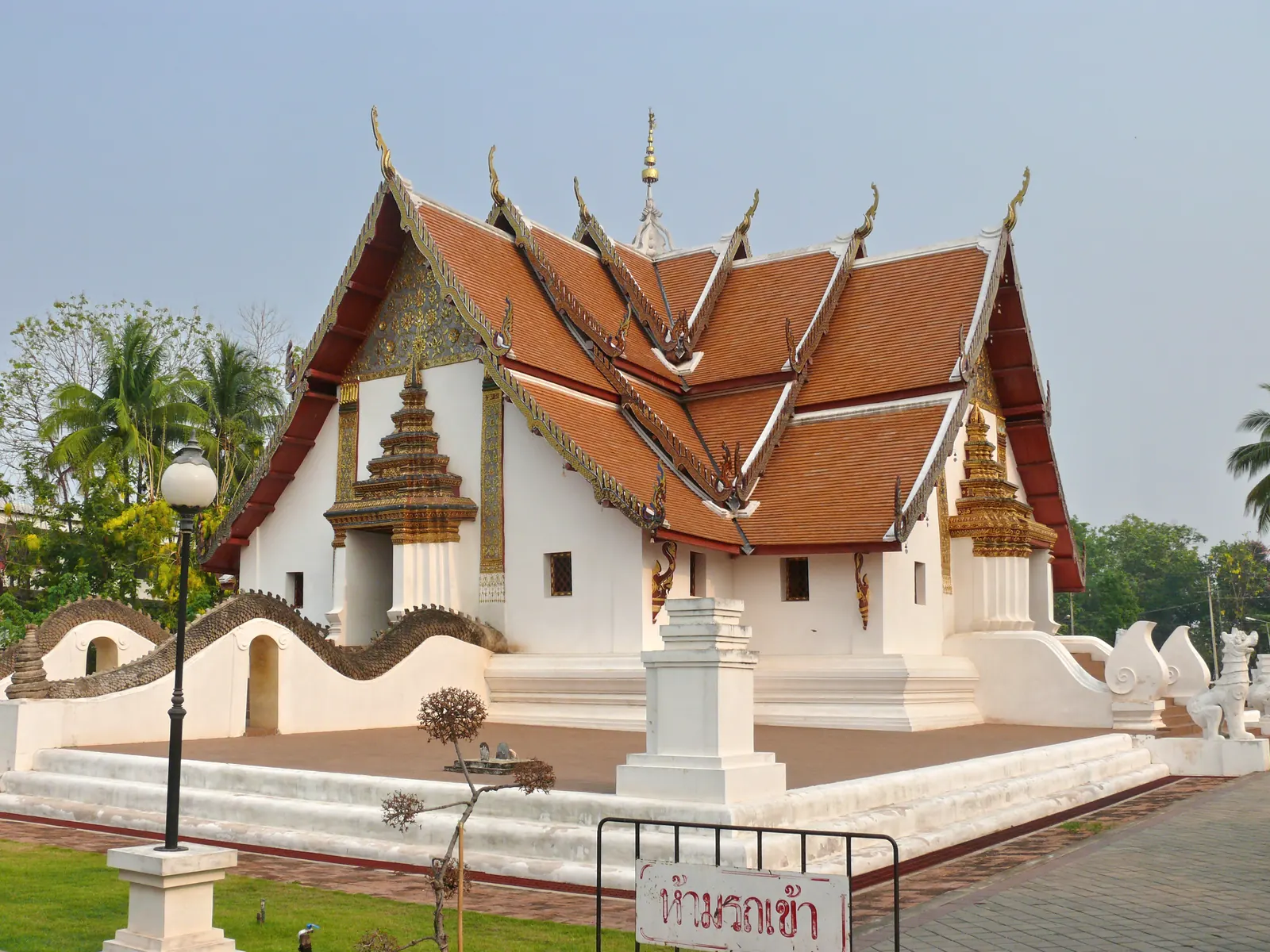
Nan is a former kingdom in a bowl of mountains, a flat old town you can cycle in an afternoon (bikes ฿50–100 a day from guesthouses). Our Nan travel guide and things to do in Nan go deeper. Wat Phumin, the cruciform hall with four back-to-back Buddhas and the whispering-lovers mural by Thit Buaphan, is entry by donation: go at opening and give it an hour. Worth it, no qualifications. The Nan National Museum in the old palace opposite, with the black elephant tusk, is ฿120 for foreigners, open Wednesday to Sunday and closed Monday and Tuesday. Worth it, if the days line up. Wat Phra That Chang Kham next door, with its elephant-buttressed chedi, is free. Wat Phra That Khao Noi, the hill with the standing Buddha west of town, is the sunset. Free.
From Friday to Sunday evenings the square in front of Wat Phumin becomes a walking street: grilled meats, sai ua, Tai Lue cloth, and khantoke trays on mats where the tourists are mostly Thai and the food is real, around ฿50–100 a dish. Verdict: two nights in Nan town, and arrange them to include a weekend evening.
The mountain day from Nan: Route 1081, the Bo Kluea salt wells and Doi Phu Kha to Pua
This is the optional day that turns out not to be optional. Leave Nan before eight with a full tank, south on the 1169 to the Santisuk junction, then north on Route 1081, which runs along ridgelines for about 80 km to Bo Kluea, above the valley mist on clear cool-season mornings. Halfway, the bend Thais call Road Number 3 (three curves stacked on a hillside like the numeral) has a viewpoint and a drinks cart. Fine, for the photograph.
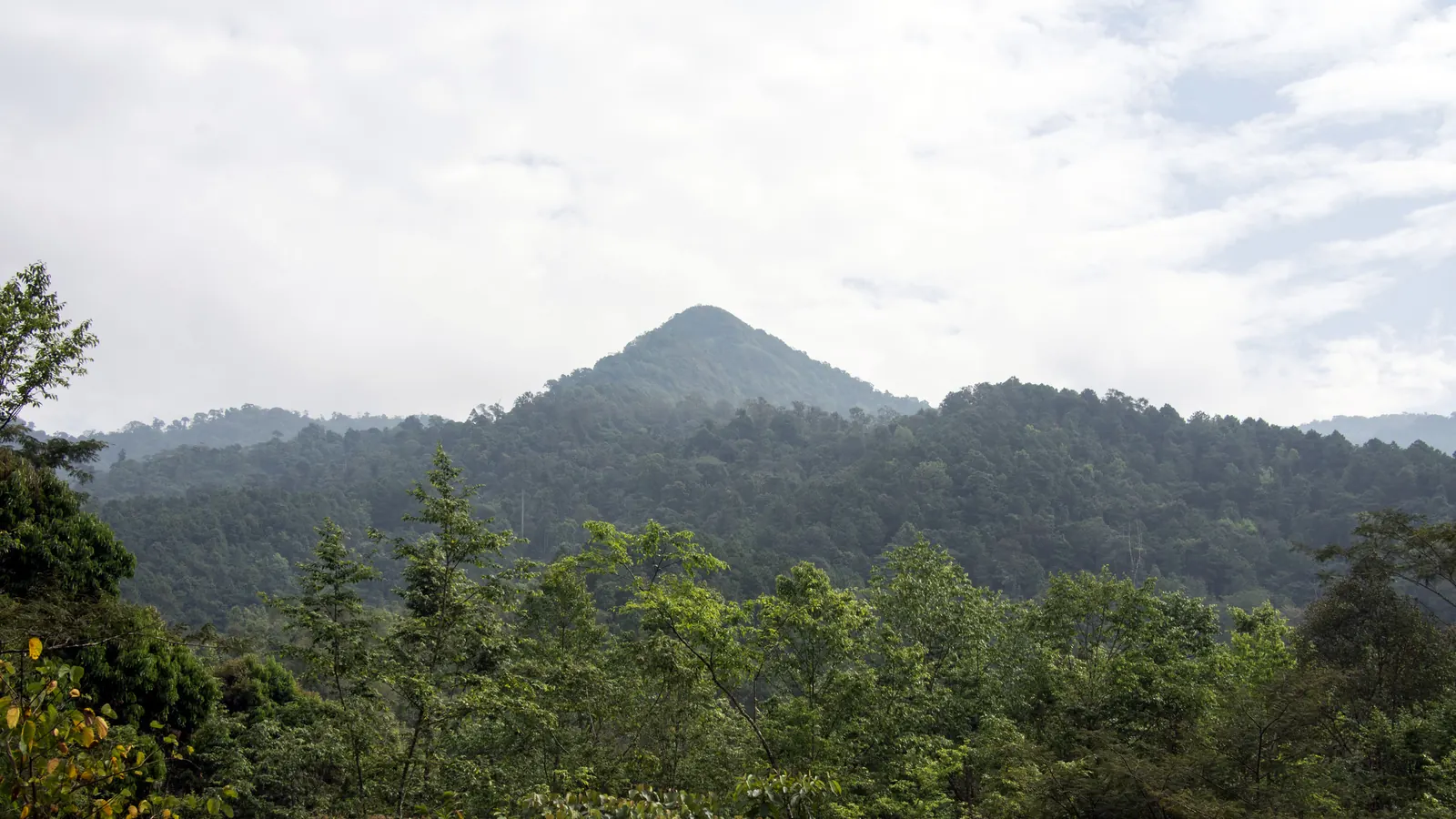
Bo Kluea means salt well, and the village still hauls brine from wells hundreds of kilometres from any sea and boils it down in wide pans over wood fires. Walk into the sheds, then buy a bag for ฿20–30. Worth it. The village of Sapan, 20 minutes north, has homestays from around ฿300 a head and its own coffee if you want to stay. From Bo Kluea, Route 1256 climbs west through Doi Phu Kha National Park, steep switchbacks to over 1,700 m, pine and mixed forest, and in February the pink chomphu phu kha blossom. The park’s foreigner fee is ฿200 if you stop at the headquarters or viewpoints. Then you drop into Pua, a Tai Lue weaving town, for the night. Verdict: do it, by car or licensed motorbike; by bus, hire a car and driver for the day from Nan rather than skip it.
The way home: Route 1148, Chiang Kham and the lake at Phayao
From Pua, 25 flat kilometres south to Tha Wang Pha, fill up, then Route 1148 west: 91 km of forest and flowing bends to Chiang Kham with no villages, no junctions and no fuel. Riders rank it the best road in the north; drivers will simply enjoy an empty mountain road. Near the top, the ridge cafés at Phu Langka do coffee with a hundred kilometres of view. In Chiang Kham, Wat Nantaram is a 1925 teak temple built by Tai Yai craftsmen that looks like it came from Mandalay; free. Do it.
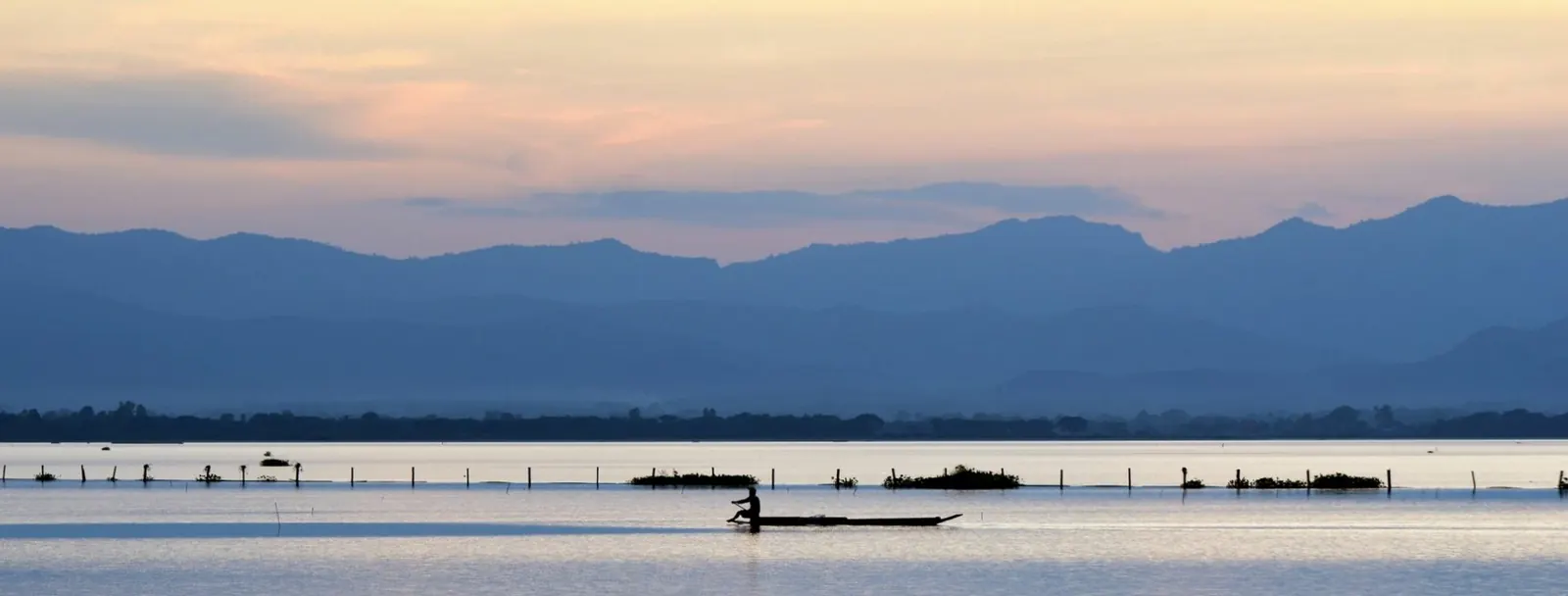
Phayao, an hour on, is a town on a lake that never hurries. Take the boat to Wat Tilok Aram, a fifteenth-century temple drowned when the lake was dammed, around ฿30 a head, and eat grilled lake fish at the lakeside restaurants for ฿200–400 for two. Our Phayao travel guide has more. Then it is two and a half hours over Route 120 to Chiang Mai, or a bus on Phayao to Chiang Mai. Bus travellers do this leg via the 1091, a slower but pastoral road through Chiang Muan. Verdict: one night in Phayao; it is the gentlest evening of the trip.
A 4–6 day Phrae and Nan plan, the budget, and when to go
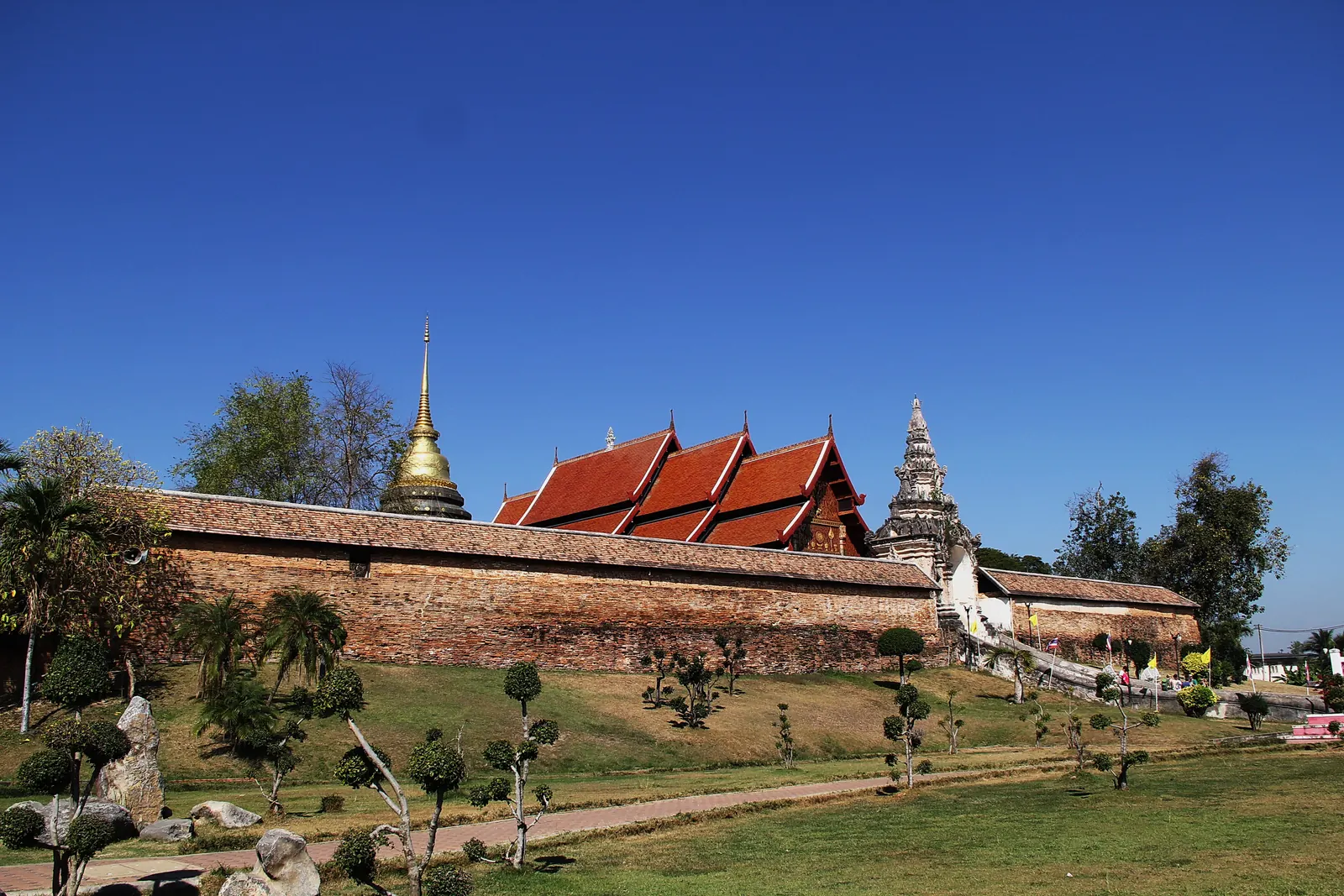
Five days by car or motorbike: day 1 Chiang Mai to Phrae, mansions in the afternoon; day 2 Cho Hae, Ban Thung Hong, Phae Mueang Phi at sunset; day 3 Phrae to Nan, Wat Phumin and Khao Noi; day 4 the mountain day to Pua; day 5 Route 1148 to Phayao, Chiang Mai the next morning or that night. Four days drops the second Phrae day. Six days adds a second night in Nan to land a weekend walking street, or a night in Sapan. By bus, do Chiang Mai–Phrae–Nan with two nights each, hire wheels in Nan, and take the direct bus home; or fly out of Nan to Bangkok. Want an extra stop on the way out? Wat Phra That Lampang Luang is a short detour off Highway 11.
Budget for two, five days, by car: around ฿6,000–7,500 car hire, ฿3,000–4,000 fuel, ฿5,000–9,000 for five nights in mid-range rooms, ฿1,000 in fees, and food at ฿500–800 a day. Call it ฿17,000–24,000 for the pair. Solo by bus and guesthouse, ฿6,000–9,000.
When: November to February, cool and clear, mist on the ridges at dawn, cold enough at Doi Phu Kha for a jacket; Thai crowds on December weekends, so book Nan and Pua. February adds the chomphu phu kha blossom. Skip March and April: the north burns its fields, the views disappear and the air is bad, as explained in our burning season guide. June to October is green and workable by car, slippery by scooter, with the Doi Phu Kha trails closed in the rains. Late October and November bring the Nan boat races. The country-wide month-by-month is in best time to visit Thailand.
Where to sleep in Phrae, Nan, Pua and Phayao, with prices
Walk up in Phrae and Phayao; book Nan and Pua for cool-season weekends. Prices are rough ranges as of November 2026. In Phrae, Huern na na Boutique Hotel is the characterful small pick near the old town, from around ฿1,000–1,800; Phrae Nakara Hotel is the comfortable mid-range one with a pool, from around ฿900–1,500; PhoomThai Garden Hotel is the dependable older standby from around ฿700–1,200.
In Nan, Pukha Nanfa Hotel, a restored teak building in the old town, is the one to book, from around ฿1,500–2,500; Nan Boutique Hotel is the quieter mid-range choice from around ฿1,000–1,800; Dhevaraj Hotel is older and plainer from around ฿600–900, with the night food market outside. In Pua, PuaDeView Boutique Resort has the mountain view and a pool; at Bo Kluea, Boklua View Resort lets you wake up in the valley. In Phayao, Phuglong Hotel sits on the lake, from around ฿1,150–1,500 with breakfast. For the start and finish, see where to stay in Chiang Mai.
The Phrae and Nan loop: your questions, answered
How many days do you need for Phrae and Nan?
Five days is right for the full loop from Chiang Mai: two nights between Phrae and the road to Nan, two in Nan with the mountain day to Bo Kluea and Pua, and one in Phayao on the way home. Four days works if you give Phrae a single night. By bus, allow five days for Chiang Mai, Phrae and Nan and accept that the mountain roads need hired wheels.
Can you do Phrae and Nan by bus?
Between the towns, easily. Green Bus runs Chiang Mai to Phrae in about four hours for around ฿210–310, Phrae to Nan buses run roughly hourly for ฿160–330, and Nan to Chiang Mai direct is six to seven hours for around ฿330–530, as of November 2026. What buses cannot do is the mountain day to Bo Kluea, Doi Phu Kha and Pua; hire a scooter or a car and driver in Nan for that.
Is the Phrae and Nan loop better than the Mae Hong Son Loop?
Better for some people. Phrae and Nan have the more interesting towns, teak mansions, Wat Phumin’s murals and a real museum, plus long, flowing, empty mountain roads that many riders prefer. Mae Hong Son has the more famous stops, Pai, the Tham Lod cave and the bamboo bridge, and better minivan coverage. First northern road trip: Mae Hong Son. Second, or allergic to crowds: Phrae and Nan.
How far is Phrae from Nan?
About 118 km on Highway 101, roughly two hours by car and two to two and a half by bus. Buses leave Phrae for Nan from early morning until evening for ฿160–330 depending on class, as of November 2026. The road is easy valley driving, and the Tham Pha Nang Khoi cave temple roughly halfway is the only stop most people bother with.
When is the best time to visit Phrae and Nan?
November to February: cool, dry and clear, with mist in the valleys at dawn and the chomphu phu kha blossom on Doi Phu Kha in February. Book Nan and Pua for December weekends, when Thai visitors fill them. Avoid March and April, when crop burning smothers the north in smoke. June to October is green and fine by car, but wet mountain roads are a poor idea on a scooter.
Related guides
- The Mae Hong Son Loop: 1,864 Bends From Chiang Mai, Costed
- Nan: Thailand’s Best-Kept Province
- Phrae Thailand: Teak Mansions and Indigo Shirts
Book the trip
Some links in this guide are affiliate links. If you book through them we may earn a small commission at no extra cost to you — it helps keep Destination Thailand independent.
Hotels: sleep in the old towns, where the temples and morning markets are: compare Phrae hotels on Agoda and Nan hotels on Agoda. Tours: for a driver and guide on the mountain day, GetYourGuide lists what runs in Nan. Getting there: reach Chiang Mai first with our Bangkok to Chiang Mai transport guide (tickets on 12Go), or go straight to the loop with Bangkok to Nan and Bangkok to Phrae by bus, train or plane. Not sure which province is next? Try our where to go in Thailand matcher.