Nobody goes to Uttaradit. That is not a figure of speech. Stand on the platform of Uttaradit railway station on a Tuesday afternoon and you will be the only foreigner for fifty kilometres, watched over by the statue of a general who kept fighting the Burmese after his sword snapped in half. Which tells you most of what you need to know about the local temperament.
Uttaradit sits in the lower north, wedged between Phitsanulok, Sukhothai, Phrae and Nan, on the main northern rail line, and it is the province every traveller passes through at 80 km/h without ever getting off. Their loss. This is where you find the largest known teak tree on the planet, the iron that forged the swords of Siamese kings, Thailand’s biggest earth-fill dam, and a legendary hidden city that now produces some of the best durian in the country.
There is no backpacker scene, no banana pancake, no elephant sanctuary charging you ฿2,500 to hug something. Just an ordinary, self-respecting Thai province getting on with its life. Our Uttaradit province profile has the short version; this is the long one.
What Uttaradit really is
Uttaradit means roughly the port of the north, and that was its job for centuries: the last decent river port on the Nan River before the hills, where goods from Luang Prabang came down by boat and switched to carts. Then the railway arrived, the river trade died, and the province settled into a quiet middle age of teak, iron, rice and fruit.
The result is a place with genuine history and zero interest in performing it for you. The town is small, flat and honest: shophouses, a night market, a couple of respectable temples, and the statue of Phraya Phichai Dap Hak standing guard with his famous broken sword. The interesting stuff is out in the districts, in Lap Lae, Tha Pla and Nam Pat, so you will want your own wheels or a patient songthaew driver.
Why go to Uttaradit
Because it has three or four things you genuinely cannot see anywhere else on earth, and it costs almost nothing. A 1,500-year-old teak tree. Iron mines so sacred their ore went exclusively into royal blades. A vast reservoir with a drowned teak forest under it. A durian valley with its own legend about a city where lying meant exile.
Go if you like your travel with substance and without an entrance queue. Skip it if you need nightlife or anyone to speak English at you. Two days here feels like being let in on something.
Getting to Uttaradit
By train: the correct answer. Uttaradit is a major stop on the northern line, and every Chiang Mai train calls here. From Bangkok’s Krung Thep Aphiwat terminal it is roughly six to seven hours: around ฿300-400 in second class fan, ฿600-900 in an air-con sleeper. The overnight train arriving at dawn is a properly good way to do it.
By bus: services from Bangkok’s Mo Chit terminal take about six to seven hours, roughly ฿350-500 depending on class. From Phitsanulok it is under two hours by bus or minivan, a few hundred baht at most.
By air: no airport. The nearest is Phitsanulok, about 100 kilometres south, with several Bangkok flights daily from around ฿1,000-1,800 one way. Fly there, then bus or hire a car up.
Getting around: the sights are scattered, so rent a car in Phitsanulok or a motorbike in town. Ton Sak Yai is about 90 minutes east; Sirikit Dam an hour northeast; Lap Lae ten minutes west.
Where to stay
Uttaradit town is the sensible base: everything else is a day trip. Around the station and the night market you will find clean, unremarkable Thai business hotels for ฿400-800 a night, the kind with hard beds, cold air-con and a receptionist watching lakorn. A newer mid-range place will run ฿800-1,400 and that is the ceiling; there is nothing resembling luxury here and the province is better for it.
Out at Sirikit Dam there is simple accommodation and raft houses on the reservoir where you can sleep on the water for a few hundred baht a head; book through the dam or ask locally, as almost none of it exists online in English. In Lap Lae, a handful of homestays among the durian orchards charge ฿500-900 including breakfast.
What to eat in Uttaradit
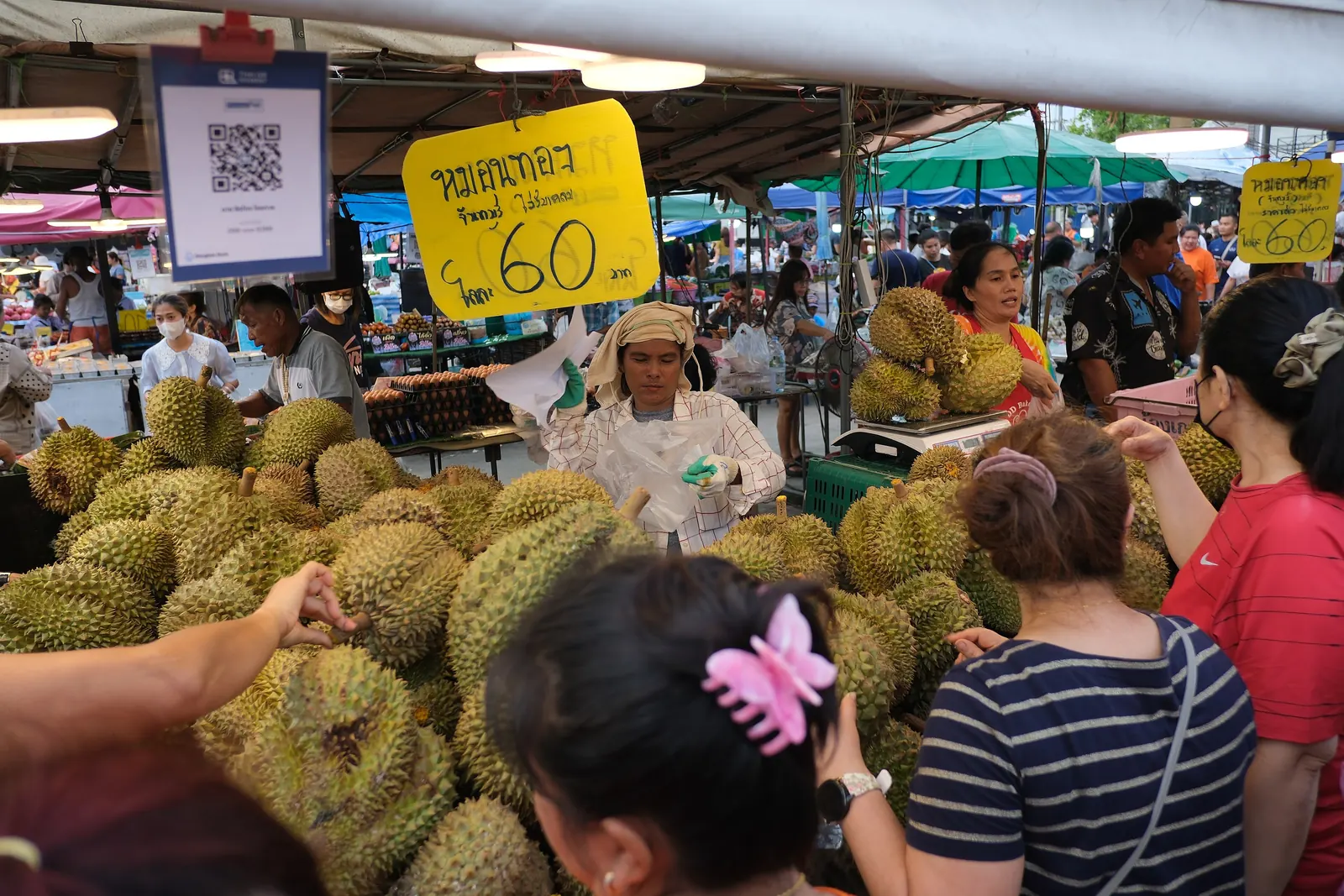
Lap Lae durian. The headline act. The Long Lap Lae and Lin Lap Lae varieties are small, creamy, sweet and far less aggressive on the nose than the Monthong you get everywhere else. In season, May to July, they sell for serious money and are worth it. Buy from roadside stalls in Lap Lae district itself, not the middlemen in town.
Langsat. Uttaradit’s other fruit obsession, a GI-protected crop harvested in September, when the province throws its annual Langsat Festival. Pale golden clusters, sweet-sharp flesh, about ฿40-80 a kilo at harvest.
Mee phan. Lap Lae’s noodle speciality: soft rice-flour sheets rolled around noodles, bean sprouts and herbs with a sweet-savoury sauce, ฿30-50 in the Lap Lae morning market. The night market in Uttaradit town covers everything else, grilled river fish, northern sausage, full meals under ฿100.
Top things to do in Uttaradit
1. Stand under Ton Sak Yai, the world’s largest teak tree
In Nam Pat district, inside its own national park, stands a teak tree roughly 1,500 years old, the largest known specimen on earth. It was a sapling before Angkor, before Sukhothai, before England existed as a country. A storm took its crown decades ago, but the trunk, nearly ten metres around, is still absurd, and the walkway lets you stand right against it. Entry is the standard national park fee, a couple of hundred baht for foreigners, and the drive out through teak country is half the pleasure. Go in the morning, have it to yourself.

2. Pay respects to Phraya Phichai Dap Hak
Uttaradit’s great hero was a boxer turned general under King Taksin who, during a battle against the Burmese in 1773, fought on after one of his swords snapped, earning the name Dap Hak, broken sword. His monument stands guard in town and his presence guards the station and, frankly, the whole province: he is on signs, statues and shrines everywhere. The monument takes twenty minutes, but understanding why locals wai as they pass tells you more about Thai provincial identity than any museum in Bangkok.
3. Sirikit Dam and the drowned teak reservoir
Thailand’s largest earth-fill dam holds back the Nan River in Tha Pla district, creating a reservoir that swallowed entire teak forests when it filled in the 1970s. The scale is genuinely impressive, the viewpoints are free, and the lake, green hills, drowned valleys, raft houses, is the closest thing the lower north has to Khao Sok, with about one percent of the visitors. Hire a boat, eat grilled reservoir fish, stay the night on a raft if you can arrange it.

4. Ban Nam Pi, where the swords of kings were mined
In Thong Saen Khan district, the iron pits of Ban Nam Pi produced ore considered so pure and auspicious that it was reserved for royal weapons, including, tradition holds, blades of the kind Phraya Phichai broke on a Burmese soldier. The old pits are still there, along with smiths forging lek nam pi knives by hand. A small knife starts around a few hundred baht; a proper forged blade runs into the thousands and is one of the few souvenirs in Thailand that is neither mass-produced nor daft.
5. Wat Phra Thaen Sila At and its holy plinth
On the edge of Lap Lae district sits one of the north’s genuinely important temples, built around a laterite plinth that tradition says the Buddha himself once sat upon. Pilgrims come from across Thailand, especially during the annual temple fair, and the atmosphere is the real, unpolished devotional kind. Free entry, dress properly, go early.
6. Lap Lae, the hidden city of honest widows and sweet durian
Legend says Lap Lae was a hidden city whose women could not tolerate a single lie; one man was exiled for a small fib and the city vanished from mortal eyes. What remains is a lovely, slightly secretive valley of durian and langsat orchards, old wooden houses and a fine morning market, ten minutes from Uttaradit town. The town gate retells the legend, the orchards do tastings in season. The province’s most easily loveable corner.

What to skip
Skip the reproduction “ancient market” walking street events that provincial tourism offices now stamp out like licence plates, and which Uttaradit occasionally attempts: vendors in period costume selling the same phone cases as everywhere else, insulting a town whose actual night market is better in every way. And do not schedule your trip around seeing the drowned teak forest itself; the trees are under the reservoir, not artfully poking out of it, and anyone implying otherwise is selling you a boat trip. Take the boat trip anyway, for the lake, not for a forest you cannot see.
Uttaradit travel: practical info
Best time to go: May to July for durian, September for langsat and the festival, November to February for cool, dry weather. April is a furnace; Uttaradit regularly posts national record temperatures.
How long: two days, three if you sleep on the reservoir. One day for Lap Lae, the temple and town; one for Ton Sak Yai and Ban Nam Pi or Sirikit Dam.
Onward: the train runs north to Den Chai (for Phrae) and on toward Chiang Mai, south to Phitsanulok and Bangkok. Sukhothai’s ruins are about 90 minutes by road, making Uttaradit a shrewd overnight stop on any northern rail itinerary.
Wikipedia’s Uttaradit entry covers Phraya Phichai and the sword history.
TAT’s official Uttaradit page keeps dam and park practicalities current.
TAT’s 7-places list for Uttaradit exists if you want the official version.
FAQ
Is Uttaradit worth visiting?
Yes, if you want the Thailand between the famous bits. The world’s largest teak tree, royal iron mines and Lap Lae durian are each genuinely singular, and you will share them with almost no one. Not worth it if you need resorts, nightlife or English menus.
How do I get to Uttaradit from Bangkok?
Take the northern line train from Krung Thep Aphiwat, six to seven hours, roughly ฿300-900 depending on class; the overnight sleeper is the smart play. Buses from Mo Chit take a similar time for ฿350-500. The nearest airport is Phitsanulok.
Where is the biggest teak tree in the world?
In Ton Sak Yai national park, Nam Pat district, Uttaradit province, about 90 minutes east of town. The tree is roughly 1,500 years old with a trunk nearly ten metres round. You need your own transport to reach it.
When is durian season in Lap Lae?
Roughly May to July, when the prized Long Lap Lae and Lin Lap Lae varieties come down from the orchards. Buy at roadside stalls in Lap Lae district itself for the best fruit and prices. September brings the langsat harvest and the province’s annual fruit festival.
Who was Phraya Phichai Dap Hak?
A general under King Taksin, born in Uttaradit, who fought on against the Burmese in 1773 after one of his swords broke, earning the epithet Dap Hak, broken sword. His monument in Uttaradit town is the province’s emotional centre.
Related guides