Most foreign travellers see Phitsanulok as the place between Bangkok and Sukhothai. They take an overnight train, change buses, and never stop. Thai travellers know better. The city sits on the Nan River in the lower north, halfway between the Bangkok lowlands and the Chiang Mai foothills, and it’s the unofficial transport hub for everything in the upper-central region — Sukhothai 60 km west, Kamphaeng Phet 80 km south-west, the Phu Hin Rong Kla mountains 130 km east. It also houses Wat Phra Si Rattana Mahathat, home to Phra Buddha Chinnarat, a 14th-century gilded bronze image that most Thais consider the most beautiful Buddha sculpture in the country. Two nights here, the right itinerary, and you’ve seen something the day-trippers chasing Sukhothai always miss. Below, the honest Phitsanulok guide.
What Phitsanulok is and where it sits
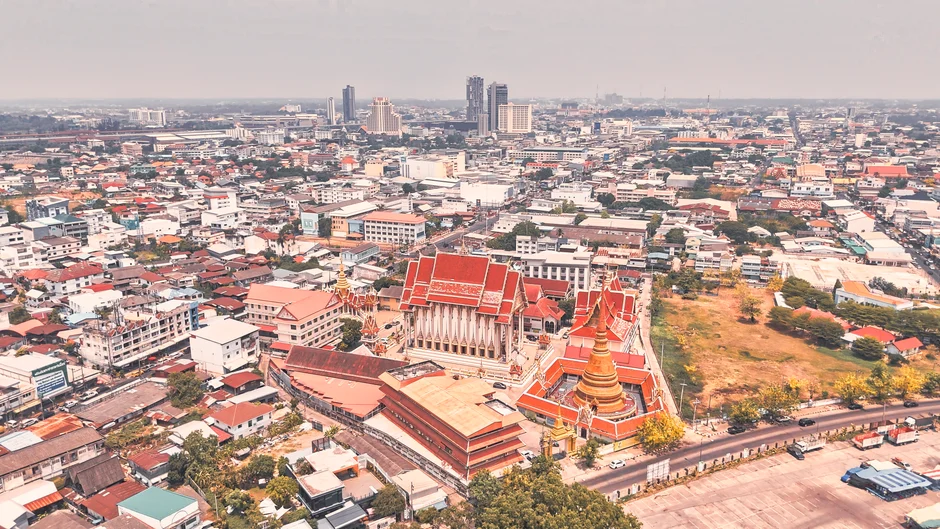
Phitsanulok is a province and its capital city in the lower-north of Thailand, about 380 km north of Bangkok. The Nan River runs through the city centre; the train station is two blocks east, the bus terminal three blocks west of the river. It’s a town of about 80,000 people in the city proper but the metropolitan area is closer to 250,000.
Historically the city was the second capital of the Sukhothai Kingdom in the 1400s, then the temporary capital of the Ayutthaya Kingdom during the war years against the Burmese. King Naresuan, the warrior king who finally drove the Burmese out, was born in Phitsanulok in 1555 — there’s a memorial museum on the southern edge of town. The combination of Sukhothai-era architecture and Naresuan history gives the city more depth than its size suggests.
Today Phitsanulok is best known for three things: the Buddha image at Wat Phra Si Rattana Mahathat, being the logistics base for Sukhothai day trips, and kuay tiew hoi kha — a regional boat-noodle dish where the cook squats with their legs swung over the bench (the literal translation is “legs-dangling noodles”), served from boats moored on the river.
Getting to Phitsanulok
- Train. Bangkok Hua Lamphong → Phitsanulok, 5–7 hours, 280–1,000 THB depending on class. Multiple daily trains including overnight sleepers (depart Bangkok 19:35, arrive 03:20 — too early; better is the morning Special Express that arrives early afternoon).
- Bus. Bangkok Mo Chit → Phitsanulok, 5.5–6 hours, 350–550 THB. Hourly through the day.
- Plane. Phitsanulok Airport (PHS) has direct flights from Bangkok Don Mueang (Nok Air, AirAsia, 75 minutes, 800–1,800 THB). Often the cheapest combined-with-time option.
From Phitsanulok the road west to Sukhothai is 60 minutes by car, hourly bus 80 THB, plus tuk-tuks and Grab.
What to do in Phitsanulok
A focused 2-day itinerary covers what matters:
Day 1 — Phra Buddha Chinnarat and the river
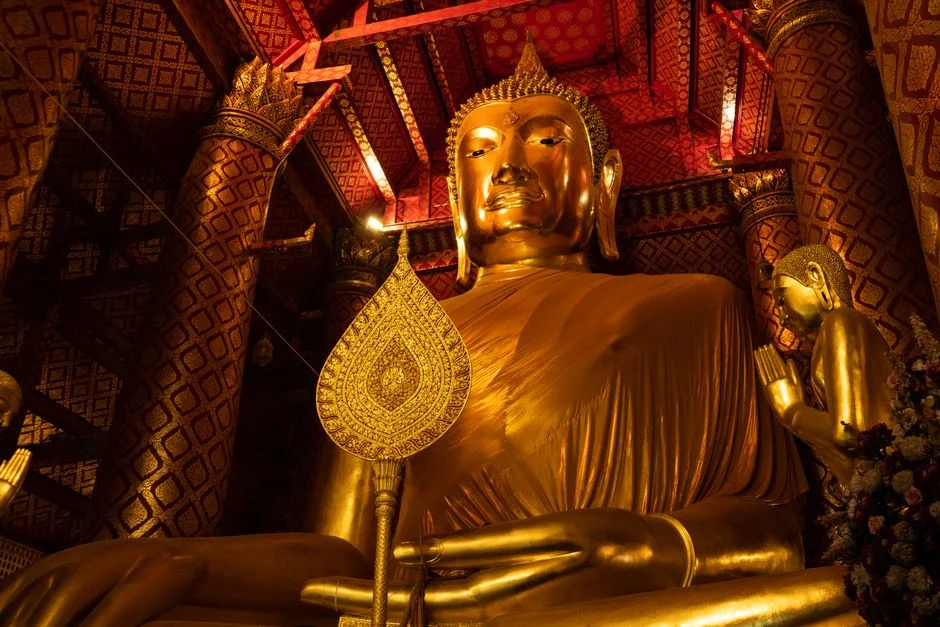
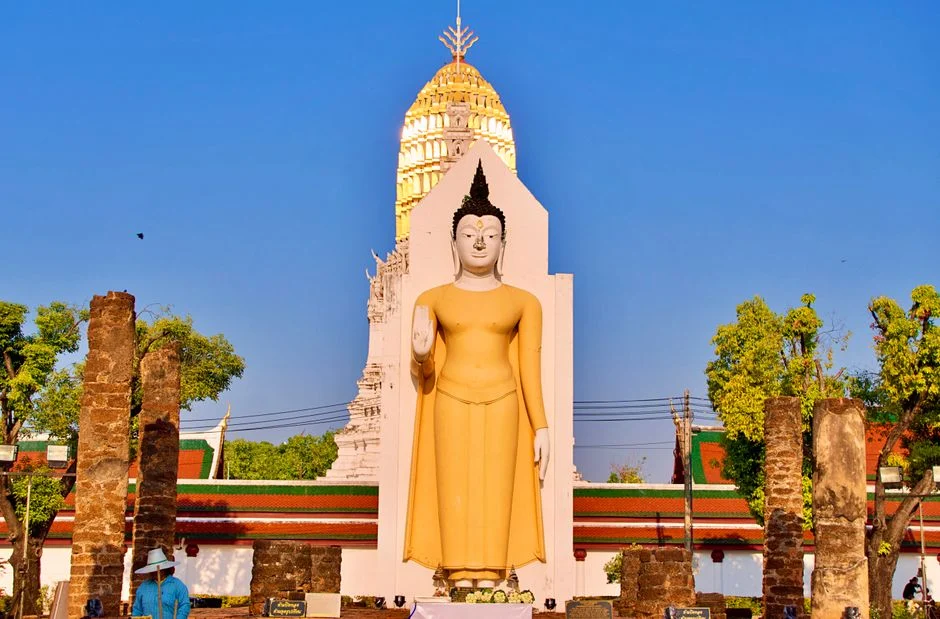
- Morning: Wat Phra Si Rattana Mahathat (also called Wat Yai). The temple complex dates to the 14th century, but the centrepiece is Phra Buddha Chinnarat, a 2.4-metre seated bronze Buddha in bhumisparsha mudra (touching the earth). Cast around 1357 and gilded in the 19th century, the image is considered by most Thai Buddhist authorities the most beautiful Buddha sculpture in the country. Open daily 06:30–18:00, free entry. Dress code enforced — long trousers / long skirts, shoulders covered. Allow 60 minutes. Around the central image is a working temple with a small museum showing the history.
- Late morning: Walk along the Nan River promenade. The river is narrow here, lined with low concrete buildings and the occasional traditional teakwood house. Pleasant in early morning light.
- Lunch: Pa Lek’s boat noodles (Soi Chao Hae, on the river bank just south of the main bridge). The classic kuay tiew hoi kha — small bowls of pork bone broth with rice noodles, 25 THB a bowl. Order 4 bowls. Locals do.
- Afternoon: Folk Museum of Sgt Maj Khun Thawee — a private collection of 19th-century Thai household items, agricultural tools, and northern Thai folk art, housed in a former teakwood house. 50 THB. 90 minutes. One of the more interesting small museums in the country.
- Evening: Dinner at one of the Nan River floating restaurants moored on the eastern bank. Grilled river fish 250–400 THB, dishes 100–200 THB. Sunset over the water is the right time.
Day 2 — Sukhothai day trip + return
- Early morning: Take the 07:30 bus to Sukhothai (60 minutes, 80 THB). Get off at the historical park. See our Sukhothai guide for the full day plan — Wat Mahathat, Wat Si Sawai, Wat Sa Si on the lake, the Ramkhamhaeng museum.
- Lunch in Sukhothai: Kuay tiew Sukhothai (the local noodle), 50 THB.
- Late afternoon: Bus back to Phitsanulok by 17:00.
- Evening: Final Phitsanulok meal — try Krua Kai Yang for grilled chicken Isan-style (60 THB).
- Overnight or back to Bangkok: Overnight train at 23:15, arriving Bangkok 05:30, lets you not pay another hotel night.
A few more things to do in Phitsanulok
If you have a third day:
- King Naresuan Memorial Hall — the king’s birthplace, with a small museum and a memorial garden. 50 THB.
- Wat Chulamani — older than the famous Wat Phra Si Rattana Mahathat, dating to the 11th century, a quieter temple with fewer visitors. Free.
- Phu Hin Rong Kla National Park — 130 km north-east, where the Communist Party of Thailand had its mountain headquarters in the 1970s. Now a national park with caves, viewpoints and remarkably preserved revolutionary-era buildings. Requires a hired car or tour; full day. Genuinely interesting Cold War history if you have any interest.
- Phitsanulok Aquarium — small but well-maintained, 100 THB. Good for families.
- Banglampoo Market night market — smaller than Sukhothai’s but very local. Tuesday and Friday evenings.
When to visit Phitsanulok
- November to February: Cool, dry, the best window. 22–30°C. Reserve accommodation for the long Thai weekends.
- March to May: Hot, 36–40°C. Brutal at midday.
- June to October: Wet season. Mornings usually dry, afternoon downpours. Cheapest hotels.
Avoid Songkran (April 13–15) for crowds and chaos; the city does the water-fight tradition.
Where to stay in Phitsanulok
The right base is along Borom Trailokanat Road or near the train station. Both are walking distance from Wat Phra Si Rattana Mahathat and the river.
- Budget: Lithai Guesthouse (450–750 THB), London Hotel (350–600 THB).
- Mid-range: The Imperial Hotel & Convention Centre (1,200–2,000 THB), Topland Hotel (1,000–1,800 THB) — both near the river.
- Upscale: Phitsanulok Thani Hotel (1,800–3,000 THB) — the best in the city.
For a 2-night Phitsanulok base, a 1,200 THB mid-range hotel by the river is the right call. Book 1 week ahead in cool season.
A Thailand itinerary 7 days easily includes a Phitsanulok-Sukhothai stop on the route between Bangkok and Chiang Mai. See our Bangkok province guide for the wider context.
Beds here are cheap for what you get — compare Phitsanulok hotels on Agoda (affiliate link — same price for you).
Practical details for Phitsanulok
- Cash: ATMs everywhere in town. Most restaurants take card; street stalls don’t.
- Transport in town: Tuk-tuks 40–80 THB across the centre. Songthaews on fixed routes 15 THB. Walking covers most of what matters.
- Mobile signal: Solid 4G across town.
- Language: Limited English. Google Translate works.
- Eat: Kuay tiew hoi kha (the legs-dangling noodle), grilled river fish at the floating restaurants, khanom jeen nam ya at the morning markets, the Sukhothai-style noodle when you cross over to Sukhothai itself.
- Combine with: A day trip to Kamphaeng Phet historical park (80 km south-west) for the other UNESCO ruins. Or Si Satchanalai (40 km north of Sukhothai) for even quieter Sukhothai-era ruins.
Phitsanulok for families
Workable but not designed for kids:
- Wat Phra Si Rattana Mahathat — atmospheric for older kids, less so for under-5s.
- Sukhothai Historical Park day trip — the bike-loop is fun for kids, and the open ruins are kid-safe.
- Phitsanulok Aquarium — proper kid distraction for a few hours.
- The Folk Museum — surprisingly engaging if kids are 8+.
Final thoughts on Phitsanulok
Phitsanulok is the lower-northern Thai city that exists between bigger destinations. Treated as a transit point it’s wasted. Treated as a 2-night base for Wat Phra Si Rattana Mahathat, Sukhothai, and the river food, it’s one of the most satisfying small Thai cities to visit. The Buddha image alone justifies the stop. The boat noodles and the Folk Museum justify the second night. Add in the Sukhothai day trip and you’ve spent two days in central Thailand history at a fraction of the cost (or the crowds) of equivalent Bangkok temples. The Thai middle-class weekend has been coming here for decades. The information is there; the queue is short.
FAQ
How far is Phitsanulok from Bangkok?
About 380 km north. Train 5–7 hours (280–1,000 THB), bus 5.5 hours (350–550 THB), flight 75 minutes (800–1,800 THB).
How far is Phitsanulok from Sukhothai?
60 km west. Bus runs hourly (80 THB, 60 minutes). The combination of Phitsanulok base + Sukhothai day trip is the standard pattern.
Is Phitsanulok worth visiting?
Yes — for the Phra Buddha Chinnarat image alone, plus the river food scene and the Sukhothai access. Skip if your trip is under 8 days and you’ve prioritised beaches.
What’s the most famous Buddha image in Phitsanulok?
Phra Buddha Chinnarat at Wat Phra Si Rattana Mahathat — a 14th-century gilded bronze image considered by most Thai Buddhist authorities the most beautiful Buddha sculpture in the country.
How many days do I need in Phitsanulok?
Two nights — one for the city itself, one for the Sukhothai day trip. Three nights if you want Kamphaeng Phet or Phu Hin Rong Kla National Park.
What’s the best time to visit?
November to February — cool, dry, manageable temperatures. Avoid April for the heat and Songkran chaos.
Should I stay in Phitsanulok or Sukhothai?
Phitsanulok has better transport links, more accommodation options, and the legs-dangling noodle scene. Sukhothai has the atmospheric ruin proximity. For most travellers Phitsanulok is the better base; for atmosphere chasers, stay in Sukhothai.
Related guides
- Temples in Ayutthaya: A Half-Day Cycle Through the Ruined Capital
- Things to Do in Sukhothai, Thailand: The Original Capital That Got Out of the Way
- Lop Buri: The City Invaded by Monkeys
Book the trip
Some links below are affiliate links. If you book through them we may earn a small commission at no extra cost to you — it helps keep Destination Thailand independent.
Getting here: Phitsanulok sits on the main northern line, so nearly every Bangkok–Chiang Mai train calls in. Compare trains and buses on 12Go — the morning expresses do Bangkok to Phitsanulok in about five and a half hours.