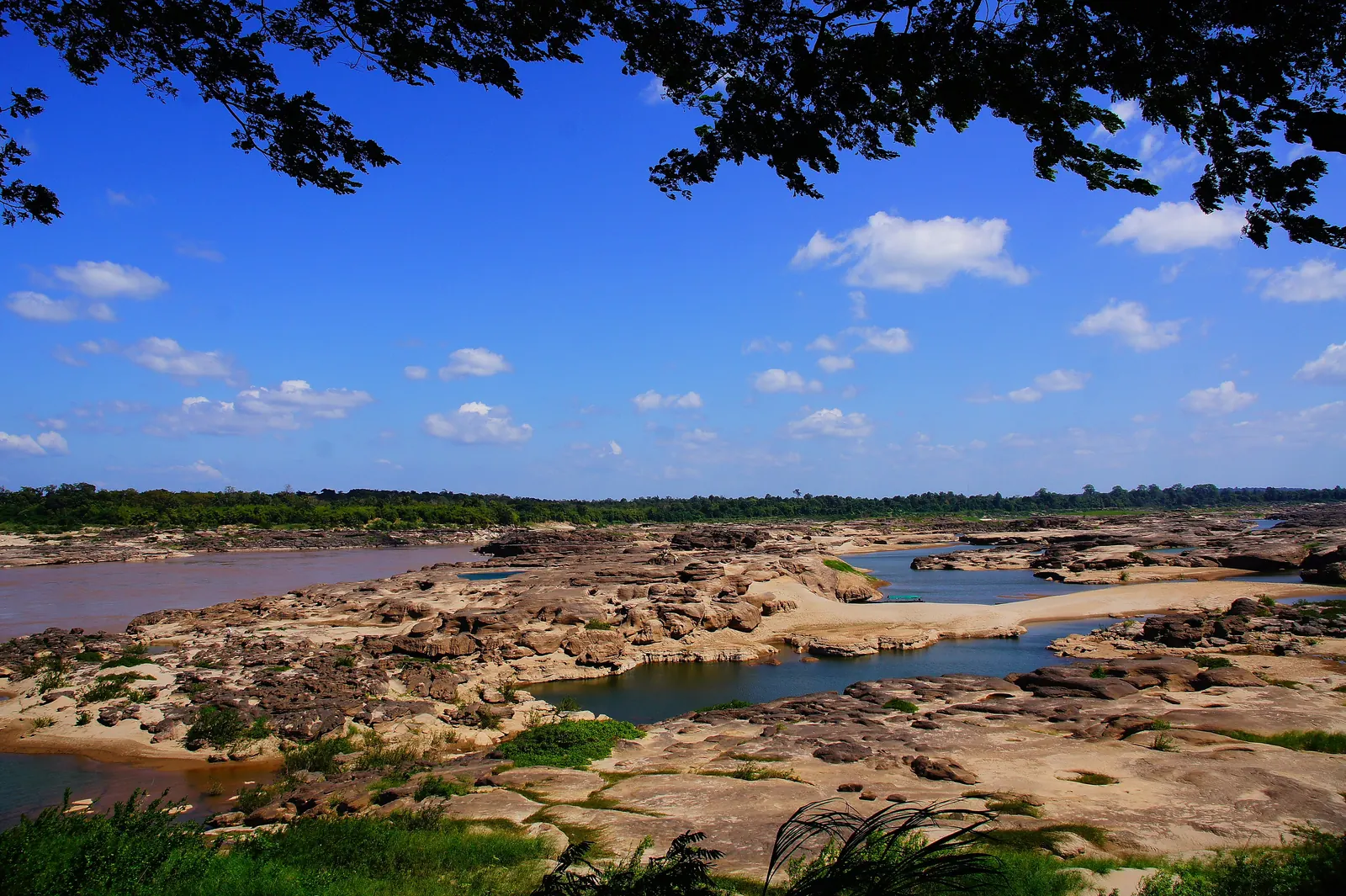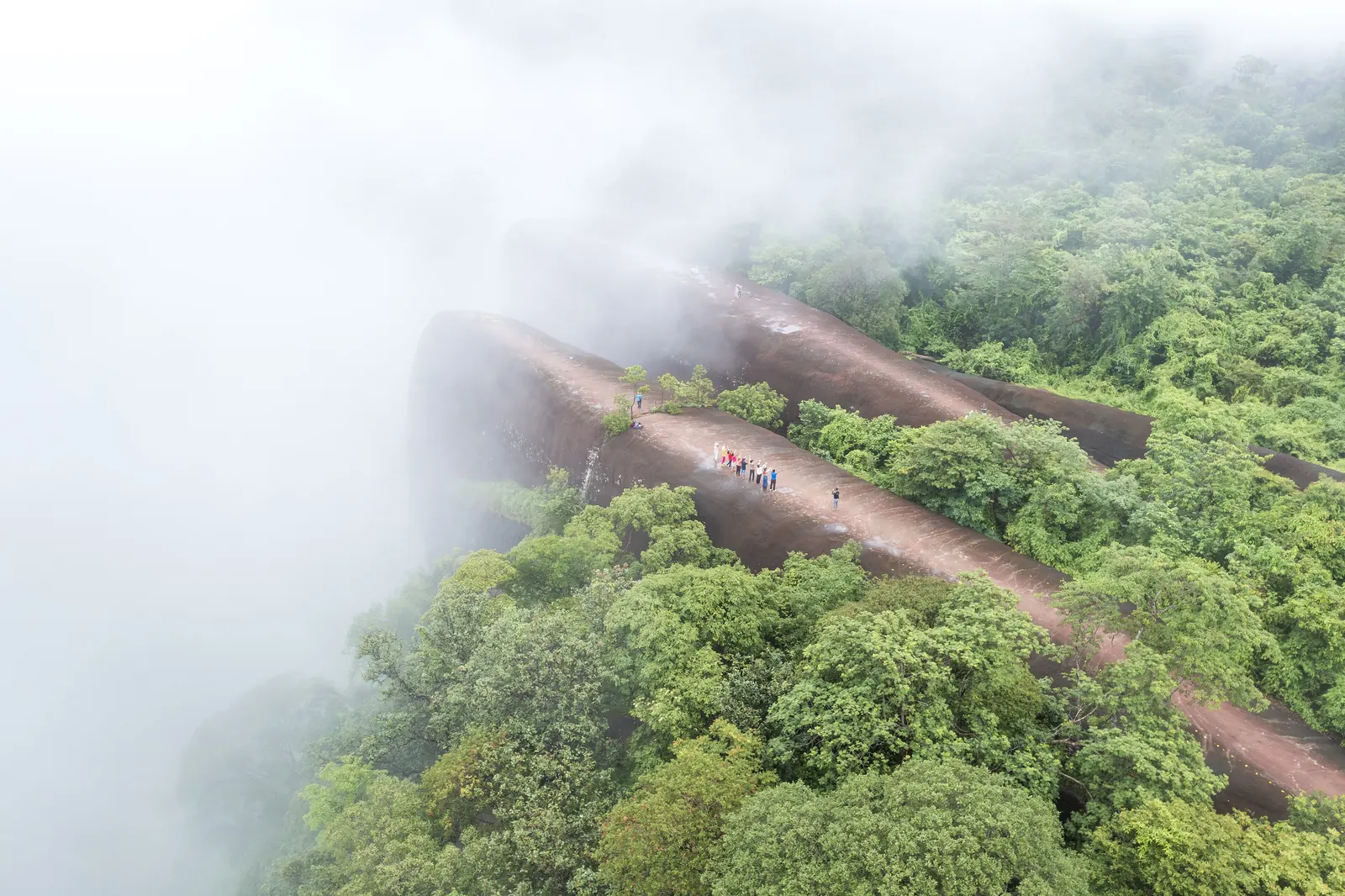
Three Whale Rock is the photograph that put Bueng Kan on the map: three sandstone humps breaking out of a forest canopy like a family of whales surfacing, with the Mekong and the hills of Laos laid out behind. It sits in Phu Sing, a forest reserve east of Bueng Kan town, and until about a decade ago it was a local secret. It is no longer a secret, but it is still remote enough that on a weekday you will share the father whale with a few Thai families and the man who drove you up.
The short version: be at the Phu Sing registration point by 5.15am, pay ฿20 and a share of the ฿500 pickup truck, walk out on the whales at first light, then spend the afternoon on the wooden ledges of Wat Phu Tok. With a second day, book Naka Cave on the QueQ app and finish at Bueng Khong Long lake. Do all of it without a tour; in a province with almost no tour industry, the only thing a tour adds is a van. Every entry ends with a verdict and a November 2026 price.
For the province as a whole — food, history, the Mekong drive — read our Bueng Kan travel guide; the basics and map are on the Bueng Kan province page. This post is the practical one: hours, trucks, bookings and what to skip.
How Bueng Kan is laid out, and how this list works
Bueng Kan is a long, thin province strung along the Mekong in Isaan’s far north-east corner, Thailand’s newest since 2011. Bueng Kan town sits on the river in the west and is the only sensible base. Phu Sing and Three Whale Rock are east of town, roughly 45 minutes to an hour by road. Wat Phu Tok is south, in Si Wilai district, around 45 minutes. The far south-east holds Bueng Khong Long lake and Phu Langka National Park with Naka Cave, about 90 minutes from town, and Phu Wua with Chet Si waterfall in Seka district, closer to two hours.
There is no airport, no railway and no meaningful public transport between the sights, which is the single fact that shapes every trip here: you need wheels. A hired car from Udon Thani airport, a driver from town, or a motorbike if you are comfortable on rural Isaan roads. Each entry ends with a verdict — Do it, Fine or Skip it — and the price as of November 2026, checked against our Thailand Price Index; estimates say “around”. Nothing was comped.
Three Whale Rock at Phu Sing: booking, permits, trucks and opening hours
1. Hin Sam Wan, the whales themselves
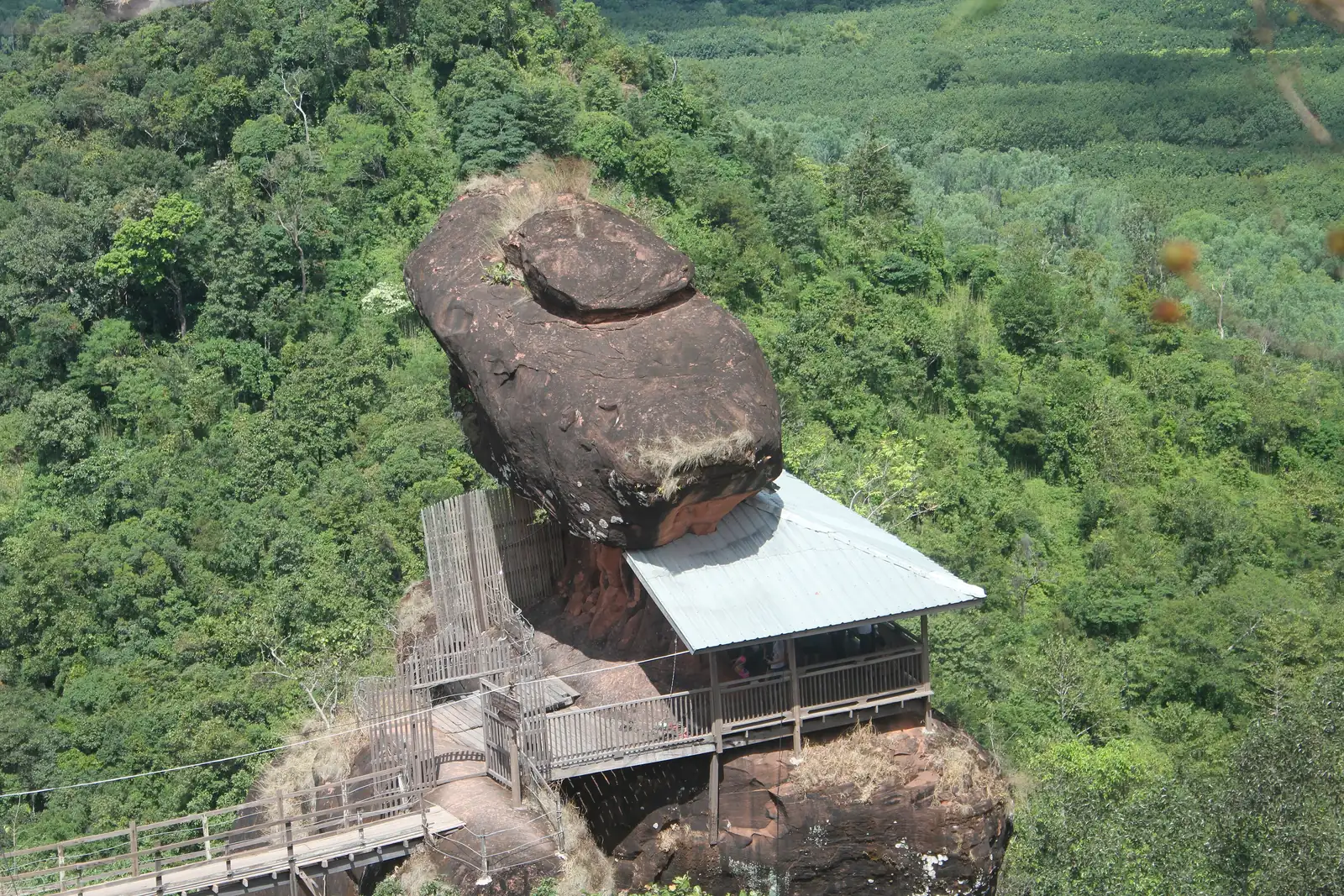
Hin Sam Wan — Three Whale Rock — is a row of sandstone boulders on the cliff edge of Phu Sing, roughly 75 million years in the making, nicknamed the father, mother and baby whale. You walk out along their backs to a drop with forest below and the Mekong beyond. The rule that surprises people: you cannot drive yourself up. You park at the foot of the hill, register with the forestry staff, pay the ฿20 forest-reserve fee and ride a ranger-run pickup to the top.
The truck is ฿500 per vehicle, not per person, and seats around ten to twelve; if you arrive as a couple, team up with whoever is in the queue and split it. The driver doubles as a guide and photographer, and the full loop takes two to three hours. Hours are roughly 5am to 5pm, first trucks from about 5am for sunrise. As of November 2026 there is no online booking or permit system for Phu Sing — you register on the spot — unlike Naka Cave below. Some listings quote a higher foreigner fee of around ฿100; bring cash for either. In heavy rain the rangers close the road; the Phu Sing office numbers widely published are 086-759-7066 and 098-097-1049. A guided Three Whale Rock trip only makes sense if you have no car.
Verdict: Do it — at dawn, without a tour. ฿20 entry plus a share of ฿500.
2. The rest of the Phu Sing loop
The truck does not just drop you at the whales. The loop includes Elephant Rock, a pinkish boulder a short walk from the drop-off; the Phu Sing Wall, a rampart of patterned sandstone; Lan Tham, a rock terrace with a lion-shaped boulder and an enshrined Buddha; the Tham Ruesi viewpoint, the clearest look down at the river; and Sang Roi Bo, the “hundred pools”, a plateau of rainwater potholes at the cliff edge. Most of it is decent rather than remarkable; Tham Ruesi earns its stop. Wear shoes that grip — the sandstone is slick after rain — and keep well back from the edges, which have no rails.
Verdict: Fine — included in the truck fee, so take it. No extra cost.
Sunrise or sunset at Three Whale Rock: which is worth the alarm?
Sunrise, and it is not close. The whales face roughly east over the valley; at first light, mist often lies in the forest below and the low sun turns the sandstone orange. The sun is up around 6am to 6.30am in the cool season, so from Bueng Kan town you leave just after 4am and reach the registration point between 5am and 5.30am. By 9am the light is flat and the rock is hot enough to regret. Sunset is the alternative for people who refuse the alarm: Sang Roi Bo is the spot, the crowds are thinner, and you lose the mist. Check what time the last truck goes down before committing to it.
The mist is not a guarantee. It is most reliable from November to January, after the rains have soaked the valley and the nights have cooled, and least likely in the hazy, hot months of March and April. If a sea of cloud is the point of your trip, compare our guide to Aiyerweng’s sea of mist in the far south, and Phu Kradueng and Phu Ruea in Loei, which do the same trick at altitude. Bueng Kan’s version is lower, smaller and has whales.
Verdict: Do it at sunrise; sunset is Fine as a consolation. Same ticket either way.
Wat Phu Tok: the wooden staircase temple an hour from the whales
3. Wat Phu Tok (Wat Chetiyakhiri Wihan)
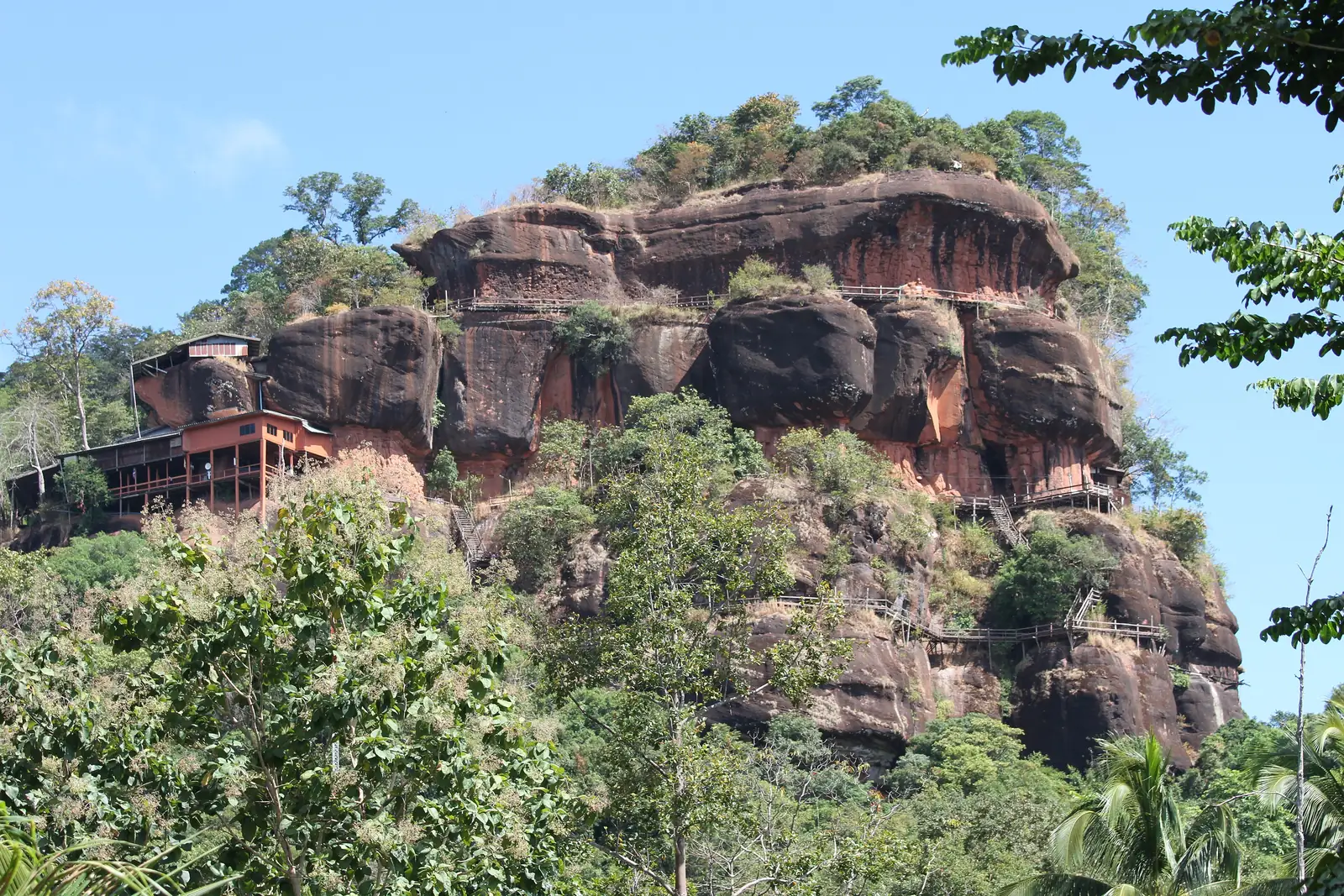
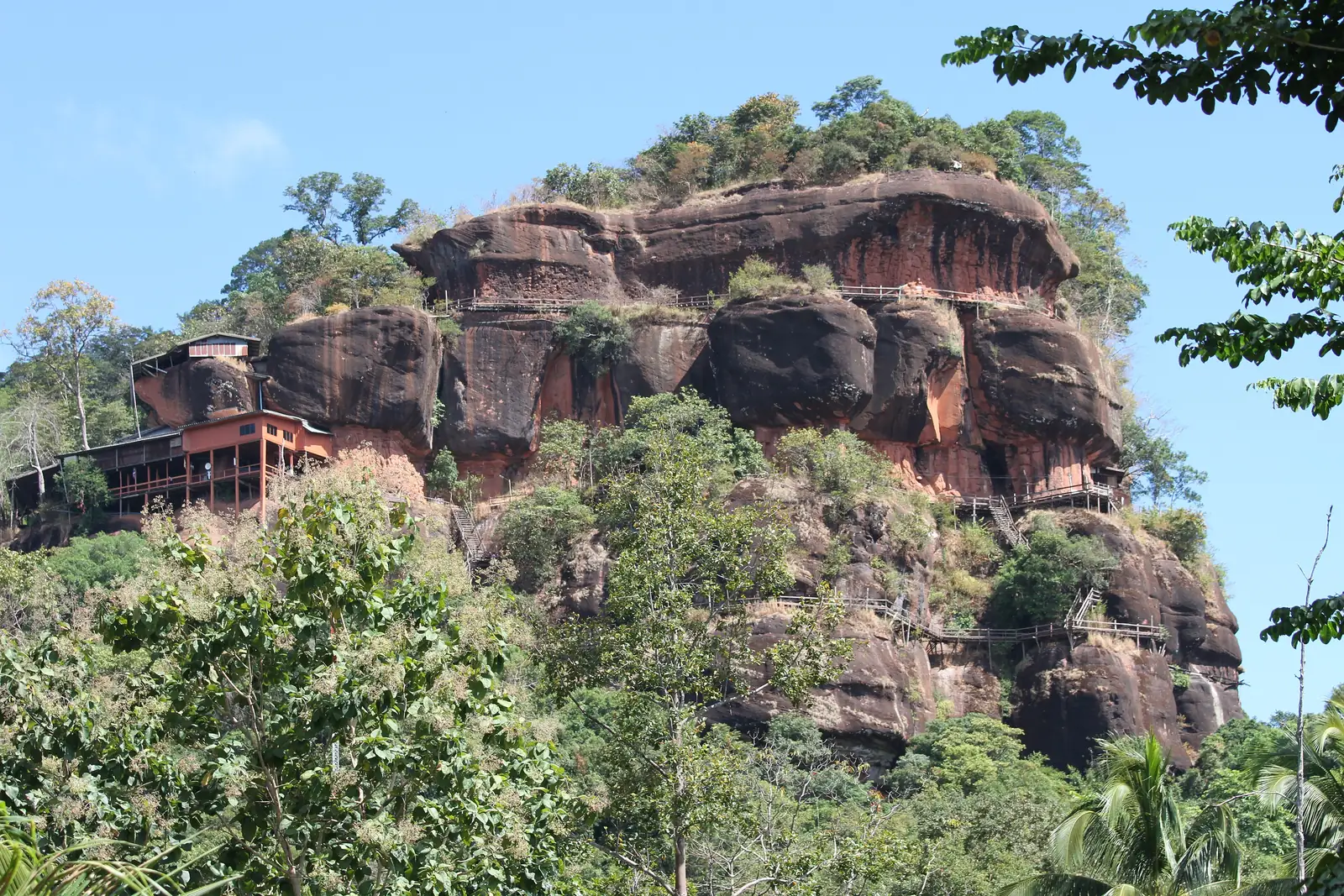
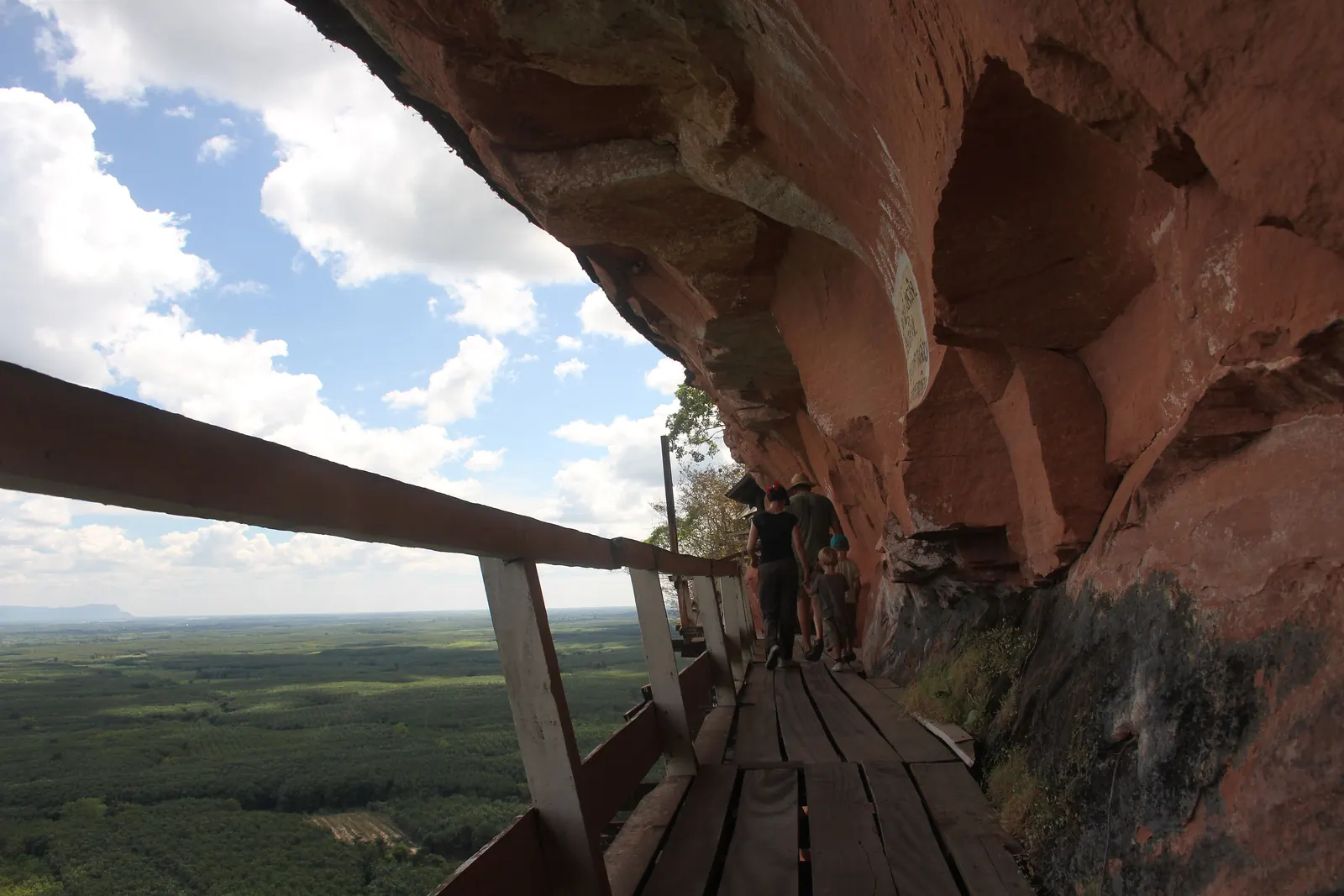
A sandstone tower rising out of flat rubber country in Si Wilai, wrapped in seven levels of wooden staircases and walkways pinned to the cliff by monks from the late 1960s onwards — seven levels for the seven stages of enlightenment. The planks creak, the drops are real and the rails are modest. The views from levels five and six over the plain justify every step. It is a working meditation monastery, founded by the forest monk Luang Pu Juan, so dress like it: shoulders and knees covered, no loud voices, and read our temple etiquette guide if in doubt.
Entry is free — leave something in the donation box. Opening hours are quoted anywhere between 6.30am and 8.30am to 5pm; aim for 8am to be safe, allow two hours, and take water, because there are no vendors on the levels. The temple closes to visitors every year around 10–16 April, over Songkran, and also does not want you on the walkways in a thunderstorm. Pair it with Three Whale Rock on the same day: whales at dawn, breakfast in town, Phu Tok by mid-morning.
Verdict: Do it — the best single sight in the province, whales included. Free; donation.
Waterfalls, a serpent cave and a lake: the rest of Bueng Kan worth the drive
4. Naka Cave, Phu Langka National Park
Tham Naka is a rock outcrop whose cracked surface looks uncannily like giant serpent scales; it went viral in 2020 and is now a pilgrimage as much as a hike. This is the one sight in the province that needs booking: the park caps visitors at around 1,000 a day, split between a walk-in quota and advance slots on the QueQ app, and you register each climber by real name. Weekends and holidays sell out. The climb is steep forest trail and steps, a few hours return; start early. National-park fees are around ฿20 for Thais and around ฿100 for foreigners. The cave closes for trail recovery at times — in 2026 it was shut for the whole of May and reopened on 1 June — so check the Phu Langka park page before driving out.
Verdict: Do it, if you have booked and have a second day. Around ฿100 foreigner fee.
5. Chet Si waterfall, Phu Wua
The “seven-colour” waterfall — originally Ka-am — is a broad sandstone cliff in Phu Wua Wildlife Sanctuary where the water spreads in a wide sheet rather than plunging, throwing up spray that catches a rainbow on sunny late mornings. About an 800-metre forest walk to the first tier, with shallow pools to wade. It depends entirely on the rain: full from about July to November, a sad trickle from February to May. Fees are quoted inconsistently — around ฿60, or up to around ฿200 on the foreigner rate — and hours are roughly 8am to 4pm. Flash floods are a real risk in heavy rain; swim only where the rangers point.
Verdict: Fine — Do it from August to November; Skip it in the dry season. Around ฿60–200.
6. Bueng Khong Long lake
A large, shallow Ramsar-listed lake in the south, with waterbirds in the cool season, fishermen in the reeds and lakeside places grilling whole fish for around ฿150–300. Nothing to do here except eat, watch the light go and feel very far from Bangkok, which is the point. It sits close to Phu Langka, so it is the natural end to a Naka Cave day.
Verdict: Fine — Do it as the sunset after Naka Cave. Free.
7. Bueng Kan town and the river at night
The town itself is small and plain, with a riverside road facing Paksan in Laos and an evening market where dinner rarely clears ฿150 a head: som tam pounded to order at ฿40–60, grilled chicken, sticky rice, and Mekong fish in a salt crust. Our Isaan food guide explains what to point at. There is no nightlife to speak of; you will be in bed by nine, which suits the 4am alarm. Draw cash in town — most of the sights are cash only, and the ฿220 ATM fee applies here too.
Verdict: Fine — a base, not a destination. Dinner around ฿100–150.
Three Whale Rock and Bueng Kan’s sights, costs compared
| Sight | Cost, Nov 2026 | Booking | Verdict |
|---|---|---|---|
| Three Whale Rock, Phu Sing | ฿20 (some quote ฿100) + ฿500 per truck | None; register on site | Do it, sunrise |
| Wat Phu Tok | Free; donation | None; closed around 10–16 April | Do it |
| Naka Cave, Phu Langka | Around ฿100 foreigner | QueQ app or walk-in quota | Do it, booked |
| Chet Si waterfall, Phu Wua | Around ฿60–200 | None | Fine, wet season |
| Bueng Khong Long lake | Free | None | Fine |
| Hire car from Udon Thani | Around ฿1,000–1,500 a day | Book ahead | Do it |
Getting to Three Whale Rock from Udon Thani, Nakhon Phanom or Bangkok
Fly to Udon Thani and drive is the honest recommendation. Flights from Bangkok take about an hour; from Udon it is roughly three and a half to four hours east by road via Nong Khai and Route 212, the Mekong on your left most of the way. Hire cars at the airport run around ฿1,000–1,500 a day, and having one is the difference between seeing three sights a day and one. Without a car, Phet Prasert and other operators run buses from Udon to Bueng Kan in about three and three-quarter hours for around ฿200–300 — Udon Thani to Bueng Kan on 12Go. If you are coming via the sculpture park, Nong Khai to Bueng Kan on 12Go is the shorter leg, and our Sala Keoku guide makes the case for the stop.
From Bangkok by bus, overnight coaches leave Mo Chit in the evening and arrive around dawn after 11 to 12 hours, around ฿600–950 depending on class — Bangkok to Bueng Kan on 12Go. From Nakhon Phanom, Route 212 runs north up the river, around four to five hours by bus; compare Nakhon Phanom to Bueng Kan on 12Go, and see our Nakhon Phanom guide for the other end. Sakon Nakhon airport is about two hours from the southern sights; our Sakon Nakhon guide covers it.
Bueng Kan is one stop on a longer river road: our Mekong road from Loei to Ubon strings it together with Chiang Khan and the rest, and the general rules for buses and vans are in our transport guides. Mobile data for maps on empty roads: our SIM and eSIM guide.
Where to stay for a Three Whale Rock sunrise
Bueng Kan town, every time: it is within an hour of both the whales and Phu Tok, and it is where the food is. Rooms are cheap — clean guesthouses from around ฿400–700, the newer hotels around ฿800–1,500 — and nobody has built a resort, which is a mercy. The One Hotel, a four-star on the Bueng Kan–Nakhon Phanom road, is the most hotel-like option, from around ฿1,000. Finn Hotel is the newer four-star alternative, from around ฿1,000–1,400. B2 Bueng Kan Boutique & Budget Hotel is the no-surprises budget pick, from around ฿600–800, with parking for the 4am getaway.
Confirm before booking that reception will be awake, or at least the gate open, at 4am. If you are doing Naka Cave and Bueng Khong Long, a night of simple lakeside homestays in the south, around ฿300–600, saves a long drive in the dark. Otherwise compare Bueng Kan hotels on Agoda; on long weekends in the cool season, book ahead, because there are not many rooms.
When to go to Three Whale Rock and Bueng Kan
November to January is the window: cool mornings, the best chance of mist under the whales, dry trails at Phu Tok and the lake full of birds. It is also Thai high season, so weekends and the New Year week bring queues at the Phu Sing trucks and sold-out Naka Cave slots; go midweek. February to April is hot and hazy, with poor sunrises, a dry Chet Si and Phu Tok closed over Songkran. June to October is green and wet: Chet Si at full roar, slippery sandstone, and the Phu Sing road occasionally closed after storms. Month by month, read our best time to visit Thailand; holiday weekends to avoid are in the festivals and public holidays calendar.
The plan we would give a friend: two nights in Bueng Kan town. Day one, Three Whale Rock at dawn and Wat Phu Tok by mid-morning. Day two, Naka Cave on a booked slot and sunset at Bueng Khong Long. Add a third night only if Chet Si is running.
Three Whale Rock: your questions, answered
Do you need to book Three Whale Rock in advance?
No. As of November 2026 Phu Sing has no online booking or permit system: you park at the foot of the hill, register with the forestry staff, pay the ฿20 entry and share a ฿500 ranger pickup to the top. Cool-season weekends bring queues, so arrive by 5.15am. Naka Cave in Phu Langka is the Bueng Kan sight that does need advance booking, on the QueQ app.
Can you drive your own car to the top of Three Whale Rock?
No. Private cars park at the registration point and visitors ride the forestry pickups up the steep forest track. The truck costs ฿500 and seats around ten to twelve, so couples should team up with others in the queue. The driver usually runs the whole Phu Sing loop, including Elephant Rock and the Tham Ruesi viewpoint, in two to three hours.
What time does Three Whale Rock open?
Roughly 5am to 5pm, with the first trucks leaving from about 5am for sunrise. The sun rises around 6am to 6.30am in the cool season, so leave Bueng Kan town just after 4am. Some listings give slightly different closing times and the rangers can shut the road after heavy rain, so call the Phu Sing office or check locally the day before.
Can you visit Three Whale Rock and Wat Phu Tok in one day?
Yes, with a car, and it is the best day the province offers. Do Three Whale Rock at sunrise, be back down by about 8.30am, eat breakfast in Bueng Kan town and drive about 45 minutes south to Wat Phu Tok for mid-morning. Allow two hours on the temple’s walkways and you are free by early afternoon. Without wheels, hire a driver from town.
How do you get to Bueng Kan without a car?
Take a bus: Udon Thani to Bueng Kan is around three and three-quarter hours and ฿200–300, and overnight coaches from Bangkok’s Mo Chit take 11 to 12 hours for ฿600–950. Once in town, there is no public transport to Phu Sing or Phu Tok, so hire a driver or a songthaew through your hotel, or rent a motorbike if you ride confidently at home.
Related guides
- Bueng Kan: Three Whale Rock and Thailand’s Youngest Province
- Nakhon Phanom: The Prettiest Stretch of the Mekong
- Sala Keoku: The Surrealist Sculpture Park on the Mekong at Nong Khai
Book the trip
Some links in this guide are affiliate links. If you book through them we may earn a small commission at no extra cost to you — it helps keep Destination Thailand independent.
Hotels: stay in town and compare Bueng Kan hotels on Agoda, early for cool-season weekends. Tours/Boats: there is little to book here, but browse Bueng Kan trips on GetYourGuide if you have no car. Getting there: book Udon Thani to Bueng Kan on 12Go, and read our transport guides before you go. Not sure the far north-east is for you? Our Where to Go in Thailand matcher scores all 77 provinces against your month, your crowd tolerance and what you actually want from the trip.