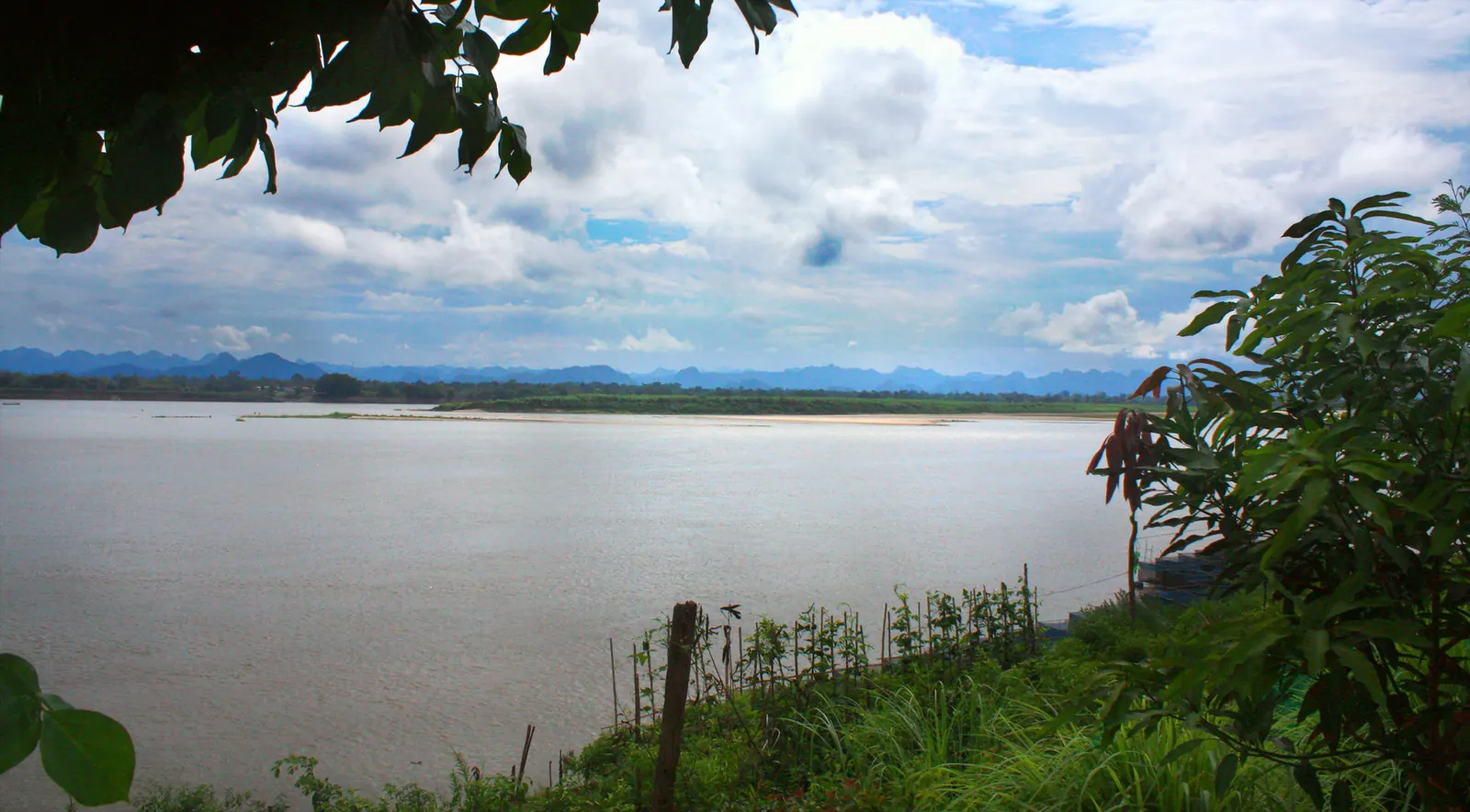
For roughly 900 kilometres the Mekong is Thailand’s eastern edge, and for most of that distance the country has politely forgotten to build anything for tourists beside it. This is the Mekong road Thailand overlooks — Route 211 out of Chiang Khan, Route 212 from Nong Khai round the top of Isaan and down through Nakhon Phanom and Mukdahan, then the back roads to Khong Chiam and the cliffs of Pha Taem in Ubon. It is the longest river drive in the country and the quietest. Laos is on your left the whole way, close enough for your phone to roam. Nobody sells you anything. So here it is costed for November 2026: every leg in kilometres, hours and baht, by bus, hire car or scooter, with a bed for every night and a verdict on every stop. Small prices are checked against our Thailand Price Index.
The short version: eight days is right, ten is better, six is a bus marathon. Start in Chiang Khan in the Loei province profile, finish in the Ubon Ratchathani province profile, and go between November and February, or December to April if the Sam Phan Bok rock flats are the point. Budget around ฿800–1,100 in bus fares for the lot, or ฿1,000–1,500 a day for a hire car plus a one-way fee. The road is the reward; the towns are pleasant rather than spectacular, and that is the deal.
The Mekong road leg by leg: kilometres, hours and baht for November 2026
Road kilometres between town centres, rounded. Hours are bus time first, then driving time. Fares are one adult, one way, at the counter or online as of November 2026; local buses on Route 211 and 212 are not sold online, so the Book column gives the nearest bookable option.
| Leg | Km | Hours (bus / car) | Mode | ฿ | Book |
|---|---|---|---|---|---|
| Bangkok → Chiang Khan (the start) | 540 | 9–10 / 7 | Overnight bus from Mo Chit, or fly to Loei or Udon | ฿511–941 | Bangkok to Chiang Khan on 12Go |
| Udon Thani → Loei → Chiang Khan | 200 | 3.5–4 / 2.5 | Bus to Loei, then local bus or songthaew | ฿140–200 | Udon Thani to Loei on 12Go |
| Chiang Khan → Pak Chom → Sangkhom → Nong Khai (Route 211) | 200 | 6–7 / 4 | Local bus, change at Pak Chom; one through bus from Loei at dawn | ฿130–200 | Loei to Nong Khai transfers on 12Go |
| Nong Khai → Bueng Kan (Route 212) | 140 | 2.5–3 / 2 | Local bus from Nong Khai terminal | ฿100–200 | At the terminal; from Udon, Udon Thani to Bueng Kan on 12Go |
| Bueng Kan → Nakhon Phanom (Route 212) | 175 | 3.5–4 / 3 | Local bus; last departures mid-afternoon | ฿150–220 | At the terminal; or Nong Khai to Nakhon Phanom transfers on 12Go |
| Nakhon Phanom → That Phanom → Mukdahan | 105 | 2 / 1.5 | Bus or van, hourly-ish | ฿80–120 | Nakhon Phanom to Mukdahan on 12Go |
| Mukdahan → Amnat Charoen → Ubon (inland Route 212) | 170 | 3–3.5 / 2.5 | Bus, several a day | ฿175 | Mukdahan to Ubon on 12Go |
| Ubon → Phibun Mangsahan → Khong Chiam | 85 | 1.5 / 1.25 | Minibus, hourly 06:00–18:00 | ฿80 | At Ubon terminal; direct from Bangkok, Bangkok to Khong Chiam on 12Go |
| Ubon → Bangkok (the way home) | 630 | 8.5–11 by bus or train / about 1 h flying | Night train, overnight bus or plane | Bus ฿545–941 | Ubon to Bangkok on 12Go |
About 1,000 km and ฿800–1,100 in fares: the transport is the cheap part, and eight to ten nights of beds at ฿500–2,500 are where the money goes.
Bus, hire car or scooter: how to travel the Thai side of the Mekong
The bus works, slowly. Every town on this route has a terminal with something leaving for the next one, but few services run along the river itself: Route 211 has orange local buses and big songthaews that stop for every sack of rice, Route 212 basic air-con buses whose last departures leave around 15:00. Fares are small and you cannot stop at the viewpoint. For the long hops into and out of the region, Bangkok to Loei and Bangkok to Nong Khai are both bookable on 12Go, the latter including the sleeper train.
The hire car is the right answer for two or more. Collect at Udon Thani airport (flights from Bangkok about an hour, Bangkok to Udon Thani on 12Go), from about ฿1,000–1,500 a day for a small saloon, drive west to Chiang Khan first and then follow the river. Dropping in Ubon adds a one-way fee we have seen quoted at around ฿3,000–5,000; ask before you sign. Fuel for the whole route is roughly ฿2,000–2,800 in a small car. The roads are flat, quiet two-lane tarmac, except the 211 between Pak Chom and Sangkhom, which bends and climbs like a northern road. Dogs, buffalo and unlit tractors own the road after dark; be off it by then.
The scooter is for loops, not the whole thing, because nobody rents one-way. Hire one for ฿200–300 a day in Chiang Khan, Nong Khai, Nakhon Phanom and Khong Chiam and ride the local stretch out and back; the river road from Nakhon Phanom to That Phanom, 50 km of flat tarmac with Lao karsts across the water, is the best scooter day on the route. Same rules as everywhere in Thailand: a motorcycle licence and an International Driving Permit, or your insurance is decoration. Verdict: car for couples and families; bus plus scooter days for solo budget travellers; never a car licence on a 125cc.
Chiang Khan to Nong Khai on Route 211: the bendy, empty first day
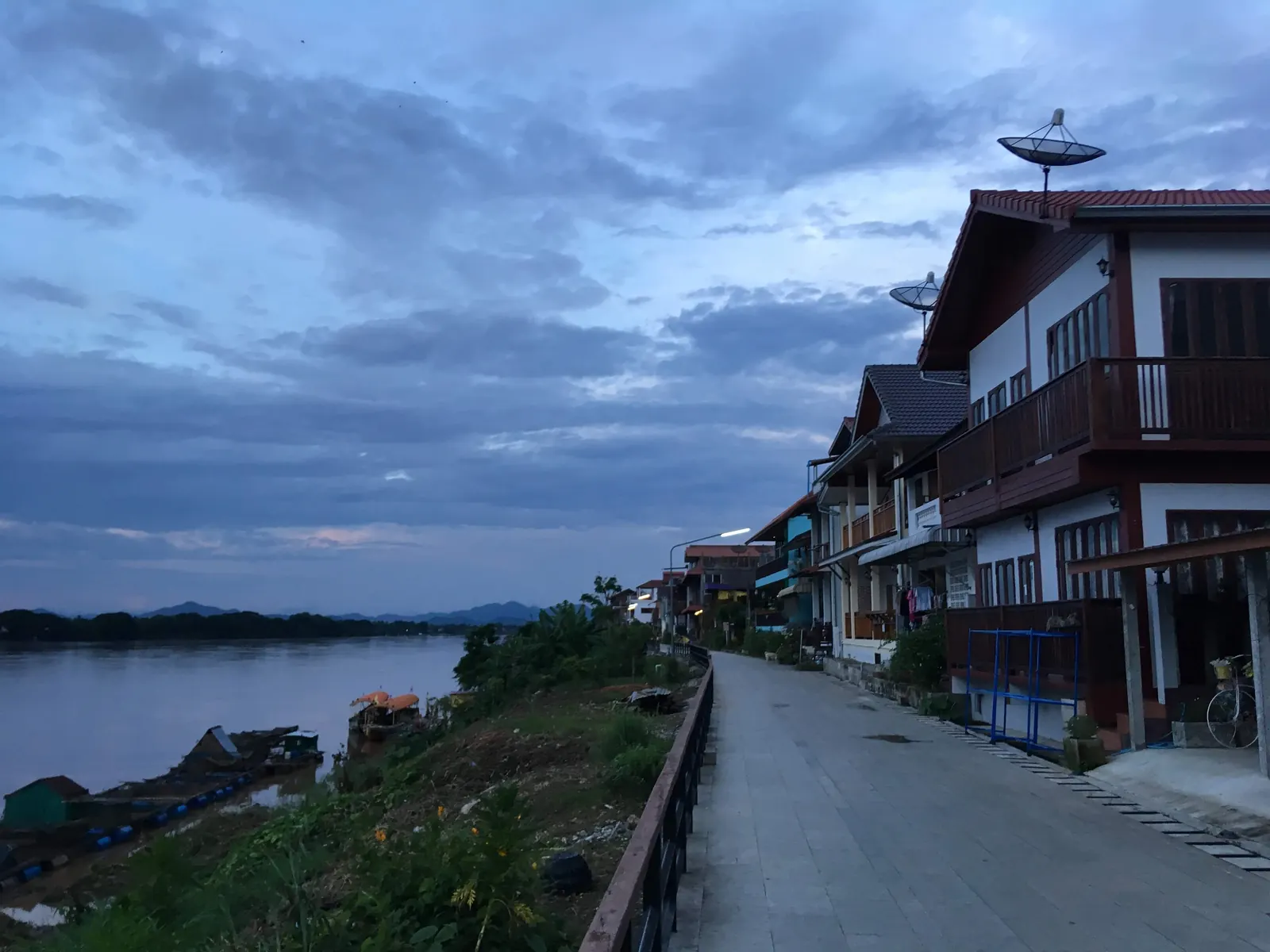
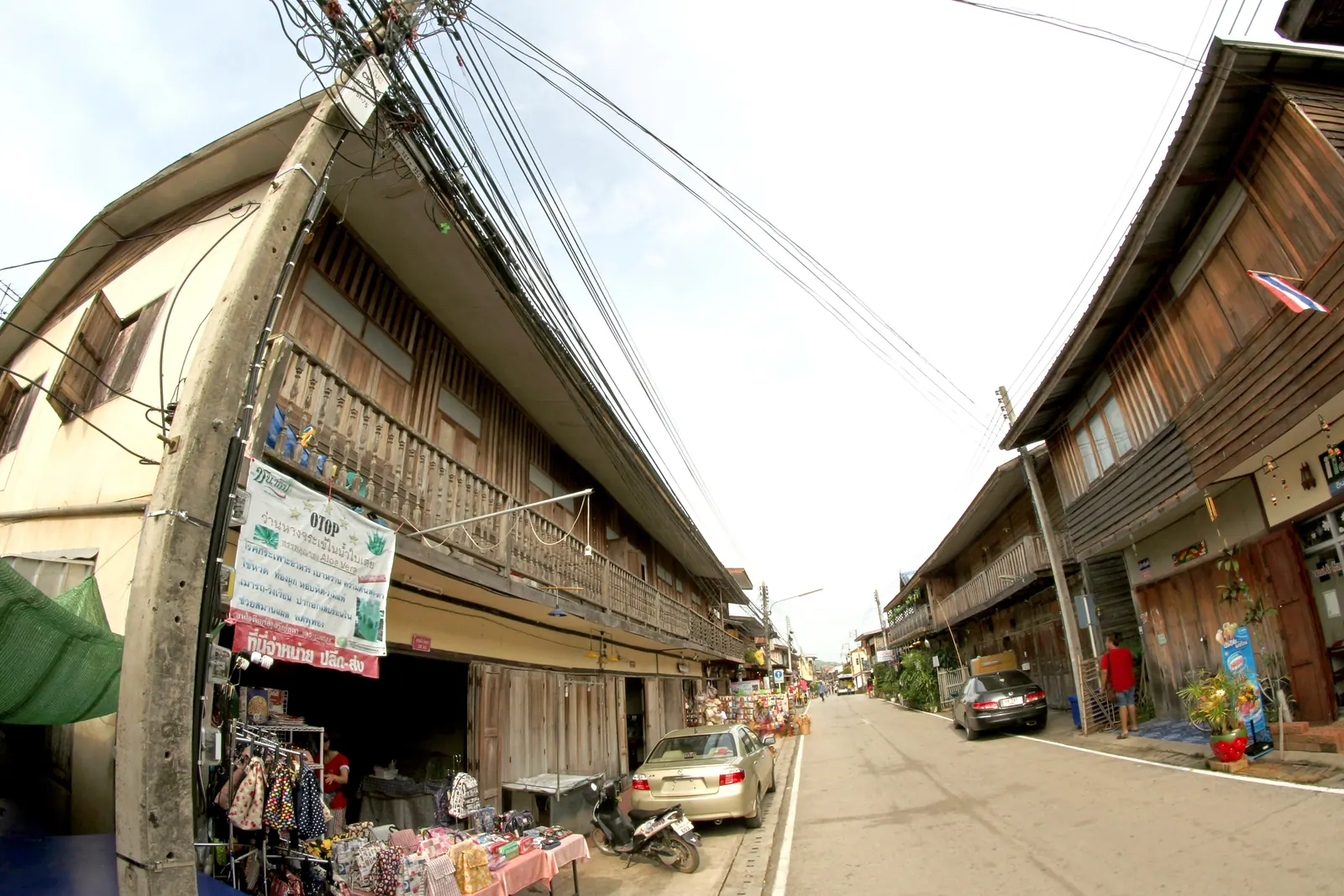
Chiang Khan is where the route starts and where most Thai visitors stop: a 1.5 km street of teak shophouses on Chai Khong Road, monks collecting sticky rice at 06:00, a sea of mist from Phu Thok at dawn (songthaew up around ฿25–40) and, on Friday and Saturday nights, more people on the walking street than live in the district. Give it a weeknight, two if you can, and leave on a weekday. Getting there from Loei is about an hour by local bus or songthaew for ฿30–70 (Chiang Khan to Loei on 12Go for the return), and the wider province, Phu Ruea and Phu Kradueng included, is in our Loei province travel guide. Verdict: worth it midweek; on a Saturday in December, fine, if you like crowds with good coffee.
East of town the 211 stays with the river for 200 km to Nong Khai, and the first half is the prettiest road on the whole route: forested hills dropping straight into the water, Lao villages on the far bank, almost no traffic. Pak Chom, 40 km on, is a junction with a market and nothing to keep you. Sangkhom, another 60 km, is the stop: a riverside village with a few bamboo guesthouses, the forest temple of Wat Hin Mak Peng on boulders above the river (free, strict dress code, silence expected) and the Than Thong waterfall nearby, which is good from October to December and a damp rock by March. Si Chiang Mai, opposite Vientiane, is where Thailand’s rice paper is made; you will see it drying on bamboo racks along the road. Verdict: do it by car with stops; on the bus it is a long, pretty day that ends at dusk.
By public transport, take a songthaew to Pak Chom and the local bus on from there, or go back to Loei for the single dawn bus right through to Nong Khai, around ฿120–150 and six hours or more. The fast alternative is Loei to Udon and on to Nong Khai (Udon Thani to Nong Khai on 12Go, vans from about ฿60): quicker, duller, and it skips the best road on the route.
Nong Khai and Bueng Kan: Sala Keoku, Wat Phu Tok and Three Whale Rock
Nong Khai is the easiest town on the route and the only one with a backpacker scene, which here means a riverside promenade, the Tha Sadet market selling Lao and Chinese goods, and a guesthouse garden with a book exchange. The one essential sight is Sala Keoku, 5 km east, a park of concrete Buddhas, nagas and Hindu gods up to 25 metres tall built by a mystic who left his body in a glass dome on the top floor; ฿40 entry, 08:00–18:00, and the full story is in our Sala Keoku guide. Hire a bicycle for around ฿50 a day and ride the river road to it. Verdict: two nights, one of them for doing nothing by the river. Province basics are in the Nong Khai province profile.
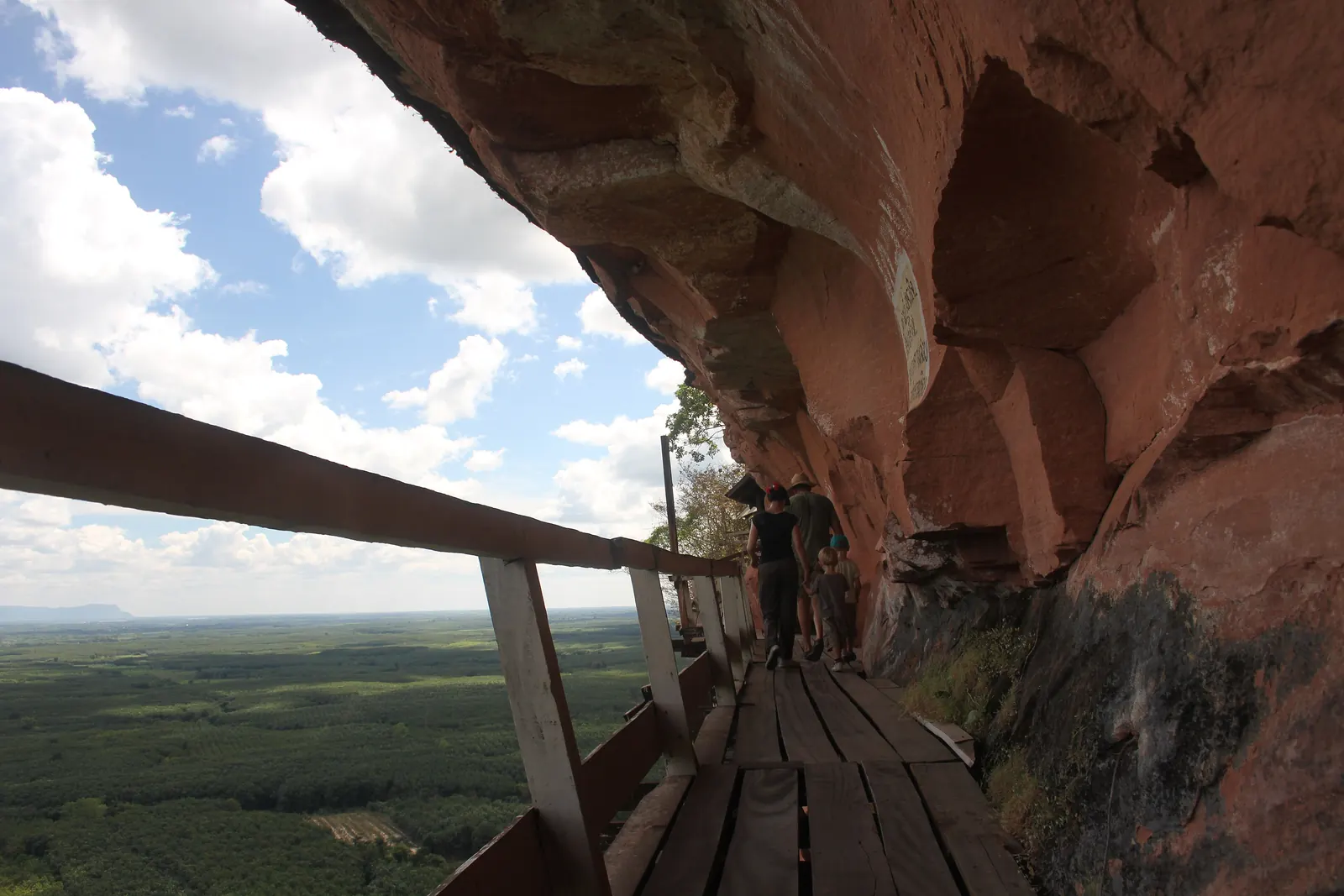
The 212 east to Bueng Kan leaves the hills behind for rubber plantations and long, straight stretches beside the river. Bueng Kan town is a base rather than a destination; the two reasons to stop are out of town. Wat Phu Tok, about 45 minutes south, is a sandstone tower wrapped in seven levels of wooden walkways pinned to the cliff by monks from the 1960s on: free, a donation box, two hours, proper shoes, and the upper planks are not for anyone who dislikes heights. Hin Sam Wan, Three Whale Rock, is three humps of 75-million-year-old sandstone above the forest of Phu Sing, best at sunrise with mist on the Mekong below; private cars cannot go up, and the ranger pickup is around ฿500 a truck return, split among whoever is in it. Both are in our Bueng Kan travel guide. Verdict: one night, Phu Tok in the afternoon, the whales at dawn; without a car, hire a driver through your hotel, as no bus reaches either.
Nakhon Phanom, That Phanom and Mukdahan: the prettiest stretch of the Mekong
From Bueng Kan the 212 turns south, and after Tha Uthen the far bank changes: the limestone karsts of Khammouane rise straight off the Lao side, and they are why Nakhon Phanom has the best river view in Thailand. The town has a long, clean promenade with a cycle lane and the best Vietnamese food in the country: naem nueang, pork balls rolled in rice paper with herbs, ฿100–150 for a set. Sunrise from the promenade, free, is the single best thing on the route. Our Nakhon Phanom travel guide has the full list. Verdict: two nights if you have ten days; this is where to spend the spare one.
Fifty kilometres south, Phra That Phanom is the holiest stupa in Isaan, said to hold the Buddha’s breastbone, rebuilt after it collapsed in 1975: free, dress properly, best early when the pilgrims are local and the light is soft. Then Mukdahan, a border trading town facing Savannakhet: the Indochina Market by the river (good for walking and eating, skip it for shopping), the Ho Kaeo tower for around ฿50, the mushroom rocks of Phu Pha Thoep 15 km south and the Kaeng Kabao rapids north of town in the dry season. Buses run between the three roughly hourly, and the Nakhon Phanom to Ubon bus on 12Go stops in Mukdahan if you want a seat booked. The detail is in our Mukdahan travel guide. Verdict: one night in Mukdahan; the river is pleasant, the market is overrated, the food is not.
Mukdahan to Ubon and Pha Taem: the Amnat Charoen detour or the river road to Khong Chiam
South of Mukdahan the route splits, and this is the one decision that matters. The bus way is inland on Route 212 through Amnat Charoen, Thailand’s least-visited province by most counts, to Ubon: 170 km, around three hours, ฿175 on the through bus or ฿105 plus ฿90 if you break it in Amnat (Amnat Charoen to Ubon on 12Go). The stop is Phra Mongkhon Ming Mueang, a large golden Buddha on a wooded hill just outside town, free and quiet. Our Amnat Charoen guide and the Amnat Charoen province profile have more. Verdict: fine for a lunch stop; nobody needs a night here unless they collect provinces.
The car way stays with the river: minor roads through Don Tan and Chanuman to Khemarat, then south through Pho Sai district to Khong Chiam, around 220 km, a long day with no public transport worth the name. It passes Sam Phan Bok, the “three thousand holes”, a shelf of sandstone in the riverbed scoured into pools and channels, which only surfaces when the Mekong drops: walkable from roughly December to May, underwater the rest of the year. Entry is free; local boats and guides ask around ฿300–600. Verdict: worth it in the dry season, the strangest landscape on the route; skip it from June to November, when there is nothing to see but river.
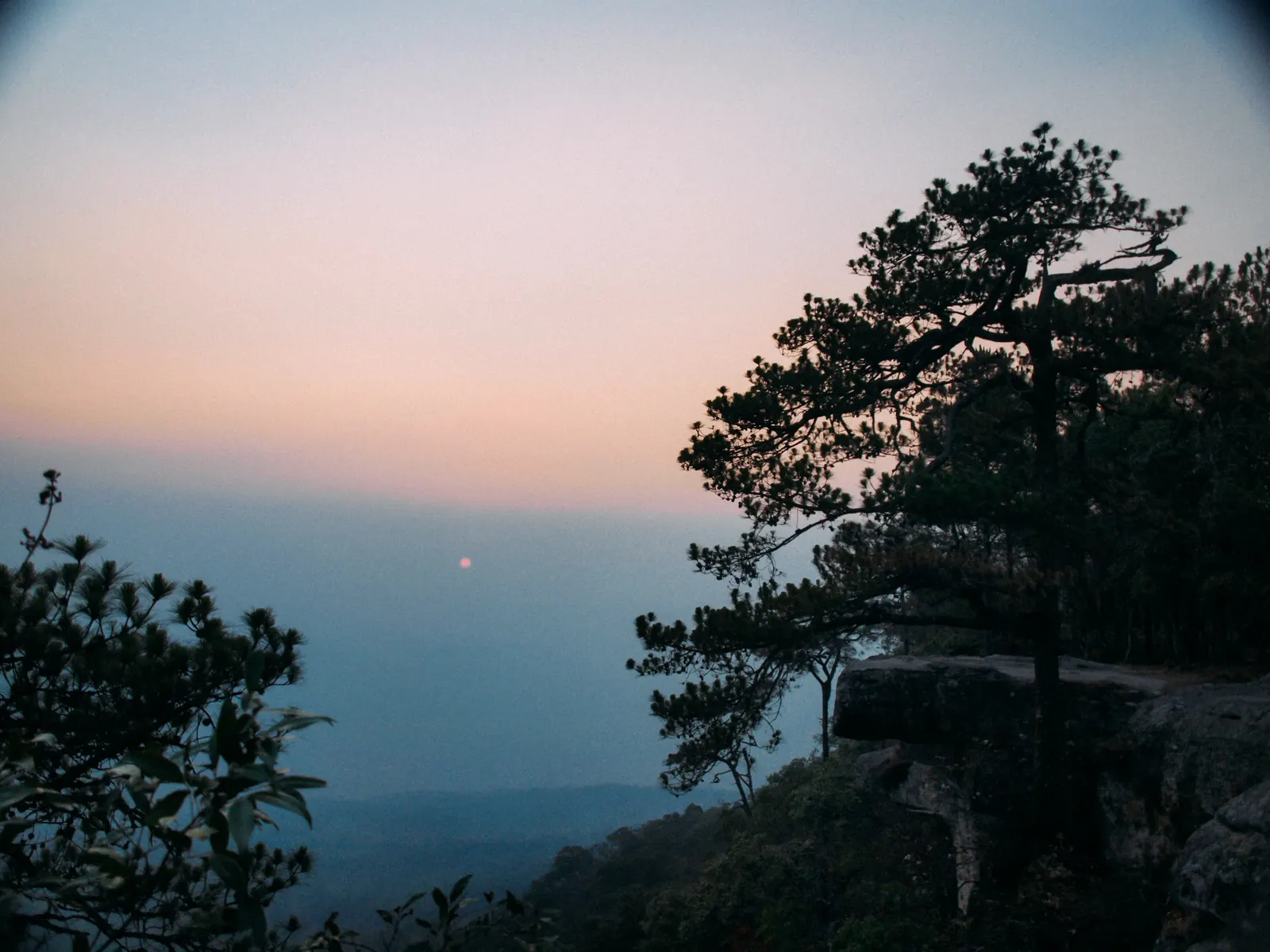
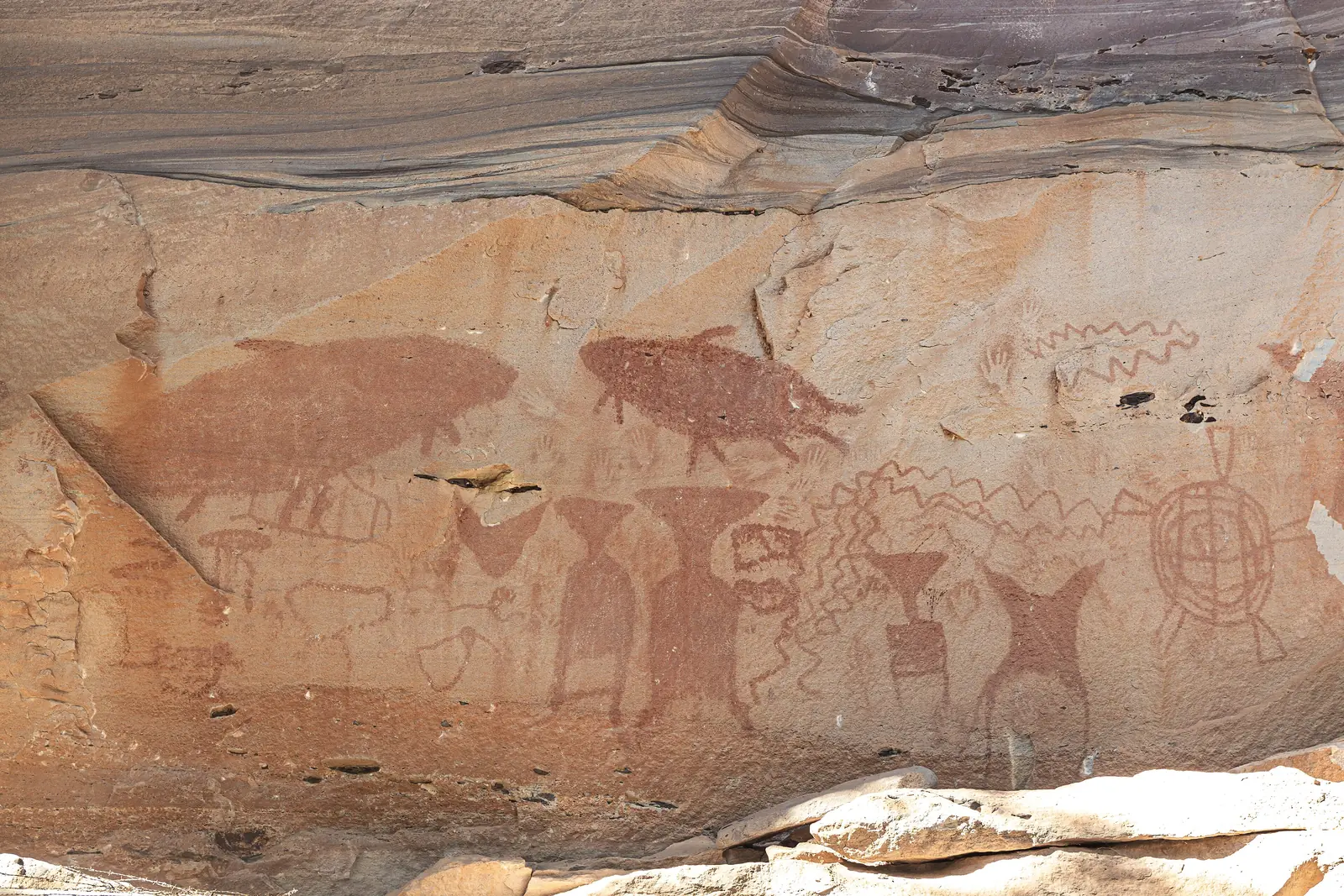
Khong Chiam, where the road ends, is a small, tidy district town where the brown Mun meets the Mekong, the “two-colour river”, most visible when the water is low. Twenty kilometres north is Pha Taem National Park: a sandstone cliff above the Mekong where Thailand claims its first sunrise, and a 500-metre path along the cliff face past prehistoric red-ochre paintings of fish, elephants and handprints, around 3,000 years old. Foreigners pay around ฿200, the park opens at 05:00, and the dawn on the cliff top in December is the reason we route the whole trip to end here. Verdict: do it, at sunrise, no qualifications.
Ubon Ratchathani itself is a pleasant, busy provincial city with good temples, the best of which are in our top five temples in Ubon, and the airport and railhead home. Minibuses to Khong Chiam via Phibun Mangsahan leave the main terminal hourly from 06:00 to 18:00 for ฿80, about 90 minutes; Pha Taem and Sam Phan Bok need your own wheels, a scooter from Khong Chiam at ฿200–300 or a driver at around ฿1,200–2,000 for the day. For the trip home, flights to Bangkok take about an hour, and the night train and buses are on 12Go’s Ubon to Bangkok page. Verdict: one night in Ubon at the end, two in Khong Chiam.
A Mekong road itinerary: eight days, or ten if you can
- Day 1, Chiang Khan: arrive off the night bus at dawn, alms on Chai Khong Road, the walking street in the evening.
- Day 2, Route 211 to Nong Khai: Phu Thok at sunrise, then the river road with stops at Sangkhom and Si Chiang Mai. On ten days, sleep in Sangkhom.
- Day 3, Nong Khai: bicycle to Sala Keoku, river fish for lunch, sunset on the promenade.
- Day 4, Bueng Kan: morning bus or drive, Wat Phu Tok in the afternoon.
- Day 5, Nakhon Phanom: Three Whale Rock at dawn, then the long leg south; on ten days, a second night here.
- Day 6, That Phanom and Mukdahan: the stupa in the morning, the Mukdahan riverfront at dusk.
- Day 7, to Khong Chiam: by car on the river road via Sam Phan Bok; by bus via Amnat Charoen and Ubon.
- Day 8, Pha Taem and home: sunrise on the cliff, minibus to Ubon, the night train or an evening flight.
Signal is good along the 212 and patchy on the 211 between Pak Chom and Sangkhom; sort data before you leave Bangkok with our SIM and eSIM guide. For what to eat at every stop, read our Isaan food guide: river fish, larb and sticky rice, three times a day, for ฿40–150 a dish.
When to drive the Mekong road: cool season, Sam Phan Bok and the festivals
| Months | Weather | The river | Crowds and prices | Verdict |
|---|---|---|---|---|
| November–February | Dry, 28–32°C by day, 12–18°C at dawn in Loei, mist in the mornings | Falling; Kaeng Kabao and Sam Phan Bok start to surface in December | Thai crowds in Chiang Khan at weekends and New Year; everywhere else quiet | Go; book Chiang Khan weekends ahead |
| March–May | Hot, 36–40°C, some haze from crop burning | Lowest; Sam Phan Bok at its widest, the two-colour river clearest | Empty, cheap; Songkran mid-April fills the buses | Fine, with air-con and early starts |
| June–September | Rainy, humid, green; storms in the afternoons | High and fast; rock flats and rapids underwater | Very quiet; Phi Ta Khon in Dan Sai, Loei, in late June | Fine by car; skip if the rocks are the point |
| October | Rains easing, air clear | Full | End of Buddhist Lent: naga fireballs near Nong Khai, fire boats in Nakhon Phanom | Do it for the festivals, and book beds early |
The trap is Sam Phan Bok: tour pages photograph it in April and sell it in September, when it is under several metres of river. The October festivals are the busiest week of the year on this road; the dates move with the lunar calendar and are in our Thailand festivals and public holidays guide. The country-wide picture is in best time to visit Thailand.
Where to sleep on the Mekong road, town by town, with prices
Outside Chiang Khan weekends and the October festivals you can walk in anywhere. In Chiang Khan, Norn Nab Dao Rimkhong Hotel puts you on the walking street with the river behind, from around ฿1,000–1,800; Chiang Khan Hill Resort, by the Kaeng Khut Khu rapids 3 km out, is the one for drivers, from around ฿1,500–2,500. In Nong Khai, Mut Mee Garden Guest House is the riverside garden every traveller on this road has slept in at some point, from around ฿400–1,200. In Bueng Kan, The One Hotel on the Nakhon Phanom road is modern and sensible, from around ฿800–1,300.
In Nakhon Phanom, ask for a Mekong-facing room at Fortune River View Hotel, from around ฿1,200–2,000, because the karsts at dawn are the point; in That Phanom, That Phanom River View Hotel is a short walk from the stupa, from around ฿700–1,200. In Mukdahan, Hop Inn Mukdahan is the clean budget chain room, from around ฿600–800, and Ploy Palace the old-school big hotel, from around ฿900–1,500. In Khong Chiam, Tohsang Heritage Khongjiam is the splurge on the river, from around ฿2,500–4,500, and Khong Chiam Orchid Riverside Resort the cheaper neighbour, from around ฿1,000–1,800. In Ubon, Sunee Grand Hotel is the reliable big hotel beside the mall, from around ฿1,200–2,000. Nothing is comped; these are low-season starting rates.
The Mekong road: your questions, answered
How many days do you need for the Mekong road from Loei to Ubon?
Eight days is the comfortable minimum: Chiang Khan, Nong Khai, Bueng Kan, Nakhon Phanom, Mukdahan and two nights around Khong Chiam, about 1,000 km on the river roads. Ten days adds a night in Sangkhom and a second in Nakhon Phanom, the two places that most reward slowing down. Six days is possible by car, but every day becomes a drive with a stop rather than a stop with a drive.
Can you do the Mekong road by public transport?
Yes, with patience. Local buses and songthaews link every town, and the full route costs around ฿800–1,100 in fares as of November 2026. The catches are slow buses on Route 211, last departures on Route 212 at around 15:00, and no buses to Wat Phu Tok, Three Whale Rock, Pha Taem or Sam Phan Bok, where you hire a scooter or a driver for the day.
When can you see Sam Phan Bok?
Only when the Mekong is low, roughly December to May, with the widest expanse of rock in March and April. From June to November the sandstone pools are underwater and there is nothing to walk on. Entry is free; local boatmen and guides charge around ฿300–600. It is in Pho Sai district, about two hours from Ubon city, and needs your own transport or a driver.
Should you drive the Mekong road north to south or south to north?
North to south, Chiang Khan to Ubon, for most people: you start with the hilly, scenic Route 211 while you are fresh, the towns get progressively quieter, and Pha Taem at sunrise is a proper ending. Ubon also has more flights and the night train home. The reverse works equally well by bus; just book Chiang Khan beds ahead if you arrive on a Friday or Saturday.
Is the Mekong road worth it compared with northern Thailand?
For travellers who have done Chiang Mai and Pai, yes. The road is flatter and safer than the northern loops, the river and the Lao karsts are the scenery, hotels cost half as much, and you will meet few other foreigners. What it lacks is big-ticket sights: the towns are pleasant rather than spectacular, and the best moments are sunrises, river fish and empty promenades.
Related guides
- Loei Province Travel Guide 2026: Thailand’s Coolest Corner Nobody Warned You About
- Nakhon Phanom: The Prettiest Stretch of the Mekong
- Bueng Kan: Three Whale Rock and Thailand’s Youngest Province
Book the trip
Some links in this guide are affiliate links. If you book through them we may earn a small commission at no extra cost to you — it helps keep Destination Thailand independent.
Hotels: start with Agoda’s Loei page for Chiang Khan, then Nong Khai, Nakhon Phanom, Mukdahan and Ubon Ratchathani for the nights down the river. Tours/Boats: there is little organised along this road, but GetYourGuide’s Ubon Ratchathani listings cover Pha Taem and the river trips for anyone not driving. Getting there: Bangkok to Chiang Khan to start, Udon Thani to Nakhon Phanom to join halfway, and Ubon to Bangkok to finish, all on 12Go, with the wider picture in our Getting Around Thailand guide. Not sure Isaan is your Thailand at all? Our Where to Go in Thailand matcher scores all 77 provinces against your month, your budget and what you actually want.