Here is a quick test of how well you know Thailand: point to Roi Et on a map. Manage it and you are in the top one percent of foreigners, because Roi Et Thailand is the small Isaan province even seasoned travellers skip. Their loss: this is a town watched over by a 59-metre Buddha, arranged around a lake with an island at its heart, and surrounded by paddies growing the best jasmine rice on the planet. Start with our Roi Et province profile, then read on.
What you get: a colossal standing Buddha looming over the rooftops like a benevolent kaiju, a 101-metre observation tower, a Khmer ruin, and a temple sculpture garden so unhinged it deserves its own documentary. What you do not get: crowds, tour groups, or anyone selling you a suit.
The honest version: Roi Et is not a place you cross the world for. It rewards travellers who have done Chiang Mai and the islands and want to see Thailand when nobody is performing. On that measure, it is one of the best small capitals in the country.
What Roi Et really is
The name means one hundred and one. The old city supposedly had eleven gates and eleven satellite towns, and eleven got inflated down the centuries to a hundred and one — if you are going to exaggerate, commit. The town leans into it: the new tower is exactly 101 metres tall, and an entire provincial identity now rests on a medieval typo.
Underneath the branding, this is rice country. The province sprawls across the Thung Kula Rong Hai, a plain named for the Kula traders who reputedly wept while crossing it. Irrigation fixed the weeping, and the plain now produces Thung Kula hom mali, geographically protected jasmine rice that wins international awards with monotonous regularity. Culturally it is deep Isaan: Lao-speaking, sticky-rice-eating, morlam-soundtracked, unbothered by what Bangkok thinks.
Why go to Roi Et
Of all the small Isaan capitals, this is the most liveable. Most Thai provincial towns are concrete shophouse grids with a market and a certain amount of traffic-related despair. Roi Et was built around Bung Phlan Chai, a big lake with an island in the middle, so the centre of town is effectively a park. People jog. Old men fish. Aerobics classes colonise the waterfront at dusk. It is oddly, persistently pleasant.
Go for the Buddha, the tower, the ruins and the khaen workshops — but mostly because Roi Et Thailand offers something increasingly rare: a genuinely Thai town going about its business, at prices that make you double-check the bill in the other direction.
Getting to Roi Et
Flying is the sensible option: budget carriers cover Bangkok Don Mueang to Roi Et in about an hour and five minutes — ฿800-1,800 one way booked a couple of weeks out, silly money late. The airport is fifteen minutes north of town; a taxi in runs about ฿200-300.
The bus takes seven to eight hours from Bangkok’s Mo Chit terminal, ฿450-650 depending on how many degrees of recline you are buying. Overnight departures are the smart play: leave at 9pm, wake up in Isaan.
There is no railway in the province, which partly explains why nobody comes. The nearest station is Khon Kaen, about 110 kilometres west, with buses onward in around two hours for roughly ฿100. Driving from Bangkok is about 510 kilometres — six and a half hours.
Where to stay
Stay near the lake — the tower, the night food and the island shrine all ring Bung Phlan Chai, and a lakeside base puts everything on foot. A clean guesthouse room runs ฿400-600; the business hotels charge ฿700-1,200 for aircon, parking and a breakfast of variable ambition; the top of the market, around ฿1,400-1,800, buys you a bathtub and a lift.
Manage expectations: no resorts, no boutique design hotels, no rooftop bars. Book ahead for the Bun Phawet festival in March; the rest of the year, turn up and take your pick.
What to eat in Roi Et
Start with the rice. Thung Kula hom mali carries European-recognised geographical protection, and the difference between it and the supermarket sack is fresh bread versus toast made from regret. A kilo bag from any market beats anything carved as a souvenir.
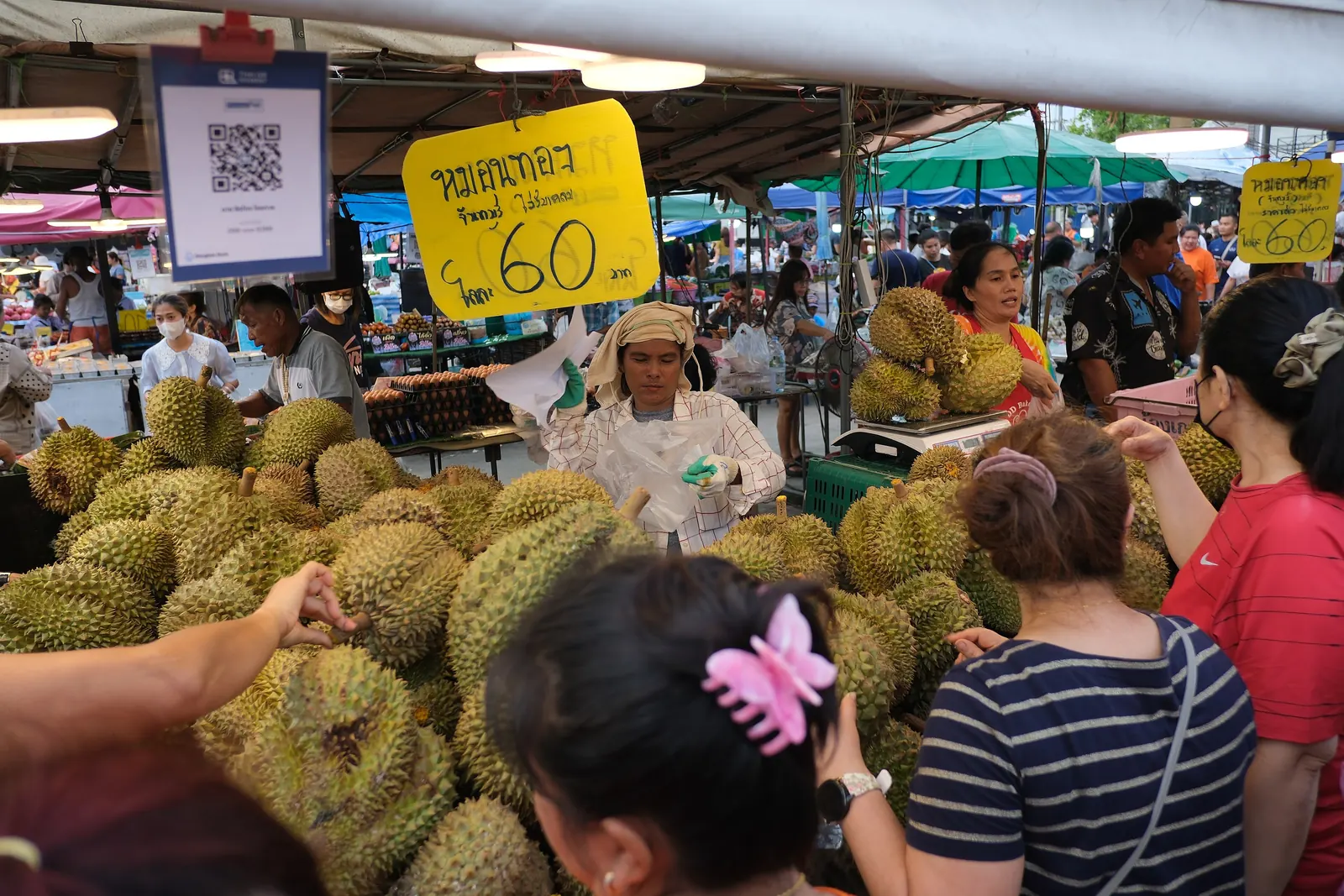
Beyond that, this is the full Isaan canon, cooked without compromise because there are no foreign palates to compromise for. Som tam runs ฿40-60 — specify how much pla ra (fermented fish) you can genuinely handle. Grilled chicken is ฿60-120 for a half bird, laap and sup no mai (bamboo shoot salad) about ฿50-80, and sai krok Isaan, the fermented pork sausages sold in knots from charcoal grills, go for ฿10-20 apiece. Mornings, hunt down khao jee: sticky rice grilled with egg, ฿10-15, the definitive Isaan breakfast.
As for where: the evening stalls around Bung Phlan Chai, the night market a few blocks in from the water, and the morning market if you want to watch the province have breakfast. No restaurant in town is famous, which is another way of saying they all cook for locals.
Top things to do in Roi Et
1. Phra Phuttha Ratana Mongkhon Maha Muni at Wat Burapha Phiram
The headline act: a 59.2-metre standing Buddha rising out of Wat Burapha Phiram in the middle of town, visible from practically everywhere and indifferent to your zoom lens. Technically he is standing rather than walking, but catch him through the afternoon heat haze and you would swear he is mid-stride, off somewhere more important. Built over most of a decade in the 1970s, he is one of the tallest standing Buddha images in Thailand. Free; go late afternoon when the light turns gold and the concrete starts to look tender.

2. Roi Et Tower — the 101 Tower
A 101-metre observation tower — of course — with a bulbous, bun-shaped deck by the lake. Pure provincial vanity, yes, but worth the lift ride: from the top you get the whole town diagram at once — lake, island, grid, giant Buddha, and the Thung Kula plain running flat to every horizon. The fee is well under ฿100. Go the hour before sunset and watch the aerobics classes assemble below like a cheerful military exercise.

3. Bung Phlan Chai island park
The lake is the town’s living room, and the island at its centre — reached by footbridges — holds the city pillar shrine and a decent amount of shade. Come at 6am for tai chi and mist, or at 6pm when half of Roi Et emerges to jog, flirt, gossip and eat amid grilled-chicken smoke. There is an aviary and usually pedal boats. Nothing here makes a bucket list, and that is the point: the most liveable little capital in Isaan, doing what it does every evening.
4. Wat Pa Non Sawan
About forty minutes from town, Wat Pa Non Sawan is what happens when a forest temple decides subtlety is for other provinces: giant ceramic-studded jars the size of houses, dragons you can walk through, herds of concrete animals, and a hell garden depicting sinners’ punishments in anatomically enthusiastic detail. Folk art, morality lesson and fever dream in one. Free, though the donation boxes deserve your coins; think twice about bringing anyone squeamish.
5. Ku Phra Kona Khmer ruins
An hour or so south in Suwannaphum district, Ku Phra Kona is a small eleventh-century Khmer sanctuary: three brick towers on a shared base, with carved sandstone lintels that reward a slow look. One tower was remodelled centuries later in a different style, so the trio no longer match — which sounds like vandalism and instead reads as a thousand years of the neighbourhood redecorating. You will likely share the site with temple dogs and the odd monk. Free; a small donation is decent form.

6. Khaen workshops at Si Kaeo
The khaen — the bamboo mouth organ that sounds like a harmonica raised on sticky rice — is the engine of morlam and the sound of Isaan itself, and the craft villages at Si Kaeo make some of the best by hand. Watch the makers cut, tune and wax the pipes, then buy one: a few hundred baht for a starter, a couple of thousand for something a professional would gig with. It is about an hour from town and you need your own wheels, but no souvenir in the province carries a better story.
What to skip
The town aquarium: a small freshwater collection built around a walk-through tunnel, presumably impressive on opening day and quietly ageing since. The fish look bored; you will match them. The fee is tiny, but so is the return. Give the time to the tower.
Also skip treating Roi Et as a nightlife stop. There are beer gardens and a karaoke economy, but arrive expecting Khon Kaen’s student buzz and you will be in bed by ten. Evenings here peak at the lake with grilled chicken, not at 2am.
Roi Et travel: practical info
Come between November and February, when Isaan is dry and cool. March brings Bun Phawet — Roi Et’s biggest festival, a retelling of the Vessantara Jataka with processions around the lake — along with serious heat; April is for masochists. The rains, roughly June to October, turn the Thung Kula green and photogenic at the price of afternoon downpours.
Two days covers the town; three adds Ku Phra Kona, Wat Pa Non Sawan and Si Kaeo without rushing. Buses reach Khon Kaen in about two hours, Kalasin and Yasothon in under two, and Ubon Ratchathani in three to four, making Roi Et a natural middle chapter in any lower-Isaan loop.
Wikipedia’s Roi Et entry runs deeper on the Sa Ket Nakhon history behind the name.
TAT’s official Roi Et page keeps festival dates current, including the May–June rocket festivals.
FAQ
Is Roi Et Thailand worth visiting?
Yes — if you have done Thailand’s headline destinations and want the country without the performance. The Buddha, the tower and the lakeside centre fill two easy days at rock-bottom prices. Not worth a first-timer’s week; very much worth a returner’s detour.
What is Roi Et famous for?
Three things: the 59.2-metre standing Buddha at Wat Burapha Phiram, Thung Kula hom mali jasmine rice — arguably the best grown anywhere — and the khaen, the bamboo mouth organ behind morlam music. Locally, add Bung Phlan Chai, the island lake at the centre of town.
How do you get from Bangkok to Roi Et?
Fly from Don Mueang in about an hour and five minutes (฿800-1,800 booked ahead), or bus it from Mo Chit in seven to eight hours (฿450-650). There is no train line; rail travellers should ride to Khon Kaen and connect by bus in about two hours.
What does Roi Et mean?
One hundred and one, in Thai. The historical city had eleven gates and eleven satellite settlements, inflated over the centuries to 101 — an exaggeration the town embraced so thoroughly it built its tower exactly 101 metres tall.
How many days do you need in Roi Et?
Two days for the town — Buddha, tower, lake, night market — and three with the day trips to Ku Phra Kona, Wat Pa Non Sawan and Si Kaeo. Beyond that you are basically living there, which would not be the worst decision.