Type White Temple Chiang Rai into a search bar and the province’s entire tourist economy appears in three colours: a white temple that is not really a temple, a blue temple that is, and a black house that belonged to a dead painter and is full of skins. Everyone who comes to Chiang Rai does these three, most of them in a minivan from Chiang Mai, in the wrong order, at the worst hour.
The short version: all three are worth it, which is rarer than it sounds. The White Temple doubled its foreigner fee to ฿200 on 1 January 2026 and is still the best ฿200 in the north. The Blue Temple is free and should be seen at five in the afternoon, not noon. The Black House is ฿80 and will unsettle a seven-year-old. Do them from a bed in Chiang Rai, not a 13-hour day tour, and add the big Guan Yin and the clock tower for the evening.
The rest of the province is in our things to do in Chiang Rai guide, the journey up in Chiang Mai to Chiang Rai, the map on the Chiang Rai province page. Prices are November 2026, checked against our Thailand Price Index; estimates say “around”. Nothing was comped.
Who built Chiang Rai’s White Temple and Black House, and why they are opposites
Two artists, both born in Chiang Rai, both National Artists, one saying between them. Thawan Duchanee (1939–2014) studied at Silpakorn under Silpa Bhirasri, who called him a copier, and spent his life proving otherwise with vast black-and-white canvases of demons and beasts so fierce that students once destroyed some as blasphemous. National Artist in 2001, he spent four decades building the Black House as home and studio. Chalermchai Kositpipat, sixteen years younger, took the dying village temple of Rong Khun in 1997 and began rebuilding it in white plaster and mirror glass with his own money, a project he says will not finish until 2070. National Artist in 2011; alive, prolific, and prone to saying what he thinks on camera.
Thais sum it up as Chalerm sawan, Thawan narok: Chalermchai heaven, Thawan hell. It describes subject matter, not a feud; they were contemporaries from the same town, not master and pupil, and the White Temple’s murals contain plenty of hell. The third site completes the school: Wat Rong Suea Ten, the Blue Temple, was designed by Phuttha Kabkaew, a local artist who learned his trade working for Chalermchai at Rong Khun, and built between 2005 and January 2016. Our Chiang Mai temples guide covers the 700-year-old originals they are all riffing on.
Wat Rong Khun, the White Temple: is ฿200 still worth it in 2026?
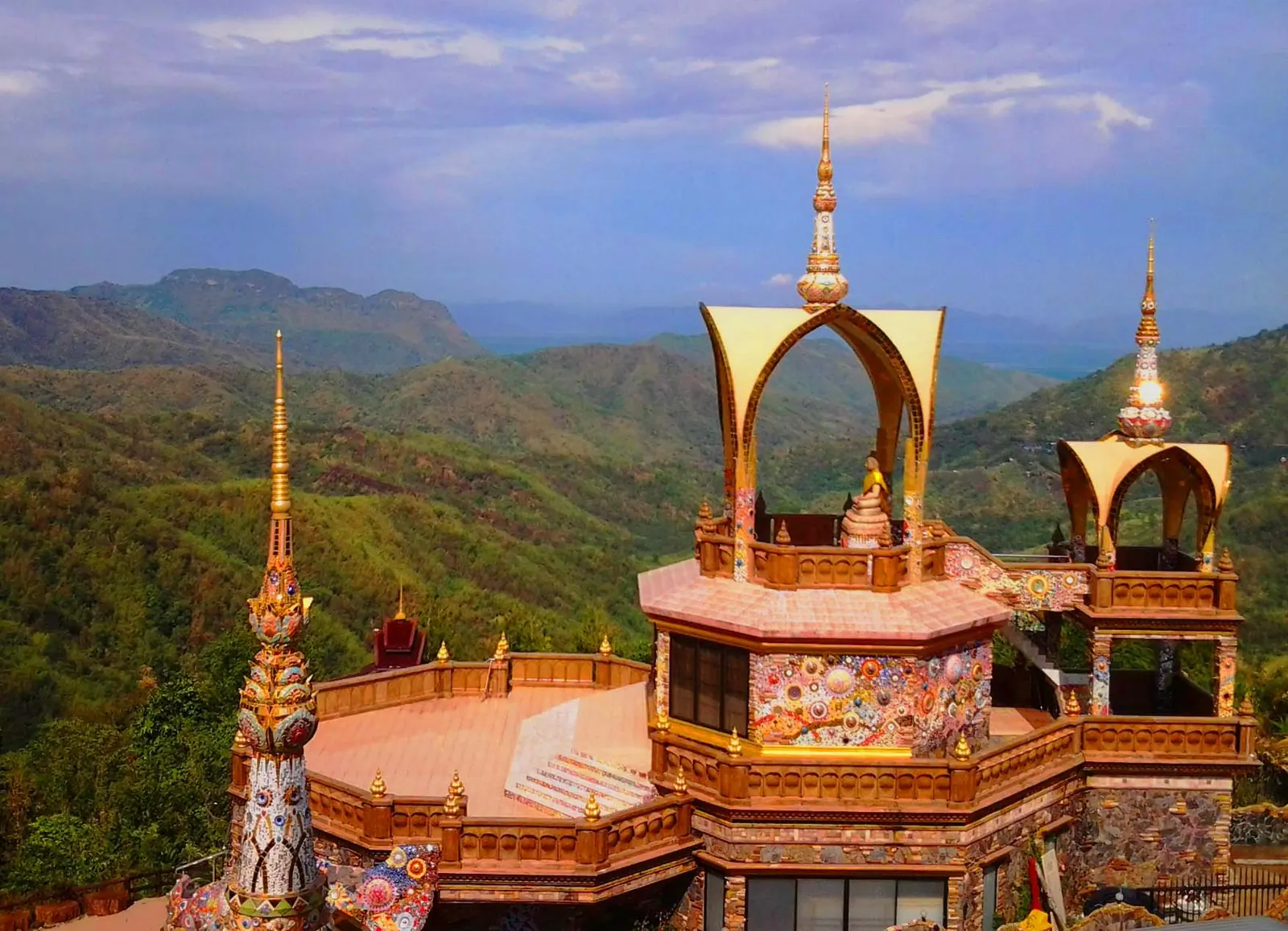
What it is. A temple-shaped art installation 13 kilometres south of town on the Phahonyothin highway: a blinding white ubosot set with mirror fragments, reached across a bridge above a pit of several hundred reaching plaster hands (desire, since you ask). Inside, the murals turn orange: a demon’s face framing the Twin Towers, Michael Jackson, Neo, Freddy Krueger, a Terminator. We are a wicked species, says the message, in glitter. The only gold building is the toilet block, gold for money and the body where white is the mind. No monks live here; it is a gallery with a Buddha in it.
Fee and hours, as of November 2026. ฿200 for foreign adults since 1 January 2026, up from ฿100, the ticket now including the Cave of Art gallery. Thais are free; so is anyone under 120 centimetres or aged 70 and over, whatever the passport. Gates 8am to 5pm; treat 4.30pm as your last safe arrival. The ubosot has a strict no-photography rule inside, enforced by a steward: phones away, hats off, shoulders and knees covered, a one-way shuffle past the murals. Outside, photograph anything you like.
The earthquake. On 5 May 2014 a magnitude-6.3 quake centred on nearby Mae Lao cracked the spire and shook murals off the walls. Chalermchai announced the next day that he would demolish the lot; engineers found the structure sound, he reversed himself on 7 May and promised a two-year restoration, and the grounds reopened on 8 May. The compound is now bigger than before the quake.
Crowds by hour. At 8am you share the bridge with a few dozen people and the light is low and kind. The Chiang Mai day tours arrive from about 10.30am and stay until two; the bridge becomes a queue and the white turns to glare. After 3.30pm it empties again. Ninety minutes is enough, Cave of Art included. The honest flaw: it is a theme park of a temple with an enormous souvenir hall; a quiet sacred space it is not.
Verdict: Do it, at 8am or after 3.30pm. ฿200; still the best-value ticket in northern Thailand.

Wat Rong Suea Ten, the Blue Temple: free, and best at five o’clock
What it is. A working village temple three kilometres north of the clock tower, across the Kok river in Rong Suea Ten village, the house of the dancing tigers. The old temple lay abandoned for decades; the new vihara, finished in January 2016, is sapphire blue inside and out with gold trim, a white seated Buddha two storeys high and murals in the White Temple’s neo-traditional style. It is smaller than the photographs suggest; half an hour covers it.
Fee and hours. Free, 7am to 8pm daily, donation box inside. Shoes off, knees covered; photography is allowed inside, which is why it fills Instagram. Best hour. The blue is a pigment, not a light show, and at noon it reads as navy under a white sky. From about 4.30pm the low sun comes through the doors and the hall glows; after dark the floodlights take over. The flaw is the coach park: between 11am and 2pm the Chiang Mai tours use it as a lunch stop. The blue coconut ice cream at the gate is around ฿30–40 and tastes of food colouring, which is the point.
Verdict: Do it, late afternoon. Free; around ฿60–80 by Grab from the clock tower, or a 35-minute walk over the bridge.
Baan Dam, the Black House: ฿80 of teak, skulls and crocodile skin
What it is. Twelve kilometres north at Nang Lae: around forty buildings scattered through a garden, most of them black-stained Lanna teak with roofs swept up into horns, a few white domes, one shaped like a fish. Thawan built it over four decades and it is still arranged as he left it. The great hall holds a long table laid with crocodile skins and buffalo horns; chairs are antler; shelves hold the skulls of buffalo, bears and an elephant; there is a room of carved phalluses. Nothing is labelled, deliberately. You are walking through a dead man’s argument about mortality.
Fee, hours and who should skip it. ฿80 at the gate, Thai and foreign alike, since the fee arrived in 2016. Open 9am to 5pm daily; several sources report the ticket office closing for lunch between noon and 1pm, so do not arrive at 11.50am. An hour covers it, and the shade makes midday fine here in a way it is not at the White Temple. Honest flaw: with no interpretation at all, it reads as a Halloween shop unless you know who Thawan was. Kids: the skins and skulls are real, and a sensitive child will not enjoy the phallus room. Over tens, generally fine; under eights, think twice. Grab from the clock tower around ฿150–200.
Verdict: Do it, having read about Thawan first. ฿80, any hour but lunch.

The supporting cast: Wat Huay Pla Kang and the clock tower show
Wat Huay Pla Kang, eight kilometres north-west, is the fourth colour: a white Guan Yin, the goddess of mercy, seated on a hill and visible from the highway, with a nine-tier Chinese-Lanna pagoda beside her. The temple quotes her height at 79 metres; other sources say 69, and either way she is the tallest thing in the province that is not a mountain. Grounds free, 7am to 9pm; the lift inside the statue to a viewing room behind her eyes is ฿40, the stairs free. The lift matters for anyone with bad knees, because the other three sites are all steps and gravel. Thai and Chinese visitors fill it, Westerners barely know it, and the dusk view over the valley is the best in town. Flaw: new, concrete, and the merit-making stalls are relentless.
Verdict: Fine; Do it with a fourth hour, or first if anyone cannot climb. Free; lift ฿40.
The clock tower in the centre of town is also Chalermchai’s, unveiled in 2008 in honour of King Bhumibol, and gold where the temple is white. Every evening at 7pm, 8pm and 9pm it runs a ten-minute light-and-music show: the tower changes colour, a song plays, the traffic keeps circling, then it stops. Free, faintly ridiculous, and 300 metres from the Night Bazaar, so you will be there anyway.
Verdict: Fine, for ten minutes on the way to dinner. Free.

How to see the White Temple, Blue Temple and Black House in a half day or a day
The geography is simple and the tours ignore it: the White Temple is 13 kilometres south, everything else is north. Go south first, early, then work back up. Distances are from the clock tower; Grab fares move with the hour, so read them as “around”.
| Site | From the clock tower | Grab, one way | Fee | Hours | Time needed |
|---|---|---|---|---|---|
| Wat Rong Khun (White Temple) | 13 km south | around ฿150–200 | ฿200 | 8am–5pm | 60–90 min |
| Baan Dam (Black House) | 12 km north | around ฿150–200 | ฿80 | 9am–5pm, lunch break | 60 min |
| Wat Huay Pla Kang | 8 km north-west | around ฿120–160 | Free; lift ฿40 | 7am–9pm | 45 min |
| Wat Rong Suea Ten (Blue Temple) | 3 km north | around ฿60–80 | Free | 7am–8pm | 30 min |
| Clock tower show | You are there | Walk | Free | 7, 8 and 9pm | 10 min |
The half day (8am to 1pm). White Temple at the 8am opening; straight on north to the Black House for 10.30am, before its lunch closure; Blue Temple at midday on the way into town. Around ฿600–700 in Grabs for two people. The compromise is the Blue Temple in flat light; accept it, or go back at five for a ฿70 ride.
The full day. Same morning, khao soi near the Black House, Wat Huay Pla Kang at about 2.30pm, the Blue Temple at 4.30pm, dinner at the Night Bazaar and the 8pm clock tower show. All five for under ฿400 in fees, which is what one Chiang Mai day tour charges for lunch and six hours in a van.
Without Grab. From Bus Terminal 1, local buses and songthaews down the Phahonyothin highway pass the White Temple gate for ฿20–30, roughly every half hour; say “Wat Rong Khun”. There is no useful public transport to the Black House or Huay Pla Kang. A tuk-tuk charter for the three sites, waiting included, is quoted at around ฿600–900 by the Night Bazaar drivers; a car and driver for the half day around ฿1,500–2,000. A scooter is ฿200–300 a day, but the highway south is fast and dusty, and without a motorcycle licence plus International Driving Permit your insurer walks away from the hospital bill. Grab needs data; see our SIM and eSIM guide.
Combo tours versus doing it yourself: what they cost
The Chiang Mai day tour (฿1,000–1,600, 7am to about 8pm) spends six hours on Route 118 and two and a half at the sites, reaching the White Temple at its worst hour; our Chiang Mai to Chiang Rai guide calls it the day tour everyone regrets. The half-day join tour from Chiang Rai (around ฿850–1,200, fees extra, hotel pickup, usually all four sites) is sensible if you cannot face Grab, though it too arrives everywhere mid-morning. A private driver lets you dictate the order, and shared by four costs what the join tour does.
| Option | Price, Nov 2026 | Verdict | Book |
|---|---|---|---|
| DIY by Grab, two people | around ฿600–700 fares + ฿280 fees each | Do it | Open the app |
| DIY by bus, White Temple only | ฿40–60 fares + ฿200 fee | Do it | Terminal 1 |
| Half-day join tour from Chiang Rai | around ฿850–1,200 + fees | Fine | Half-day temple tours |
| Private car and driver, half day | around ฿1,500–2,000 per car | Do it, as four | Private Chiang Rai drivers |
| Tuk-tuk charter, three sites | around ฿600–900 per tuk-tuk | Fine, agree the stops first | Tuk-tuk tours |
| Day tour from Chiang Mai | ฿1,000–1,600 | Skip it, unless you cannot stay a night | Compare day tours |
From Chiang Mai, the Green Bus is ฿200–400 and three and a half hours: book Chiang Mai to Chiang Rai on 12Go and arrive at Terminal 1, five minutes from the clock tower. For two people, a night in Chiang Rai costs roughly what two day-tour seats do.
Dress code, the photo rule, kids and the elderly at Chiang Rai’s temples
Two of the three are real temples, so the rules in our Thai temple etiquette guide apply across the board: shoulders and knees covered, shoes off at the hall, hats off inside, no feet pointed at the Buddha, no climbing on anything for a photograph. The White Temple stewards turn away shorts and lend a sarong for a deposit; the Blue Temple sells wraps at the gate for around ฿100–150. The no-photo rule inside the White Temple ubosot is the one visitors argue about and lose; photography is fine inside the Blue Temple and throughout the Black House.
With children: the White Temple is a hit from about six, hands pit included; the Blue Temple is a ten-minute wow; the Black House needs a judgement call. With older travellers: the White Temple is flat but long, with gravel, full sun and nowhere to sit; the Black House is shaded but spread over a hillside; Wat Huay Pla Kang has the lift. Go early, especially in March and April, when the northern burning season fills the valley with smoke and the White Temple photographs grey.
Where to sleep in Chiang Rai for the temples, and when to come
Sleep in the centre, within walking range of the clock tower, Terminal 1 and the Night Bazaar, and every site is a ฿60–200 Grab away. Nak Nakara Hotel (from around ฿1,500–2,200) is the mid-range pick: Lanna teak, a pool, five minutes from the Saturday walking street. Mercy Hostel (dorm beds from around ฿350–500) is the clean, quiet budget bed a few streets from the clock tower. Riverside places add ฿100 to every ride. Everything else is on the Agoda Chiang Rai page.
When. November to February is cool, clear and the best light of the year; it is also peak, and rooms rise by a third over New Year. March and April are hot and smoky. May to October is green and quiet, with rain that rarely starts before three, which suits a plan built around mornings. Month by month in best time to visit Thailand; the public holidays that close nothing here but fill every hotel are in the festivals calendar; the official line is on the Tourism Authority’s Chiang Rai page. Weighing it against the louder neighbour? Read things to do in Chiang Mai; the answer is usually both.
White Temple, Blue Temple and Black House: your questions, answered
How much is the White Temple in Chiang Rai in 2026?
฿200 for foreign adults since 1 January 2026, doubled from ฿100, and the ticket now includes the Cave of Art gallery. Thai nationals enter free, as do children under 120 centimetres and anyone aged 70 or over, regardless of nationality. It is open 8am to 5pm daily, and the ubosot does not allow photography inside.
Can you do the White Temple, Blue Temple and Black House in one day?
Comfortably, in half a day. White Temple at the 8am opening, Black House at 10.30am, Blue Temple at noon or, better, at 4.30pm for the light. By Grab it is around ฿600–700 in fares for two people plus ฿280 in fees each; a half-day join tour from Chiang Rai is around ฿850–1,200 plus fees.
Which is better, the White Temple or the Blue Temple?
The White Temple is the greater work: a complete artistic statement, hands pit and murals included, and worth its ฿200. The Blue Temple is a single, very beautiful hall that costs nothing and takes half an hour. See both; if forced to choose, the White Temple at 8am, and spend the ฿200.
Is the Black House in Chiang Rai suitable for children?
It depends on the child. The exhibits include real animal skulls, crocodile and python skins, antler furniture and a room of carved phalluses, with no labels or softening. Curious children over about ten tend to find it thrilling; sensitive younger ones do not. It is ฿80, open 9am to 5pm, and skippable without guilt if in doubt.
How do you get from Chiang Rai town to the White Temple without a tour?
From Bus Terminal 1 in the centre, local buses and songthaews down the Phahonyothin highway stop at the gate for ฿20–30 and take about 25 minutes; ask for Wat Rong Khun. A Grab is around ฿150–200 each way, a scooter ฿200–300 for the day, and the Night Bazaar tuk-tuks will wait for you for around ฿300–400 return.
Related guides
- Things to Do in Chiang Rai, Thailand: The Northern Province That Doesn’t Try to Be Chiang Mai
- Chiang Mai to Chiang Rai: Green Bus, Minivan, Private Car or the Day Tour Everyone Regrets (2026)
- Chiang Mai Temples: The Five Worth Your Morning (and the Rest)
Book the trip
Some links in this guide are affiliate links. If you book through them we may earn a small commission at no extra cost to you — it helps keep Destination Thailand independent.
Hotels: stay within walking range of the clock tower, then compare Chiang Rai hotels on Agoda. Tours/Boats: browse Chiang Rai tours on GetYourGuide and read the newest reviews. Getting there: book Chiang Mai to Chiang Rai on 12Go, or Bangkok to Chiang Rai by overnight bus or flight; every option is costed in our Chiang Mai to Chiang Rai guide. Not sure the north is your Thailand? Our Where to Go in Thailand matcher scores all 77 provinces against your month, your crowd tolerance and what you actually want from the trip.