Prachin Buri is the most useful province in Thailand that almost nobody can place on a map. It sits a couple of hours east of Bangkok, owns the quiet southern flank of Khao Yai National Park, and sees roughly none of the foreign tourists fighting for weekend parking on the Pak Chong side. Same park. Same elephants. The biggest waterfall in the whole place, closer to this gate than the famous one. No queue.
That alone would justify the petrol money, but the province then gets properly strange in ways I can only applaud: a working government hospital housed in a 1909 baroque mansion that runs Thailand’s most famous herbal-medicine brand, the oldest recorded bodhi tree in the country, a ruined city more than a thousand years old scattered through the rice fields, and durian orchards good enough to have earned official protected status. For the map and the vital statistics, see our Prachin Buri province profile — this guide is the argument for actually going.
Fair warning: this is not a nightlife province and not a beach province. It rewards people with their own wheels and a tolerance for Thailand slightly unexplained.
What Prachin Buri really is
An eastern farming province wedged between the Khao Yai massif to the north and the flat sugar-and-eucalyptus country running down towards Chachoengsao. The Prachin Buri River — which becomes the Bang Pakong downstream — slides through the middle of the provincial capital, a low-rise, unhurried government town Thailand does brilliantly and brochures ignore.
Economically it is orchards, bamboo and, increasingly, industrial estates along the 304 road, which is why the better hotels host more Japanese engineers than backpackers. Historically it punches far above its profile: the Si Mahosot plain south-west of town was a major Dvaravati-era settlement over a millennium ago, and the fields out there are still littered with laterite ruins most of the country has forgotten.
Why go to Prachin Buri
One reason towers over the rest: Khao Yai without the circus. The park’s southern checkpoints sit inside this province, and Haew Narok — the park’s biggest waterfall — is far nearer this gate than the northern one. While the Pak Chong entrance backs up with Bangkok SUVs every long weekend, the southern approach stays close to empty.
Then there is everything else: the Abhaibhubejhr herbal empire, a two-thousand-year-old tree, ancient ruins you will have entirely to yourself, and some of the best durian in the country sold at farm-gate prices. It is a two-day province, and both days are good ones.
Getting to Prachin Buri
Train: ordinary services on the eastern line from Bangkok’s Hua Lamphong take about three hours, and third class costs well under ฿100 — one of the great bargains of Thai travel. Several departures daily, continuing to Kabin Buri and on towards Aranyaprathet and the Cambodian border.
Bus and minivan: vans run from Bangkok’s Mo Chit terminal roughly every hour, take two and a half to three hours and cost about ฿120-160.
Driving: around 135 kilometres from Bangkok — two hours via motorway 7 and the 304, or the prettier 305 through Nakhon Nayok. There is no airport; Suvarnabhumi is about two hours away. The sights are 20 to 30 kilometres apart and no songthaew goes up to Khao Yai, so hire a car or a driver for the day (around ฿1,500-2,000).
Where to stay
Three sensible options. Prachin Buri town has clean ฿400-800 guesthouses and ฿800-1,400 business hotels near the river and the night market — the right base for the hospital, the museum and Si Mahosot. The Route 3077 corridor towards Khao Yai’s southern gate is the resort strip: garden and boutique places from about ฿1,200 to ฿3,500, and they fill up on Thai holiday weekends. Kabin Buri is a transit town with ฿500-900 hotels — stay there only if you are catching an early bus east, and expect nothing.
What to eat
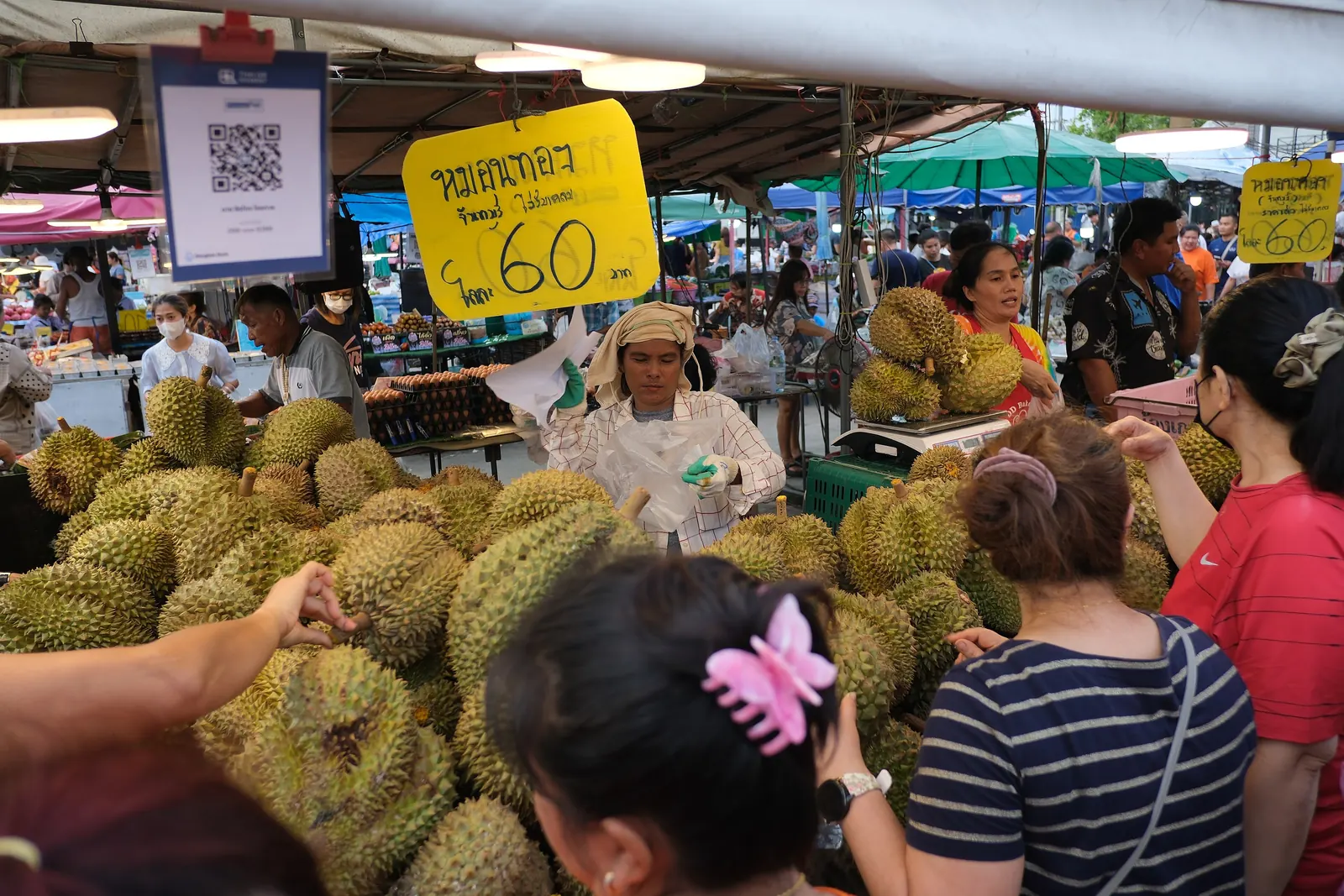
Two local obsessions. The first is bamboo shoots — the province grows famously sweet ones, and in season you will find them boiled and served with chilli dips, stir-fried, and in proper peppery bamboo-shoot curries at market stalls around town. The second is durian: the local fruit carries GI protected status, and from about May to July roadside stalls along Route 3077 sell it straight from the orchards — expect roughly ฿100-200 a kilo for good mon thong, more for the fancier varieties, all of it better than anything in a Bangkok supermarket.
Beyond that: river fish from the Bang Pakong river system, grilled or in tom yam at the riverside places in town, and the usual excellent night-market circuit where a bowl of noodles runs ฿50-70. Wash it down with an Abhaibhubejhr herbal drink, because in this province even the beverages are prescribed.
Top things to do in Prachin Buri
1. Enter Khao Yai through the quiet southern gates
Route 3077 climbs out of the orchards and into proper mountain forest at the park’s southern checkpoint. Entry is the standard Khao Yai price — ฿400 for foreign adults, ฿40 for Thais, plus ฿50 for a car — and the gates open around 6am, which is exactly when you want to be there for wildlife. The road up is steep, winding and largely empty; on a weekday you can drive twenty minutes without seeing another vehicle, which on the Pak Chong side is science fiction.
2. Haew Narok waterfall
The biggest waterfall in Khao Yai — around 150 metres over three tiers, thundering into a gorge whose name translates, cheerfully, as ravine of hell. It sits much closer to the southern entrance, so coming from the south you get the park’s headline sight first. From the car park it is roughly a kilometre on foot, ending in a long, steep staircase to the viewing platform. Go in or just after the rains, June to October, when it is genuinely ferocious. The gorge has tragically claimed wild elephants over the years — hence the barriers, which you should take seriously.

3. Chao Phraya Abhaibhubejhr Hospital
Yes, a hospital, and it is one of the most quietly brilliant stops in eastern Thailand. The centrepiece is a baroque yellow mansion built in 1909 by Chao Phraya Abhaibhubejhr, the former governor of Battambang, to receive King Rama V. Today it houses a museum of Thai traditional medicine, while the modern hospital around it runs the country’s most famous herbal-medicine brand. The shop is the real event: turmeric capsules, herbal toothpaste, shampoos, balms — buy the turmeric everything, most of it under ฿200 — Thais drive from Bangkok specifically to stock up.

4. Si Mahosot ancient city and Thailand’s oldest bodhi tree
South-west of town, the Si Mahosot plain hides the remains of a Dvaravati-era city — laterite foundations, ancient ponds and shrines scattered across working farmland, including Sa Morakot, where a Buddha footprint carved into the laterite bedrock ranks among the oldest found in Thailand. Ten minutes away at Wat Ton Pho Si Maha Pho stands the oldest recorded bodhi tree in the country, said to be over two thousand years old and grown from a cutting brought from Bodh Gaya in India. It is on the provincial seal, it is enormous, and you will likely share it with nobody but the temple dogs. Free, but dress respectfully.

5. Graze the orchards of Route 3077
The road between town and the park doubles as the province’s larder. From roughly May to July the durian stalls appear at the farm gates, alongside mangosteen, rambutan and the sweet bamboo shoots the province is known for. The fruit was cut that morning and the money goes straight to the grower — no middleman, no Bangkok mark-up. Take cash, take your time, and accept that your car will smell of durian for a week.
6. Dasada flower gallery and the Khao Yai fringe
On the same corridor sits Dasada, a flower gallery and resort where landscaped gardens and glasshouse displays pull in a steady stream of Thai weekenders with cameras. It is manicured rather than wild, but as a lunch-and-flowers stop on the way down from the park it works well. This foothill strip is the province’s slice of Khao Yai’s resort country — calmer and cheaper than the wine-and-ranch belt over the ridge in Pak Chong.
What to skip
Haew Narok between February and May. In the dry season the ravine of hell is reduced to the drip of mild inconvenience, and you will have paid ฿400 and climbed several hundred stairs to watch a cliff perspire. In the dry months spend your park time on trails and wildlife instead, and save the waterfall for a rainy-season return.
Also skip any plan for a wine tour on this side of the mountain. The vineyards you have seen on Instagram are on the other side of the mountain in Pak Chong district — a long drive around the massif, not a hop over it. This side does fruit, herbs and forest; go to the Khorat side for the cabernet.
Prachin Buri travel: practical info
Best time: June to October is peak waterfall and peak durian — carry a rain jacket and consider it cheap admission. November to February is cool, dry and pleasant for the park, though the falls run thinner.
How long: two days is right — one for Khao Yai’s southern side, one for the hospital, Si Mahosot and the bodhi tree. A hard day trip from Bangkok is possible but wastes the province’s best asset, which is the total absence of hurry.
Onward: trains and buses continue east to Sa Kaeo and the Aranyaprathet border crossing for Cambodia. Nakhon Nayok and its own waterfall country is next door, and you can loop back to Bangkok through Chachoengsao.
Wikipedia’s Prachinburi entry covers the Dvaravati history under the orchards.
TAT’s official Prachin Buri page has park-gate practicalities for the southern Khao Yai entrances.
FAQ
Is Prachin Buri worth visiting?
Yes, if you want Khao Yai without crowds, plus a genuinely odd supporting cast of herbal hospitals, ancient ruins and durian orchards. No, if you need nightlife, beaches or anyone to have arranged things for you. It suits travellers with a car and two spare days.
How do you get from Bangkok to Prachin Buri?
Ordinary trains run from Hua Lamphong on the eastern line in about three hours for well under ฿100, and minivans leave Mo Chit roughly hourly for about ฿120-160. Driving takes around two hours, and once there you really do want your own vehicle.
Can you enter Khao Yai National Park from Prachin Buri?
Yes — the park’s southern checkpoints are inside the province, reached via Route 3077. Entry is ฿400 for foreign adults plus ฿50 per car, gates open around 6am, and Haew Narok waterfall is far closer to this entrance than to the Pak Chong gate.
What is Prachin Buri famous for?
Three things: the Abhaibhubejhr herbal-medicine brand run from a baroque 1909 hospital building, GI-protected durian and sweet bamboo shoots, and the quiet southern access to Khao Yai. Thais also know it for Wat Ton Pho Si Maha Pho, home to the oldest recorded bodhi tree in Thailand.
How many days do you need in Prachin Buri?
Two. Day one for the park and Haew Narok, day two for the hospital museum, Si Mahosot and the orchards.