Krabi has two towns, and they keep different hours. Krabi Town, twenty kilometres inland on a mangrove river, is where the province eats: a nightly seafood market on the pier car park, a Friday-to-Sunday walking street beside a department store, and a plate of gaeng som for ฿60 that costs ฿180 with a sea view. Ao Nang, the beach strip everyone sleeps on, has one proper Krabi night market of its own, a rota of village markets nobody lights up, and a beach road of ice-bed seafood restaurants that price by the hundred grams so the number looks small.
Days and hours were checked in September 2026 against local listings. Krabi’s village markets shift with the weather and the mosque calendar, so confirm the day with your hotel before you spend a taxi fare on it.
The short version: Chao Fah pier in Krabi Town is the best cheap dinner in the province and it runs every night. The walking street is the one to see, Friday to Sunday, and the one to graze at rather than dine at. Ao Nang Landmark is fine, nightly and near your bed; the beach-road seafood restaurants are the trap, and Nopparat Thara is the way round it. Where you sleep decides which is a stroll and which is a ฿300 ride home; where to stay in Krabi settles that, and things to do in Krabi fills the daylight in between.
Krabi Town Walking Street on Soi Maharaj 8: Friday to Sunday
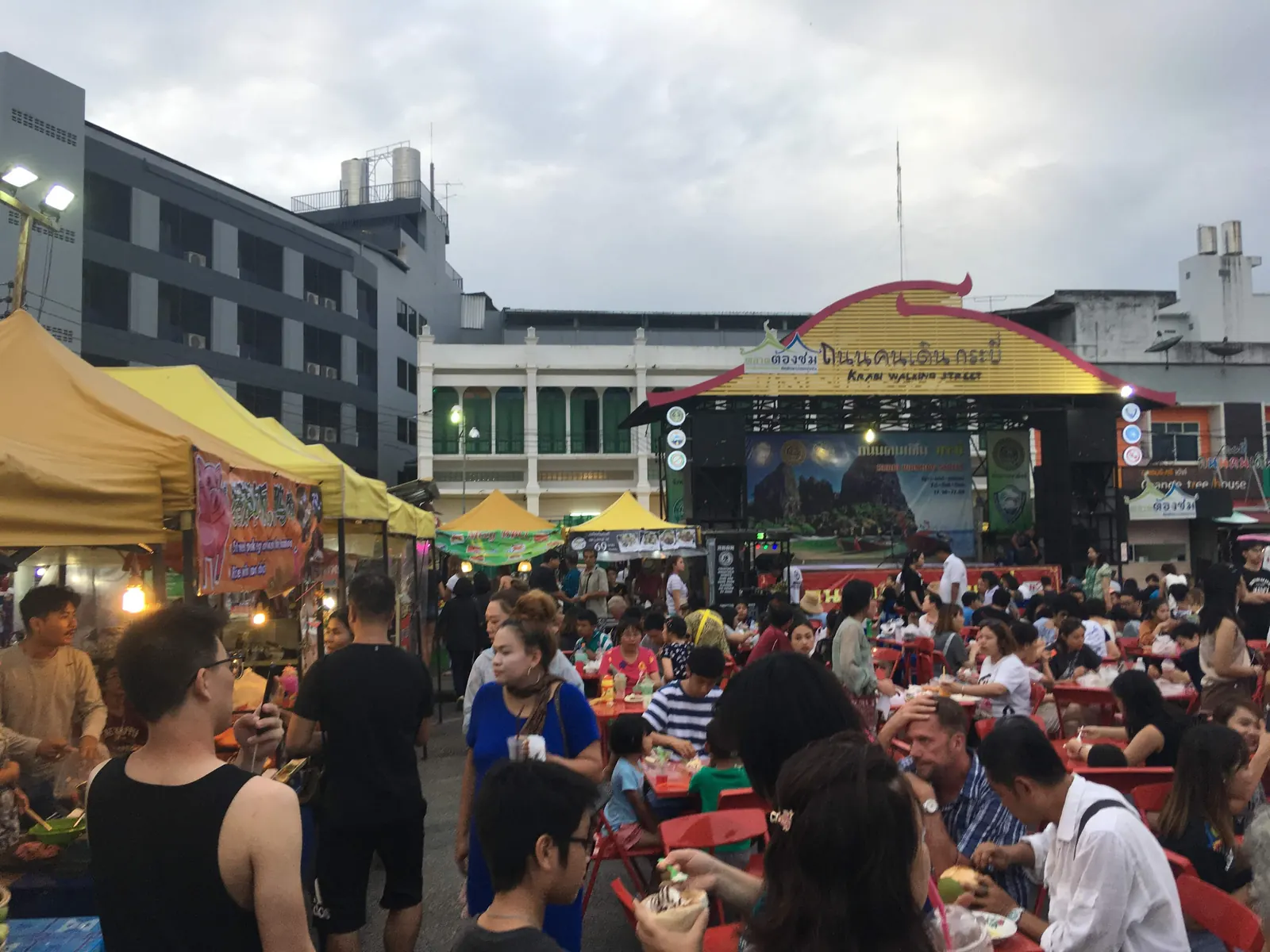
Krabi Town’s walking street takes over Soi Maharaj 8, the lane beside the Vogue department store, with entrances on Maharat Road and on Uttarakit Road above the river. Friday, Saturday and Sunday from about 5pm to 10pm it closes to cars and fills with two rows of stalls and a stage at the far end: school dance troupes in full costume, a karaoke hour nobody asked for, and a local band better than it needs to be. It is a town market that tourists attend, not a tourist market that locals tolerate, and the prices show it.
Half the stalls are crafts: soap, candles, clay figurines, paintings of longtails, jewellery somebody actually made. The other half is the southern Muslim and Chinese-Thai food this town runs on, the dishes our southern Thai cuisine guide sends you south for: gaeng som, the sour turmeric curry with fish and green papaya, ฿60–80 over rice, hot, and pet nit noi gets you a mild one; khao mok gai, the Thai biryani with fried shallots and green chilli sauce, ฿50–70; roti, ฿20 plain, ฿40–60 with banana and condensed milk; khanom jeen nam ya, rice noodles under a fish-and-turmeric curry with a tray of raw vegetables, ฿40–50; kua kling, the dry minced-pork curry, ฿60–80, the dish southern Thais use to test foreigners; sataw, the stink beans stir-fried with prawns, ฿80–120, smell them first; skewers ฿10–15 a stick and squid ฿60–100 from the grill. Portions are small and made for grazing at the plastic tables in front of the stage. As of our last check the stalls do not sell beer; the riverfront bars two hundred metres away take that trade.
Arrive at 6pm; by 7.30pm the lane is a slow shuffle of prams. One 2026 local listing gives the market as Friday and Saturday only, so build your evening around those and treat Sunday as a bonus. The white songthaews to Ao Nang leave from the 7-Eleven at the Maharat Road end of this same soi, which is convenient until about 6pm, when they stop. Pak Up Hostel, from around ฿400 a bed, is two minutes’ walk away with a rooftop bar; Krabi Heritage Hotel, from around ฿1,400, is the clean double for anyone past dorms.
Verdict: Do it, on a Friday or Saturday. Skip unless you are sleeping in Krabi Town or happy to pay for the ride home.
Chao Fah Pier night market: the one that runs every night
Walk down to the river and along Khong Kha Road and you are at Chao Fah pier, where the Koh Klang longtails tie up and where, every evening from about 5pm until around midnight, the pier car park becomes the best cheap dinner in Krabi. It is not pretty: the kitchens are motorbikes with sidecars, the furniture is plastic, and the river breeze brings mosquitoes from about 6pm, so put repellent on before you sit. Across the water the twin limestone stacks of Khao Khanab Nam go black against the sky, which is more than any restaurant in Ao Nang can offer.
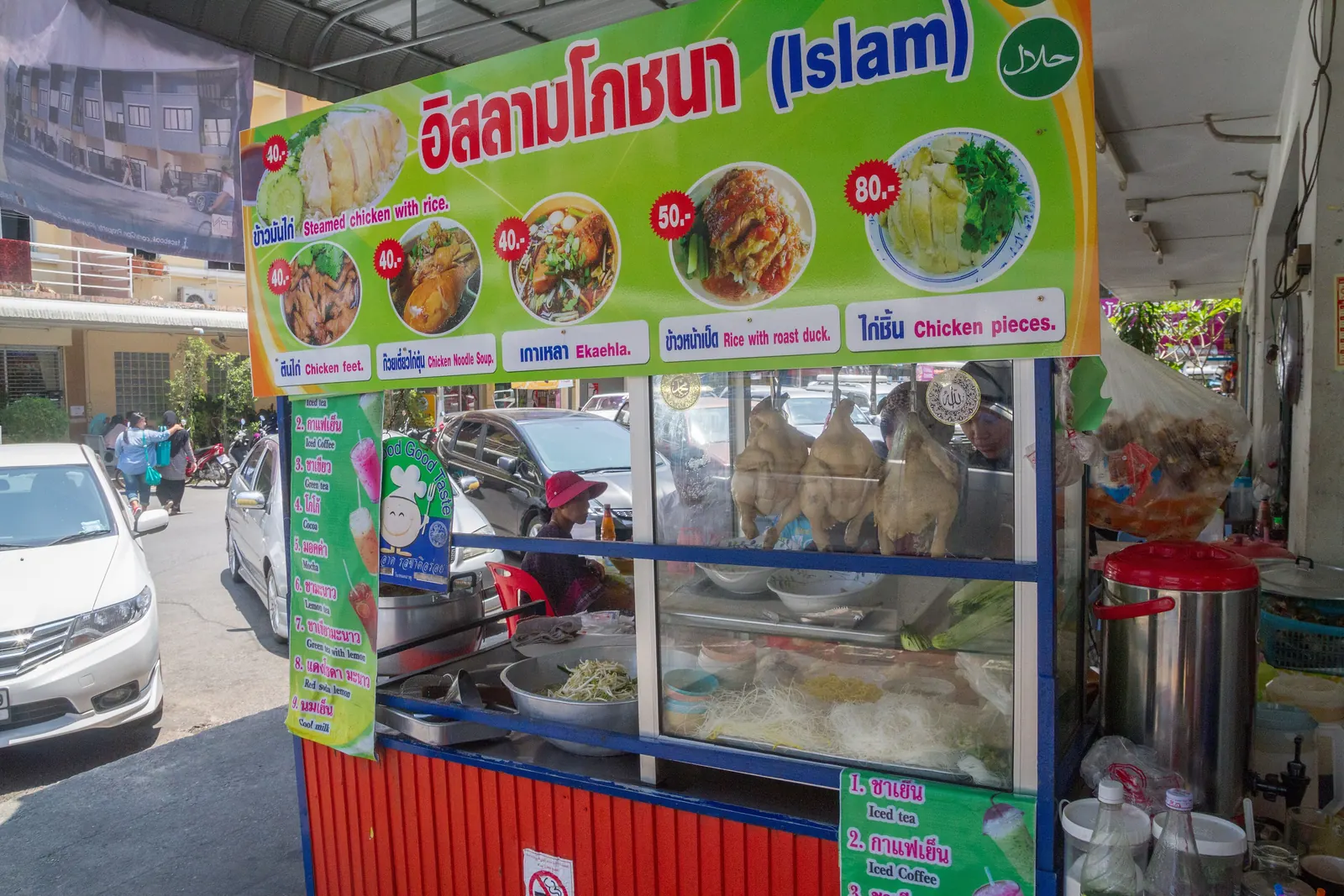
What is on: whole fish on the charcoal, prawns and squid by the plate, blue crab, mussels; Muslim stalls with roti, khao mok gai and massaman; Chinese-Thai stalls with pad thai and noodle soups; a fried-banana cart and fruit-shake stands. Most plates are ฿40–60, the number that makes this market worth a taxi. Grilled prawns or squid run around ฿100–150 a plate, a whole fish around ฿150–250, a shake ฿30–40, soft drinks ฿15–20, beer from a cooler ฿50–60. Two people eat seafood until they stop for about ฿400. If a kitchen on wheels with no menu worries you, is Thai street food safe gives the honest answer: a stall that grills to order and sells out by nine beats a hotel buffet.
The catch is the ride: ฿60 out from Ao Nang by songthaew, ฿300-plus back. Either sleep in Krabi Town, the honest budget base for Krabi province, and eat here twice, or let someone else drive: a guided Krabi street food tour covers Chao Fah and, at weekends, the walking street for around ฿1,300–2,000 with Ao Nang pick-up. Verdict: Do it, and go hungry. This is the market the walking street is a warm-up for.
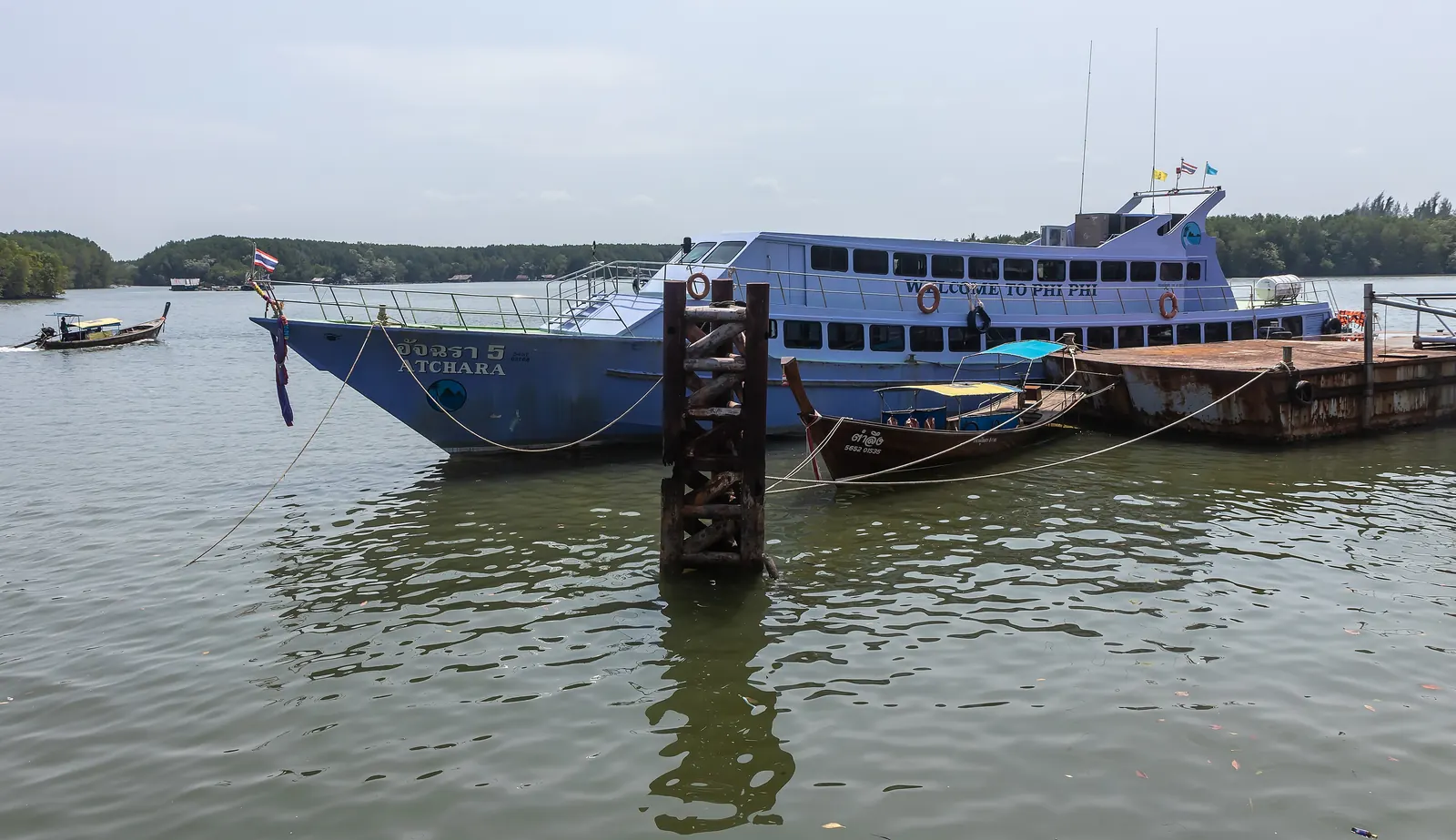
Krabi Town by day: the fresh market, the City Market and the second-hand Saturday
The seafood on the pier came through Krabi Town’s fresh market on Maharat Road, and it is best before 8am: fish on ice, crabs tied with raffia, curry paste by the ladle, and breakfast counters doing khao yam, the herb-and-rice salad, and roti with massaman for ฿40–60. Hours are not posted anywhere we could find; treat before-nine as the rule. For contrast, the City Market on Sukhon Road runs daily from about 2pm to 8pm with the best fruit counter in town, a fresh coconut ฿25–30; on Tuesday and Saturday afternoons, 2pm to 7pm, a second-hand and produce market sets up below the elephant traffic lights on Maharat Road, used shirts beside the grilled meats; and with a scooter, the Sator market at the Highway 4 junction, 3pm to 8pm every day except Tuesday and Saturday, is the most Muslim market in the province: roti, prayer caps, no other foreigners. Verdict: the morning market once; the rest only if passing.
Ao Nang Landmark Night Market: nightly, and the only real night market in Ao Nang
Ao Nang’s beach road has bars, tailors and a longtail pier, but no market. The Ao Nang Landmark Night Market is fifteen to twenty minutes’ walk inland, in the Landmark complex on the main road through Khlong Haeng, beside the KFC; a tuk-tuk or Grab from the beach road is ฿80–90. It runs every night from 4pm to about 11pm, is dead until 6pm and full by 7.30pm, and grows to eighty or a hundred stalls in high season, half that in the wet months, half of those selling the same elephant trousers.
It is built for tourists and honest about it: covered seating on two levels, a beer zone where a bar sells small Chang and Singha at ฿70–80, and a free zone where you eat what you carried in, including the ฿10 7-Eleven water the stalls sell for ฿20. Prices run a third above Krabi Town: pad thai or a noodle bowl ฿70–100; five skewers around ฿100; roti with banana and chocolate around ฿60; mango sticky rice ฿20–60; rolled ice cream, inevitably, ฿100; a wood-fired pizza ฿200–220, for people who flew eleven hours to eat pizza. Seafood is sold by the plate at ฿150–300 rather than by the kilo, the one thing done better here than on the beach road. Two people eat well for ฿300–500; check any quote against our Thailand price index.
A room at the Nopparat Thara end of Ao Nang puts it on foot: Glur Hostel, from around ฿450 a bed, is the pool-and-pods hostel a few streets back; Avani Ao Nang Cliff Krabi Resort, from around ฿3,800, has the hillside pool that looks down the whole bay. Verdict: Fine. Do it on the night you cannot face the ride to Krabi Town, eat Thai, skip the pizza.
Khlong Haeng, the mosque market and the Ao Nang day market: the small ones
Khlong Haeng, the village the Landmark sits in, has its own rota that most visitors never notice because nobody has strung fairy lights over it. As reported in 2026: a Wednesday market, about 4pm to 8pm, in the side street by the Muay Thai stadium next to a 7-Eleven; a Thursday and Saturday market along the main road by the other 7-Eleven; and a small Friday food market opposite the Ao Nang mosque, Masjid Al-Munawarah, selling roti, curries and grilled chicken to people coming out of prayers. All are ฿30–60 a plate, done by 8pm, with no beer zone; days shift, so ask at your hotel desk rather than trusting a map pin. There is also an Ao Nang day market 200 metres east of the Makro on the Krabi road, Monday, Tuesday and Friday, 1.30pm to 7pm: fruit, hats, ฿100 flip-flops, and Ao Nang with nobody selling it anything. Verdict: the Friday mosque market if you are here on a Friday; the rest, skip unless you are bored of the Landmark.
Seafood on the Ao Nang beach road and at Nopparat Thara: by the plate, not the kilo
The beach road’s ice-bed restaurants are Ao Nang’s real night market, in that they are where most visitors eat and most money changes hands. The fish is genuinely fresh. The trap is the menu, priced by the hundred grams so that ฿89 for prawns looks a bargain until the kilo arrives at ฿890 plus a cooking charge. Ask the price per kilo, watch the scale, agree the cooking fee, and read Thailand scams for the sentence that ends the conversation. Realistic 2026 prices before anyone touches the animal: prawns around ฿500–900 a kilo, a whole fish ฿400–700, blue crab ฿500–800, lobster from around ฿2,500. A plate of grilled prawns at ฿250–350 is a dinner; a “kilo” is a lesson, the same trick our Phuket night markets and Koh Samui night markets guides warn about.
The way round it is Nopparat Thara, the quieter beach north of the bridge, where Thai families eat. Wang Sai Seafood sits at the Ao Nang end just over the bridge, open-sided and breezy, with barbecued crab, prawns and oysters a notch below beach-road prices. At the far end, in the national-park car park by the Nopparat Thara pier, Krua Thara is the seafood restaurant Krabi people drive to: live tanks, no view, plastic chairs, and a bill for two of around ฿600–900. Neither is cheap; both are honest. Verdict: Skip the beach-road ice beds unless you order by the plate; do Krua Thara once.
Krabi night markets by day of the week, and how to get between them
Chao Fah and the Landmark run nightly; the walking street is Friday to Sunday; the village markets fill the gaps. Ao Nang to Krabi Town is twenty kilometres and thirty to forty minutes, and the table assumes you start in Ao Nang, because most people do.
| Day | Krabi Town | Ao Nang and Khlong Haeng | Verdict |
|---|---|---|---|
| Monday | Chao Fah pier, 5pm–midnight | Landmark, 4pm–11pm; Ao Nang day market, 1.30pm–7pm | Chao Fah, do it |
| Tuesday | Chao Fah; second-hand and produce market, 2pm–7pm | Landmark; Ao Nang day market | Chao Fah; the rest if passing |
| Wednesday | Chao Fah; Sator market, 3pm–8pm | Landmark; Khlong Haeng side-street market, 4pm–8pm | Khlong Haeng if you are in Ao Nang |
| Thursday | Chao Fah; Sator market | Landmark; Khlong Haeng main-road market, 4pm–8pm | Only if staying nearby |
| Friday | Walking Street, 5pm–10pm; Chao Fah; Sator market | Landmark; mosque market, evening; Ao Nang day market | Walking Street, do it |
| Saturday | Walking Street; Chao Fah; second-hand market | Landmark; Khlong Haeng main-road market | Walking Street, do it |
| Sunday | Walking Street (thinner); Chao Fah; Sator market | Landmark | Fine; Friday or Saturday is better |
| Daily, daytime | Fresh market, Maharat Road, until about 10am; City Market, Sukhon Road, 2pm–8pm | None | Morning market, once |
Transport, honestly. The white songthaews are the province’s bus: ฿50–60 a head between Ao Nang and Krabi Town, flagged down along the beach roads or the main road, and boarded in Krabi Town at the 7-Eleven on Maharat Road at Soi 8. They are a daytime service; by about 6pm they are gone, and the same trucks become private hire at around ฿300–500. Grab works in both towns, with thinner coverage than Phuket: an evening ride is around ฿250–400 and can take ten minutes to be accepted, so book it from the table. A scooter is ฿200–250 a day. Our Krabi airport arrival guide has the ฿100 van to town and the ฿150 van to Ao Nang, Bangkok to Krabi covers the night bus and the flights, and rooms at both ends are on Agoda’s Krabi listings.
| Route | How | Price | Book |
|---|---|---|---|
| Ao Nang to Krabi Town (day, to about 6pm) | Shared white songthaew | ฿50–60 pp | Flag it down |
| Ao Nang to Krabi Town (night) | Grab, or a chartered songthaew | ฿250–400 / ฿300–500 | In the app / agree it first |
| Ao Nang beach road to the Landmark market | Tuk-tuk or Grab, 5 minutes | ฿80–90 | In the app |
| Krabi airport or bus terminal to Ao Nang | Shared minivan, 40 minutes | ฿150 pp | 12Go |
| Guided evening street-food tour from Ao Nang | Minivan, 3–4 hrs | ฿1,300–2,000 | GetYourGuide |
| Bangkok to Krabi by night bus | Overnight, 12–13 hrs | ฿700–1,200 | 12Go |
| Phuket to Krabi by bus or minivan | 2½–3 hrs | ฿200–350 | 12Go |
Season. Krabi’s wet season is May to October, and October is the last of it: the walking street is open to the sky and a 7pm downpour thins it to the awnings, while Chao Fah carries on under tarpaulins and the Landmark has a roof. From November the Andaman dries out; best time to visit Thailand has the month by month. Two dates from our festivals calendar: the Vegetarian Festival, 9–18 October 2026, when yellow-flag jay stalls take corners of the town markets (what to eat at the Vegetarian Festival explains the flags); and Loy Krathong, 24 November 2026, when the town floats its krathongs from the Chao Fah riverfront and a plastic chair at the pier market is the best seat in the province.
Krabi night markets: your questions, answered
What day is the Krabi Town walking street?
Friday, Saturday and Sunday, from about 5pm to 10pm, on Soi Maharaj 8 beside the Vogue department store. Friday and Saturday are the reliable nights; one 2026 listing gives the market as Friday and Saturday only, and Sunday is noticeably thinner. Chao Fah pier’s seafood market runs every night of the week regardless of the walking street.
Is there a night market in Ao Nang every night?
Yes. The Ao Nang Landmark Night Market runs nightly from 4pm to about 11pm in the Landmark complex on the main road at Khlong Haeng, a fifteen-to-twenty-minute walk inland from the beach road or ฿80–90 by tuk-tuk or Grab. It is quiet until 6pm. The beach road itself has no market, only seafood restaurants and bars.
How do I get from Ao Nang to the Krabi Town night market at night?
Out is easy: a white songthaew for ฿50–60 a head, flagged down on the beach road or the main road, until about 6pm. Back is the problem: after dark the shared songthaews stop, so it is a Grab at around ฿250–400 or a chartered songthaew at ฿300–500 for the truck. Book the Grab from your table before you finish eating, because acceptance can take ten minutes.
How much does street food cost at Krabi night markets?
In Krabi Town, ฿40–60 a plate at Chao Fah and the walking street, ฿100–150 for grilled prawns or squid, ฿150–250 for a whole fish. At Ao Nang Landmark add about a third: ฿70–100 for noodles, ฿100 for five skewers, ฿70–80 for a small beer. The beach-road restaurants sell seafood by weight, from around ฿500 a kilo for prawns plus a cooking charge.
Do Krabi night markets run in the rainy season?
Yes. Chao Fah and the Landmark open every night year round; the walking street runs Friday to Sunday, but a heavy evening downpour, common from May to October, can shut it early because it is open to the sky. Stall numbers drop by a third or more in the wet months and recover from November, when the Andaman coast dries out.
Related guides
- Where to Stay in Krabi: Best Areas by Traveller Type
- Railay Beach: The Peninsula That Thinks It’s an Island (What’s Worth It in 2026)
- Bangkok to Krabi: Fly, Night Bus or Train — Every Route Costed
Book the trip
Some links in this guide are affiliate links. If you book through them we may earn a small commission at no extra cost to you — it helps keep Destination Thailand independent.
A room in Krabi Town puts Chao Fah and the walking street on foot and the Railay boats twenty minutes away; a room at the Nopparat Thara end of Ao Nang puts the Landmark on foot. Compare both on Agoda’s Krabi page. Boats and day trips out of Ao Nang, and a guided evening at Chao Fah with the ordering and the driving done for you, are on GetYourGuide’s Krabi tours. Flights and the night bus from Bangkok are on 12Go, with the honest comparison in our Bangkok to Krabi guide. Not sure Krabi beats Phuket for your trip at all? Our Where to Go in Thailand matcher will tell you in about a minute.