Thale Noi is the reason to go to Phatthalung, and very nearly the reason to go to southern Thailand’s interior at all. It is a shallow freshwater lake at the top of the Songkhla lake system, about 30 km north-east of Phatthalung town, where from roughly late February to April the water turns pink with flowers, herds of buffalo swim between grazing patches with only their horns showing, and the birdlife runs to several hundred species. You see all of it from a longtail at dawn, for around ฿450–600 for the whole boat. No queue, no tour buses, no one selling you a coconut with a straw in it.
What follows is when to go, which pier, what the boat costs, how to reach it from Hat Yai or Nakhon Si Thammarat, and where to sleep so the 5.30am start is not a hardship. The province overview is on our Phatthalung travel guide and the Phatthalung province page; prices are checked against the Thailand Price Index. Thale Noi translates as “little sea”, which is half right: it is little only next to the Songkhla lake it drains into.
What Thale Noi actually is, and why birders take it seriously
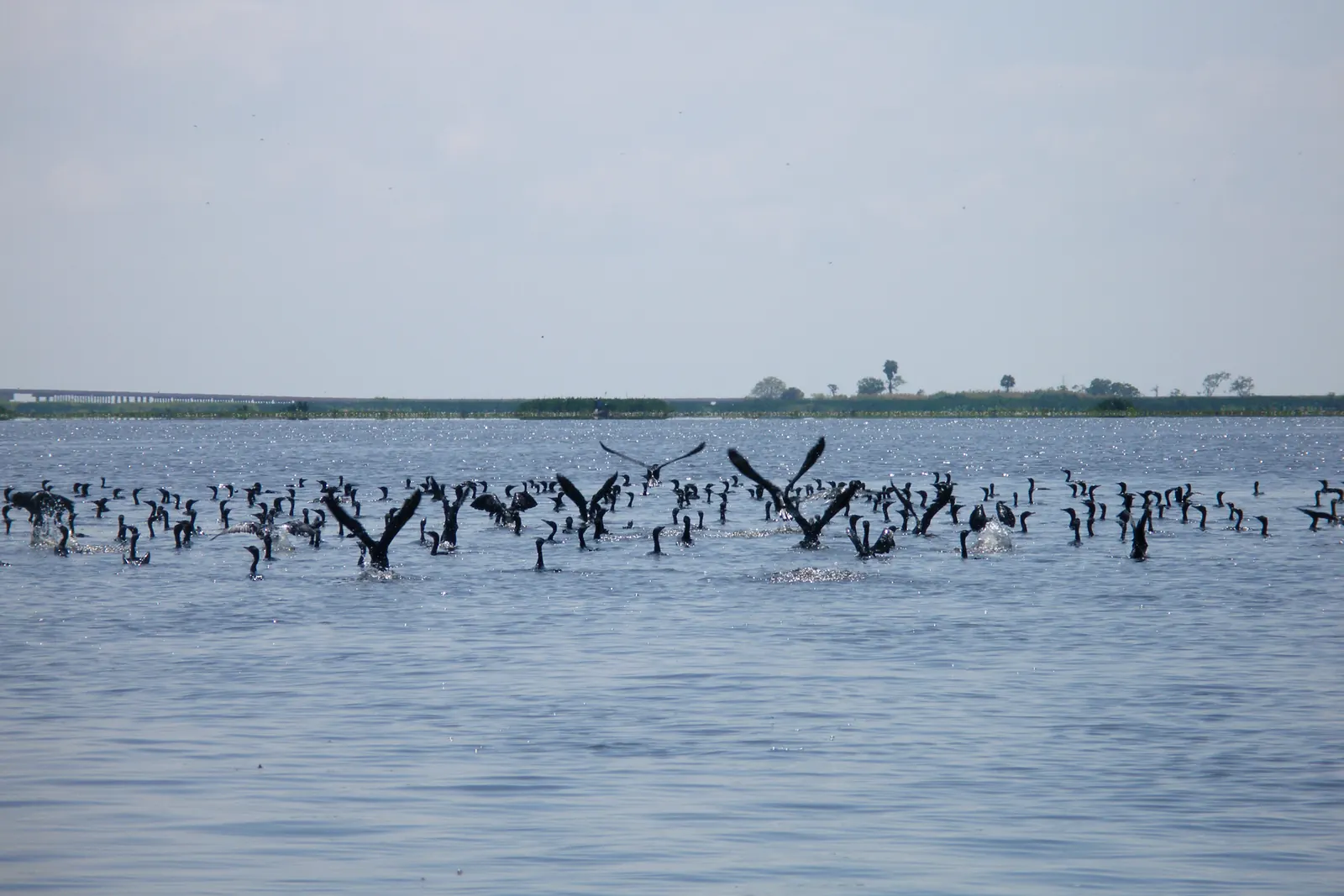
The formal name is the Thale Noi Non-Hunting Area, declared in 1975 as Thailand’s first, and its Khuan Khi Sian peat swamp became the country’s first Ramsar wetland of international importance on 13 September 1998. The lake itself averages little more than a metre deep, which is why it is so full of reeds, water grass, melaleuca and the red water lilies (bua sai in Thai) that everyone calls lotus. The provincial authority counts more than 287 bird species: purple swamphens in their hundreds, herons, egrets, cormorants and whistling ducks, with the migrants swelling the numbers from about November to March.
Signs and Thai travel pages call it the Thale Noi Waterfowl Park, which makes it sound like a zoo. It is not; it is a working wetland, fished with lift nets, cut for krajood reed for mats and baskets, and grazed by buffalo. That farming system was recognised by the FAO in 2022 as a Globally Important Agricultural Heritage System, the first in Thailand. The verdict: do it. Of Thailand’s cheap wildlife experiences, few match this one for return on ฿500.
When is lotus season at Thale Noi? Month by month
The Phatthalung provincial administration puts the bloom from mid-February to April, with the flowers at their best from late February to mid-April. Other sources stretch it to May or June in a good year, and you will always find a few flowers outside those months. The buffalo run on a different calendar: when the water is high, roughly December to February, the grazing islands flood and the herds swim and dive for the water plants; in the dry season they stand on exposed mudbanks instead and look like ordinary cattle with wet feet. The fortnight where the two shows overlap, late February into early March, is the sweet spot.
| Months | Lotus | Buffalo | Birds and weather | Verdict |
|---|---|---|---|---|
| November–January | Few or none | Swimming; high water | Migrants arriving; the east-coast monsoon means rain and grey mornings | Fine for buffalo and birds; skip for flowers |
| Late February–mid-March | Good and building | Still in the water most years | Migrants still here; dry, clear dawns | Do it: the best window |
| Mid-March–April | Peak | Grazing on the mudbanks | Hot by 9am; fewer migrants | Do it for the flowers |
| May–June | Fading, patchy | On the banks | Hot, humid, occasional storms | Fine if you are passing |
| July–October | Sparse | On the banks | Unsettled; quiet | Skip unless you are a birder |
The trap here is that southern Thailand’s Gulf side gets its heavy rain from October to December, the opposite of Bangkok, so “cool season” in Phatthalung means wet. Our best time to visit Thailand guide has the coast-by-coast version. Thai long weekends, especially around Songkran in April, bring Hat Yai families north; the dates are on our festivals and public holidays calendar.

Thale Noi boat tours: prices, timings and which pier
There is no entry fee; you hire a longtail by the boat, with a boatman who knows where the flowers and the buffalo are this week. The pier inside the reserve at Ban Thale Noi starts boarding at around 5.30am, and the lily beds begin within two minutes of the jetty, so even a short trip sees flowers. Expect around ฿450–600 for the boat, up to about five passengers, for a loop of an hour to an hour and a half; the longer two-hour route out to the buffalo grounds and the long bridge runs nearer ฿600–900. Prices vary by boat and route, as of November 2026; agree the route and the price at the counter, not mid-lake. Go early: after about 10am the flowers start to close and by noon they are mostly shut.
| Pier | What the trip covers | Typical boat price | Verdict |
|---|---|---|---|
| Thale Noi pier (Ban Thale Noi, inside the reserve) | Lily beds within minutes, birds, viewing salas, buffalo grounds on the longer loop | Around ฿450–600 short loop; ฿600–900 longer | Do it: the default, and the beds are closest |
| Pak Pra (Ban Pak Pra, Khuan Khanun) | Sunrise through the giant yo lift nets, the canal, the bridge | Around ฿500–800 | Do it for sunrise photographs; fewer flowers |
Pak Pra is the photographers’ alternative: the mouth of the canal where the giant bamboo lift nets, the yo yak, are silhouetted against the sunrise. It is a different trip, mostly canal and nets rather than lily beds, and the two combine well over two mornings. A tip of ฿50–100 for a boatman who earns it is customary. Bring a hat and water; there is no shade on the boat after 8am. Prefer to have it organised from Hat Yai, pick-up included? Compare Thale Noi and Phatthalung tours on GetYourGuide; check that the boat is included and that the pick-up time gets you there for dawn.
The swimming buffalo of Thale Noi: what you will actually see
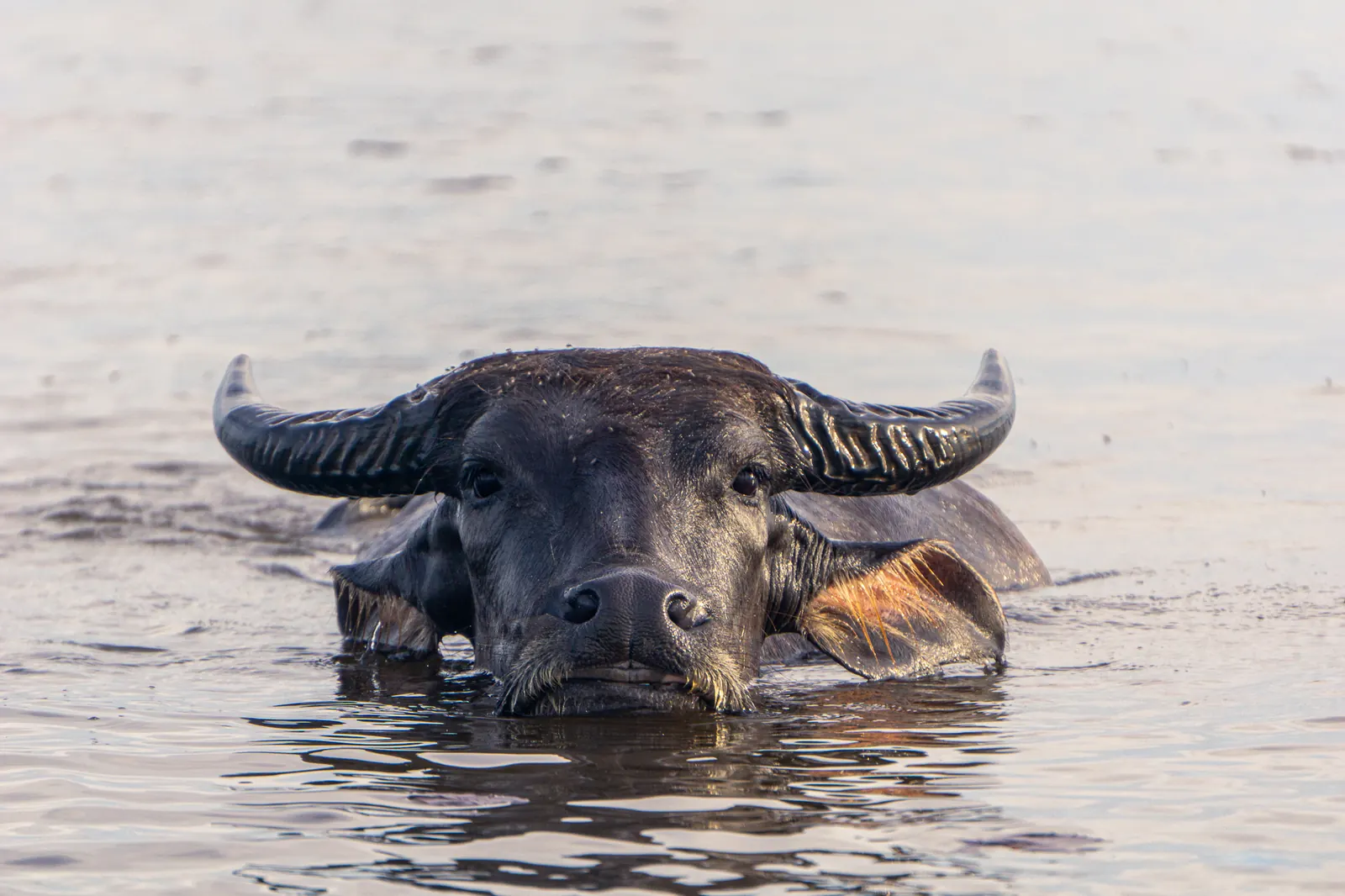
These are swamp buffalo, kwai nam, owned by local families and left to graze the wetland largely on their own, a system the villages say goes back more than 250 years. In high water they swim between patches and duck under to graze on submerged plants, which is the image everyone comes for: a line of heads and horns moving across open water like a slow amphibious landing. In the dry months they stand on mudbanks and look smug. Either way they are not performers, and nobody can promise a swim on your morning.
Two ways to see them. From the boat, ask for the buffalo grounds by name at the counter; the boatman will cut the engine and drift in, which is the right distance for a phone and too close for anyone flying a drone over the herd. From the land, the long bridge has lay-bys where the herds often graze below, and a car on the bridge at 7am is a fine second option. Verdict: do it, ideally between December and early March, and keep your expectations at “farm animals in a lake” rather than “nature documentary”. They are still the best farm animals in Thailand.
Is the Ekachai Bridge really the longest bridge in Thailand?
Not quite, and the distinction matters only to pub-quiz people. The Chaloem Phrakiat 80 Phansa bridge, known to everyone as the Ekachai Bridge, runs about 5.45 km across the wetland from Khuan Khanun in Phatthalung to Ranot in Songkhla, built to mark King Bhumibol’s 80th birthday on 5 December 2007. The Department of Rural Roads calls it the longest bridge across a lake in Thailand, which it is. Bangkok’s elevated expressways are far longer bridges by any engineer’s definition; you will see Thai pages and some English ones claiming 15 km, which is wrong.
What it is, is a very good road: a dead-straight, low causeway on stilts with water and reeds to both horizons, buffalo underneath, egrets on the rails and sunrise straight down the line. There is no toll and no fee; there are lay-bys for photographs, and people do pull up on the shoulder, which on a fast, straight road is less clever than it looks. Verdict: do it, by car or scooter, ideally at 6.30am on the way to or from the pier. Cycling it is lovely before 8am and miserable after.

How to get to Thale Noi from Hat Yai, Nakhon Si Thammarat and Bangkok
Step one is Phatthalung town, on the southern main line. From Hat Yai, the train takes about 70–90 minutes for pocket change in third class (Hat Yai to Phatthalung on 12Go), or a minivan around ฿100 and 90 minutes. From Bangkok, the sleeper from Krung Thep Aphiwat takes roughly 12–13 hours, around ฿900–1,100 in a second-class air-con berth, or fly to Hat Yai or Trang and come up by road (Bangkok to Phatthalung). From Nakhon Si Thammarat, vans take around two hours (Nakhon Si Thammarat to Phatthalung); from Trang, about an hour over the hills (Trang to Phatthalung). Coming off the Gulf islands, Surat Thani to Phatthalung is a half-day by van or train.
Step two, town to lake, is the awkward bit. Local minivans and a slow songthaew run to Thale Noi in the daytime, around ฿35–70, but nothing leaves town in time for a 6am boat. The options: rent a scooter in town, around ฿250–350 a day (do it, if you ride); a car and driver arranged through your hotel, around ฿1,200–1,800 for the day (do it, for families); or sleep in Ban Thale Noi and walk to the pier (the smartest of the three). Driving yourself from Hat Yai at 4am is possible, about two hours, and grim.
Where to stay for Thale Noi: lakeside homestay or Phatthalung town
For the boat, sleep by the lake. Nobody comps us, and rates are typical asking prices, not quotes. In and around Ban Thale Noi, Nabua Thalenoi Resort and the homestay Baan Chomchan – Thale Noi run from around ฿600–1,500, and most places near the pier will book your 5.30am boat for you. For a pool and more privacy, The Brahminy Kite Poolvilla Thale Noi is the upmarket local option, from around ฿2,000–3,500. On the Pak Pra side, Sripakpra Boutique Resort suits the sunrise-at-the-nets plan, around ฿1,200–2,500. Confirm the exact location on the map before booking; “near Thale Noi” stretches.
For a base with restaurants, the night market and Khao Ok Thalu on the doorstep, stay in Phatthalung town: Dusit Princess Phatthalung is the branded choice, from around ฿1,500–2,500; The Centris Hotel and Siva Royal Hotel are the plainer mid-range options at around ฿700–1,300. On the lagoon east of town, Lampam Resort sits by the Lam Pam fish restaurants. Compare dates on Agoda’s Phatthalung page; if you insist on Hat Yai as a base, Hat Yai hotels are cheaper and plentiful, and the 4am alarm is the price.
Thale Noi verdict, and how to fit it into a southern trip
Late February to mid-April, first boat, one night by the lake: do it. It is a better morning than most of what the south charges ฿2,000 for. December to early February: fine for buffalo and birds, but you are gambling on the monsoon tail and there are few flowers. A day trip from Hat Yai arriving at 10am: skip it; you will see closed flowers in heat. For a longer loop, Thale Noi slots between Nakhon Si Thammarat’s night market to the north and Songkhla old town to the south; eat your way through it with our southern Thai cuisine guide. Heading further south, Betong and its Aiyerweng sea of mist are the deep-south version of a dawn wake-up call, and the north-east has its own lotus lake in a different season: the Red Lotus Sea in Udon Thani, which peaks in January.
Thale Noi: your questions, answered
When is the best time to see the red lotus at Thale Noi?
Between late February and mid-April, according to the Phatthalung provincial administration, with the flowers open from first light until mid to late morning. Late February to early March is the best compromise, because the buffalo are usually still swimming in the high water and migrant birds are still around. From October to December the Gulf monsoon brings rain and few flowers, so avoid those months if lotus is the point.
How much is a boat tour at Thale Noi?
There is no entry fee; you hire the whole longtail. Expect around ฿450–600 for a loop of an hour to an hour and a half, for up to about five passengers, and roughly ฿600–900 for a longer two-hour route out to the buffalo grounds and the long bridge. Prices vary by boat and pier, so agree the route and the price at the counter before you board, and tip a good boatman.
What time should I take the boat at Thale Noi?
As early as possible. Boats at the Thale Noi pier start boarding at around 5.30am, and the hour after sunrise gives you open flowers, still water, mist and the most active birds. By about 10am the lilies are closing and the heat is building; by noon most flowers are shut. In practice that means sleeping in Ban Thale Noi or leaving Phatthalung town by 5am.
How do I get from Hat Yai to Thale Noi?
Take the train or a minivan from Hat Yai to Phatthalung town, about 70–90 minutes, then a scooter, a hired car with driver, or a daytime local minivan for the last 30 km or so to the lake. Public transport will not get you there for sunrise, so most people either sleep by the lake the night before or book a tour with an early pick-up from Hat Yai.
Is the Ekachai Bridge the longest bridge in Thailand?
It is the longest bridge across a lake in Thailand, at about 5.45 km, linking Khuan Khanun in Phatthalung with Ranot in Songkhla. Officially it is the Chaloem Phrakiat 80 Phansa bridge, built for King Bhumibol’s 80th birthday in 2007. Claims of 15 km are wrong, and Bangkok’s elevated expressways are longer bridges overall. Driving it at sunrise is free and well worth the detour.
Related guides
- Phatthalung: Buffalo in the Lake and the Rice Bowl of the South
- Songkhla Old Town: Sino-Portuguese Streets and the Southern City Most Foreigners Skip
- Southern Thai Cuisine: 6 Essential Dishes and the Cultures Behind Them
Book the trip
Some links in this guide are affiliate links. If you book through them we may earn a small commission at no extra cost to you — it helps keep Destination Thailand independent.
Hotels: compare Phatthalung hotels on Agoda, and for the dawn boat book a night by the lake at Nabua Thalenoi Resort or Baan Chomchan, with Dusit Princess Phatthalung as the town option. Tours/Boats: Thale Noi and Phatthalung tours on GetYourGuide bundle the pick-up and boat; the boat itself is easiest booked at the pier. Getting there: Hat Yai to Phatthalung on 12Go is the short hop, and Bangkok to Phatthalung compares the sleeper train and the bus; our Phatthalung guide covers the rest of the province. Not sure the deep south is your Thailand this season? The Where to Go in Thailand matcher scores all 77 provinces against your month, budget and crowd tolerance.