Phatthalung is the province Thai travellers quietly adore and foreign travellers have never heard of, and those two facts are connected. No airport. No beach strip. No banana-pancake trail. What it has instead is a shallow lagoon where herds of buffalo genuinely swim to their grazing grounds, dawn boat rides through square kilometres of pink lotus, limestone mountains erupting out of rice paddies, and the best plate of rice in Thailand. If you have done the islands and wondered what the south was like before mass tourism, here is your answer: in Phatthalung, it never arrived at all.
The province lies between the Khao Banthat mountains and the Songkhla Lake system, with no sea coast at all — a southern rarity. Thais call it the rice bowl of the south. Everyone else calls it nothing, because they have never looked. For the quick-reference version of everything below, see our Phatthalung province profile.
What Phatthalung really is
Strip away the brochure copy and Phatthalung is a farming province of roughly half a million people, running in green stripes from the Banthat range down to the lagoon. Rice is the economy, the culture and the pride — specifically Sangyod rice, the reddish heirloom grain with geographical-indication protection and a national following. It is also the heartland of Nora, the crowned, silver-fingernailed southern dance-drama that UNESCO inscribed as intangible cultural heritage in 2021.
The provincial capital is a low-rise town organised around a railway station, a night market and a mountain with a hole clean through it. Weekenders drive over from Hat Yai for paddy-view coffee and buffalo photographs; Western visitors amount to a rounding error. There is no scene here, no strip, no touts. That is the entire point.
Why go to Phatthalung
Three reasons. First, Thale Noi, which at dawn in lotus season is one of the great cheap wildlife experiences in Asia — a boat, a boatman, a few hundred baht, and a horizon of pink flowers, waterbirds and swimming buffalo. Second, the food: a province that grows its own protected rice and fishes a lagoon the size of a small country eats extremely well, at prices that make you laugh. Third, the feeling of Thailand carrying on entirely without reference to you: menus in Thai, local prices, nobody selling you anything. After the performance economies of Phuket and Samui, the province recalibrates you.
Getting to Phatthalung
The train is the honourable way in: Phatthalung sits on the southern main line, and every Bangkok service bound for Hat Yai stops here. Night trains from Krung Thep Aphiwat take roughly 12 to 13 hours; a second-class air-con sleeper runs around ฿900-1,100, and you wake up to karst and paddies. The station is dead central, and Khao Ok Thalu — the holed mountain — is visible from the platform, which is a better arrival than most airports manage.
In a hurry, fly to Hat Yai (about an hour from Bangkok, ฿1,200-2,000 booked ahead), then come north by local train (about 75 minutes, pocket change) or minivan (about 90 minutes, roughly ฿100). Trang airport also works — about an hour away over the Banthat hills on Route 4, with minivans all day for around ฿100.
Once here, you want your own wheels: public transport is sparse songthaews and optimism. Thale Noi is about 30 km north-east of town, Lam Pam about 6 km east. Rent a scooter, or arrange a car and driver through your accommodation for around ฿1,200-1,800 a day.
Where to stay
Ban Thale Noi village is the smart choice for a first night: homestays and small waterfront resorts in the ฿500-1,500 range, most will sort your 5.30am boat. Being three minutes from the pier at dawn beats anything a fancier hotel offers.
Phatthalung town works as a base for the mountain, the cave temple and the night market — clean, unremarkable guesthouses and small hotels near the station run ฿400-800. Lam Pam, on the town’s watery eastern edge, has a handful of quiet places with lagoon breezes. Inland, the hot-springs district of Khao Chai Son does small resorts around ฿800-1,500.
No chains, no infinity pools: what you get is clean, cheap and honest, which is more than can be said for half of Patong.
What to eat in Phatthalung
Start with the rice; everyone here does. Sangyod is a small, reddish-pink grain — nutty, faintly sweet, with actual texture — and ordinary lunch plates serve it as standard. Then work the lagoon: the row of breezy waterside places at Lam Pam grills whole freshwater fish and prawns off the boats — a fish, a kaeng som sour curry and rice for two runs about ฿300-500.
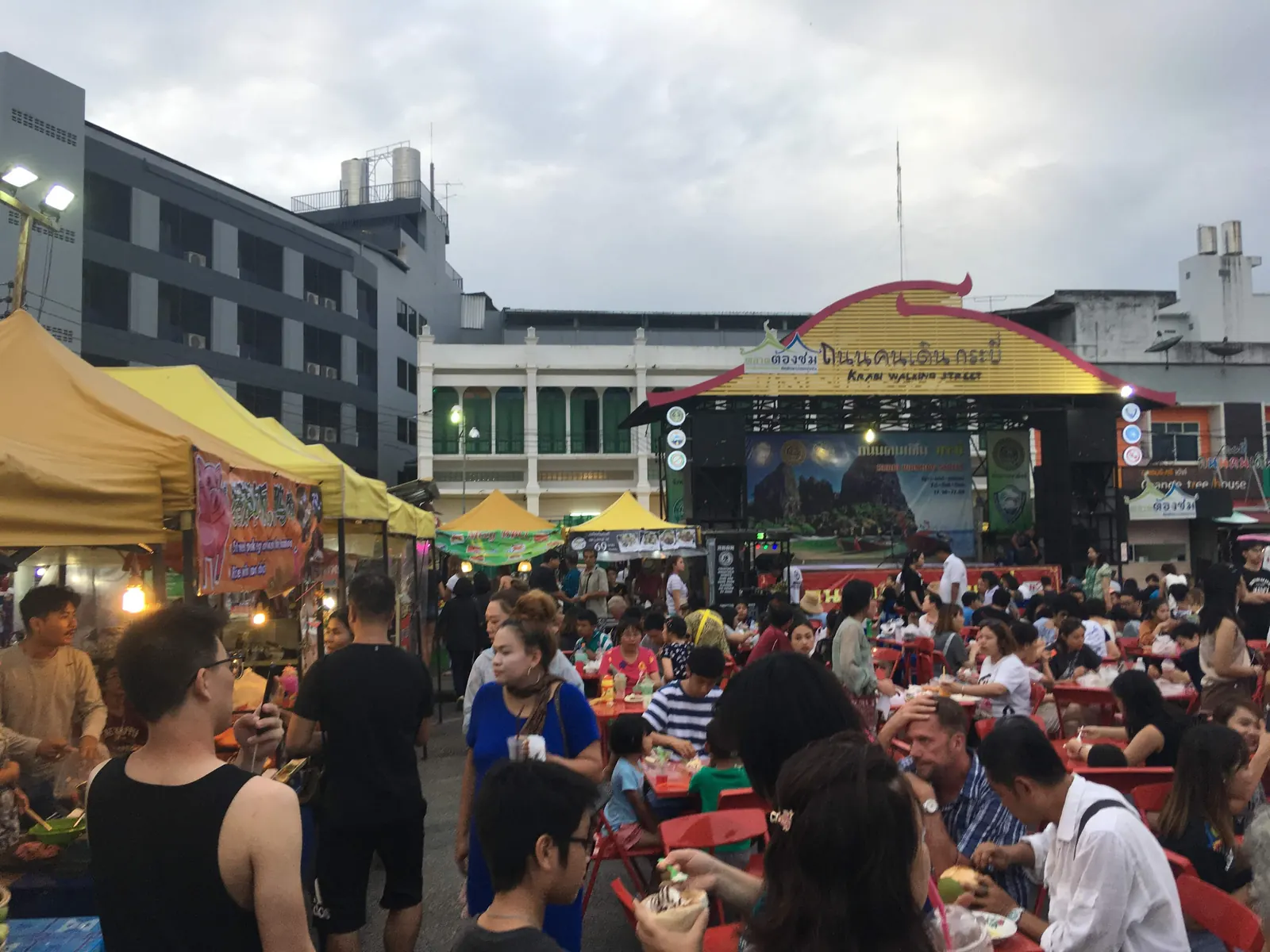
In Thale Noi village, look for lotus-stem stir-fries, racks of dried lagoon fish, and khao yam — the southern herb-and-rice salad — at ฿40-60 a plate. In town, the night market near the station does fiery southern khanom jeen (fermented rice noodles under fish curry) for about ฿40, plus grilled chicken, roti and enough sweets to end you. Budget ฿150 a head and you will struggle to spend it.
Top things to do in Phatthalung
1. Take the dawn boat through Thale Noi’s lotus fields
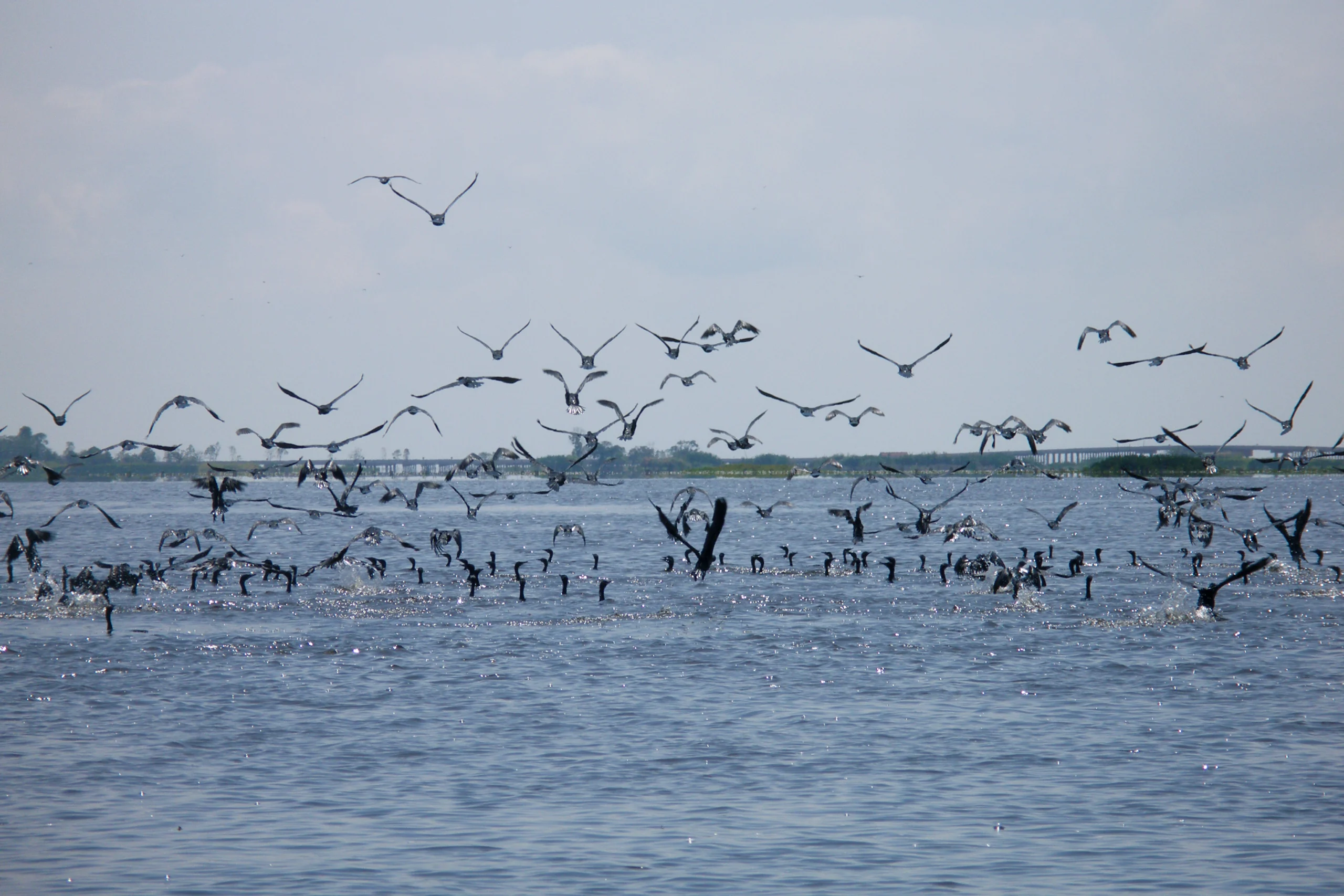
Thale Noi, at the top of the Songkhla Lake system, was Thailand’s first Ramsar-listed wetland. At the pier in Ban Thale Noi, long-tail boats leave from about 5.30am — expect roughly ฿450-600 for the whole boat, not per person, for a 90-minute to two-hour run. From about February to May the lotus bloom in their millions, open at first light and largely closed by mid-morning, so the early start is not optional. Around you: purple swamphens, whistling ducks, herons and egrets by the thousand, with migratory numbers peaking January to March.
2. Watch the buffalo swim
The same wetland hosts one of Thailand’s strangest agricultural sights: herds of water buffalo that swim between grazing patches, horns and nostrils above the waterline like a very calm invasion. The buffalo-and-wetland grazing system here is centuries old, and the FAO recognised it as a Globally Important Agricultural Heritage System in 2022 — Thailand’s first. Ask your boatman to include the buffalo grounds; in early light the scene looks least real and photographs best.
3. Eat Sangyod rice at the source
Sangyod is Phatthalung’s GI-protected heirloom rice, grown in the paddies around Khuan Khanun and long associated with royal patronage. It costs several times what white jasmine does and is worth every satang: better flavour, better bite, and the money goes straight to the farms you have been driving past. Farm shops, co-operatives and market stalls sell kilo bags for roughly ฿60-100 — the only souvenir from the province anyone actually wants.
4. Stand under the hole in Khao Ok Thalu
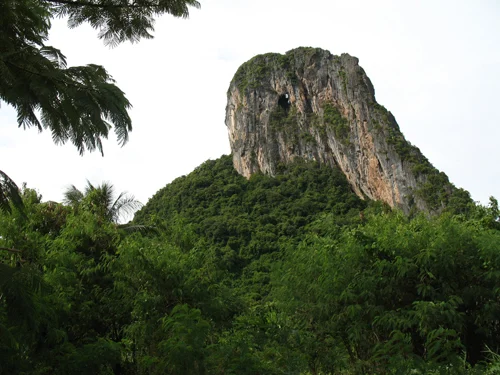
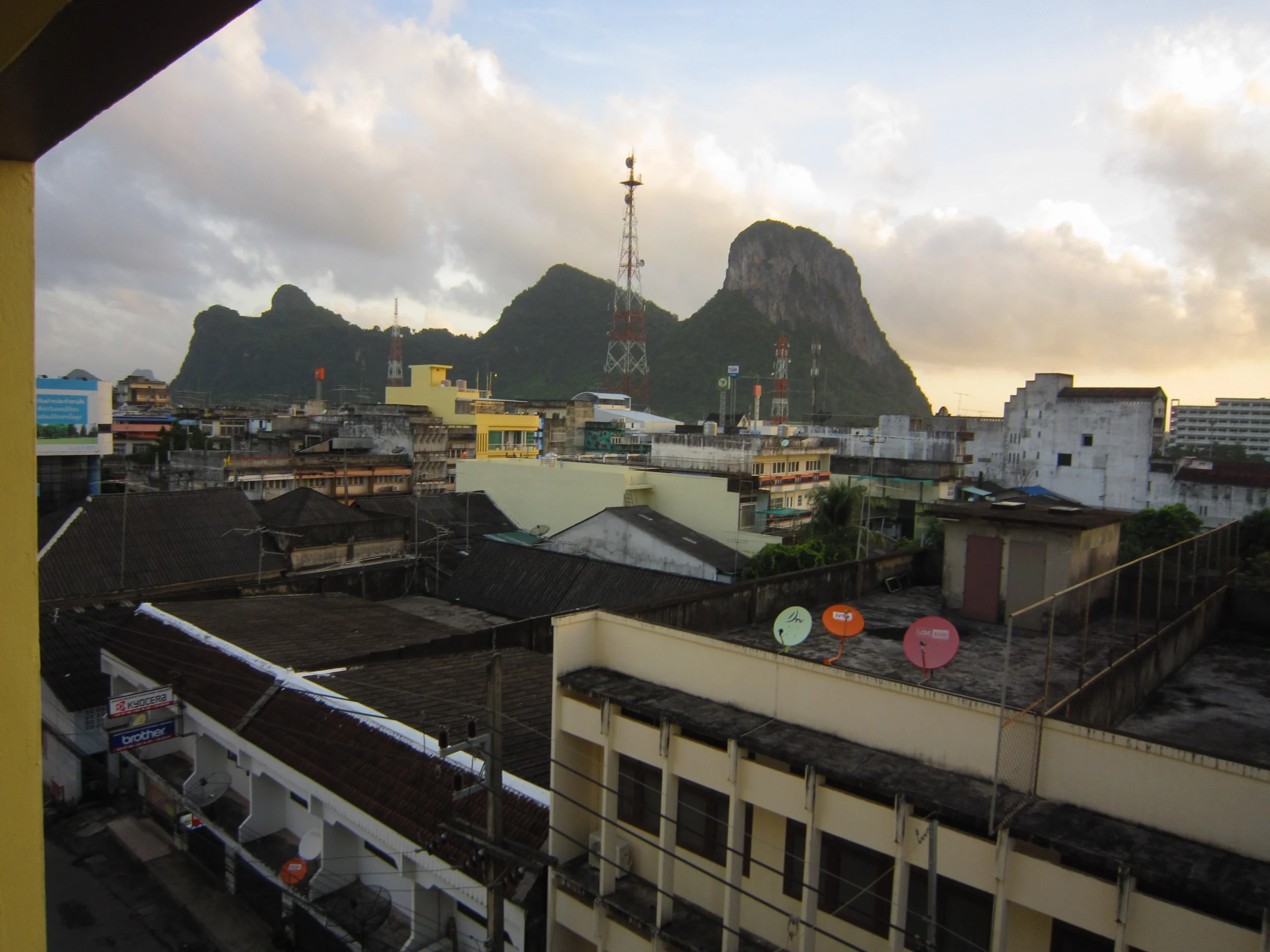
Khao Ok Thalu — roughly, the mountain with the pierced chest — is about 250 metres of limestone with a natural tunnel through its upper reaches, and it is the symbol on the provincial seal. Local legend blames a fight between two wives for the wound, which tells you something about southern storytelling. A stairway serves the fit and the stubborn: go early, carry water, and expect a sweaty hour rewarded with the town and paddies laid out below. Even from ground level it is absurdly photogenic.
5. Wat Khuha Sawan’s cave and viewpoint
On the western edge of town, Wat Khuha Sawan is an Ayutthaya-era temple built into a limestone outcrop, its main cave lined with Buddha images in cool, dripping half-light. Steps continue up the rock behind to a viewpoint that frames Khao Ok Thalu across the rooftops — the best free view in the province. Leave something in the donation box and go in the morning, before the rock turns into a griddle.
6. An evening at Lam Pam — and Nora, if you are lucky
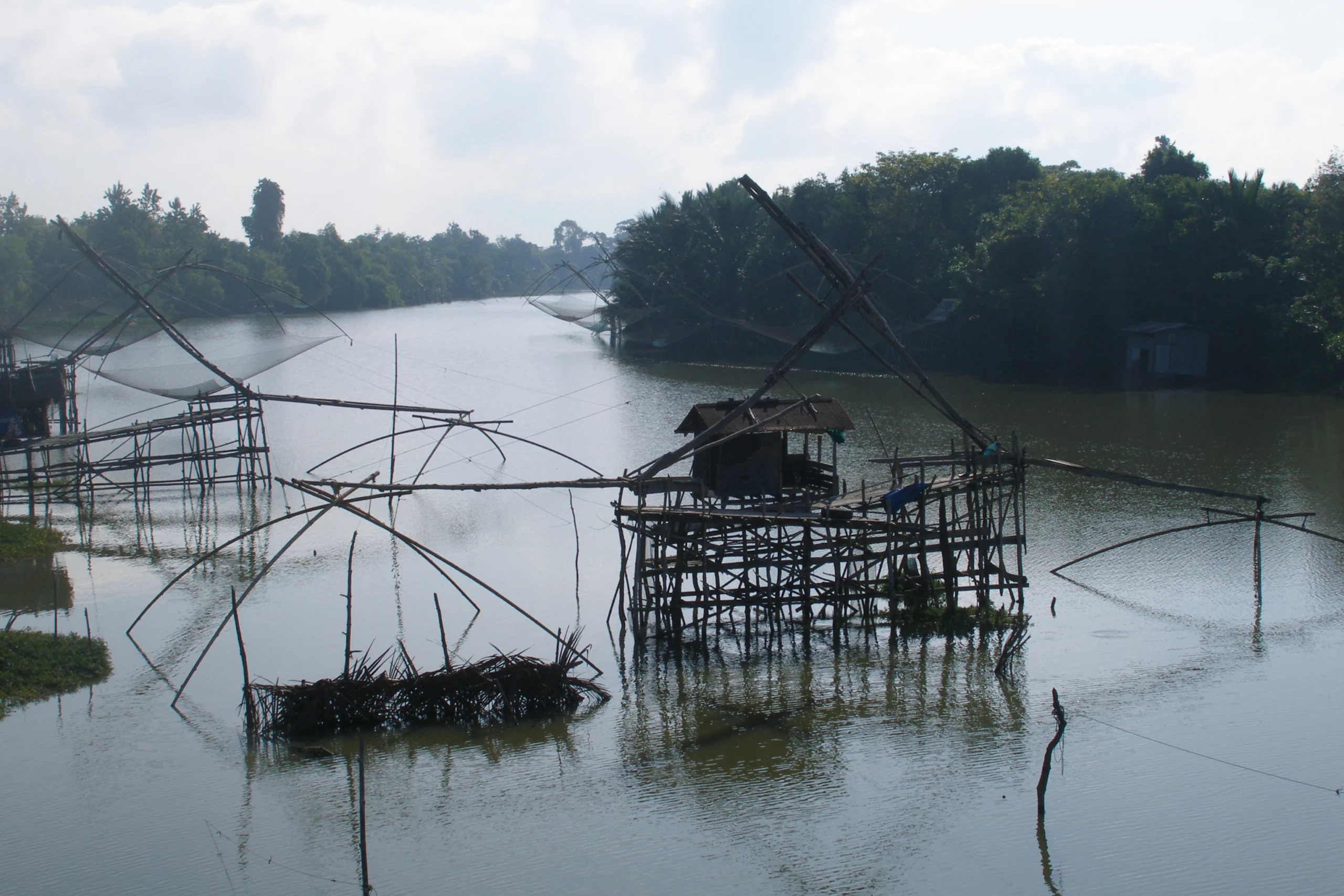
Lam Pam is where Phatthalung meets the lagoon: a sleepy waterfront of seafood tables, fishing boats and the historic former governor’s residence, a teak compound worth half an hour of anyone’s time. Eat by the water at sunset. And keep an ear out for Nora — this is the acknowledged heartland of the dance-drama UNESCO listed in 2021, with its towering crowns, curved silver fingernails and hypnotic drumming. Performances surface at temple fairs and local festivals rather than tourist stages — exactly why they are worth cancelling plans for.
What to skip
The midday boat trip, in the wrong months. Every disappointed review of Thale Noi comes from someone who rolled up at 11am in October expecting the postcard: the lotus closed or absent, the birds gone, the buffalo sensibly in the shade, the light flat and the heat biblical. If you cannot be on the water by 6.30am between roughly February and May, reroute the trip rather than do Thale Noi badly — it is the difference between one of Thailand’s great mornings and an expensive sweat.
Also skip hunting for nightlife (there is none) and allotting more than half a day to Phatthalung town itself. It is pleasant, it feeds you well, and it is a two-street town. The province is the show; the capital is the interval.
Phatthalung travel: practical info
When to go: January to April is the sweet spot — drier weather, peak birdlife, and lotus from February. October to December is the east-coast monsoon and the wettest stretch; the wetland is full but the skies are grim. How long: two nights minimum, three days ideally — one dawn at Thale Noi, one day for the mountain, cave temple and Lam Pam, and slack for eating.
Wikipedia’s Phatthalung entry has the deeper history.
TAT also keeps a useful 10-things-to-do list for Phatthalung.
TAT’s official Phatthalung page lists current boat-hire rates and events.
Onward travel: Hat Yai and Songkhla are about 90 minutes south, Trang about an hour west over the hills, and Nakhon Si Thammarat roughly two hours north — all with regular minivans and trains. Carry cash outside the provincial capital, expect thin English, and treat both as features rather than bugs.
FAQ
Is Phatthalung worth visiting?
Emphatically, if you want rural southern Thailand without another tourist in frame. The dawn boat at Thale Noi alone justifies the detour, and the food, the karst scenery and the prices seal it. Skip it if your trip depends on beaches or nightlife — it has neither.
When do the pink lotus bloom at Thale Noi?
Roughly February to May, with flowers open from first light and mostly closed by 9 or 10am. Book a boat for 5.30-6am, no exceptions. Outside those months you still get the birds and the buffalo, but not the pink horizon.
How do you get to Phatthalung from Bangkok?
Overnight train from Krung Thep Aphiwat, roughly 12-13 hours, around ฿900-1,100 in a second-class sleeper. Faster: fly to Hat Yai or Trang, then a train or minivan of 60-90 minutes. The province has no airport.
Does Phatthalung have beaches?
No — it is one of southern Thailand’s few landlocked provinces, fronting the brackish Songkhla Lake system instead. The waterfront at Lam Pam is for eating and idling, not swimming. For sand, Songkhla and Trang are each about 90 minutes away.
How many days do you need in Phatthalung?
Two to three. One dawn at Thale Noi, one day for Khao Ok Thalu, Wat Khuha Sawan and an evening at Lam Pam, and a spare morning for markets and rice-buying.