Fifty minutes east of Bangkok by train, for ฿28 — less than the coffee you drank while deciding whether to go — sits Chachoengsao, a province most foreign tourists could not place on a map and most Bangkokians visit at least once a year. That gap is the whole story. Chachoengsao is where the capital goes to pray, to eat mangoes at the source, and to have breakfast in a wooden riverside market that has been frying noodles for over a century. The tourists simply have not got the memo.
Which is exactly why you should go. This is Thailand doing what Thailand does when nobody is performing for a camera: temple economics, river commerce, fruit farming and serious eating, all within an hour of Sukhumvit. No beach, no buckets, no elephant-print trousers. If that sounds like a loss, stay in Pattaya. If it sounds like a relief, keep reading — and have a look at our Chachoengsao province profile for the quick facts.
What Chachoengsao really is
Chachoengsao — locals often call it Paet Riu, the old name, from a tale about a giant fish carved into eight strips — is a working agricultural province draped along the Bang Pakong river on Bangkok’s eastern shoulder. Rice paddies, prawn farms and, above all, mango orchards. The provincial town is compact, low-rise and completely unbothered by your presence, arranged around one of the most important temples in the country.
That temple is the engine of everything here. Wat Sothon pulls in millions of Thai pilgrims a year, and the province has organised itself accordingly: markets to feed them, boats to float them, a pink Ganesha the size of a house to photograph them next to. This is domestic tourism in its purest form, which means the prices are honest, the English is scarce and nobody tries to sell you a suit.
Why go to Chachoengsao
Three reasons. First, it is the easiest genuinely local day trip from Bangkok — closer than Ayutthaya, quieter than Amphawa, cheaper than both. Second, the food: a hundred-year-old market economy produces noodle and coffee standards that embarrass most of Sukhumvit at a third of the price. Third, the mangoes. Chachoengsao grows the nam dok mai — the golden, honeyed variety your mango sticky rice dreams are built on — and eating one straight from an orchard in April is a different fruit from the one that limps onto your hotel buffet.
Go for the day, or stay a night and do the river slowly. Do not come expecting nightlife. There is none, and that is rather the point.
Getting to Chachoengsao
The train is the correct answer. Ordinary trains on the eastern line leave Bangkok’s Hua Lamphong station several times a day and take about 50 minutes to Chachoengsao Junction for ฿28 in third class. Hard seats, open windows, paddies sliding past — the best-value 50 minutes in Thai transport. No booking needed or possible; turn up, buy a ticket at the window, board.
Minivans run from Bangkok’s Mo Chit and Ekkamai terminals for around ฿100 and take an hour to 90 minutes depending on how badly the motorway is behaving. Driving is roughly 80 kilometres — about an hour without traffic, a phrase which in Bangkok means nothing.
From the railway station, the town centre and Wat Sothon are a short motorbike-taxi or songthaew hop; expect ฿20-40. For the Ganesha at Wat Saman or the orchards out in Bang Khla you will want a hired songthaew, a Grab if one materialises, or your own wheels.
Where to stay
Be honest with yourself: most people do Chachoengsao as a day trip, and the hotel scene reflects that. In town you will find clean, unglamorous business hotels in the ฿600-1,200 range and simple guesthouses from about ฿400 — perfectly decent, aggressively beige. Base yourself within walking distance of Wat Sothon and the riverside night market and you will not need transport again until you leave.
The more interesting option is out along the Bang Pakong towards Bang Khla, where a handful of small riverside places trade on mango orchards and water views for ฿800-1,500 a night. If you want one night of river traffic and birdsong instead of air-conditioned corridors, spend it there.
What to eat in Chachoengsao
Start at the Ban Mai hundred-year market on a weekend morning: old-style Thai coffee brewed through a cloth sock for ฿20-30, pork satay by the stick, duck noodles, and pad Thai fried in woks older than your parents. A proper breakfast here runs about ฿100, and you will need to be dragged away from the third course.
The Bang Pakong estuary means river prawns and seafood. The riverside restaurants strung along the banks between town and the river mouth grill giant river prawns and whole fish at ฿200-500 a head, depending on how carried away you get — and you will get carried away. In town, the night market near Wat Sothon covers the standard Thai hits at ฿50-80 a plate.
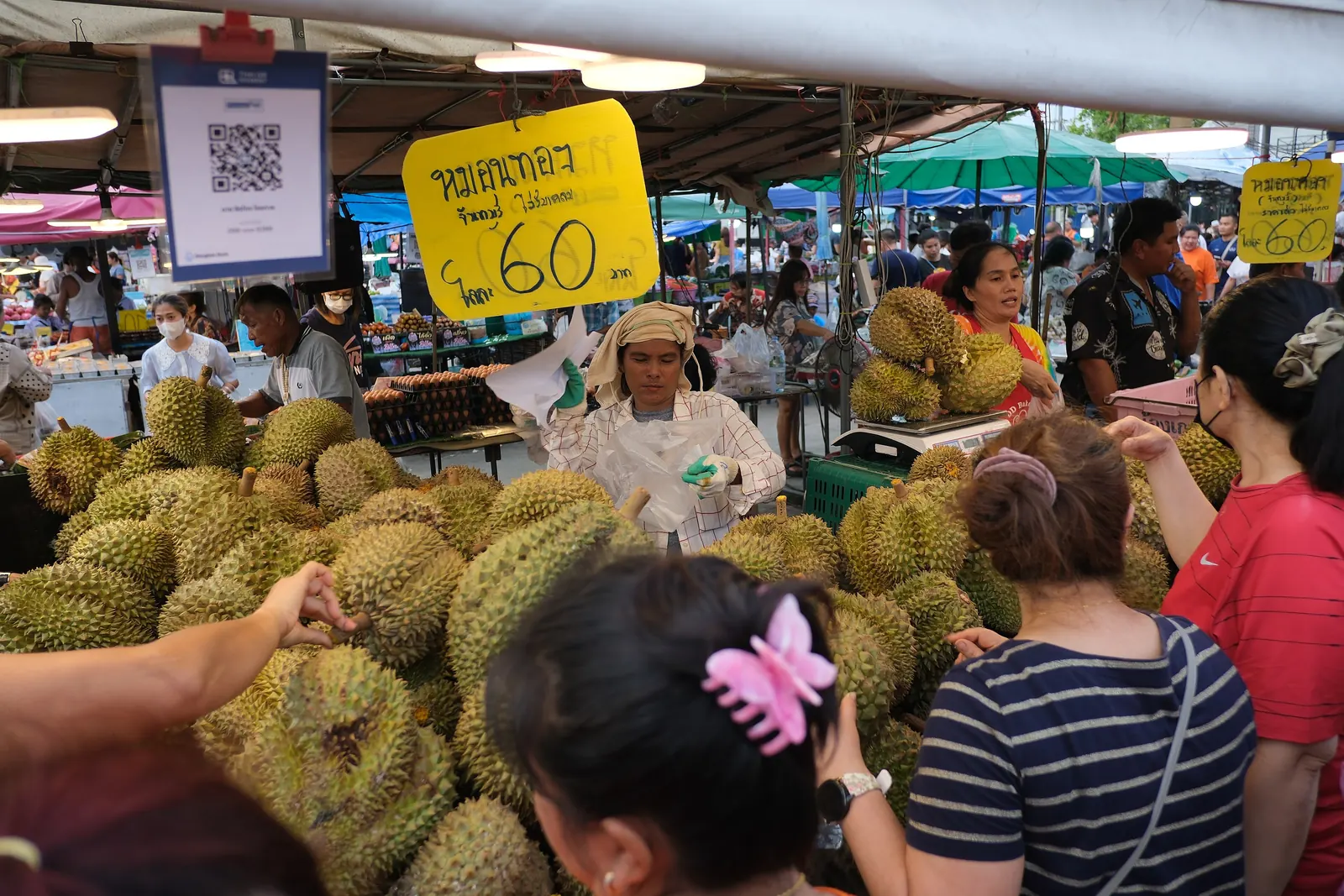
Then the mangoes. In season, roughly March to May, nam dok mai mangoes sell at roadside stalls for a fraction of Bangkok prices, and mango sticky rice made with fruit picked that morning is the province’s honest signature dish. Buy a box for the train home. Buy two.
Top things to do in Chachoengsao
1. Wat Sothon Wararam Worawihan
Home of Luang Pho Sothon, quite possibly the most petitioned Buddha image in Thailand. The legend has the image floating up the Bang Pakong before settling here; the present reality is a gleaming marble ordination hall and a steady conveyor of devotees asking for luck, babies, lottery numbers and exam results. When a wish comes true, you repay it — traditionally with boiled eggs delivered by the thousand, or by hiring the resident dance troupe to perform your thanks. Watching a grandmother hand over trays of eggs with the seriousness of a bank transfer tells you more about Thai faith than any museum could.
Entry is free (donations welcome), open daylight hours, shoulders and knees covered. Weekends are a crush; a weekday morning is far calmer. Even with terminal temple fatigue, give it an hour — this is a working faith economy, not a photo stop.

2. Ban Mai 100-year market
A strip of century-old teak shophouses on the Bang Pakong where the same Thai-Chinese families have been pouring coffee and skewering satay for generations. Film crews love it for the obvious reason: it looks like Thailand before the 7-Elevens landed. Come hungry, eat your way down the wooden walkway, and take the river-facing tables at the back where the breeze does the air-conditioning.
Crucially, it is a weekend animal — Saturdays, Sundays and public holidays, mornings until mid-afternoon. Plan around that or be disappointed.
3. The pink Ganesha of Wat Saman Rattanaram
A 16-metre bubblegum-pink Ganesha reclining on one elbow beside the river, like a god sleeping off a heavy Sunday. It is enormous, unapologetically kitsch and genuinely great fun. Devotees whisper their wishes into the ear of the rat statues stationed around the plinth — the rat being Ganesha’s messenger — and the rats presumably pass them up the chain. Entry is free, the riverside setting is handsome, and the photographs take themselves.
Come early or on a weekday if you can; weekend afternoons bring coach parties by the dozen.

4. Mango orchards and the Bang Khla mango season
Chachoengsao is Thailand’s mango capital and takes the title seriously. The prized nam dok mai orchards spread through Bang Khla district east of town, and in March and April the province throws its annual mango festival — tastings, farmers’ stalls, competitive fruit judging conducted with the gravity of a court proceeding. Buy direct from growers at a fraction of city prices; a kilo of top-grade fruit that would cost real money in a Bangkok mall goes for pocket change here.
5. A Bang Pakong river cruise
Weekend boats from the piers around town and Wat Saman chug along the Bang Pakong for an hour or two for a couple of hundred baht — temples, stilt houses, fish farms and river life at walking pace. In the cool season, roughly November to February, boats down at the river mouth go looking for Irrawaddy dolphins that follow the brackish water in. No guarantees, ever, but a wild dolphin an hour from Bangkok is a properly strange and wonderful thing when it comes off.

What to skip
The floating market bolted onto Wat Saman Rattanaram. It floats in the way a shopping-centre car park floats: a line of concrete pontoons selling the same squid-on-a-stick, keyrings and factory amulets you can buy at every tourist stop in the kingdom. The Ganesha is magnificent; the retail barnacles attached to it are not. Look at the big pink god, enjoy him thoroughly, then walk straight past the pontoons with your wallet closed.
Likewise, do not bother with Ban Mai market on a weekday, when half the shutters are down and the place feels like a film set between takes. Save it for the weekend, when it earns its century.
Chachoengsao travel: practical info
Best time: November to February for cool weather and the dolphin season; late March into April for mangoes, if you can stand proper heat. How long: one full day covers the big three — Wat Sothon, Ban Mai and the Ganesha. Add a night for the river and the orchards.
Onward travel is easy because Chachoengsao Junction is where the eastern rail line splits: one branch runs northeast towards Prachin Buri and on to Aranyaprathet for the Cambodian border; the other heads south through Chon Buri towards Pattaya. Minivans from town cover the same directions faster. Nobody needs a tour package here — the province runs perfectly well on trains, songthaews and pointing.
Wikipedia’s Chachoengsao entry covers the Luang Pho Sothon story and the Pad Riew nickname.
TAT’s official Chachoengsao page lists the markets and mango-season dates.
FAQ
Is Chachoengsao worth visiting?
Yes — if you want a cheap, easy, genuinely Thai day out of Bangkok built on temples, markets, river life and the best mangoes in the country. It is not worth visiting for beaches or nightlife, because it has neither and is not pretending otherwise.
How do I get from Bangkok to Chachoengsao by train?
Take an eastern-line ordinary train from Hua Lamphong station. The ride takes about 50 minutes and costs ฿28 in third class. There are no reservations — buy a ticket at the window and board.
What is Chachoengsao famous for?
Wat Sothon and its revered Luang Pho Sothon Buddha image, nam dok mai mangoes, the Ban Mai hundred-year market, and the 16-metre pink reclining Ganesha at Wat Saman Rattanaram.
Can I do Chachoengsao as a day trip from Bangkok?
Easily. Catch an early train, do Wat Sothon and Ban Mai market in the morning, the Ganesha after lunch, and be back in Bangkok for dinner. Go on a weekend, because that is when the market runs at full tilt.
When is the Chachoengsao mango festival?
Late March into early April, at the peak of the nam dok mai harvest. Dates shift slightly each year, so check locally, but any visit in that window will find orchard-fresh fruit everywhere at farm prices.