When travellers think of southern Thailand they think islands — Krabi, Koh Samui, the beaches around Phuket. They don’t think of the southern mainland, and they certainly don’t think of Songkhla, the historic port city sitting between the Gulf of Thailand and a 1,000-square-kilometre coastal lagoon. Which is a shame, because Songkhla Old Town has the best-preserved Sino-Portuguese streetscape in southern Thailand, a real working seafood pier, mountain temples with views over both the lagoon and the Gulf, and a pace so calm it makes Penang feel busy. Below, the honest version of Songkhla Old Town — what it is, what to do there, where to eat, and why two nights here beats another night on Koh Phi Phi.
What Songkhla is and why nobody talks about it
Songkhla is the provincial capital, on Thailand’s deep south Gulf coast about 950 km south of Bangkok. The city sits on a thin peninsula between the Gulf of Thailand and Songkhla Lake — the biggest natural lake in Thailand. It’s been a port since at least the 7th century, traded by Srivijaya merchants, Malay sultans, and Chinese clans, and by the 19th century it was one of the wealthier multi-ethnic ports of the peninsula.
What you see today as Songkhla Old Town — the shophouse streets of Nakhon Nai, Nakhon Nok, and Nang Ngam roads — was built between the 1860s and the 1920s in the Sino-Portuguese style (Chinese clan-house structure, Portuguese arched colonnades, Malay roof tiles). The same style you find in Penang and Malacca, but here without the UNESCO listing, the crowds, or the gentrification.
The reason nobody talks about it is geography. Western governments issue travel warnings for the four southernmost Thai provinces (Pattani, Yala, Narathiwat, Songkhla) because of a low-level insurgency that’s been running since 2004. The insurgency stays almost entirely south of Songkhla city — but the warning sticks, foreign tourism stays low, and the town remains under-visited.
Realistically, Songkhla city is one of the safest places in southern Thailand. The action is in Pattani/Yala/Narathiwat, 80+ km further south.
Getting to Songkhla
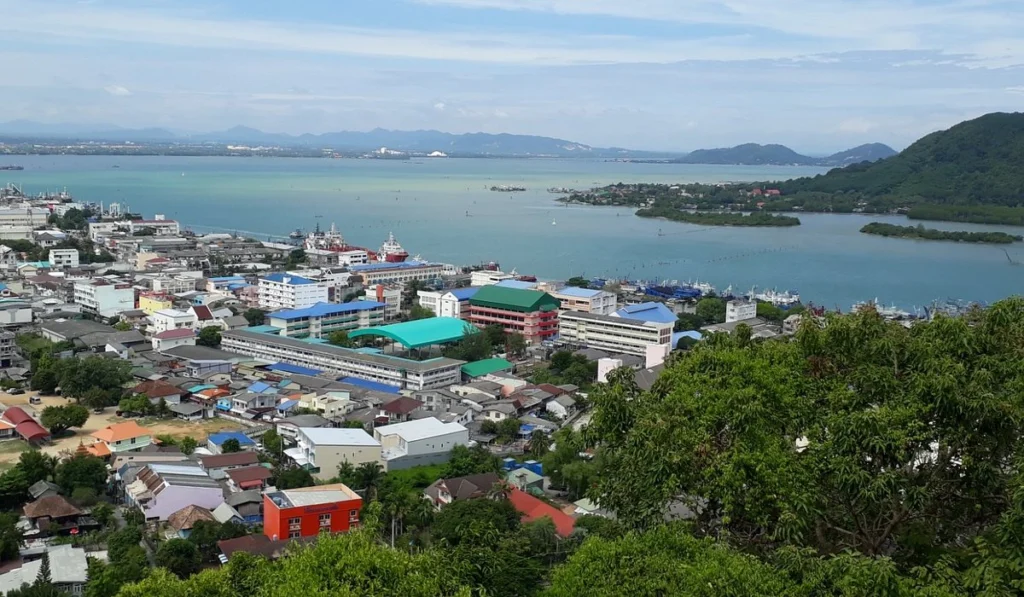
Songkhla doesn’t have its own airport — you fly into the bigger city of Hat Yai, 30 km west.
- Plane to Hat Yai (HDY) → bus/taxi to Songkhla. Flights from Bangkok DMK and BKK, 90 minutes, 1,200–2,500 THB. From Hat Yai airport, taxi to Songkhla city centre is 350–500 THB, 35 minutes. Shared minivan is 50 THB.
- Train. Bangkok Hua Lamphong → Hat Yai (overnight sleeper, 15 hours, 600–1,400 THB). Then bus or taxi to Songkhla.
- Bus. Bangkok Sai Tai Mai → Songkhla, 13–14 hours, 700–1,000 THB. Long but workable.
Once in Songkhla, the old town is small enough to walk in 90 minutes, but rentals (bicycle 80 THB/day, scooter 250 THB/day) make further sights easy.
What to do in Songkhla Old Town
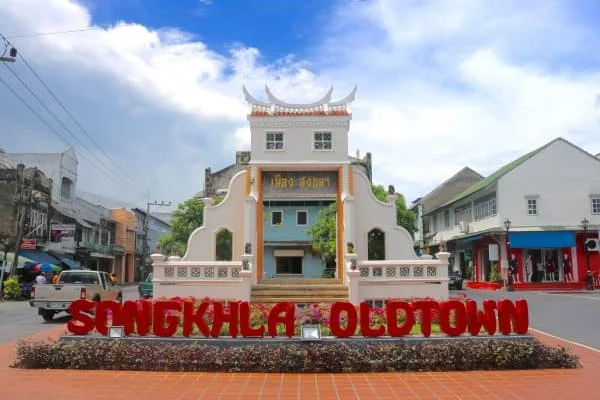
A 2-day rhythm covers it without rushing:
Day 1 — old town walking + Khao Tang Kuan
- Morning: Start on Nakhon Nai Road — the spine of Songkhla Old Town. Walk slowly. The street art (commissioned in 2019) is genuinely good — black-and-white murals of old Songkhla scenes alongside the original Chinese clan shopfronts. Stop at Songkhla Heritage Café (50 THB for proper southern Thai-style coffee with condensed milk) for a sit-down with locals.
- Late morning: Nakhon Nok Road is the parallel street with the second concentration of Sino-Portuguese shophouses. A few have been converted to galleries or guest houses; most are still home to families or working as ground-floor businesses (a noodle stall, a tailor, a hardware shop).
- Lunch: Local kanom jeen stalls on Nang Ngam Road, 30 THB a bowl. Get the nam ya (yellow fish curry) version.
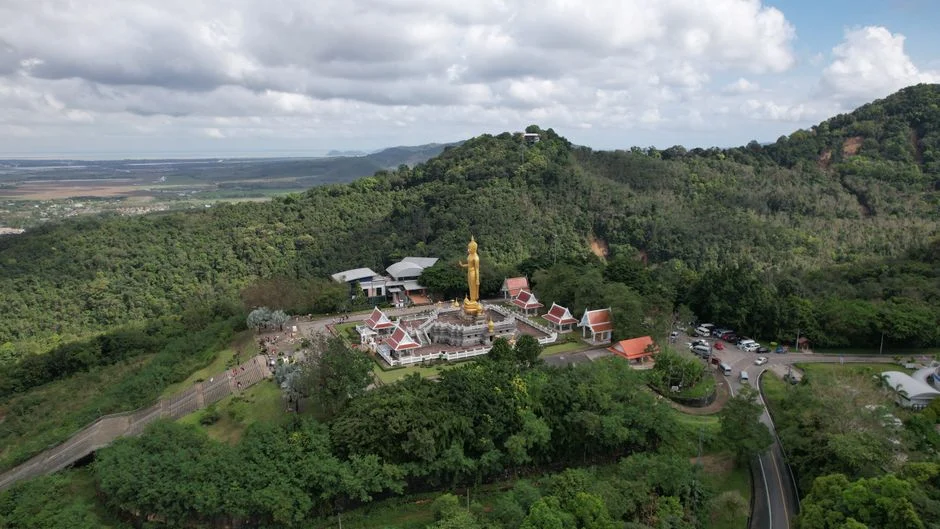
- Afternoon: Khao Tang Kuan — the small mountain (the name means “small foothill”) rising right behind the old town. There’s a 200-step climb to a Chinese-style pavilion at the top with 360° views over the old town, the Gulf, and Songkhla Lake. Free. Best in the cool of late afternoon (16:00–17:30). Bring water.
- Evening: Walk along Samila Beach — the city’s beach side, with the famous golden Mermaid Statue at sunset. The beach is more atmospheric than swimmable. Dinner at one of the seafood shacks at the south end (200–400 THB).
Day 2 — temples and the lake
- Morning: Wat Matchimawat Worawihan — the most important temple in Songkhla Old Town. 17th-century, restored, atmospheric early. Free, 30 minutes.
- Late morning: Songkhla National Museum in a 19th-century Chinese mansion (originally the deputy governor’s residence). Strong display on multi-ethnic Songkhla history. 100 THB, 90 minutes.
- Lunch: Khao mok kai (Malay-influenced chicken biryani) at Nai Wah Roti, 60 THB.
- Afternoon: Hire a longtail boat from the central pier for 90 minutes on Songkhla Lake (500–800 THB, fits 6). The lake is so big you don’t see the far shore.
- Late afternoon: Khao Noi — smaller foothill, temple at the top, fewer steps than Khao Tang Kuan, quieter views.
- Evening: Dinner at Tang Hua Seng — 50-year-old Chinese-Thai seafood institution in the old town, 300–500 THB per person.
A few more things in Songkhla Old Town worth knowing
- The cat-and-mouse statues on Khao Tang Kuan road — three stone cats chasing a mouse — are a Songkhla landmark with a Chinese settler legend behind them.
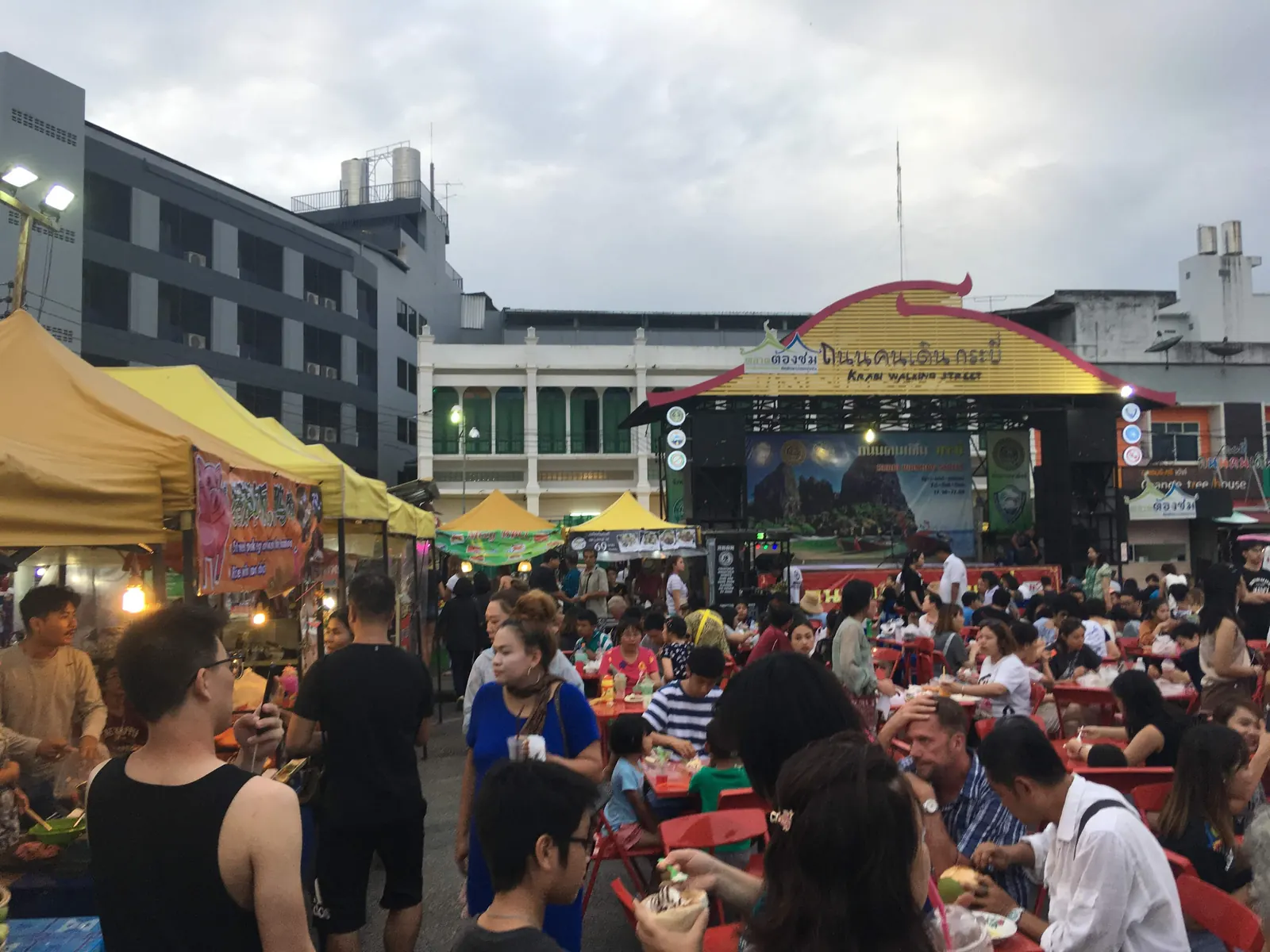
- Songkhla Walking Street runs Saturday and Sunday evenings on Nang Ngam Road (17:00–22:00). Smaller and more local than Chiang Mai or Hua Hin’s versions.
- The fishing pier at the south end is a working pier — boats unload at dawn (05:30–07:00), you can buy direct (whole snapper 80 THB/kg, prawns 350 THB/kg).
When to visit Songkhla Old Town
- December to February: Cool and dry. 22–28°C. The best window.
- March to May: Hot, 32–36°C. Walking the old town gets uncomfortable from 11:00 to 15:00.
- June to August: South-west monsoon — moderate rain, plenty of sunny windows. Visitable.
- September to November: Heaviest rain of the year. Some flooding occasionally affects the lower old town.
The deep south’s two-monsoon climate means there’s usually a wet pocket somewhere. Check the forecast for Songkhla specifically rather than for “southern Thailand” which averages out.
Where to stay in Songkhla Old Town
Staying inside the old town is the point of the trip:
- Budget: Songkhla Old Town Hostel (350–600 THB dorm/private), Pungtai Hostel (450–800 THB).
- Mid-range: Asia Hotel Songkhla (1,000–1,800 THB), Sea Sun Sand Resort & Spa (a few km south at Samila Beach, 1,500–2,500 THB).
- Upscale: BP Samila Beach Hotel (2,500–4,500 THB) — the only proper international-standard option in the city.
For a heritage stay, Le Mae House on Nakhon Nai Road is a restored shophouse with 4 rooms (1,200–2,000 THB), genuinely the right kind of accommodation for this trip.
A Thailand itinerary 7 days can fit Songkhla as a 2-night southern stop after Krabi or instead of one of the Phuket nights. See our Bangkok province guide for the wider context.
Shophouse rooms in the old town are limited — compare Songkhla hotels on Agoda (affiliate link — same price for you) and book the heritage quarter early.
Practical details for Songkhla Old Town
- Safety: The city itself is calm and safe — police presence is normal, locals are friendly. The deep-south travel warning is real for Pattani/Yala/Narathiwat but Songkhla town is essentially unaffected. Don’t drive further south after dark without local advice.
- Mobile signal: Solid 4G in town. Patchy on the lake boat trip.
- Cash: ATMs in town centre. Most shophouse food stalls don’t take card.
- Language: Some Mandarin and Thai spoken; English is patchy but improving as heritage tourism grows.
- Combine with: A side trip down to Hat Yai (30 km west) for the Sunday Khlong Hae Floating Market and Lee Garden Plaza shopping. Or a longer trip across the lake to Phatthalung (covered separately).
Songkhla Old Town for families
Workable but not designed for it:
- Samila Beach + the Mermaid Statue — kids run on the sand.
- Khao Tang Kuan — easy 200-step climb, kids manage it.
- The cat-and-mouse statues are a kid-favourite.
- Songkhla Aquarium (15 km south) — small but well-maintained, 100 THB adults.
Final thoughts on Songkhla Old Town
Songkhla Old Town is what Penang Georgetown was twenty years ago — a real Sino-Portuguese port city that hasn’t been buffed for tourism, with all the consequences (the food is cheaper, the shophouses are dustier, the locals haven’t learned to overprice the trinkets) and all the benefits (you have a proper walking street largely to yourself, the cafés are local, the seafood prices haven’t been inflated). The travel warning keeps Western tourism low and the place keeps its character. Two nights is the right shape. Anyone serious about Thai port history or quietly photogenic streets should put Songkhla Old Town on their itinerary.
FAQ
Is Songkhla safe to visit?
Songkhla city itself is calm and safe. The deep-south insurgency is in Pattani, Yala, and Narathiwat provinces (south of Songkhla). Songkhla town has had essentially no insurgency-related incidents in years.
How do I get to Songkhla?
Fly into Hat Yai (HDY) and take a 35-minute taxi (350–500 THB) or shared minivan (50 THB) the 30 km to Songkhla city. Train and bus are slower alternatives.
Is Songkhla Old Town worth visiting?
Yes — particularly if you’re interested in heritage architecture, multi-ethnic Thai history, or want a quieter alternative to Phuket Old Town or Penang. Skip if your trip is under 8 days and you’ve prioritised beaches.
How long do I need in Songkhla Old Town?
Two days is the right shape — one for the old town and Khao Tang Kuan, one for the temples, museum and lake. Three days if you also want a Hat Yai side trip.
What’s the best time of year for Songkhla?
December to February — cool, dry, predictable. Avoid September–November for the wettest weeks.
Where should I eat in Songkhla?
Nakhon Nai and Nang Ngam roads for street food at 30–80 THB. Tang Hua Seng for sit-down Chinese-Thai seafood. The Saturday walking street on Nang Ngam for evening browsing.
What’s the deal with the Mermaid Statue?
The Golden Mermaid on Samila Beach is the city’s most-photographed landmark, installed in 1966 based on a Thai folktale. Sunset is the time.
Related guides
- Nakhon Si Thammarat Night Market: The Southern Thai Food Scene Tourists Keep Missing
- Where to Stay in Phuket: The Complete 2026 Guide
- Koh Samet From Rayong: The Beach Weekend That Beats Pattaya
Explore the Deep South
- Songkhla Travel Guide
- Phatthalung Travel Guide
- Pattani Travel Guide
- Yala Travel Guide
- Narathiwat Travel Guide
Book the trip
Some links below are affiliate links. If you book through them we may earn a small commission at no extra cost to you — it helps keep Destination Thailand independent.
Getting here: Songkhla has no station and no airport of its own — you come via Hat Yai, half an hour down the road. Book trains, buses or flights to Hat Yai on 12Go, then let a songthaew do the rest.