Southern · Thailand
Pattani · ปัตตานี
Krue Se mosque, Malay Muslim culture, Pattani Bay fishing villages.
- Region
- Southern
- Population
- 738,000
- Area
- 1,940 km²
- Stories filed
- 1
About Pattani
History
Pattani was the most powerful Malay Islamic sultanate on the Thai-Malay peninsula from the thirteenth to the eighteenth centuries, its port at the mouth of the Pattani river the commercial hub of a trading network connecting Persia, India, China, and Java. It was absorbed into Siamese administration in stages between 1786 and 1909 and has contested that annexation intermittently since; the current insurgency, which began in 2004, reflects deep historical grievances. The province remains majority Malay-Muslim; Yawi (a Malay dialect) is the everyday language, and Islamic law governs personal matters in ways not replicated elsewhere in Thailand.
Landscape & geography
A long Gulf of Thailand coastline with a wide, sheltered bay that gives the provincial town its name and historical significance as an anchorage. The interior is low-lying rice and rubber country, cross-cut by irrigation canals and rising gently toward the Titiwangsa range on the Malaysian border. The Pattani river bisects the town, its banks flanked by Chinese shophouses and Malay fishing wharves in an urban waterfront that has changed little in outline since the nineteenth century.
Why visit
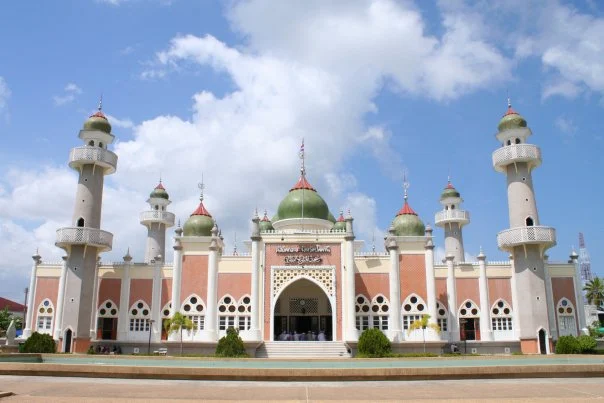
The province has been under a government travel advisory since 2004; most foreign governments counsel caution. Travellers who choose to go find a culturally significant destination largely inaccessible to the standard tourist circuit: the Krue Se mosque — a sixteenth-century structure whose incomplete roof was left unfinished after an attack and never repaired — is one of Thailand's most historically charged monuments. Pattani town's old Chinese waterfront, its Malay food stalls, and the Matsayit Klang mosque are among the peninsula's most authentic cultural concentrations.
Stories from Pattani
Articles, reviews, and itineraries tagged to this province.