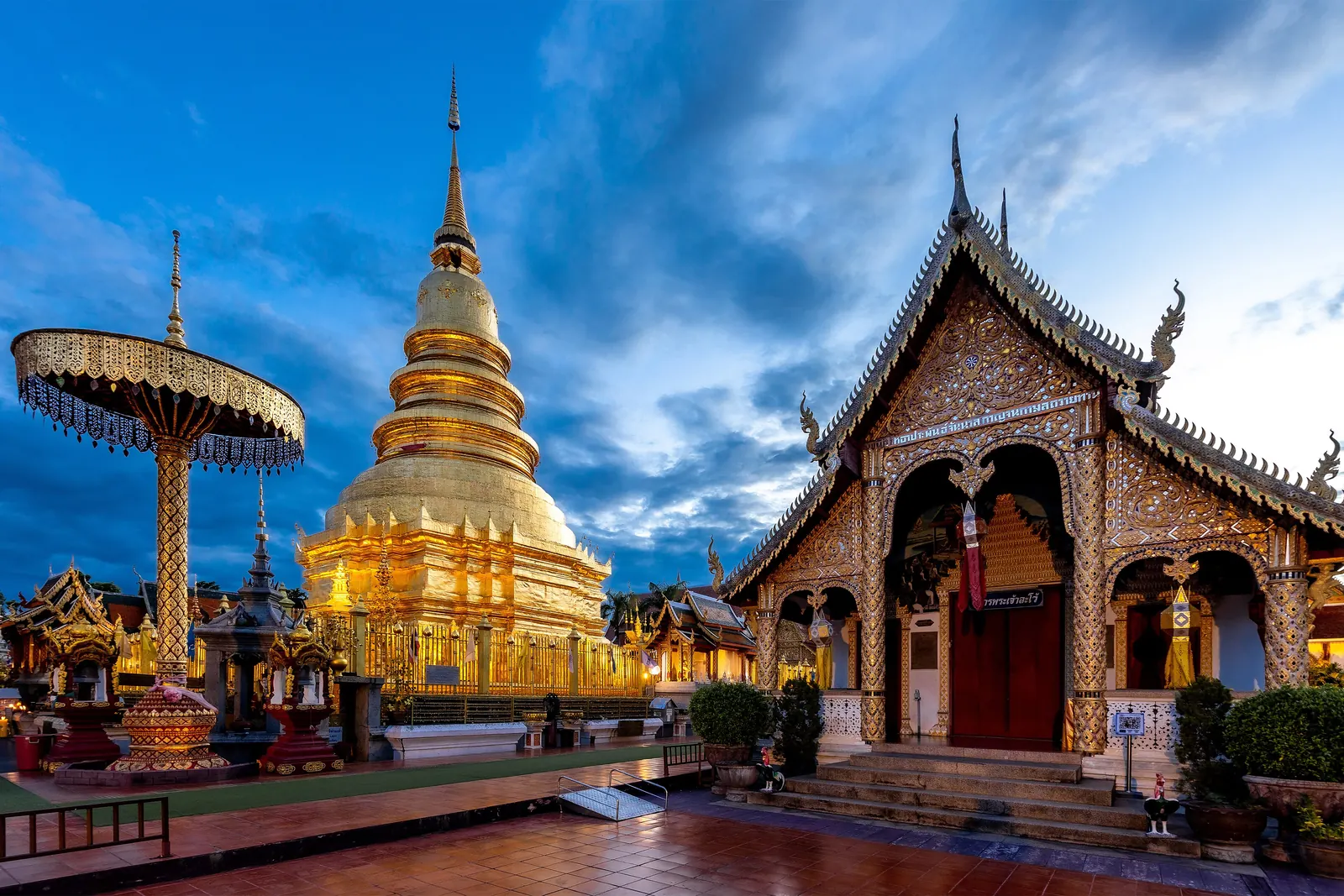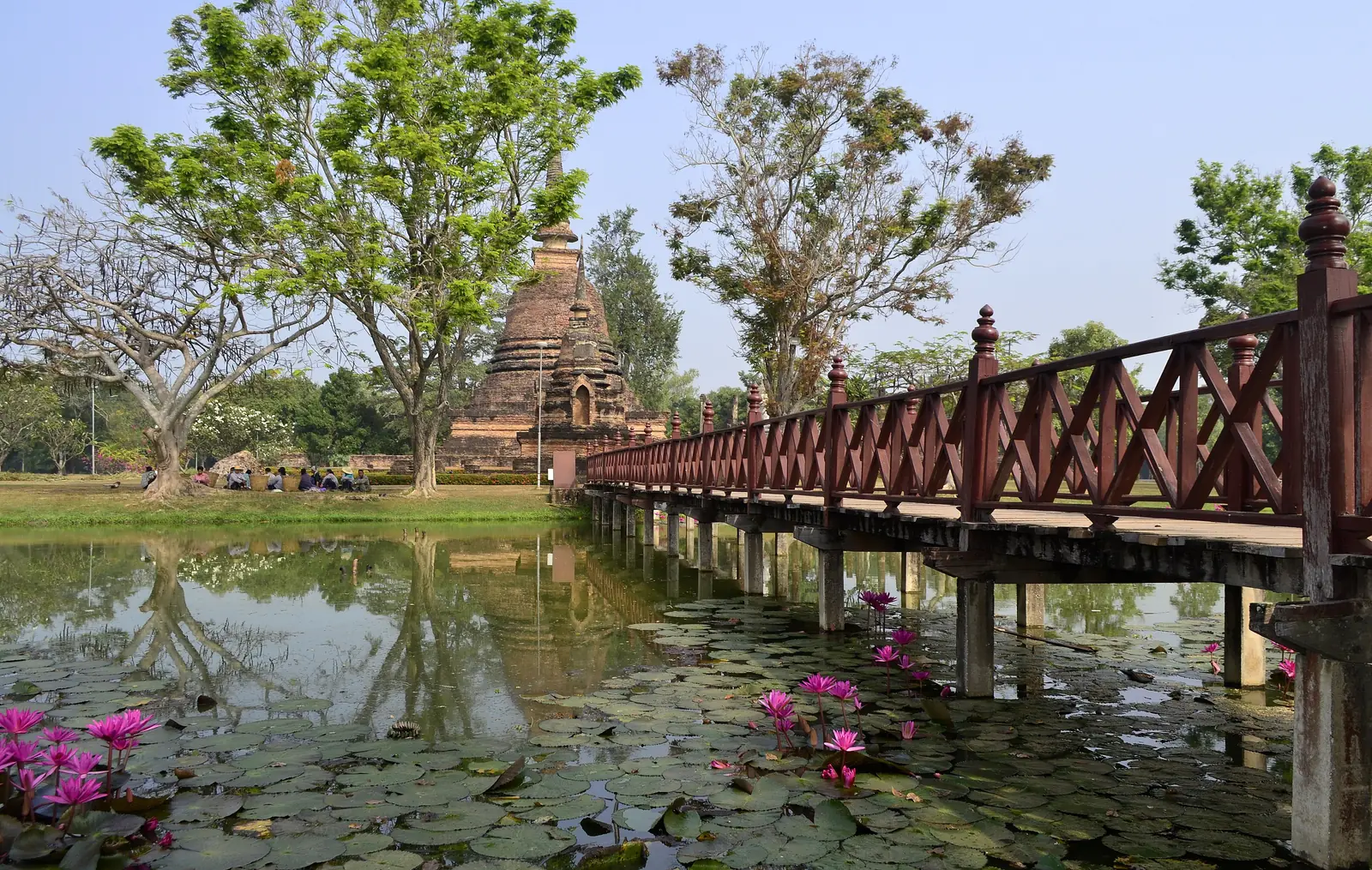
Lampang is the province the Chiang Mai minivans drive straight through, which is the best thing that ever happened to it. Ninety minutes down Highway 11 it still runs horse carts as transport, makes the rooster bowl every noodle stall in Thailand serves from, and keeps Wat Phra That Lampang Luang, the finest surviving wooden temple in the Lanna world, in a rice-field village with barely a coach park. Most people who know the name know one photograph: an upside-down golden chedi projected through a pinhole onto a cloth in a dark room.
The short version: one day from Chiang Mai does the temple, a horse cart and the ceramics museum, if you take the 07:30 train down and the 15:59 back. The weekend walking street and the cliff-top pagodas at Wat Chaloem Phra Kiat need a night. The government elephant centre is defensible, with caveats. Here is every stop with a fee, an hour to go and a verdict, as of November 2026.
The full province, food and all, is in our Lampang travel guide, the map on the Lampang province page; the stop on the railway before it is our Lamphun day trip from Chiang Mai. Prices are checked against our Thailand Price Index; estimates say “around”. Nothing was comped.
Lampang in a day: what fits from Chiang Mai, and what needs a night
| Stop | Where | Fee (foreigner) | Time needed | Fits a day trip? | Verdict |
|---|---|---|---|---|---|
| Wat Phra That Lampang Luang | Ko Kha, 18 km south-west of town | Free to around ฿40 | 1–1.5 h plus 30 min each way | Yes | Do it |
| Horse cart | Town centre stands | ฿150–300 per carriage, published | 20–60 min | Yes | Do it, once |
| Dhanabadee Ceramic Museum | Town | ฿100 | 1 h | Yes | Worth it |
| Kad Kong Ta walking street | Talad Gao Road, by the Wang | Free | 2 h | Only on Sat/Sun evenings, then you miss the last train | Do it if you stay |
| Wat Chaloem Phra Kiat | Chae Hom, around 60–70 km north-east | ฿290 incl. shuttle truck | Half a day with the drive | No | Do it, with a car and a night |
| Thai Elephant Conservation Center | Highway 11, between Lampang and Chiang Mai | Around ฿200 | 2–3 h | Only by car | Fine: hospital yes, show skip |
Wat Phra That Lampang Luang: the camera obscura, the bullet hole and the best hour
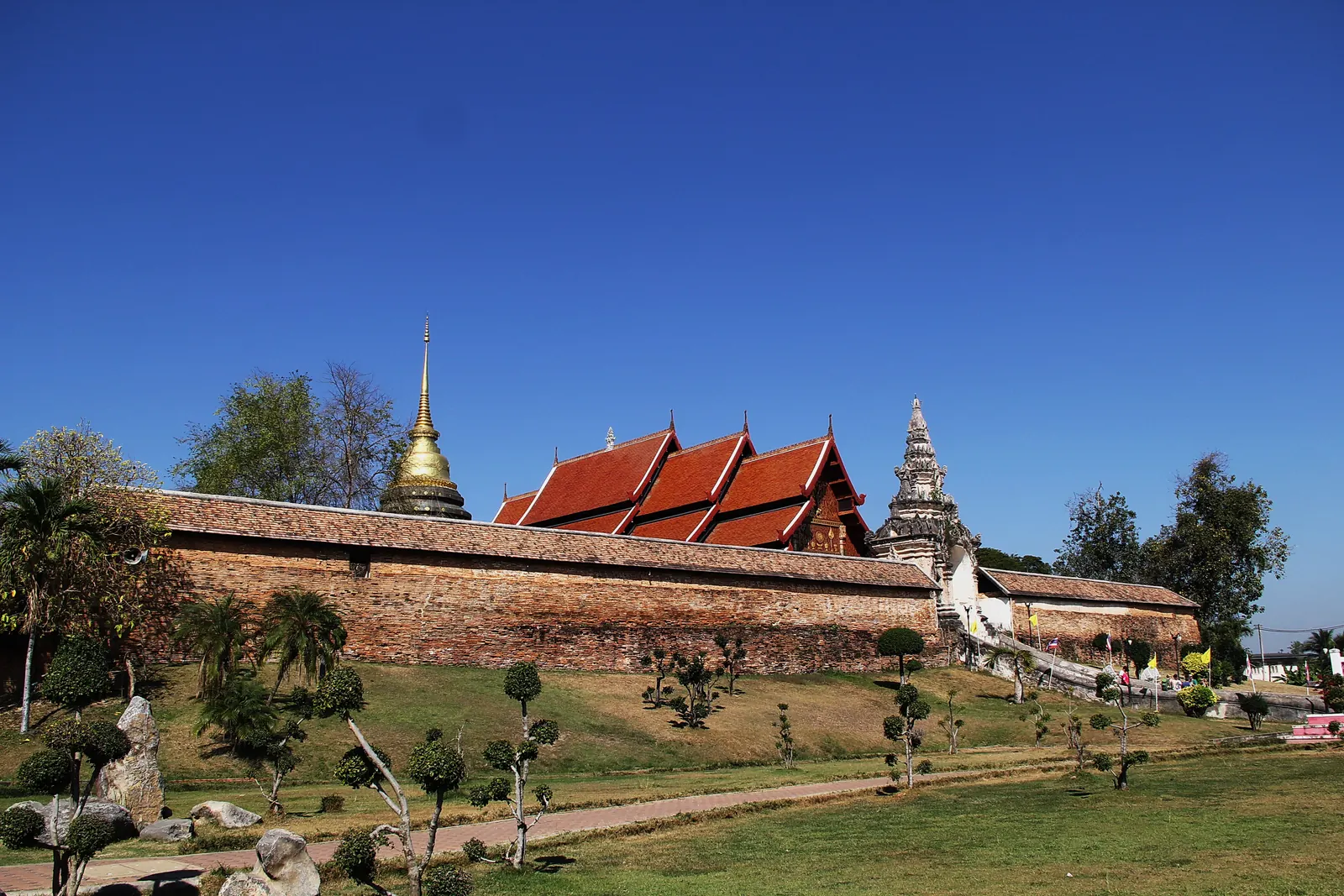
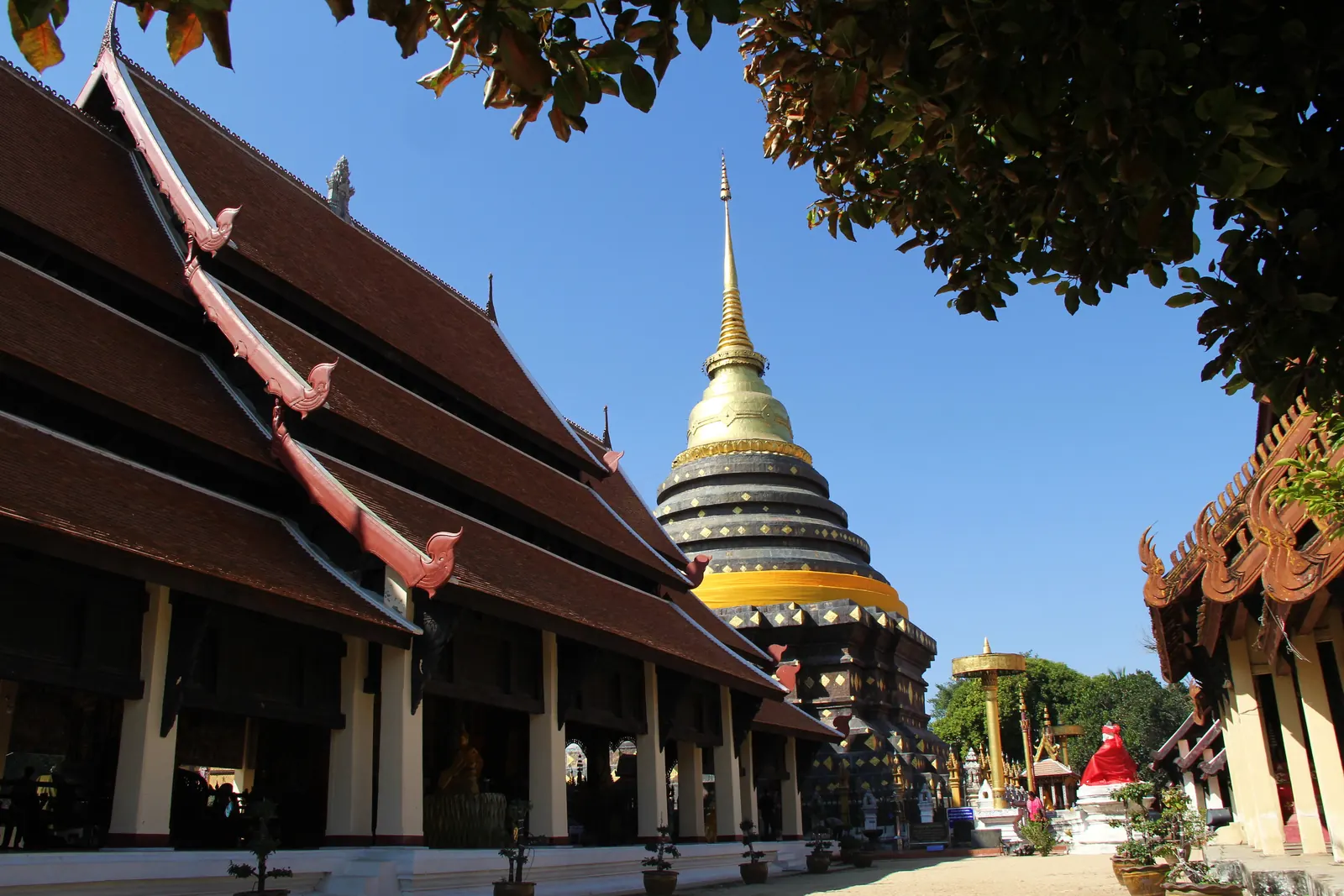
What it is. A fortified temple on a mound: brick walls, a naga stairway up to a single gate, and inside, the open-sided Viharn Luang, a late-fifteenth-century hall of dark teak with no walls at all, only pillars and a three-tiered roof dropping so low you duck. At the back stands a gilded ku, a Lanna shrine-tower housing the main Buddha, and behind the halls the chedi, around 45 m of brick sheathed in metal plates gone green-bronze with age. This is what Chiang Mai’s temples looked like before they were rebuilt in concrete, and the reason the north’s architects come here to measure things. Compare it with the restored originals in our Chiang Mai temples guide and the difference is obvious.
The camera obscura. In a small, dark building by the Buddha footprint, a pinhole in the door throws a live, inverted image of the chedi onto a white cloth on the far wall: colour, sky and all, with no lens. It works best in strong late-morning sun. The catch: that building, like many Lanna footprint shrines, admits men only. There is a second projection in a hall open to everyone, so nobody misses out; ask a monk or the attendant which door. The chedi’s railing also carries a hole said to come from a musket ball fired in the 1730s by Thip Chang, the local hunter turned prince, at the Burmese commander holding the temple. It is a good story; nobody sensible will swear to the hole.
Fee and hours, as of November 2026. Thais enter free. Foreigners have recently been asked anything from nothing to ฿40 at a desk below the steps, which matches our own Lampang page’s “donation”; carry small notes and do not argue either way. Open roughly 07:30–17:00. Shoulders and knees covered and shoes off in the halls, as in our temple etiquette guide. Best hour: 08:00–10:00 on a weekday, before the Thai coach groups at weekends, and with the sun high enough by ten for the projection.
Getting there. There is no useful direct bus. From Lampang town a Grab is around ฿250–350 each way and may leave you hunting for a return; a yellow songthaew or tuk-tuk chartered for the round trip with an hour’s wait is around ฿500–800 after a short negotiation, and a scooter is ฿200–300 a day for anyone licensed. Verdict: do it. Of the big northern temples, this is the one we would keep if we could keep only one. Ninety minutes is enough.
Lampang horse carts: what a ride costs and whether it is fair on the horse
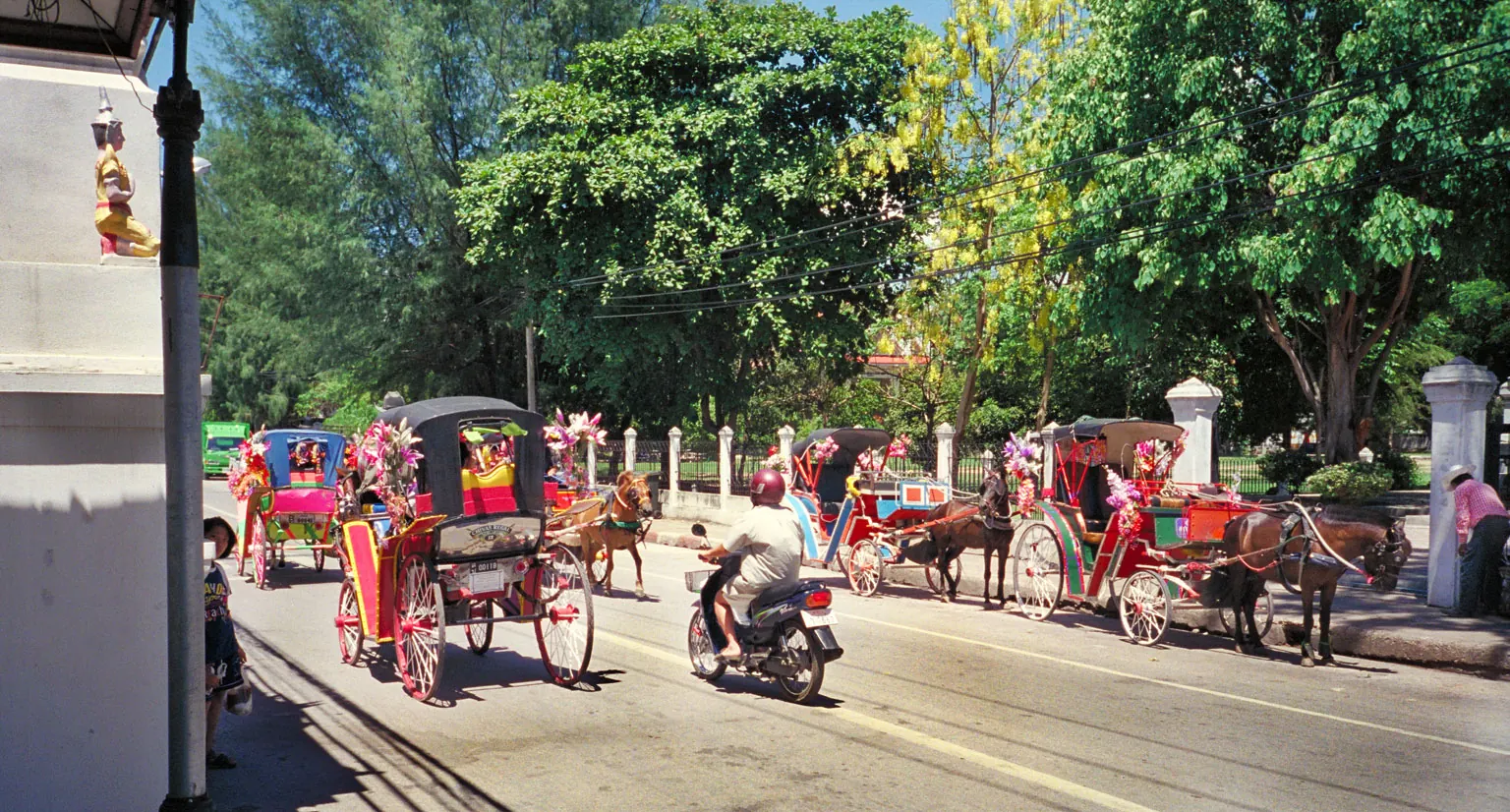
What it is. Lampang is the last Thai town where horse-drawn carriages, introduced in the Rama V era, never stopped working, and it now puts them on its signposts. They wait at stands around the centre, by the City Pillar shrine, near the station and around the old market quarter, painted, flowered and driven by members of the local carriage association.
Fare. The municipality publishes three fixed prices: ฿150 for the short town loop of about 20 minutes along Thip Chang Road’s old shophouses, ฿200 for the 40-minute circuit that adds Kelang Nakhon park and Assawin market, and ฿300 for an hour on a route of your choosing. Those are per carriage, not per person, and the boards at some stands have lately shown more, so check before you climb in; budget ฿200–500. The horse. Loops are short, the trade is licensed and the horses are a point of civic pride, but rides at 14:00 in April are no kindness: go early or late, pick an alert horse in shade, and walk away from a thin one. Verdict: do it once, for 20 minutes, at the cool end of the day. The 40-minute loop is a long time to look at a horse’s back.
Dhanabadee Ceramic Museum: is the chicken bowl worth ฿100?
What it is. The factory and museum of Dhanabadee, the oldest of Lampang’s ceramics works, founded in the 1950s by a Chinese immigrant potter after kaolin clay was found in the province. Its product was the cham kai, the white bowl with a hand-painted red rooster that became the default noodle bowl of Thailand and now turns up as a design object in shops that charge ten times the price. The tour covers the brick dragon kiln, the hand-throwing and painting, and how a provincial town became the crockery capital of the country; there is a paint-your-own-bowl corner, charged extra.
Fee and hours. ฿100 for foreign adults, ฿60 for Thais, under-13s and over-60s free; open daily, roughly 09:00–17:00. An hour covers it. The shop sells the real thing: around ฿100–300 for a standard rooster bowl, more for the big hand-painted pieces, and it outlasts the market copies by decades. Verdict: worth it. One of the few factory museums in Thailand that is more museum than gift shop, and it gives the noodle bowl you will eat from tonight a back story.
Kad Kong Ta: Lampang’s weekend walking street, and why it costs you a night
What it is. Every Saturday and Sunday from about 17:00 to 21:00, Talad Gao Road along the Wang River closes to traffic and fills with food stalls, crafts and half of Lampang out for a walk. The setting is the point: the old teak-trade quarter, Burmese, Chinese and British-trader shophouses in brick and carved teak, still lived in. It is smaller and calmer than Chiang Mai’s Sunday market and does not feel like it was built for you.
What to spend. Snacks are ฿20–60, a proper graze ฿200; take a bag of khao taen, the palm-sugar rice crackers that are Lampang’s signature, for around ฿50, and find the northern dishes in our northern Thai food guide. The catch: the market opens as the 15:59 train to Chiang Mai is leaving, and the last vans back are early evening, so Kad Kong Ta means a night in Lampang or a ฿1,500–2,000 private car home. Verdict: do it if you stay. Plan the trip on a Saturday and it becomes the best evening of the week.
Wat Chaloem Phra Kiat: the cliff-top pagodas, the ฿290 truck and the climb
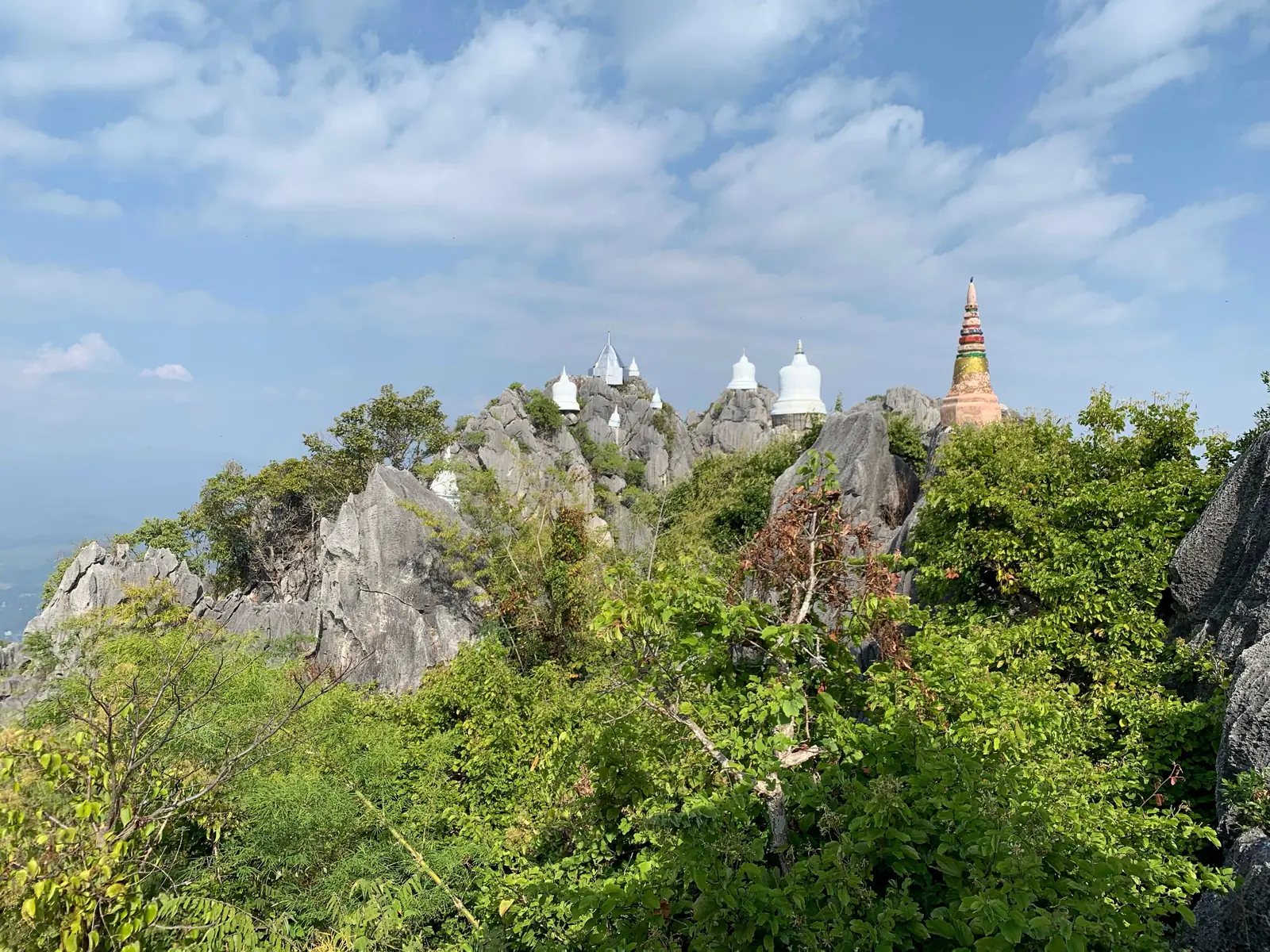
What it is. In Chae Hom district, around 60–70 km north-east of town, white and gold pagodas stand on the tips of limestone pinnacles at around 800 m, as if dropped there. Built by monks and villagers over roughly a decade from 2004 to honour King Mongkut’s bicentenary, it is the temple Thai social media decided had inspired a Louis Vuitton runway set, which did its visitor numbers no harm. It is now officially registered as Wat Phra Phutthabat Sutthawat; nobody calls it that.
Fee, access and status, as of late 2026. Open and operating. You drive to the base, buy a ticket and ride a shared songthaew up a narrow, frighteningly steep road for ten minutes; the truck waits until it is half full. Foreign adults pay ฿290 including the round trip (foreign children ฿180, Thais ฿120). Tickets are sold 07:30–16:00 on weekdays and from 07:00 at weekends and on holidays. From the drop-off it is a steep stair climb of around 20–30 minutes to the main viewpoint; bring water and knees. There is no public transport: a car and driver from Lampang for the half day is around ฿1,500–2,500, and from Chiang Mai it is a 170 km day. Verdict: do it, with a car, first thing, on a clear cool-season day. In March and April the view is a grey wall; see our burning season guide.
The Thai Elephant Conservation Center: an honest welfare verdict
What it is. The state elephant institute, run by the Forest Industry Organization off Highway 11 between Lampang and Chiang Mai: retired working elephants, the royal elephant stables, a mahout school and the elephant hospital that treats the hardest cases in the country, landmine injuries included. It is not a private camp and not a sanctuary in the sense our ethical elephant sanctuaries guide uses the word.
The honest part. The visitor programme still includes a twice-daily show, around 10:00 and 13:30, with log-hauling demonstrations and elephants painting, and at times short rides; those are exactly the activities welfare groups ask visitors not to pay for. The bathing sessions before each show, around 09:45 and 13:15, are elephants in a river with their mahouts, and the hospital is the real work. Entry is around ฿200 for foreigners, feeding baskets around ฿50. Times shift by season; call ahead. Verdict: fine, selectively. Go for the bathing and the hospital, put the money in the feeding basket rather than a ride, and leave before the painting. If you want to spend a whole day with elephants, do it at a no-riding sanctuary instead.
Getting to Lampang from Chiang Mai or Bangkok: train, bus or car
| Option | Times (as of the 2026 timetable) | Journey | Cost one way | Verdict | Book |
|---|---|---|---|---|---|
| Train from Chiang Mai | 07:30 (#8), 09:35 (#408), 15:30 (#52); back 09:31, 12:43, 15:59 | 2–2.5 h | around ฿25–40 third class, around ฿150–300 in second | Do it: the 07:30 down, the 15:59 back | Chiang Mai to Lampang on 12Go |
| Bus or van from Chiang Mai | Roughly hourly from Arcade | 1.5–2 h | around ฿80–150 | Fine; the flexible return | Lampang to Chiang Mai on 12Go |
| Car and driver from Chiang Mai | Your hours | 1.5 h each way | around ฿2,500–3,500 the day | Best for three or four, adds the elephant centre | — |
| Train from Bangkok | 07:30 (#7, day) or 20:05 (#13, sleeper) | 8.5–10.5 h | around ฿700–1,000 sleeper | Do it: the #13 arrives 06:38 | Bangkok to Lampang on 12Go |
| Bus from Bangkok | Day and night, Mo Chit | 8–9 h | around ฿450–700 | Fine if the train is full | Buses on 12Go |
The day-trip plan: the 07:30 Special Express #8 from Chiang Mai (reserved air-con seats) reaches Lampang at 09:30. A yellow songthaew into town is ฿20; charter one, or a tuk-tuk, straight to Lampang Luang for 10:00. Back in town for lunch by 12:30, Dhanabadee at 13:30, a horse cart at 14:45, and the 15:59 Special Express #7 to Chiang Mai, arriving 17:50, which comes up from Bangkok and is often full in season, so book it the day you book the outbound. Missed it? The vans run into the evening — Lampang to Chiang Mai. Leaving the north altogether, Lampang to Bangkok has the #10 sleeper at 20:24, and the full Chiang Mai–Bangkok picture is in our Bangkok to Chiang Mai guide. For a guided version, Lampang day tours on GetYourGuide are mostly private cars from Chiang Mai.
Where to stay in Lampang for the weekend market and the cliff temple
Stay by the river, in or near the Talad Gao quarter, and Kad Kong Ta is outside your door. The Riverside Guest House is the long-standing pick: old teak buildings on the Wang, creaking floors and rooms from around ฿800–1,200, the kind of place that books out on market weekends. Wienglakor Hotel is the central four-star for people who want a lift and a breakfast buffet, from around ฿1,000–1,600. Lampang River Retreat is the four-star resort option outside the centre, from around ฿1,500–2,500, and only makes sense with your own wheels. The best bed in Lampang costs less than a mediocre one in Chiang Mai.
When to go: November to February, cool, dry and clear; June to October is green and quiet between showers; March and April are burning season and the north’s views vanish. The country-wide calendar is in best time to visit Thailand. Onward, Phrae is two hours east (our Phrae travel guide) and Nan beyond it; for the other headline temples of the north, see Chiang Rai’s big three, ranked.
Wat Phra That Lampang Luang and Lampang: your questions, answered
How much does Wat Phra That Lampang Luang cost to enter?
Very little. Thais enter free, and foreign visitors have recently been asked anything from nothing to around ฿40 at a desk below the steps, depending on the day; treat it as a donation and carry small notes. The temple is open roughly 07:30 to 17:00. Getting there costs more than getting in: around ฿250–350 each way by Grab from Lampang town, or ฿500–800 for a chartered round trip.
Can women see the camera obscura at Wat Phra That Lampang Luang?
Yes, though not in every building. The best-known projection, in the small shrine beside the Buddha footprint, follows the Lanna tradition of admitting men only. A second pinhole projection of the inverted chedi appears in a hall that everyone may enter, so ask the attendant or a monk which door. Strong late-morning sun gives the clearest image; on an overcast day it is faint.
Can you do Lampang as a day trip from Chiang Mai?
Yes, for the essentials. Take the 07:30 Special Express from Chiang Mai, arriving 09:30, see Wat Phra That Lampang Luang, the Dhanabadee ceramic museum and a horse cart, and return on the 15:59, which reaches Chiang Mai at 17:50 and should be booked ahead. The Kad Kong Ta weekend market and the cliff-top pagodas at Wat Chaloem Phra Kiat need an overnight stay.
How much is a horse cart ride in Lampang?
The municipality’s published fares are ฿150 for a 20-minute town loop, ฿200 for a 40-minute circuit and ฿300 for an hour on a route you choose, per carriage rather than per person. Some stands have lately quoted more, so check the board before setting off and budget ฿200–500. Ride in the early morning or late afternoon, when it is cooler for you and for the horse.
Is the Thai Elephant Conservation Center in Lampang ethical?
Partly. It is a government institute with vets and an elephant hospital that treats injured animals from all over Thailand, which no roadside camp can claim. But its visitor programme still includes shows with painting and log-hauling, and at times rides, which welfare groups advise against. Watch the river bathing, visit the hospital, skip the show and rides; entry is around ฿200.
Related guides
- Lampang: Horse Carts and the Temple Louis Vuitton Copied
- Lamphun Day Trip From Chiang Mai: Hariphunchai and Khun Tan, Costed
- Ethical Elephant Sanctuaries in Thailand: How to Tell the Real From the Rebranded (2026)
Book the trip
Some links in this guide are affiliate links. If you book through them we may earn a small commission at no extra cost to you — it helps keep Destination Thailand independent.
Hotels: browse Lampang hotels on Agoda and book the riverside quarter early for Saturday nights. Tours/Boats: GetYourGuide’s Lampang listings cover private day trips from Chiang Mai, the cliff-top pagodas included. Getting there: Chiang Mai to Lampang and Bangkok to Lampang trains and buses are on 12Go, with the wider route in our Bangkok to Chiang Mai transport guide. Not sure the north is your Thailand at all? Our Where to Go in Thailand matcher scores all 77 provinces against your month, your budget and what you actually want.