Type Ang Thong Thailand into a search engine and half of what comes back is a marine park: 42 limestone islands rising out of the Gulf near Ko Samui, roughly 700 kilometres south of the place this guide is about. Forget those. This Ang Thong is a small, flat, rice-growing province on the central plains about an hour past Ayutthaya, and the tourism industry has more or less forgotten it exists. That is precisely the point of going.
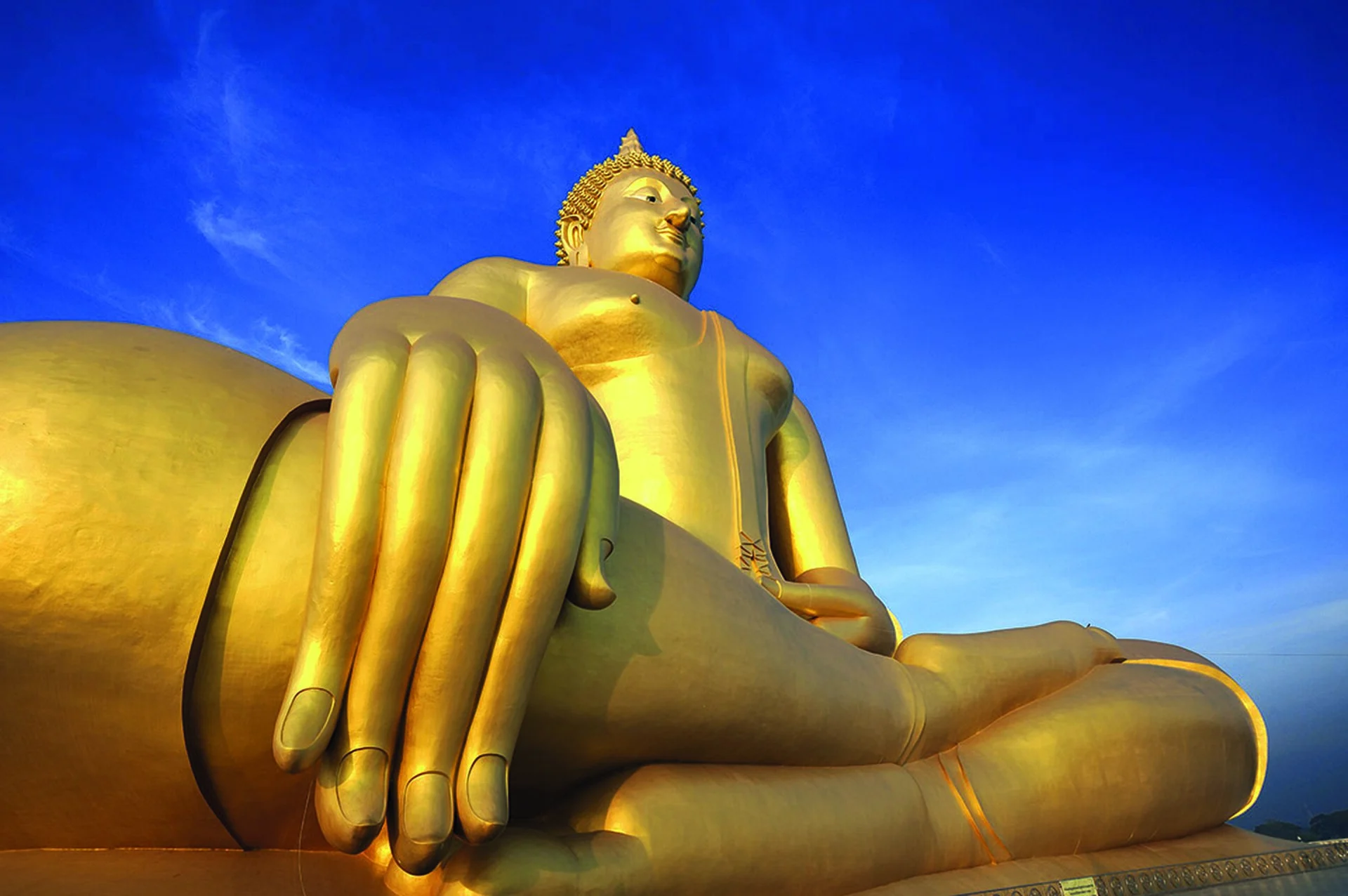
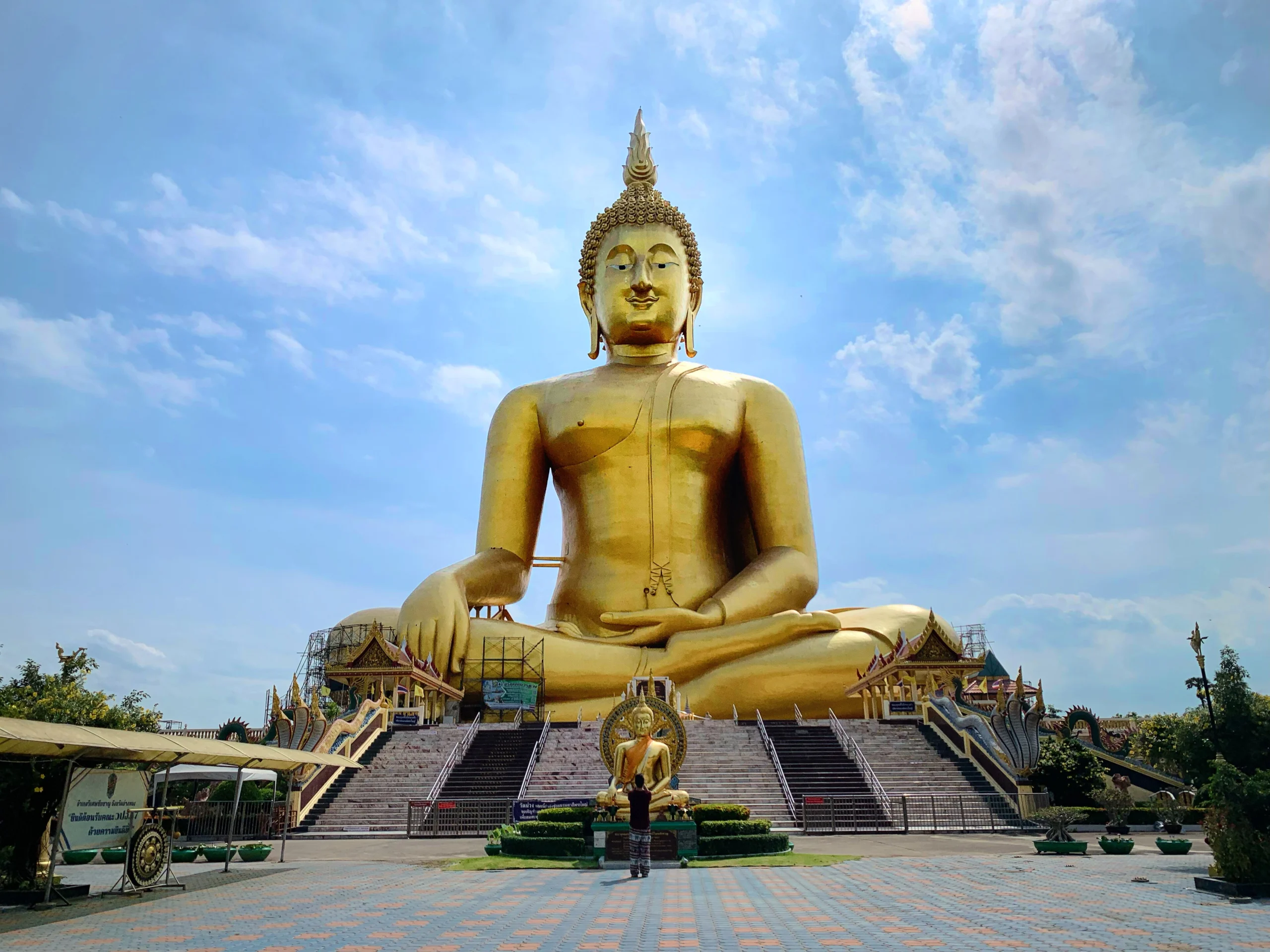
Because standing in a field in Wiset Chai Chan district is the largest Buddha statue in Thailand: 92 metres of gold-painted concrete, visible from ten kilometres away across the paddies. No queue, no coach park the size of an airfield, no man insisting you need a wooden frog that croaks.
This guide covers the giant, the reclining Buddha that has lain under open sky since Ayutthaya burned in 1767, the royal drum and doll villages, and how to bolt the lot onto an Ayutthaya trip. For the quick statistics, see our Ang Thong province profile.
What Ang Thong really is
Ang Thong means golden basin, and for once a Thai place name is a literal description: a shallow bowl of rice country fed by two rivers, the Chao Phraya and the Noi. It is one of the smallest provinces in Thailand at roughly 970 square kilometres, with no mountains, no coastline and no railway station. The capital is a modest market town, and everything around it is temples, craft villages and green fields running flat to the horizon.
What the province does have is a ridiculous concentration of superlatives for somewhere this size: the biggest Buddha in the country, one of the longest reclining Buddhas, and villages making royal ceremonial drums, palace court dolls and prize-winning bamboo weave. Ang Thong is what the central plains looked like before mass tourism arrived, largely because mass tourism never bothered to arrive.
Why go to Ang Thong
Three reasons. First, the sights are properly first-rate, not consolation prizes. A 92-metre Buddha is a 92-metre Buddha; it does not become less astonishing because nobody wrote an Instagram caption about it. Second, the emptiness. Ayutthaya, forty minutes down the road, processes coachloads by the thousand; Ang Thong on a Tuesday is you, the rice and the temple dogs. Third, the economics: entry to almost everything is free or a donation, a fiery bowl of noodles costs ฿50, and the most expensive thing you can do all day is over-order river prawns.
Getting to Ang Thong
From Bangkok, buses and minivans leave Mo Chit (the Northern Bus Terminal) for Ang Thong town throughout the day, running up Highway 32. Count on about two hours and ฿80-120 depending on the service. Driving yourself takes around an hour and a half outside rush hour, and having your own wheels transforms the whole day, because the sights are scattered across four districts.
There is no railway; the nearest station is Ayutthaya. Take a train up from Krung Thep Aphiwat (฿20-70, about 90 minutes), then a minivan for the last 45 minutes, around ฿50 — which is why the sane play is treating this as a day trip from there.
Once in the province, Grab exists in name rather than in practice. Charter a songthaew or a local driver for the loop of Wat Muang, Wat Khun Inthapramun and the craft villages; agree the price before you get in, and expect somewhere around ฿1,000-1,500 for a full day depending on your negotiating face.
Where to stay
The honest answer: most people should not stay, and Ang Thong will not be offended. Base yourself in Ayutthaya, where the guesthouse choice is fifty times deeper, and come over for the day.
If you do want a night here, the town has clean, unremarkable hotels near the market in the ฿400-800 band. Along the Chao Phraya towards Pa Mok there is a small clutch of riverside resort-style places at ฿800-1,500 where you get a deck over the water and grilled fish delivered to it, which is the only version of an Ang Thong overnight worth arguing for.
What to eat in Ang Thong
River food, and lots of it. The riverside restaurants near the piers in Pa Mok and Chaiyo grill giant freshwater prawns (kung mae nam pao) over charcoal and sell them by the kilo — expect ฿400-800 depending on size. Roadside stalls along Highway 32 do whole snakehead fish baked in a salt crust (pla chon pao) for ฿100-150, eaten with fistfuls of basil and a chilli-lime sauce that means business.
In town, the morning market feeds you noodles and rice-and-curry for ฿40-60 a plate, and the stall rows outside Wat Muang sell old-fashioned Thai sweets — coconut, palm sugar, sticky rice in banana leaf — made by people who have been making them since before you were born.
Top things to do in Ang Thong
1. Stand under the Great Buddha of Wat Muang
Phra Buddha Maha Nawamin, 92 metres of seated, golden, faintly smiling enormity in Wiset Chai Chan district — the largest Buddha statue in Thailand and among the tallest statues anywhere on the planet. Finished in 2008 after nearly two decades of donation-funded building, it looms over the paddies long before you reach the gate, which does something to your sense of scale that photographs refuse to capture.
Walk up the steps to the base and you can press your forehead against the fingertips, as Thai visitors do for blessings — each finger is taller than you are. There is no ticket, only donation boxes. Go early: the light is better, and by 11am the concrete apron doubles as a griddle.
2. Walk the hell garden below it
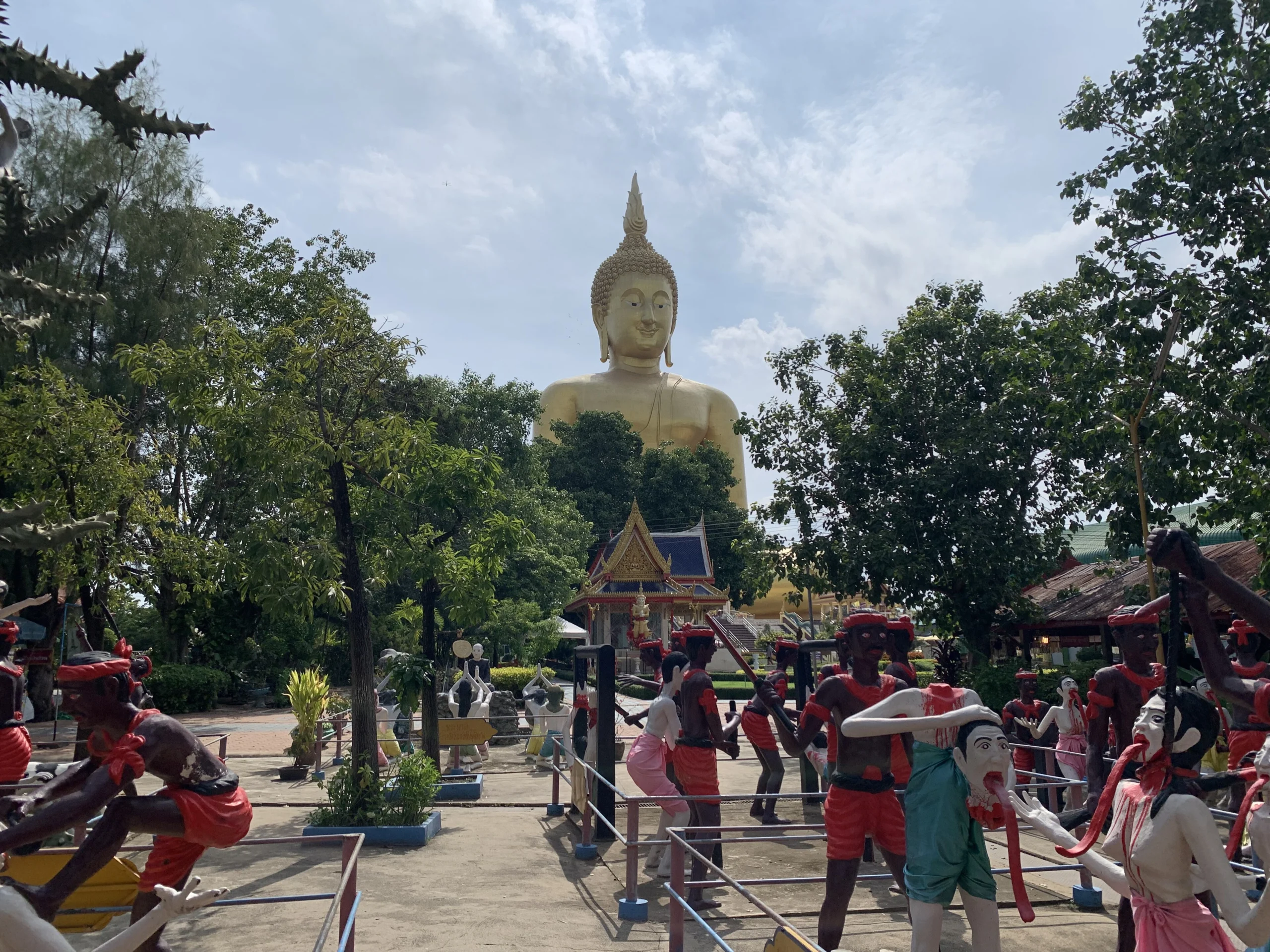
In the grounds beneath the Great Buddha, Wat Muang keeps a sculpture park depicting Buddhist hell, and it does not do subtlety. Emaciated sinners with metre-long tongues, adulterers climbing thorn trees, the dishonest being boiled in a cauldron by cheerful demons. It is gruesome, garish and completely sincere — a morality lesson built in concrete. Free to wander, and worth a second thought if you are travelling with small children who ask questions.
3. See the reclining Buddha that sleeps outdoors at Wat Khun Inthapramun
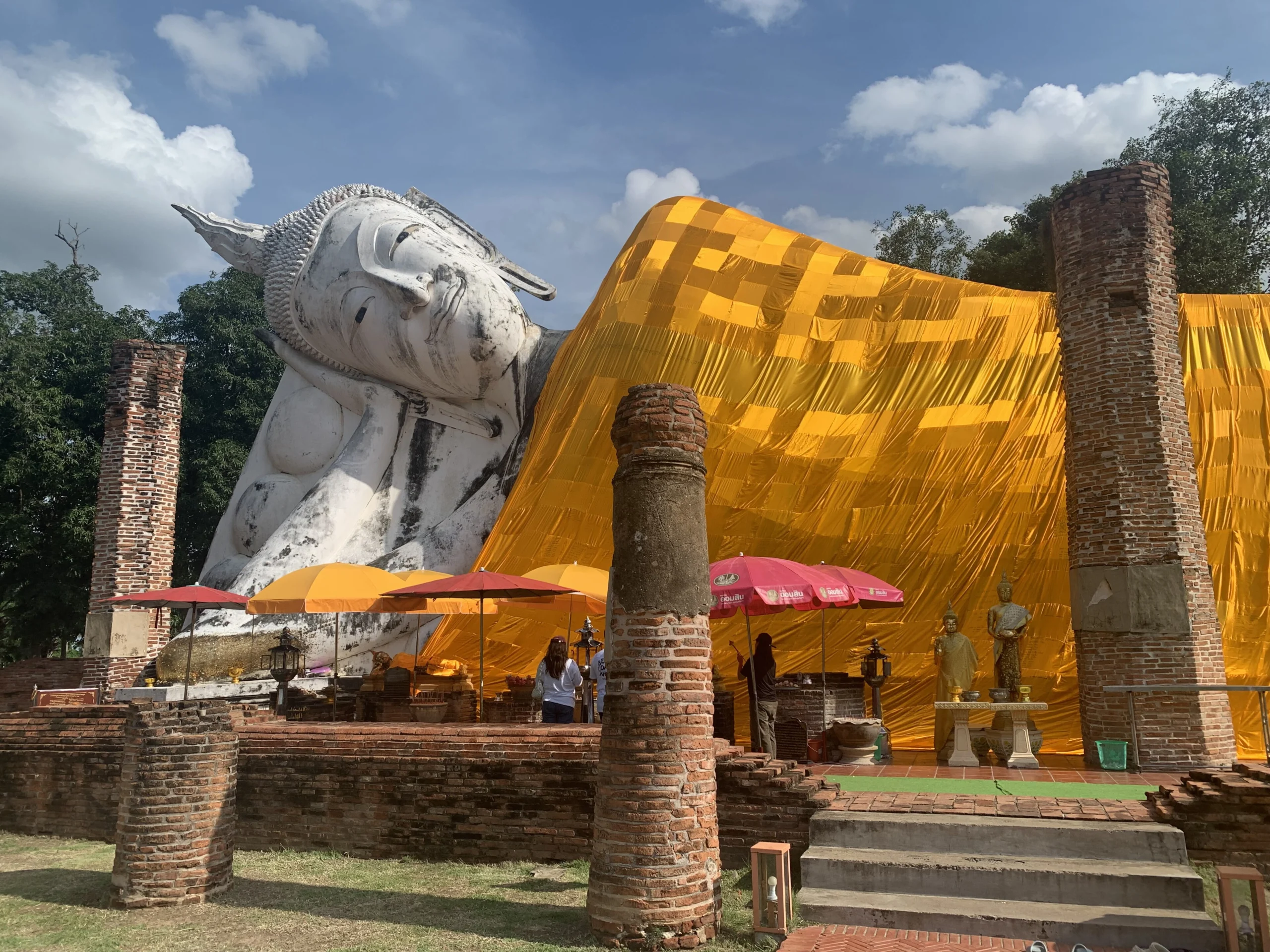
In Pho Thong district lies a 50-metre reclining Buddha with no roof over it and no walls around it — only rows of broken brick columns where the viharn once stood. The story attached to it is superb: a tax official named Khun In allegedly diverted royal revenue to fund the Buddha and was executed for it, the temple taking his name as consolation. When the Burmese destroyed Ayutthaya in 1767 the hall burned, and the image has lain under open sky ever since.
Go late in the afternoon, when the low sun hits the length of it and the whole figure glows against the grass. Free entry, and you will very likely have all 50 metres to yourself.
4. Watch the drum makers of Ban Ekkarat
In Pa Mok district, the village of Ban Ekkarat has made drums for generations — hollowed hardwood bodies, stretched buffalo hide, pegs tapped in by hand, tuned by ear. These are not trinkets; the village supplies working temple drums and instruments used in royal ceremony. Workshops line the village road with drums of every size drying out front, from palm-sized souvenirs for about ฿100 to temple monsters costing tens of thousands. The makers are used to visitors wandering in, and watching a hide being stretched and pegged is worth the detour on its own.
5. Buy court dolls at Ban Bang Sadet
Also in Pa Mok, the women of Ban Bang Sadet make tukata chao wang — court dolls, a miniature clay craft that began inside the palace and was revived here under royal patronage in the 1970s. The figures are small scenes of Thai life: fruit vendors, boxers, mothers with babies, each a few centimetres tall and painted by hand. Prices start around ฿50-100 for simple figures, and unlike almost every souvenir you will encounter in this country, they are made in the room where you buy them.
6. See the bamboo weavers of Ban Bang Chao Cha
In Pho Thong district — pair it with the reclining Buddha — Ban Bang Chao Cha weaves bamboo wickerwork that has earned royal patronage. Baskets, trays, bags and lampshades, from ฿100 workhorses up to intricate pieces that take days of splitting and plaiting bamboo into threads nearly as fine as fabric. Unstaged and quietly brilliant: a whole village economy running on plants and patience.
What to skip
Ang Thong town, with affection. The provincial capital is shophouses, government offices painted ministry cream, and a market — and the market is the only bit that earns your time. Eat noodles, buy fruit, leave. Anyone who schedules an afternoon of sightseeing in the town centre will spend most of it looking at a roundabout.
Skip, too, the idea of a multi-night stay. This is a glorious one-day province, two if the craft villages hook you; on night three you would be inventing errands. And if what you actually wanted was snorkelling and kayaks, that is Mu Ko Ang Thong Marine Park in Surat Thani, boats from Ko Samui — same name, 700 kilometres away, and no amount of optimism will produce a coral reef in a rice paddy.
Ang Thong travel: practical info
Best season is November to February, when the air is dry and mornings are almost cool. March to May is punishing, 38 degrees and climbing in April — which matters when the main activity is standing on concrete looking at very large statues. September and October turn the paddies their deepest green but bring flood risk — this low-lying river country gets wet in bad years.
One full day with your own transport covers the Great Buddha, the hell garden, the reclining Buddha and one or two craft villages without rushing. Onward travel is easy: Ayutthaya is 40 minutes south, Sing Buri 30 minutes north, Suphan Buri about an hour west and Lopburi about an hour to the northeast, so the province slots neatly into any central-plains loop.
Wikipedia’s Ang Thong entry covers the court-craft village history.
TAT’s official Ang Thong page keeps temple opening hours current.
FAQ
Is Ang Thong Thailand the same as the Ang Thong Marine Park?
No. Mu Ko Ang Thong National Marine Park is an island archipelago in Surat Thani province, reached by boat from Ko Samui. Ang Thong province is a landlocked rice-farming province in central Thailand, an hour and a half north of Bangkok. Same name, roughly 700 kilometres apart.
How do I get from Bangkok to Ang Thong?
Buses and minivans run from Mo Chit up Highway 32, about two hours and ฿80-120. Driving takes around 90 minutes. There is no train line; the nearest station is Ayutthaya, with minivans covering the last 45 minutes.
Is one day enough for Ang Thong province?
Comfortably, with your own transport or a chartered driver. Add a second day only if the drum, doll and basket villages hook you.
How much does the Great Buddha at Wat Muang cost to visit?
Nothing. There is no ticket at Wat Muang, just donation boxes, which the temple thoroughly deserves. The grounds are open during daylight hours; mornings are cooler and quieter.