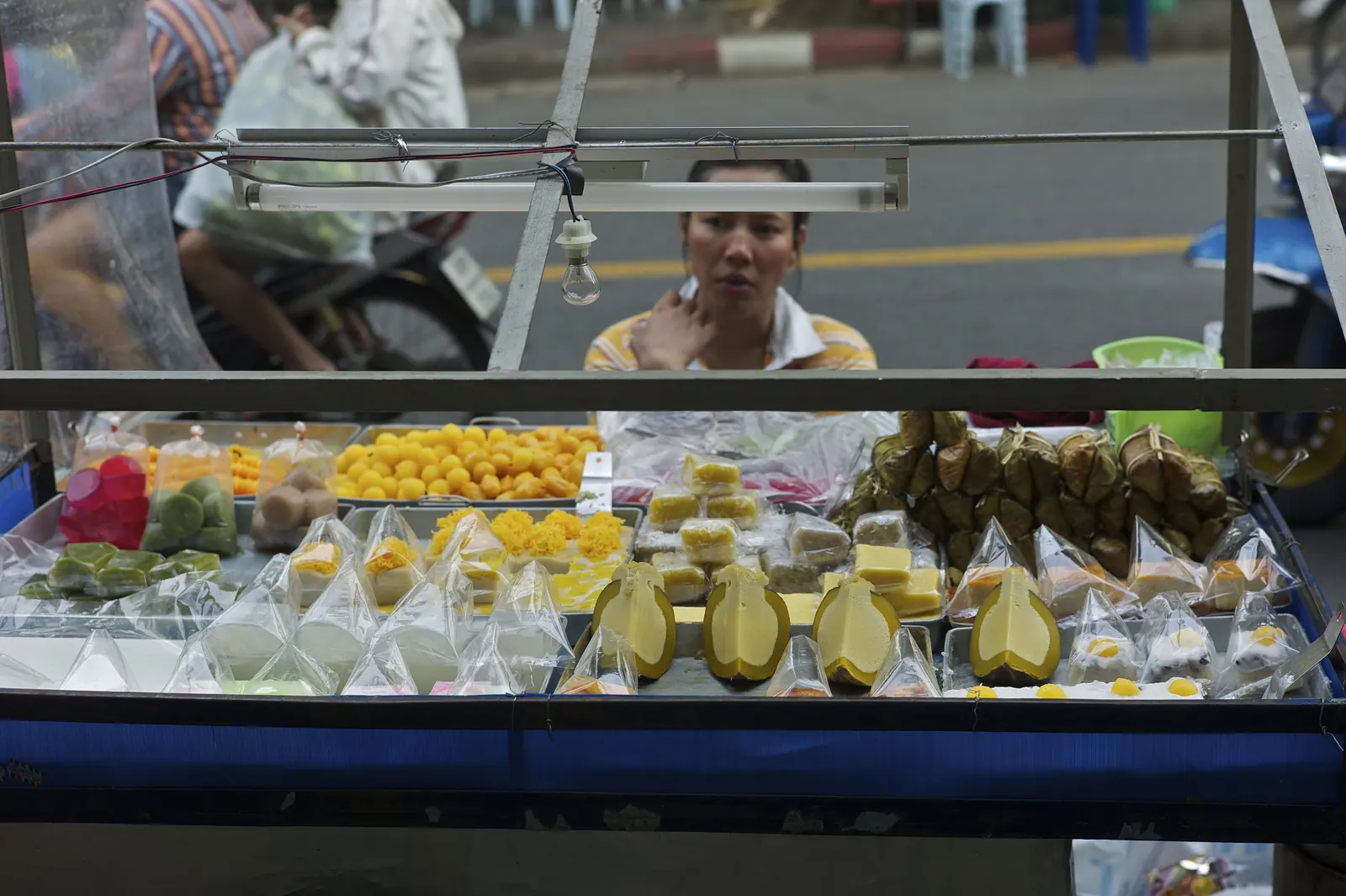
Phetchaburi desserts are why half of Bangkok’s southbound traffic stops at a car park on the Phetkasem Highway and leaves with a carrier bag of custard. The town, three hours south of the capital, sits in Thailand’s sugar-palm country, and everything sweet here is built on the smoky, fudgy sugar tapped from those trees: the baked custard called khanom mo kaeng, the steamed palm cake khanom tan, the golden egg-yolk sweets the court of Ayutthaya borrowed from the Portuguese. UNESCO named Phetchaburi a Creative City of Gastronomy in 2021, mostly on the strength of what it puts in foil trays. This is what to eat, which shops are real, what a box costs and how to fit it round the palace and the cave.
The short version: a tray of mo kaeng costs around ฿50–80, a box of the golden sweets around ฿80, a set of khao chae ฿50, and a full day of deliberate eating under ฿500. Buy the custard in town in the morning, not on the highway at dusk. Prices are sanity-checked against our Thailand Price Index; the sights, the palace hill and Kaeng Krachan are in our Phetchaburi travel guide, and the map is on the Phetchaburi province profile.
In this guide10 sections
- Why is Phetchaburi the capital of Thai desserts?
- The Phetchaburi desserts worth eating, with 2026 prices
- Khanom mo kaeng: what makes Phetchaburi’s custard different, and which flavour to buy
- Where to buy Phetchaburi desserts: the shops on Phetkasem Road and in town
- The golden sweets: thong yip, thong yot, foi thong and the Portuguese connection
- Phetchaburi palm sugar: tan farms, nam tan sod and Uncle Thanom’s orchard
- Khao chae in Phetchaburi: the hot-season rice that is better than dessert
- A Phetchaburi dessert day with Khao Wang and Tham Khao Luang
- Getting to Phetchaburi for the desserts, and where to stay
- Phetchaburi desserts: your questions, answered
Why is Phetchaburi the capital of Thai desserts?
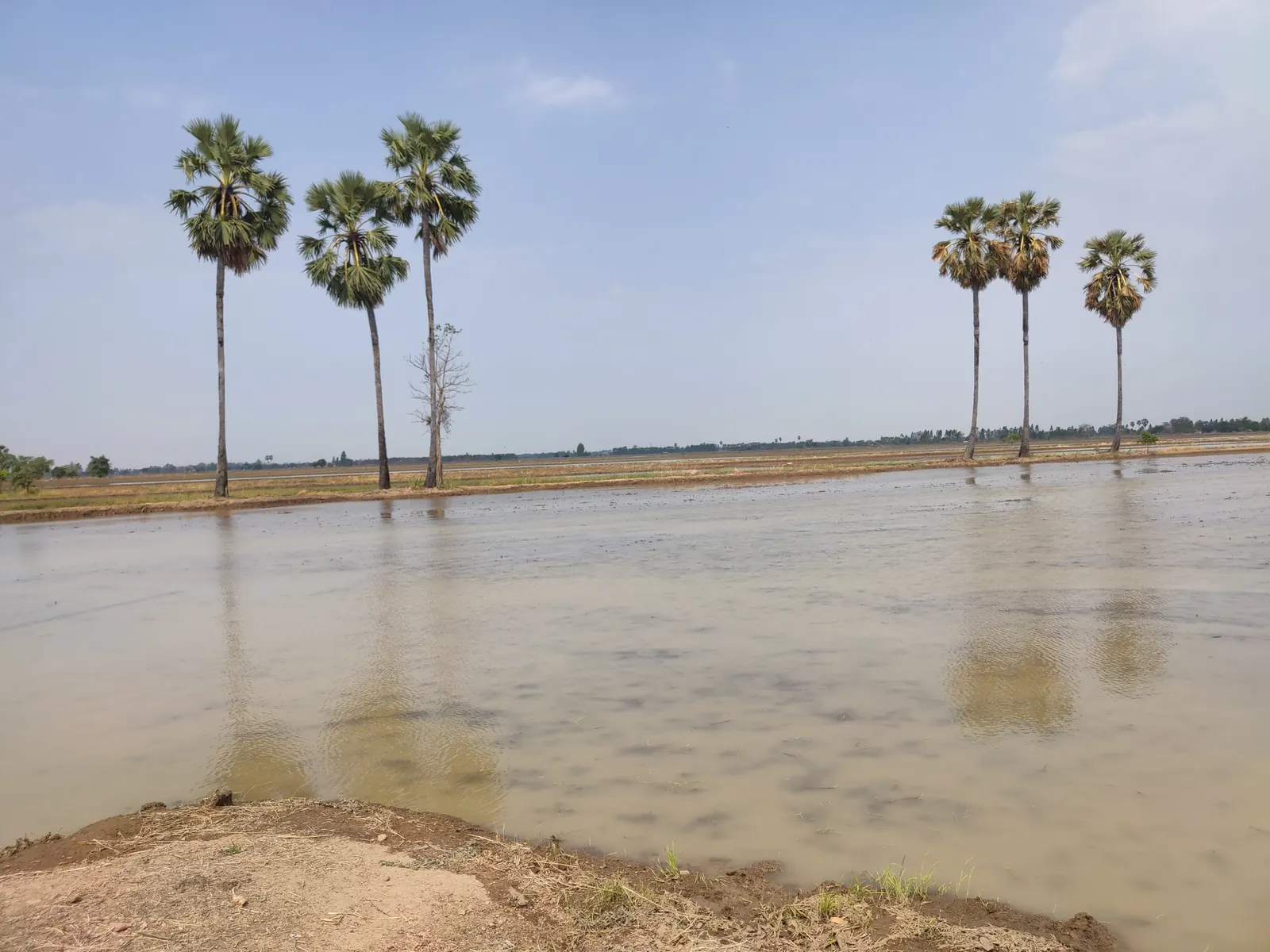
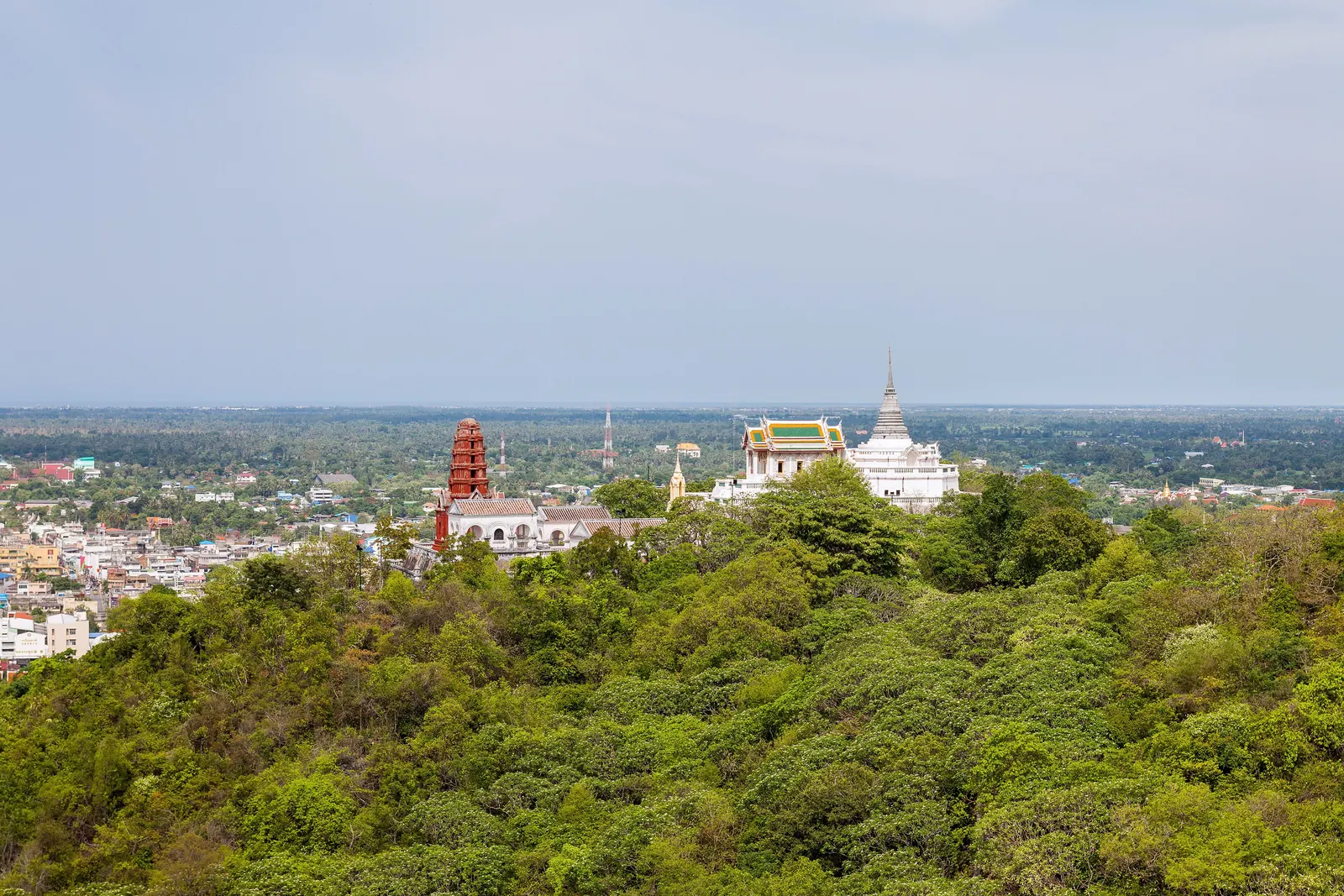
Two reasons: a tree and a king. The tree is the toddy or sugar palm, tan in Thai, which grows across the rice country around the town in a density you will not see anywhere else; Phetchaburi is Thailand’s largest palm-sugar producer and the palm is the provincial symbol. Its sap, boiled down, gives a sugar with a caramel, almost smoky depth that cane sugar does not have, and it goes into nearly everything sweet made here. The king is Rama IV, who built his hilltop palace at Phra Nakhon Khiri in the 1850s and turned the town into a royal retreat, which brought palace cooks and palace tastes with him.
The modern dessert trade is younger than the legend. TAT’s Phetchaburi office credits a shop called Mae Pin, near the old market, with popularising mo kaeng in town; the boom came in the mid-1980s, when Phra Nakhon Khiri was restored as a tourist site and the families at the foot of the hill started baking for visitors. From there the bigger names moved out to the highway, and the rest followed. Our guide to ahan boran, Thailand’s ancient recipes, explains why palace-era sweets carry the prestige they do.
The Phetchaburi desserts worth eating, with 2026 prices
| Dessert | What it is | Price (as of Nov 2026) | Verdict |
|---|---|---|---|
| Khanom mo kaeng | Baked custard of egg, coconut milk and palm sugar, with taro, mung bean or lotus seed; fried shallots on top | Around ฿50–80 a tray | Do it. The reason you came |
| Khanom tan | Small steamed cakes of ripe toddy-palm fruit, rice flour and coconut; yellow, spongy, faintly fermented | Around ฿20–40 a bag | Worth it; only good fresh |
| Thong yip, thong yot, foi thong | The golden trio: egg yolks in syrup as pinched flowers, drops and threads | Around ฿80 a box | Worth it, in small doses |
| Nam tan sod | Fresh palm sap, cold, sweet and faintly floral | Around ฿20–40 a bottle; ฿40 as shaved ice | Do it in the hot season |
| Khanom chan, ba bin | Layered pandan jelly; coconut and sticky-rice griddle cake | Around ฿45 a tray | Fine; better elsewhere for khanom chan |
| Palm sugar | Soft tubs of pure toddy-palm sugar to take home | Around ฿60–150 a tub | Do it. The best edible souvenir in Thailand |
| Khao chae | Not a dessert: rice in jasmine-scented iced water with sweet fried sides | Around ฿50 a set | Do it, March to May |
Our best Thai desserts beyond mango sticky rice covers the national canon; this is the Phetchaburi edit. Sweetness is the point and there is no low-sugar version, so pair everything with something bitter, a black coffee or unsweetened tea. The five tastes of Thai cuisine explains why a Thai meal ends on sweet and starts on everything else.
Khanom mo kaeng: what makes Phetchaburi’s custard different, and which flavour to buy
Mo kaeng means curry pot, after the pans it was once baked in. Every region makes it; Phetchaburi makes it with toddy-palm sugar, duck eggs and freshly pressed coconut milk, and bakes it until the top is brown and close to caramel. The result is denser and less sweet than the factory versions in Bangkok’s convenience shops, with a crust of crisp fried shallots that sounds wrong and tastes right. A good one is firm enough to cut cleanly, glossy rather than spongy, and tastes of egg and palm, not just sugar.
The flavours: taro (phueak) is the classic and the one to start with, soft and earthy; mung bean (thua) is the original and the richest; lotus seed (met bua) is nutty and slightly firmer; plain egg is for purists. Durian and pumpkin exist for the gift market. Verdict: buy taro and mung bean, one tray each, and eat them the same day. Mo kaeng keeps a day or two at room temperature and three or four in the fridge, so it will survive a drive back to Bangkok but not a flight home.
Where to buy Phetchaburi desserts: the shops on Phetkasem Road and in town
The names all start with Mae, mother, which confuses everyone; several of them are family. These are the ones we can confirm are trading, with a call on each. Hours shift, so check before you detour far.
- Mae Kim Lai (Rai Som branch), Phetkasem Road, Bangkok-bound side. The big one: a hangar of custard, sweets and souvenirs with a food court and a car park full of tour buses, open daily around 7am to 8pm. Kim Lai’s mo kaeng won the provincial Thai dessert contest in 1972, which is the origin of the brand. Trays around ฿60. Verdict: Fine, and the easiest stop on the drive back to Bangkok; the custard is good, the experience is a motorway services.
- Mae Kim Lang. Kim Lai’s elder sister’s brand, with a shop in town and a pink-and-red box; a box of two taro trays is ฿160, thong yip or thong yot ฿80 a box. Verdict: Worth it, slightly richer, and locals argue about which sister is better.
- Mae Lamiad, Damnoen Kasem Road, opposite Wat Mahathat Worawihan. A narrow shophouse that has made one thing for years and wraps it in brown paper. Daytime only. Verdict: Do it, the best reason to walk the old town.
- Nok Noi, a few doors from Mae Lamiad. An evening sweet shop with dozens of kinds laid out on the pavement, from ba bin to golden sweets to bananas in coconut milk. Verdict: Worth it for variety after dark.
- Mae Bun Lon, Tha Yang. The shop people from Tha Yang district grew up on, down a narrow soi, with mo kaeng, ba bin and thong muan rolls; the ba bin has a reputation for selling out by midday. Verdict: Worth it if you are driving south to Cha-am anyway.
Honesty line on the highway shops: the custard on the long strip of Phetkasem Road is mostly baked in bulk early in the day and sits in a hot showroom until the evening rush, and some of the brands with Mae names are no relation to anyone. Buy in town before noon and you get the same thing fresher. The highway remains the right stop for palm sugar, which does not care what time it is.
The golden sweets: thong yip, thong yot, foi thong and the Portuguese connection
The three golden sweets are egg yolks cooked in boiling syrup: thong yip, pinched into five-pointed flowers; thong yot, dropped into little teardrops; foi thong, drizzled into fine golden threads. They are the Thai descendants of Portuguese convent sweets, and foi thong is plainly a cousin of the Portuguese fios de ovos. Thai tradition credits the adaptation to Maria Guyomar de Pinha, known in Thai as Thao Thong Kip Ma, a cook of Japanese-Portuguese descent at the seventeenth-century court of King Narai in Ayutthaya. The details are as much legend as record, but the lineage is real. Because thong means gold, the trio is served at weddings, ordinations and house blessings for luck.
Phetchaburi did not invent them, but it makes them seriously, and they are sold by weight at the morning market and by the box in the dessert shops. Verdict: Worth it, a few pieces at a time; a whole box in one sitting is a medical event. Buy them fresh rather than in sealed plastic packs, which last longer and taste of it.
Phetchaburi palm sugar: tan farms, nam tan sod and Uncle Thanom’s orchard
Toddy palms grow to 30 metres or more, and the sap is still collected the old way: a climber goes up a bamboo ladder lashed to the trunk, cuts the flower stalk and hangs a bamboo tube to catch the drip, then comes down and goes up the next one. The sap is filtered, boiled in wide pans over a wood fire for a couple of hours and beaten until it sets. Drunk fresh and cold it is nam tan sod, palm juice; left a day, it starts to ferment into a mild toddy. Harvest runs all year but peaks between January and June.
The place to see it is Uncle Thanom Palm Orchard (Suan Tan Lung Thanom), in Tham Rong subdistrict, Ban Lat, around 20–30 minutes south-west of town by car: a palm-sugar learning centre of around 450 trees, run by the family of the late Thanom Phungern, with demonstrations of climbing and boiling, a small market and a café. It works farmers’ hours, from the very early morning until about 10am, so go first thing. Groups pay a ฿500 guide fee; individuals should call ahead or go with a tour. Verdict: Worth it, if you can get there by 8am. Buy the sugar on the spot.
Khao chae in Phetchaburi: the hot-season rice that is better than dessert
Khao chae is not a dessert, but it is the other thing Phetchaburi is famous for, and it belongs in the same day. Cooked rice is rinsed and served in iced water scented with jasmine and candle smoke, with a plate of sweet, salty fried sides: shrimp-paste balls, sweet shredded fish, sweet preserved radish. You eat a mouthful of a side, then a spoonful of the cold rice; you do not tip everything into the bowl. It is usually traced to the Mon, refined in the palaces of the early Bangkok kings, and it is the most civilised thing to eat in April.
The shop we would drive to is Khao Chae Mae Lek Sakitjai on the riverside road by Tha Yang market, across from the Guan Yu shrine: open daily around 8am to 4pm and, unusually, all year; a set is around ฿50 at the table, ฿60 to take away, ฿120 for the two-person set. Verdict: Do it. In town, stalls at the riverside market sell it from March to May only. Read is Thai street food safe if iced water from a stall worries you; at a shop with a queue it is the least of your risks.
A Phetchaburi dessert day with Khao Wang and Tham Khao Luang
Desserts fit around the two big sights in one day, as long as you start early. 8am: Phra Nakhon Khiri on Khao Wang, by the cable car or the stairs, around ฿150 for foreigners, before the heat and the macaques wake up. 10:30am: Tham Khao Luang cave, a few kilometres north, free, for the late-morning shaft of sunlight onto the Buddha images. Noon: lunch and khao chae, then a slow walk down Damnoen Kasem Road past Wat Mahathat for the custard. 3pm: Mae Kim Lang or the palm sugar, then the highway shops on the way out. With the Uncle Thanom orchard at dawn, it is a long day; without it, an easy one.
From Bangkok it works as a long day trip or a stop on the way south; Samut Songkhram’s Amphawa and the railway market is an hour north and pairs well, and so, with low expectations, does Damnoen Saduak floating market. If you are basing in Bangkok for longer, our own Bangkok Field Guide in the field guides covers day-trip logistics in more depth. Organised trips that do the palace, the cave and a palm farm in a day are on GetYourGuide’s Phetchaburi page; Fine if you do not want to drive, but they give you twenty minutes for the custard.
Getting to Phetchaburi for the desserts, and where to stay
Phetchaburi is on the southern railway and the Phetkasem Highway, so getting there is easy. Trains from Krung Thep Aphiwat take around three hours, from about ฿40 in third class to a couple of hundred baht in an air-conditioned seat; minivans from the Southern Bus Terminal take about two hours for ฿120–180. All of them are on 12Go’s Bangkok to Phetchaburi page. From Hua Hin it is 45 minutes to an hour by train or van, well under ฿100, on 12Go; our Bangkok to Hua Hin guide covers the same line and the same buses one stop further.
Sleep in town if the food is the point, on Cha-am beach if it is a stop on a beach week. Cha-am is in Phetchaburi province too, a fact almost nobody knows, and it is on the same bus line. Rates are normal-season starting points; nothing is comped.
| Hotel | Where | Best for | From | Book |
|---|---|---|---|---|
| Sun Hotel | Phetchaburi town, near Khao Wang | Simple, clean base for a dessert morning | around ฿900 | Agoda |
| Baan Kiang Wang | Phetchaburi town | Small, well-rated, the best-reviewed in-town pick | around ฿1,000 | Agoda |
| Royal Diamond Hotel | Phetkasem Road, Rai Som | Drivers; the custard shops are on the doorstep | around ฿1,000 | Agoda |
| Whale Hostel Cha-Am | Cha-am beachfront | Budget beach base | around ฿450 | Agoda |
| Tara Mantra Cha-Am Resort | Cha-am beachfront | The Cha-am mid-range that holds up | around ฿2,500 | Agoda |
| Dusit Thani Hua Hin | Cha-am strip (Phetchaburi side) | The grand old splurge, technically in Phetchaburi | around ฿5,500 | Agoda |
Verdicts: Baan Kiang Wang is Worth it; the Sun Hotel is Fine and central; the Royal Diamond is for drivers only. If you would rather be in Hua Hin and drive up for the day, where to stay in Hua Hin sorts the areas, and the Hua Hin night markets sell Phetchaburi custard too, at Hua Hin prices. More regional eating is on our Eat and Drink hub.
Phetchaburi desserts: your questions, answered
What dessert is Phetchaburi famous for?
Khanom mo kaeng, a baked custard of duck egg, coconut milk and toddy-palm sugar, usually with taro or mung bean and a topping of fried shallots. The town is also known for khanom tan, a steamed toddy-palm cake, the golden egg-yolk sweets thong yip, thong yot and foi thong, and for its palm sugar itself, which is the base of almost everything.
How much does khanom mo kaeng cost in Phetchaburi?
Around ฿50–80 a tray as of November 2026, depending on the shop and the flavour; taro and plain egg are cheapest, durian dearest. Mae Kim Lang sells a box of two taro trays for ฿160. Gift boxes on the Phetkasem Road strip cost more. A day of eating custard, golden sweets, palm juice and khao chae comes in under ฿500.
Which khanom mo kaeng shop in Phetchaburi is the best?
There is no agreed answer, and locals tend to back the shop from their own district. Mae Kim Lai is the most famous and the easiest stop on the highway; Mae Kim Lang, run by Kim Lai’s elder sister’s family, is the one many prefer; Mae Lamiad in the old town is the small, single-product option. Buy two and compare before noon, when they are freshest.
How long does khanom mo kaeng keep?
A day or two at room temperature and three or four days in the fridge, because it is egg and coconut milk with no preservatives worth mentioning. It will survive the drive back to Bangkok in a cool bag. It will not survive a long-haul flight in checked luggage. For a souvenir that travels, take a tub of Phetchaburi palm sugar instead.
Can I do Phetchaburi as a day trip from Bangkok or Hua Hin?
Yes. From Bangkok it is about three hours by train or two by minivan, so leave early, do Khao Wang and Tham Khao Luang before lunch and the dessert shops after. From Hua Hin it is under an hour by train, van or car, which makes it an easy half-day. An overnight stay lets you add the palm-sugar orchard at dawn.
Plan · Book · Go
Book the trip
Some links in this guide are affiliate links. If you book through them we may earn a small commission at no extra cost to you — it helps keep Destination Thailand independent.