Phuket food is two cuisines sharing one small island, and the beach-road restaurants serve neither. The first is southern Thai: turmeric, fresh chilli, shrimp paste, sour fruit and fish, the hottest regional cooking in the country, sold from glass cabinets and market carts. The second is the Hokkien-Baba cooking of the old tin-mining families: pork braises, fat noodles, dim sum and dark soy, almost none of it spicy, found in the shophouses of Old Town. Then there is the third thing, the laminated-menu pad thai at ฿120–200 on every beach road, which is the one you came to avoid.
**The short version:** eat breakfast in Old Town (dim sum, o-tao, kopi, ฿100–200 a head), lunch at a khao gaeng curry counter (฿50–80), dinner at a night market (฿250–400 for two) or at a seafood market where you buy by the kilo and have it cooked next door. Phuket runs 20–40% above the mainland for the same plate, and the island is cheap exactly as far as you walk from the sand. Prices are as of November 2026 and checked against our Thailand Price Index; the island’s wider profile is on the Phuket province page, and the rest of the Thai table is in our Eat & Drink section.
In this guide9 sections
- Why does Phuket eat Hokkien food in a southern Thai province?
- Phuket dishes worth ordering, with 2026 prices
- Old Town: breakfast, lunch and the Hokkien counters
- Khao gaeng curry counters: where the southern food really is
- Phuket night markets for dinner, ranked
- Seafood by weight, and how not to get stung
- Phuket food prices: the fair price and the quoted price
- A Phuket eating day, from the roti cart to the late plate
- Phuket food: your questions, answered
Why does Phuket eat Hokkien food in a southern Thai province?
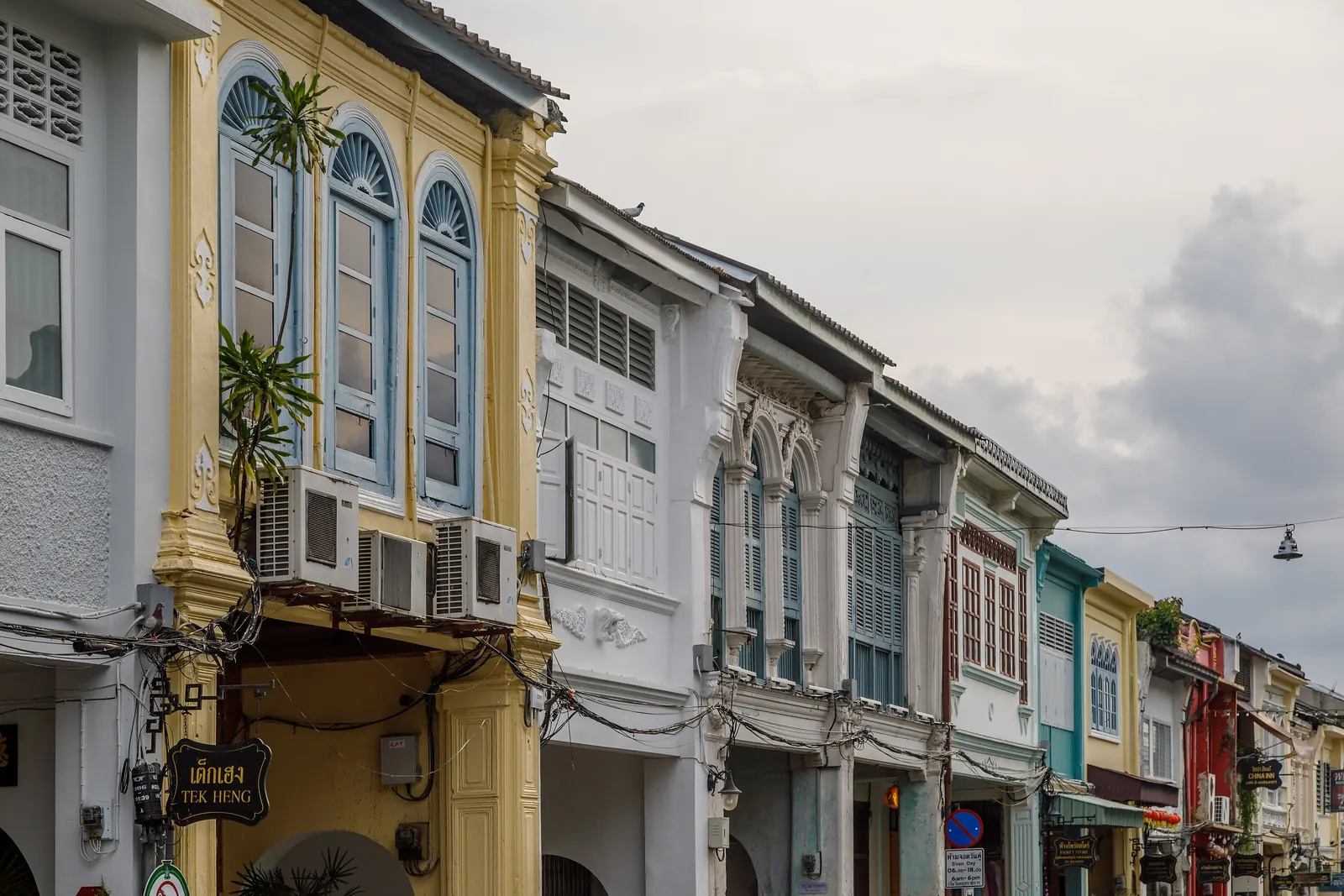
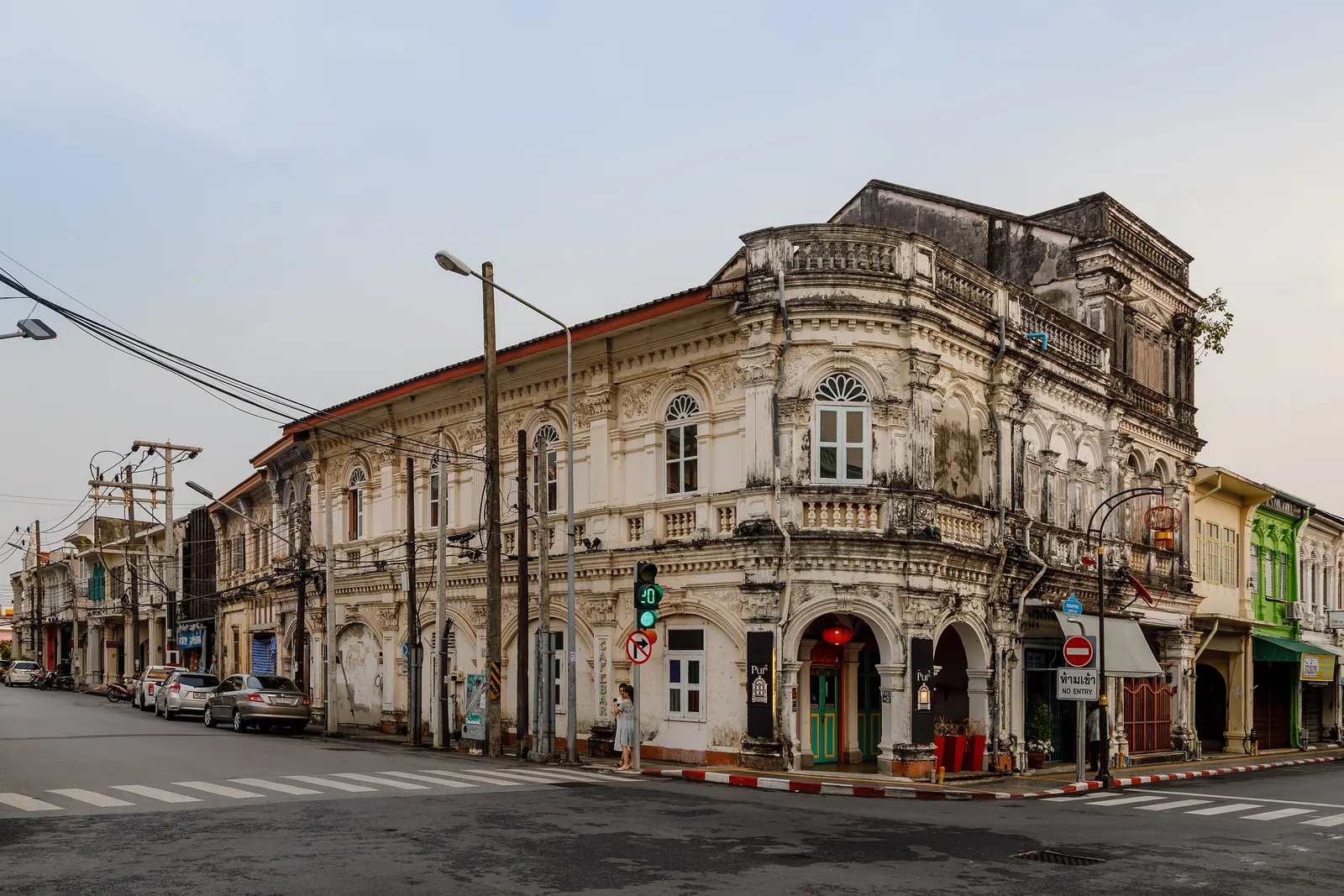
Because of tin. From the nineteenth century, Hokkien and Hakka miners and traders came to work the mines and the rubber, married into local families, and their descendants, the Baba or Peranakan families, built the Sino-Portuguese shophouses of Old Town and a table to match. A third of the island is also Muslim, so roti carts and halal curry shops sit a street from the pork. Add the southern Thai base around them and you get a food scene that changes every kilometre: pork braised in the old town, a fierce fish curry at the next khao gaeng counter, roti at the kerb. Our southern Thai cuisine guide explains the heat and the turmeric; Phuket is where the Chinese half of the story is loudest.
Phuket dishes worth ordering, with 2026 prices
Prices are what a shophouse, market stall or curry counter charges, as of November 2026. Beach-road and resort versions of the same plates run 1.5 to 3 times higher. Thai script is there so you can point.
| Dish | What it is | Fair ฿ | Verdict |
|---|---|---|---|
| Moo hong (หมูฮ้อง) | Pork belly braised dark with black pepper, garlic, soy and palm sugar until it collapses. Rich, not hot | 60–80 over rice at a market | Do it; the island’s signature |
| Hokkien mee (หมี่ฮกเกี้ยน) | Fat yellow noodles stir-fried with pork, squid, greens and egg, darker than Penang’s | 50–90 | Do it |
| O-tao (โอวต้าว) | Taro and small oysters fried with egg and pork crackling on a hot plate | 50–80 | Do it, at Lock Tien |
| Loba (โลบะ) | Five-spice braised pork offal, deep-fried, with a sour dip | around 50 | Do it, if you like offal |
| Dim sum (ติ่มซำ) | Siu mai, char siu buns, prawn dumplings; sit and the baskets come | 15–30 a basket | Do it, before 09:00 |
| Gaeng som (แกงส้ม) | Sour-orange turmeric fish curry, no coconut, hot and fish-forward | 50–80 on rice | Do it, if you like heat |
| Gaeng tai pla (แกงไตปลา) | Fermented fish-innard curry with bamboo shoot; bitter, salty, blistering | 50–80 on rice | Fine; the most southern thing you can eat |
| Kua kling (คั่วกลิ้ง) | Minced pork dry-fried with a turmeric-galangal paste, no gravy, pure heat | 50–80 on rice | Do it, with sticky rice |
| Kanom jeen (ขนมจีน) | Fermented rice noodles under a southern curry, with raw greens | 40–60 | Do it for lunch |
| Roti with curry | Flaky roti with chicken curry for dipping, or the stuffed mataba | 40–80 | Do it; the best west-coast breakfast |
| O-aew (โอ้เอ๋ว) | Hokkien jelly with shaved ice, syrup and beans | 30–40 | Do it, at dusk |
Order mechanics: say “mai phet” and the cook will still make it hot; “phet nit noi” (a little spicy) with a smile gives you a chance. The one phrase that earns respect is “phet baep khon tai”, spicy the southern way. Shrimp paste is in everything, and “mai sai gapi” removes it for allergies. Sit, point at the tray or the pot, pay cash, and do not tip at a stall.
Old Town: breakfast, lunch and the Hokkien counters
Old Town is the best eating on the island and the cheapest. We keep the full tour in Phuket Old Town, so here are the short verdicts.
- **Boonrat (dim sum), Bangkok Road.** Baskets arrive as you sit: siu mai, char siu bao, prawn dumplings, ฿15–30 each, with kopi. Opens early and shuts around 10:30. Verdict: do it, before nine.
- **Lock Tien Food Court, corner of Dibuk and Yaowarat roads.** A hawker centre going since the 1950s: o-tao, loba, popia and Hokkien mee at ฿50–80 a plate. Verdict: do it; it explains the town.
- **Mee Ton Poe, at the clock tower.** Hokkien mee since 1946, ฿60–90. Verdict: do it, for lunch.
- **Raya, Dibuk Road.** The famous restaurant in a 1920s mansion: moo hong around ฿250, crab curry with cha-plu leaves ฿400–600, ฿300–600 a head. Verdict: worth it once, for the building and the crab; locals eat the same dishes for a third of the price at the counters above.
A morning here, with dim sum, kopi and a hawker lunch, is around ฿250–800 a head depending on whether you add a museum. In the early hours the roti carts around the Ranong Road market sell roti with curry for around ฿20–50. For the full day-by-day plan, our Old Town guide and the where to stay in Phuket page cover where to base yourself; if you want to be on foot for breakfast, The Neighbors Hostel (from around ฿450) and The Memory at On On Hotel (from around ฿1,300) are the two Old Town beds we have on file.
Khao gaeng curry counters: where the southern food really is
Look for a glass cabinet of metal trays at the front of a shophouse, in Old Town, Chalong or behind any beach road. This is khao gaeng: rice with two curries ladled over it, ฿50–80, a fried egg for ฿10 more, and a plate of raw vegetables and herbs to put out the fire. Point at two. The curries are the southern ones in the table above, and they will be hot. Our khao gaeng guide explains the point-and-pay system in detail; in Phuket it happens a few hours earlier than in Bangkok, with the best trays emptying by about 13:00.
Roti and the Muslim kitchens are the other half of the island’s daytime eating. Around Chalong, Rawai, Cherng Talay near Bang Tao and the villages behind Kamala, roti carts and halal shops do roti with chicken curry or a stuffed mataba for ฿40–80. No pork, no beer, no problem. Verdict: do it for breakfast number two.
Phuket night markets for dinner, ranked
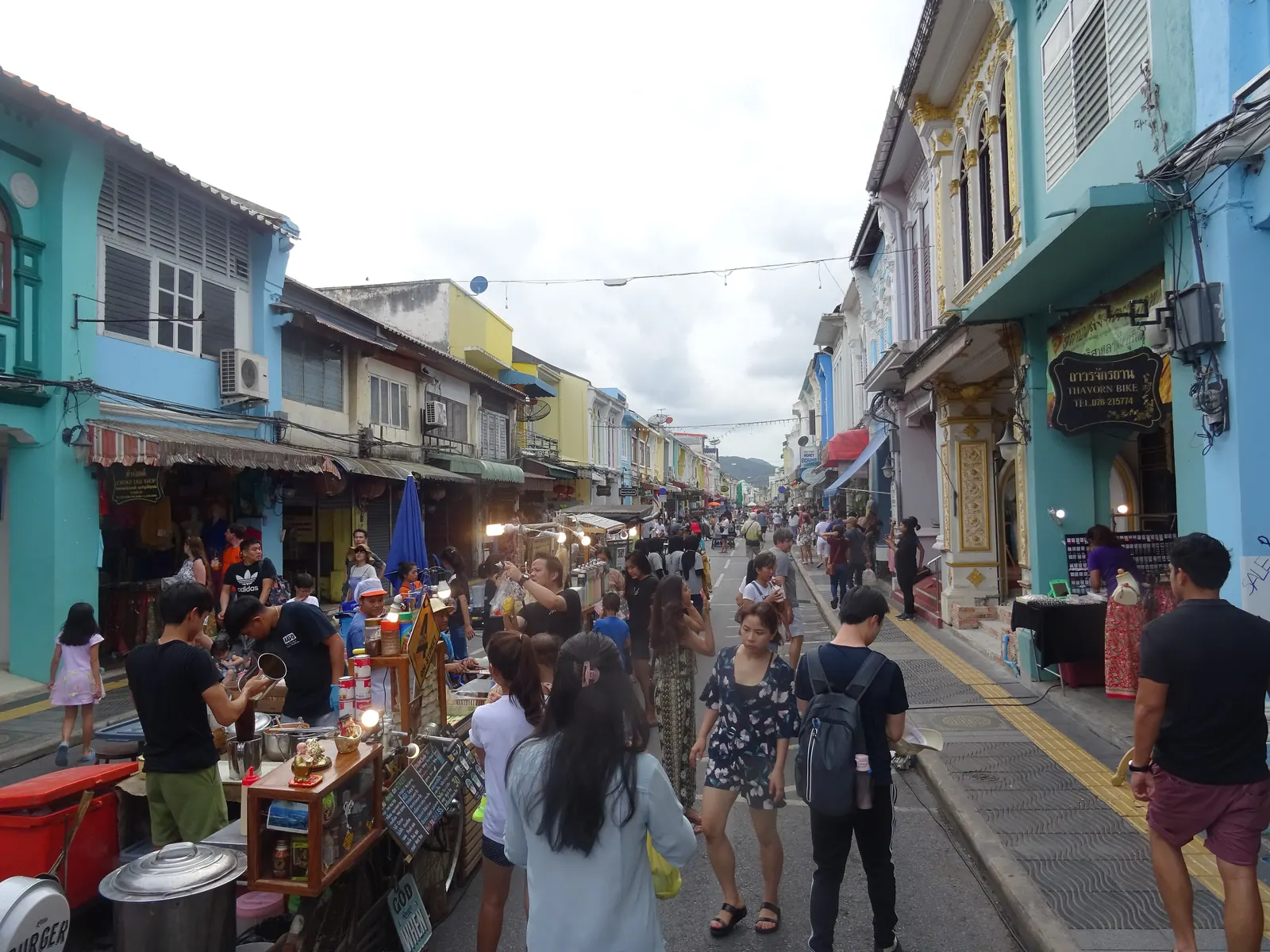
Phuket’s night markets are the eating ones; Bangkok’s are the shopping ones. We have a full guide, Phuket night markets, with the ranking and getting-there fares, and the short list is:
- **Lard Yai, Thalang Road, Sunday.** About 16:00–22:00, best food between 17:00 and 20:00; moo hong, Hokkien mee, loba, a-pong crêpes and o-aew in a shophouse setting. Dinner for two ฿350–500. Verdict: do it; plan the week around it.
- **Naka Weekend Market, Saturday and Sunday.** The biggest food section on the island and the cheapest: skewers ฿10, khao man gai ฿40–50, whole grilled fish ฿120–180. The roads lock by about 18:30 on a Sunday, so arrive at 16:30.
- **Chillva, Monday to Saturday.** A roofed container-market food zone on the north edge of town; pad krapao ฿50–60, grilled pork neck ฿60–80.
- **Banzaan, Patong.** The honest Patong option: a real wet market with a food court upstairs. Malin Plaza is tolerable in the rain; the OTOP market is phone cases and ฿120 pad thai.
Seafood by weight, and how not to get stung
Everything on ice on the Patong beach road came through the fishing beach at Rawai that morning, and the mark-up between the two is most of Patong’s economy. The rules, which also apply at any restaurant with a tank:
- Agree the weight, the price per kilo and the cooking fee before anything touches the grill. Out loud, ideally written on the order pad.
- Watch it weighed. A kilo of tiger prawns is about 20 to 25 of them; a scale that reads 1.4 kg for a handful is not a neutral instrument.
- Know the source price. Tiger prawns are around ฿400–600 a kilo at Rawai and Banzaan, with roughly ฿100–150 a kilo to have them cooked next door. The beach road will quote perhaps ฿900–1,400 for the same kilo “cooked”.
- “Market price” on a menu is a negotiation you have already lost. Ask for the number.
- Check the bill against the order: an unmentioned service charge, two extra beers and a “per 100 g” price multiplied by a weight you did not see are the usual padding. Our scams guide has the pattern.
A whole grilled fish is ฿120–180 at a night-market stall, around ฿400–600 at Malin Plaza and ฿800 or more with a sea view. A kilo of prawns, a crab in curry, morning glory and rice for two at an honest seafood row is around ฿900–1,200. Pay in cash and count the beers. On hygiene, the rule from our street food safety guide holds: eat where it is busy and the food is moving.
Phuket food prices: the fair price and the quoted price
| Dish | Fair (market, Old Town, a street back) | Quoted (beach road, Patong, resort) |
|---|---|---|
| Pad krapao with fried egg | ฿50–80 | ฿120–180 |
| Pad thai | ฿50–80 stall; ฿100–160 restaurant | ฿120–200 |
| Som tam | ฿40–70 | ฿100–150 |
| Hokkien mee | ฿50–90 | ฿150+ |
| Kanom jeen with curry | ฿40–60 | not on the menu |
| Whole grilled fish | ฿120–180 stall | ฿400–800 |
| Large beer | ฿55–75 at a 7-Eleven; ฿70–100 market | ฿100–150 bar; ฿180–300 beach club |
| Fresh coconut | ฿40–60 | ฿80–120 on the sand |
| Kopi | ฿30–50 | ฿90–140 for a flat white on Soi Romanee |
Eating this way costs about ฿500–700 a head a day, or ฿900–1,300 with the kilo of seafood. The resort breakfast alone often costs more than the first half of that day.
A Phuket eating day, from the roti cart to the late plate
The route in order: 06:00 roti with curry from a cart, ฿40–60. 07:30 dim sum at Boonrat if you are in town, then o-tao at Lock Tien. 12:30 khao gaeng, two ladles over rice, ฿50–80. 15:00 o-aew or a-pong, ฿20–40. 17:30 a large beer on the sand: ฿80–120 from a beach stall, or ฿55–75 from the 7-Eleven two streets back. 19:30 the market or the kilo. 22:30 pad krapao with a fried egg from whichever shophouse is still open, ฿50–80; on Bangla Road the same plate is ฿150 and the egg is cold. If you visit in October, the Vegetarian Festival turns Old Town into a yellow-flag jay food market; our vegetarian festival food guide explains the flags, and the 2026 festival guide has the rest.
Phuket food: your questions, answered
What is the most famous food in Phuket?
Moo hong, pork belly braised dark with black pepper, garlic, soy and palm sugar, is the island’s signature, followed by Hokkien mee, o-tao and dim sum from the Old Town shophouses. The southern Thai side is hotter: gaeng som sour fish curry, kua kling dry pork curry and kanom jeen noodles with curry.
Where can you eat cheaply in Phuket?
Old Town hawker centres and curry counters, the Naka and Chillva night markets and the Rawai and Banzaan seafood markets. A khao gaeng plate is ฿50 to ฿80, a market dinner for two is ฿250 to ฿400, and a hawker lunch can be under ฿100. Beach-road restaurants cost two to three times more for the same plate.
How do you avoid being overcharged for seafood in Phuket?
Agree the weight, price per kilo and cooking fee before it is cooked, watch it weighed and ask for the total. Buying prawns at Rawai or Banzaan at around ฿400 to ฿600 a kilo and paying ฿100 to ฿150 a kilo to have them cooked next door usually works out far cheaper than the beach road.
Is Phuket food spicy?
The southern Thai dishes are among the hottest in the country, and cooks will not assume you want them mild. The Hokkien-Baba dishes, such as moo hong, Hokkien mee and dim sum, are mostly not spicy at all. Ask for phet nit noi, a little spicy, or mai phet if you want to be careful.
What should vegetarians eat in Phuket?
In the first half of October the Vegetarian Festival fills Old Town with jay food stalls, with yellow flags marking strict vegan food with no garlic or onion. At other times, ask for jay or mang sa wirat, expect fish sauce and shrimp paste in most things, and rely on roti, fruit, khao yam and Old Town cafes.
Plan · Book · Go
Book the trip
Some links in this guide are affiliate links. If you book through them we may earn a small commission at no extra cost to you — it helps keep Destination Thailand independent.