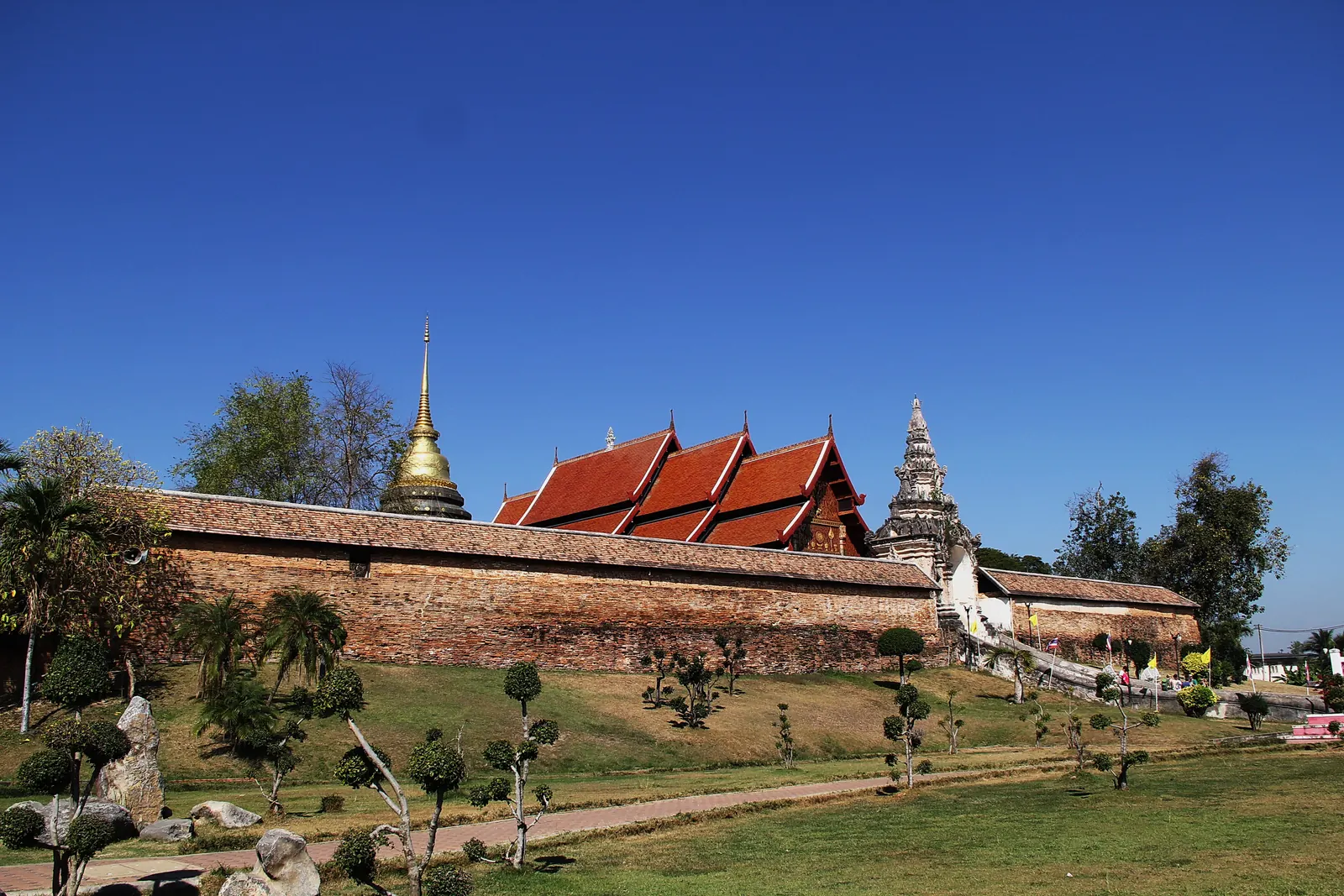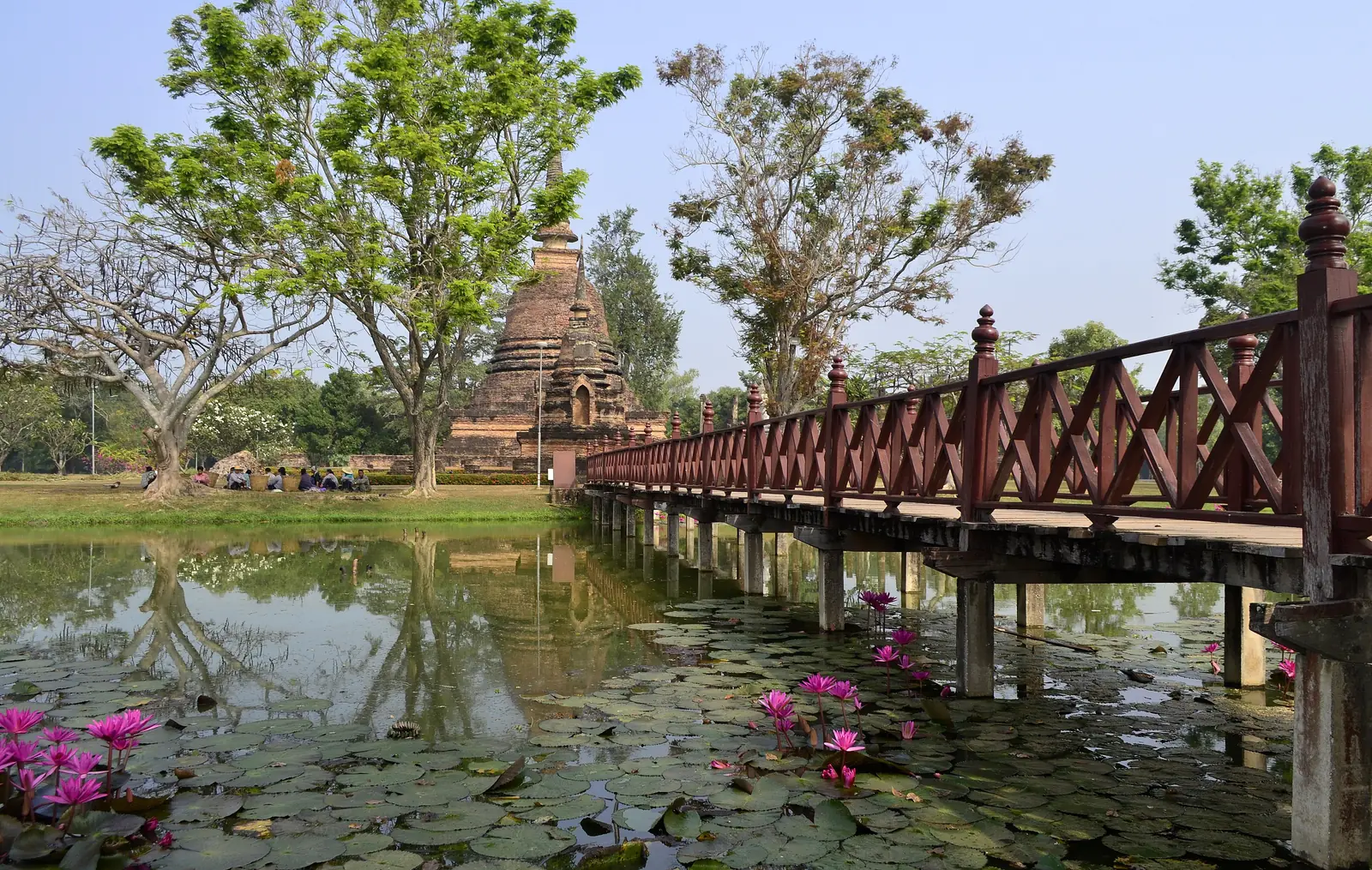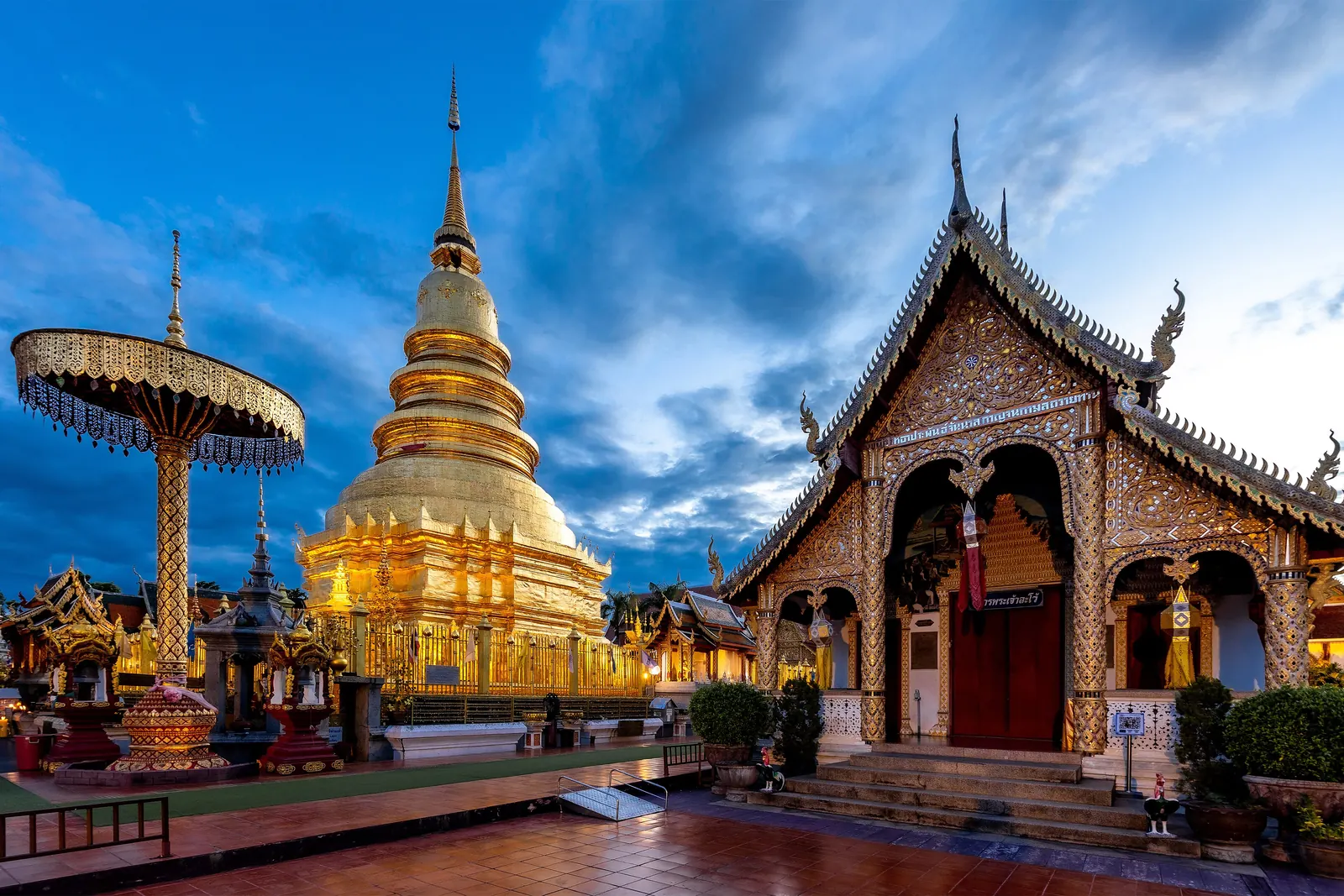
Lamphun is the oldest city in northern Thailand and the one Chiang Mai treats as a suburb. It is 26 km down an avenue of century-old yang trees, it was a Mon capital four centuries before Chiang Mai existed, and its main temple has a gold chedi that the whole Lanna world comes to pay respects to. No minivan tour bothers, which makes a Lamphun day trip from Chiang Mai one of the best-value days in the north: under ฿100 in transport if you take the blue songthaew or the train, ฿20 to get into the big temple, and the country’s longest railway tunnel if you add the train to Khun Tan. Here it is costed for November 2026, with a verdict on every stop. Small prices live in our Thailand Price Index.
The short version: half a day does Wat Phra That Hariphunchai, the museum opposite and Wat Chamadevi by songthaew (฿25–50) or Grab (฿300–500). A full day adds the 09:35 train to Khun Tan, a walk in the hills and the 13:36 back to Lamphun. Go Wednesday to Sunday if you want the museum, never in March or April if you want to see anything at all. The province basics are on the Lamphun province profile, and the wider list of what is out there, waterfalls included, is in our best things to do in Lamphun province guide.
How to get from Chiang Mai to Lamphun: songthaew, train, Grab or scooter, costed
One adult, one way, as of November 2026. Times are door to door from the Old City; the train time is the ride itself, from Chiang Mai station 3 km east of the moat.
| Option | Where from | Time | Cost one way | Verdict | Book |
|---|---|---|---|---|---|
| Blue songthaew | Nawarat Bridge / Warorot Market | 45–60 min | ฿25–50 | Do it: cheapest, most local, no timetable | Pay the driver |
| Train (Local #408, 3rd class) | Chiang Mai station, 09:35 | about 27 min | around ฿10–20 | Do it: the slow, open-window way, and the only way to Khun Tan | Chiang Mai to Lamphun on 12Go |
| Bus | Arcade (Bus Terminal 2/3) | 45–60 min plus the ride to Arcade | around ฿30–50, ฿100–150 with the Grab to the terminal | Fine if you want air-con; otherwise pointless | Buses on 12Go |
| Grab or Bolt | Anywhere | 35–45 min | ฿300–500 per car | Best for three or four sharing, and for the ride home | In the app |
| Scooter | Any rental shop | 30–40 min | ฿200–300 a day plus ฿40 of fuel | Do it if you hold a motorcycle licence: Route 106 is the prettiest short ride in the north | — |
The blue songthaew is the answer for most people. The Chiang Mai–Lamphun trucks pick up on the east bank by the Nawarat (iron) bridge and around Warorot Market, run from before 07:00 until early evening, and leave when the benches are full, which in the morning means every 15–30 minutes. Tell the driver “Lamphun” and “Wat Phra That” and most will drop you near the temple; the rest stop at the Lamphun bus terminal, a 1 km walk or ฿30 motorbike taxi away. Coming back, wave one down on the main road heading north and stop worrying after 17:00, because they do.
The bus from Arcade is the trap: the Grab to the terminal costs more than the fare. Grab is ฿300–500 each way, fine split three or four ways; Lamphun has fewer drivers, so book the return early. If you are coming up from Bangkok anyway, the night train calls at Lamphun before Chiang Mai — Bangkok to Lamphun on 12Go — and the full set of options is in Bangkok to Chiang Mai, costed (tickets on 12Go).
The scooter is the most enjoyable and the most legally fraught. Old Route 106 runs under a tunnel of century-old yang trees, worth the trip by itself on a clear morning. A car licence does not cover a scooter in Thailand; weekend checks fine ฿500–1,000 and your insurer will not pay. Licensed riders: the 106 down, Highway 11 back.
The Lamphun train and the Khun Tan tunnel: times, fares and the catch
The train is the reason to make this a full day. As of the SRT timetable in force from February 2026, the only useful southbound departure is the Local #408: Chiang Mai 09:35, Lamphun 10:02, Khun Tan 10:58. It is third class, fan-cooled, unreserved and bought at the counter on the morning: around ฿10–20 to Lamphun, ฿15–25 to Khun Tan. Between Lamphun and Khun Tan it climbs through longan orchards and over the white Tha Chomphu railway bridge before hauling itself up the steepest gradient on the network; older locomotives have needed a push. Sit on the right leaving Chiang Mai.
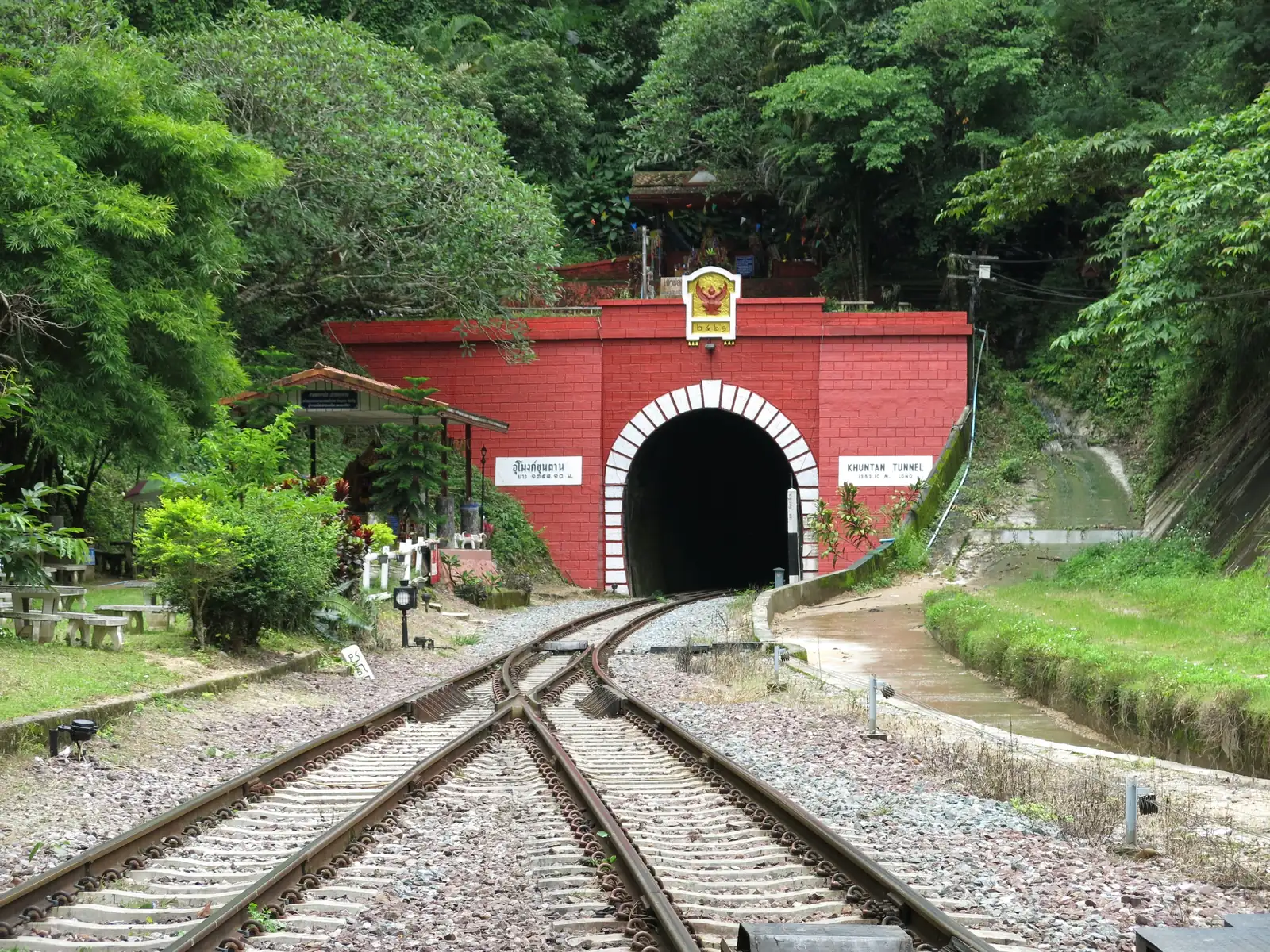
Khun Tan station is the highest in Thailand at 578 m, a hamlet of a noodle shop, a grocery and a platform that ends at the north-western portal of the Khun Tan Tunnel: 1,352 m through granite, begun in 1907 under the German engineer Emil Eisenhofer, interrupted when Siam joined the Allies in 1917 and he was interned, and opened in 1918. Here is the catch the day-trip blogs skip: from Chiang Mai the train stops before the tunnel. You can stand at the mouth, which is a short walk from the platform, but to ride through it you must stay on to Mae Tan Noi on the Lampang side and wait for a train back, which most days does not work. Verdict on the tunnel itself: a fine ten minutes at the portal; not a reason on its own.
The reason is Doi Khun Tan National Park, whose gate is a climb of steps from the station. Foreign adults pay ฿100 (Thais ฿20). The trail to the summit at 1,373 m runs around 8 km one way through teak, bamboo and then pine, past four numbered rest points with campsites; the first is a steady hour up and has the view. The trains back are the Local #407 at 13:36 (Lamphun 14:22, Chiang Mai 14:45) and the Special Express #7 at 16:50 (Lamphun 17:32, Chiang Mai 17:50), the latter all reserved air-con seats and often full in season, so buy it in advance — Lamphun and Khun Tan to Chiang Mai on 12Go. The 13:36 gives you two and a half hours: the first viewpoint and lunch, not the summit. Verdict: do it in the cool season if you like a walk with a train at each end; skip it if hills are not your thing and spend the day in Lamphun town instead.
Wat Phra That Hariphunchai: is Lamphun’s gold chedi worth the trip on its own?
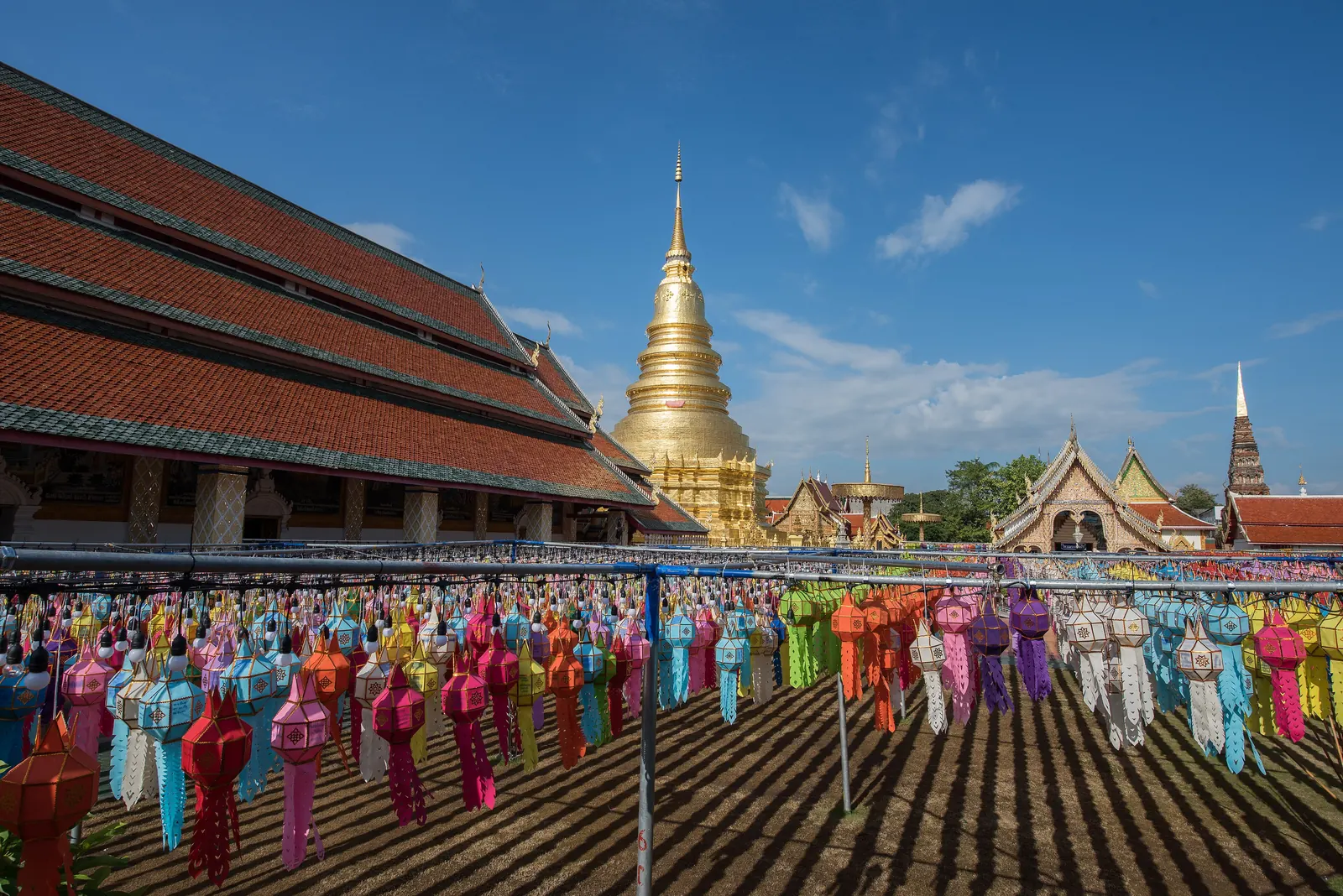
Yes, and it is the reason the town exists in anyone’s itinerary. What it is: the royal temple of the old Hariphunchai kingdom, a relic site since the Mon kings of the eleventh century by the usual telling, rebuilt by the Lanna rulers after King Mangrai took the city at the end of the thirteenth. The centrepiece is a chedi around 46 m tall, sheathed in gilded copper plates and fenced by a bronze railing, which in the Lanna zodiac belongs to everyone born in the year of the rooster; northern Thais try to come once in a lifetime. Around it: a big viharn, a red Lanna library on a plinth, a stepped brick Hariphunchai-style chedi and a gong reputed to be one of the largest anywhere.
Fee and hours, as of November 2026: ฿20 for foreigners, Thais free, open daily 06:00–18:00, which is what the TAT lists and what our own Lamphun guide has said all year. Shoulders and knees covered, shoes off inside the halls; the rest of the protocol is in eight things to know before entering a Thai temple. Best hour: before 10:00, when the gold is lit from the east and the courtyard belongs to the old ladies with jasmine garlands; it gets very hot by noon and there is little shade. Unlike the big five in our Chiang Mai temples guide, it has almost no tour groups. Verdict: do it. Forty-five minutes to an hour, and the best ฿20 you will spend in the north.
Wat Chamadevi, the Hariphunchai museum and the rest of old Lamphun
Hariphunchai National Museum is directly opposite the temple’s back gate on Inthayongyot Road: Mon and Dvaravati stone inscriptions, terracotta Buddha heads with the wide Hariphunchai smile, bronzes, a modest building and decent English labels. It opens Wednesday to Sunday, 09:00–16:00, and closes Mondays, Tuesdays and public holidays — the single most common way to waste a Lamphun trip. Foreigners pay around ฿100–150. Verdict: fine, worth 40 minutes if it is open and you have just seen the temple; not worth rearranging the week for.
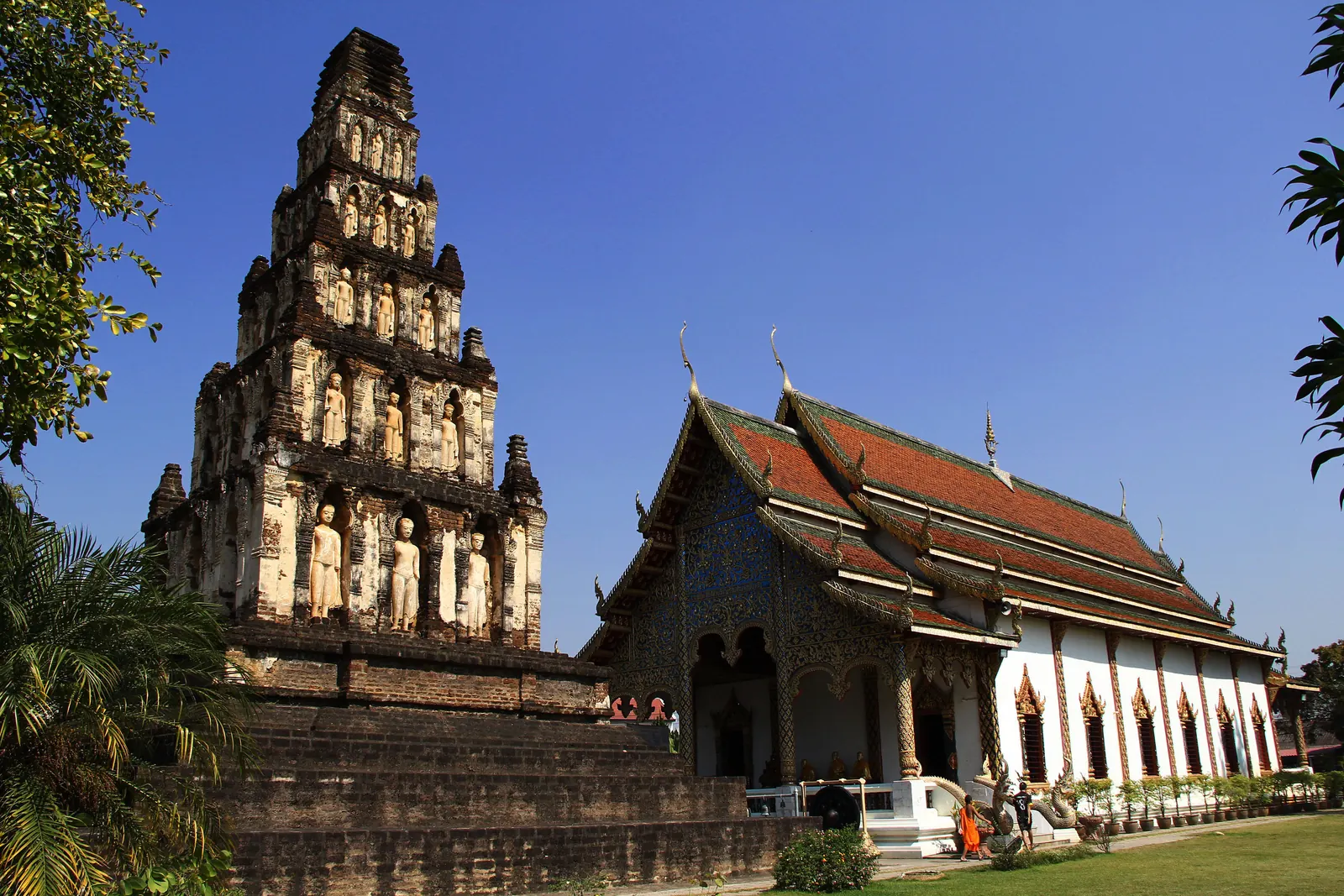
Wat Chamadevi, also called Wat Ku Kut, is 1.5 km west of the centre and the older, stranger half of the town. Its square brick chedi, Suwan Chang Kot, rises in five tiers with three niches a side on each, sixty standing Buddhas in all, and is said to hold the ashes of Queen Chamadevi, the Lavo princess who legend says came up the Ping in the seventh century to found the city. The spire fell long ago, hence ku kut, the chedi with the missing top. Free, quiet, shaded and almost always empty. Verdict: do it — it is the best piece of pre-Lanna architecture within an hour of Chiang Mai. Walk it in twenty minutes or take a ฿30–40 motorbike taxi.
Then the small things. Ku Chang and Ku Ma, stupas for a royal war elephant and a horse in a residential lane north-east of the centre: free, five minutes. Verdict: fine if you are passing. The old moat and walls still outline the town, a 3 km loop that goes nowhere in particular. Pa Sang, 12 km south-west, is the cotton-weaving district. Verdict: skip it on a songthaew day.
Lunch is khanom jeen nam ngiao, rice noodles in a tomato-and-pork broth with a sour edge, ฿40–60 a bowl in the shops around the old town, many of which sell out by early afternoon; the rest of the northern menu is decoded in our northern Thai food guide. The cafés facing the temple charge Chiang Mai prices, ฿60–90 for a latte; several close on Tuesdays.
A Lamphun day trip itinerary: the half day and the full day with the train
The half day (songthaew or Grab, around ฿100–1,000 for two depending on which). Leave Chiang Mai by 08:30 from the Nawarat bridge. Wat Phra That Hariphunchai at 09:30 while the light is good, the museum opposite at 10:30 (Wednesday to Sunday), a motorbike taxi or walk to Wat Chamadevi at 11:30, khanom jeen for lunch, and a songthaew home by 14:00. One person spends under ฿350: songthaews, ฿20 temple, ฿100–150 museum, ฿60 lunch.
The full day (train both ways, around ฿500 a head all in). Grab to Chiang Mai station (around ฿80) for the 09:35 #408 to Khun Tan, arriving 10:58. Look at the tunnel mouth, pay the ฿100 park fee and walk up to the first rest point. Back down for the 13:36 #407 and get off at Lamphun at 14:22; the station is 2.5 km north-east of the centre, so take a ฿30–60 songthaew or motorbike taxi. You will have time for Wat Phra That Hariphunchai and Wat Chamadevi before the light goes, but the museum closes at 16:00, so do it first if it is open. Home by songthaew before 17:00 or Grab after. If the 13:36 is too early, take the 16:50 #7 straight back to Chiang Mai and see Lamphun another day; trying to squeeze both into a later train leaves you racing the temple gates.
The organised option. Lamphun tours and day trips on GetYourGuide are mainly private cars with a guide and, in season, the lantern festival evenings. A private car and driver for the half day is ฿1,200–1,800; worth it for families. Verdict: do it yourself; it is the easiest independent day out from Chiang Mai.
When to go to Lamphun: longan season, the lantern weeks and the smoke
| When | What happens | Verdict |
|---|---|---|
| November–February | Cool, dry, clear; 15°C mornings, best walking weather, best light on the chedi | Go |
| October–November | The Hundred Thousand Lanterns festival hangs coloured Lanna lanterns over the old town, peaking around Loy Krathong (24 November 2026) | Go in the evening; stay for dark |
| March–April | Burning season: thick haze, PM2.5 often well into the unhealthy range, 38°C by afternoon | Skip it |
| May–June | First storms clear the smoke; hot and humid between them | Fine, early starts |
| July–August | Longan harvest: roadside stalls by the kilo, the province’s longan fair, green orchards | Do it for the fruit; carry a rain layer |
| September–October | Heaviest rain; trails at Doi Khun Tan muddy and leechy | Town fine, hills skip |
Lamphun is the longan capital of Thailand, and in July and August the roads out of town are lined with stalls selling bunches for ฿40–80 a kilo and dried longan by the bag; when the fruit is in season and what else is on is in our Thailand fruit season chart. The lantern festival runs from October through November 2026, with the best nights around the full moon, so pair it with Loy Krathong 2026 and Chiang Mai’s Yi Peng on 24–25 November. The month to avoid is the one every Chiang Mai guide warns about: the valley shares the smoke, and the dates and thresholds are in our Chiang Mai burning season guide. The country-wide picture is in best time to visit Thailand.
Should you stay the night in Lamphun, or sleep in Chiang Mai?
Sleep in Chiang Mai. Lamphun has no nightlife, few restaurants after 20:00 and nothing that needs a second morning, so the honest answer is a day trip from a bed you already like. If you want an early songthaew, stay near the east moat: Tamarind Village sits on Ratchadamnoen Road a 15–20 minute walk from the Nawarat bridge pickup, from around ฿4,000–6,000, and Rachamankha, behind Wat Phra Singh, is the Old City’s quiet Lanna splurge from around ฿6,000–9,000. Everything else, by area and budget, is in where to stay in Chiang Mai.
The exception is the lantern weeks, when staying lets you see the old town lit without the last-songthaew panic. Nornlamphun Boutique Hotel is a small, simple two-star in town from around ฿700–1,200, and Thai Thani Loft & Life Lamphun is the three-star alternative from around ฿900–1,500. Neither is a destination in itself; both are a clean bed a short walk from the lanterns. If Lamphun leaves you wanting more of the slow north, Lampang is next on the railway: our Lampang travel guide and Lamphun to Lampang on 12Go. Further east still, Nan is the same idea at five times the distance.
A Lamphun day trip from Chiang Mai: your questions, answered
How do you get from Chiang Mai to Lamphun cheaply?
Take the blue Chiang Mai–Lamphun songthaew from the Nawarat bridge or Warorot Market on the east bank: ฿25–50 a seat, 45–60 minutes along the yang-tree avenue of Route 106, leaving whenever it fills from before 07:00 until early evening. The 09:35 third-class train is even cheaper, around ฿10–20, but there is only one useful departure. Grab is ฿300–500 a car each way.
Is Lamphun worth a day trip from Chiang Mai?
Yes, if temples and history interest you at all. Wat Phra That Hariphunchai is one of the most important temples in the north, costs ฿20 and has almost no tour groups; Wat Chamadevi is older still and free. Transport is under ฿100 by songthaew. It is a half day, not a full one, unless you add the train to Khun Tan and a walk in the national park.
Can you ride through the Khun Tan tunnel on a day trip?
Not easily. Coming from Chiang Mai, Khun Tan station sits at the tunnel’s north-western end, so the train stops before going through. You can walk to the portal from the platform. Riding through means staying on to Mae Tan Noi on the Lampang side and waiting for a northbound train, which rarely fits a day. The 09:35 out and the 13:36 or 16:50 back give you the station, the portal and the park.
When is the Hariphunchai National Museum open?
Wednesday to Sunday, 09:00 to 16:00, closed on Mondays, Tuesdays and public holidays. Foreign adults pay around ฿100–150. It stands directly opposite the back gate of Wat Phra That Hariphunchai on Inthayongyot Road, so the two fit together in a morning. If your only free day is a Monday or Tuesday, go anyway: the temples are open daily and are the main reason to come.
What is the best time of year for a Lamphun day trip?
November to February, for cool mornings and clear light on the gold chedi. October and November add the Hundred Thousand Lanterns festival in the old town, peaking around Loy Krathong on 24 November 2026. July and August are longan season, with fruit by the kilo on every roadside. Avoid March and April, when crop-burning smoke fills the valley between Chiang Mai and Lamphun.
Related guides
- Best Things to Do in Lamphun Province, Thailand
- Lampang: Horse Carts and the Temple Louis Vuitton Copied
- Things to Do in Chiang Mai Beyond the Checklist: Worth It vs Skip It
Book the trip
Some links in this guide are affiliate links. If you book through them we may earn a small commission at no extra cost to you — it helps keep Destination Thailand independent.
Hotels: most people base themselves in the city, so pick your Chiang Mai hotel on Agoda near the east moat, or browse Lamphun hotels for a lantern-festival night. Tours/Boats: GetYourGuide’s Lamphun listings cover private guided days and the lantern evenings. Getting there: Chiang Mai to Lamphun and Lamphun to Chiang Mai are on 12Go, with the journey north in our Bangkok to Chiang Mai transport guide. Not sure the north is your Thailand at all? Our Where to Go in Thailand matcher scores all 77 provinces against your month, your budget and what you actually want.