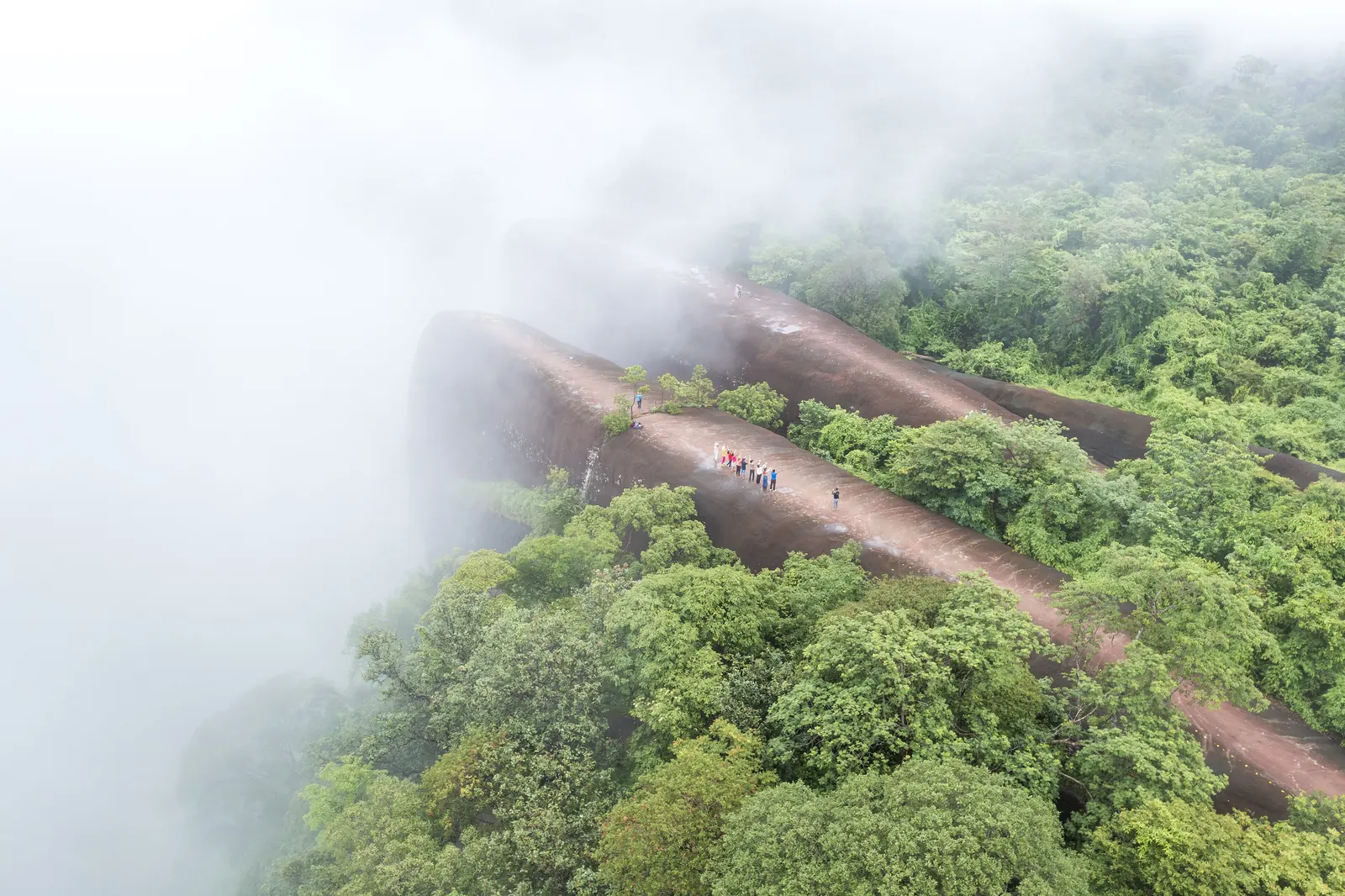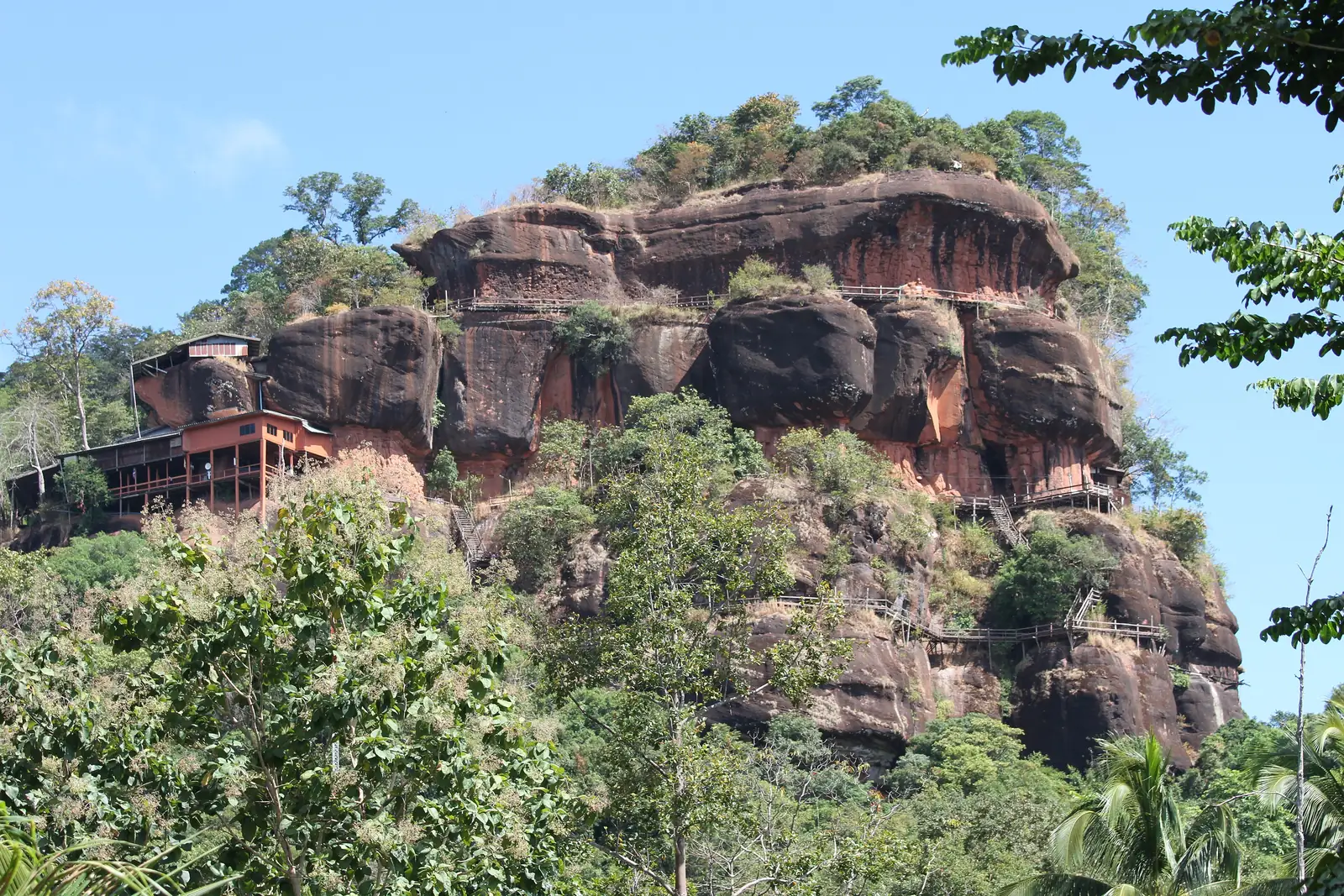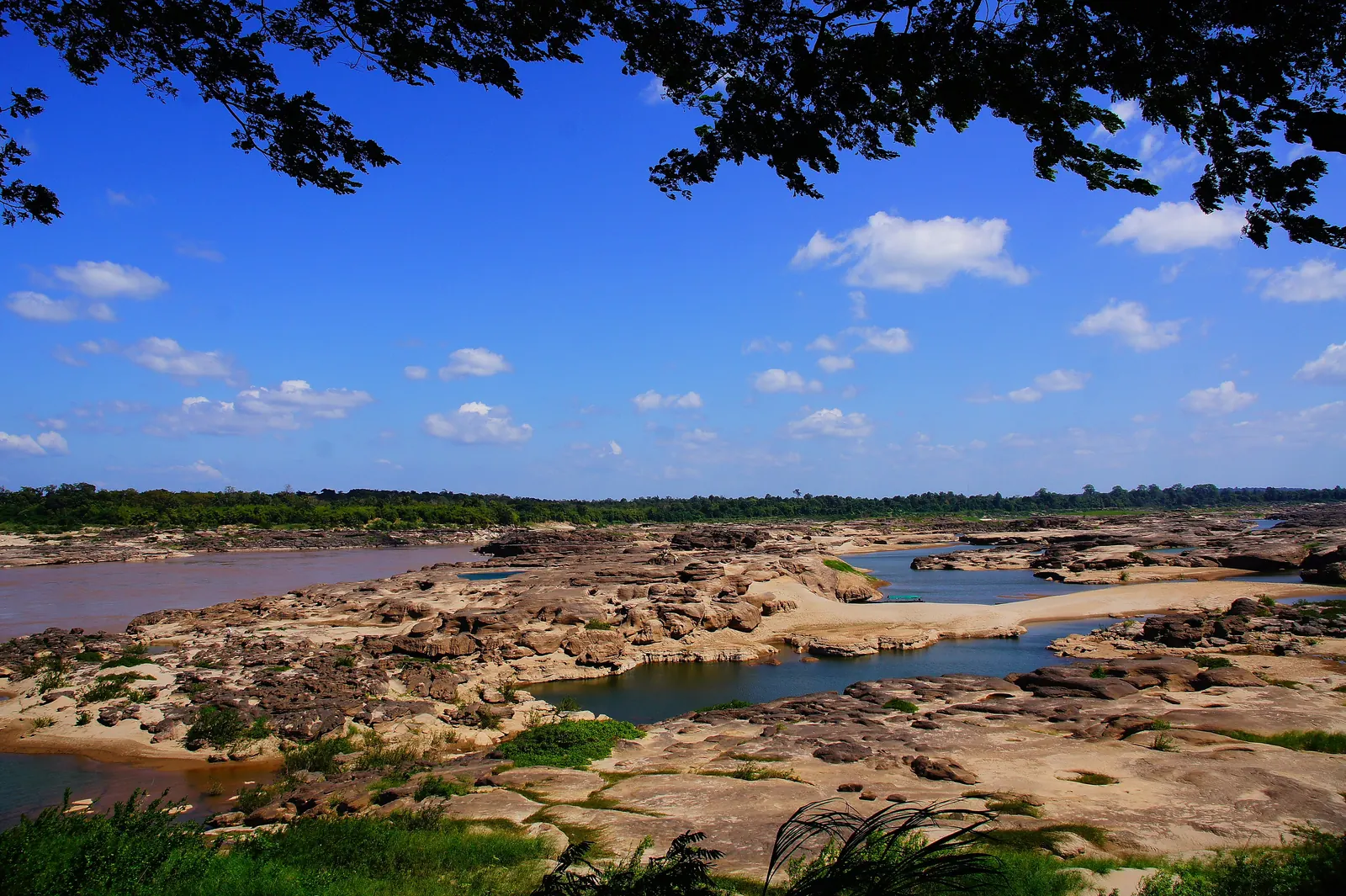
Sam Phan Bok is a sight with an on-off switch. For half the year it is a stretch of brown Mekong in Ubon Ratchathani’s Pho Sai district with nothing to see; from roughly December to May the river drops and a sandstone bed several kilometres long comes up out of the water, scoured into thousands of round potholes, channels and basins. The name means “three thousand holes”, the Thai press calls it the Grand Canyon of Thailand, and both are exaggerations in the right direction. Get the month wrong and you have driven 110 kilometres to look at a river.
The short version: come January to April, when the rock is widest; walk it at 6am or after 4pm, never at noon; take the longtail from Hat Salueng if there are four of you; and sleep in Khong Chiam, an hour south, so you can be at Pha Taem’s cliff paintings for sunrise and at the two-colour river for sunset. November is a gamble, June to October is a no. The province overview is on the Ubon Ratchathani province page.
When is Sam Phan Bok above water? The month-by-month table
The Mekong does not read calendars. Its level depends on the previous monsoon and on releases from the dams upstream in China and Laos, so the rock can surface in late November one year and late December the next. The table is the typical shape; the local boatmen at Hat Salueng and the Pho Sai district Facebook pages will tell you whether “the water has dropped” this week, which beats any calendar. For the country as a whole, see best time to visit Thailand.
| Month | Sam Phan Bok | Pha Taem sunrise | Soi Sawan waterfall | Heat | Verdict |
|---|---|---|---|---|---|
| June–September | Under water | Often cloudy | Full, muddy track | Hot, wet | Skip Sam Phan Bok |
| October | Under water | Clearing | Strong; wildflowers start | Warm | Fine for Pha Taem only |
| November | Surfacing in some years | Clear, cool | Good; wildflower fields | Pleasant | Gamble; ask first |
| December | Partly exposed, rising fast | Best of the year, cold dawns | Thinning | Cool mornings | Do it from mid-month |
| January–February | Wide and walkable | Clear, some haze late Feb | Trickle | Comfortable | Do it: the best window |
| March–April | Widest exposure | Hazy | Dry or near-dry | 35–40°C on the rock | Do it, dawn and dusk only |
| May | Shrinking as rains begin | Variable | Returning | Hot, storms | Fine, early month |
The trade-off is plain: the rock is at its biggest exactly when the waterfalls are dry and the plateau is an oven. December to February is the best compromise for a trip that covers all three sights; March and April are for people who want Sam Phan Bok at its fullest and will get up at five for it. Thai long weekends and the New Year sunrise at Pha Taem fill every room in Khong Chiam; dates are in our festivals and public holidays calendar.
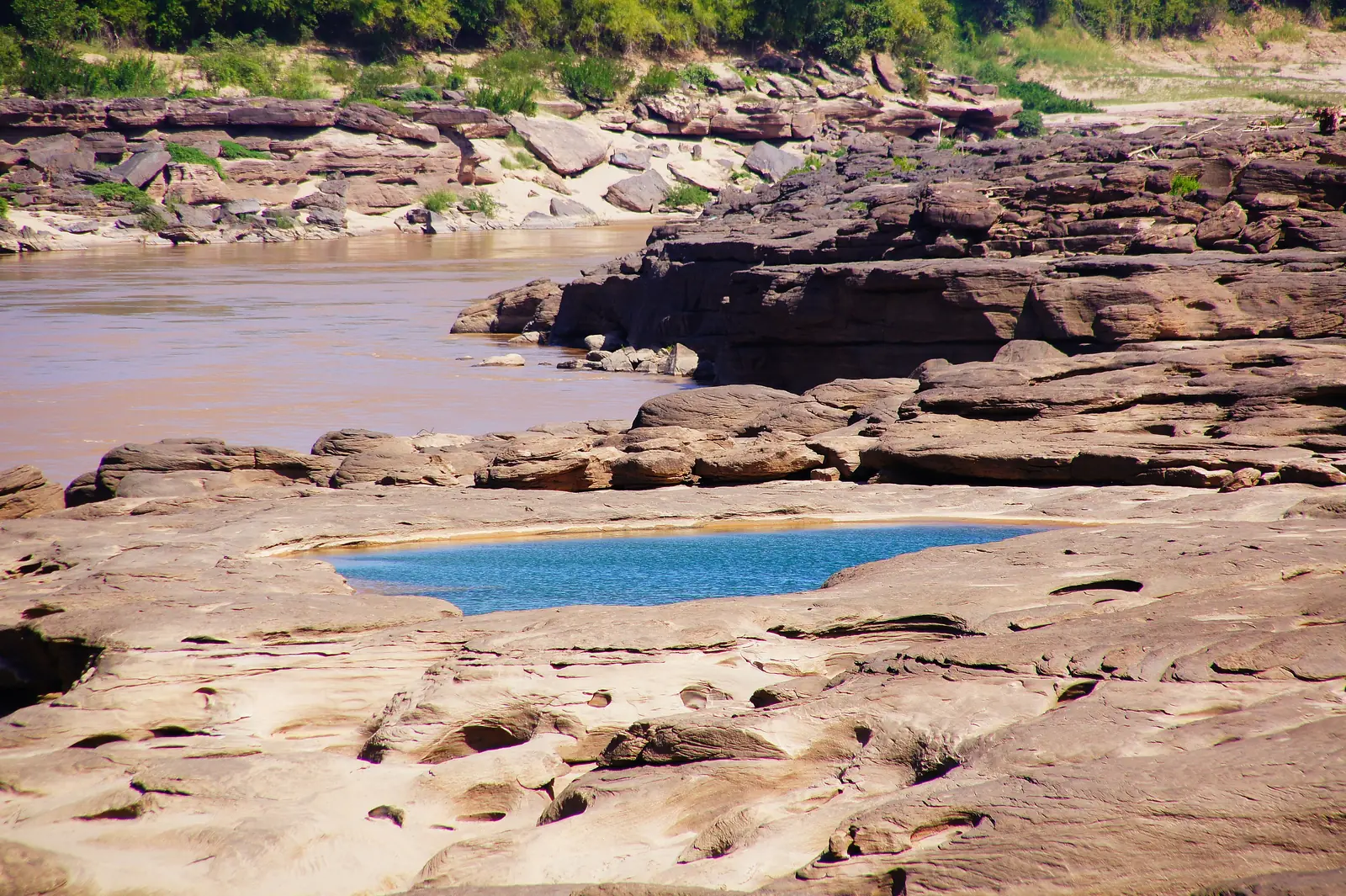
Seeing Sam Phan Bok: walk the rock, or take the longtail from Hat Salueng
On foot. You drive to the car park above the rock field, about 110 kilometres north-east of Ubon town, roughly two hours on paved roads with a short gravel stretch at the end. Parking is around ฿30 a car and a villager’s pickup shuttle down to the rock is around ฿20 a head; there is no official entry fee. Then you wander. The holes range from teacups to swimming pools, some filled with green trapped water, some with names (a dog’s head, a heart) that require squinting. Wear proper shoes: the sandstone is uneven, the edges are sharp and the deep holes are a real fall. There is no shade at all. Go at 6–8am or 4–6.30pm, when the low light gives the rock its texture and you can stand on it without cooking.
By boat. Hat Salueng is a long white Mekong sandbank at Ban Song Khon, a few kilometres upstream, and the longtails there run about 4 kilometres down to the rock field and back in roughly an hour, past fishing camps and Pak Bong, where the Mekong narrows to around 56 metres. Expect around ฿500–1,000 a boat for a standard trip, more for a bigger boat or a longer run; agree the price, the route and the stop time before you get in. Split four ways it is the best ฿250 you will spend in Ubon. Sunset from the Hat Salueng sand, with Laos a stone’s throw away, is free.
Verdict: Do it, December to April, dawn or dusk; boat if you are a group, walk if you are not. Parking ฿30, shuttle ฿20, boat around ฿500–1,000.
Pha Taem National Park: the cliff paintings and the first sunrise in Thailand
Twenty-odd kilometres north of Khong Chiam, a sandstone cliff drops straight to the Mekong with the hills of Laos on the far bank. Pha Taem faces due east, which is why it sells itself as the place to see Thailand’s first sunrise; Pha Chana Dai, deeper in the same park, makes the same claim, and both are close enough to true that nobody is checking. Be on the cliff terrace by 5.30–6am in the cool season, with a jacket; the wind off the river is colder than you expect. Foreigner entry is ฿200 on most 2026 listings, though one guide quotes ฿400, so bring ฿400 in cash and hope; the fee covers Soi Sawan and Sao Chaliang on the same day. Park notices are on the Department of National Parks site.
The rock paintings
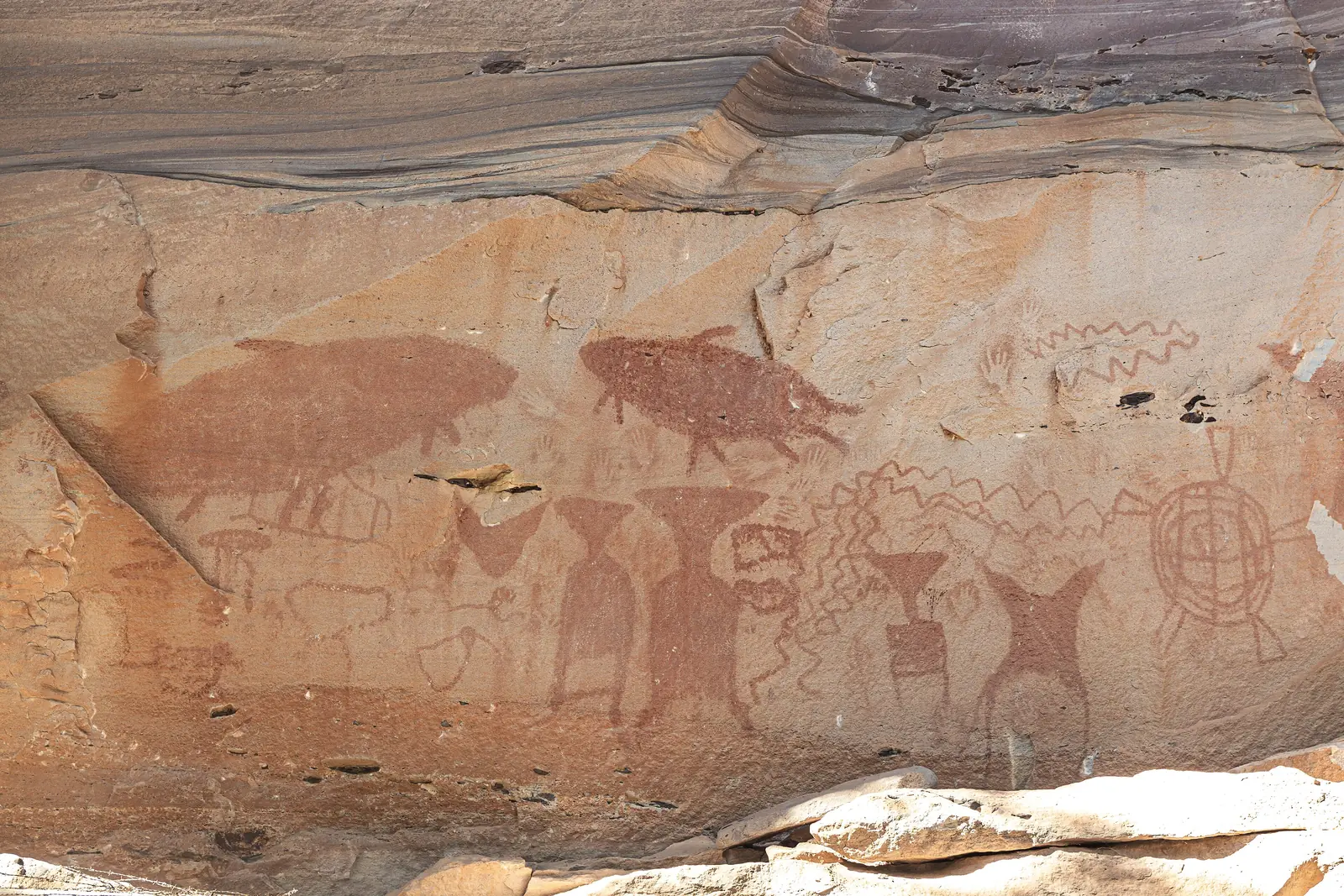
From the terrace a path drops below the cliff: about 300 metres to the first group of paintings, another 300 to the main panel, a continuous band of around 180 metres. More than 300 figures in red ochre, at least 3,000 years old: people, handprints, elephants, turtles, a giant catfish, and the conical fish traps Isaan villagers still use. They are fainter than the posters, and the best of them are a little above eye level, but standing under a cliff where someone painted a catfish three millennia ago, a few metres from the river that still feeds this district, is the strongest thing on this trip. Allow an hour and a half there and back; the return is a climb. Do not touch the rock.
Verdict: Do it, straight after sunrise before the tour vans. Park fee covers it.
Sao Chaliang and Soi Sawan waterfall
Sao Chaliang, about a kilometre before the visitor centre, is a cluster of mushroom-shaped sandstone pillars: ten minutes, a photograph, and a sense of déjà vu if you have just come from Phu Pha Thoep in Mukdahan. Soi Sawan, about 20 kilometres from the park office, is the park’s best waterfall, two streams meeting in a 20-metre fall that the brochures call a necklace. It is a short forest walk from the car park, and from late in the rains into the early cool season, roughly October to December, the open ground around it fills with tiny wildflowers. From March it is a damp stain on a rock face.
Verdict: Sao Chaliang, Fine as a stop; Soi Sawan, Do it October to January, Skip it March to May.
Khong Chiam: the two-colour river, and why it is the base
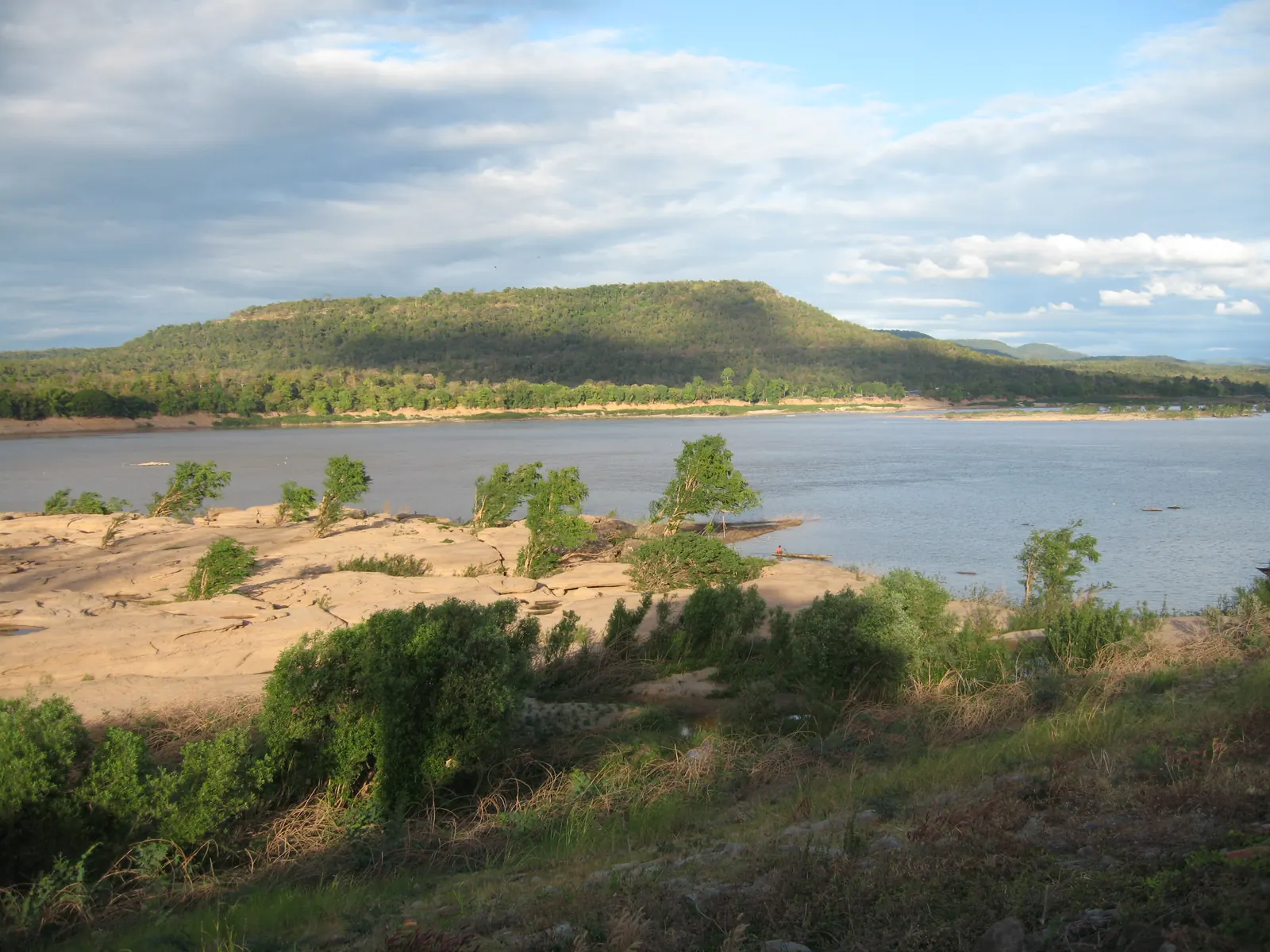
Khong Chiam is a small, slow town on the point where the Mun River runs into the Mekong, about 75–80 kilometres east of Ubon, and it is the only sensible place to sleep for this trip: Pha Taem is around 20 kilometres away, Sam Phan Bok an hour north. The Mun arrives darker and bluer, the Mekong brown and silty, and for a stretch they run side by side before mixing. That is Mae Nam Song Si, the two-colour river, free to view from the riverside pavilion at the end of town. The contrast is clearest in the dry months; in the rains both rivers are the same tea colour and you will wonder what the fuss was.
Above town, Wat Tham Khuha Sawan sits on a hill with a long view over the Mekong to Laos, free, shoulders and knees covered (our temple etiquette guide). In the evening the riverside restaurants do grilled Mekong fish stuffed with lemongrass at around ฿150–300, with som tam and sticky rice on the side; our Isaan food guide explains what arrives. Khong Chiam has no nightlife whatsoever, which after a 5am sunrise is exactly right.
Verdict: Do it; the two-colour river at sunset, then dinner. Free; fish ฿150–300.
Where to stay in Khong Chiam for Sam Phan Bok and Pha Taem
Khong Chiam is small and books out on Thai holidays, so reserve if your dates touch a long weekend or New Year. Tohsang Heritage Khongjiam is the big riverside resort with a pool, the comfortable choice (from around ฿2,000–3,000). Khong Chiam Orchid Riverside Resort, on the same stretch, is the mid-range alternative (from around ฿1,000–1,500). In town, Araya Resort Khongchiam Riverside on Rim Mun Road puts you walking distance from the two-colour river (from around ฿900–1,400), and View Khong Khong Chiam is the small, well-reviewed newcomer (from around ฿900). Or compare all Khong Chiam rooms on Agoda.
If you only have a day and are doing it by car from the city, sleep in Ubon either side: Sunee Grand Hotel & Convention Center is the reliable big hotel with a pool and a mall attached (from around ฿1,600–2,500), and the old-town temples in our top five Ubon temples fill the other half-day.
Getting to Khong Chiam and Sam Phan Bok from Ubon and Bangkok
Ubon Ratchathani is the gateway: an hour’s flight from Bangkok, an overnight train or bus. From Ubon, minivans run to Khong Chiam via Phibun Mangsahan; past Khong Chiam, public transport stops being useful. Sam Phan Bok, Soi Sawan and Pha Chana Dai are realistically a car, a driver or a tour. Prices are November 2026 ranges.
| Route | Time | Price | Verdict | Book |
|---|---|---|---|---|
| Fly Bangkok (Don Mueang) to Ubon Ratchathani | About 1 hr 5 min | Around ฿800–1,800 | Do it | Bangkok to Ubon |
| Train or bus Bangkok to Ubon Ratchathani | 8–11 hours overnight | Around ฿545–1,000 | Fine, overnight | Trains and buses |
| Direct bus Bangkok to Khong Chiam | About 11–12 hours | Around ฿655 | Fine; one a day | Bangkok to Khong Chiam |
| Minivan Ubon to Khong Chiam | About 1.5–2 hours | Around ฿80–100 | Do it | Ubon to Khong Chiam |
| Hire car from Ubon airport | Self-drive | Around ฿1,000–1,500 a day | Do it for Sam Phan Bok | Airport desks |
| Day tour from Ubon (Pha Taem, Sam Phan Bok, Khong Chiam) | Full day | Around ฿2,500–4,000 a head | Fine if solo | Ubon tours |
In Khong Chiam, a motorbike is around ฿300 a day, and a tuk-tuk or pickup for Pha Taem and Soi Sawan has been quoted at around ฿1,200 for up to four; agree it the night before so the driver is outside at 5am. Do not ride the Sam Phan Bok road on a scooter you cannot handle on gravel, and read our scams guide on fare-setting before you hire anything. Onward: Mukdahan is about three hours north up the river road (Ubon to Mukdahan on 12Go, and our Mukdahan and Savannakhet guide), and the Chong Mek border south of Khong Chiam is the way into southern Laos (Ubon to Pakse on 12Go); land entries back into Thailand now count against a two-a-year cap, explained in our 30-day exemption guide.
A two-day plan that gets the timing right
Day one. Morning flight or overnight train into Ubon, collect a car, lunch in the city, and drive two hours north-east to Sam Phan Bok for 4pm: the rock in low light, then sunset from the Hat Salueng sand. Drive an hour south to Khong Chiam in the dark (slowly; buffalo and unlit motorbikes) and eat fish by the river.
Day two. Up at 4.45am for the Pha Taem sunrise, the paintings at 6.30 before the vans, Sao Chaliang on the way out, Soi Sawan if it is running, a nap, and the two-colour river and Wat Tham Khuha Sawan before dinner. Day three is back to Ubon for the temples, or north up the river to Mukdahan. Reverse it in March and April if you want Sam Phan Bok at dawn instead: sleep in Khong Chiam, leave at 5am, and be on the rock by 6.15.
The verdict: come between December and April, and bring a torch
Sam Phan Bok is worth the drive in the right months and pointless in the wrong ones, and there is no middle. December to February gives you the rock, a clear Pha Taem sunrise and the last of the waterfalls in cool weather; March and April give you the biggest rock field and 40°C by 11am. Either way, pack a head torch for the 5am cliff path and the dark drive back from Hat Salueng. Pha Taem works almost all year, the two-colour river is a pleasant hour rather than a destination, and Khong Chiam is the kind of riverside town people mean when they say they want “the real Isaan”. If you are driving the whole river, this is the end of our Mekong road from Loei to Ubon; Amnat Charoen is the quiet province in between. Budgets against the rest of the country are in our Thailand Price Index.
Sam Phan Bok and Khong Chiam: your questions, answered
When is the best time to see Sam Phan Bok?
January to April, when the Mekong is lowest and the rock field widest. It usually starts surfacing in December, sometimes late November, and disappears under the rising river from late May; from June to October there is nothing to see. The exact timing shifts each year with rainfall and upstream dams, so ask a boatman at Hat Salueng or check a local Pho Sai page before you drive.
How much does it cost to visit Sam Phan Bok?
There is no official entry fee. Expect around ฿30 to park a car and around ฿20 a head for the villagers’ shuttle down to the rock. A longtail from Hat Salueng at Ban Song Khon, about an hour on the river, is around ฿500–1,000 a boat, more for larger boats or longer trips. Agree the price and the route before boarding.
Can you visit Sam Phan Bok and Pha Taem in one day from Ubon?
Yes, with a car or a tour, but it is a long day of around 300 kilometres and you will see one of them in harsh midday light. Better to sleep a night in Khong Chiam: Sam Phan Bok in the late afternoon, Pha Taem at sunrise the next morning, and the two-colour river before you drive back. Public transport reaches Khong Chiam, not Sam Phan Bok.
How much is the entrance fee at Pha Taem National Park?
Most 2026 listings give ฿200 for foreign adults and ฿40 for Thai adults, with a small vehicle fee; one guide quotes ฿400 for foreigners, so carry ฿400 in cash to be safe. The ticket covers the cliff terrace, the rock-painting trail, Sao Chaliang and Soi Sawan waterfall on the same day. Arrive by 5.30am for sunrise in the cool season.
Where does the Mun meet the Mekong, and when are the two colours visible?
At Khong Chiam, about 75–80 kilometres east of Ubon town. The darker, bluer Mun and the brown, silty Mekong run side by side before mixing, and the line is clearest in the dry months, roughly December to May. In the rainy season both rivers carry so much sediment that the contrast mostly disappears. The riverside viewpoint is free and easy to walk to from town.
Related guides
- Top 5 temples in Ubon Ratchatani
- Isaan Food: Som Tam, Larb, Gai Yang and the Fire That Follows
- Amnat Charoen: Inside Thailand’s Least-Visited Province
Book the trip
Some links in this guide are affiliate links. If you book through them we may earn a small commission at no extra cost to you — it helps keep Destination Thailand independent.
Hotels: sleep by the river and compare Ubon Ratchathani and Khong Chiam hotels on Agoda, early for New Year and long weekends. Tours/Boats: browse Ubon Ratchathani trips on GetYourGuide and read the newest reviews; the Sam Phan Bok longtail is booked on the sand. Getting there: book Bangkok to Ubon Ratchathani on 12Go, and plan the river beyond it in our Mekong road guide. Not sure the far east of Isaan is your trip? Our Where to Go in Thailand matcher scores all 77 provinces against your month, your crowd tolerance and what you actually want from the trip.