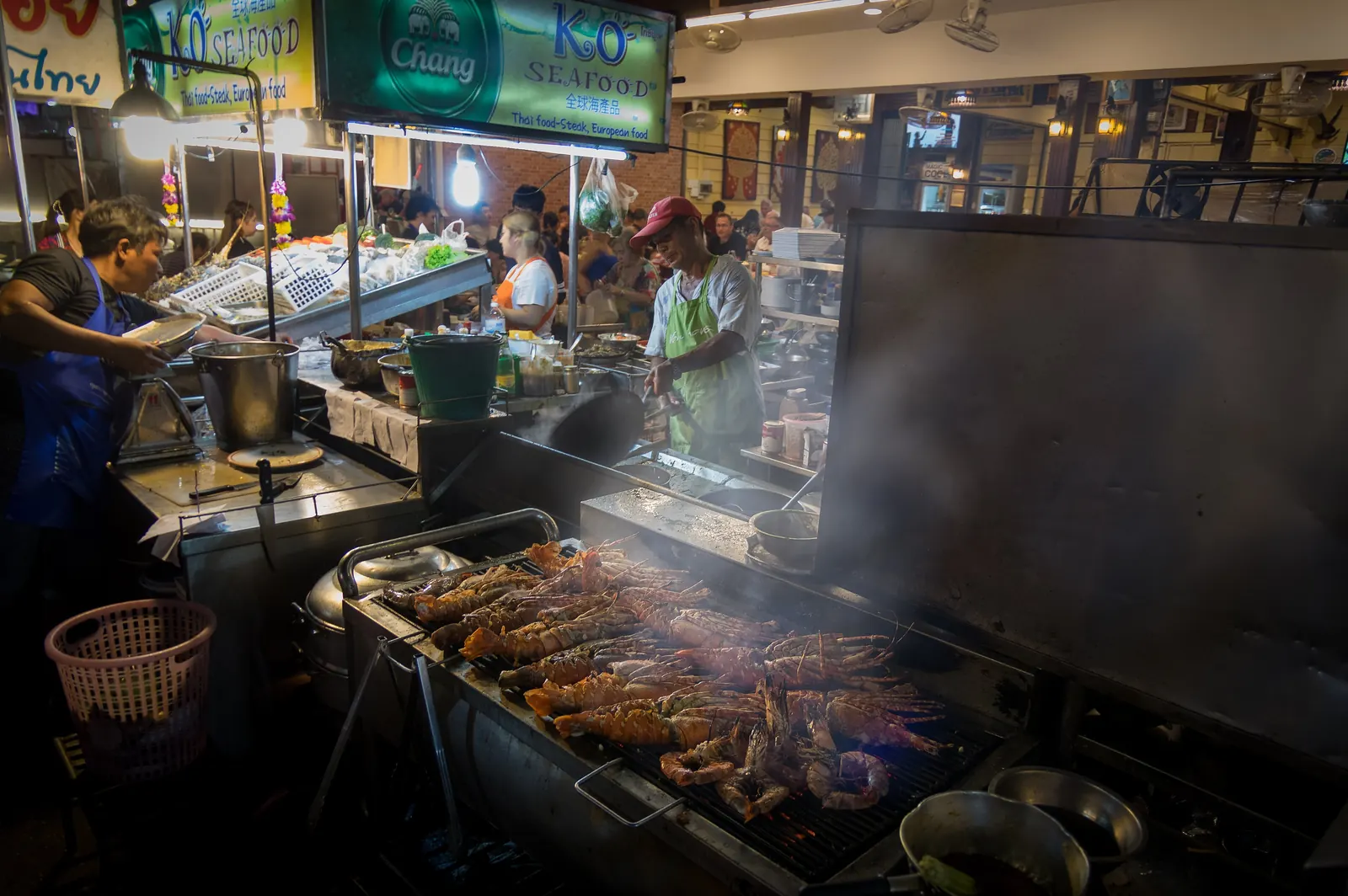
Every evening at about half past five, a man on Dechanuchit Road tips a box of lobsters onto a bed of ice and writes “1,500” on a bit of card. By seven, four coachloads of people will have photographed those lobsters and perhaps three tables will have bought one. That, in one image, is the Hua Hin night market: a very good place to eat that has learned, over thirty years, exactly how much a tourist will pay for a shellfish.
The complication is that Hua Hin now has six or seven things calling themselves a night market, spread along twelve kilometres of coast, opening on different days. Two are excellent. One closed in 2020 and is still on half the itineraries in circulation. This guide sorts them, with days, hours, real prices and a verdict on each.
The short version: eat at Tamarind (Thursday to Sunday), walk Cicada next door for twenty minutes because it is free and pretty, and do the Dechanuchit Road market once for the grilled squid and the theatre, not the lobster. Our Hua Hin weekend plan slots all three into two nights, and where to stay in Hua Hin tells you which end of town puts you within walking distance of which.
Hua Hin Night Market on Dechanuchit Road
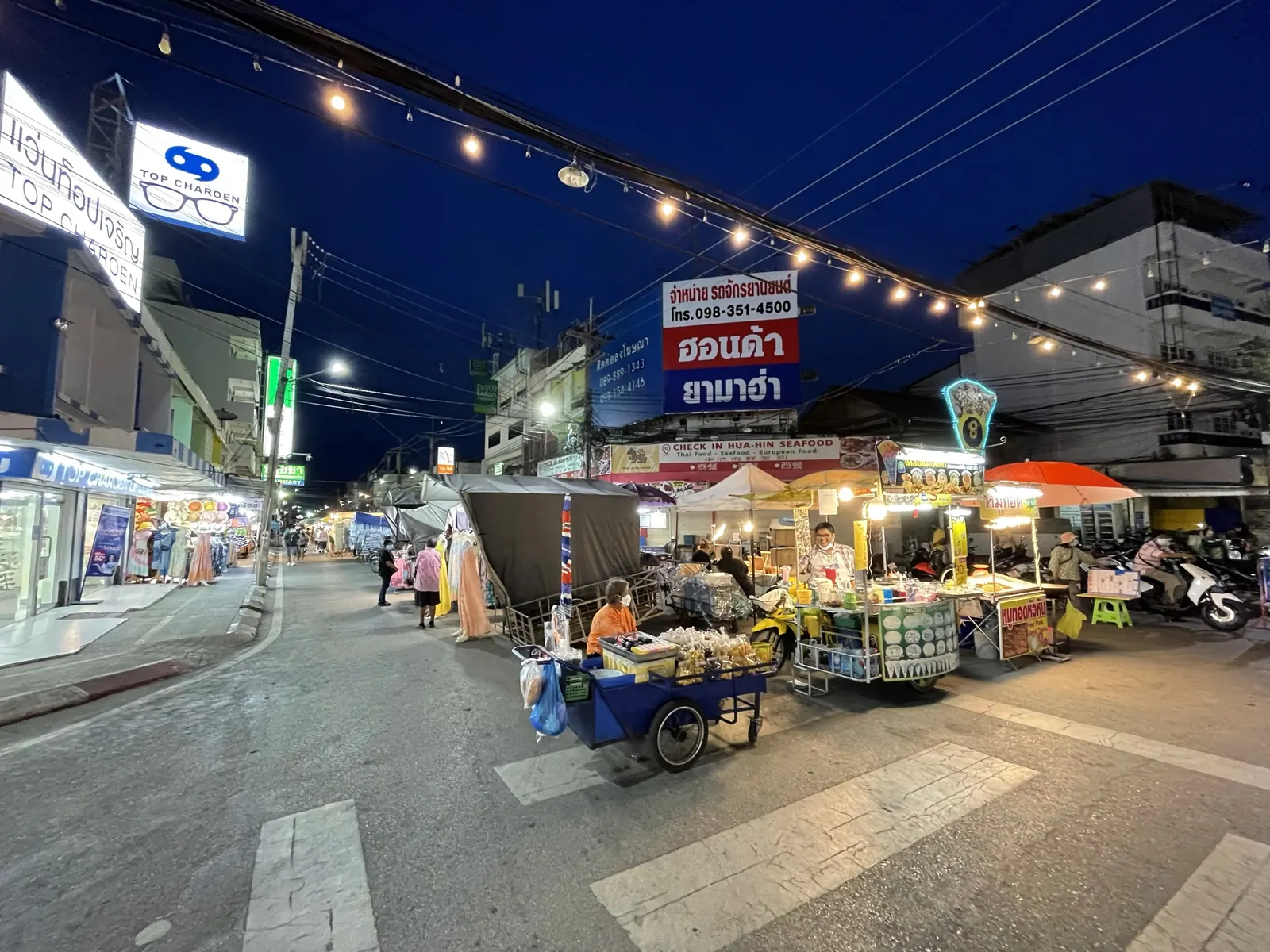
This is the original. When a Thai person says “the night market” they mean Dechanuchit Road, also signed Soi Hua Hin 72, the two blocks between Phetkasem Road and Prapokklao Road in the centre of town. It opens nightly, all year. Stalls drag out from 4pm, the food is properly going by 6pm, and the last squid comes off the grill around 11pm, later at weekends. It is five minutes on foot from the Clock Tower and the railway station, so a room between Soi 70 and Soi 80 on Agoda’s Hua Hin listings means no transport at all.
Down the middle, food carts and folding tables. Along the sides, sit-down seafood restaurants with the ice displays, and behind them the shops selling elephant trousers (฿150 to ฿200, identical to every other province’s) and wooden frogs that croak when you drag a stick across them. Walk past.
Now, the seafood. The restaurants sell by weight, on a scale you cannot see, operated by someone who has already sized you up. Expect roughly: lobster ฿1,500 to ฿1,700 per kilo; tiger prawns ฿600 to ฿900; crab ฿500 to ฿800; a whole grilled sea bass ฿350 to ฿600; squid or mussels ฿150 to ฿250 a plate. The per-kilo price is not the trick. The trick is that a “small” lobster weighs 700 grams, the prawn “set” is two kilos, and the cooking charge goes on top. The same prawns at Huana wet market are ฿140 to ฿260 a kilo. Confirm the weight, the cooking fee and the total before anything touches the grill; as our Thailand scams guide says, nothing here is a crime, it is just a price you did not ask about.
What to actually eat is what the Thai families at the plastic tables are eating. Grilled squid on a stick, ฿60 to ฿100. Pork satay, ten sticks, ฿60. Hoi tod, the crispy mussel omelette, ฿80 and better than most of Bangkok’s. Pad thai ฿60 to ฿80. Mango sticky rice ฿80 to ฿120 in season. A large Chang from the corner shop is ฿70, against ฿120 at the seafood tables.
Verdict: Do it, with a caveat. Go once, go at 6pm before the tour buses, eat from the carts, and if you must have a lobster, watch it weighed.
Chatsila, Patio Oldtown and the Grand Night Market
Three more markets sit within ten minutes’ walk, and the naming is a mess. Chatsila Night Market was the covered arcade at the Phetkasem end of Dechanuchit Road; in late 2023 it was rebuilt as Patio Oldtown Night Market, which is what the signs say now, though Google Maps and the taxi drivers still say Chatsila. Same place. It runs 5.30pm to 11pm, Wednesday to Monday (closed Tuesday), entrance off Phetkasem opposite the Clock Tower. Cleaner and calmer than the main strip, with real toilets, acoustic music from 7pm, cocktails at ฿180 to ฿250 and dishes about ฿20 dearer than outside. Verdict: do it, as the sit-down second half of a Dechanuchit evening.
The Grand Night Market is a different animal: on Phetkasem just past Soi 86 by the Grand Thai boxing stadium, 1.5 kilometres south of the centre, nightly 5pm to 11pm. This is where Hua Hin’s Thai residents and its Burmese and Cambodian construction workers shop. ฿100 T-shirts, ฿150 foot massages, phone repairs, and an aisle of food stalls where nothing costs more than ฿60 and nobody has printed an English menu. Pad krapao with a fried egg for ฿50 and a ฿20 iced Milo is an honest evening. Verdict: do it if you are staying at the southern end of town; skip it if you have one night.
Chatchai Market, for completeness, is the morning wet market on Phetkasem between Soi 72 and Soi 76 and not a night market at all: 5am until early afternoon, boat noodles ฿40 to ฿50, the best fruit prices in town. The evening stalls on the pavement outside it are the western fringe of the Dechanuchit market, not a separate thing.
Cicada Market vs Tamarind Market
Seven kilometres south of town, where the beach road bends toward Khao Takiab, two markets sit side by side under casuarina trees opposite the Hyatt Regency. Different owners, different days, different appetites. Most people do both in one evening without noticing they have crossed a boundary.
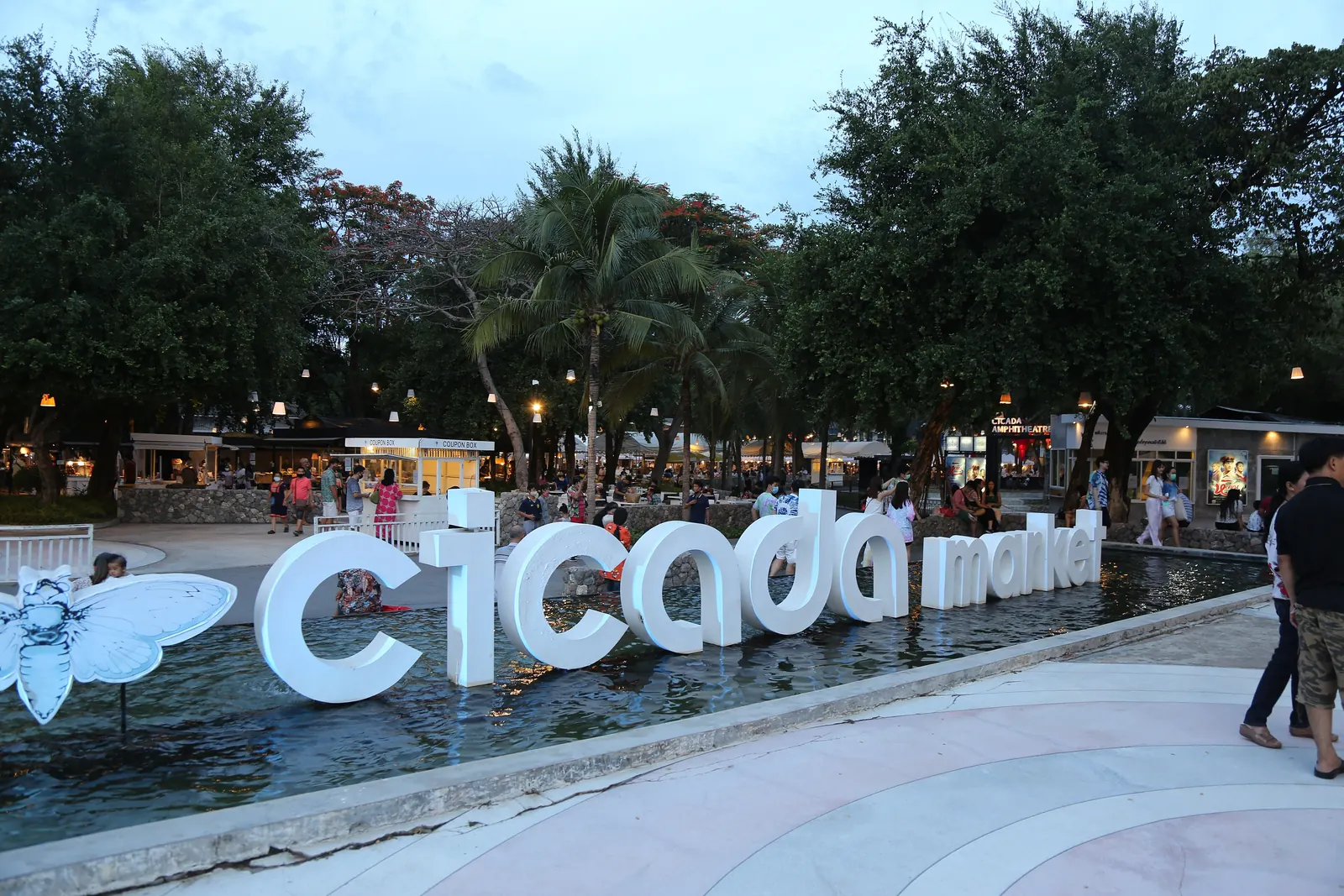
Cicada is the older one, opened in 2010 as an art market, and that is still what it is. Official 2026 hours are Friday, Saturday and Sunday, 4pm to 11pm; it does not open other days, whatever a concierge says. Entry is free. Hand-thrown ceramics, prints, silver, linen dresses, ฿200 to ฿2,000, mostly made by the person selling them. A lawn with an open-air stage where student bands and jazz trios play from 7pm. A food zone at the back on a coupon system: buy a ฿100 strip, spend it at the stalls, queue again to refund the rest. Dishes ฿80 to ฿150, fifteen to twenty per cent above town, decent but secondary. Verdict: do it, for an hour, and buy the ceramics rather than the dinner.
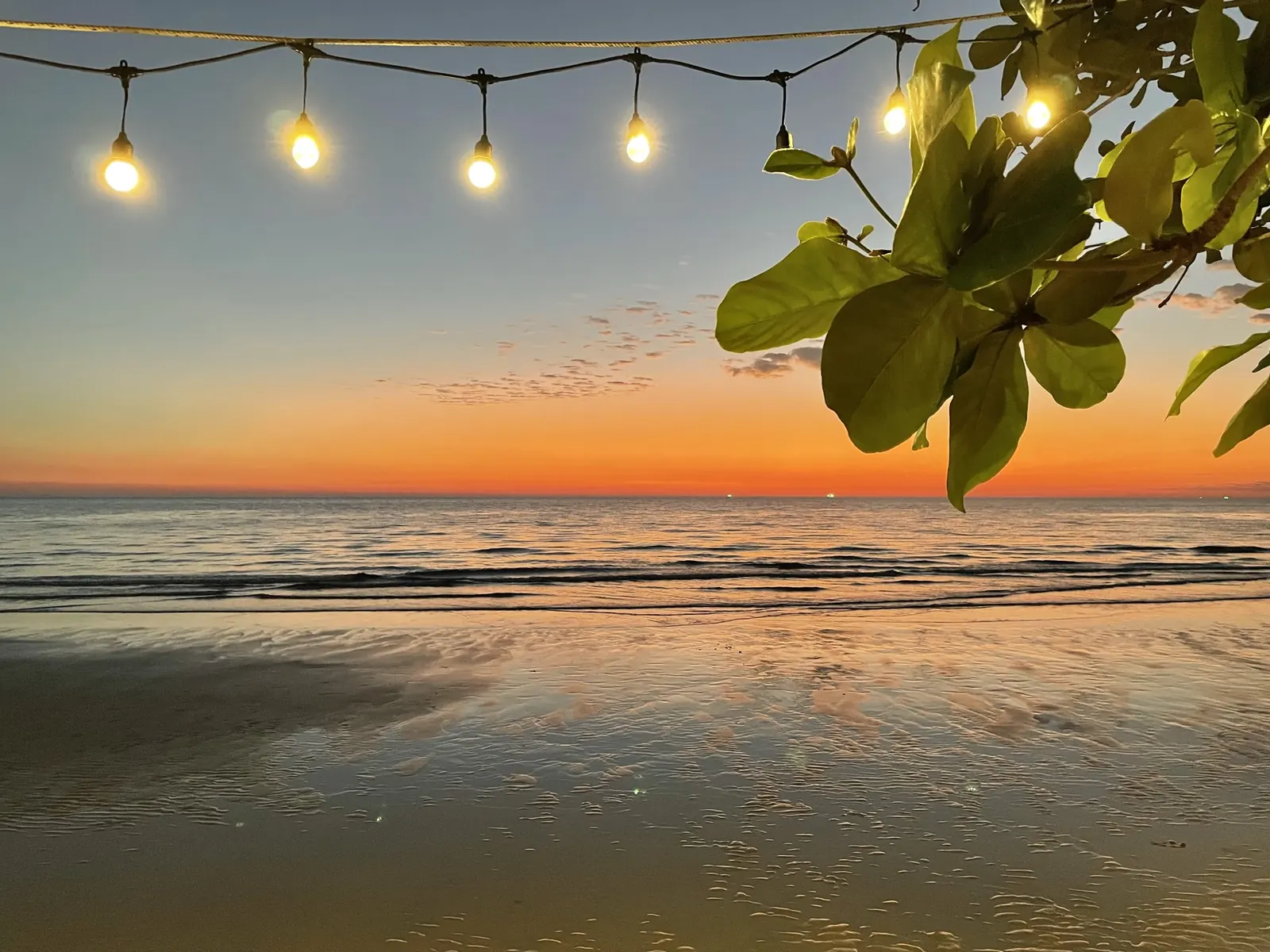
Tamarind, immediately next door, opened in 2015 and is the one for food. Thursday to Sunday, roughly 5pm to 10.30pm, cash or QR at each stall, no coupons. The line-up rotates but the core holds: grilled chicken skewers three for ฿100; Isan sausage ฿60; whole grilled squid ฿120; beef cubes that are not the wagyu they claim but are ฿150 and good; pad krapao cooked in front of you ฿80; southern curries from a couple out of Nakhon Si Thammarat, ฿90, and our southern Thai food guide explains why that matters. Craft beer in cans ฿150 to ฿200. The stage is louder and later than Cicada’s, and the long tables under fairy lights are the one point where it tips into Instagram bait. The stalls are permanent, with running water, which is more than the carts in town can say; see is Thai street food safe. Verdict: do it. The best evening meal in Hua Hin for under ฿400 a head.
Getting there is the bit people get wrong. The green songthaew runs down Phetkasem and the beach road to Khao Takiab for ฿10 by day and ฿15 after 7pm, stopping outside; flag it near the Clock Tower and say “Cicada”. The catch is that songthaews thin out from 8pm and stop by 9pm to 10pm, so they get you there, not back. Return by Grab or Bolt at ฿100 to ฿150, or a tuk-tuk at the gate that opens at ฿200 to ฿300 and settles at ฿150 if you walk two hundred metres up the road first. From Khao Takiab village it is a fifteen-minute walk. If you would rather someone else handled night one, a Hua Hin evening food tour covers Tamarind, Cicada and town for around ฿1,500 to ฿2,000 with transport.
Sam Phan Nam, Plearn Wan and the ones to skip
Plearn Wan first, because it keeps coming up. The retro “vintage village” on Phetkasem between Soi 38 and Soi 40, with its 1950s shopfronts and neon Ferris wheel, closed for good on 31 January 2020 and has not reopened. Anything listing it as current was written before then, or copied from something that was. Verdict: skip it, on the grounds that it does not exist.
Hua Hin Sam Phan Nam Floating Market is a stranger case. A purpose-built canal-side market on Soi Hua Hin 112, fifteen kilometres inland at Thap Tai, it shut during Covid and stayed shut for years. It reopened on 1 November 2024 with free entry and is trading daily 8am to 8pm as of this writing. It is a day market that stays open into the evening, not a night market, and it floats in the sense that there is water near it. Souvenirs, Thai-style clothing, ฿50 to ฿100 plates, a ฿20 train ride, ฿40 boat trips, ฿100 swan pedalos, and a ฿250 to ฿350 Grab each way. Verdict: skip it unless you have children under ten and a hire car, in which case go at 4pm and leave by dark.
Cha-am, twenty-five kilometres north, has no organised night market, just seafood shacks and grill carts along the beachfront Ruamjit Road from about 5pm, and a Wednesday and Saturday walking street that is mostly clothes. Seafood is a third cheaper than Hua Hin and the crowd is entirely Thai. If you are staying in Cha-am, eat there; from Hua Hin it is not worth the ฿400 taxi.
The alternative: Khao Takiab seafood restaurants
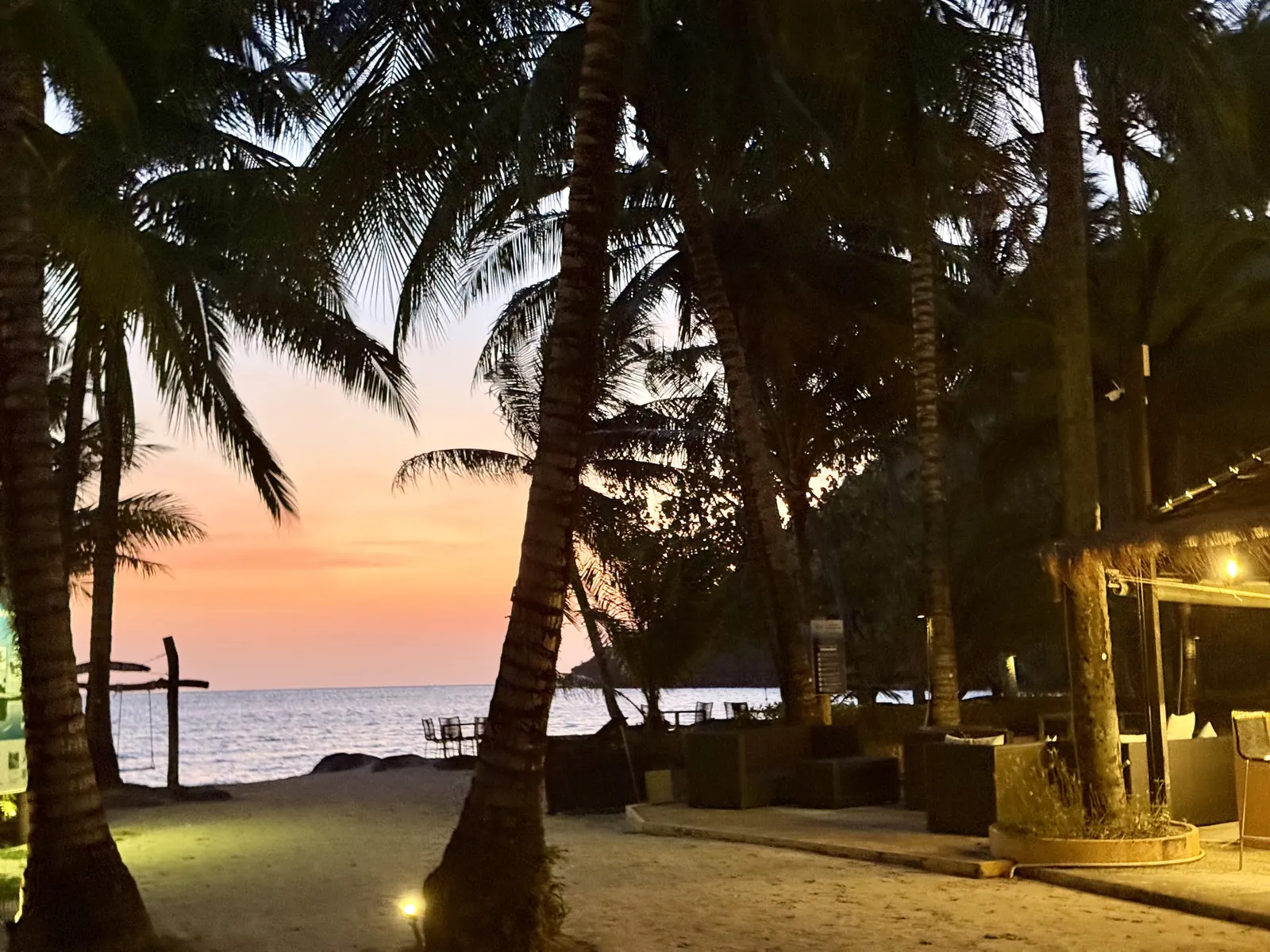
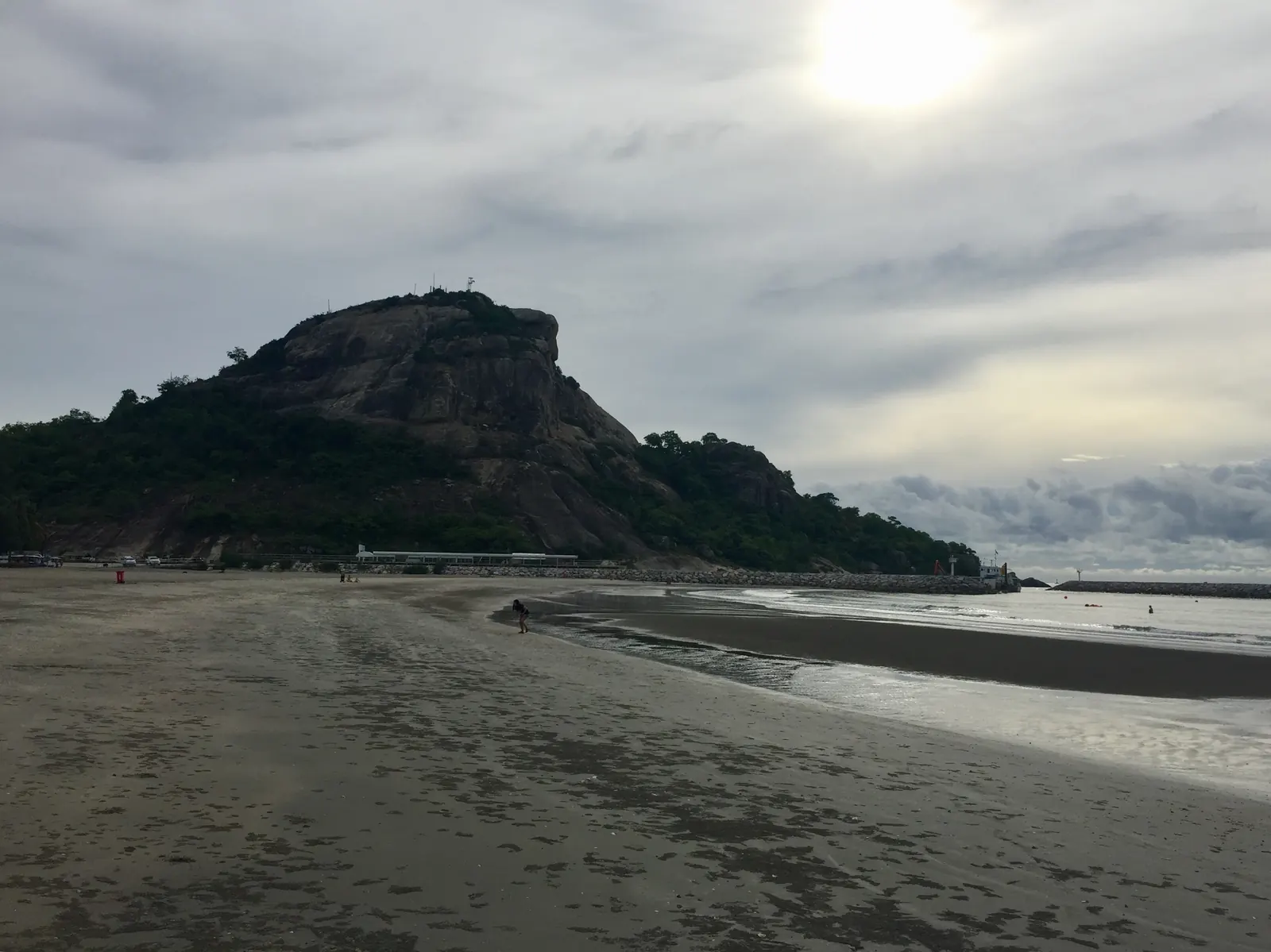
Here is what nobody selling you a night market wants you to hear. If what you want is Gulf seafood at a fair price, the place is not a market but the row of open-fronted restaurants along the beach at Khao Takiab village, at the foot of the monkey temple, ten minutes’ walk past Cicada. Thai family restaurants, Thai clientele, prices to match: whole steamed sea bass with lime and chilli ฿280 to ฿350; a kilo of grilled tiger prawns ฿450 to ฿600; crab in yellow curry ฿300 to ฿400 for a plate that feeds two; tom yum goong ฿150; a large Singha ฿90. Plastic chairs on the sand, the squid boats’ green lamps offshore, monkeys occasionally attempting a robbery. This is the evening the markets are re-enacting.
Two rules. Order by the plate, not the kilo. Go at 6pm, because the kitchens peak at 7.30pm and Thai kitchens do not slow down gracefully. Check anything you are quoted against our Thailand price index; the Hua Hin premium is real but smaller than you fear. Verdict: do it, and if it is this or the Dechanuchit lobsters, this.
Hua Hin night markets by day of the week
The most useful fact in this guide: the two best markets do not open Monday to Wednesday. Thursday to Sunday gets you everything; Monday to Wednesday gets you Dechanuchit, Patio Oldtown (not Tuesday), the Grand Night Market and the Khao Takiab restaurants, still three good evenings. Trains from Bangkok’s Krung Thep Aphiwat station take about four hours; minivans from the Southern Terminal take three and cost ฿220 to ฿280. Both are on 12Go, which matters on Friday afternoons when the minivans sell out.
| Market | Days | Hours | What for | Verdict |
|---|---|---|---|---|
| Hua Hin Night Market (Dechanuchit Rd / Soi 72) | Daily | 5pm–11pm | Cart food, grilled squid, the spectacle; seafood by the kilo | Do it, with a caveat |
| Patio Oldtown (ex-Chatsila) | Wed–Mon | 5.30pm–11pm | Sit-down second half, cocktails, toilets | Do it |
| Grand Night Market (Phetkasem, past Soi 86) | Daily | 5pm–11pm | Local clothes market, ฿50 plates | Do it if nearby |
| Cicada Market (Khao Takiab) | Fri–Sun | 4pm–11pm | Art, crafts, live music, coupon food | Do it, for an hour |
| Tamarind Market (Khao Takiab) | Thu–Sun | 5pm–10.30pm | Best food of the lot, live bands | Do it |
| Sam Phan Nam Floating Market (Thap Tai) | Daily | 8am–8pm | Day market with boats, families with children | Skip it |
| Plearn Wan | Closed since Jan 2020 | — | — | Skip it (does not exist) |
| Cha-am beachfront stalls | Daily (walking street Wed & Sat) | 5pm–late | Cheaper seafood, Thai crowd | Only if staying in Cha-am |
| Khao Takiab seafood restaurants | Daily | 11am–10pm | Seafood by the plate at Thai prices | Do it |
Three evenings, then: Thursday at Tamarind; Friday at Dechanuchit then Patio Oldtown; Saturday an hour at Cicada and dinner in Khao Takiab village. If it rains, and from May to October it will, Patio Oldtown is the only one with a roof worth the name. The rest of Prachuap Khiri Khan is a good deal quieter than any of this, which is either a warning or a recommendation depending on how you feel about wooden frogs.
Hua Hin night market: your questions, answered
What time does Hua Hin night market open and close?
The main Hua Hin Night Market on Dechanuchit Road (Soi 72) runs every night of the year. Stalls set up from about 4pm, the food is in full swing by 6pm, and it winds down around 11pm, a little later on Friday and Saturday. Arrive before 6.30pm to beat the coach parties.
Which is better, Cicada Market or Tamarind Market?
They are next door to each other and do different jobs. Cicada (Fri–Sun, 4pm–11pm) is an art and craft market with live music and a coupon-based food zone that is pleasant but overpriced. Tamarind (Thu–Sun, 5pm–10.30pm) is almost entirely food and drink, paid at each stall, and is the better place to eat. Browse Cicada, then walk through the trees to Tamarind for dinner.
How much does seafood cost at Hua Hin night market?
Restaurants on Dechanuchit Road sell by weight: lobster ฿1,500–1,700 per kilo, tiger prawns ฿600–900, crab ฿500–800, a whole grilled fish ฿350–600. A cooking charge is usually added, and the piece you point at often weighs more than you expect, so confirm weight, fee and total before it goes on the grill. Cart food is a different world: squid, satay and pad thai are ฿60–100 a plate.
How do I get from Hua Hin town to Cicada and Tamarind?
The green songthaew from Phetkasem Road near the Clock Tower goes past the door for ฿10 by day and ฿15 after 7pm; tell the driver “Cicada”. Songthaews stop around 9pm to 10pm, so return by Grab or Bolt (฿100–150 to the old town) or a tuk-tuk from the gate, which opens at ฿200–300 and should settle at ฿150. From Khao Takiab village it is a fifteen-minute walk.
Is Plearn Wan in Hua Hin still open?
No. Plearn Wan, the retro shopping village on Phetkasem Road, closed permanently on 31 January 2020 and has not reopened; any guide still listing it is out of date. Patio Oldtown, the rebuilt Chatsila market in the town centre, is the closest current equivalent, and Cicada covers the craft-market side.
Related guides
- Where to stay in Hua Hin: which end of town, and why
- A Hua Hin weekend from Bangkok: the two-night plan
- Bangkok street food: what to eat and where to find it
Book the trip
Some links in this guide are affiliate links. If you book through them we may earn a small commission at no extra cost to you — it helps keep Destination Thailand independent.
Rooms between Soi 70 and Soi 80 put the Dechanuchit market on foot and Khao Takiab a ฿15 songthaew away; compare them on Agoda’s Hua Hin and Cha-am page. Trains and minivans from Bangkok are on 12Go, and if you want a guide to do the ordering on your first night, GetYourGuide’s Hua Hin night market tours cover Tamarind, Cicada and the town market with transport included. Not sure Hua Hin is the right beach for you at all? Our where to go in Thailand matcher will tell you in about a minute.