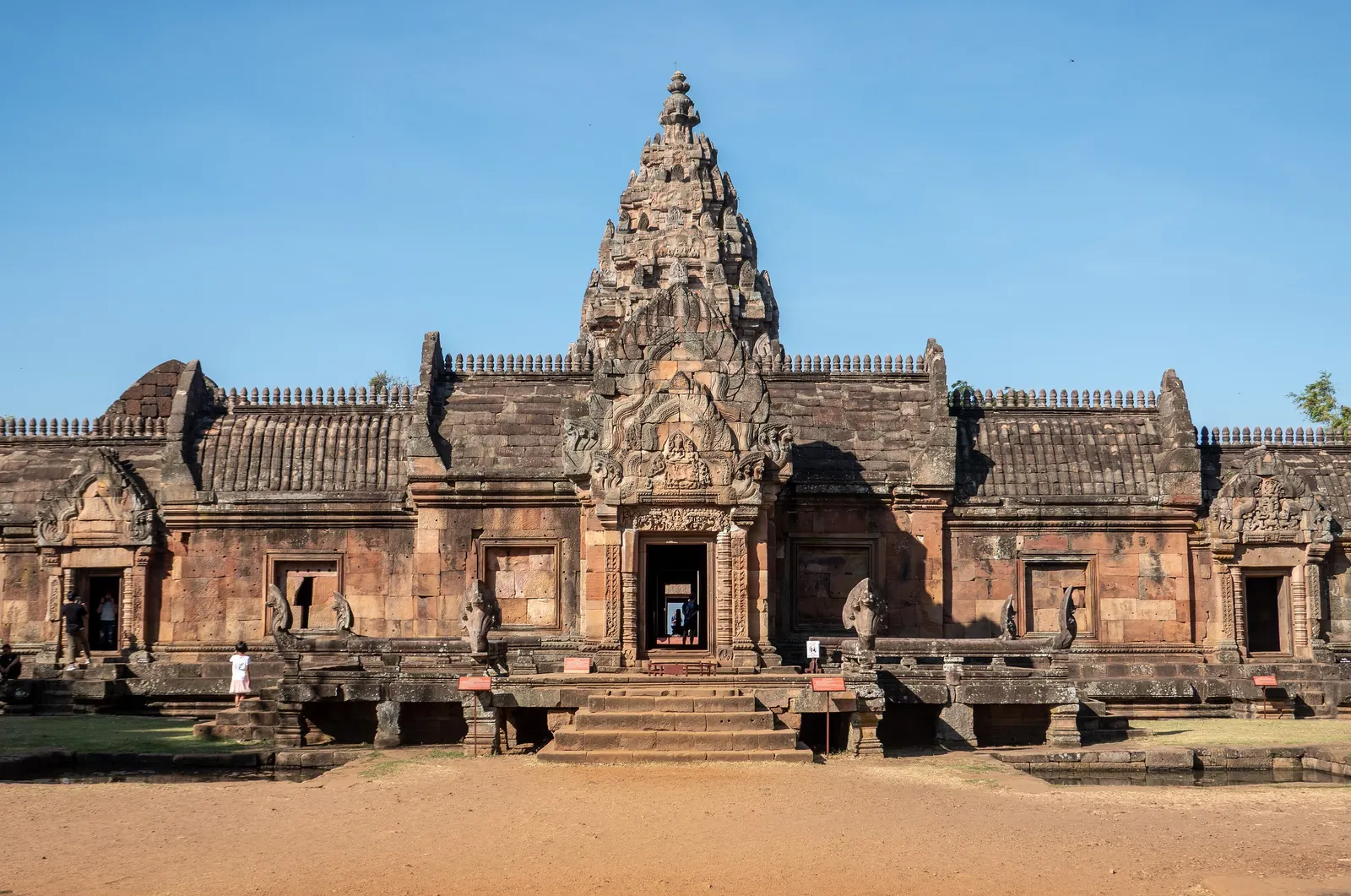
Phanom Rung is the temple people mean when they say Thailand has its own Angkor, and for once the boast holds up. A Shiva sanctuary of pink sandstone sits on the rim of an extinct volcano in Buriram, reached up a processional avenue, three naga bridges and a stairway built to make you feel small on the way to a god. Eight kilometres down the hill, Prasat Muang Tam is older, flatter and ringed by four lotus ponds. Between them they are the best pair of Khmer monuments in the country, and on most weekday mornings you will share them with a school trip and a dog.
Culture first: what these temples were for, how to read a lintel, and the stolen Vishnu that came home from Chicago. Then the fee, the 2027 sun-through-fifteen-doors windows and how to reach a hilltop with no bus. The wider province, football and MotoGP included, is in our Buriram travel guide and on the Buriram province page. Prices are checked against our Thailand Price Index; estimates say “around”. Nothing was comped.
In this guide10 sections
- What are Phanom Rung and Muang Tam, and why are Khmer temples in Thailand at all?
- How to read a Khmer temple: naga bridges, lintels, pediments and the prang
- Phanom Rung itself: the volcano, the walk up and the Narai lintel that came home from Chicago
- The Phanom Rung sun alignment: 2027 dates for the sun through 15 doors
- The Phanom Rung Festival in April: the climb, the procession and the light show
- Prasat Muang Tam: the lotus ponds, the older temple and why some people prefer it
- For the keen: Kuti Ruesi, Sikhoraphum and the border temples you cannot visit
- How to get to Phanom Rung from Bangkok, Buriram or Nang Rong
- Where to stay for Phanom Rung: Nang Rong for the temples, Buriram for everything else
- Phanom Rung and Muang Tam: your questions, answered
What are Phanom Rung and Muang Tam, and why are Khmer temples in Thailand at all?
For roughly four centuries, from the 9th to the 13th, the Khmer empire ruled from Angkor across most of what is now north-east Thailand. Its kings built a network of laterite roads running north-west from Angkor through the Dangrek hills to Phimai near Korat, lined with rest houses and small hospital chapels; Phanom Rung and Muang Tam sit just off that road. The people who carved them were the ancestors of the Khmer-speaking villagers who still live across southern Buriram, Surin and Sisaket, a story told in our guide to the ethnic groups of Thailand.
These are Hindu temples, not Buddhist ones, which is the first thing to get straight. A Khmer prasat is a model of the cosmos: the central tower, the prang, stands for Mount Meru or Mount Kailash, home of the gods; the walls are the mountain ranges around it; the ponds and moats are the oceans. Phanom Rung, whose name comes from the Khmer for “big hill”, makes the metaphor literal by sitting on a real mountain. Its main sanctuary dates mostly from the early 12th century, built by a local lord called Narendraditya, a relative of the Angkor royal house who retired here as a Shaivite ascetic; inscriptions on site record the works of his son Hiranya. Muang Tam is earlier, late 10th to early 11th century, and was a lowland temple beside a great reservoir.
| Site | Built | Dedicated to | Foreigner fee (FAD list) | Time needed | Verdict |
|---|---|---|---|---|---|
| Phanom Rung | 10th–13th c., main tower early 12th c. | Shiva | ฿100, or ฿150 with Muang Tam | 1.5–2 h | Do it |
| Muang Tam | Late 10th–early 11th c. | Shiva | ฿100 alone, included in the ฿150 ticket | 45–60 min | Worth it, late afternoon |
| Kuti Ruesi and Prasat Ban Bu | Late 12th c. | Hospital chapel and rest house on the royal road | Free | 15 min, from the car | Fine if passing |
| Prasat Sikhoraphum (Surin) | Early 12th c. | Shiva | Around ฿50 | 30–45 min | Worth it for the keen |
| Prasat Ta Muen group (Surin border) | 11th–13th c. | Shiva; rest house and hospital chapel | n/a | n/a | Skip: closed since the 2025 border fighting |
How to read a Khmer temple: naga bridges, lintels, pediments and the prang
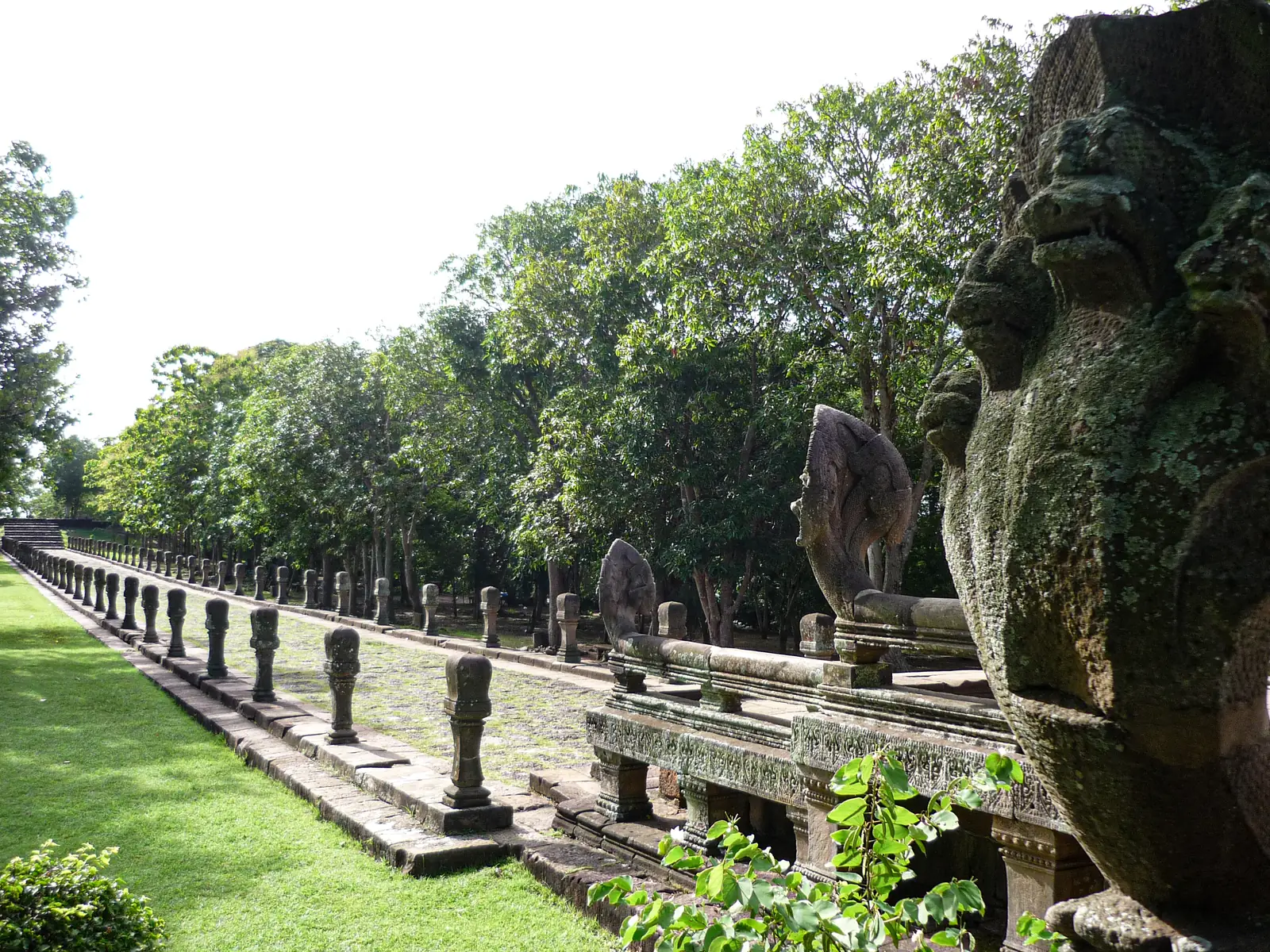
Five things, and you will understand more than most of the people photographing them. The approach. You do not wander into a Khmer temple; you are processed into it. Phanom Rung’s avenue runs about 160 m, edged with some seventy sandstone posts topped with lotus buds, the boundary markers between the human world and the sacred one. The naga bridge. A cross-shaped platform with railings formed by five-headed serpents. The naga is the rainbow bridge between earth and heaven; crossing it is the point where you stop being a tourist and become, in theory, a pilgrim.
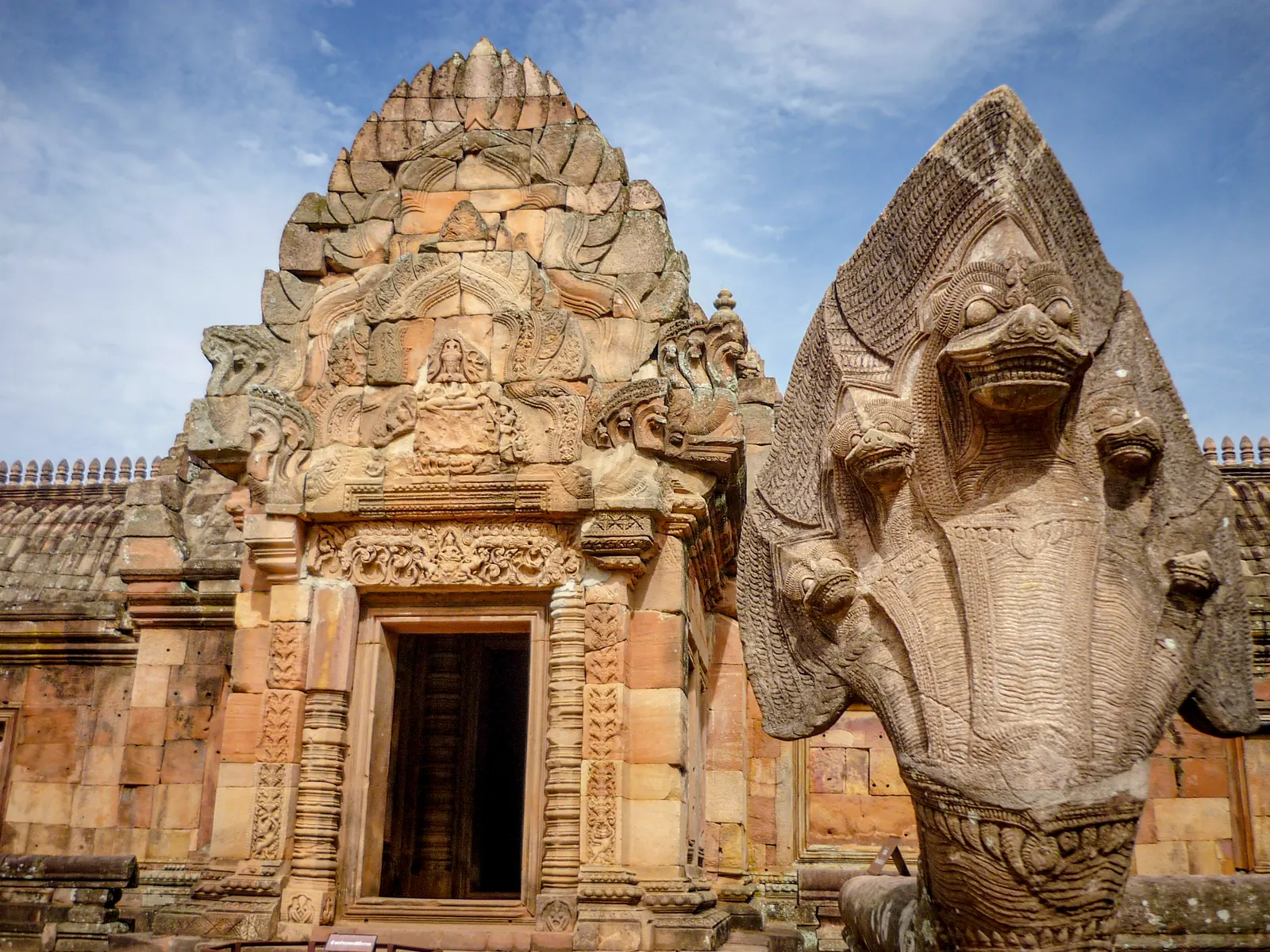
The lintel. The horizontal stone block over a doorway, carved with a scene. Most of the story-telling of a Khmer temple happens here, at eye-strain height, and the subjects are Hindu: Vishnu reclining on the serpent of eternity, Shiva on his bull Nandi, Krishna performing heroics. Above it sits the pediment, the triangular gable, with a second scene; Phanom Rung’s eastern pediment shows Shiva dancing the dance that destroys and recreates the universe. The prang. The corn-cob tower, stepped in diminishing tiers, each tier a smaller copy of the whole. Inside, in a cell barely bigger than a lift, stood the linga, Shiva’s stylised phallic emblem, washed with water that drained out through a spout in the north wall as holy water.
The rule for reading any of it: start at the east, the direction of the sunrise and the main door, and work clockwise. Thai Buddhists treat these sites as sacred too, which is why you will see marigolds on a Hindu lintel. Dress for a temple, shoulders and knees covered, and keep off the walls; our Thai temple etiquette guide covers the rest. More context on how Thailand’s faiths overlap sits in our Thai culture and etiquette hub.
Phanom Rung itself: the volcano, the walk up and the Narai lintel that came home from Chicago
What it is. The best-restored Khmer temple in Thailand, re-assembled by the Fine Arts Department between 1971 and 1988 using anastylosis, the method of numbering every stone, taking the lot apart and rebuilding it on a sound base. The hill is an extinct volcano a little under 400 m high; on a clear day from the top you can see the old crater as a reservoir and the Dangrek range towards Cambodia. The walk up from the main car park is around 400 m and a few hundred steps, without shade. The rear gate, with a vehicle fee of ฿50 per car or ฿20 per motorbike, drops you about 100 m from the top for anyone who does not climb.
The lintel story. Above the eastern porch of the main tower is the Thap Lang Narai Banthomsin, Vishnu reclining on the serpent Ananta in the cosmic ocean, a lotus rising from his navel to carry Brahma, who will create the world. It went missing in the early 1960s, when the site was a ruin, and surfaced in the collection of the Art Institute of Chicago. In the 1980s it became a national cause, with newspaper campaigns, student marches and a Carabao song demanding it back. On 10 November 1988 it came home, via a foundation-funded exchange that let the museum save face. It is why every Thai schoolchild knows this temple, and why the lintel gets more attention than the finer dancing Shiva above it. Look for both.
Fee and hours, as of November 2026. The Fine Arts Department’s own service page lists opening as 06:00–18:00 daily, holidays included, with foreigners paying ฿100 for Phanom Rung alone or ฿150 for the combined ticket with Muang Tam, and Thais ฿20 or ฿30. Several travellers and guides in late 2026 report the gate charging ฿200 and ฿250, and hours of 07:00–18:00; we cannot reconcile the two, so carry ฿250 in cash per person and expect to be pleasantly surprised. The free information centre at the bottom does the history well. Verdict: do it. If you see one Khmer temple in Thailand, this is the one. Arrive at opening, before the coach groups and the heat.
The Phanom Rung sun alignment: 2027 dates for the sun through 15 doors
The temple faces slightly off due east, its fifteen doorways on a single axis. Four times a year the sun sits exactly on that axis at sunrise or sunset and shines through all fifteen at once. Design or happy accident is an academic argument; it is beautiful either way, and draws thousands of Thai visitors on each date.
The 2026 dates, as announced by the park: sunset 5–7 March, sunrise 3–5 April, sunrise 8–10 September and sunset 5–7 October. The alignment moves by a day at most from year to year, so the 2027 windows are expected to be the same, but the 2027 dates had not been announced as of November 2026; the historical park normally confirms them on its Facebook page early in the year, along with extended opening hours. Treat the windows below as expected, not confirmed, and check our Thailand festivals and public holidays calendar, which we update when they are.
| Window | Sun | 2026 (confirmed) | 2027 (expected) | Crowds | Verdict |
|---|---|---|---|---|---|
| Early March | Sets, around 18:15 | 5–7 Mar | Around 5–7 Mar | Busy | Fine: hot, hazy, but a lie-in |
| Early April | Rises, around 06:00 | 3–5 Apr | Around 3–5 Apr, with the festival | Very busy | Do it for the festival, not the photo |
| Early September | Rises, around 06:00 | 8–10 Sep | Around 8–10 Sep | Moderate | Do it: the same physics, a fraction of the people |
| Early October | Sets, around 18:00 | 5–7 Oct | Around 5–7 Oct | Moderate | Worth it, if the rain holds off |
The honest part. It is a coin toss: in September 2026 cloud hid the sun on at least one morning while a crowd waiting since 05:30 looked at a grey door. For sunrise be in the western courtyard by around 05:15, which means sleeping in Nang Rong, not Buriram city. Pick the middle day of the three. The sunset windows are easier on sleep and harder on clothes; it is still 35°C at 17:00 in March.
The Phanom Rung Festival in April: the climb, the procession and the light show
The Prapheni Khuen Khao Phanom Rung, the hill-climbing festival, is older than the restoration: villagers have walked up in the fifth lunar month for generations to make merit. The province now runs it as a three-day event timed to the April sunrise, held 3–5 April in 2026, with a costumed procession re-enacting a Khmer royal pilgrimage, Brahmin-style rites, food stalls and an evening light-and-sound show, ticketed separately. Expect 2027 in the same early-April window, announced around February. Verdict: worth it once, if you like your heritage with a PA system. Every room in Nang Rong goes, so book by February; if you want the temple rather than the event, come in September.
Prasat Muang Tam: the lotus ponds, the older temple and why some people prefer it
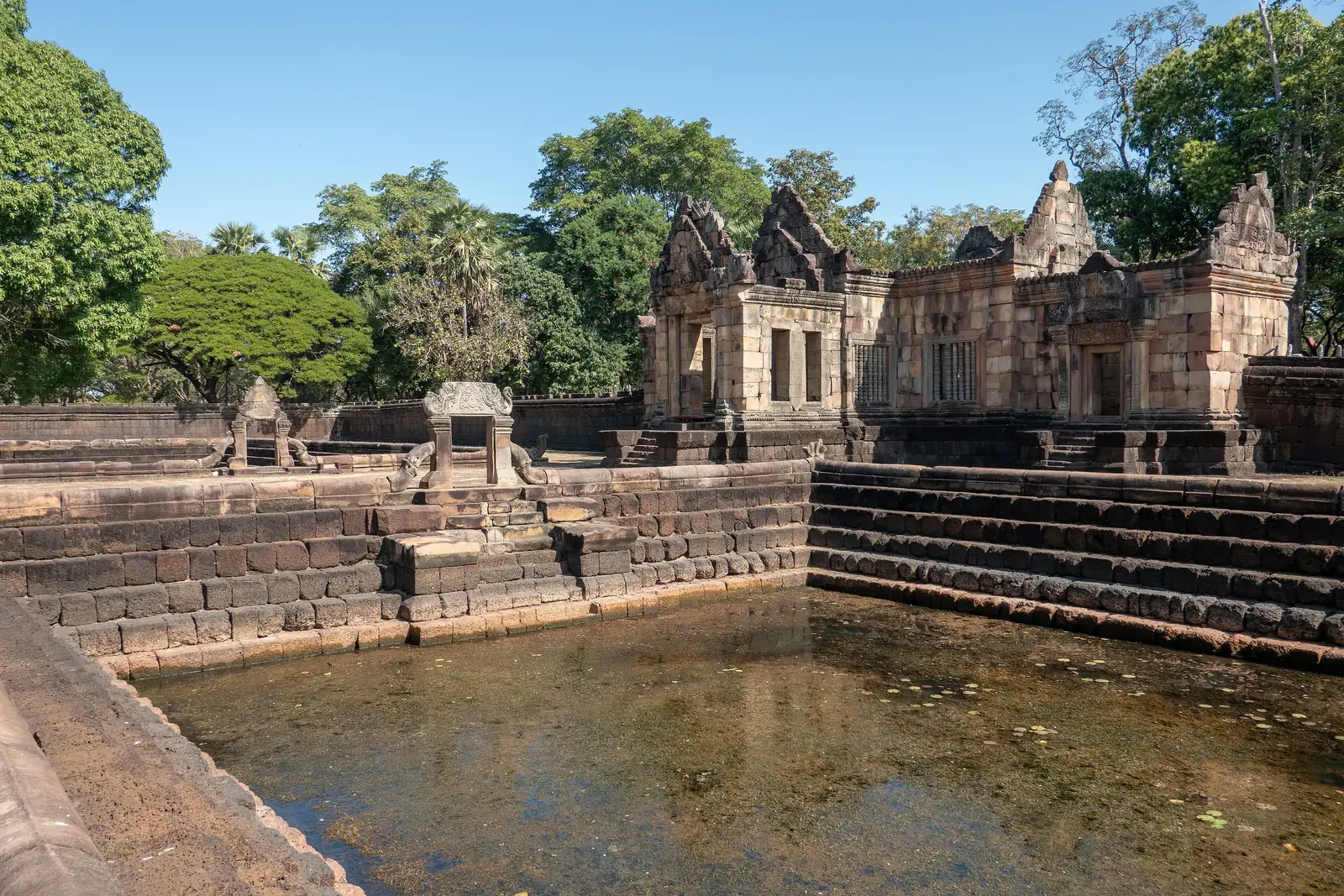
What it is. A lowland Shiva temple about 8 km south-east of Phanom Rung, built roughly a century earlier, when the local elite still built in brick on sandstone frames. Five brick prangs stand on a single platform, three in front and two behind; the central one collapsed long ago, leaving the four corners. Between the outer laterite wall and the inner gallery sit four L-shaped ponds, their edges formed by the bodies of five-headed nagas, so that the whole temple floats on water like Meru in the cosmic ocean. Across the road is the old reservoir, the baray, around a kilometre long, still holding water and still used by farmers.
What to look for. Some of the best-preserved lintels of their period, including Shiva and his consort Uma riding the bull Nandi; in the cool season the ponds fill with lotus. Fee and hours: ฿100 alone or included in the ฿150 combined ticket on the Fine Arts list, as of November 2026; opening as Phanom Rung. Verdict: worth it, late in the afternoon when the brick turns orange and the vans have gone. Where Phanom Rung is a cathedral, Muang Tam is a cloister.
For the keen: Kuti Ruesi, Sikhoraphum and the border temples you cannot visit
Kuti Ruesi Nong Bua Rai and Prasat Ban Bu, at the foot of Phanom Rung, are two small late-12th-century laterite buildings from the reign of Jayavarman VII: a hospital chapel and a fire-house, or rest house, on the royal road. Free, roadside, ten minutes each. Verdict: fine if passing.
Prasat Sikhoraphum, in Surin province about 90 minutes by car east of Nang Rong, is five brick towers in a moat, early 12th century, with the finest carved door guardians and female divinities of any Khmer temple in Thailand. Entry around ฿50, open roughly 08:00–16:30. Verdict: worth it for anyone heading on to Surin; the full province is in our Surin travel guide. The Ta Muen group on the Surin–Cambodia border, three temples on a pass through the Dangrek hills, was the scene of fighting in 2025 and was still closed to visitors in November 2026, with the land border shut. Skip it until both governments say otherwise, and do not try to talk your way past a checkpoint.
How to get to Phanom Rung from Bangkok, Buriram or Nang Rong
The awkward truth: no public bus goes up the hill. Phanom Rung is about 65–75 km south-west of Buriram city and about 20 km south of Nang Rong, the small town on Highway 24 that is the natural base. Get to Nang Rong or Buriram by public transport, then hire wheels.
| Leg | Option | Time | Cost (around) | Verdict | Book |
|---|---|---|---|---|---|
| Bangkok to Buriram | Flight from Don Mueang | 1 h 5 min, plus 30 km taxi in | ฿800–1,800, taxi ฿300–400 | Best if short of time | Bangkok to Buriram on 12Go |
| Bangkok to Buriram | Train from Krung Thep Aphiwat | 6–7 h | ฿300–500 second class, ฿600–1,000 sleeper | Fine; station is central | Trains on 12Go |
| Bangkok to Nang Rong | Bus from Mo Chit | 5–6 h | ฿300–450 | Do it: drops you at the temple base | Bangkok to Nang Rong on 12Go |
| Bangkok to the temple | Private car and driver | 4.5–5 h | Quoted per car | Best for three or four | Private transfer on 12Go |
| Nang Rong to both temples | Scooter, or car with driver | 30 min to the hill | ฿200–300 a day, or ฿1,200–1,500 the circuit | Do it | Arrange locally |
No car? From Nang Rong take a songthaew towards Ban Ta Pek, at the foot of the hill, for around ฿30–40, then a motorbike taxi up, on to Muang Tam and back for around ฿250–400; it works, slowly, until about 16:00. From Korat it is two hours each way by car, in the opposite direction to Phimai. Dates and seasons for the whole north-east are in our best time to visit Thailand guide: November to February is cool and dry, March to May is a furnace, and the September alignment comes with green paddies and an umbrella.
Where to stay for Phanom Rung: Nang Rong for the temples, Buriram for everything else
Nang Rong, for sunrise and an early start. Phanomrungpuri Hotel is the town’s four-star, with a pool and a breakfast early enough for the alignment, from around ฿1,000–1,600; it is the first to fill in April. Rabbit Hotel Nangrong is the small, spotless, high-scoring budget pick from around ฿500–800, and Nangrong Garden Home is the quiet garden option at a similar price.
Buriram city, if you are here for football, the circuit or the night market and day-tripping the temples. Hee Pee Hostel Buriram is a tiny, spotless hostel from around ฿350. Best Western Royal Buriram is the comfortable central three-star from around ฿1,300, sensible with a hired car. Amari Buriram United, beside Chang Arena, is the province’s only real splurge from around ฿2,500, and an hour and a quarter from the temple. Eat the way the province does, grilled chicken, som tam and sticky rice, using our Isaan food guide; Nang Rong’s evening market does all three for under ฿150.
Phanom Rung and Muang Tam: your questions, answered
How much is the entrance fee to Phanom Rung?
The Fine Arts Department’s published rate for foreigners is ฿100 for Phanom Rung, ฿100 for Muang Tam, or ฿150 for a combined ticket covering both; Thais pay ฿20, or ฿30 combined. Several visitors in late 2026 reported being charged ฿200 and ฿250 at the gate, so carry ฿250 in cash per person. Driving in through the rear gate adds ฿50 per car or ฿20 per motorbike.
When does the sun shine through the 15 doors of Phanom Rung in 2027?
Expected windows, based on the dates confirmed for 2026: sunset around 5–7 March, sunrise around 3–5 April, sunrise around 8–10 September and sunset around 5–7 October 2027. The park had not announced the 2027 dates as of November 2026; it usually confirms them early in the year with extended hours. Cloud can hide the sun on any morning, so aim for the middle day.
Is Phanom Rung or Muang Tam better?
Phanom Rung, if you can only see one: the hilltop setting, the processional avenue, the naga bridges and the Narai lintel make it the finest Khmer temple in Thailand. Muang Tam is smaller, flatter and older, with its four naga-rimmed lotus ponds, and is calmer and more photogenic late in the day. The combined ticket costs barely more than one, so the honest answer is both, eight kilometres apart.
Can you visit Phanom Rung without a car?
Yes, slowly. Take a bus from Bangkok’s Mo Chit or Korat to Nang Rong, then a songthaew towards Ban Ta Pek for around ฿30–40 and a motorbike taxi up the hill and on to Muang Tam for around ฿250–400 return. A scooter from Nang Rong at ฿200–300 a day, or a car with driver at around ฿1,200–1,500 for both temples, saves hours. No public bus reaches the gate.
What should I wear to Phanom Rung?
Temple dress, because Thais treat the sanctuary as sacred even though it was built for Shiva: shoulders and knees covered, nothing see-through. Add a hat, proper shoes for a few hundred sandstone steps and at least a litre of water; there is almost no shade between the car park and the top. Do not climb on walls or sit on carvings, and keep drones grounded unless the park has given permission.
Plan · Book · Go
Book the trip
Some links in this guide are affiliate links. If you book through them we may earn a small commission at no extra cost to you — it helps keep Destination Thailand independent.