Bangkok’s trains are the best thing about the city and the worst explained. Ten rail lines, five operators, four ways to pay, a ฿20 flat fare the whole world reported and almost no tourist can use, and a river-boat timetable that quietly changed this summer. Consider this the Bangkok BTS MRT guide we wish someone had handed us at Suvarnabhumi: every line, every fare, which card opens which gate, the boats, the buses, the taxis, and a verdict for each kind of trip. Prices are as of October 2026, cross-checked against our Price Index; the Bangkok province page has the rest of the city.
The short version: the BTS Skytrain costs ฿17–62 a ride and takes a Rabbit card or a paper ticket, not your bank card. The MRT costs ฿17–45 and takes a tapped Visa or Mastercard credit card at the gate. The ฿20 flat fare is for Thai citizens with a Thai ID registered in a government app; you pay full fare. A meter taxi starts at ฿35, a motorbike taxi at ฿15, the express boat at ฿18. Rails stop around midnight, after which Grab owns the city.
Which train lines does Bangkok have in 2026, and who runs them?
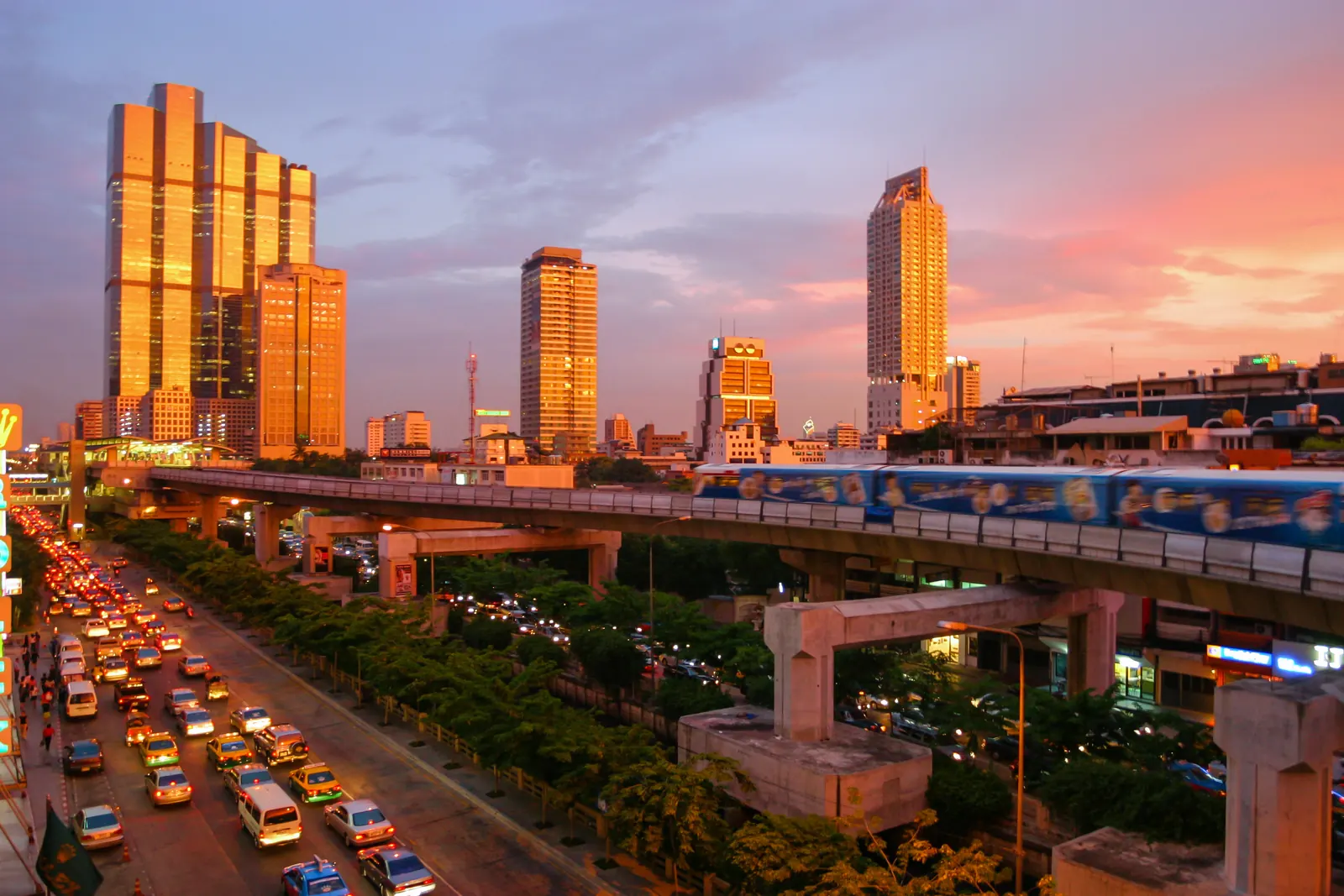
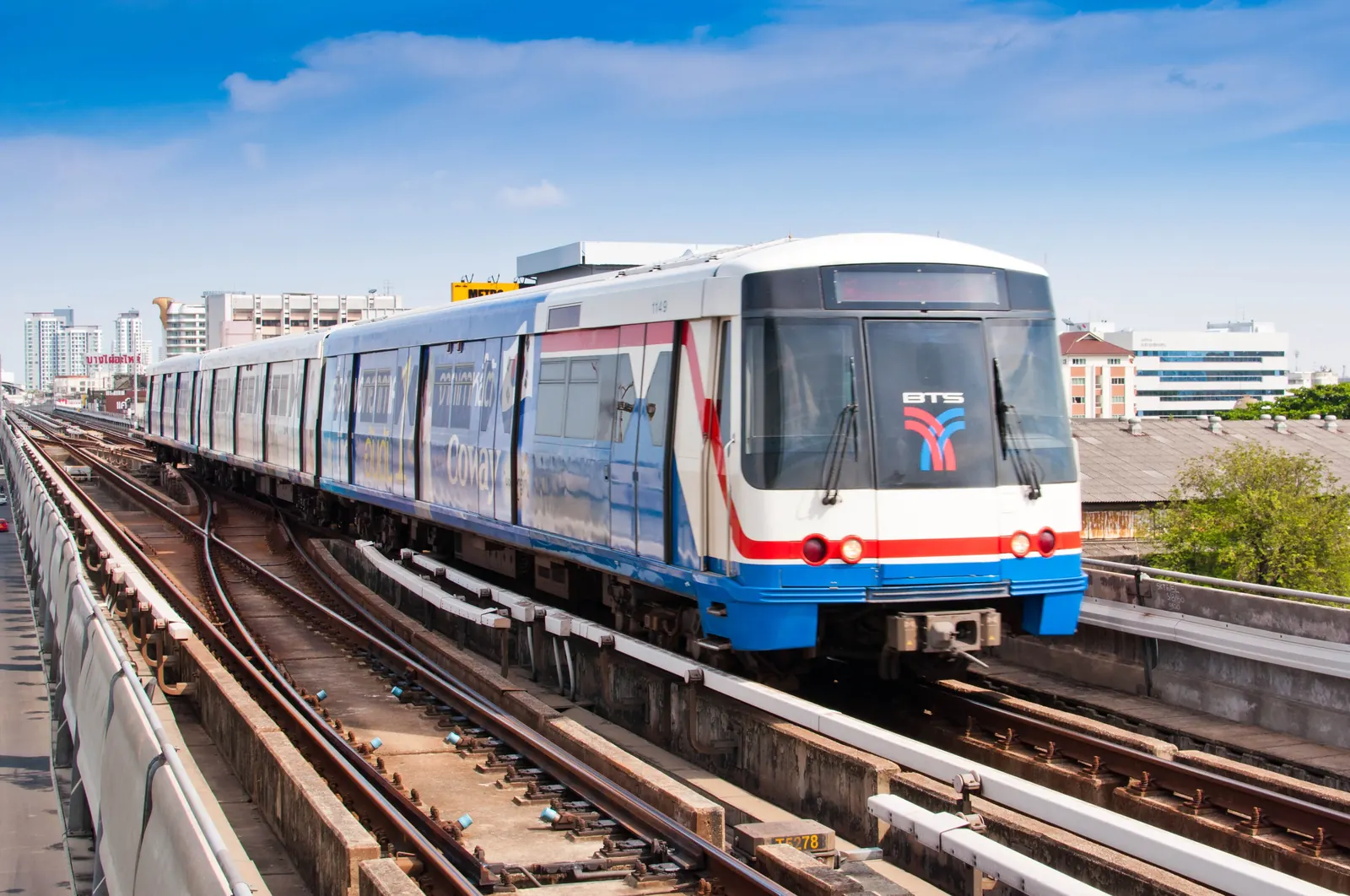
Bangkok never built one metro; it built several and let them meet where convenient. The BTS Skytrain is the elevated green one: the Sukhumvit Line from Khu Khot through Mo Chit, Siam, Asok and On Nut to Kheha, and the Silom Line from National Stadium through Siam, Sala Daeng and Saphan Taksin to Bang Wa across the river. Siam is where they cross and the only place you change trains without leaving the paid area; the three-station Gold Line to Iconsiam (฿16 flat) is the same company. The MRT Blue Line is the underground one, run by BEM: a loop through Silom, Sukhumvit, Chatuchak and Bang Sue to Hua Lamphong, Chinatown, the Old Town at Sanam Chai and over the river to Tha Phra. The Purple Line runs from Tao Poon out to Nonthaburi, which you will ride exactly never unless Koh Kret is on the list. The Yellow (Lat Phrao to Samrong) and Pink (Khae Rai to Min Buri) monorails are badged MRT but built and run by the BTS group. Add the Airport Rail Link from Suvarnabhumi to Phaya Thai and the SRT Red Lines from Krung Thep Aphiwat past Don Mueang to Rangsit and west to Taling Chan, and that is the set. For a visitor: BTS for Sukhumvit and Silom, Blue Line for Chinatown, the Old Town and the river, the rest for airports and errands.
How much do the BTS and MRT cost in 2026? The fare table
| Line | Single fare | Hours | Pays with | Verdict |
|---|---|---|---|---|
| BTS Sukhumvit and Silom | ฿17–62 | 05:30–24:00 | Rabbit card, paper ticket, ฿150 day pass | The workhorse; no bank-card tap |
| BTS Gold Line | ฿16 flat | 06:00–24:00 | Rabbit card, paper ticket | Iconsiam shuttle; fine |
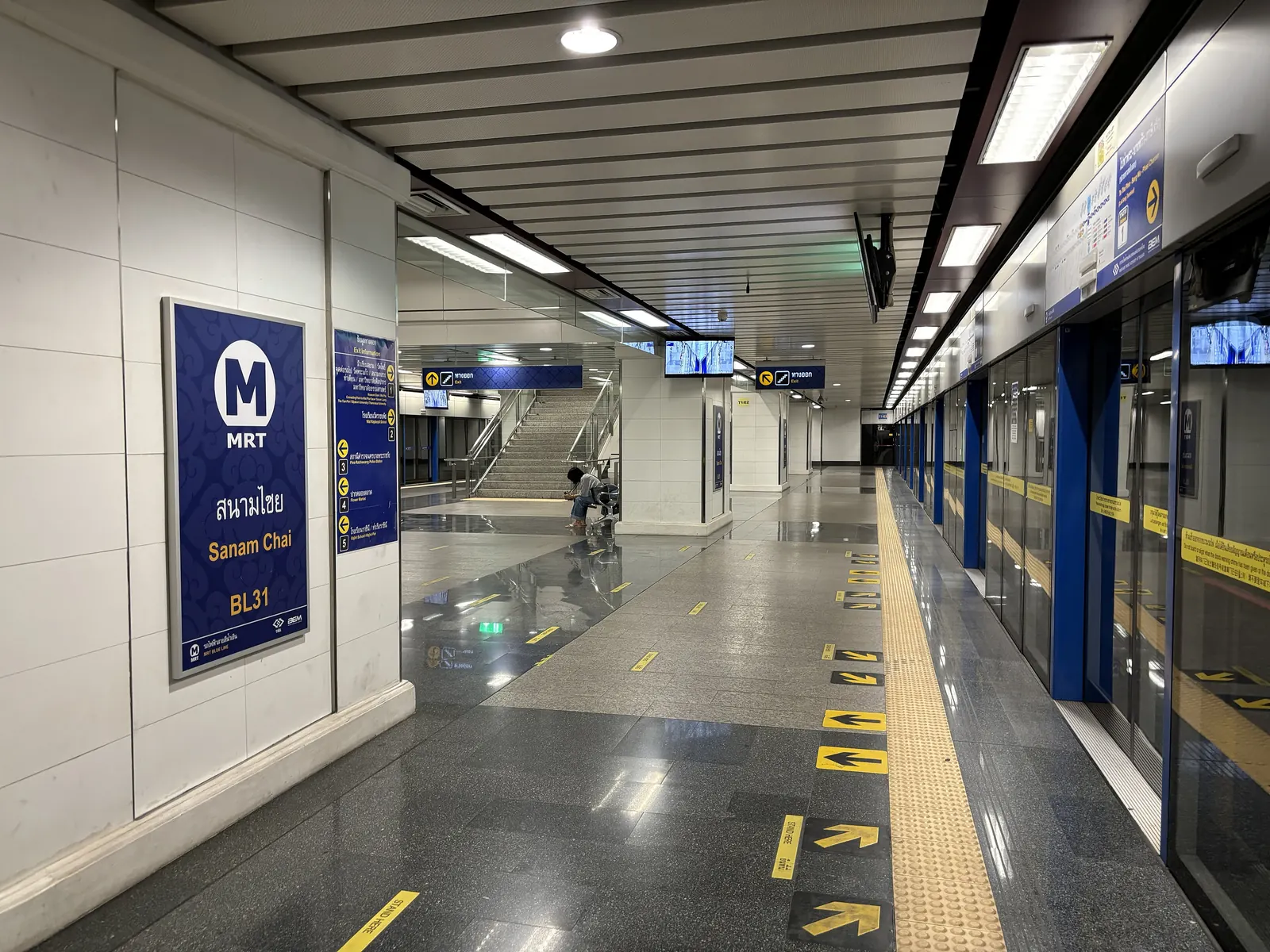
| MRT Blue Line | ฿17–45 | 06:00–24:00 | Contactless credit card, token | Best for the Old Town and river |
| MRT Purple Line | ฿14–42 | 05:30–24:00 | Contactless credit card, token | Skip unless Nonthaburi |
| Yellow and Pink monorails | ฿15–45 | 06:00–24:00 | Rabbit card, contactless, ticket | Suburban; errands only |
| Airport Rail Link | ฿15–45 | 05:30–24:00 | Token, contactless | ฿45 from Suvarnabhumi; do it |
| SRT Red Lines | ฿12–42 | 05:00–24:00 | Token, contactless | ฿33 from Don Mueang; do it |
Every fare is by distance. The BTS charges ฿17–47 inside its original central section and a flat ฿15 more on the extensions beyond On Nut, Mo Chit or Wongwian Yai, which is how ฿62 happens to someone riding Kheha to Khu Khot; the rides you will take, Siam to Asok, Mo Chit to Sala Daeng, land between ฿25 and ฿47. There is no through ticket between operators: Siam to Sanam Chai is a BTS fare plus an MRT fare, around ฿55–65 for the pair, and only the Blue-to-Purple change at Tao Poon counts as one journey. Children under 90 cm ride free; the gate has a height sticker, not an age check.
Does the ฿20 flat fare apply to tourists? No, and here is how it works
On 1 October 2025 the government extended its ฿20 flat fare from the state-owned Purple and Red lines to every rail line in the capital, Airport Rail Link included, and the headline went round the world. Read the small print: the fare is for Thai nationals only, and only after they register a Thai national ID in the state “Tang Rat” (ทางรัฐ) app and link it to a travel card. There is no tourist version, no desk at the airport, and no point asking at the window; the seller has been asked before, in several languages. The scheme is paid for out of the annual budget, so its shape can shift each October, and a QR ticket has been promised for 2026; what has not changed is that a foreign passport does not qualify. The Purple and Red lines carry, on paper, a ฿40-a-day cap for unregistered passengers until the end of November 2026; whether a gate applies it to a tourist’s token is not something we would put ฿20 on. Yes, it is dual pricing, the national-park kind, only smaller: ฿20 against ฿47 is a bottle of water. Save the outrage for the tuk-tuk quote.
Rabbit card, tokens, one-day pass or a tapped credit card: which works where?
| Way to pay | Works on | Does not work on | Verdict |
|---|---|---|---|
| Single ticket or token (cash) | Everything | Nothing, but you queue every ride | Fine for one or two rides a day |
| Rabbit card (฿200: ฿100 fee, ฿100 credit; passport) | BTS Sukhumvit, Silom and Gold, Yellow and Pink, BRT | MRT, Airport Rail Link, Red Lines | Worth it from three days on Sukhumvit |
| BTS One-Day Pass (฿150) | BTS Sukhumvit and Silom | Everything else | Pays from the fourth ride; skip otherwise |
| Contactless Visa or Mastercard credit card | MRT Blue and Purple, Yellow and Pink, Airport Rail Link, Red Lines | BTS Sukhumvit, Silom and Gold | The default; credit card, not debit |
| Mangmoom EMV card (MRT ticket offices) | MRT and other EMV gates | BTS | Only if your bank card is refused |
The BTS sells single-journey cards from touchscreen machines (newer ones take notes, older ones coins; the booth changes notes) or a Rabbit card from the booth: ฿200 to start, ฿100 of it a non-refundable issuing fee and ฿100 credit, passport shown because the card is registered to a name. Top up from ฿100. Adults get no per-trip discount; what you buy is not standing in the Siam ticket queue at 18:00. The One-Day Pass is ฿150 for unlimited Sukhumvit and Silom rides and nothing else. As of October 2026 the BTS gates still do not read bank cards; the operator’s ticket pages are where that will change first.
The MRT went the other way. On 1 June 2026 BEM switched off its old MRT and MRT Plus stored-value cards; the gate now wants a black plastic token (touch in, drop it in the slot on the way out) or a tapped EMV contactless card. Visa and Mastercard credit cards, Thai or foreign, work; so do UnionPay and the Mangmoom EMV card sold at ticket offices. Debit cards are the gamble: officially only certain Thai bank debit cards qualify, and a foreign one is as likely to bounce as to open the gate. Tap the same card in and out or you are charged the maximum. Your bank’s foreign-transaction fee applies per tap, a rounding error on a ฿30 ride; the money guide covers which cards to bring. The Yellow and Pink monorails, the Airport Rail Link and the Red Lines take the tap too, so the only reason to carry a Rabbit is the BTS.
Where the lines meet: interchanges and the walk-between-systems traps
Only Siam lets you change platforms without touching a gate. Everywhere else you exit one company, walk, and buy from the next, so a BTS-to-MRT trip is two fares and a walk in 34-degree heat. Asok to Sukhumvit (BTS to MRT) is three minutes on a covered walkway and the one you will use most; Sala Daeng to Silom is five minutes across Rama IV on a skywalk; Mo Chit to Chatuchak Park is short but a crowd on market weekends, when the MRT to Kamphaeng Phet opens straight into the market. Phaya Thai joins the Airport Rail Link to the BTS with lifts; Makkasan to Phetchaburi (Airport Rail Link to MRT) is a long skywalk that is no fun with suitcases, so change at Phaya Thai anyway. Bang Wa joins Silom to Blue, Lat Phrao joins Blue to Yellow, Samrong joins Sukhumvit to Yellow, and Krung Thep Aphiwat joins the Red Lines to the Blue Line’s Bang Sue station by a ten-minute walk through a station the size of an airport. Three naming traps: the MRT station called Sukhumvit is at Asok, one point on a road twenty kilometres long; Hua Lamphong is a Blue Line stop, but most long-distance trains now leave from Krung Thep Aphiwat, so check the ticket before heading there for Hua Hin or Ayutthaya; and for the Grand Palace and Wat Pho the station is Sanam Chai, which has never been late for a tide.
Bangkok by boat in October 2026: what changed on the river, and the canal that did not
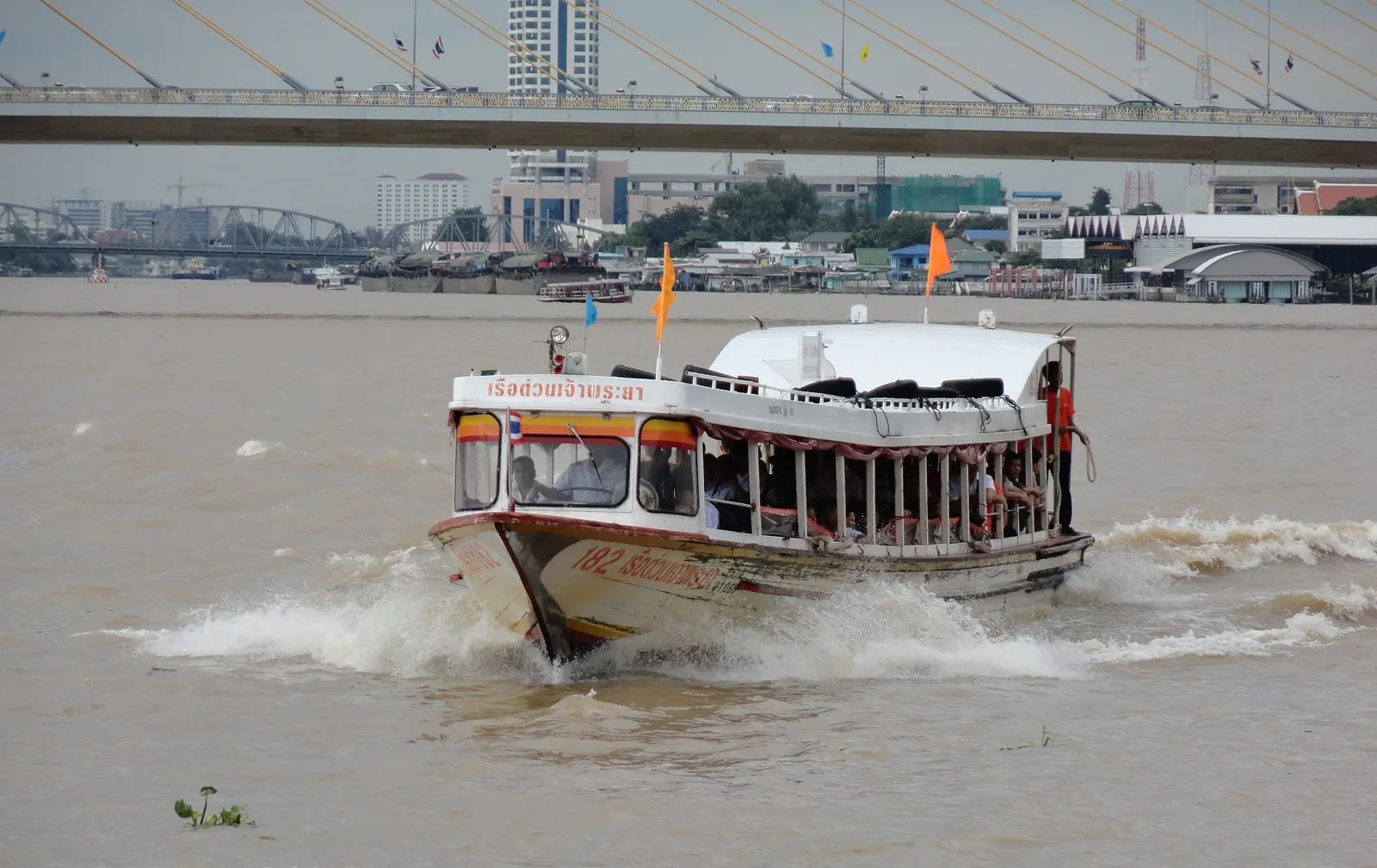
The Chao Phraya Express Boat used to be the simplest fare in the city: a ฿16 orange flag every fifteen minutes, dawn to dusk. As of October 2026 it is not, and older guides, ours included, have not caught up. Fares rose on 21 August 2026 and the timetable changed in June: the orange flag (฿18) now runs weekdays only and only around the rush hours, roughly 06:00–07:45 and 15:40–18:05; the yellow flag (฿23, Nonthaburi to Sathorn, limited stops) covers the weekday daytime; and the operator lists every commuter flag as Monday to Friday. That leaves the blue-flag tourist boat, ฿40 a hop or ฿150 for a day pass, 08:30–19:40 daily from Sathorn, as the reliable weekend boat, which is irritating, because it is the slow one with the commentary. Verdict: on a weekday the yellow flag from Sathorn to Tha Tien (Wat Pho, and the ฿5 ferry to Wat Arun) or Phra Athit (Khao San) is still the best ฿23 in Bangkok; at the weekend take the Blue Line to Sanam Chai and walk. Check the operator’s timetable before building a day around it; our boat guide has the piers.
The Khlong Saen Saep canal boat is unchanged: loud, fast, ฿10–20 paid to a crew member walking the gunwale in a crash helmet, roughly 05:30–20:30 on weekdays. It runs from Phan Fa in the Old Town past Hua Chang (Siam, Jim Thompson House) to Pratunam, where everyone changes boats, then Nana Nua, Asok (Phetchaburi MRT), Thong Lo and out to Bang Kapi; at 17:30 it is the fastest vehicle in the city, and a fare rise has been discussed this year. Longtail charters through the Thonburi canals are ฿1,000–1,500 an hour for the whole boat from Tha Chang; a guided canal tour is the version with someone explaining the stilt houses. On public holidays the commuter boats mostly stay tied up: check the holiday calendar first.
Buses, motorbike taxis, meter taxis, Grab and the tuk-tuk question
| Mode | What it costs | Verdict |
|---|---|---|
| BMTA bus, no air-con (red and cream) | ฿8 flat; ฿9.50 after 23:00 | Once, for the experience; the A1 airport bus (฿30) is the one worth knowing |
| Air-con bus (BMTA) and Thai Smile blue electric buses | ฿13–25 by distance; ฿10 on Thai Smile’s fan-only EVs | Fine with the ViaBus app open; slower than the canal at 17:00 |
| Motorbike taxi (orange vests at every soi mouth) | ฿15–25 for the first 2 km, ฿50–100 for longer hops | The soi-mouth hop; wear the helmet |
| Meter taxi | ฿35 flag fall, about ฿6.50 per km, ฿3 a minute stuck; Sukhumvit to Silom ฿80–120, tolls extra | The deal of the city, if the meter goes on |
| Grab or Bolt | ฿100–250 across town; doubles in rain and at 18:00 | After midnight, three people, luggage, or a driver who says no meter |
| Tuk-tuk | ฿100–200 after haggling, agreed before you sit | Once, short, at night; the ฿20 “temple tour” is a scam |
The ฿35 meter is one of the great bargains of urban Asia, which is why the argument is always about whether it gets switched on. A driver who quotes a price instead gets a smile and a closed door; the next cab is thirty seconds away, except outside Nana at 02:00 and the Grand Palace at noon, where every cab knows it. Grab and Bolt remove the argument for ฿50–100 more, on a card, with a plate number; Bolt is usually cheaper, Grab usually turns up, and in afternoon rain both surge until a ฿120 ride is ฿300 with a fifteen-minute wait, which is when the trains earn their keep. The motorbike taxi is the honest short hop, ฿15–25 down the soi and legal only with the helmet on; beyond five kilometres you negotiate. Tuk-tuks are a ride, not transport: once, at night, for an agreed ฿100–150, and if anyone offers a ฿20 tour because the temple is closed today, read the twelve scams still running before you get in.
Hours, rush hours, luggage and the rules nobody tells you
The BTS runs from about 05:30 to midnight, the MRT from 06:00, the Airport Rail Link from 05:30 and the Red Lines from 05:00, all finishing around 24:00, with last trains from the central stations nearer 23:30. Rush hours are 07:00–09:00 and 17:00–19:30, when Siam, Asok and Mo Chit run a two-train wait and the BTS is a polite scrum; the Friday before a long weekend and any hour with rain in it are worse. Trains come every two to four minutes at peak, so nobody looks at a timetable; they look at the sky.
Luggage is allowed and unloved: fine off-peak, hopeless at 18:00. Every MRT station has lifts and a bag table where a guard glances into your rucksack; most BTS stations have lifts, not all. The Airport Rail Link has no racks, which is why the two-airports guide sends anyone with two suitcases to the taxi rank. The rules: queue in the painted lanes, let people off first, no eating or drinking on trains or platforms (the fine is real, the durian ban is realer), give up the marked seats, and women do not sit beside a monk. Nobody will shout; they will simply know.
Airports, briefly, because they have their own guides: from Suvarnabhumi the Airport Rail Link is ฿45 and 26 minutes to Phaya Thai; from Don Mueang the Red Line is ฿33 to Krung Thep Aphiwat or the A1 bus ฿30 to Mo Chit. Our Suvarnabhumi and Don Mueang arrival guides take it from the aerobridge; a fixed-price car booked on 12Go from Suvarnabhumi or Don Mueang is the answer with a toddler or a 01:00 landing, and a local eSIM (the SIM guide) makes every app here work from the arrivals hall.
Which ticket for which trip: our verdicts
- One day on Sukhumvit, Siam and Silom: single BTS tickets. Three rides is about ฿90; the ฿150 day pass loses money until the fourth.
- Chatuchak, Siam, Thong Lo and a Saphan Taksin sunset: the One-Day Pass, ฿150 for five or six BTS rides. Worth it.
- Chinatown, the Old Town and Wat Arun: the MRT Blue Line on a tapped credit card, Wat Mangkon and Sanam Chai stations, no queue. Skip the BTS.
- Three or more days on Sukhumvit: a ฿200 Rabbit card on day one; top up ฿100 at a time so you leave with nothing on it.
- A river day: weekday yellow-flag singles at ฿23; at the weekend the ฿150 blue-flag pass only if you will make four hops, otherwise the Blue Line.
- After midnight, three people, rain, a buggy or a bad knee: Grab or Bolt and accept the surge. The MRT has lifts everywhere, the BTS does not; the where-to-stay guide says which areas put a step-free station at your door.
Bangkok BTS and MRT: your questions, answered
Can tourists use the ฿20 flat fare on Bangkok trains?
No. As of October 2026 the ฿20 flat fare is for Thai nationals who register a Thai national ID in the government’s Tang Rat app and link a travel card. Foreign passport holders pay the normal distance fares: ฿17–62 on the BTS, ฿17–45 on the MRT Blue Line, ฿15–45 on the Airport Rail Link. The scheme is funded year by year, so check each October.
Can I pay for the BTS Skytrain with a contactless credit card?
Not as of October 2026. BTS gates on the Sukhumvit, Silom and Gold lines take a Rabbit card, a single-journey ticket or the ฿150 One-Day Pass only. The MRT Blue and Purple lines, the Yellow and Pink monorails, the Airport Rail Link and the Red Lines all accept a tapped Visa or Mastercard credit card; foreign debit cards are unreliable at the gate.
How much is a Rabbit card and where do I buy one?
฿200 at any BTS ticket booth: ฿100 is a non-refundable issuing fee and ฿100 is travel credit, and you show your passport because the card is registered to you. Top up from ฿100 at booths. It works on the BTS lines, the Yellow and Pink monorails and the BRT bus, but not on the MRT, the Airport Rail Link or the Red Lines.
What time do the BTS and MRT stop running?
Around midnight, every day. The BTS starts at about 05:30, the MRT at 06:00, the Airport Rail Link at 05:30 and the SRT Red Lines at 05:00; last departures from the central stations are closer to 23:30, so be on a platform by 23:15. After that it is Grab, Bolt, a metered taxi or a motorbike until about 05:00.
Is the Chao Phraya Express Boat still running all day?
Not the orange flag. Since June 2026 it runs weekdays only, around 06:00–07:45 and 15:40–18:05, at ฿18 since 21 August 2026. On weekday daytimes take the ฿23 yellow flag; at weekends the blue-flag tourist boat (฿40 a hop, ฿150 day pass, 08:30–19:40) is the one running. Cross-river ferries are still around ฿5 and run all day.
Related guides
- BKK vs DMK: Bangkok’s Two Airports and Getting Into Town (2026)
- Bangkok by boat: how to use the city’s water taxis like a local
- Where to Stay in Bangkok: Every Area, Honestly Ranked
Book the trip
Some links in this guide are affiliate links. If you book through them we may earn a small commission at no extra cost to you — it helps keep Destination Thailand independent.
Hotels: Agoda’s Bangkok listings filter by BTS and MRT station, the only hotel filter that matters in this city. Tours/Boats: GetYourGuide’s Bangkok listings for the canal longtails and the evening river cruises the commuter boats cannot do. Getting there: fix the airport transfer price before you land with a pre-booked Suvarnabhumi car on 12Go, and the two-airports guide settles which airport your ticket means. Once you can ride the Sukhumvit Line in your sleep, our Where to Go in Thailand matcher will tell you where the train out of town should be heading.