Every October a fairly sleepy provincial town on Thailand’s west coast fills with firecracker smoke, men in white with steel rods through their cheeks, and a level of noise that makes a Bangkok expressway sound like a library. Then, for nine days, everybody eats tofu. This is the Phuket Vegetarian Festival, and the name is a lie. It is a nine-day Taoist purification rite for the Nine Emperor Gods, carried over by Hokkien tin miners two centuries ago; the vegetables are a side effect. I first went as a teenager because an aunt in Phuket Town insisted, and I still flinch. If you want a gentle cultural morning with a nice lunch, the Phuket Vegetarian Festival 2026 is not for you.
The short version: stay in Phuket Old Town, not Patong; the main shrines and the yellow-flag food streets are within a twenty-minute walk of each other. Watching costs nothing, a jay meal costs ฿30–60, and it will rain. For the food, read our companion guide to Thai vegetarian festival food; for where this sits in the year, see Thailand’s festivals and public holidays.
Confirmed dates: the Phuket Vegetarian Festival 2026 runs Saturday 10 October to Sunday 18 October 2026. Go Teng pole-raising: Friday 9 October, late afternoon, with the nine lanterns lit at midnight. Farewell procession: the night of Sunday 18 October into the small hours of Monday 19 October, when the poles come down.
When is the Phuket Vegetarian Festival 2026?
The festival occupies the first nine days of the ninth Chinese lunar month, so the dates wander around October. Chinese New Year 2026 fell on 17 February; count nine new moons forward and day one lands on Saturday 10 October, day nine on Sunday 18. Thai media, the shrine committees and the long-running Phuket expat sites all agree on 10–18 October 2026.
Pages that say 9–19 October are counting differently, not wrongly. On Friday 9 October every shrine raises its Go Teng pole between roughly 4pm and 6pm and hangs nine lanterns from it at midnight to invite the gods down; the shrines consider that the start. The gods are sent off in the early hours of Monday 19 October and the poles come down that day. Arrive on the Friday if you can; the pole-raising at Jui Tui is the last quiet thing you will see for a week.
What actually happens over the nine days
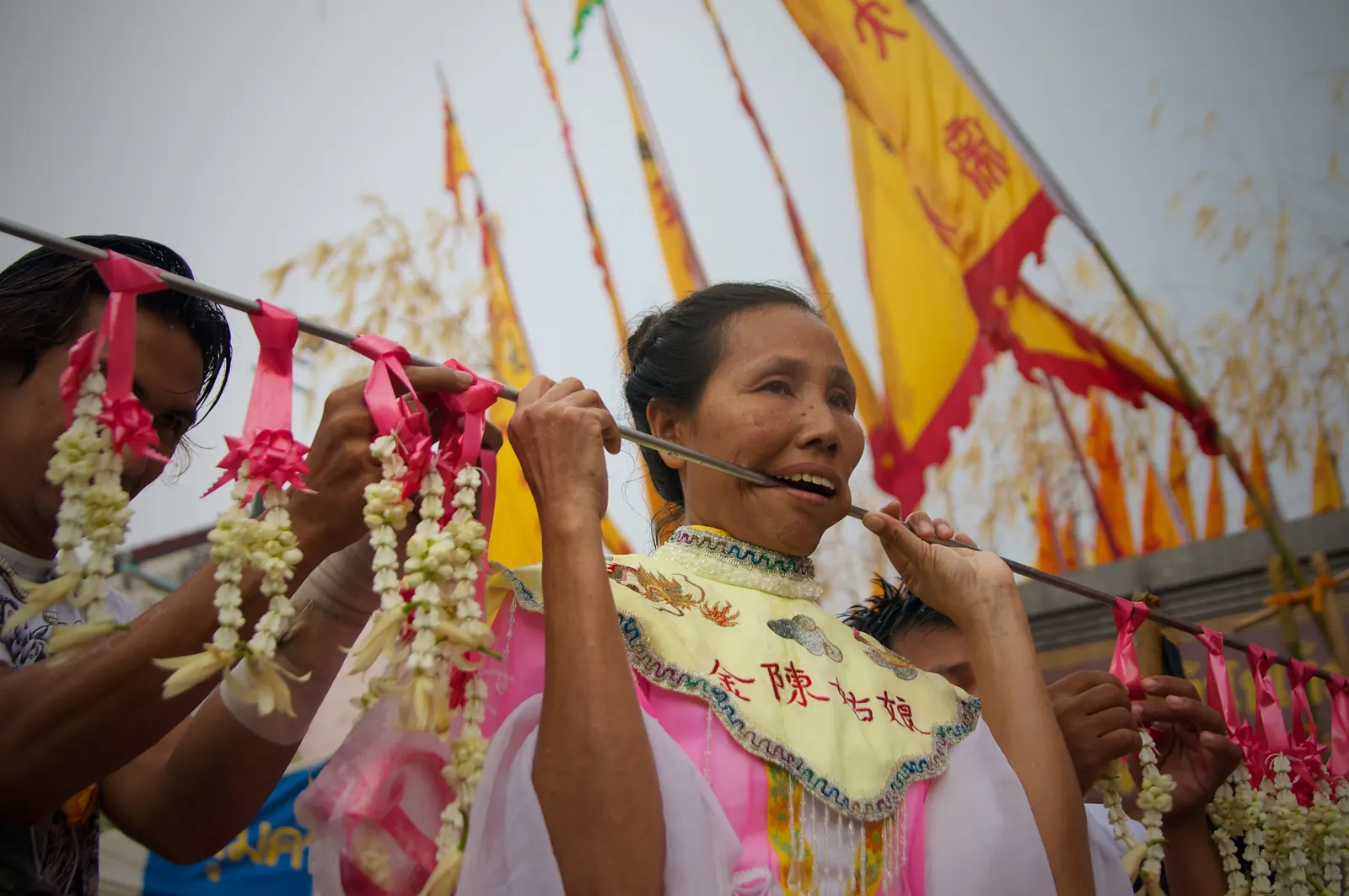
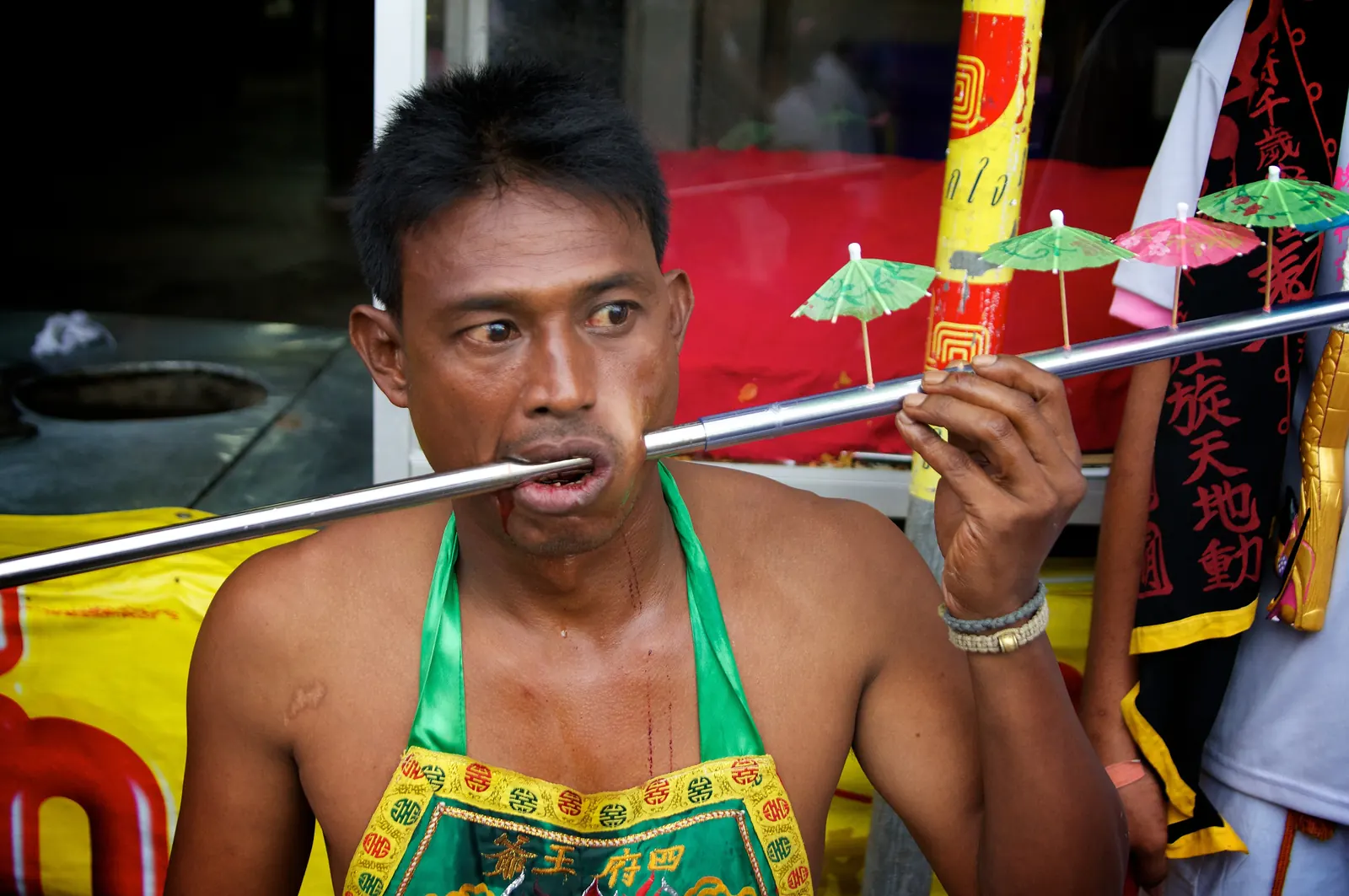
Once the lanterns are lit, the devotees who will act as ma song, literally “entranced horses”, go into trance inside the shrines. They are ordinary people, mostly men but increasingly women too, who believe the gods ride them for the duration. Attendants then pierce their cheeks with whatever the god apparently requested: skewers, swords, a bicycle, a petrol-pump nozzle, a small tree. This is done without anaesthetic and, remarkably, with very little blood. It is not a show. Nobody is doing it for you.
Each morning from day two, one shrine’s ma song walk a route through Phuket Town, starting between 6am and 8am and finishing by mid-morning. Households set up pavement altars with fruit, tea and incense; the ma song stop, bless the family, and move on while the family sets off a string of firecrackers at their feet. In the second half of the week the shrines hold their evening rites, usually around 8pm in the courtyard: firewalking, climbing a ladder of blades barefoot, and the oil bath. On the last night everything converges on Saphan Hin, where the gods are carried into the sea after midnight under hours of fireworks. A guided walk is reasonable for a first-timer, though not essential: Phuket Vegetarian Festival tours on GetYourGuide run from around ฿1,500.
Phuket Vegetarian Festival 2026 schedule by shrine
Honesty first: the shrine committees and TAT Phuket never publish the official procession order until the last week of September; we will update this table the day they do. The order below has held for years and the start times are last year’s, which shift by fifteen minutes at most.
| Date (2026) | Shrine or event | What happens |
|---|---|---|
| Fri 9 Oct (eve) | All shrines: Go Teng pole-raising | Poles up 4–6pm; nine lanterns lit at midnight; gods invited |
| Sat 10 Oct (day 1) | No street procession | Shrines open, ma song go into trance, first jay meals |
| Sun 11 Oct | Naka Shrine (Choor Su Gong) | First procession into town, about 7.30am |
| Mon 12 Oct | Sapam Shrine | Long route in from the north, about 7am |
| Tue 13 Oct | Sam Kong Shrine | Down Yaowarat Road into Old Town, about 7.45am |
| Wed 14 Oct | Tha Rua Shrine | Thalang district, from 6am; mostly a local affair |
| Thu 15 Oct | Bang Neow Shrine | Big one, from 6am; firewalking at several shrines that evening |
| Fri 16 Oct | Jui Tui Shrine | The biggest, about 8am; bladed-ladder climbing at Bang Neow and Sam Kong in the evening |
| Sat 17 Oct | Kathu Shrine | From Kathu into town, 6.45am; more firewalking that night |
| Sun 18 Oct (day 9) | Sui Boon Tong Shrine; then the send-off | Morning procession; from late evening all shrines march to Saphan Hin, gods to sea after midnight |
| Mon 19 Oct | All shrines | Go Teng poles lowered; town sweeps up several tonnes of red paper |
Cherng Talay and Bang Khu shrines process around their own villages rather than into town, the better bet if you are staying up at Bang Tao. Firewalking and ladder nights are posted on a board outside each shrine gate a day or two ahead, so walk past and look.
The shrines, and which ones deserve your 6am
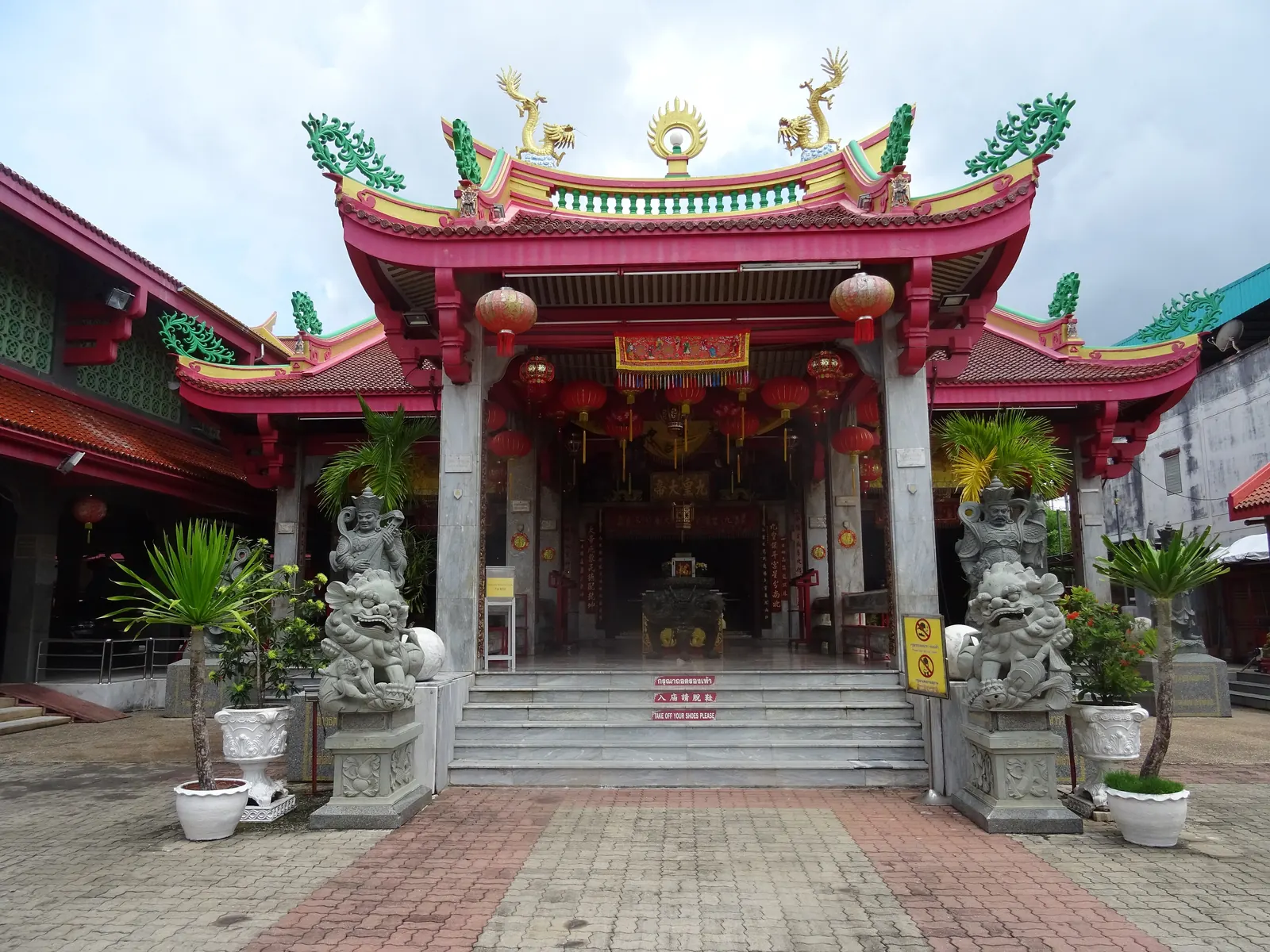
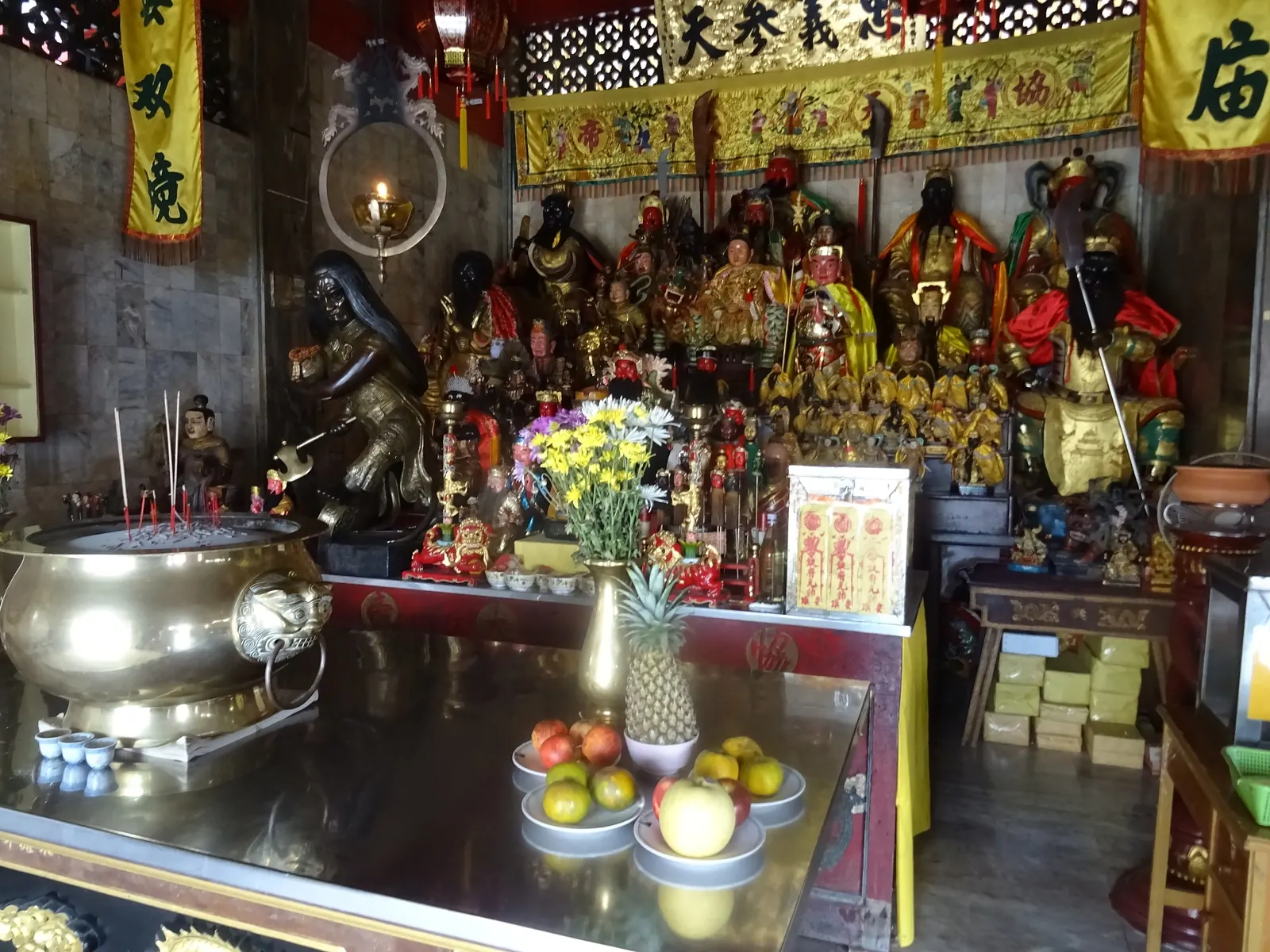
Jui Tui, on Ranong Road in Old Town, is the headline act: the biggest procession, the densest crowds, the fresh market and most of the jay stalls right outside. If you see one procession, see this one, and be on Ranong Road by 7am. Bang Neow, on Phuket Road towards Saphan Hin, is the one for the evening rites; its bladed-ladder ceremony is the most watched on the island. Kathu, 8km west of town, is where it all started in 1825 when a visiting Chinese opera troupe fell ill, went vegetarian in penance, recovered and never quite stopped. Its procession has the longest walk and the most exhausted ma song.
Sam Kong, at the north end of Yaowarat Road, is quieter and its ladder climb is easier to see. Sapam and Tha Rua are out along the 402 towards the airport; early, long and mostly for locals. Cherng Talay is the Thalang-side shrine nearest the west-coast resorts, smaller, with fewer cameras, and the one my aunt prefers. Verdict: Jui Tui morning, Bang Neow evening, Saphan Hin on the last night. Our things to do in Phuket guide covers the daylight hours, and the Phuket province profile has the map.
The ten rules, and which ones apply to you
Every shrine posts the same ten rules. They bind the devotees, not you, but three are basic manners near a shrine and the last three are house rules you follow whether or not you agree with them.
- Keep the body clean for the duration of the festival.
- Use clean kitchen utensils, kept separate from those used by anyone not observing the festival.
- Wear white. This one applies to you.
- Behave well, physically and mentally.
- No meat, and for the strict, no eggs, dairy, garlic, onion, chives, leek or strong spices. Near a shrine, this applies to you too.
- No sex.
- No alcohol.
- Anyone in mourning should not attend the rituals.
- Pregnant women should not watch the rituals.
- Menstruating women should not attend the rituals.
The last two are the ones foreign visitors argue about. Do not argue about them at the gate; you are a guest in someone’s religious observance. The street processions are open to everybody; the inner halls during the rites are where these rules are enforced. Our guide to Thai temple etiquette covers the rest: shoes off inside, no pointing your feet at the altar, no climbing on anything for a better photo.
Jay food and where the yellow flags are
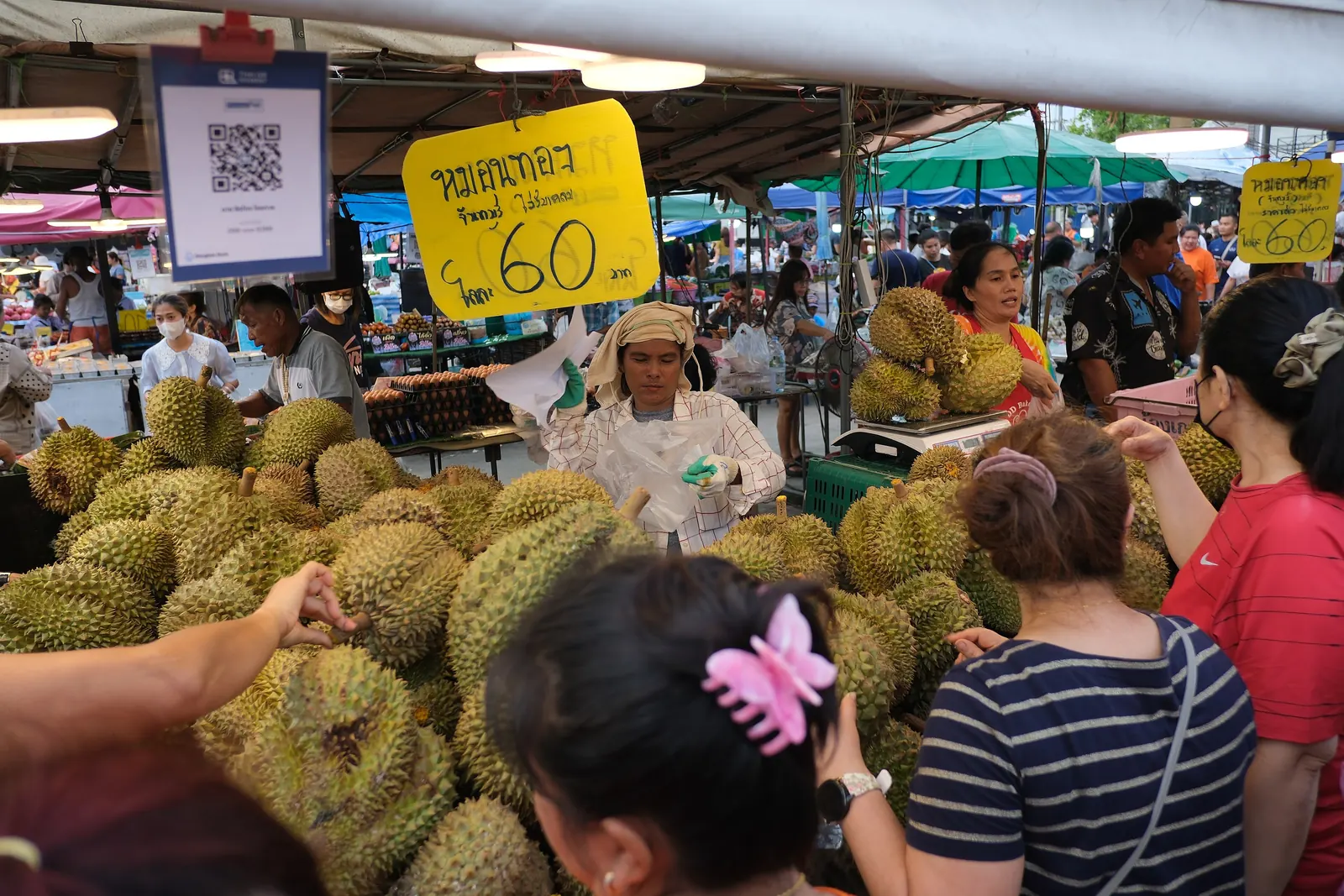
Jay (เจ) is the strict Chinese-Buddhist vegetarian diet: no animal products, and none of the five pungent vegetables either. Any stall serving it flies a yellow flag with the character เจ in red. During the festival those flags cover Phuket Town, but the real concentration is on Ranong Road outside Jui Tui, around the fresh market and along the streets between there and Bang Neow. A plate of stir-fried mock duck or a bowl of jay noodles is ฿30–60, a tray of three dishes with rice about ฿70, all cooked in front of you.
We have already written the menu: what jay food actually is, dish by dish. The two-line version is that the tofu and mushroom dishes are excellent, the bright-orange mock pork is a matter of taste, and you should eat where the queue of white-shirted locals is longest. If you would like someone to translate the stalls, an Old Town food tour on GetYourGuide costs ฿1,200–1,800 and most run a jay menu during the festival.
What to wear, where to stand and how not to be that tourist
Wear white, or at least a white top with light trousers, and closed shoes. Not black, and not shorts: firecrackers are thrown at ground level and hot paper lands on shins. Bring proper foam earplugs, because a string of a thousand crackers going off two metres away is painful. Add a scarf or mask for the smoke, glasses for the ash, and water.
Stand on the pavement behind the household altars, not in the road. The ma song move erratically and their attendants will shove anyone in the path; let them. Never touch a ma song, never stand between one and an altar, and do not put a phone with the flash on into a face with a sword through it. If a ma song offers you a blessing, a yellow paper talisman or a piece of fruit, take it with both hands and a small nod.
The honest bit
The piercing is graphic and it goes on for hours. I have watched grown men from Manchester go very quiet and sit down on a kerb. If you are squeamish, watch from further back and go to the food streets earlier; nobody will think less of you. The smoke sits in Old Town’s narrow streets and your clothes will smell of it for days. Starts are before dawn, roads close without warning, and Grab surge-prices from 5am. And October, with September, is Phuket’s wettest month; assume one procession in three happens in a downpour, and the ma song do not stop for rain, so neither will the crackers. Our best time to visit Thailand guide will tell you this is the wrong month for beaches. It is, and it is the only month for this.
What to skip: chasing every procession, which gets you nine early mornings and a headache; coach tours that drop you at a shrine at 10am when the ma song have gone home; and treating the whole thing as a photo safari. If you would rather see a Thai festival that is beautiful instead of bruising, Loy Krathong 2026 is six weeks later, and nobody puts anything through their face.
Where to stay and how to get there
Old Town wins this one and it is not close. From a shophouse hotel on Thalang, Dibuk or Yaowarat Road you can walk to Jui Tui in ten minutes, Bang Neow in fifteen, and be in bed by 9pm. October is low season, so a decent Sino-Portuguese boutique room is ฿1,800–3,200 and a clean guesthouse ฿900–1,400, but Old Town books out with Thai-Chinese families coming home for the festival, so book now. Patong is 40 minutes and ฿500–600 by taxi at 6am, and you will see nothing of the festival from Bangla Road. If you are set on a beach, Bang Tao with Cherng Talay shrine down the road is the sensible compromise. Browse Phuket hotels on Agoda and filter for Phuket Town; our where to stay in Phuket guide explains the areas.
From Bangkok it is an hour and twenty-five minutes in the air and ฿1,200–2,500 one way on AirAsia, Nok or Thai Lion if you book three or four weeks out. From the airport, the ฿100 airport bus or a ฿700–800 taxi gets you to Old Town in 45 minutes. The overnight bus is 12–13 hours and ฿700–1,100. Compare on 12Go, and read our full Bangkok to Phuket guide for the detail.
Phuket Vegetarian Festival 2026: your questions, answered
Does the Phuket Vegetarian Festival 2026 start on 9 or 10 October?
Day one is Saturday 10 October 2026, the first day of the ninth Chinese lunar month, and day nine is Sunday 18 October. The Go Teng poles go up on the evening of Friday 9 October and the lanterns are lit at midnight, which is why some sources count from the 9th.
Do I have to be vegetarian to attend?
No. The rules bind the devotees, not spectators, and the processions are on public streets. The courtesy is not to eat or carry meat in the blocks around a shrine, and to go jay for the days you are in Old Town, which is easy when every second stall is charging ฿40 a plate.
Can I photograph the ma song?
Yes, from the pavement, without flash and without stepping into their path. The attendants will move you if you get in the way, and they are not gentle about it. If a ma song stops to bless someone, wait until it is over before you raise the camera.
Is the festival suitable for children?
The food streets and the pole-raising, yes. The processions and the piercing, not for younger children: the noise alone is frightening and the imagery is graphic. Thai families bring kids of all ages, but they have grown up with it. Earplugs are non-negotiable for anyone under ten.
If I only have one day, which one?
Friday 16 October, Jui Tui procession day, followed by the bladed-ladder ceremony at Bang Neow that evening. If you can stretch to the weekend, stay through the night of Sunday 18 for the send-off at Saphan Hin, the single most extraordinary hour of the festival.
Related guides
- Thai Vegetarian Festival food: what jay is, dish by dish
- Where to stay in Phuket 2026
- Things to do in Phuket
Book the trip
Some links in this guide are affiliate links. If you book through them we may earn a small commission at no extra cost to you — it helps keep Destination Thailand independent.
Book an Old Town room early on Agoda, compare Bangkok–Phuket flights and buses on 12Go, and if you want the Sino-Portuguese backstory before the shrines take over, an Old Town walking tour on GetYourGuide fills the quiet afternoon. Still deciding whether Phuket in October is your trip at all? Run our where to go in Thailand matcher first.