Bangkok street food is not one thing, and the lists that treat it as one — “the 15 best street food stalls in Bangkok”, pins scattered across a city of ten million — send people on ninety-minute taxi rides for a bowl of noodles that has an equal somewhere near their hotel. The city eats by neighbourhood. Yaowarat is a Chinese-Thai night city of noodles and roast meats; the Old Town is the old royal capital’s sweets and noodle shops; Bang Rak is a Christian-Chinese-Muslim trading quarter with a century of duck and pork leg; Victory Monument is a bus interchange that grew a boat-noodle alley; Thonburi across the river is where Bangkokers go on a Sunday to eat like it’s 1985. This guide is organised that way — by where you are standing — with what to eat there, what it should cost in 2026, how to get there, and the honest verdict on the famous places versus the ones you’d actually queue for.
The short version: eat where the neighbourhood eats, at the hour it eats — Yaowarat after dark, markets before nine, noodle shops at lunch — and judge a stall by its queue and its turnover, not its tablecloth. Prices in the ฿50–80 range for a plate or bowl are normal; ฿120 for pad thai means you’re somewhere with an English menu and a view. If you’re nervous about any of it, our street-food safety guide is the honest read, and the Thai food guide has the dish-by-dish glossary this one assumes.
Three rules before the map
Monday is the quiet day. Bangkok’s street-cleaning rule keeps many pavement vendors home on Mondays, and plenty of family noodle shops take the same day; Yaowarat and the markets are thinner, some famous stalls are shut, and the “is it closed for good?” panic is usually just Monday. Turnover is the hygiene test. The safety question isn’t answered by a shiny cart; it’s answered by a stall that’s cooking constantly for a queue, so nothing sits. Cash, small notes, and the condiment caddy. Stalls take cash (PromptPay QR if you have a Thai bank; most visitors don’t — see the money guide), change for a ฿1,000 note is a chore, and the four jars on the table — fish sauce, sugar, dried chilli, chilli in vinegar — are for you to finish the dish with, not a test. Prices below are the going rates from our Thailand Price Index, August 2026.
Yaowarat (Chinatown): the night city of noodles
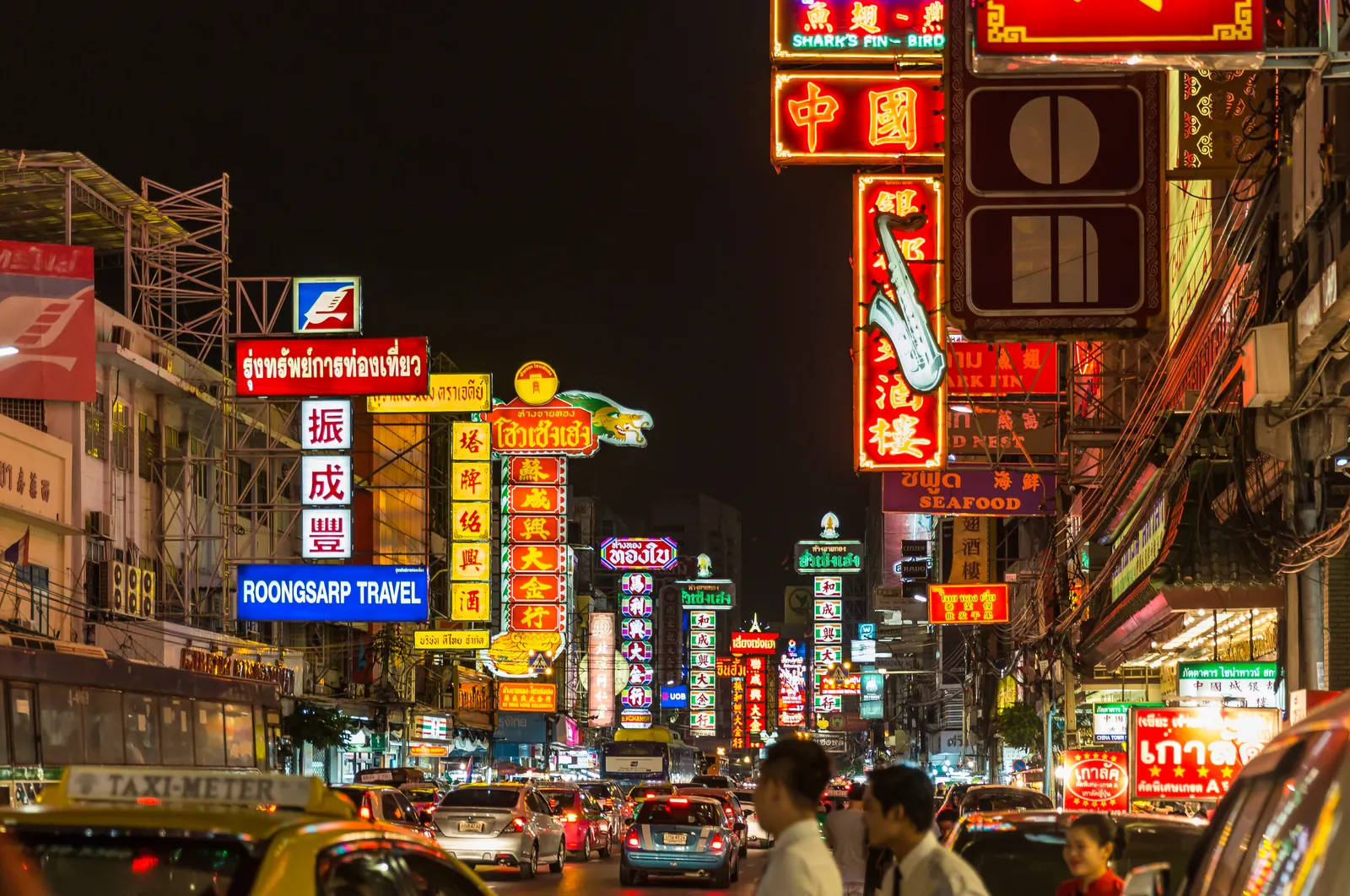
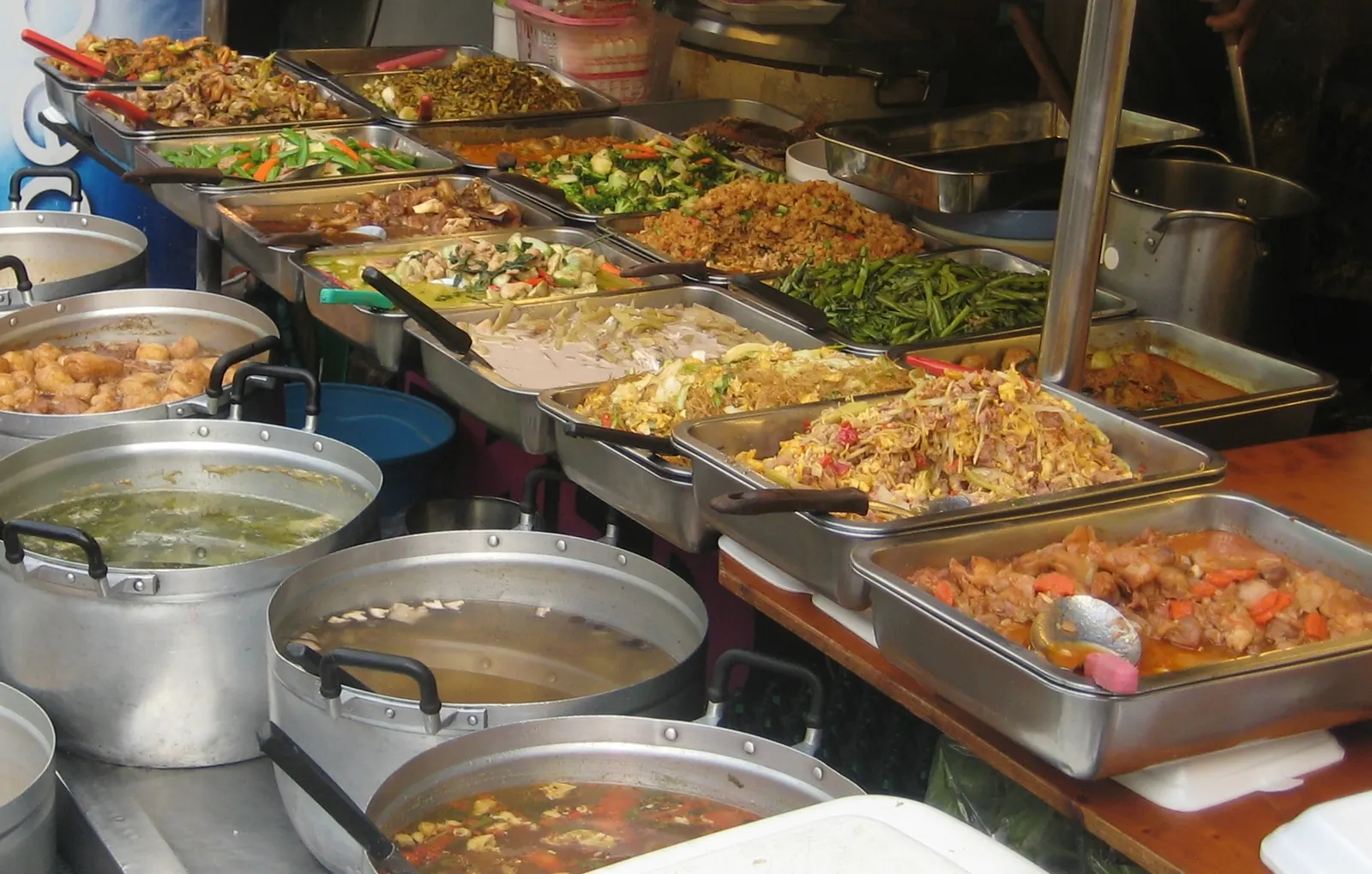
The one neighbourhood that deserves its reputation, with caveats. From about 6pm the main road and its sois fill with roast-duck counters, seafood grills on the pavement, noodle carts and dessert stalls under neon, and the crowd is half Bangkok and half the world. What to eat: kuay jab — rolled rice noodles in a peppery clear broth with crispy pork belly, the Chinatown bowl (฿60–80; Nai Ek on the main road is the institution, and the queue moves); roast duck and red pork over rice at the counters with the birds hanging in the window (฿60–90); hoi tod, the crisp oyster omelette off a charcoal griddle (฿80–150; Nai Mong on Phlap Phla Chai is the one people queue for); grilled seafood at the pavement tables on the Soi Texas corners (a whole fish or a plate of prawns runs ฿200–500 — the T&K and Lek & Rut corners are famous, the queue is real, and the food is good rather than life-changing); bird’s-nest and dessert soups in the little shops; and, if it’s your first Bangkok night and you’d rather have someone ordering for you, a guided Chinatown food walk is the one food tour in the city that earns its price. Verdict: Do it, after 7pm, not on a Monday. Walk the whole strip before you sit; eat small plates at three stalls rather than a meal at one. Getting there: MRT Wat Mangkon drops you in the middle of it.
The Old Town and Banglamphu: the famous ones, and the ones next to them
Rattanakosin and the streets behind Khao San hold Bangkok’s most photographed stalls and, a soi away, its most honest. What to eat: pad thai at Thipsamai on Maha Chai Road — the “ghost gate” pad thai, open since the sixties, wrapped in a net of egg, ฿100–150 for the famous versions with the orange juice on the side (the queue is forty minutes at 7pm; at 5pm it’s ten); the crab omelette at Jay Fai across the road, the one with the Michelin star and the goggles, at ฿1,000-plus a plate and a queue system — the honest verdict is that it’s a very good omelette you will remember for the price, and that the restaurant is a once-in-a-trip event, not a street-food meal; kuay tiew kua gai and khao tom shops along Tanao and Dinso roads in the evening; khanom bueang crisp crepes and kanom krok coconut pancakes from carts near Sao Chingcha; and the old-school khao gaeng curry shops around Phra Athit, ฿50–80 for two curries over rice — our khao gaeng guide explains the pointing. Khao San Road itself is the exception: the pad thai carts there are the tourist quote in the Price Index (฿100–150 for a ฿60 plate), the “insect” carts charge for the photo, and the food is fine and forgettable. Walk two streets west to Phra Athit or south to Tanao and the prices halve. Verdict: Do it, in the late afternoon and evening, and treat the two famous ones as events. Getting there: the Chao Phraya boats to Phra Athit pier (our water-taxi guide) or MRT Sam Yot.
Bang Rak and Charoen Krung: a century of duck, pork leg and dim sum
The old trading riverfront below Silom, where Chinese, Muslim and Christian Bangkok have eaten side by side since the river was the road. What to eat: roast duck at Prachak on Charoen Krung, a shophouse that has been roasting since 1909 — ฿70–120 a plate, lunch is the hour; khao kha moo — braised pork leg over rice with pickled mustard greens and a boiled egg — at Charoen Saeng Silom in a soi off Charoen Krung, where the regulars are in at 8am and the pot is empty by early afternoon (฿60–90); the Muslim quarter’s roti mataba and khao mok gai (biryani) around Haroon mosque and the Charoen Krung sois; and the evening food lines by the Saphan Taksin pier and in the lanes behind Robinson. Verdict: Do it, and do it at lunch — this is a working quarter and its best kitchens sell out early. Getting there: BTS Saphan Taksin, then walk north.
Victory Monument: boat noodles by the canal
The bus interchange nobody visits on purpose, and the home of kuay tiew reua — boat noodles — in an alley of shops along the Khlong Samsen on the north-east side of the roundabout. The bowls are tiny by design, ฿15–25 each, dark with pork or beef blood in the broth, sweet-sour-spicy, eaten in stacks of five or eight that pile up beside you as the bill. Crisp pork rinds on the side, chilli in vinegar to taste. Verdict: Do it; it’s the best ฿100 lunch in the city, and the alley is the real thing in a way the shopping-mall “boat noodle” franchises aren’t. Getting there: BTS Victory Monument, exit towards the canal.
Wang Lang and Thonburi: across the river, back in time
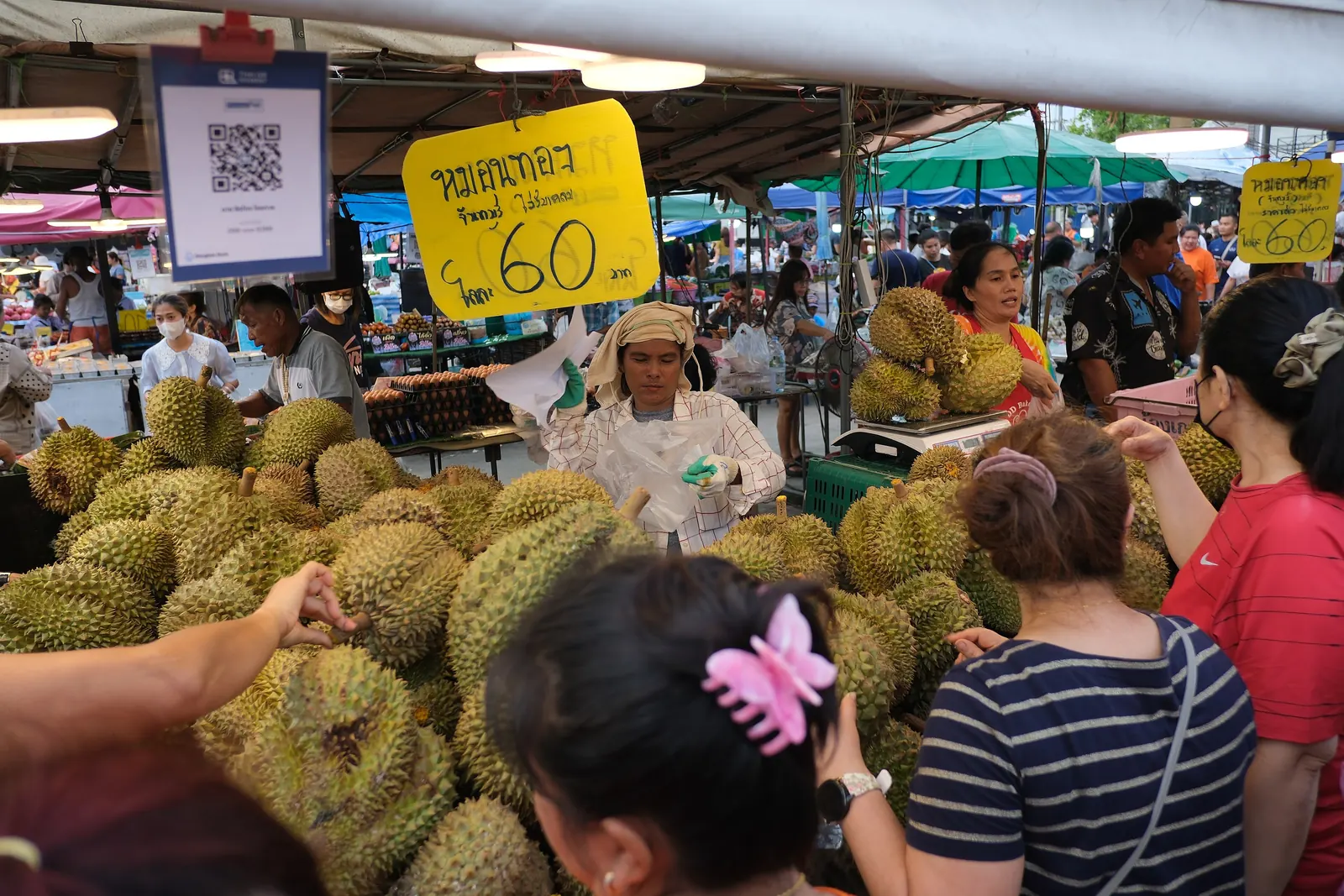
Take the ฿5 cross-river ferry from Tha Chang or Tha Phra Chan to the Siriraj side and you land in Wang Lang market, a warren of lanes feeding the hospital and the university: southern-Thai curry shops, khao man gai, grilled pork, sweets, bubble tea, all priced for medical students (฿40–70 a plate). Further south, Talad Phlu on the Thonburi rail line is Bangkok’s best old-food evening — roast duck, kuay tiew kua gai, Chinese sweets, the hundred-year-old market feel — with almost no foreign visitors. Verdict: Do both; Wang Lang at lunch, Talad Phlu after dark. Getting there: ferry for Wang Lang; BTS Talat Phlu for the market.
Ekkamai, Thonglor and the Sukhumvit sois: where the old-school survives the condos
The glossy east end still hides the city’s most famous beef noodle: Wattana Panich on Ekkamai Soi 18, where the beef stew has reportedly been simmering in the same pot, topped up, for decades — ฿100–150 a bowl, the rich neua tun with tendon and the clear version both worth it. Sukhumvit’s famous Soi 38 night market is gone to redevelopment, but the sois behind Phrom Phong and Thonglor keep late-night khao tom shops and grilled-chicken carts, and Saew’s noodle shop in the Thonglor back streets is a local institution for the ฿60 bowl. Verdict: Do it for the beef noodle; don’t come to Sukhumvit for a street-food “scene” — it isn’t one. Getting there: BTS Ekkamai / Thong Lo.
Ari, Pratunam, Lumpini and the markets
Ari is the neighbourhood Bangkokers spend weekends in, and its Soi Ari and the Phahon Yothin sois have the city’s best ratio of good stalls to good cafés — the Ari guide has the walk. Pratunam means one thing: khao man gai, Hainanese chicken rice, at Go-Ang — the pink-shirted shop by the Pratunam intersection open since 1960, ฿50–70 a plate, and the 5pm queue is locals. Soi Polo off Wireless Road beside Lumpini Park is the city’s famous fried chicken — Isaan-style, showered with crisp fried garlic, ฿150–200 for a half bird with som tam and sticky rice, and a ฿60 lunch if you share. Or Tor Kor market by Chatuchak is the upmarket fresh market with a food hall of cooked dishes — pricier than the street (฿80–150) and the cleanest introduction to Thai market eating you’ll find; Chatuchak itself on Saturday and Sunday is a grazing course of grilled pork, coconut ice cream and som tam at ฿50–80 a stop. Verdict: all worth it for what they are; none worth crossing the city for twice.
Skip it, or sidestep it
Khao San Road as a food destination — Skip it. Covered above; go two sois over. The “Michelin street food” queue as a plan — Sidestep it. Jay Fai is one meal; the Bib Gourmand list is a good map of durable stalls, but the queue at the famous ones is often longer than the difference in the food. Mall food courts as a substitute — Don’t skip them, actually. The food courts at Terminal 21, MBK and the Siam malls are where office Bangkok eats lunch for ฿50–80, air-conditioned, with a coupon-card system; they’re not street food but they’re not a compromise either, and on a 38°C afternoon they’re the right answer. Scooter food tours and “hidden gem” tuk-tuk tours — Do one, if at all, on night one: the evening street-food tours are a pleasant shortcut for a first night and a poor use of a fourth.
Honest warnings before you eat
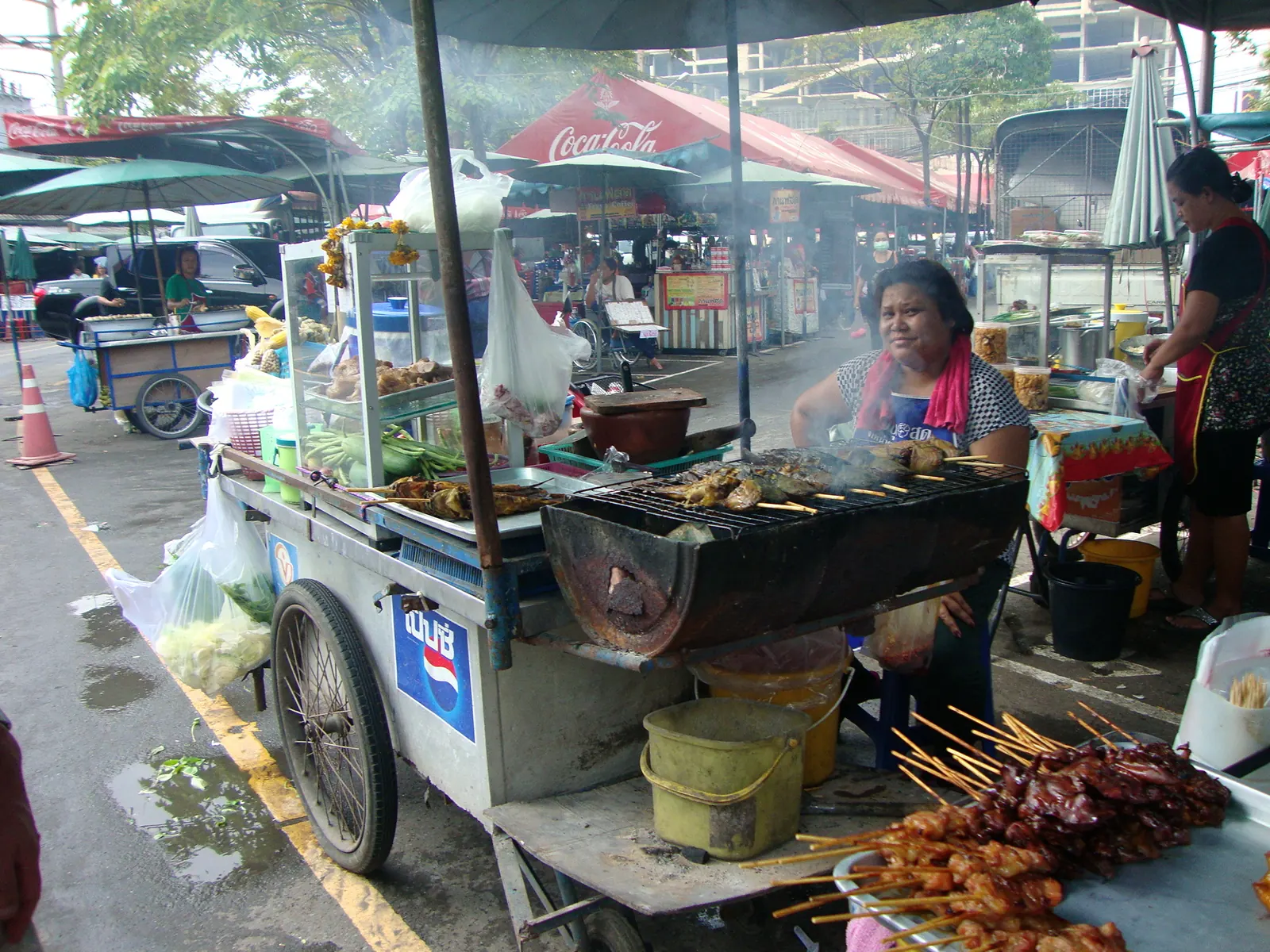
Spice. “Not spicy” (mai phet) is respected at noodle shops and ignored at som tam carts, where “a little spicy” is two chillies and “Thai spicy” is a dare; say phet nit noi and watch what goes in. Ice from the cylindrical commercial kind is fine; the crushed block kind at a few stalls is a gamble. Mornings. The best market eating is 7–9am, which is also the coolest hour — the noodle shops and jok (rice porridge) stalls are breakfast businesses. Closing. Lunch shops sell out by 2pm; night stalls run from 6pm to late; many are shut on Mondays. Your stomach. The street-food safety guide has the honest arithmetic: most visitors eat everything and are fine; the ones who aren’t usually drank the tap water or ate the buffet. Sleeping near it: Yaowarat and the Old Town are the two neighbourhoods where a hotel within walking distance changes the trip — our Bangkok stay guide covers both, with the hotels we’d book.
Bangkok street food: your questions, answered
Where is the best street food in Bangkok?
Yaowarat (Chinatown) after dark is the one area that lives up to the reputation; the Old Town around Maha Chai and Tanao roads, Bang Rak below Silom, the boat-noodle alley at Victory Monument and Wang Lang market across the river are the others we’d send a friend to. Khao San Road is the one to skip.
How much does street food cost in Bangkok?
฿50–80 for a plate of pad krapao, pad thai or curry over rice, ฿60–90 for a bowl of noodles, ฿15–25 per tiny bowl of boat noodles, ฿60–100 for mango sticky rice. Tourist-strip carts charge roughly double for the same dishes; over ฿100 for pad thai means you’re on a tourist menu.
Is Bangkok street food safe to eat?
Overwhelmingly, yes. Pick stalls with a queue and constant turnover, eat food cooked to order in front of you, drink bottled water and use the cylindrical commercial ice. Most visitors eat street food daily without trouble; our dedicated safety guide has the detail.
Is Yaowarat (Chinatown) worth visiting for food?
Yes — it’s the best single street-food night in the city. Go after 7pm, not on a Monday, walk the whole strip before sitting down, and eat small plates at several stalls: kuay jab, roast duck, the oyster omelette, grilled seafood, and a dessert soup.
Is Jay Fai worth it?
As a once-in-a-trip event, if you’ve reserved and you’re happy to pay ฿1,000-plus for a crab omelette, it’s excellent. As street food, no — it’s a restaurant with a queue. Thipsamai’s pad thai across the road and the ฿60 bowls around the corner are the neighbourhood’s real street meal.
Related guides
- Is Thai Street Food Safe? An Honest Answer
- Khao Gaeng: How Thailand’s Curry-Rice Shops Actually Work
- Things to Do in Bangkok That Aren’t a Tourist Trap: Worth It vs Skip It
Book the trip
Some links in this guide are affiliate links. If you book through them we may earn a small commission at no extra cost to you — it helps keep Destination Thailand independent.
Food walks worth the money: a Chinatown evening walk or a market-and-cooking morning — compare Bangkok food tours on GetYourGuide and pick the one with the smallest group. Sleep near the food: Yaowarat or the Old Town — compare Bangkok hotels on Agoda by area after reading the stay guide. Onward: the sleeper north or the flight south — book the next leg on 12Go. Still deciding where Bangkok fits? Our Where to Go in Thailand matcher scores all 77 provinces against your month and what you actually want from the trip.