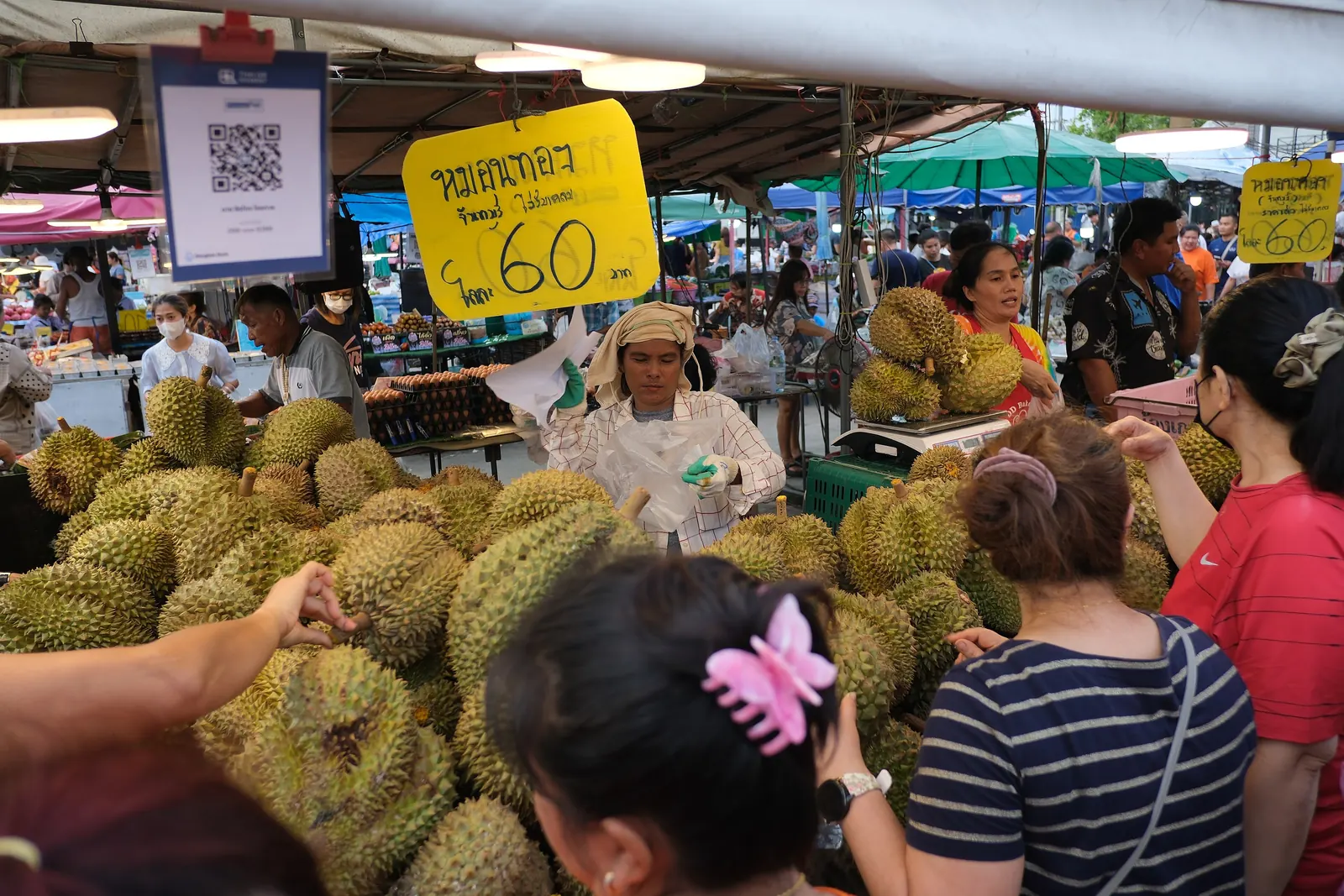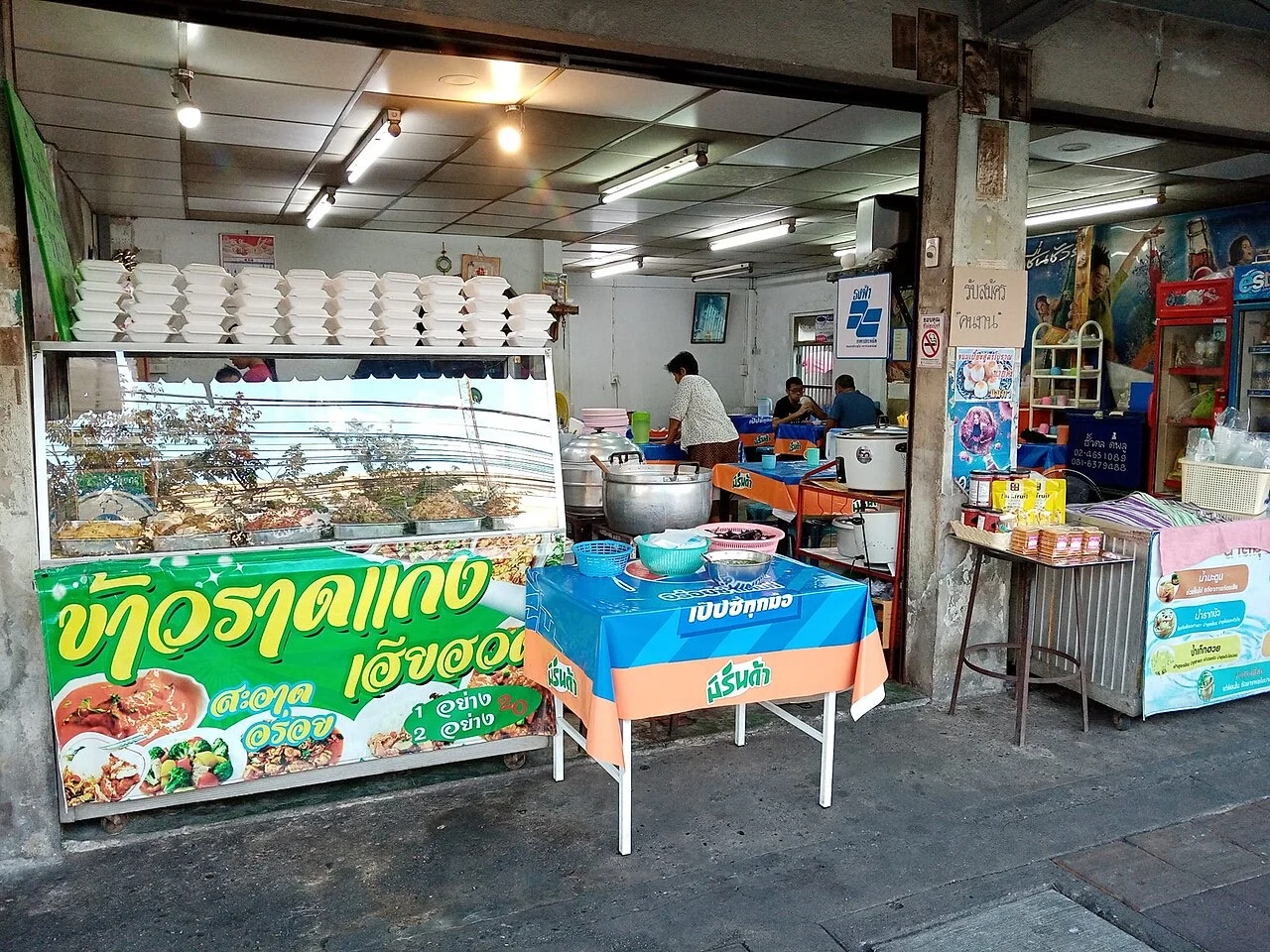
Walk down any working street in Thailand between seven in the morning and one in the afternoon and you’ll pass a shop with a row of steel trays behind glass, each one holding a different curry or stir-fry, with a rice cooker the size of a washing machine humming behind them. That’s a raan khao gaeng — a curry-rice shop — and it’s where a huge share of the country actually eats lunch. Not the night markets tourists photograph, not the restaurants with laminated English menus. This.
Guidebooks mostly skip khao gaeng (ข้าวแกง), and it’s easy to see why: there’s no menu, no English sign, nothing to link to. You order by pointing. Which is exactly why it’s the best-value meal in Thailand and the fastest way to eat like you live here — once someone explains the four or five unwritten rules. Consider this that explanation.
What khao gaeng actually is
The name means “rice curry”, and the format is older than any food trend in Bangkok: cook everything in the morning, put it in trays, sell it over rice until it runs out, close. A typical shop has eight to fifteen dishes on display — a couple of coconut curries, a sour orange curry, dry-fried pork or chicken with holy basil or chilli paste, stir-fried vegetables, an omelette folded like an envelope, maybe stewed eggs or fried fish. The spread changes daily and regionally; in the south it leans hotter and heavier on turmeric, which is a story of its own — see our guide to southern Thai food.
Nothing is cooked to order except a fried egg. That’s not a compromise — it’s the point. These are the braises and curries that need a morning of work, made once, properly, by someone who has made them several thousand times.
How ordering works (it’s pointing, with rules)
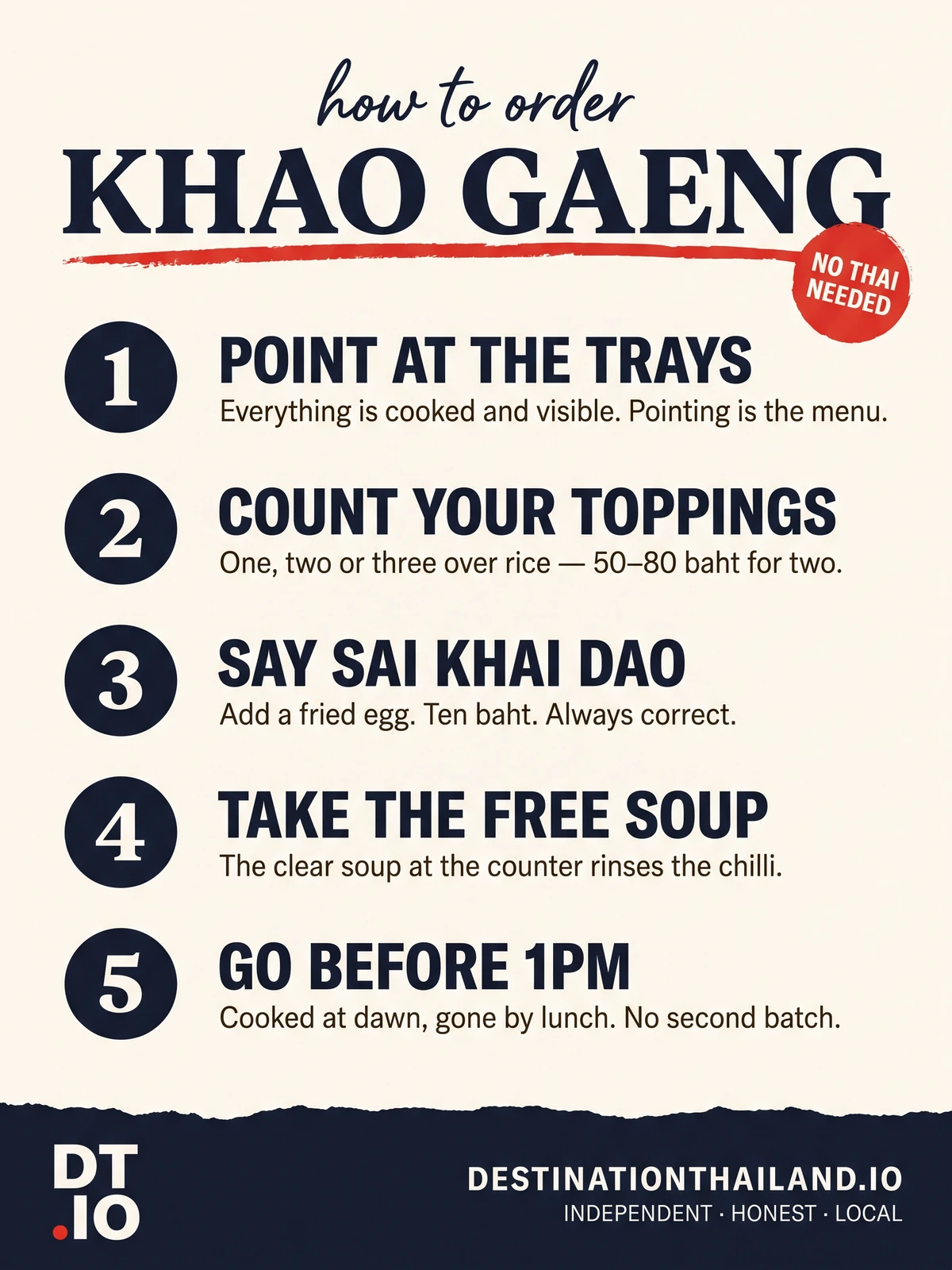
Stand at the glass. The vendor will look at you and say something that means “how many things?” Your options are one, two or three toppings over rice, and the price scales with the count: expect around ฿50–80 for rice with two items at an ordinary shop — the number we track in our Thailand Price Index. Three toppings might reach ฿90 in Bangkok’s business districts. If a plate somehow costs ฿150, you’re at a food court in a mall, which is khao gaeng with air conditioning and a 40% surcharge.
The phrases, if you want them: ao song yang (I’ll take two things), raad khao (over the rice), sai khai dao (add a fried egg — usually ฿10 more and always correct). Point at the tray as you say it, or just point and hold up fingers. Nobody has ever failed to order khao gaeng. There is usually a vat of clear soup at the end of the counter; a small bowl of it comes free with your plate at most shops, ladled by you or by them. It’s there to rinse the chilli off your palate, and it works.
What to point at, your first time
A sane first plate: one curry, one stir-fry. For the curry, gaeng khiao wan (green curry) or gaeng phanaeng (thicker, milder, peanutty) are the friendly entries; gaeng som — the sour, vegetable-heavy orange one — is the local favourite and noticeably hotter than it looks. For the stir-fry, pad krapao (holy basil, usually pork or chicken) or pad prik khing (dry red-curry-paste fry with green beans). If the heat map of your mouth is still calibrating to Thailand — our five tastes guide explains what you’re calibrating to — the folded omelette, khai jiao, is the universal safe harbour, and nobody will judge you for it. Locals order it too. That’s why it’s there.
One honest warning: khao gaeng shops season for Thai customers, not for visitors. The curries are saltier and hotter than restaurant versions of the same dishes. That’s not a defect. Rice is the volume knob — use it.
The timing rule everyone learns the hard way
Khao gaeng runs on a schedule with no mercy in it. The trays are full at 7am, the office crowd hits between 11:30 and 12:30, and the good shops are scraping the last of the gaeng som by 1pm. There is no second batch. If you turn up at 2:30 and the trays are empty, that isn’t a closed shop — it’s a successful one. Go at 11 if you want the full spread, go at 12:15 if you want to see the machine at full speed: forty plates in twenty minutes, a queue of motorbike-taxi drivers and bank staff, zero wasted motion.
Payment is at the end of the counter or when your plate is handed over, cash, and the whole transaction from arrival to eating takes under ninety seconds. Bus your own nothing — plates stay on the table when you leave.
How to pick a shop
We’re not going to name “the best khao gaeng in Bangkok”, because we haven’t sat in every contender and neither has anyone else who publishes that list. The honest selection method: at noon, the shop on your soi with the longest line of locals is the right shop. High turnover means the trays empty and nothing sits — which is also the answer to the hygiene question every first-timer is quietly asking (we wrote up the whole subject in our honest guide to street food safety). A khao gaeng shop that’s busy at lunch is one of the safer places you can eat in Thailand, because everything in it was cooked this morning and will be gone by two.
Khao gaeng: your questions, answered
How much does khao gaeng cost in 2026?
Around ฿50–80 for rice with two toppings at a normal neighbourhood shop, a little more in central Bangkok, plus ~฿10 for a fried egg. Mall food courts charge more for the same format. Current street-food prices live in our Thailand Price Index, which we check against real vendors, not menus written for tourists.
Is it safe to eat food that’s been sitting in trays?
At a busy shop, yes — the trays are cooked in the morning and empty by early afternoon, which is faster turnover than most restaurant kitchens manage. The rule is the queue: locals at lunch are the certification. A khao gaeng shop with no customers at 12:30 is the one to skip.
Can vegetarians eat at khao gaeng shops?
At an ordinary shop, options are limited — stir-fried vegetables are usually cooked with oyster or fish sauce. What you want is a jay (เจ) shop: the same tray format, fully plant-based, marked with a yellow flag. They exist year-round and multiply enormously every October during the Vegetarian Festival.
Do khao gaeng vendors speak English?
Often not, and it doesn’t matter. The entire system was designed around pointing. Hold up fingers for how many toppings, point at the trays, say sai khai dao if you want the egg. You’ll be holding a plate before you finish deciding whether to be nervous.
What time should I go?
Between 11am and 1pm. Earlier gets you the full selection; later gets you whatever survived the office rush. Most shops are done — sold out, cleaning up — by mid-afternoon. Khao gaeng is not dinner.