Ask a Bangkok taxi driver to name the most Thai place in Thailand and there is a fair chance he will say Suphan Buri — probably while a luk thung ballad by one of the province’s dead superstars crackles out of his radio. Suphan Buri sits about 100 kilometres northwest of the capital, grows an absurd share of the nation’s rice, produced its best-loved singers, staged its most famous battle and keeps a 135-metre concrete dragon in the middle of town. Foreign tourists, meanwhile, ignore it almost entirely.
That is not because there is nothing here. It is because nobody earns a commission sending you here. There are no islands, no beach clubs, no elephant parks with gift shops. What you get instead is actual central Thailand — rice, rivers, temples, noodles and a large helping of history — getting on with life with or without you. Our Suphan Buri province profile has the quick facts; this is the long version.
One thing before we start: the roads. This province has the best roads in Thailand — wide, smooth, lit like an airport apron — because for four decades it was the personal project of Banharn Silpa-archa, a former prime minister nicknamed the walking ATM. He funnelled a startling share of the national budget home; the result is big-city infrastructure with Sunday-morning traffic.
What Suphan Buri really is
Rice country, first and always. The Tha Chin River — the Suphan Buri River along this stretch — crawls down a flood plain so flat and green it looks computer-generated. This is the Thailand of school textbooks and country songs: buffalo, rice barns, temple fairs.
It is also the heartland of luk thung, Thai country music. Suraphol Sombatcharoen, the genre’s king, and Pumpuang Duangjan, its queen, were both Suphan Buri natives, and the local drawl is practically the genre’s official sound. Pumpuang’s shrine at Wat Thapkradan, down in Song Phi Nong district, still pulls crowds of lottery hopefuls asking the late queen for numbers.
And it is old. U Thong, west of the modern town, was trading with India when Ayutthaya was still a swamp, and the museum there makes a quiet case that Dvaravati civilisation started right here. Khun Chang Khun Phaen — the great Thai epic of love, war and catastrophic decision-making — is set in these streets too. Suphan Buri was being written about before most of Thailand had names.
Why go to Suphan Buri
Because it is the easiest genuinely untouristed province you can reach from Bangkok. Two hours in a minivan buys you a century-old wooden market, the battlefield that saved a kingdom, boat noodles at their source and a museum inside a dragon — and you will probably be the only foreigner at all four. Come to see what central Thailand looks like when nobody is performing for visitors.
Getting to Suphan Buri
Minivans leave Bangkok’s Mo Chit and Southern Bus terminals roughly every half hour: about two hours, ฿100-140 depending on the operator. Ordinary buses ply the same routes slightly slower and cheaper.
There is also a train, and it is a lovely absurdity: one ordinary service a day up a sleepy branch line, about three hours, costing less than a fizzy drink. Hard seats, open windows, rice fields the whole way — if you like railways, do it once. Check the State Railway timetable on the day; departures have been shuffled since Bangkok’s new central station opened.
Drivers take Route 340 — about an hour and a half, on tarmac smooth enough to land a jet on. From Kanchanaburi or Ayutthaya, local buses and songthaews take one to two hours; nothing needs booking ahead.
Where to stay
Base yourself in the town centre, near the night market and the river. A clean guesthouse with air conditioning runs ฿400-700, and the newer mid-range hotels — proper beds, parking, a lift — sit around ฿800-1,500, which here buys a room that would cost triple in Bangkok. Book nothing in advance except during the Don Chedi fair.
Two alternatives. In Sam Chuk, a few of the old wooden shophouses operate as simple homestays — creaky, characterful, about ฿500-800 — which gets you the market at dawn before anyone else arrives. And around Bueng Chawak lake there are family resorts if you are travelling with children.
What to eat in Suphan Buri
Boat noodles, obviously. This is kuay tiew rua country, and here they are served the proper way: tiny bowls, dark broth deepened with blood and star anise, a few slivers of beef or pork, ฿15-25 a bowl. You do not order one; you order a stack, and the empty bowls pile up as a public scoreboard. The shops around the town centre and out towards Wat Pa Lelai are the real thing — if the tables are steel and the average customer is sixty, you are in the right place.
The take-home speciality is khanom sali, a pillowy sponge cake — every bus back to Bangkok carries boxes of it. Beyond that, this is river-food territory: salt-crusted grilled snakehead and big freshwater prawns at the row of riverside places along the Tha Chin, plus old-recipe snacks at Sam Chuk — pork satay, coffee in enamel cups, sweets a Thai grandmother would recognise.
Top things to do in Suphan Buri
1. Sam Chuk 100-Year Market
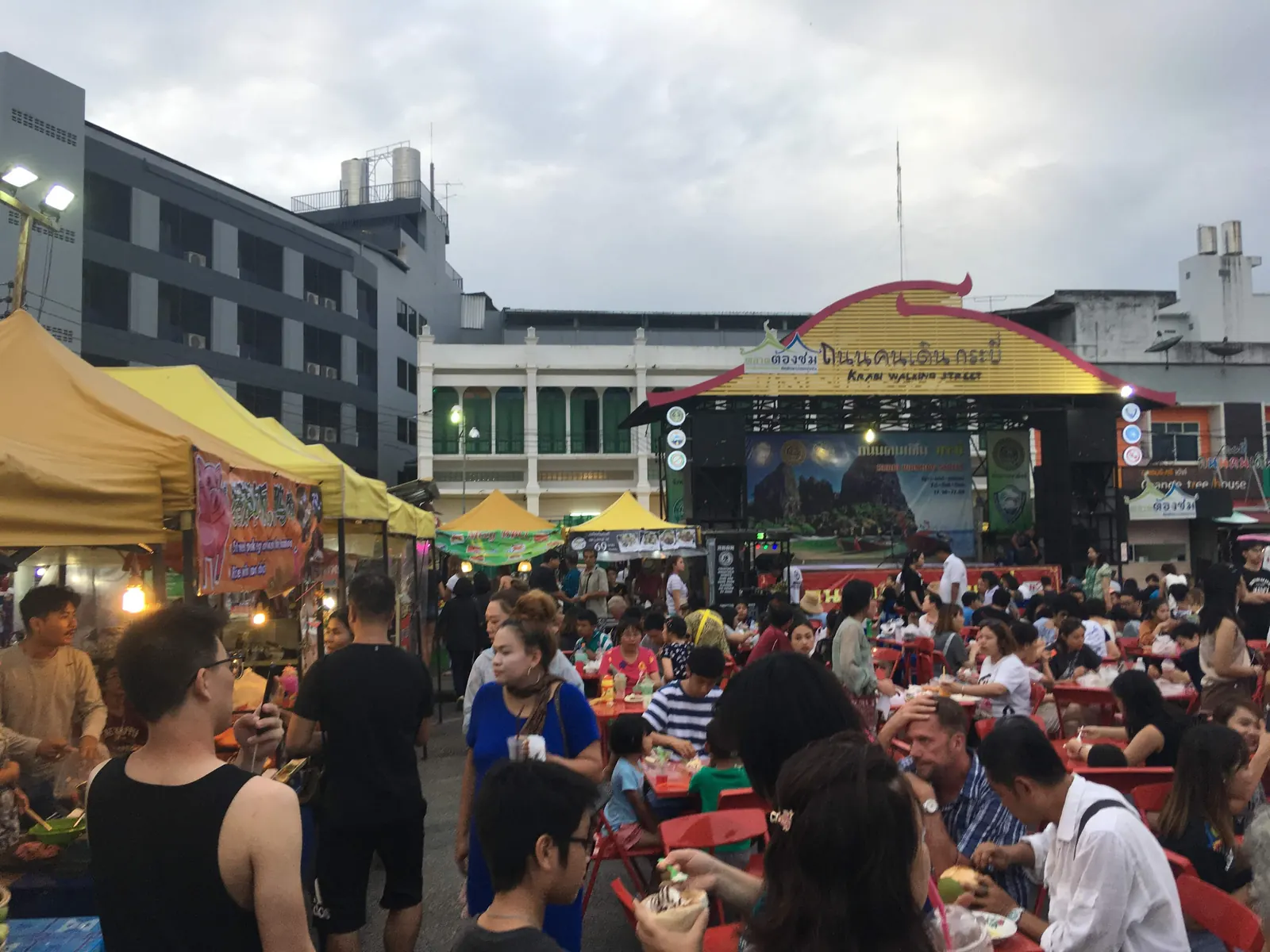
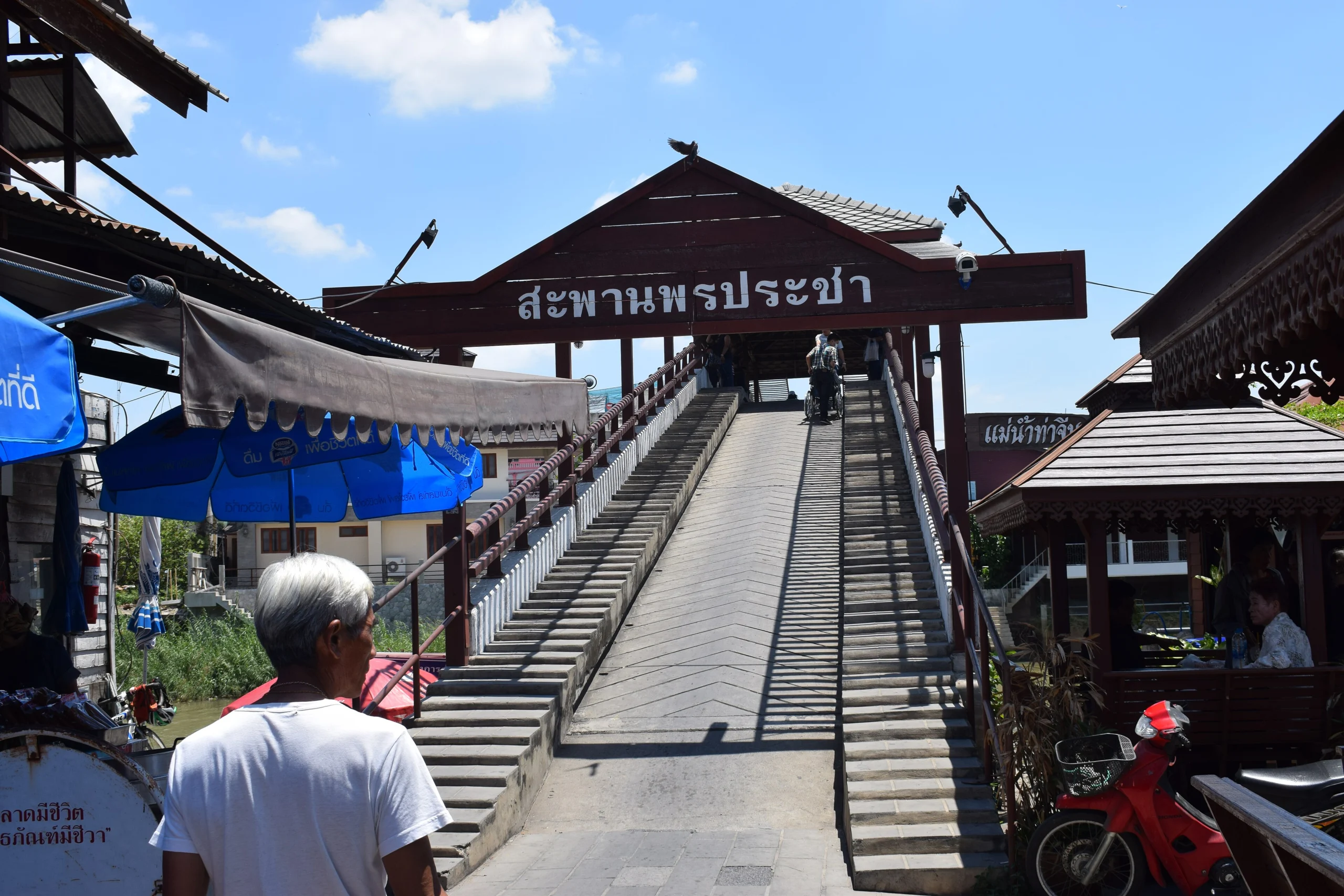
About 45 minutes north of town, four lanes of century-old teak shophouses lean over the Tha Chin River, and — the crucial part — it is still a real market. Locals buy fish, school uniforms and dried goods here; the coconut ice cream is a sideline, not the point. The conservation effort picked up a UNESCO Asia-Pacific heritage award. Come on a weekday morning and eat continuously. Free, naturally.
2. Dragon Descendants Museum
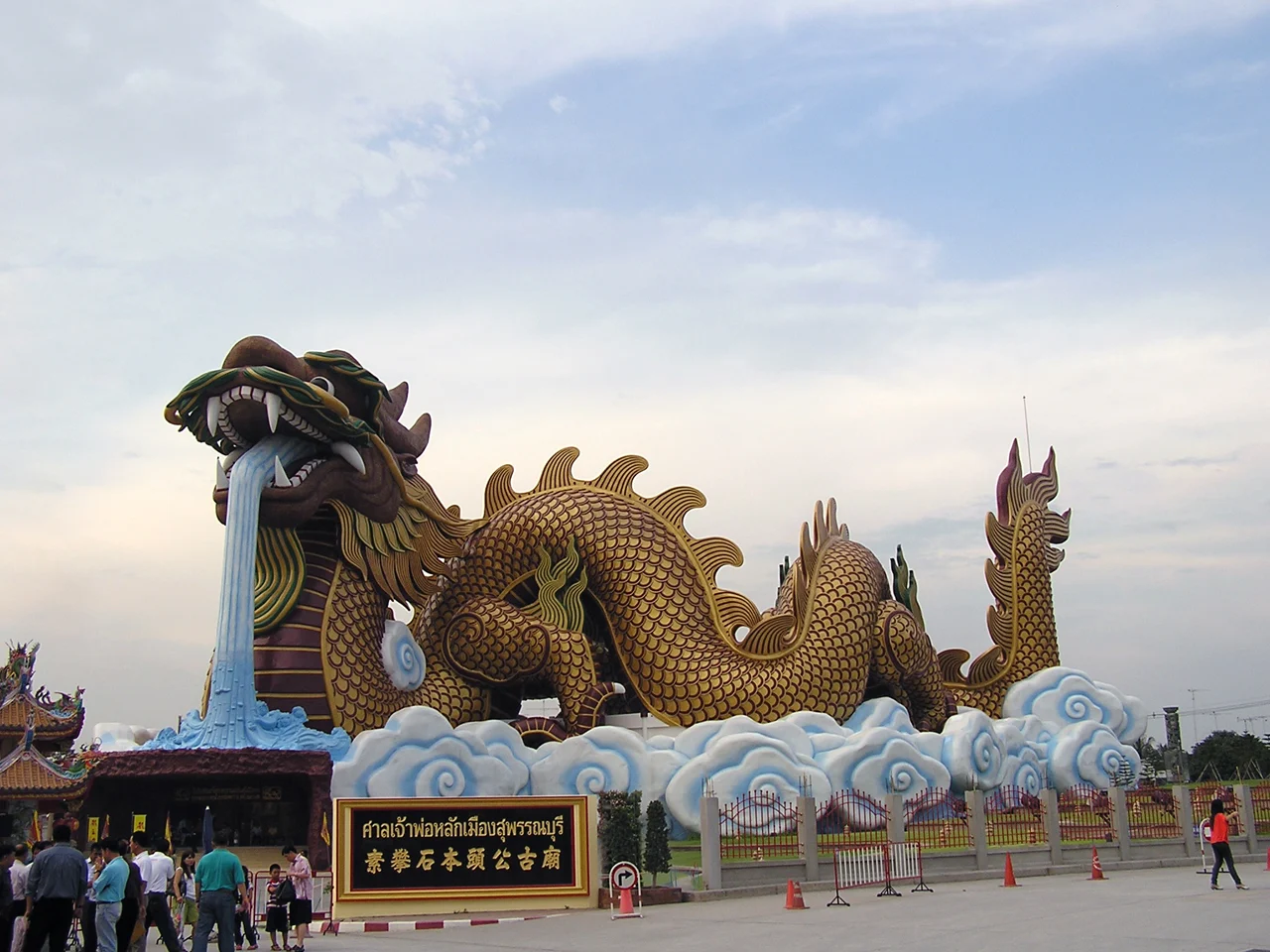
At the City Pillar Shrine, Banharn built a museum honouring the city’s Chinese merchant roots — and because subtlety was never his thing, he built it inside a 135-metre dragon. Inside: room after room of dioramas covering several thousand years of Chinese history, with lighting effects and dramatic narration. It is gloriously over the top and oddly sincere at the same time. Entry is about ฿300 for foreigners, much less for Thais; the old Chinese shrine itself is worth your time on its own.
3. Don Chedi Monument
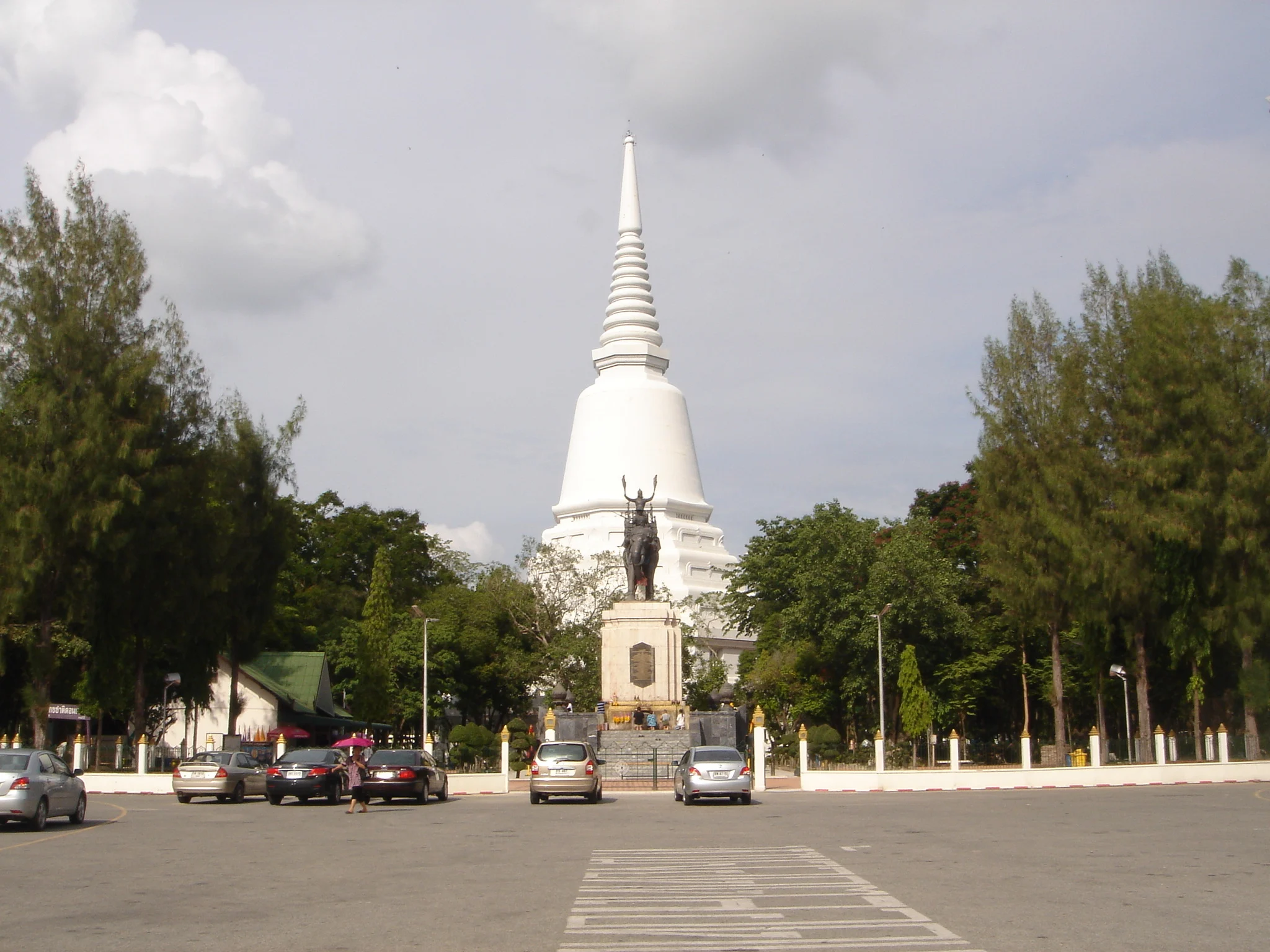
In 1592 — or 1593, depending on whose calendar you trust — King Naresuan of Ayutthaya killed the Burmese crown prince in single combat on elephant-back, on this spot, and bought his kingdom its independence. The memorial chedi and the bronze of Naresuan mid-duel sit about half an hour northwest of town. Go in late January if you can: the annual Don Chedi fair wraps the battlefield in re-enactments, luk thung stages and funfair chaos. Free, and one of the most consequential patches of grass in Thai history.
4. Banharn-Jamsai Tower
Every great city has its tower, and Banharn saw no reason his should be an exception: an observation tower of about 120 metres named after himself and his wife Jamsai. It is the province’s Eiffel, and precisely as subtle. A lift takes you up to green flood plain running flat to the horizon in every direction. Entry is small — well under ฿100 — and the park below is manicured within an inch of its life. Go at sunset.
5. Bueng Chawak Aquarium and Safari
A little over an hour north of town, Bueng Chawak is a big natural lake with an aquarium — walkthrough tunnel included — plus zoo and safari-style animal zones spread along the shore. It is a day out built for Thai families, not a slick international attraction — taken on those terms it is good fun and absurdly cheap, each zone priced separately and none more than a couple of hundred baht. Combine it with Sam Chuk on the way back to town.
6. Wat Pa Lelai
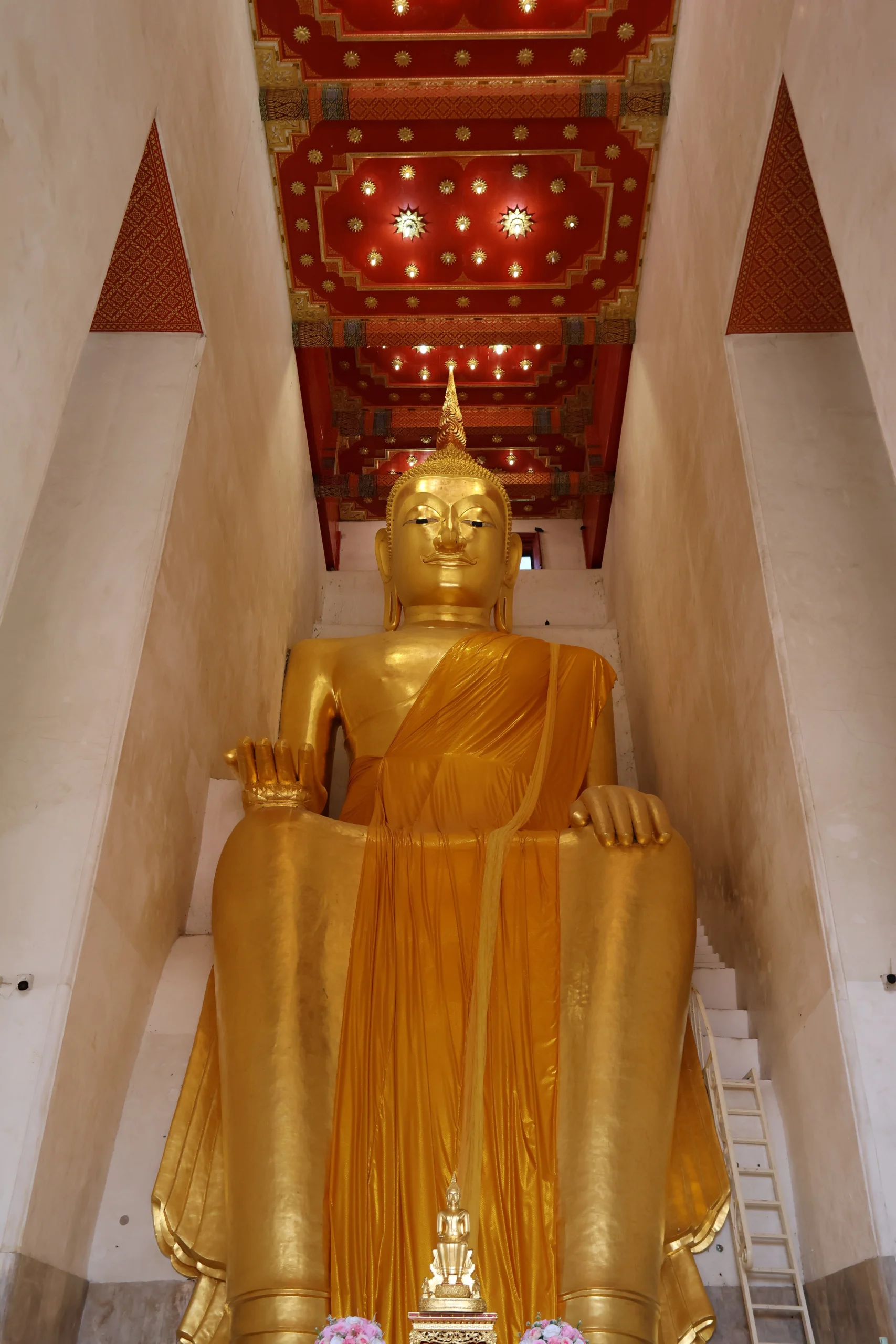
The spiritual heavyweight of Suphan Buri: a temple that predates Ayutthaya by local reckoning, housing Luang Pho To, a seated Buddha 23 metres tall in the rare pa lelai posture — hands resting open on the knees, a pose you will rarely see elsewhere in Thailand. The temple stars in Khun Chang Khun Phaen, so Thai visitors arrive already knowing the story. It is a working temple, free to enter, and best in the early morning when the chanting is real.
What to skip
Sam Chuk between 11am and 4pm on a Saturday or Sunday. The same market that feels like time travel on a Wednesday morning becomes a conveyor belt: coaches from Bangkok disgorge, everyone shuffles the lanes for 45 minutes holding an ice cream, the coaches leave. The wooden arcades are still lovely; the experience is not. If a weekend is your only option, be there by 8am and leave when the megaphones arrive.
Also skip any plan built around nightlife. Suphan Buri goes to bed early — a night market, a few beer gardens, done. Treat that as a feature: it is exactly why the place still feels like itself.
Suphan Buri travel: practical info
Come between November and February, when the flood plain is cool and green — April here is a furnace. The Don Chedi memorial fair, late January into early February, is the province at full volume and the single best week to visit. Bring cash; card machines are rare outside the bigger hotels.
Wikipedia’s Suphan Buri entry covers the Ayutthaya-era border wars properly.
TAT’s official Suphan Buri page keeps current hours and festival dates.
One full day covers the town, the dragon and Wat Pa Lelai; two nights lets you do Sam Chuk properly, Don Chedi and Bueng Chawak. Moving on is easy: buses run west to Kanchanaburi and east to Ayutthaya in one to two hours, or you can drift north up Route 340 through Ang Thong towards Chai Nat and the quiet heart of the rice belt.
FAQ
Is Suphan Buri worth visiting?
Yes — provided you want central Thailand rather than a beach: real markets, serious history, superb cheap food and almost no other foreigners. If your measure of a destination is rooftop bars, stay in Bangkok.
How do you get from Bangkok to Suphan Buri?
Minivan from Mo Chit or the Southern Bus Terminal — about two hours, ฿100-140, departures every half hour or so. There is also one slow, charming ordinary train a day, and driving via Route 340 takes about an hour and a half.
What is Suphan Buri famous for?
Boat noodles, luk thung music legends, King Naresuan’s elephant-back duel at Don Chedi, the Sam Chuk 100-year market and a 135-metre dragon with a museum inside it. Among Thais it is equally famous for having suspiciously excellent roads.
Can you do Suphan Buri as a day trip from Bangkok?
Easily — leave after breakfast, be back for dinner. Pick two sights and do them properly rather than sprinting between five. That said, an overnight costs very little and gets you Sam Chuk at dawn — the best version of it.
When is the best time to visit Suphan Buri?
November to February for cool, dry weather. Aim for the Don Chedi fair in late January if you can. Avoid April unless you enjoy 40-degree heat on a plain with no shade.