The first Loy Krathong I saw properly was on a canal in Nonthaburi, not at any of the places that make the postcards. A woman in her seventies knelt at a concrete step, lit two incense sticks and a candle on a banana-leaf cup, said something quiet I wasn’t meant to hear, and pushed it out with both hands. It went about four metres, caught a current, and joined maybe two hundred others drifting under a footbridge. Nobody photographed it. That is the festival. Everything else — the drone shots, the ticketed lantern releases, the hotel packages — is built on top of that gesture.
Here is what is actually happening on the night, when Loy Krathong falls in 2026, where to be, and the parts most guides leave out. You will also see it written Loi Krathong — both are accepted romanisations of ลอยกระทง, and they mean the same festival on the same night.
When is Loy Krathong 2026?
Tuesday 24 November 2026. One night, nationwide. It lands on the full moon of the twelfth month of the Thai lunar calendar, which is why the Gregorian date moves every year — it was 5 November in 2025, and it will be Sunday 14 November in 2027.
Two things people get wrong. First, it is not a public holiday: banks, offices and schools run normally on the 24th, and most people go out after work. Second, the celebrating is concentrated in a single evening — roughly 18:00 to 22:00 — even in cities that run multi-day programmes around it. Turn up on the 25th and you will find a lot of swept-up banana leaf.
In Chiang Mai the same full moon carries a second, separate northern festival — Yi Peng, the lantern festival, on 24–25 November 2026. They coincide; they are not the same thing, and confusing them is how people end up disappointed. Our full festival and public-holiday calendar has every 2026–27 date with a downloadable .ics.
What Loy Krathong actually is
Loi (ลอย) means to float. A krathong (กระทง) is the vessel — traditionally a slice of banana trunk, dressed with folded banana leaves, flowers, three sticks of incense and a candle. You float it on moving water.
The stated purpose is to pay respect to Phra Mae Khongkha, the goddess of water, in thanks for the year’s supply and in apology for having fouled it. Layered on that is a more personal idea that most Thais will describe first if you ask: you put your grudges, bad luck and regrets from the past year into the krathong and let the current take them away. Some people clip a fingernail or a strand of hair into it to make the transfer literal. Couples float one together, and there is a piece of folklore that if it stays lit and the two halves don’t separate, so will they.
It is genuinely a merit-making night rather than a party night, which surprises visitors who arrive expecting Songkran energy. The mood at the water’s edge is closer to quiet and slightly sentimental.
Where to go, ranked honestly
Sukhothai — the best-looking version, and the original one
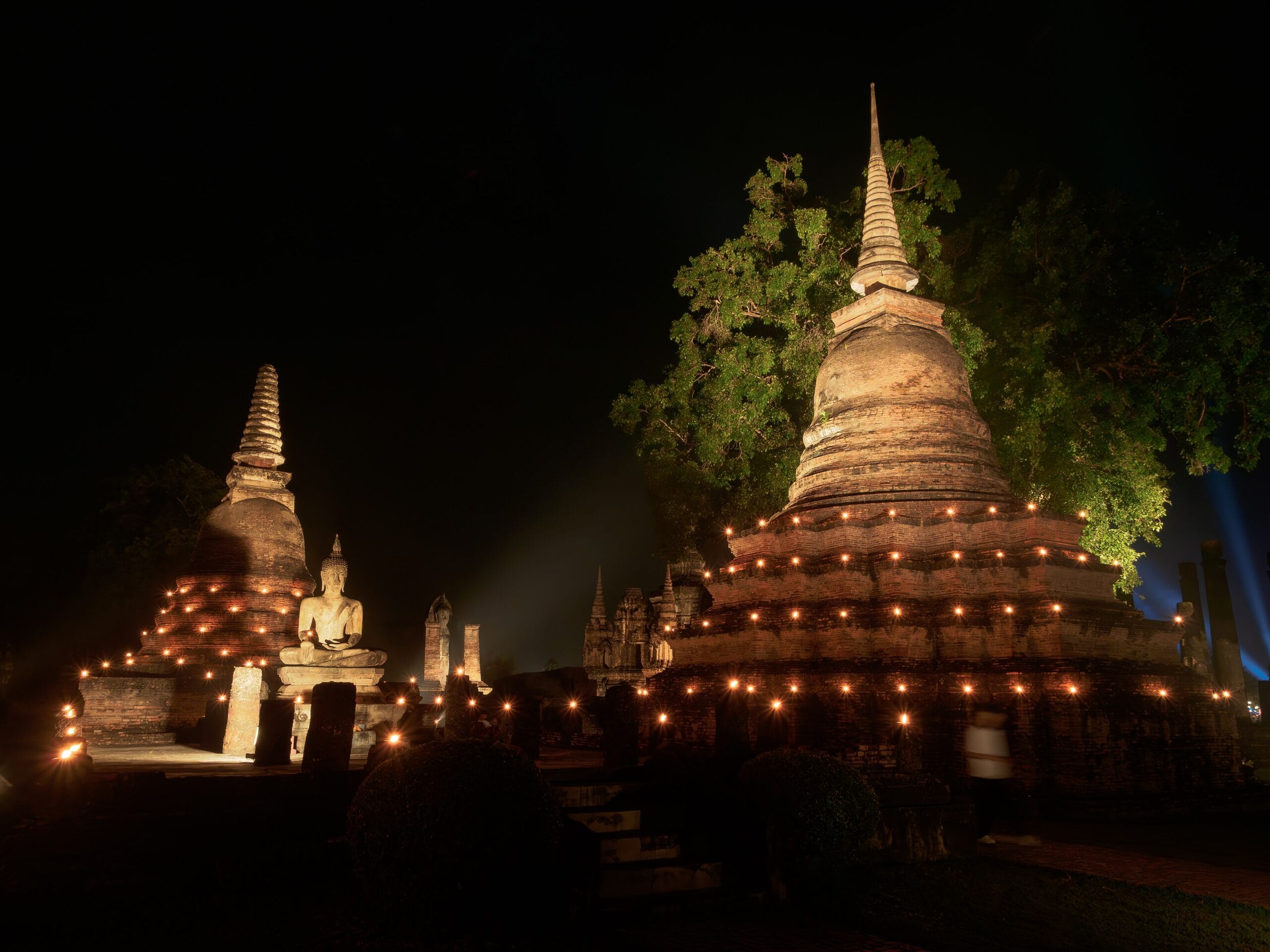
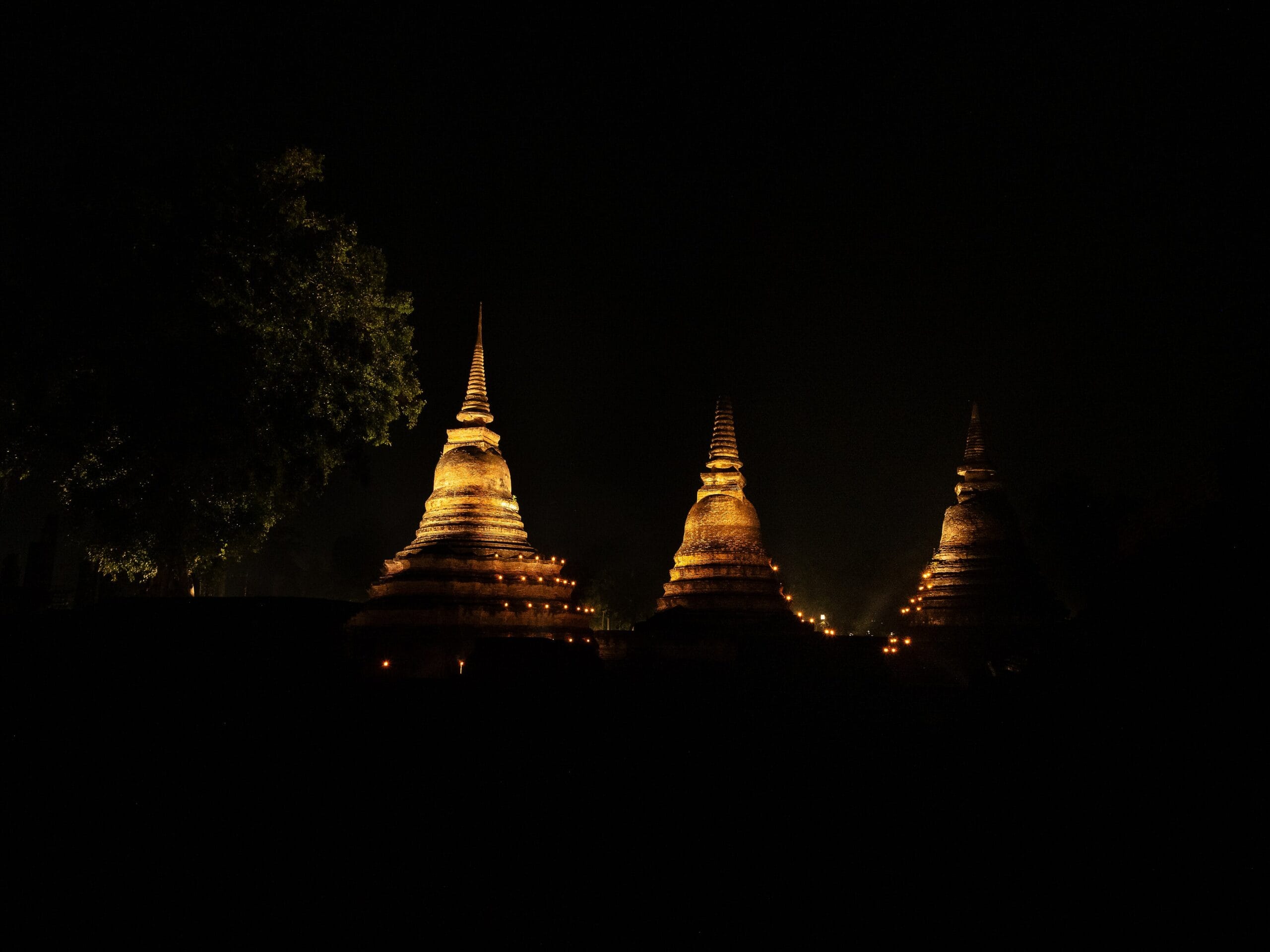
The festival’s origin story is usually placed at Sukhothai, and the celebration inside the historical park is the one that justifies rearranging a trip. Krathongs on the ponds between thirteenth-century ruins, the stupas lit from below, a sound-and-light programme across several nights. It is ticketed inside the park, it sells out, and the town has a fraction of the beds it needs that week.
If you want this one, book accommodation now rather than in October — Sukhothai hotels go early and prices roughly double. Getting there is an overnight bus or a train to Phitsanulok then a minibus; Bangkok–Sukhothai routes are worth locking in the same week. More context in our Sukhothai guide and the Sukhothai province profile.
Chiang Mai — the biggest, and the most complicated
Because Yi Peng runs alongside it, Chiang Mai draws the heaviest crowds in the country. The Ping River fills with krathongs, the Old City moat gets its own float-off, there are parades on Tha Phae Road, and the sky fills with lanterns. It is spectacular and it is very busy: expect road closures, surge pricing and hotels booked six months out. Chiang Mai accommodation for that week is the single most competitive booking in the Thai calendar.
Bangkok — easy, convenient, not transcendent
The Chao Phraya is the main event, with the best free viewing along the riverside promenades and from the Wat Arun side. Asiatique, Iconsiam and the big riverside hotels run organised events; most khlongs and park ponds across the city will have people floating quietly. It is the least atmospheric of the major options and by far the easiest if you are already there — no booking, no travel, and you can walk to it. See where to stay in Bangkok for riverside areas.
Ayutthaya — the Sukhothai experience without the scramble
Ruins, water on three sides, an hour and a half from Bangkok, and a fraction of Sukhothai’s competition for beds. If you want krathongs drifting past old brick and you left your planning late, this is the answer. Pair it with our guide to the temples of Ayutthaya.
Anywhere with water, actually
The honest recommendation: the nearest canal, pond or riverbank to wherever you are sleeping. Every town in Thailand does this. Provincial celebrations — Tak’s lantern-lit river floats, Lopburi, Chiang Rai, the temples along the Mekong — are smaller, free, unphotographed and much closer to what the night is for. You will be the only foreigner and someone will almost certainly help you light your candle.
The krathong itself, and why it matters now
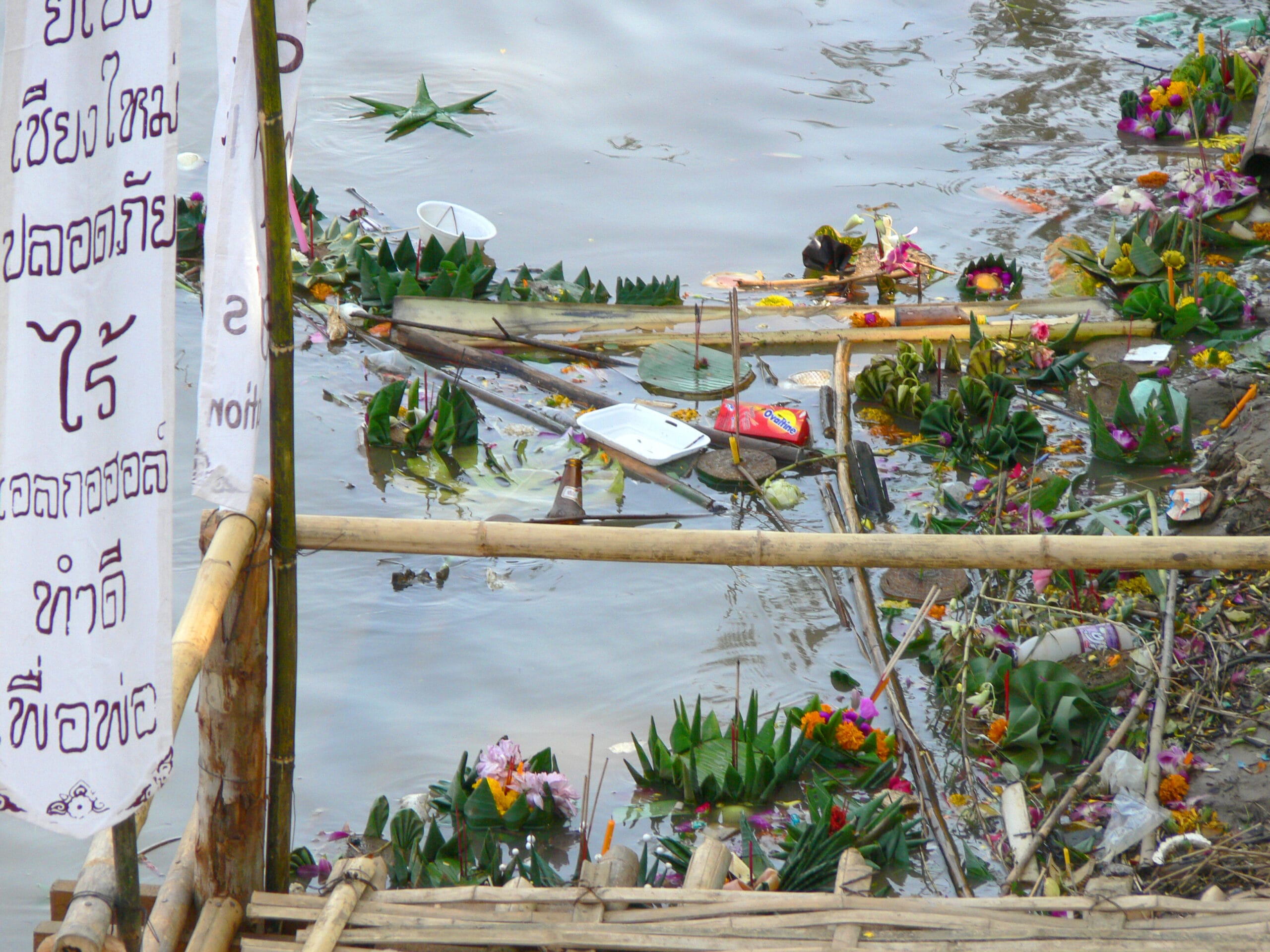
Millions of these go into Thai waterways in a single evening, and every one is retrieved by municipal crews the following morning — Bangkok alone typically pulls out several hundred thousand. What yours is made of decides whether that clean-up is composting or landfill.
- Banana trunk and leaf — the traditional build, fully biodegradable, and what most vendors now sell. This is the one to buy.
- Bread — marketed as fish food and popular for a while, now discouraged in many municipalities: en masse it fouls water quality and the fish cannot eat a fraction of it.
- Styrofoam — banned or refused at most official sites for years. Don’t.
Buy from someone selling at the water’s edge rather than a supermarket. They are usually made that afternoon by people from the neighbourhood, they cost ฿30–100 depending on size and flowers, and the money stays local. Several cities now run a one-krathong-per-family message to cut volume; floating one between a group is normal and nobody will think less of you.
Sky lanterns: read this before you buy one
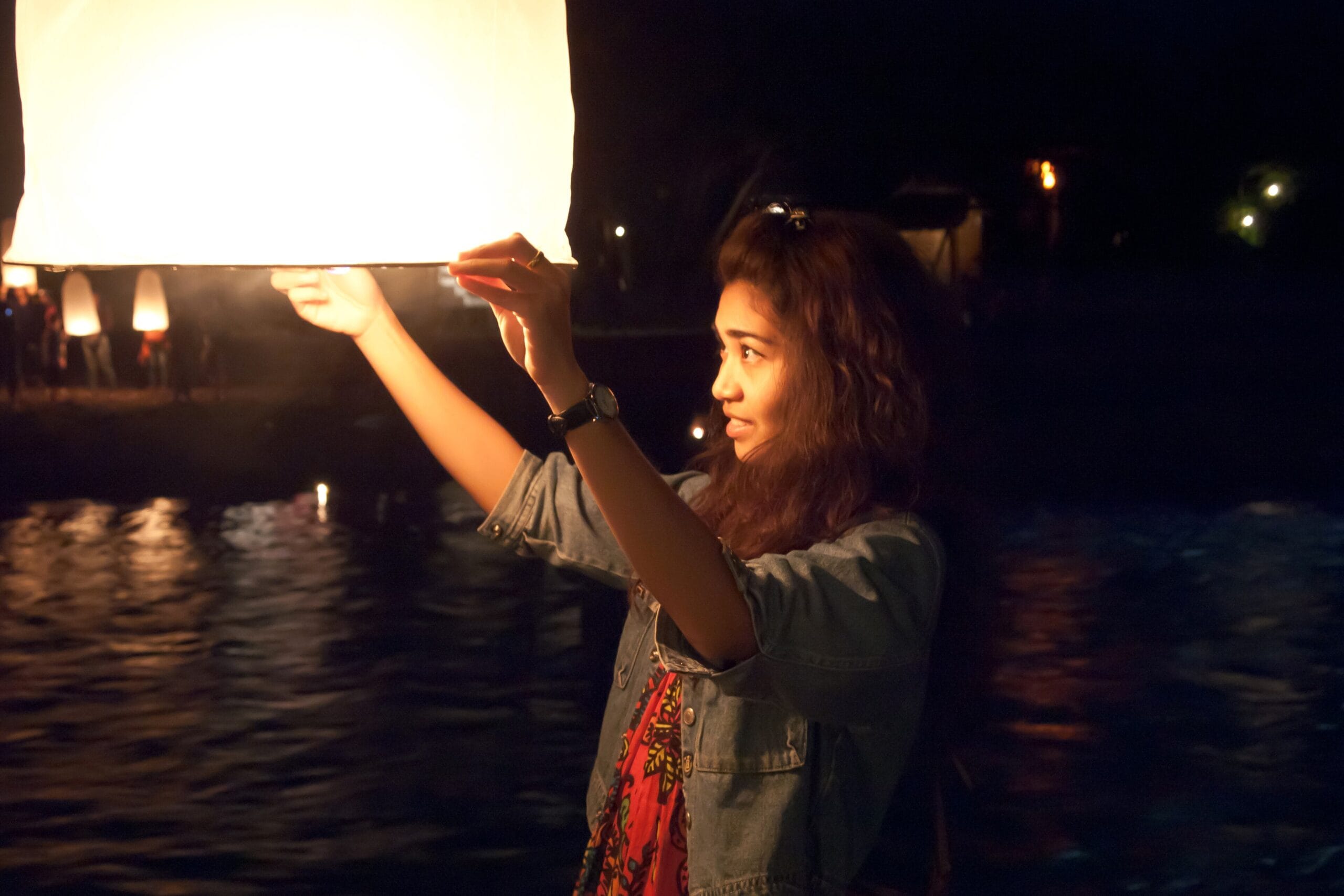
The floating lanterns (khom loi) that appear in every Loy Krathong image are a northern Yi Peng tradition, and they are regulated, not free-for-all. They are aviation hazards: releases near flight paths have grounded and diverted aircraft, and Chiang Mai publishes designated release zones and permitted time windows each year, coordinated with the airport, with fines for releasing outside them.
Practically: in Chiang Mai, release only in a sanctioned zone during a sanctioned window, or at a licensed event. Outside the north, lanterns are broadly not part of the local tradition and in many places are simply not permitted. If a vendor sells you one, that is not evidence it is legal to light where you’re standing. Full detail in the Yi Peng guide.
Practicalities for the night
- Timing. Get to the water before dusk. The best hour is 18:30–20:00; after 21:00 the candles thin out.
- Transport. Riverside roads close in every major city. Take the BTS/MRT or a boat in Bangkok, walk the last kilometre everywhere else, and expect ride-hailing surge from about 17:00.
- Money. Krathong vendors are cash-only. Bring small notes.
- Accommodation. Sukhothai and Chiang Mai need booking months ahead. Bangkok and Ayutthaya are fine a couple of weeks out.
- Fireworks. Widespread, informal and often launched at head height by teenagers. Keep a little distance from groups near the bank.
- Dress. Nothing is required, but plenty of Thais wear traditional dress and photograph each other; you will not be out of place if you make an effort.
Etiquette that will save you an awkward moment
Don’t wade in after a krathong that stalls — let it go, that is the whole idea. Don’t lift a stranger’s krathong out for a better photo. If you’re at a temple pond, the usual temple rules apply: shoulders and knees covered, shoes off where indicated, don’t turn your back on the Buddha image for a selfie. Our temple etiquette guide covers the rest.
And eat before you go, or plan to eat there — the stalls that set up along every route are one of the better street-food nights of the year. Our Thai food guide has the ordering phrases if you want more than a pork skewer.
Some links in this guide earn us a small commission at no extra cost to you — it is how the site stays independent. Full disclosure.
Loy Krathong 2026: your questions, answered
What is the date of Loy Krathong 2026?
Tuesday 24 November 2026, nationwide. It follows the full moon of the twelfth Thai lunar month, so the date shifts annually — 5 November 2025, and Sunday 14 November in 2027. It is a festival, not a public holiday, so businesses stay open during the day.
Is it Loy Krathong or Loi Krathong?
Both are correct. ลอยกระทง has no single official romanisation, so “Loy Krathong” and “Loi Krathong” refer to the same festival on the same night — Tuesday 24 November 2026. “Loy” is the more common spelling in English-language and Thai tourism sources; “Loi” is closer to the Royal Thai General System of Transcription.
What is the difference between Loy Krathong and Yi Peng?
Loy Krathong is nationwide and involves floating decorated vessels on water. Yi Peng is a northern Lanna festival, centred on Chiang Mai, in which paper lanterns are released into the sky. They fall on the same full moon and are celebrated together in Chiang Mai, which is why the two get conflated — but the floating one is the national tradition.
Where is the best place to celebrate Loy Krathong?
Sukhothai Historical Park for the most beautiful version and the strongest link to the festival’s origins; Chiang Mai for the biggest spectacle, combined with Yi Peng lanterns; Ayutthaya as an easier alternative with the same ruins-and-water setting; Bangkok’s Chao Phraya riverside if you are already there. Any local canal or pond is a legitimate and often better experience.
Can I release a sky lantern at Loy Krathong?
Only in designated zones during permitted windows, and realistically only in and around Chiang Mai. Sky lanterns are an aviation hazard, releases are coordinated with airport authorities each year, and launching outside sanctioned areas and times carries fines. Being sold a lantern is not the same as being allowed to light it there.
How far in advance should I book for Loy Krathong?
For Sukhothai and Chiang Mai, several months — both towns sell out and prices roughly double for that week. Bangkok and Ayutthaya are comfortable two to three weeks ahead. Book transport at the same time as accommodation; intercity buses and trains fill for the days either side.
What should a krathong be made of?
Banana trunk and banana leaf, with real flowers, a candle and incense. Avoid styrofoam, which is banned at most official sites, and bread, which is increasingly discouraged because it degrades water quality when floated in these volumes. Buy from a maker at the waterside rather than a supermarket.