
Things to do in Khon Kaen start with a lake, a nine-tier pagoda and a plate of grilled chicken on the west bank at dusk, and get better the further you drive. This is the unofficial capital of Isaan: a university city of a couple of hundred thousand people, sat in the middle of the Khorat Plateau with no beach, no old town and no backpacker street, so almost nobody from outside Thailand has heard of it. The dinosaurs are in the hills ninety kilometres west, the silk villages an hour south, and the best night-market eating in the northeast is a short Grab from wherever you sleep.
**The short version:** three nights, November to February, based by the lake. Day one is the city on foot and by bicycle, day two is a hire-car run to the dinosaur park and the dam, day three is silk at Chonnabot. A proper Isaan dinner is ฿100–150, a good air-con room ฿900–1,800, a Grab across town about the price of a Bangkok coffee. Prices are as of November 2026 and checked against our Thailand Price Index; the wider picture is on our Khon Kaen province page.
In this guide9 sections
- Is Khon Kaen worth a stop, and how long do you need?
- The nine-tier pagoda at Wat Nong Wang
- The lake loop, the city museum and the heat of the day
- Rim Bueng and the night markets: where Khon Kaen actually eats
- Phu Wiang: Thailand’s dinosaur capital, by hire car
- Chonnabot silk: learn how mudmee is tied, then buy a length
- Festivals: the Silk Festival and Songkran on Khao Niao Road
- Where to stay in Khon Kaen, and how to get here and onward
- Things to do in Khon Kaen: your questions, answered
Is Khon Kaen worth a stop, and how long do you need?
Yes, if you want Isaan without the five-hour drive that Udon or Ubon asks of you. Khon Kaen is the only city in the northeast with the airport, the railway, the bus terminal and the hire-car counters in one place, so it works as a hub: Kalasin, Roi Et, Chaiyaphum and the Phu Kradueng climb are all within three hours. Three nights covers the city, the dinosaurs and the silk. Five lets you use it as the base it was built to be. If you are weighing it against its northern neighbour, our things to do in Udon Thani guide is the comparison: Udon has the lotus lake and the Mekong, Khon Kaen has the museums, the food scene and the day trips.
Songthaews are the numbered, coloured pick-ups that cover the city for ฿10–20, but Grab is the default (฿60–120 across town) and a bicycle is the right tool for the lake. A hire car is what makes the dinosaur and silk days work, at around ฿1,200 a day plus fuel, or ฿2,000 or so with a driver. Public transport reaches both only with a painful change of vehicle.
The nine-tier pagoda at Wat Nong Wang
Phra Mahathat Kaen Nakhon is the building on every Khon Kaen postcard: an 80-metre, nine-tier pagoda in the Isaan–Lao style, with stacked upturned roofs and a gold spire, on the south bank of the lake. It was built in the 1990s, which makes it younger than most readers and more impressive than that sounds. Entry is free with a donation box at the door. The grounds open from around 06:00, but the doors to the upper floors are unlocked by the monks when they get round to it, roughly 07:30 or 08:00, and locked again around 16:30 or 17:00. Shoes off at the foot of the stairs, shoulders and knees covered, wraps free to borrow.
Climb it. The lower floors are a running museum of the city, with murals, old photographs and a floor of Isaan textiles; the ninth floor is a balcony with a 360-degree view of the lake, the small cluster of towers to the north and the Khorat Plateau running flat to every horizon. It tells you how big and empty Isaan is, which is why we do it first. Allow 90 minutes; it is quiet before nine and full of school groups after ten. Verdict: do it, early. The honest warning is the stairs: steep, narrow and worn smooth by thirty years of socks. Coming down the top three floors with a phone in hand is where people slip, so use the rail and do not do it in the five minutes before the monks lock up.
The lake loop, the city museum and the heat of the day
Bueng Kaen Nakhon is Khon Kaen’s park, gym, dining room and dating venue in one. Hire a bicycle by the temple (around ฿30–50 an hour) and do the four-kilometre loop anticlockwise: flat, car-free, shaded for about half of it, past bronze figures from the Sinxay epic on the lampposts, the municipal aquarium, a couple of Chinese shrines and, on the north bank, the Hong Moon Mung city museum. Verdict: do it, before 09:30.
Hong Moon Mung (“treasure hall”) walks you from the Bronze Age to the railway’s arrival in 1933 and the university years, for around ฿90 for foreigners. Opening days have changed more than once, so check at your hotel the night before. If it is shut, the Khon Kaen National Museum, around three kilometres north, has a strong Ban Chiang and Dvaravati collection for about ฿100 (Wednesday to Sunday, 09:00–16:00). Verdict: fine, for an hour of air-conditioning with a point.
By late morning the plateau is at full power, so do what locals do and go indoors. Central Plaza on Sri Chan Road has a food court (฿50–90 a plate) and two hours of shade; a street-shop massage is around ฿200–300 an hour, among the cheapest in the country; lunch at any air-con Isaan restaurant around the lake is ฿100–200 a dish.
Rim Bueng and the night markets: where Khon Kaen actually eats
This is the section that earns the stay. The west bank of the lake (Rim Bueng) fills every evening from about 17:00 with food stalls and plastic tables facing the water: grilled chicken, grilled pork neck, som tam pounded to order, salt-crusted tilapia, sticky rice in woven baskets and beer in ice buckets. A full dinner for two is around ฿200–300, and the pagoda across the water goes gold, then floodlit. Verdict: do it, every evening you are here.
The rest of the rota: Ton Tann Green Market on the south-west edge, 200 stalls under fairy lights, the prettiest and most visitor-friendly, around a ฿80 Grab; the university night market and Kang Sadan behind Khon Kaen University for ฿35 noodle shops and student bars; the Saturday Walking Street in front of the Provincial Hall (about 17:00–22:00); and the late-night noodle rows after 20:00. Our Khon Kaen night market guide ranks them, and the Isaan food guide explains what you are eating. In the mornings Talat Bang Lamphu, the central market, does khao jee (grilled sticky-rice cake with egg), and the old shophouse streets between the station and the market give you forty-five minutes of ordinary Isaan town life. Verdict: fine, worth exactly that.
Phu Wiang: Thailand’s dinosaur capital, by hire car
Khon Kaen’s best day is the car day. In 1976 a geologist surveying for uranium found a lump of fossil bone in a stream bed in the Phu Wiang hills, about ninety kilometres west of the city, and Thai palaeontology began here. Leave by 07:00, take Highway 12 towards Chum Phae and then north to the park; it is about an hour and a half by car and two and a half hours with a problem by public transport.
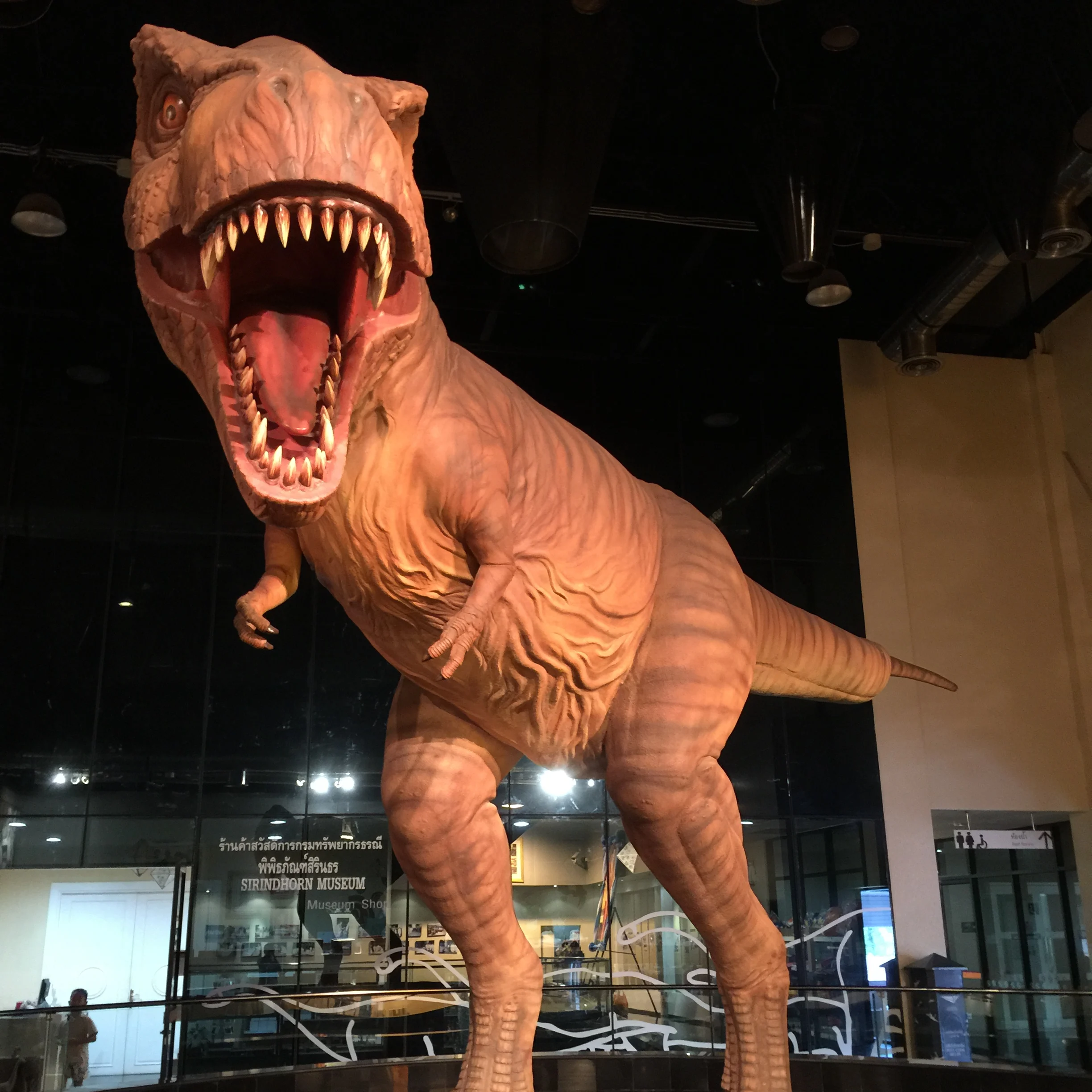
- **Phu Wiang Dinosaur Museum.** Do this first, because it explains the sites: full-scale skeletons, a working fossil lab behind glass and a garden of life-size concrete dinosaurs that school groups adore. Open Tuesday to Sunday, 09:00–17:00, closed Mondays, foreigners around ฿60 (as of our latest check). Allow 90 minutes. The names to learn are Phuwiangosaurus sirindhornae, the long-necked sauropod, and Siamotyrannus isanensis, the small predator that every Isaan sign calls an ancestor of T. rex, though palaeontologists are less sure.
- **The excavation sites.** National park entry is around ฿100–200 for foreigners, so carry cash. Site 1 is a steep 1.5 km walk up to the original 1976 find under a tin roof, with the bones in the rock as they were found. The footprint site (Site 9, near the Tat Fa waterfall) is a separate twenty-minute drive and has real theropod prints on a sandstone shelf. Do not try all nine; two to three hours is plenty.
- **Ubol Ratana Dam.** Back east and north, about an hour away, the reservoir is the biggest water in this part of Isaan. The shore is lined with floating restaurants serving grilled tilapia or snakehead, salt-crusted, with a fierce jaew dip, som tam and sticky rice, around ฿150–250 for a fish that feeds two. Take your shoes off and lie on the platform while it cooks. It is open daily and charges no fee at the crest.
This is not Jurassic Park. It is bones in brown rock under tin roofs in hot forest. For the person who was eight once, it is the best morning in Isaan; for the other kind, a long drive to look at a rock. A day for two costs about ฿2,500 all in with a car, or around ฿2,000 with a driver. If you would rather not drive, guided dinosaur-and-dam trips from the city are listed on GetYourGuide, at roughly ฿2,000–3,000 a head. Verdict: do it, if you like fossils. For the bigger dinosaur museum, see things to do in Kalasin, where the Sirindhorn Museum sits beside the Phu Kum Khao excavation pit.
Chonnabot silk: learn how mudmee is tied, then buy a length
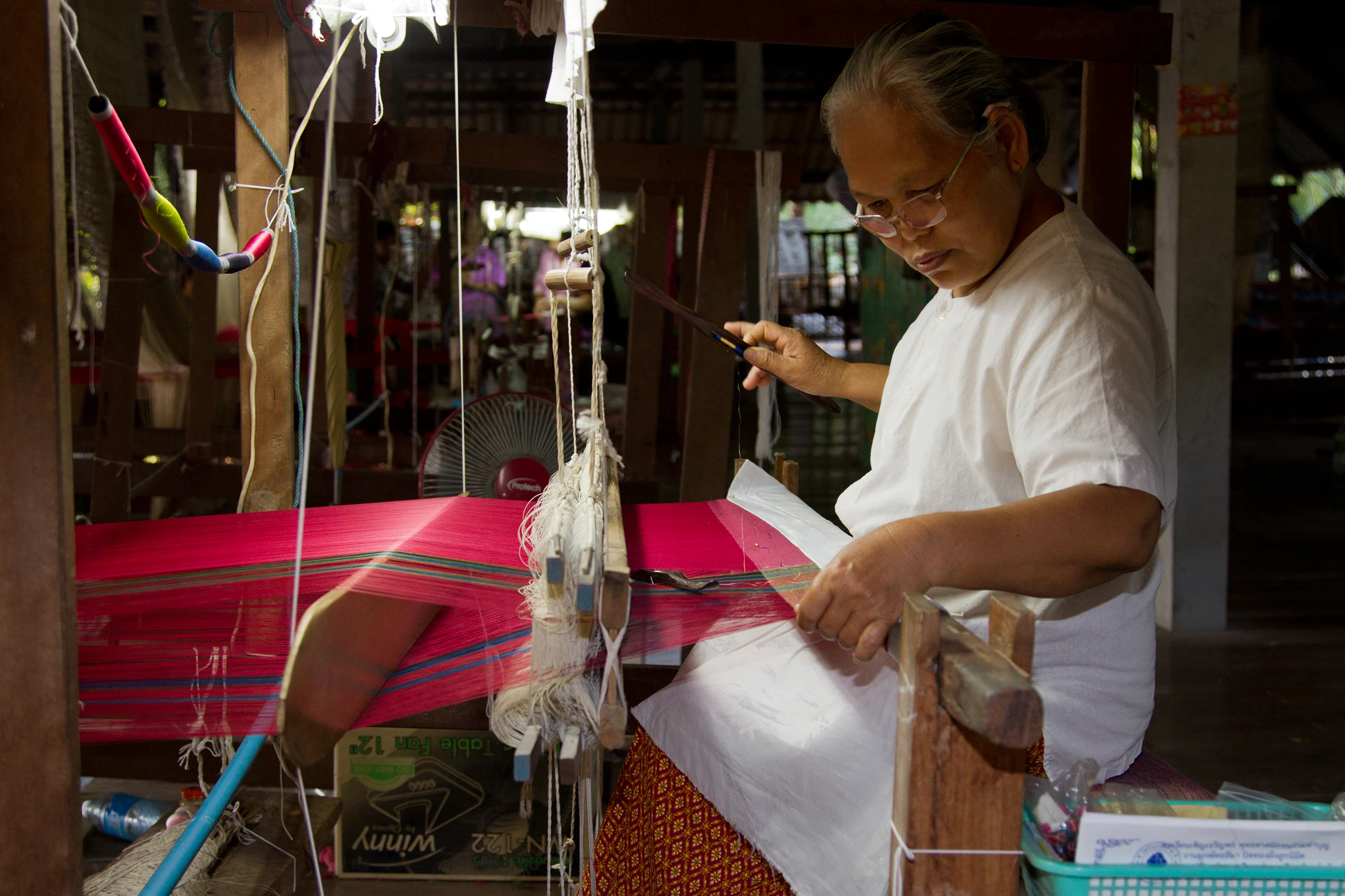
Day three is the one you bring something home from. Mudmee (mat mi, “tied threads”) is Isaan’s name for ikat: the weft threads are tied in bundles, dyed, untied, re-tied and dyed again before they ever reach the loom, which is what gives the motifs that soft, slightly blurred edge. Chonnabot district, about 55 km south of the city, is the capital of it, and Chonnabot mudmee has been a protected geographical indication since 2006.
Start at the Sala Mai Thai silk pavilion on the edge of town, a free one-room introduction to the craft that is open weekdays, roughly 08:30–16:30. Then walk the villages: the looms are under the stilt houses, and the weavers are used to visitors. Fair prices as a guide, per bolt rather than per metre:
| What | Fair price (฿) | Verdict |
|---|---|---|
| Silk scarf, mudmee or plain | 300–900 | Easy gift |
| Simple-pattern mudmee, chemical dye | 600–1,500 | Fine; a first purchase |
| Traditional pattern, hand-tied, good silk | 2,000–4,000 | What most people should buy |
| Dense classical pattern, natural dye | 5,000–12,000 | Wedding cloth; weeks of work |
| Cotton mudmee | 250–700 | Underrated: lighter and washable |
Prices are the same for foreigners and Thais because the buyers are overwhelmingly Thai, so haggle gently: you are talking to the woman who tied it. To tell real mudmee from a print, check that the pattern appears identically on both sides, that motif edges are softly feathered rather than crisp, and that a pulled thread burns to a brittle bead that smells of hair rather than melting like plastic. The big roadside silk centres with coach parking are fine if you ran out of time, but expect prices 30–50% above the village. For the pattern of a typical Isaan weaving centre elsewhere, see our Surin travel guide.
The one stop we would skip is the king cobra village at Ban Khok Sa-Nga, an hour on the other side of the city, where handlers drag king cobras out of boxes into a ring for “boxing” shows. We have seen it: the snakes are listless and provoked into striking, nobody independent has assessed the welfare, and the conservation framing does not survive watching. The village is poor and your few hundred baht are real money to it, but we would spend the afternoon at Phra That Kham Kaen, the 19-metre stupa in Nam Phong that gave the province its name, or back on the lake. Verdict: skip it.
Festivals: the Silk Festival and Songkran on Khao Niao Road
Two dates change the trip. The International Silk Festival and Phuk Siao fair runs on the same twelve days each year in front of the Provincial Hall, normally 29 November to 10 December: hundreds of stalls of mudmee silk from every district, mor lam stages until midnight and the phuk siao ceremony of tying white cotton threads around a friend’s wrist. If you can only come once, come for this, and book ahead because the centre fills. Songkran, 13–15 April, turns nearly three kilometres of Sri Chan Road into “Khao Niao” (Sticky Rice) Road and a water fight for tens of thousands, the biggest in Isaan. Confirm both dates with the city nearer the time, and use our festivals calendar. March to May is 38–41°C with no breeze, and June to October is rain; best time to visit Thailand has the monthly picture.
Where to stay in Khon Kaen, and how to get here and onward
Stay on the lake if you can. It means walking to the temple at dawn, cycling the loop at dusk and eating without a car. The city centre around Sri Chan Road and Central Plaza is the practical base, especially around a train, and the university side is for the young, the broke and the curious. Verified picks (from-prices are starting rates, check live):
- Baan Hall Hostel, from around ฿400: the budget bed in town.
- Supanniga Home: the boutique garden house by the lake, the pick if you can get a room.
- The Heritage Grand Khon Kaen, from around ฿1,500: the old grand hotel with a pool.
- Avani Khon Kaen Hotel & Convention Centre, from around ฿2,500: five-star comfort at three-star Bangkok money.
Getting here: the train and bus from Bangkok are bookable on 12Go, and Khon Kaen has its own airport. Onward, Khon Kaen to Kalasin and Khon Kaen to Loei are the usual next legs, the latter for the Phu Kradueng climb (see Phu Kradueng and Phu Ruea) and then the river town of Chiang Khan. Our own Khon Kaen Field Guide runs the three-day plan in more depth, at /field-guides/.
Things to do in Khon Kaen: your questions, answered
How many days do you need in Khon Kaen?
Three nights covers the city and lake, a hire-car day to the Phu Wiang dinosaur sites and Ubol Ratana Dam, and a day of silk villages at Chonnabot. Five nights lets you add Kalasin, Roi Et or the Phu Kradueng climb, since Khon Kaen is the transport hub for central Isaan.
What is the best time to visit Khon Kaen?
November to February, when the plateau is 20 to 30°C and dry. The International Silk Festival normally runs 29 November to 10 December, and Songkran on 13 to 15 April is the biggest in Isaan. March to May reaches 38 to 41°C and June to October is the rainy season.
Do you need a car in Khon Kaen?
For the city, no: Grab is ฿60 to ฿120 across town and a bicycle covers the lake. For the dinosaur park and the silk villages, yes, or a driver, because both are an hour or more out in opposite directions and public transport needs a change and a motorbike taxi. Car hire is around ฿1,200 a day plus fuel.
Is Khon Kaen worth visiting?
Yes, if you want a real Isaan city with almost no tourists. It has a lake, a nine-tier pagoda, some of the best night-market eating in the northeast, dinosaur sites and silk villages. It has no beach and no old town, and the heat in April and May is hard work.
Is the king cobra show at Ban Khok Sa-Nga worth it?
We would skip it. The cobras are pulled from boxes and provoked into striking in a ring, and no independent welfare body has assessed the village. The afternoon is better spent at Phra That Kham Kaen in Nam Phong, the stupa that gave the province its name, or back on the lake.
Plan · Book · Go
Book the trip
Some links in this guide are affiliate links. If you book through them we may earn a small commission at no extra cost to you — it helps keep Destination Thailand independent.